

🏛 Part of the "dental" topic shelf →
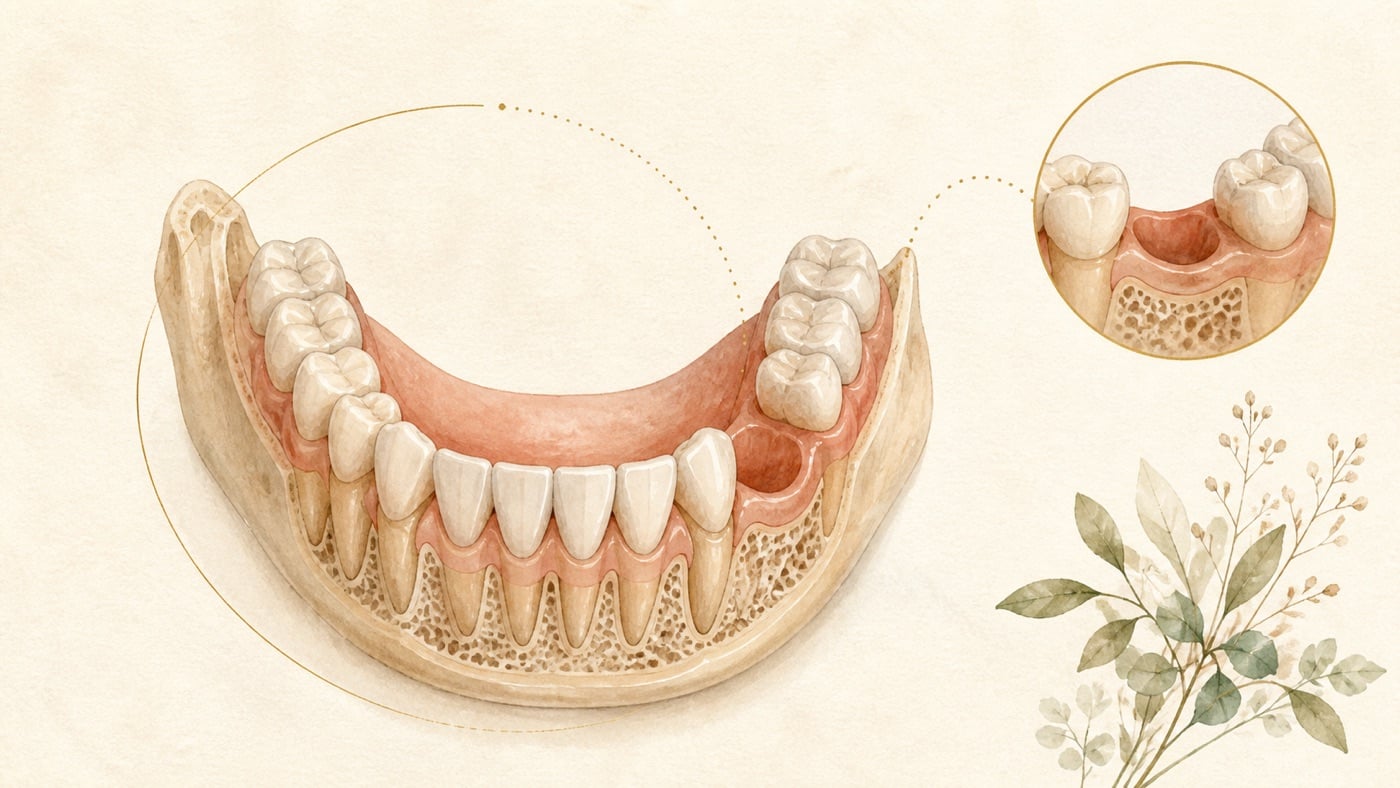
Can a molar be left unreplaced after extraction? What can happen?
What the literature records after a molar is extracted and not replaced (overeruption of the opposing tooth, tipping and rotation of adjacent teeth, occlusal interference, and changes in alveolar-bone dimensions); when the shortened dental arch concept may or may not apply; four ways of replacing a tooth (implant, bridge, removable denture, tooth autotransplantation and spontaneous third-molar substitution); and how to ask about costs and discuss the choice with a dentist.
Can a molar be left unreplaced after extraction? What can happen?
Direct answer in 60 words or fewer
Not always. One study recorded overeruption in 92% of unopposed teeth [F1]; however, shortened-dental-arch research indicates that an occlusion with anterior teeth and premolars can still function [F7]. Whether to replace the tooth requires a dentist’s assessment.
Scope: The main text is general health education based on international literature and does not concern any particular country’s insurance or regulations. Care and cost systems should be checked locally. The “How to ask about costs” section cites Taiwan’s system (National Health Insurance and medical-care regulations); its F-Units are individually marked geo: TW and should not be applied by readers in other regions.
This is really three questions, not one
People searching for “leave a molar unreplaced after extraction” are usually weighing three things at once: whether leaving it will cause problems, whether there are situations in which not replacing it is reasonable, and what the choices are if it is replaced. Each question has its own evidence base, so combining them can produce apparently conflicting messages: “all the teeth will shift if you do not replace it” versus “overseas studies say losing a few back teeth is fine.”
Both positions have supporting literature; the difference is the conditions. The sections below separate the three questions and identify the type of study and people covered by each piece of evidence. This is this site’s editorial framework for explaining the issue, not a diagnostic tool [F30].
1. What can happen without replacement: four changes documented in the literature
Overeruption of the opposing tooth (the tooth that lost its opposing tooth grows into the gap)
- A study comparing 100 people with unopposed teeth with 100 controls recorded overeruption in 92% of unopposed teeth in the study group. Mean movement was 1.68 mm (standard deviation 0.79; range 0 to 3.99 mm), compared with 0.24 mm (standard deviation 0.39) in controls; overeruption of unopposed maxillary teeth was statistically greater than that of mandibular teeth [F1].
- A 12-year follow-up study of 292 women found that unopposed molars had 4.9 times the risk of overeruption of 2 mm or more compared with molars with an opposing tooth (95% confidence interval 1.5 to 15.3). Mean overeruption among unopposed teeth over 12 years was 4.5% (standard deviation 7.6), approximately 0.9 mm [F4].
- The two estimates differ because the study designs differ: one was a cross-sectional clinical population with symptoms, and the other was a long-term follow-up of women in the community. That is why “will teeth shift?” has no single answer: the direction is consistent (the tooth may grow upward or downward), but the amount varies between people [F1][F4].
- The common idea that “if half the tooth still contacts, it will not grow out” is not supported by the literature: the degree of overeruption did not differ significantly between partial-contact and completely unopposed groups, and the study stated that partial contact should not be relied on to maintain vertical position [F5].
Tipping and rotation of adjacent teeth
- Part 2 of the same study series recorded a statistically significant difference between study and control groups in tipping of teeth mesial and distal to the extraction site. The tooth in front of the gap tended to tip distally, and its rotation also differed significantly [F2].
- The amount is not necessarily large. The 12-year study estimated mean mesial tipping at only 0.8° (standard deviation 5.6), stated that molars facing a mesial edentulous space had a low risk of mesial tipping, and also reported a significant interaction between overeruption and tipping [F4].
- In other words, overeruption pointed in a consistent direction in these studies, whereas estimates of tipping differed between studies. Neither should be described as something that will “certainly” happen [F1][F2][F4].
Occlusal interference and later restorative difficulty
- Part 3 of the same series recorded that unopposed posterior teeth were more likely than matched controls to be involved in retruded contact position (RCP) contacts or occlusal interferences. RCP contacts were associated with the degree of overeruption of unopposed teeth, and working-side interferences were associated with tipping of the tooth in front of the extraction site [F3].
- As time passes, the challenge is not only tooth position but also making a prosthesis. One study recorded positional changes that deviate from the Broadrick occlusal curve when a posterior tooth has been unopposed for 5 years or more. The deviation may be substantial and can make it difficult to restore a harmonious occlusal plane [F6].
- This is a practical part of “what happens if I do not replace it”: an overerupted tooth can occupy space needed for a future prosthesis, becoming one obstacle to restoring the edentulous area [F1].
Dimensional changes in alveolar bone and soft tissue
- The alveolar ridge itself changes after extraction. A systematic review including 20 studies estimated that, 6 months after extraction, horizontal bone-dimension reduction was 3.79 ± 0.23 mm and exceeded vertical reduction (1.24 ± 0.11 mm buccally, 0.84 ± 0.62 mm mesially, and 0.80 ± 0.71 mm distally). By percentage, vertical change at 6 months was 11% to 22%; horizontal change was 29% to 63% at 6 to 7 months; soft tissue gained 0.4 to 0.5 mm in thickness buccolingually at 6 months [F24].
- This explains a common question: why “leave it for now and have an implant later” can sometimes require bone management first. Related information appears in another card on this site (see the internal links at the end).
2. “Shortened dental arch”: the literature does discuss conditions in which no replacement is considered
This is an easily missed but important part of the search results. International literature describes an established concept, the shortened dental arch (SDA): retaining anterior and premolar occlusion without replacing posterior molars with a prosthesis.
- A narrative review of work by the Käyser/Nijmegen research group reported that people with three to five occlusal units in a shortened dental arch generally had no clinically significant differences from people with complete dental arches in masticatory ability, signs and symptoms of temporomandibular disorders, migration of remaining teeth, periodontal support, or oral comfort. Its cross-sectional findings were supported by longitudinal research, and it found no systematic clinical study with conflicting conclusions [F7].
- A multicentre randomised controlled trial (RaSDA) compared two non-implant approaches: a precision-attachment-retained distal-extension removable partial denture (PRDP) versus retaining or restoring premolar occlusion according to the SDA concept. At 5 years, survival for tooth loss was 0.74 in both groups; survival for the study jaw was 0.88 in the PRDP group and 0.84 in the SDA group, with no significant difference [F12].
- At 10 years in the same trial, intention-to-treat survival for tooth loss was 0.44 (95% confidence interval 0.30 to 0.56) in the PRDP group and 0.52 (0.37 to 0.65) in the SDA group; it was 0.67 and 0.60 for the study jaw. The authors wrote that tooth loss was higher than expected and suggested that the influence of prosthetic management of bilateral SDA may previously have been overestimated; patient preference should be given appropriate weight in treatment decisions [F13].
- For quality of life, a systematic review and meta-analysis including 2 randomised controlled trials and 1 non-randomised trial, with 516 participants, found no statistically significant difference in OHIP summary scores between SDA and removable partial denture groups at 6 and 12 months after treatment (standardised weighted mean differences 0.24 and 0.40) [F9].
- A systematic review in older adults comparing SDA with conventional removable-denture rehabilitation recorded no significant difference in nutritional status, while treatment and maintenance costs were higher in the removable-denture group. On limited evidence, the authors described SDA as a reasonable alternative in cost-effectiveness and nutrition [F11].
But the same literature also describes where it does not apply or remains uncertain; that half matters equally:
- After reviewing replacement strategies for adult SDA, one systematic review concluded that there is currently insufficient evidence to recommend one tooth-replacement strategy over another and noted too few high-quality randomised controlled trials [F8]. This does not mean “not replacing is better”; it means “the literature cannot decide for you.”
- Masticatory performance does decline. A systematic review found that people with SDA with 3 to 5 posterior occlusal pairs, and those with extremely shortened dental arches with 0 to 2 pairs, had comminution or mixing ability 28% to 39% lower than people with complete dentitions. Distal-extension removable partial dentures could partly compensate for that reduction (about one-half), and more artificial teeth in the denture were associated with better masticatory performance (significant in four of five studies) [F14].
- Another review reported that, in patients with a history of periodontitis, two retrospective studies indicated a greater risk of tooth loss with removable dentures than with fixed bridges, and several studies indicated increased plaque accumulation with removable dentures. Removable dentures may improve oral-health-related quality of life, but the improvement was smaller than with SDA management [F15].
- Another systematic review comparing functional outcomes of untreated SDA with complete-arch prosthetic restoration described SDA findings as encouraging for function, patient satisfaction, and cost-effectiveness, while also stating that some included studies were downgraded for methodological errors [F10].
Conditions in which the shortened dental arch concept may be more or less applicable
The following comparison is this site’s synthesis of the above literature (an editorial framework, not a clinical criterion) [F30]:
- Conditions more often present in the literature: the missing teeth are posterior molars; anterior and premolar occlusion remains intact; remaining occlusal pairs number three to five; periodontal status is stable; and the person’s own chewing and aesthetic needs can be met [F7][F12].
- Conditions less often present in the literature: remaining posterior occlusal pairs have fallen to 0 to 2 (with a larger decline in masticatory performance) [F14], there is a history of periodontitis [F15], remaining teeth are already mobile or defective, or the opposing tooth has markedly overerupted and affects the occlusion [F1][F3].
- What cannot be derived from the literature: your own chewing needs, dietary pattern, condition of other teeth, and capacity for long-term maintenance. Only a clinical examination and discussion with your dentist can decide these; treatment method and outcome vary from person to person and require a dentist’s assessment.
3. If you do replace it: four options compared
This section covers only literature on survival, complications, and conditions for each option. It gives no prices.
Implant (an implant-supported single crown)
- A systematic review of 46 studies estimated 5-year survival of implants supporting single crowns at 97.2% (95% confidence interval 96.3 to 97.9) and 10-year survival at 95.2% (91.8 to 97.2); survival of implant-supported single crowns was 96.3% (94.2 to 97.6) at 5 years and 89.4% (82.8 to 93.6) at 10 years [F16].
- The same review also recorded that complications were not uncommon: 5-year cumulative soft-tissue complications 7.1%, bone loss greater than 2 mm 5.2%, screw loosening 8.8%, loss of retention 4.1%, veneering-material fracture 3.5%, and aesthetic complications 7.1% [F16].
- As a condition, implants require sufficient bone and healthy soft tissue. Dimensional changes of the alveolar ridge after extraction affect feasibility and whether additional management is needed [F24].
Bridge (a tooth-supported fixed dental prosthesis using adjacent teeth as abutments)
- A systematic review of 40 studies estimated 5-year survival at 94.4% (95% confidence interval 91.2 to 96.5) for metal-ceramic multiple-unit fixed dental prostheses, 90.4% (84.8 to 94.0) for densely sintered zirconia, 89.1% for reinforced glass ceramic, and 86.2% for glass-infiltrated alumina [F17].
- The same review recorded significantly more caries in abutment teeth for densely sintered zirconia fixed dental prostheses than for metal-ceramic prostheses. Framework fracture was significantly more frequent with reinforced glass ceramic (8.0%) and glass-infiltrated alumina (12.9%) than with metal ceramic (0.6%) and zirconia (1.9%) [F17].
- As a condition, a bridge requires preparation of adjacent teeth. A systematic review of economic aspects reported similar initial costs (which vary by payment system), similar failure rates, and similar long-term economic comparisons for single implant crowns and tooth-supported fixed dental prostheses. The authors considered the benefit of retaining healthy adjacent teeth without preparation to make an implant crown more economical in that respect [F18]. This is a study-level comparison and cannot replace an individual assessment.
Removable denture (removable partial denture)
- A systematic review recorded that distal-extension removable partial dentures can partly compensate for the masticatory deficit of SDA (about one-half), and that more artificial teeth in the denture are associated with better masticatory performance [F14].
- Another review on the same question recorded increased plaque accumulation with removable dentures. In people with a history of periodontitis, retrospective studies indicated a higher risk of tooth loss than with fixed dental prostheses; however, prospective studies also reported long-term maintenance of removable dentures without significant periodontal destruction. The review concluded that there is no strong evidence that removable partial dentures themselves cause periodontal destruction [F15].
- As a condition, regular cleaning and review adjustments are needed, and suitability is closely related to the ability to maintain the remaining teeth [F15].
Tooth autotransplantation and spontaneous third-molar substitution (two routes sometimes described as “a wisdom tooth replacing a molar”)
People searching for “a wisdom tooth replacing a molar” are usually encountering two different situations:
First, spontaneous eruption of a third molar to substitute after second-molar extraction. A retrospective study followed 48 orthodontic patients and 128 extracted permanent second molars (age at extraction 11 to 23 years). The median eruption time was 3 to 4 years (interquartile range 2 years). With a good position defined as contact with the adjacent molar and an angle of no more than 35 degrees between the teeth, 96.2% of maxillary and 66.2% of mandibular third molars erupted into good positions. Unsuccessful eruption was more common in older patients and those at higher Nolla developmental stages; mandibular failures were mostly due to excessive mesial tipping or lack of proximal contact [F23]. This evidence is for adolescents undergoing orthodontic treatment while still developing, and cannot be applied directly to adults.
Second, tooth autotransplantation (moving one of your own teeth into the edentulous area).
- A meta-analysis of 14 studies estimated overall survival of tooth autotransplantation with developing teeth (open apices) at 97.9%; 98% at 1 year, 97% at 2 years, 95.9% at 5 years, and 96.9% at 10 years [F19].
- An umbrella review of 17 systematic reviews found 5-year and 10-year survival above 95% for autotransplantation of teeth with open apices. In the same review’s AMSTAR 2 assessment, 5 reviews were low quality and 12 were critically low quality [F21].
- A systematic review and meta-analysis with follow-up of 6 years or more gave more conservative estimates: survival ranged from 75.3% to 91%, with a meta-analytic effect size of 81%; the effect size was 4.8% for ankylosis and 4% for root resorption. The authors noted that ankylosis and root resorption, although low in proportion, can affect the prognosis of a transplanted tooth [F22].
- Root-development stage is a key condition. A systematic review of 38 studies found that teeth with open apices were less likely to require extraction than teeth with closed apices (3 studies; 413 teeth; relative risk 0.3, 95% confidence interval 0.2 to 0.6). It also listed complications including extraction, failure, excessive mobility, pulp necrosis, pulp obliteration, and root resorption, and stated that no firm conclusion could be drawn because of few studies, methodological limitations, and heterogeneity [F20].
The honest answer to “can a wisdom tooth replace an extracted molar?” is therefore: this route exists in the literature, but it depends heavily on the third molar’s position, its root-development stage, and conditions in the edentulous area. Survival estimates differ clearly between studies with different follow-up lengths [F19][F22]. Feasibility requires imaging assessment by a dentist.
4. Risk factors and limitations: every route has trade-offs
- The trade-off of not replacing: overeruption of the opposing tooth (92% of unopposed teeth in that study, with a mean of 1.68 mm) [F1], tipping and rotation of adjacent teeth [F2], increased occlusal interference [F3], and conditions for later reconstruction may change over time (deviation of the occlusal curve after 5 years or more without an opposing tooth can make reconstruction more complex in some cases) [F6].
- Limits of SDA: masticatory performance is 28% to 39% lower (more noticeably with extremely shortened dental arches) [F14]; risk is higher in people with a history of periodontitis [F15]; and current systematic reviews find insufficient evidence to recommend one strategy [F8].
- Risks of implants: soft-tissue complications, bone loss, screw loosening, loss of retention, and veneering fracture, with 5-year cumulative proportions listed above [F16]; bone conditions may require additional management [F24].
- Risks of bridges: adjacent teeth need preparation [F18], and framework-fracture and abutment-tooth caries incidence differs by material [F17].
- Risks of removable dentures: increased plaque accumulation [F15] and limited masticatory compensation [F14].
- Risks of tooth autotransplantation: complications including ankylosis, root resorption, and pulp necrosis; prognosis is poorer with closed apices [F20][F22].
- Shared premise: these are population-level study figures and cannot predict your individual result. Treatment method and outcome vary from person to person and require a dentist’s assessment.
5. How to ask about costs (no quotations, only how to read them and where to check)
This section cites Taiwan’s system, geo: TW. Readers in other regions should check the system where they live.
- This card lists no monetary amount. Under Article 51 of Taiwan’s National Health Insurance Act, “dentures, artificial eyes, eyeglasses, hearing aids, wheelchairs, crutches, and other devices that are not actively therapeutic” are not included in National Health Insurance coverage [F25]. Whether an individual item in missing-tooth reconstruction is covered must be confirmed against its indication, billing item, and current National Health Insurance Administration rules. This card makes no coverage determination.
- A cost estimate should be read by asking which components it includes, not as a single number: surgery, materials, the prosthesis above the implant or tooth, and possible additional management (for example, when bone is insufficient) are separate items. The same question, “how much to replace one tooth?”, can cover different components in different treatment plans.
- There are only two routes for verifying dental charges: the dental-fee schedule approved by the relevant city or county health authority (for example, the government open-data dataset “Taipei City Medical Fee Standards,” provided by the Taipei City Department of Health) [F27], and the institution’s written quotation and itemised cost statement. Neither search track on the National Health Insurance Administration’s “Medical Materials Price Comparison Website” includes dentistry, so it cannot verify missing-tooth reconstruction items or dental charges [F28].
- You are entitled to an explanation: Article 81 of Taiwan’s Medical Care Act requires medical institutions, when treating patients, to inform the patient or their legal representative, spouse, relatives, or related persons about the condition, treatment plan, procedure, medication, prognosis, and possible adverse reactions [F26].
6. Checklist before an appointment (7 questions)
- Which tooth was removed (or is going to be removed), and how many pairs of posterior teeth will still contact on that side afterward?
- Does my situation more closely fit the conditions in the literature in which SDA may be feasible, or those in which it may not be (number of occlusal pairs, periodontal status, and whether the opposing tooth has overerupted)?
- If I choose not to replace it for now, how often should I return for follow-up, and what changes should be monitored (opposing-tooth position, adjacent-tooth tipping, occlusal interference)?
- If I want replacement later, could waiting now reduce my future options? How does the dentist judge this from my bone volume and available space?
- Which replacement methods may suit me, and what are the limitations of each for me (whether adjacent teeth need preparation, whether bone is sufficient, and cleaning difficulty)?
- Could my third molar be used for this edentulous area, through spontaneous eruption or tooth autotransplantation? What do the imaging findings suggest?
- Which components are included in this treatment plan’s cost, could extra items be added, and can I receive a written itemised statement? (Article 81 of Taiwan’s Medical Care Act requires medical institutions to explain the treatment plan and procedure.) [F26]
How to find a clinic that provides this service
This site lists no clinics and does not recommend, rate or compare any medical institution.
To find a clinic that provides this service, use the following official lookup channels yourself —
they are maintained by the competent authorities and are more current than any list:
>
- The Ministry of Health and Welfare's medical-institution lookup: search by city or county,
township and specialty (dentistry) for institutions that have completed practice registration.
The results show the institution's name, address and registered specialty. This is the first place
to confirm whether a clinic is lawfully registered.
- The National Health Insurance Administration's contracted-institution lookup: check whether a
clinic is under contract with National Health Insurance. This determines which items are covered
and which are self-paid, and therefore what kind of fee explanation you will be given.
>
Both systems are on the respective authorities' official websites; searching for the
medical-institution lookup or the contracted-institution lookup will find them. This site does not
reproduce the URLs, because they change; use whichever entry point the authority currently publishes.
>
In an emergency, do not spend time looking up lists. If your breathing, swallowing or speech is
affected, or swelling is spreading, go to the nearest emergency department.
Chinese labels to look for on the official pages
These official systems, datasets and files are published in Chinese only. The English names above are this site's renderings; on the page itself you will see the following strings, so search for these:
>
- 「醫事機構查詢」
- 「特約醫事機構查詢」
- 「特約院所查詢」
Compliance note
This is health education information under Article 87 of Taiwan’s Medical Care Act, not medical advertising; it does not recommend a particular medical institution. Missing-tooth reconstruction (including implants, bridges, removable dentures, and tooth autotransplantation) has risks and contraindications. Treatment method and outcome vary from person to person and require a dentist’s assessment. The survival and complication proportions cited in this card are population-level study figures; they cannot predict an individual result and do not replace clinical diagnosis.
Every clinical statement in this article is mapped line by line to its cited source (see the sources and evidence chain below). It has not been clinically reviewed by a licensed practitioner. This is health information, not individual advice; assessment by a clinician is required.
FAQ
- Is it really okay not to replace an extracted second molar?
- **The literature does discuss maintaining function without replacement, but only under conditions.** SDA literature concerns people with three to five occlusal units and intact anterior and premolar occlusion; it generally found no clinically significant difference in masticatory ability, temporomandibular symptoms, migration of remaining teeth, or periodontal support [F7]. At the same time, 92% of unopposed teeth in the study population showed overeruption (with large individual variation in amount) [F1], and masticatory performance declines more as fewer occlusal pairs remain [F14]. Whether it is “okay” depends on your remaining occlusion and requires a dentist’s assessment.
- 第二大臼歯を抜いて補わなくても、本当に大丈夫ですか? — **補わずに機能を保てるという文献上の議論はありますが、条件付きです。** SDA 文献の場面は、三から五の咬合単位があり、前歯と小臼歯の咬合が保たれた人です。咀嚼能力、顎関節症状、残存歯の移動、歯周支持には一般に臨床的有意差がないとされます [F7]。一方、研究対象の対合歯のない歯の 92% に挺出があり(量の個人差は大きい)[F1]、残る咬合対が少ないほど咀嚼能率の低下は大きくなります [F14]。大丈夫かは残る咬合状態によるため、歯科医師の評価が必要です。
- Is it really okay not to replace an extracted second molar? — **The literature does discuss maintaining function without replacement, but only under conditions.** SDA literature concerns people with three to five occlusal units and intact anterior and premolar occlusion; it generally found no clinically significant difference in masticatory ability, temporomandibular symptoms, migration of remaining teeth, or periodontal support [F7]. At the same time, 92% of unopposed teeth in the study population showed overeruption (with large individual variation in amount) [F1], and masticatory performance declines more as fewer occlusal pairs remain [F14]. Whether it is “okay” depends on your remaining occlusion and requires a dentist’s assessment.
- If I do not replace it, when will teeth start to shift?
- **The literature does not give one universal point such as “after a certain number of months,” but it provides several time frames.** The 12-year study records long-term accumulation: unopposed molars had 4.9 times the risk of overeruption of 2 mm or more and a mean of approximately 0.9 mm [F4]. Another study recorded deviation in the occlusal curve after a posterior tooth had been unopposed for 5 years or more [F6]. Alveolar-bone changes can be measured within 6 months after extraction (horizontal reduction 3.79 ± 0.23 mm) [F24]. Individual rates vary greatly.
- 補わないと、いつから歯が動きますか? — **文献に「何か月後から」という共通の時点はありませんが、複数の時間尺度があります。** 12 年研究は長期の蓄積を記録し、対合歯のない大臼歯で 2 mm 以上の挺出リスクは 4.9 倍、平均は約 0.9 mm でした [F4]。別研究では後方歯に 5 年以上対合歯がないと咬合曲線の位置逸脱が記録されました [F6]。歯槽骨の変化は抜歯後 6 か月以内にも測定可能で、水平減少は 3.79 ± 0.23 mm でした [F24]。個人差は大きいです。
- If I do not replace it, when will teeth start to shift? — **The literature does not give one universal point such as “after a certain number of months,” but it provides several time frames.** The 12-year study records long-term accumulation: unopposed molars had 4.9 times the risk of overeruption of 2 mm or more and a mean of approximately 0.9 mm [F4]. Another study recorded deviation in the occlusal curve after a posterior tooth had been unopposed for 5 years or more [F6]. Alveolar-bone changes can be measured within 6 months after extraction (horizontal reduction 3.79 ± 0.23 mm) [F24]. Individual rates vary greatly.
- Can a wisdom tooth replace an extracted molar?
- **The literature describes two routes, but both have strict conditions.** After second-molar extraction in adolescent orthodontic patients, 96.2% of maxillary and 66.2% of mandibular third molars erupted into a good position, with a median eruption time of 3 to 4 years; success was lower with older age [F23]. For tooth autotransplantation, pooled survival with open apices was 97.9% (96.9% at 10 years) [F19], but a meta-analysis with follow-up of 6 years or more reported survival of 75.3% to 91% (effect size 81%), with ankylosis 4.8% and root resorption 4%; closed-apex teeth had a greater risk of extraction [F20][F22]. Feasibility requires imaging assessment by a dentist.
- 親知らずで抜いた臼歯を置き換えられますか? — **文献には二つの道がありますが、どちらも条件は厳格です。** 青年矯正患者で第二大臼歯を抜いた後、第三大臼歯が良好な位置へ自然萌出した割合は上顎 96.2%、下顎 66.2%、萌出期間中央値は 3 から 4 年で、年齢が高いほど成功は少なくなりました [F23]。自家歯牙移植では根尖未閉鎖歯の統合生存率は 97.9%(10 年 96.9%)[F19] ですが、6 年以上追跡したメタ解析では 75.3% から 91%(効果量 81%)、癒着 4.8%、歯根吸収 4% とされ、根尖閉鎖歯は抜去リスクが高いです [F20][F22]。可能性は歯科医師が画像で評価します。
- Can a wisdom tooth replace an extracted molar? — **The literature describes two routes, but both have strict conditions.** After second-molar extraction in adolescent orthodontic patients, 96.2% of maxillary and 66.2% of mandibular third molars erupted into a good position, with a median eruption time of 3 to 4 years; success was lower with older age [F23]. For tooth autotransplantation, pooled survival with open apices was 97.9% (96.9% at 10 years) [F19], but a meta-analysis with follow-up of 6 years or more reported survival of 75.3% to 91% (effect size 81%), with ankylosis 4.8% and root resorption 4%; closed-apex teeth had a greater risk of extraction [F20][F22]. Feasibility requires imaging assessment by a dentist.
- If I wait now, will it be too late to replace it later?
- **What the literature can say is that time changes the conditions, not that it becomes “too late.”** Overeruption of the opposing tooth can take up space needed for a future prosthesis and is one obstacle to restoring the edentulous area [F1]. Deviation of the occlusal curve after 5 years or more without an opposing tooth may make restoration of a harmonious occlusal plane difficult [F6]. At 6 months after extraction, horizontal alveolar-ridge reduction was 3.79 ± 0.23 mm and vertical change was 11% to 22% [F24]. These are objective reasons why later treatment may be more complex, but whether and how replacement remains possible is an individual clinical judgment.
- 今は補わず、後で補うのでは遅いですか? — **文献が言えるのは「時間で条件が変わる」であり、「遅すぎる」ではありません。** 対合歯の挺出は将来の義歯に必要な空間を占め、欠損部修復の障害の一つになります [F1]。対合歯がない状態が 5 年以上続くと咬合曲線が逸脱し、調和した咬合平面の再建を難しくする可能性があります [F6]。抜歯後 6 か月で歯槽堤の水平減少は 3.79 ± 0.23 mm、垂直変化は 11% から 22% でした [F24]。これらは後の治療が複雑になる客観的根拠ですが、補えるか・どう補うかは個別の臨床判断です。
- If I wait now, will it be too late to replace it later? — **What the literature can say is that time changes the conditions, not that it becomes “too late.”** Overeruption of the opposing tooth can take up space needed for a future prosthesis and is one obstacle to restoring the edentulous area [F1]. Deviation of the occlusal curve after 5 years or more without an opposing tooth may make restoration of a harmonious occlusal plane difficult [F6]. At 6 months after extraction, horizontal alveolar-ridge reduction was 3.79 ± 0.23 mm and vertical change was 11% to 22% [F24]. These are objective reasons why later treatment may be more complex, but whether and how replacement remains possible is an individual clinical judgment.
- Is National Health Insurance coverage available if I leave it unreplaced, and how can I check costs?
- **This card lists no monetary amount.** Article 51 of Taiwan’s National Health Insurance Act excludes “dentures, artificial eyes, eyeglasses, hearing aids, wheelchairs, crutches, and other devices that are not actively therapeutic” from insurance coverage [F25]. Whether a particular item is covered depends on current National Health Insurance Administration notices and its indication; this card makes no coverage determination. For dental self-pay charges, use the dental-fee schedule approved by the relevant city or county health authority (for example, the government open-data “Taipei City Medical Fee Standards,” provided by the Taipei City Department of Health) [F27], and ask the institution for a written quotation and itemised cost statement. The National Health Insurance Administration’s “Medical Materials Price Comparison Website” has no dental category in either search track and cannot be used to verify dental charges [F28].
- 補わない場合、全民健康保険の給付はありますか?費用はどう調べますか? — **本カードは金額を一切示しません。** 台湾全民健康保険法第 51 条では、「義歯、義眼、眼鏡、補聴器、車椅子、松葉杖およびその他の積極的治療性を有しない器具」は保険給付の範囲に含まれません [F25]。個別項目の給付は全民健康保険署の現行公告と適応によるため、本カードは給付判定をしません。歯科の自費料金は、県市の衛生主管機関が認定した歯科料金基準(例:台北市政府衛生局提供の「台北市医療費基準」)[F27] と、医療機関の書面による見積書・費用明細で確認してください。全民健康保険署の「医材比価網」は二つの検索区分とも歯科を含まず、歯科料金の確認には使えません [F28]。
- Is National Health Insurance coverage available if I leave it unreplaced, and how can I check costs? — **This card lists no monetary amount.** Article 51 of Taiwan’s National Health Insurance Act excludes “dentures, artificial eyes, eyeglasses, hearing aids, wheelchairs, crutches, and other devices that are not actively therapeutic” from insurance coverage [F25]. Whether a particular item is covered depends on current National Health Insurance Administration notices and its indication; this card makes no coverage determination. For dental self-pay charges, use the dental-fee schedule approved by the relevant city or county health authority (for example, the government open-data “Taipei City Medical Fee Standards,” provided by the Taipei City Department of Health) [F27], and ask the institution for a written quotation and itemised cost statement. The National Health Insurance Administration’s “Medical Materials Price Comparison Website” has no dental category in either search track and cannot be used to verify dental charges [F28].
Medical notice This article is provided for health education and medical information purposes. It is not a solicitation for medical services and does not constitute diagnosis or treatment advice. Actual treatment methods and outcomes vary between individuals and require evaluation by a dentist; every treatment has its own indications, limitations and possible risks. If you have related symptoms or treatment needs, please book a consultation for evaluation by a dentist.
Source anchors
- Craddock HL, Youngson CC. Occlusal changes following posterior tooth loss in adults. Part 1. J Prosthodont. 2007. PMID 17559530 · https://pubmed.ncbi.nlm.nih.gov/17559530/ · 在 IDAEO 的其他引用
- Craddock HL, et al. Occlusal changes following posterior tooth loss in adults. Part 2. J Prosthodont. 2007. PMID 17672834 · https://pubmed.ncbi.nlm.nih.gov/17672834/ · 在 IDAEO 的其他引用
- Craddock HL, et al. Occlusal changes following posterior tooth loss in adults. Part 3. J Prosthodont. 2008. PMID 17927736 · https://pubmed.ncbi.nlm.nih.gov/17927736/ · 在 IDAEO 的其他引用
- Christou P, Kiliaridis S, et al. Changes in molar position associated with missing opposed and/or adjacent tooth: a 12-year study in women. J Oral Rehabil.… · https://pubmed.ncbi.nlm.nih.gov/21902708/ · 在 IDAEO 的其他引用
- Craddock HL. An investigation of overeruption of posterior teeth with partial occlusal contact. J Oral Rehabil. 2007. PMID 17371561 · https://pubmed.ncbi.nlm.nih.gov/17371561/ · 在 IDAEO 的其他引用
- Craddock HL, et al. Deviation from the Broadrick occlusal curve following posterior tooth loss. J Oral Rehabil. 2006. PMID 16671988 · https://pubmed.ncbi.nlm.nih.gov/16671988/ · 在 IDAEO 的其他引用
- Kanno T, Carlsson GE. A review of the shortened dental arch concept focusing on the work by the Käyser/Nijmegen group. J Oral Rehabil. 2006. PMID 17002745 · https://pubmed.ncbi.nlm.nih.gov/17002745/ · 在 IDAEO 的其他引用
- McKenna G, et al. Effectiveness of prosthodontic interventions and survival of remaining teeth in adult patients with shortened dental arches — A systematic… · https://pubmed.ncbi.nlm.nih.gov/29476794/ · 在 IDAEO 的其他引用
- Reissmann DR, et al. Shortened dental arch and prosthetic effect on oral health-related quality of life: a systematic review and meta-analysis. J Oral… · https://pubmed.ncbi.nlm.nih.gov/28370239/ · 在 IDAEO 的其他引用
- Khan SB, et al. Differences in functional outcomes for adult patients with prosthodontically-treated and -untreated shortened dental arches: a systematic… · https://pubmed.ncbi.nlm.nih.gov/24992473/ · 在 IDAEO 的其他引用
- Impact of shortened dental arch therapy on nutritional status and treatment costs in older adults: A systematic review. J Dent. 2023. PMID 37001792 · https://pubmed.ncbi.nlm.nih.gov/37001792/ · 在 IDAEO 的其他引用
- Walter MH, et al. The randomized shortened dental arch study: tooth loss over five years. Clin Oral Investig. 2013. PMID 22733244 · https://pubmed.ncbi.nlm.nih.gov/22733244/ · 在 IDAEO 的其他引用
- Walter MH, et al. The Randomized Shortened Dental Arch Study: Tooth Loss Over 10 Years. Int J Prosthodont. 2018. PMID 29316570 · https://pubmed.ncbi.nlm.nih.gov/29316570/ · 在 IDAEO 的其他引用
- Effects of removable dental prostheses on masticatory performance of subjects with shortened dental arches: A systematic review. J Dent. 2015. PMID 26066662 · https://pubmed.ncbi.nlm.nih.gov/26066662/ · 在 IDAEO 的其他引用
- Efficacy and risks of removable partial prosthesis in periodontitis patients: A systematic review. J Clin Periodontol. 2022. PMID 34761421 · https://pubmed.ncbi.nlm.nih.gov/34761421/ · 在 IDAEO 的其他引用
- Jung RE, et al. Systematic review of the survival rate and the incidence of biological, technical, and aesthetic complications of single crowns on implants… · https://pubmed.ncbi.nlm.nih.gov/23062124/ · 在 IDAEO 的其他引用
- Sailer I, et al. All-ceramic or metal-ceramic tooth-supported fixed dental prostheses (FDPs)? Part II: Multiple-unit FDPs. Dent Mater. 2015. PMID 25935732 · https://pubmed.ncbi.nlm.nih.gov/25935732/ · 在 IDAEO 的其他引用
- Brägger U, et al. Implants versus short-span fixed bridges: survival, complications, patients' benefits. A systematic review on economic aspects. Clin Oral… · https://pubmed.ncbi.nlm.nih.gov/23062127/ · 在 IDAEO 的其他引用
- Autotransplantation of teeth with incomplete root formation: systematic review and meta-analysis. Clin Oral Investig. 2022. PMID 35258700 · https://pubmed.ncbi.nlm.nih.gov/35258700/ · 在 IDAEO 的其他引用
- Machado LA, et al. Autotransplantation of teeth in humans: a systematic review and meta-analysis. Clin Oral Investig. 2015. PMID 25903060 · https://pubmed.ncbi.nlm.nih.gov/25903060/ · 在 IDAEO 的其他引用
- Tooth autotransplantation: An umbrella review. Dent Traumatol. 2023. PMID 36898857 · https://pubmed.ncbi.nlm.nih.gov/36898857/ · 在 IDAEO 的其他引用
- Almpani K, et al. Long-term prognosis of tooth autotransplantation: a systematic review and meta-analysis. Int J Oral Maxillofac Surg. 2016. PMID 26696138 · https://pubmed.ncbi.nlm.nih.gov/26696138/ · 在 IDAEO 的其他引用
- Spontaneous third-molar eruption after second-molar extraction in orthodontic patients. Am J Orthod Dentofacial Orthop. 2006. PMID 16527628 · https://pubmed.ncbi.nlm.nih.gov/16527628/ · 在 IDAEO 的其他引用
- Tan WL, et al. A systematic review of post-extractional alveolar hard and soft tissue dimensional changes in humans. Clin Oral Implants Res. 2012. PMID… · https://pubmed.ncbi.nlm.nih.gov/22211303/ · 在 IDAEO 的其他引用
- 全民健康保險法 第 51 條(全國法規資料庫 · https://law.moj.gov.tw/LawClass/LawSingle.aspx?pcode=L0060001&flno=51 · 在 IDAEO 的其他引用
- 醫療法 第 81 條(全國法規資料庫 · https://law.moj.gov.tw/LawClass/LawSingle.aspx?pcode=L0020021&flno=81 · 在 IDAEO 的其他引用
- 政府資料開放平臺:臺北市醫療收費標準(提供機關:臺北市政府衛生局 · https://data.gov.tw/dataset/121913 · 在 IDAEO 的其他引用
- 衛生福利部中央健康保險署 醫材比價網(入口 · https://info.nhi.gov.tw/INAE2000/INAE2010S01 · 在 IDAEO 的其他引用
- 本文證據鏈:逐條出處、行號與原文引句 · https://km.idaeo.ai/reports/dental-molar-extraction-no-replacement-evidence · 在 IDAEO 的其他引用
Cite this article
Lucy・《Can a molar be left unreplaced after extraction? What can happen?》・IDAEO 知識庫・2026-08-13・https://km.idaeo.ai/post/dental/molar-extraction-no-replacementUpdated 2026-08-27