

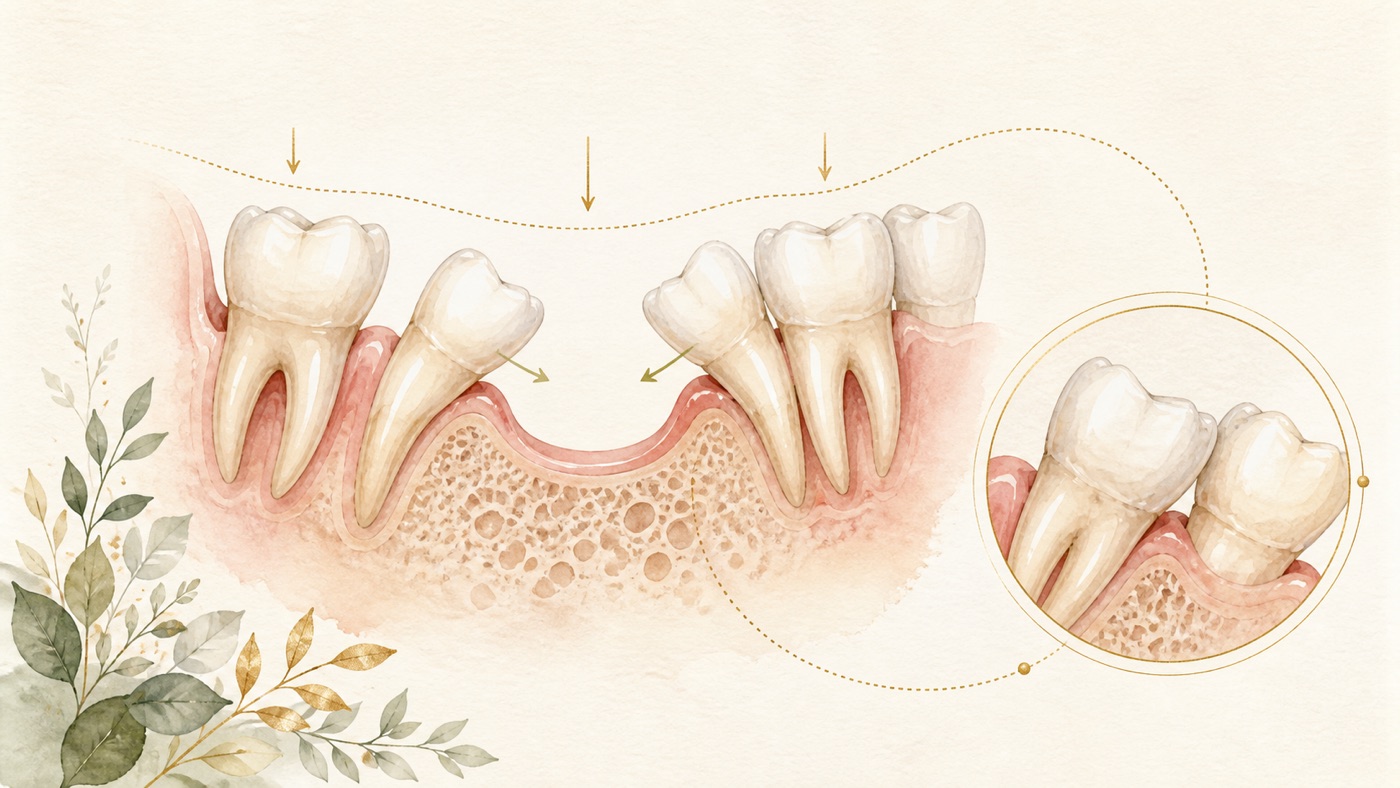
臼齒拔掉可以不補嗎?會怎樣?|證據鏈
本頁是〈臼齒拔掉可以不補嗎?會怎樣?〉的事實單元帳:每一條主張對應的來源、證據等級、地域與期間、原文引句與限制,逐條攤開。
臼齒拔掉可以不補嗎?會怎樣?|證據鏈
F-Units(事實單元帳)
- F1|confidence: verified|basis: peer_reviewed(PMID 17559530)|period: 2007 刊出|geo: universal|span: 「The mean supraeruption for subjects was 1.68 mm (SD 0.79, range 0 to 3.99 mm) and for controls, 0.24 mm (SD 0.39, range 0 to 1.46 mm)」「Supraeruption was found in 92% of subjects' unopposed teeth」「The extent of supraeruption was statistically greater in maxillary unopposed teeth than in mandibular unopposed teeth」|caveat: 100 例+100 對照之診斷模型研究,就診族群,非社區普查
- F2|confidence: verified|basis: peer_reviewed(PMID 17672834)|period: 2007 刊出|geo: universal|span: 「A statistical significance in the degree of tipping of teeth both mesial and distal to the extraction site was detected between the subject and control groups」「Teeth mesial to the extraction site had a tendency to tip distally」|caveat: 同系列第二部分,同一 100+100 樣本
- F3|confidence: verified|basis: peer_reviewed(PMID 17927736)|period: 2008 刊出|geo: universal|span: 「Unopposed posterior teeth are more likely to be involved in RCP contacts or interferences than their matched controls」「Initial RCP contacts have associations with the extent of supraeruption of the unopposed teeth」「Working side interferences were associated with tipping of the tooth mesial to the extraction site」|caveat: 同系列第三部分
- F4|confidence: verified|basis: peer_reviewed(PMID 21902708)|period: 12 年追蹤,2012 刊出|geo: universal|span: 「unopposed molars showed 4·9 times higher risk of overeruption of ≥2 mm (95% CI 1·5-15·3)」「The average overeruption for the unopposed molars was 4·5% (s.d. 7·6), which corresponds to approximately 0·9 mm」「The average mesial tipping was 0·8° (s.d. 5·6)」「Molars facing a mesial edentulous space showed a low risk for mesial tipping」|caveat: 292 位女性之前瞻性族群研究,全女性樣本
- F5|confidence: verified|basis: peer_reviewed(PMID 17371561)|period: 2007 刊出|geo: universal|span: 「Partial tooth contact does not appear to prevent or reduce overeruption」「partial tooth contact should not be relied on clinically to maintain vertical tooth position」|caveat: 91 位病人之臨床研究
- F6|confidence: verified|basis: peer_reviewed(PMID 16671988)|period: 2006 刊出|geo: universal|span: 「when a posterior tooth has remained unopposed for 5 years or more positional changes, which cause deviation from the Broadrick curve, occur」「The extent of the deviation may be extreme, potentially leading to difficulties in restoring a harmonious occlusal scheme」|caveat: 咬合曲線技術面研究,非病人結果研究
- F7|confidence: verified|basis: peer_reviewed(PMID 17002745,文獻回顧)|period: 1966 至 2005-11 檢索,2006 刊出|geo: universal|span: 「no clinically significant differences between subjects with shortened dental arches of three to five occlusal units and complete dental arches regarding variables such as masticatory ability, signs and symptoms of temporomandibular disorders, migration of remaining teeth, periodontal support, and oral comfort」「No systematic clinical study with conflicting results was found」|caveat: 敘事性回顧(非統合分析),主要納入單一研究群作品
- F8|confidence: verified|basis: peer_reviewed(PMID 29476794,系統性回顧)|period: PROSPERO CRD42017064851,2018 刊出|geo: universal|span: 「there is currently insufficient evidence to recommend one tooth replacement strategy over another in adult patients with reduced dentitions」|caveat: 納入 10 篇;作者明言隨機對照試驗數量不足
- F9|confidence: verified|basis: peer_reviewed(PMID 28370239,系統性回顧與統合分析)|period: 1980 至 2016-11 檢索,2017 刊出|geo: universal|span: 「There was no statistically significant difference in OHIP summary scores between SDA and RPDP at 6 (SWMD = 0·24) or 12 (SWMD = 0·40) months post-treatment」「516 participants」|caveat: 僅 2 篇 RCT+1 篇非 RCT,短期(12 個月)結果
- F10|confidence: verified|basis: peer_reviewed(PMID 24992473,系統性回顧)|period: 2014 刊出|geo: universal|span: 「The shortened dental arch as a treatment option is encouraging in terms of functioning, patient satisfaction and cost-effectiveness」「some of the included studies had to be downgraded due to methodological errors」|caveat: 敘事性合成,未做統合分析
- F11|confidence: verified|basis: peer_reviewed(PMID 37001792,系統性回顧)|period: 檢索至 2022-11-06,2023 刊出|geo: universal|span: 「No significant difference was recorded in the nutritional status of patients rehabilitated using the SDA concept compared with RPDs」「Higher costs for treatment provision and maintenance for patients in the RPD group was found when compared to SDA treatment」|caveat: 僅 4 篇報告(來自 2 個 RCT),無法統合分析;成本結論不可轉換為任何地區價格
- F12|confidence: verified|basis: peer_reviewed(PMID 22733244,多中心 RCT 5 年)|period: 2013 刊出|geo: universal|span: 「the Kaplan-Meier survival rates at 5 years were 0.74 (95% CI 0.64, 0.84) in the PRDP group and 0.74 (95% CI 0.63, 0.85) in the SDA group」「For tooth loss in the study jaw, the survival rates at 5 years were 0.88 … and 0.84 …. The differences were not significant」|caveat: 152 人受治療、132 人達 5 年追蹤;德國多中心
- F13|confidence: verified|basis: peer_reviewed(PMID 29316570,同一 RCT 10 年)|period: 2018 刊出|geo: universal|span: 「the survival rates for tooth loss at 10 years were 0.44 (95% confidence interval [CI]: 0.30 to 0.56) in the PRDP group and 0.52 (95% CI: 0.37 to 0.65) in the SDA group」「The number of teeth lost was higher than expected」「The results suggest an overestimation of the influence of the prosthetic management of the bilateral SDA」「For tooth loss in the study arch, the survival rates were 0.67 (95% CI: 0.52 to 0.78) in the PRDP group and 0.60 (95% CI: 0.45 to 0.73) in the SDA group.」|caveat: 152 人中 82 人達 10 年檢查,流失率高
- F14|confidence: verified|basis: peer_reviewed(PMID 26066662,系統性回顧)|period: 2003 至 2014 檢索,2015 刊出|geo: universal|span: 「Subjects with (E)SDA had a 30-40% reduced masticatory performance」「Comminution or mixing ability in subjects with (E)SDA was 28-39% lower compared to that of subjects with complete dentitions」「distal-extension RDPs could compensate this reduction partially (some 50%)」「more artificial teeth in RDPs resulted in better performance」|caveat: SDA=3 至 5 對後牙咬合、ESDA=0 至 2 對;納入研究數少
- F15|confidence: verified|basis: peer_reviewed(PMID 34761421,系統性回顧)|period: 1966 至 2020 檢索,2022 刊出|geo: universal|span: 「Two retrospective studies indicated that RDPs increased the risk of tooth loss compared to FDPs in patients with a history of periodontitis」「Several studies indicated that RDP increased plaque accumulation」「There is no strong evidence that RDPs per se will cause periodontal destruction including tooth loss」|caveat: 資料異質,未做統合分析;族群限牙周炎病人
- F16|confidence: verified|basis: peer_reviewed(PMID 23062124,系統性回顧與統合分析)|period: 2006 至 2011 檢索,2012 刊出|geo: universal|span: 「Based on the meta-analysis, survival of implants supporting SCs at 5 years amounted to 97.2% (95% CI: 96.3-97.9%), and at 10 years amounted to 95.2% (95% CI: 91.8-97.2%).」「The survival of implant-supported SCs was 96.3% (95% CI: 94.2-97.6%) after 5 years and 89.4% (95% CI: 82.8-93.6%) after 10 years.」「8.8% (95% CI: 5.1-15.0%) for screw-loosening, 4.1% (95% CI: 2.2-7.5%) for loss of retention, and 3.5% (95% CI: 2.4-5.2%) for fracture of the veneering material」「technical, biological, and aesthetic complications were frequent」「For biological complications, a 5-year cumulative soft tissue complication rate of 7.1% (95% CI: 4.4-11.3%) and a cumulative complication rate for implants with bone loss >2 mm of 5.2% (95% CI: 3.1-8.6%) were calculated.」「Based on the meta-analysis, survival of implants supporting SCs at 5 years amounted to 97.2% (95% CI: 96.3-97.9%), and at 10 years amounted to 95.2% (95% CI: 91.8-97.2%).」|caveat: 納入 46 篇;存活率非成功率,不等於個人預期
- F17|confidence: verified|basis: peer_reviewed(PMID 25935732,系統性回顧與統合分析)|period: 2006 至 2013 檢索,2015 刊出|geo: universal|span: 「an estimated 5-year survival rate of metal-ceramic FDPs of 94.4% (95% CI: 91.2-96.5%)」「densely sintered zirconia FDPs was 90.4%」「A significantly higher incidence of caries in abutment teeth was observed for densely sintered zirconia FDPs compared to metal-ceramic FDPs」「framework fractures … reinforced glass ceramic FDPs (8.0%) and glass-infiltrated alumina FDPs (12.9%) compared to metal-ceramic FDPs (0.6%) and densely sintered zirconia FDPs (1.9%)」「The estimated survival rate of reinforced glass ceramic FDPs was 89.1% (95% CI: 80.4-94.0%), the survival rate of glass-infiltrated alumina FDPs was 86.2% (95% CI: 69.3-94.2%) and the survival rate of densely sintered zirconia FDPs was 90.4% (95% CI: 84.8-94.0%) in 5 years of function.」|caveat: 多單位固定假牙;材料別差異大
- F18|confidence: verified|basis: peer_reviewed(PMID 23062127,系統性回顧)|period: 2012 刊出|geo: universal|span: 「Initial costs for single implant crowns and FDPs on teeth were similar, but varied between tariff systems」「Failure rates reported with single implant crowns and FDPs on teeth were similar」「The utility for the patient to keep healthy adjacent teeth unprepared makes the implant crown more economic」|caveat: 經濟面向回顧,費用制度依各國而異,本卡不引用任何金額
- F19|confidence: verified|basis: peer_reviewed(PMID 35258700,系統性回顧與統合分析)|period: 2022 刊出|geo: universal|span: 「The meta-analytic study of overall survival included a total of 14 studies, yielding an overall survival rate of 97.9%」「the 5- and 10-year survival rates were 95.9% and 96.9%」|caveat: 限「牙根尚未發育完成」之移植牙;不適用於根尖已閉合者
- F20|confidence: verified|basis: peer_reviewed(PMID 25903060,系統性回顧與統合分析)|period: 2015 刊出|geo: universal|span: 「Teeth with open apex were less likely to be extracted in comparison to teeth with closed apex (3 studies; 413 teeth; relative risk 0.3; 95% confidence interval 0.2-0.6)」「Reported complications included the need for extraction, failure, hypermobility, pulp necrosis, pulp obliteration, and root resorption」「no firm conclusions can be drawn」|caveat: 作者明言因研究數少、方法學限制與異質性而無法下確定結論
- F21|confidence: verified|basis: peer_reviewed(PMID 36898857,傘狀回顧)|period: 檢索至 2022-09-25,2023 刊出|geo: universal|span: 「Seventeen SRs met the inclusion criteria」「The 5-year and 10-year survival rates were >95%」「Five SRs were rated as 'low quality' and 12 SRs were rated as 'critically low quality' in the AMSTAR 2 RoB assessment」|caveat: 納入回顧品質評級偏低,數字需保守解讀
- F22|confidence: verified|basis: peer_reviewed(PMID 26696138,系統性回顧與統合分析)|period: 追蹤 6 年以上之研究,2016 刊出|geo: universal|span: 「Survival rates ranged from 75.3% to 91% and the meta-analysis showed an effect size of 81%」「The percentage ankylosis ranged from 4.2% to 18.2% and the effect size was 4.8%」「Root resorption percentages ranged from 3% to 10% and the effect size was equal to 4%」|caveat: 僅 6 篇納入;長期追蹤數字低於短期研究,本卡兩者並列不擇一
- F23|confidence: verified|basis: peer_reviewed(PMID 16527628,回溯性研究)|period: 2006 刊出|geo: universal|span: 「The subjects were 48 patients who had 128 permanent second molars extracted during or before orthodontic treatment. Their ages at extraction were 11 to 23 years」「The median time of eruption was 3 to 4 years」「A total of 96.2% of the maxillary and 66.2% of the mandibular third molars erupted in good positions」「Unsuccessful third-molar eruptions occurred in older patients who had higher Nolla developmental stages」|caveat: 族群限矯正治療中的青少年與年輕成人,不可套用於一般成年病人
- F24|confidence: verified|basis: peer_reviewed(PMID 22211303,系統性回顧)|period: 2012 刊出,納入 20 篇|geo: universal|span: 「horizontal dimensional reduction (3.79 ± 0.23 mm) was more than vertical reduction (1.24 ± 0.11 mm on buccal, 0.84 ± 0.62 mm on mesial and 0.80 ± 0.71 mm on distal sites) at 6 months」「Percentage vertical dimensional change was 11-22% at 6 months. Percentage horizontal dimensional change was 32% at 3 months, and 29-63% at 6-7 months」「Soft tissue changes demonstrated 0.4-0.5 mm gain of thickness at 6 months」|caveat: 限未經處置之自然癒合拔牙窩;與本站 #28 卡同族錨
- F25|confidence: verified(2026-08-05 實測 200+逐字對得上,同 #9 卡錨 C2、#28 卡 F16)|basis: law|period: 現行條文|geo: TW|span: 《全民健康保險法》第 51 條「下列項目不列入本保險給付範圍:……十一、義齒、義眼、眼鏡、助聽器、輪椅、拐杖及其他非具積極治療性之裝具。」|caveat: 個別給付以健保署現行公告為準,本卡不作給付判定
- F26|confidence: verified(2026-08-05 實測 200+逐字對得上)|basis: law|period: 現行條文|geo: TW|span: 《醫療法》第 81 條「醫療機構診治病人時,應向病人或其法定代理人、配偶、親屬或關係人告知其病情、治療方針、處置、用藥、預後情形及可能之不良反應。」|caveat: 條文引述,非法律意見
- F27|confidence: verified(2026-08-05 實測 200)|basis: official_statement|period: 資料集現況|geo: TW|span: 政府資料開放平臺資料集「臺北市醫療收費標準」,提供機關臺北市政府衛生局|caveat: 單一縣市例證;其他縣市頁面放量前逐一補驗;同 #9 卡錨 C3 家族
- F28|confidence: verified(入口可及,2026-08-05 實測 200)|basis: official_statement|period: 入口現況|geo: TW|span: 健保署醫材比價網入口 info.nhi.gov.tw/INAE2000/INAE2010S01|caveat: 頁面內容為 JS 動態載入,curl 無法逐字比對;缺牙重建相關品項是否在可查範圍,發布前補實測(同 #9 卡錨 C4 待驗殘項);2026-08-05 OP 實測更正:該網不含牙科品項,缺牙重建相關項目無法由此查證
- F29|confidence: verified|basis: internal_data|period: 2025-03 至 2026-08 GSC|geo: TW|span: backlog #34「第二大臼齒拔掉不補」等 7 詞項合計曝光 107,506,跨 4 站|caveat: 曝光為資產級數字,非去重流量;
- F30|confidence: 結構性整理(編輯框架,非外部事實宣稱)|basis: editorial_framework|period: 2026-08-05|geo: universal|span: 「三個問題的拆解」與「短牙弓適用/不適用條件對照」為本站依 F1 至 F24 文獻整理的溝通用架構|caveat: 非臨床判準、非診斷工具,不取代醫師評估
來源清單
取用日期均為 2026-08-05;PubMed 條目以 E-utilities efetch 取得摘要原文逐字對照,並逐條實測條目頁回應 200。
- Craddock HL, Youngson CC. Occlusal changes following posterior tooth loss in adults. Part 1. J Prosthodont. 2007. PMID 17559530
- Craddock HL, et al. Occlusal changes following posterior tooth loss in adults. Part 2. J Prosthodont. 2007. PMID 17672834
- Craddock HL, et al. Occlusal changes following posterior tooth loss in adults. Part 3. J Prosthodont. 2008. PMID 17927736
- Christou P, Kiliaridis S, et al. Changes in molar position associated with missing opposed and/or adjacent tooth: a 12-year study in women. J Oral Rehabil. 2012. PMID 21902708
- Craddock HL. An investigation of overeruption of posterior teeth with partial occlusal contact. J Oral Rehabil. 2007. PMID 17371561
- Craddock HL, et al. Deviation from the Broadrick occlusal curve following posterior tooth loss. J Oral Rehabil. 2006. PMID 16671988
- Kanno T, Carlsson GE. A review of the shortened dental arch concept focusing on the work by the Käyser/Nijmegen group. J Oral Rehabil. 2006. PMID 17002745
- McKenna G, et al. Effectiveness of prosthodontic interventions and survival of remaining teeth in adult patients with shortened dental arches — A systematic review. J Dent. 2018. PMID 29476794
- Reissmann DR, et al. Shortened dental arch and prosthetic effect on oral health-related quality of life: a systematic review and meta-analysis. J Oral Rehabil. 2017. PMID 28370239
- Khan SB, et al. Differences in functional outcomes for adult patients with prosthodontically-treated and -untreated shortened dental arches: a systematic review. PLoS One. 2014. PMID 24992473
- Impact of shortened dental arch therapy on nutritional status and treatment costs in older adults: A systematic review. J Dent. 2023. PMID 37001792
- Walter MH, et al. The randomized shortened dental arch study: tooth loss over five years. Clin Oral Investig. 2013. PMID 22733244
- Walter MH, et al. The Randomized Shortened Dental Arch Study: Tooth Loss Over 10 Years. Int J Prosthodont. 2018. PMID 29316570
- Effects of removable dental prostheses on masticatory performance of subjects with shortened dental arches: A systematic review. J Dent. 2015. PMID 26066662
- Efficacy and risks of removable partial prosthesis in periodontitis patients: A systematic review. J Clin Periodontol. 2022. PMID 34761421
- Jung RE, et al. Systematic review of the survival rate and the incidence of biological, technical, and aesthetic complications of single crowns on implants reported in longitudinal studies with a mean follow-up of 5 years. Clin Oral Implants Res. 2012. PMID 23062124
- Sailer I, et al. All-ceramic or metal-ceramic tooth-supported fixed dental prostheses (FDPs)? Part II: Multiple-unit FDPs. Dent Mater. 2015. PMID 25935732
- Brägger U, et al. Implants versus short-span fixed bridges: survival, complications, patients' benefits. A systematic review on economic aspects. Clin Oral Implants Res. 2012. PMID 23062127
- Autotransplantation of teeth with incomplete root formation: systematic review and meta-analysis. Clin Oral Investig. 2022. PMID 35258700
- Machado LA, et al. Autotransplantation of teeth in humans: a systematic review and meta-analysis. Clin Oral Investig. 2015. PMID 25903060
- Tooth autotransplantation: An umbrella review. Dent Traumatol. 2023. PMID 36898857
- Almpani K, et al. Long-term prognosis of tooth autotransplantation: a systematic review and meta-analysis. Int J Oral Maxillofac Surg. 2016. PMID 26696138
- Spontaneous third-molar eruption after second-molar extraction in orthodontic patients. Am J Orthod Dentofacial Orthop. 2006. PMID 16527628
- Tan WL, et al. A systematic review of post-extractional alveolar hard and soft tissue dimensional changes in humans. Clin Oral Implants Res. 2012. PMID 22211303
- 全民健康保險法 第 51 條(全國法規資料庫)
- 醫療法 第 81 條(全國法規資料庫)
- 政府資料開放平臺:臺北市醫療收費標準(提供機關:臺北市政府衛生局)
- 衛生福利部中央健康保險署 醫材比價網(入口)
- 內部數據:`analysis/reports/km-dental-backlog.md` #34 附錄(詞×站×曝光逐筆可對帳)
- 編輯框架:本站「三個問題」拆解與短牙弓條件對照(無外部來源,標示為結構性整理)
內部引用鏈
- 拔牙後齒槽骨的變化與補骨處置:補骨粉會有後遺症嗎?失敗了會怎樣?(KM-DENTAL-28)
- 費用怎麼問、報價單怎麼讀:植牙一顆到底多少錢?(KM-DENTAL-09)
- 「牙套」名稱分流(矯正牙套與假牙牙套不同):「牙套」要多少錢?(KM-DENTAL-08)
FAQ
- 第二大臼齒拔掉不補,真的沒關係嗎?
- **文獻中確有「不補也可維持功能」的討論,但那是有條件的。** 短牙弓文獻談的情境是保留三到五個咬合單位、前牙與小臼齒咬合完整者,在咀嚼能力、顳顎關節症狀、剩餘牙齒移位與牙周支持上一般無臨床顯著差異 [F7]。但同時,該研究族群中的無對咬牙有 92% 出現過度萌出(幅度個別差異大)[F1],且剩餘咬合對數愈少、咀嚼表現下降愈明顯 [F14]。所以「沒關係」與否取決於你的剩餘咬合狀況,須由牙醫師評估。
- 第二大臼歯を抜いて補わなくても、本当に大丈夫ですか? — **補わずに機能を保てるという文献上の議論はありますが、条件付きです。** SDA 文献の場面は、三から五の咬合単位があり、前歯と小臼歯の咬合が保たれた人です。咀嚼能力、顎関節症状、残存歯の移動、歯周支持には一般に臨床的有意差がないとされます [F7]。一方、研究対象の対合歯のない歯の 92% に挺出があり(量の個人差は大きい)[F1]、残る咬合対が少ないほど咀嚼能率の低下は大きくなります [F14]。大丈夫かは残る咬合状態によるため、歯科医師の評価が必要です。
- Is it really okay not to replace an extracted second molar? — **The literature does discuss maintaining function without replacement, but only under conditions.** SDA literature concerns people with three to five occlusal units and intact anterior and premolar occlusion; it generally found no clinically significant difference in masticatory ability, temporomandibular symptoms, migration of remaining teeth, or periodontal support [F7]. At the same time, 92% of unopposed teeth in the study population showed overeruption (with large individual variation in amount) [F1], and masticatory performance declines more as fewer occlusal pairs remain [F14]. Whether it is “okay” depends on your remaining occlusion and requires a dentist’s assessment.
- 不補的話,多久會開始跑位?
- **文獻沒有給出「幾個月開始」的統一時間點,但有幾個時間刻度可以參考。** 12 年追蹤研究記錄的是長期累積:無對咬牙的大臼齒發生 2 毫米以上過度萌出的風險為有對咬牙者的 4.9 倍,平均約 0.9 毫米 [F4]。另一項研究記錄,後牙無對咬牙達 5 年以上會出現咬合曲線的位置偏離 [F6]。齒槽骨方面的變化則在拔牙後 6 個月內即可量測到(水平向縮減 3.79 ± 0.23 毫米)[F24]。個別速度差異很大。
- 補わないと、いつから歯が動きますか? — **文献に「何か月後から」という共通の時点はありませんが、複数の時間尺度があります。** 12 年研究は長期の蓄積を記録し、対合歯のない大臼歯で 2 mm 以上の挺出リスクは 4.9 倍、平均は約 0.9 mm でした [F4]。別研究では後方歯に 5 年以上対合歯がないと咬合曲線の位置逸脱が記録されました [F6]。歯槽骨の変化は抜歯後 6 か月以内にも測定可能で、水平減少は 3.79 ± 0.23 mm でした [F24]。個人差は大きいです。
- If I do not replace it, when will teeth start to shift? — **The literature does not give one universal point such as “after a certain number of months,” but it provides several time frames.** The 12-year study records long-term accumulation: unopposed molars had 4.9 times the risk of overeruption of 2 mm or more and a mean of approximately 0.9 mm [F4]. Another study recorded deviation in the occlusal curve after a posterior tooth had been unopposed for 5 years or more [F6]. Alveolar-bone changes can be measured within 6 months after extraction (horizontal reduction 3.79 ± 0.23 mm) [F24]. Individual rates vary greatly.
- 智齒可以拿來取代拔掉的臼齒嗎?
- **文獻中有兩條路,但條件都很嚴格。** 青少年矯正病人拔除第二大臼齒後,智齒自然萌發到良好位置的比例為上顎 96.2%、下顎 66.2%,中位萌發時間 3 至 4 年,且年齡愈大成功率愈低 [F23]。自體齒移植方面,根尖未閉合者的統合存活率為 97.9%(10 年 96.9%)[F19],但追蹤 6 年以上的統合分析給出的存活率為 75.3% 至 91%(效應值 81%),並記錄沾黏 4.8%、牙根吸收 4% [F22];根尖閉合者被拔除的風險較高 [F20]。可不可行,須由牙醫師以影像評估。
- 親知らずで抜いた臼歯を置き換えられますか? — **文献には二つの道がありますが、どちらも条件は厳格です。** 青年矯正患者で第二大臼歯を抜いた後、第三大臼歯が良好な位置へ自然萌出した割合は上顎 96.2%、下顎 66.2%、萌出期間中央値は 3 から 4 年で、年齢が高いほど成功は少なくなりました [F23]。自家歯牙移植では根尖未閉鎖歯の統合生存率は 97.9%(10 年 96.9%)[F19] ですが、6 年以上追跡したメタ解析では 75.3% から 91%(効果量 81%)、癒着 4.8%、歯根吸収 4% とされ、根尖閉鎖歯は抜去リスクが高いです [F20][F22]。可能性は歯科医師が画像で評価します。
- Can a wisdom tooth replace an extracted molar? — **The literature describes two routes, but both have strict conditions.** After second-molar extraction in adolescent orthodontic patients, 96.2% of maxillary and 66.2% of mandibular third molars erupted into a good position, with a median eruption time of 3 to 4 years; success was lower with older age [F23]. For tooth autotransplantation, pooled survival with open apices was 97.9% (96.9% at 10 years) [F19], but a meta-analysis with follow-up of 6 years or more reported survival of 75.3% to 91% (effect size 81%), with ankylosis 4.8% and root resorption 4%; closed-apex teeth had a greater risk of extraction [F20][F22]. Feasibility requires imaging assessment by a dentist.
來源錨定
- Craddock HL, Youngson CC. Occlusal changes following posterior tooth loss in adults. Part 1. J Prosthodont. 2007. PMID 17559530 · https://pubmed.ncbi.nlm.nih.gov/17559530/ · 在 IDAEO 的其他引用
- Craddock HL, et al. Occlusal changes following posterior tooth loss in adults. Part 2. J Prosthodont. 2007. PMID 17672834 · https://pubmed.ncbi.nlm.nih.gov/17672834/ · 在 IDAEO 的其他引用
- Craddock HL, et al. Occlusal changes following posterior tooth loss in adults. Part 3. J Prosthodont. 2008. PMID 17927736 · https://pubmed.ncbi.nlm.nih.gov/17927736/ · 在 IDAEO 的其他引用
- Christou P, Kiliaridis S, et al. Changes in molar position associated with missing opposed and/or adjacent tooth: a 12-year study in women. J Oral Rehabil.… · https://pubmed.ncbi.nlm.nih.gov/21902708/ · 在 IDAEO 的其他引用
- Craddock HL. An investigation of overeruption of posterior teeth with partial occlusal contact. J Oral Rehabil. 2007. PMID 17371561 · https://pubmed.ncbi.nlm.nih.gov/17371561/ · 在 IDAEO 的其他引用
- Craddock HL, et al. Deviation from the Broadrick occlusal curve following posterior tooth loss. J Oral Rehabil. 2006. PMID 16671988 · https://pubmed.ncbi.nlm.nih.gov/16671988/ · 在 IDAEO 的其他引用
- Kanno T, Carlsson GE. A review of the shortened dental arch concept focusing on the work by the Käyser/Nijmegen group. J Oral Rehabil. 2006. PMID 17002745 · https://pubmed.ncbi.nlm.nih.gov/17002745/ · 在 IDAEO 的其他引用
- McKenna G, et al. Effectiveness of prosthodontic interventions and survival of remaining teeth in adult patients with shortened dental arches — A systematic… · https://pubmed.ncbi.nlm.nih.gov/29476794/ · 在 IDAEO 的其他引用
- Reissmann DR, et al. Shortened dental arch and prosthetic effect on oral health-related quality of life: a systematic review and meta-analysis. J Oral… · https://pubmed.ncbi.nlm.nih.gov/28370239/ · 在 IDAEO 的其他引用
- Khan SB, et al. Differences in functional outcomes for adult patients with prosthodontically-treated and -untreated shortened dental arches: a systematic… · https://pubmed.ncbi.nlm.nih.gov/24992473/ · 在 IDAEO 的其他引用
- Impact of shortened dental arch therapy on nutritional status and treatment costs in older adults: A systematic review. J Dent. 2023. PMID 37001792 · https://pubmed.ncbi.nlm.nih.gov/37001792/ · 在 IDAEO 的其他引用
- Walter MH, et al. The randomized shortened dental arch study: tooth loss over five years. Clin Oral Investig. 2013. PMID 22733244 · https://pubmed.ncbi.nlm.nih.gov/22733244/ · 在 IDAEO 的其他引用
- Walter MH, et al. The Randomized Shortened Dental Arch Study: Tooth Loss Over 10 Years. Int J Prosthodont. 2018. PMID 29316570 · https://pubmed.ncbi.nlm.nih.gov/29316570/ · 在 IDAEO 的其他引用
- Effects of removable dental prostheses on masticatory performance of subjects with shortened dental arches: A systematic review. J Dent. 2015. PMID 26066662 · https://pubmed.ncbi.nlm.nih.gov/26066662/ · 在 IDAEO 的其他引用
- Efficacy and risks of removable partial prosthesis in periodontitis patients: A systematic review. J Clin Periodontol. 2022. PMID 34761421 · https://pubmed.ncbi.nlm.nih.gov/34761421/ · 在 IDAEO 的其他引用
- Jung RE, et al. Systematic review of the survival rate and the incidence of biological, technical, and aesthetic complications of single crowns on implants… · https://pubmed.ncbi.nlm.nih.gov/23062124/ · 在 IDAEO 的其他引用
- Sailer I, et al. All-ceramic or metal-ceramic tooth-supported fixed dental prostheses (FDPs)? Part II: Multiple-unit FDPs. Dent Mater. 2015. PMID 25935732 · https://pubmed.ncbi.nlm.nih.gov/25935732/ · 在 IDAEO 的其他引用
- Brägger U, et al. Implants versus short-span fixed bridges: survival, complications, patients' benefits. A systematic review on economic aspects. Clin Oral… · https://pubmed.ncbi.nlm.nih.gov/23062127/ · 在 IDAEO 的其他引用
- Autotransplantation of teeth with incomplete root formation: systematic review and meta-analysis. Clin Oral Investig. 2022. PMID 35258700 · https://pubmed.ncbi.nlm.nih.gov/35258700/ · 在 IDAEO 的其他引用
- Machado LA, et al. Autotransplantation of teeth in humans: a systematic review and meta-analysis. Clin Oral Investig. 2015. PMID 25903060 · https://pubmed.ncbi.nlm.nih.gov/25903060/ · 在 IDAEO 的其他引用
- Tooth autotransplantation: An umbrella review. Dent Traumatol. 2023. PMID 36898857 · https://pubmed.ncbi.nlm.nih.gov/36898857/ · 在 IDAEO 的其他引用
- Almpani K, et al. Long-term prognosis of tooth autotransplantation: a systematic review and meta-analysis. Int J Oral Maxillofac Surg. 2016. PMID 26696138 · https://pubmed.ncbi.nlm.nih.gov/26696138/ · 在 IDAEO 的其他引用
- Spontaneous third-molar eruption after second-molar extraction in orthodontic patients. Am J Orthod Dentofacial Orthop. 2006. PMID 16527628 · https://pubmed.ncbi.nlm.nih.gov/16527628/ · 在 IDAEO 的其他引用
- Tan WL, et al. A systematic review of post-extractional alveolar hard and soft tissue dimensional changes in humans. Clin Oral Implants Res. 2012. PMID… · https://pubmed.ncbi.nlm.nih.gov/22211303/ · 在 IDAEO 的其他引用
- 全民健康保險法 第 51 條(全國法規資料庫 · https://law.moj.gov.tw/LawClass/LawSingle.aspx?pcode=L0060001&flno=51 · 在 IDAEO 的其他引用
- 醫療法 第 81 條(全國法規資料庫 · https://law.moj.gov.tw/LawClass/LawSingle.aspx?pcode=L0020021&flno=81 · 在 IDAEO 的其他引用
- 政府資料開放平臺:臺北市醫療收費標準(提供機關:臺北市政府衛生局 · https://data.gov.tw/dataset/121913 · 在 IDAEO 的其他引用
- 衛生福利部中央健康保險署 醫材比價網(入口 · https://info.nhi.gov.tw/INAE2000/INAE2010S01 · 在 IDAEO 的其他引用
引用本文
Lucy・《臼齒拔掉可以不補嗎?會怎樣?|證據鏈》・IDAEO 知識庫・2026-08-13・https://km.idaeo.ai/post/reports/dental-molar-extraction-no-replacement-evidence更新於 2026-08-27