

🏛 Part of the "dental" topic shelf →
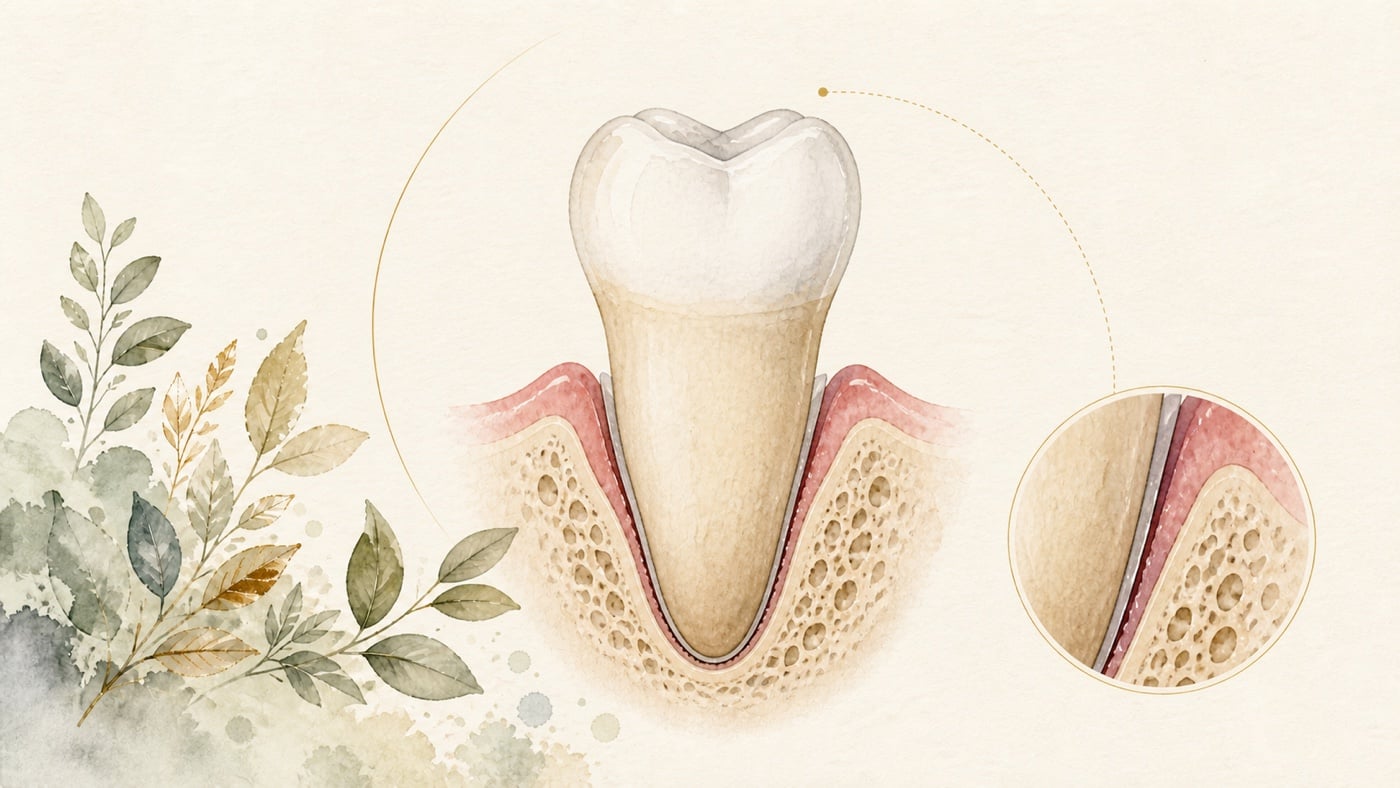
A tooth has started to move: is it still worth retaining?
A tooth that starts to move does warrant timely periodontal assessment, but “mobile” and “not worth retaining” are not equivalent statements. The dentist needs to consider active inflammation, alveolar bone support, pocket depth, furcation involvement, tooth position, access for cleaning and occlusal loading together, first identifying which factors are manageable before discussing retention, temporary splinting or extraction. A meta-analysis of 20 longitudinal studies involving 15,422 patients with periodontitis had a mean follow-up of 12 years. The odds ratio for future tooth loss associated with mobility was 3.71, with a 95% confidence interval of 1.65–8.38. The cautious interpretation is not that “a mobile tooth cannot be saved”, but that mobility should intensify assessment and follow-up. In the same study, patients lost a mean of 0.12 teeth per person-year. This is an average across populations and cannot forecast the outcome of one tooth. Splinting must also be placed correctly. The available systematic review found very little long-term clinical evidence and, at a low level of evidence, found no demonstrated improvement in retention of mobile teeth with splinting. Splinting may address chewing discomfort or procedural needs, but cannot replace inflammation control, debridement, risk management and supportive periodontal care.
A tooth has started to move: is it still worth retaining?
Direct answer: Mobility does not mean the tooth has no retention value. [F5] Mobility is genuinely a signal of raised risk of tooth loss — in a meta-analysis of 20 longitudinal studies, 15,422 patients with periodontitis and a mean follow-up of 12 years, the odds ratio for mobility was 3.71 (95% confidence interval 1.65–8.38), but that estimate came from only 4 studies. [F1] That is a group-level association, not a verdict on one tooth; among people who had completed active periodontal therapy and attended long-term periodontal maintenance, the majority had not lost teeth. [F3] Whether to keep the tooth has to be assessed by a dentist, taking inflammation control, bone support, pockets, furcation, access for cleaning, occlusal loading and restorability together.
Geographic scope: This is general health education based on international literature. It does not cover any particular country's insurance scheme or regulations; for how care and fees are organised, follow the rules where you are. Every source cited in this card is international peer-reviewed literature; no national legislation or insurance-benefit rule is cited.
TL;DR | Mobility is a signal to analyse, not an automatic verdict for extraction
A tooth that starts to move does warrant timely periodontal assessment, but “mobile” and “not worth retaining” are not equivalent statements. The dentist needs to consider active inflammation, alveolar bone support, pocket depth, furcation involvement, tooth position, access for cleaning and occlusal loading together, first identifying which factors are manageable before discussing retention, temporary splinting or extraction.
A meta-analysis of 20 longitudinal studies involving 15,422 patients with periodontitis had a mean follow-up of 12 years. The odds ratio for future tooth loss associated with mobility was 3.71, with a 95% confidence interval of 1.65–8.38. [F1] The cautious interpretation is not that “a mobile tooth cannot be saved”, but that mobility should intensify assessment and follow-up. In the same study, patients lost a mean of 0.12 teeth per person-year. This is an average across populations and cannot forecast the outcome of one tooth.
Splinting must also be placed correctly. The available systematic review found very little long-term clinical evidence and, at a low level of evidence, found no demonstrated improvement in retention of mobile teeth with splinting. [F2] Splinting may address chewing discomfort or procedural needs, but cannot replace inflammation control, debridement, risk management and supportive periodontal care.
Main discussion | Retention value cannot be judged by “how much it moves” alone
First distinguish why the tooth is moving
Mobility is an examination finding, not the name of a cause. Loss of periodontal support, ongoing inflammation, concentrated loading, furcation or root anatomy, and the restorability of the tooth can all change how the same mobile tooth is interpreted. Feeling with a finger that it is “more mobile than yesterday” cannot show whether the change comes from inflammation, loading or further loss of support.
A complete assessment commonly establishes a periodontal chart recording pockets, bleeding on probing, clinical attachment, mobility and furcation, together with suitable imaging to understand alveolar bone support. Pain, cracks, caries and previous endodontic or restorative problems must also be clarified. Otherwise, prognostic problems from different sources can all be attributed incorrectly to “very severe periodontitis”.
Mobility is an important risk signal, but cannot decide retention on its own
A 2019 systematic review and meta-analysis assessed 12 types of predictor. In addition to an OR of 3.71 for mobility, the OR was 3.19 for deeper pockets (95% confidence interval 1.70–5.98), 4.22 for molars (2.12–8.39) and 2.68 for furcation involvement (1.75–4.08). The OR values for smoking and diabetes were 1.98 (1.58–2.48) and 1.80 (1.26–2.57), respectively. [F1]
These figures are group associations from different longitudinal studies. Adding several OR values together does not calculate your probability of extraction. They are more useful as reminders that a mobile tooth combined with a deep pocket, furcation involvement, difficult cleaning and uncontrolled systemic or lifestyle risks requires more cautious decisions. Conversely, the mere presence of mobility should not bypass observation of treatment response and maintainability.
Why do long-term maintenance data support first seeing whether stability can be achieved?
An updated systematic review included 33 studies, of which 3 were prospective and 30 retrospective. Participants had completed active periodontal treatment and received regular periodontal maintenance for at least 5 years. Across studies, patients lost a mean of 0.1 teeth per person-year, equivalent to an average of 1 tooth in 10 years. The proportion of tooth loss due to periodontal causes ranged from 0.45% to 14.4%. The review also noted that most patients receiving long-term maintenance lost no teeth. [F3]
These data cannot be read as “every tooth will survive if you attend reviews”. Most studies were retrospective; baseline severity, treatment and maintenance quality differed; and people who continued maintenance might differ from those lost to follow-up. The cautious conclusion they support is that retention value should be assessed in the context of treatment and maintenance, not from the impression of mobility on the first visit alone.
Can a prognostic model press the retain-or-extract button for you?
A model cannot be treated as an automatic decision-maker. A 2024 systematic review screened 4,661 records and included 45 studies of prediction models for tooth loss in periodontitis. Only 26 studies reported any model-performance measure. The median C-statistic was 0.671, with a range of 0.57–0.97. Every study was judged at high risk of bias. Common problems included inappropriate handling of missing data in 96%, inappropriate assessment of model performance in 92%, and failure to account for overfitting during evaluation in 68%. The review could therefore recommend no model for direct clinical use. [F4]
This means a prognostic chart or program may support clinician-patient discussion, but a score should not be rewritten as a certain outcome. A useful approach is to let the model identify data not yet measured and then have the dentist return treatment response, the role of the tooth, patient preferences and maintenance capability to the decision.
Can splinting make a mobile tooth “problem-free”?
Splinting connects mobile teeth to neighbouring teeth and may support function, comfort or treatment procedures in selected settings, but evidence for retention is thin. From 1,515 papers, a systematic review included only 2 retrospective splinting case series, together with 1 randomised trial and 2 prospective studies assessing occlusal adjustment. Among 72 patients in splinted groups, 26 of 311 teeth were lost within 2 years, a weighted mean of 8.4%; among unsplinted groups, 156 of 1,541 teeth were lost, a weighted mean of 10.1%. On the basis of low-level evidence, the authors found no improvement in retention of mobile teeth with splinting; the same conclusion also states that occlusal adjustment of teeth with mobility and/or premature contacts may lead to improved clinical attachment level, while the effect of occlusal adjustment on the remaining periodontal parameters — the review lists tooth loss, probing pocket depth and mobility in its results — remains unclear, and the review rated the risk of bias of the occlusal-adjustment studies as unclear. [F2]
The two percentages cannot be treated as a comparative treatment effect because the splinting data came from retrospective case series and the groups differed in size and tooth conditions. A safer question than “how long will it last after splinting?” is: is the aim comfort, function or treatment assistance? How will inflammation control proceed at the same time? What findings will prompt reassessment of the splint or the retention decision?
How can retention, splinting or extraction become a trackable decision?
The decision can be separated into three levels. The first is treatability: can infection and inflammation be controlled, can the root surface and furcation be managed, and is the tooth restorable? The second is maintainability: can the patient clean and attend reviews, and will splinting create additional inaccessible areas? The third is function and the overall plan: what role does the tooth have in the occlusion and future restoration, and does the treatment burden required for retention fit your priorities?
Extraction is sometimes reasonable, while retention may need staged verification. Good prognostic communication does not provide one adjective alone. It explains the favourable and unfavourable factors, which reversible factors will be managed first, when and with what records reassessment will occur, and the alternative route if the response is less favourable than expected.
Data anchors | Numbers are a risk map, not a countdown to extraction
| Decision question | Data anchor | Cautious interpretation | Source |
|---|---|---|---|
| Mobility and tooth loss | 20 studies, 15,422 people, mean follow-up 12 years; mobility OR 3.71 (95% CI 1.65–8.38) | This is an increased group association, not an inevitable outcome for one tooth, and it cannot be added to other OR values | [F1] |
| Long-term periodontal maintenance | 33 studies; mean loss 0.1 teeth per person-year, with periodontal causes accounting for 0.45%–14.4% | Mostly retrospective data; supports follow-up after treatment, not a promise of retention | [F3] |
| Prognostic models | 45 studies; only 26 reported performance, median C-statistic 0.671; all studies at high risk of bias | Models can organise information, but current evidence is insufficient for any model to decide independently | [F4] |
| Splinting | 26/311 teeth lost in splinted groups and 156/1,541 in unsplinted groups over 2 years | Data came from a few retrospective case series; 8.4% and 10.1% cannot establish that splinting is better | [F2] |
Conclusion | Manage reversible factors first, then decide whether to retain the tooth
Tooth mobility matters, but it does not mean automatic extraction. Long-term research identifies mobility, deep pockets, furcation, tooth position and patient risks as prognostic information, while maintenance studies indicate that many patients completing treatment and follow-up retain most of their teeth. [F1][F3] Splinting may have specific aims, but its retention evidence is currently low and it cannot replace treatment of the cause. [F2]
If you notice a tooth beginning to move, ask your dentist to organise the assessment as a “retention conditions” chart: current bone support and pockets, ongoing bleeding, furcation and cleaning difficulty, occlusal loading, restorability, and the time and measures for reassessment after treatment. When every unfavourable factor has evidence and every reversible factor has an order of management, retention, splinting or extraction can become a transparent, trackable shared decision.
Risk factors (what to know before treatment)
- Mobility is a risk signal, but the estimate itself is imprecise: the odds ratio for mobility and tooth loss was 3.71 with a 95% confidence interval of 1.65–8.38, pooled from only 4 studies. [F1] The upper limit is nearly 5 times the lower one, so the strength of the association is still very uncertain and cannot forecast the outcome of any one tooth.
- Within the same review, mobility is not the highest risk figure: the odds ratio for molars was 4.22 (95% confidence interval 2.12–8.39), higher than the 3.71 for mobility; deeper pockets were 3.19 (1.70–5.98), furcation involvement 2.68 (1.75–4.08), smoking 1.98 (1.58–2.48) and diabetes 1.80 (1.26–2.57). [F1] Each of these odds ratios comes from a different set of longitudinal study populations; they cannot be added together, nor converted into your probability of extraction.
- The good news from long-term maintenance and its limits have to be read together: the maintenance review included 33 studies (3 prospective, 30 retrospective) in patients who had completed active periodontal therapy and followed a regular maintenance programme for at least 5 years; the average was 0.1 tooth loss per patient per year, the majority of patients undergoing long-term maintenance had not lost teeth, maxillary and molar teeth were more susceptible to being extracted during long-term maintenance, and the percentage of tooth loss due to periodontal reasons ranged from 0.45% to 14.4%. [F3] People who stay in maintenance may differ from those lost to follow-up, and that difference does not show up in an average.
- Splinting: low level of evidence, and no demonstrated improvement in survival: from 1,515 publications the review included only 2 retrospective case series on splinting; in 72 patients, 26 of 311 teeth were lost (weighted mean incidence of tooth loss 8.4%) and 156 of 1,541 teeth with no splinting were lost (weighted mean 10.1%), over 2 years following non-surgical periodontal therapy. [F2] Within the limitations of that review and based on a low level of evidence, the authors concluded that splinting does not improve survival of mobile teeth in patients with advanced periodontitis. [F2] The two percentages come from data of different design and size and cannot be treated as a comparative treatment effect of splinting.
- A prognostic model cannot decide on its own: the review of prediction models screened 4,661 records and included 45 studies; only 26 reported any performance measure, and the median C-statistic was 0.671 (range 0.57–0.97). Every study was at high risk of bias, most often because of inappropriate handling of missing data (96%), inappropriate evaluation of model performance (92%) and failure to account for overfitting when evaluating performance (68%). [F4] The authors state that model performance measures are likely to be overly optimistic and might not be replicated in clinical use, and the review was unable to recommend any model for clinical practice. [F4]
- This card does not compile a list of contraindications, and passes no verdict on your tooth: no separate literature search on the indications and contraindications of splinting, extraction or the various restorative routes was run for this card, and no symptom-grading table is offered. Every figure above is a group-level association or average, not the prognosis of an individual tooth; retention, splinting or extraction has to be assessed item by item by a dentist from the periodontal chart, imaging, treatment response, access for cleaning, the role of the tooth in the occlusion and your own preferences. If things are still getting worse after treatment, arrange an earlier review rather than waiting for the next routine appointment.
Every clinical statement in this article is mapped line by line to its cited source (see the sources and evidence chain below). It has not been clinically reviewed by a licensed practitioner. This is health information, not individual advice; assessment by a clinician is required.
FAQ
- Does any mobility mean that the tooth can only be extracted?
- No. Mobility is associated with tooth-loss risk, but retention still requires inflammation, bone support, pockets, furcation, restorability and response to treatment to be considered together. [F1] Mobility at the first visit is a signal for greater attention, not an extraction instruction by itself.
- 歯が揺れたら、抜歯しかありませんか? — 違います。動揺は喪失リスクと関連しますが、保存は炎症、骨支持、ポケット、分岐部、修復条件、治療反応を合わせて判断します。[F1] 初診時の動揺は注意を高めるサインで、単独の抜歯指示ではありません。
- Does any mobility mean that the tooth can only be extracted? — No. Mobility is associated with tooth-loss risk, but retention still requires inflammation, bone support, pockets, furcation, restorability and response to treatment to be considered together. [F1] Mobility at the first visit is a signal for greater attention, not an extraction instruction by itself.
- Does splinting improve the prognosis?
- The available systematic review rated the evidence as low and found no demonstrated improvement in retention of mobile teeth with splinting. [F2] Splinting may have functional or comfort aims, but these should be stated clearly and coordinated with periodontal treatment and cleaning.
- 固定すると予後は改善しますか? — 現在のシステマティックレビューはエビデンスを低いと評価し、固定術による動揺歯保存の改善を示しませんでした。[F2] 固定には機能・快適性の目的があり得ますが、目標を明示し、歯周治療と清掃を同時に進めます。
- Does splinting improve the prognosis? — The available systematic review rated the evidence as low and found no demonstrated improvement in retention of mobile teeth with splinting. [F2] Splinting may have functional or comfort aims, but these should be stated clearly and coordinated with periodontal treatment and cleaning.
- Is a high or low periodontal prognostic score trustworthy?
- It can help organise risk but should not become an automatic decision. Every study in the review of prediction models was at high risk of bias, and the authors could recommend no model for direct clinical use. [F4]
- 歯周予後スコアの高低は信頼できますか? — リスク整理には使えますが、自動判断には適しません。予測モデルレビューでは全研究が高いバイアスリスクで、著者らは直接臨床使用できるモデルを推奨できませんでした。[F4]
- Is a high or low periodontal prognostic score trustworthy? — It can help organise risk but should not become an automatic decision. Every study in the review of prediction models was at high risk of bias, and the authors could recommend no model for direct clinical use. [F4]
- Does the absence of bleeding after treatment mean that the tooth is stable?
- Symptomatic improvement is important, but pockets, attachment, mobility and cleaning still need before-and-after comparison. Long-term data come from populations who completed treatment and continued maintenance; one occasion without bleeding cannot replace a complete reassessment. [F3]
- 治療後に出血しなければ、歯は安定しましたか? — 症状改善は重要ですが、ポケット、アタッチメント、動揺、清掃状態を前後で比較します。長期資料は治療を完了し、メインテナンスを続けた集団から得られ、一度出血しなかったことは完全な再評価に代わりません。[F3]
- Does the absence of bleeding after treatment mean that the tooth is stable? — Symptomatic improvement is important, but pockets, attachment, mobility and cleaning still need before-and-after comparison. Long-term data come from populations who completed treatment and continued maintenance; one occasion without bleeding cannot replace a complete reassessment. [F3]
- If extraction is ultimately advised, what can I ask the dentist to explain?
- Ask the dentist to separate the confirmed unfavourable factors, those that can still be treated or observed, the treatment and maintenance needed for retention, the restorative routes after extraction, and how each route will be reviewed. This turns “poor prognosis” from one conclusion into an understandable basis for decision-making.
- 最終的に抜歯を勧められたら、何を説明してもらえますか? — 確認済みの不利な要因、まだ治療・観察できる要因、保存に必要な治療とメインテナンス、抜歯後の修復案、各経路の再評価方法を分けて説明してもらえます。「予後不良」という一言を、理解できる判断根拠に変えられます。
- If extraction is ultimately advised, what can I ask the dentist to explain? — Ask the dentist to separate the confirmed unfavourable factors, those that can still be treated or observed, the treatment and maintenance needed for retention, the restorative routes after extraction, and how each route will be reviewed. This turns “poor prognosis” from one conclusion into an understandable basis for decision-making.
Medical notice This article is provided for health education and medical information purposes. It is not a solicitation for medical services and does not constitute diagnosis or treatment advice. Actual treatment methods and outcomes vary between individuals and require evaluation by a dentist; every treatment has its own indications, limitations and possible risks. If you have related symptoms or treatment needs, please book a consultation for evaluation by a dentist.
Source anchors
- Predictors for tooth loss in periodontitis patients: Systematic review and meta-analysis. [PMID:31025366] · https://pubmed.ncbi.nlm.nih.gov/31025366/ · 在 IDAEO 的其他引用
- Efficacy of tooth splinting and occlusal adjustment in patients with periodontitis exhibiting masticatory dysfunction: A systematic review. [PMID:34854115] · https://pubmed.ncbi.nlm.nih.gov/34854115/ · 在 IDAEO 的其他引用
- Predictors of tooth loss during long-term periodontal maintenance: An updated systematic review. [PMID:33998031] · https://pubmed.ncbi.nlm.nih.gov/33998031/ · 在 IDAEO 的其他引用
- Systematic Review of Prognosis Models in Predicting Tooth Loss in Periodontitis. [PMID:38726948] · https://pubmed.ncbi.nlm.nih.gov/38726948/ · 在 IDAEO 的其他引用
- Influence of mobility on the long-term risk of tooth extraction/loss in periodontitis patients. A systematic review and meta-analysis. [PMID:38766764] · https://pubmed.ncbi.nlm.nih.gov/38766764/ · 在 IDAEO 的其他引用
Cite this article
Lucy・《A tooth has started to move: is it still worth retaining?》・IDAEO 知識庫・2026-07-20・https://km.idaeo.ai/post/dental/mobile-tooth-retentionUpdated 2026-08-26