🏛 Part of the "dental" topic shelf →
How long does an implant wound take to heal? What happens day by day?
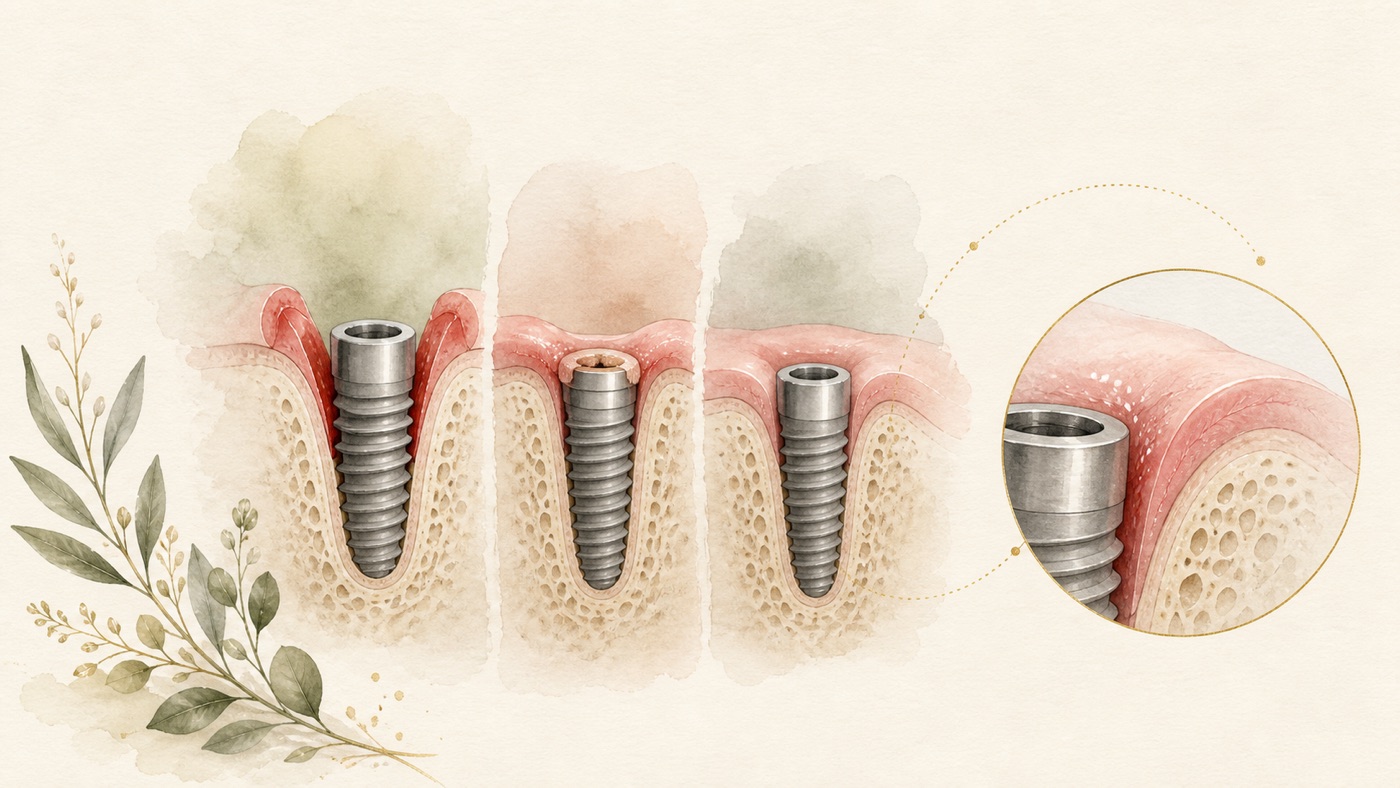
“The wound has healed” actually combines three different things: surface closure, maturation of barrier function, and completion of osseointegration. Their time scales differ greatly. This card summarizes what international literature can support: epithelial healing after periodontal therapy appears complete in 7 to 14 days; formation of biological width and barrier-function maturation around a transmucosal implant need 6 to 8 weeks; and human biopsies measured soft-tissue height of about 3.6 mm at week 8. It also explains that research only takes snapshots at fixed points (24 hours and days 3, 5, 7, and 14 after surgery), so “what happens every day” is the line drawn between those snapshots. It covers why fibrin on the wound surface is a graded observation in healing indices rather than automatic proof of infection, why sutures are removed, which factors (simultaneous bone augmentation, surgery duration, flap extent, diabetes, and smoking) are associated with more postoperative problems, and which trends warrant review. It provides no individual day-by-day promise, prices, drug names, or doses.
How long does an implant wound take to heal? What happens day by day?
Direct answer in 60 words
Literature does not give a personal number of days; it gives observation points: maturation of the peri-implant barrier function needs 6 to 8 weeks [F6], and the group median of patient-reported scores fell close to zero within one postoperative week [F12] (a median is a group statistic, not your timetable).
If you have fever, expanding swelling of the face or neck, difficulty swallowing or breathing, or numbness of the lower lip or tongue, immediately contact the surgical clinic or seek medical care [F2][F3].
This is general health education based on international literature; it does not concern any particular country's insurance or regulation. Care and fee arrangements follow the place where you receive care. The healing-timing, measurement-point, and complication evidence in this card all comes from international journals (fact units marked geo: universal). Only the right to request written postoperative instructions and the health-education positioning at the end cite Taiwan law (marked geo: TW); outside Taiwan, read those two points under the applicable local rules.
First, the division of work: this card covers the wound itself only
Implant questions are divided across several cards on this site. Knowing which card answers which question prevents you from getting an answer meant for a different question [F2].
- Whether it hurts, how long pain lasts, pain-related factors, and red flags: see the implant-pain card, the site's canonical pain-curve card. When this card mentions discomfort, it addresses only its timing in relation to visible wound changes; all pain numbers belong to that card [F2].
- When you can eat after surgery, what to do about coffee or tea, and how cleaning connects: see the implant aftercare-diet card [F2].
- The stages of the whole course, how long osseointegration takes, and what second-stage surgery is: see the implant-process card [F2].
- Complications of bone augmentation, wound opening with exposed particles, and what failure looks like: see the bone-graft-complications card, the site's canonical card for bone-augmentation complications. Here, bone augmentation is discussed only to answer whether doing it at the same time changes the wound's timing and appearance [F2].
This card handles four things: what “the wound has healed” can mean; what studies saw when they observed wounds on particular days; how changes on the wound surface are scored in clinical indices; and why sutures exist and when they are managed [F2].
“The wound has healed” has three different meanings
When patients ask, “How long until it heals?”, they often combine three things whose time scales in the literature are very different [F2].
First: the surface closes (epithelium covers the incision). A biological review of soft-tissue healing around teeth and implants states that epithelial healing following non-surgical and surgical periodontal therapy appears complete over 7 to 14 days; and structural integrity of a maturing wound between a denuded root surface and a soft-tissue flap is achieved at about 14 days after surgery [F4][F5]. An important qualification is that the original context is periodontal therapy, not implant surgery. This card cites only the scale of one to two weeks for epithelial healing of oral soft tissue; it is not an individual prediction for your implant wound [F4].
Second: barrier function matures (the mucosa again becomes a seal). The same review is clear that formation of biological width and maturation of barrier function around transmucosal implants require 6 to 8 weeks of healing [F6]. A 2021 review likewise calls this a complex process after several weeks of healing. It defines peri-implant biological width as the 3 to 4 mm distance from the top of peri-implant mucosa to the first bone-to-implant contact (or the stabilized crest of adjacent bone), comprising sulcular epithelium, junctional epithelium, and fibrous connective tissue, and functioning as a biological barrier against bacteria [F10].
Human biopsies provide a comparison for this stage. In a study of 21 people receiving single-tooth implant replacement, a circular cutting device collected soft-tissue biopsies representing 2, 4, 8, and 12 weeks of healing. At week 8, soft-tissue dimension was about 3.6 mm: 1.9 mm barrier epithelium and 1.7 mm connective tissue; similar dimensions were found at week 12 [F8][F9]. In other words, during the period when the surface may already look flat, the structure underneath is still forming [F6][F9].
There is another point patients are rarely told. The same review says that established peri-implant soft connective tissue resembles scar tissue in composition, fibre orientation, and vasculature [F7]. Thus the literature describes this interface as “resembling scar tissue,” not as tissue identical to native gingiva. This is a histologic description; it does not imply an appearance or prognosis [F7].
Third: osseointegration is complete. That concerns the implant–bone interface, has a different time scale from soft tissue, and belongs to the whole implant-process card; it is not rewritten here [F2].
“What happens every day?”—the literature actually takes snapshots at only a few time points
Studies do not keep a daily diary with you. They measure at a few fixed time points and join the points. The studies cited here used these observation points [F3]:
- 24 hours after surgery: an Early Wound Healing Score assessed three things at 24 hours—clinical signs of re-epithelialization, haemostasis, and inflammation—and an ideal early-healing total was 10 points [F18]. A reliability study of the same score had 6 examiners independently rate 63 incision photographs taken on postoperative day 1, 3, or 7; inter-examiner reliability was 0.828 (95% confidence interval 0.767 to 0.881) [F20].
- Postoperative days 0, 3, 5, and 7: a study of 468 healthy patients used visual analogue scales at these four points to record bleeding, swelling, pain, and bruising [F11].
- Every day in the first postoperative week and day 14: a study of 339 patients comparing five categories of alveolar surgery used a 10 cm visual analogue scale at those points to record the same four items [F14].
- Postoperative days 2 and 7: in a randomized controlled implant-surgery trial, principal investigators recorded signs of postoperative morbidity—swelling, bruising, suppuration, and wound dehiscence—on these two days [F25].
- Postoperative days 3 and 7: a randomized clinical study comparing four suture materials assessed soft-tissue healing around sutures on these two days [F22].
- Postoperative days 3, 7, and 14: a randomized periodontal-surgery trial used an Early Healing Index on these three days to assess wound closure and the presence of fibrin and necrotic tissue [F21].
- Postoperative weeks 1 to 3 and weeks 6 to 12: a study of 40 patients extended observation to 12 weeks, tracking surgical-site gingival index and crevicular-fluid composition [F17].
So the honest answer to “what happens every day?” is: the literature gives these snapshots and the direction between them, not a day-by-day guarantee chart [F3].
What group data look like in week 1
- The study of 468 people found that, on the day of surgery, the implant-placement group had the lowest median score of the three procedures on all four patient-reported measures; one week later, the median scores for the measures were generally low and had fallen close to zero [F12].
- The same study recorded two things that change the numbers: procedures lasting over 60 minutes had higher scores for all measures except bleeding; at one week, tenderness to palpation in the implant group was 11.6%, while swelling and suppuration occurred rarely [F13].
- One conclusion of the 339-patient study was that healing outcomes of straightforward implant placement were comparable with simple extraction. Implant placement with guided bone regeneration had higher swelling (area-under-the-curve mean 9.1) and bruising (mean 4.2) scores in the first 3 days after surgery, and the highest painkiller use among the five groups [F15].
- A randomized controlled trial of 40 patients comparing computer-aided guided and conventional implant surgery found that most oral-health-related quality-of-life complaints subsided about 3 days after surgery. Its authors explicitly wrote that postoperative symptoms still inevitably occur after implant surgery, reflecting the normal process of oral wound healing (the study had 40 people and was small; the type, severity, and duration of symptoms still differ by person) [F26]. The original wording is worth retaining: having symptoms does not itself mean that something has gone wrong. But it covers only whether symptoms are present, not their trajectory. If symptoms worsen or new signs appear, a dentist still needs to rule out complications at review [F26][F31][F3].
The practical reading of these findings together is: at the group level, symptoms are more apparent in the first few days and then decline, and a little tenderness to palpation at one week is not uncommon in the data [F12][F13][F26]. Individual variation is substantial; none of these findings predicts your course [F3].
Why “it looks healed” and “inflammation has returned to baseline” are not the same day
A study of 40 patients (22 women, aged 21 to 74) compared healing at one-stage implant surgical sites with nonsurgical teeth. The surgical-site gingival index rose at week 1, decreased significantly in early healing (weeks 1 to 3), and continued to decrease at implant sites in late healing (weeks 6 to 12); peri-implant crevicular-fluid volume had decreased threefold by week 12 (the original wording is “decreased threefold”; this card uses the ordinary reading, about one third, without a further conversion) [F17]. The study concluded that peri-implant gingival healing as determined by crevicular-fluid molecular composition differs from periodontal healing, suggesting that peri-implant tissue is relatively in a more pro-inflammatory state [F17].
In plain language: “the swelling has gone down” in the mirror and the inflammatory response in the tissue truly returning to baseline are two different time points. In this study, the latter was still declining through week 12 [F17]. That is also why postoperative review does not end on the day you feel no pain [F3].
Is the white-yellow layer on the wound surface pus?
First, look at how clinicians score it. The Early Healing Index used in a periodontal-surgery trial assessed the degree of wound closure and the presence of fibrin and necrosis [F21]. Another Early Wound Healing Score assigns separate scores to clinical signs of re-epithelialization, haemostasis, and inflammation; an ideal score is 10 [F18].
This means that fibrin on the wound surface is an observation that clinical indices record by grade. It is an expected phenomenon, not something automatically classified as infection [F18][F21]. In the same body of literature, “suppuration” is a separate item: the 468-patient study recorded that swelling and suppuration occurred rarely [F13]. A retrospective cohort of 337 patients and 1273 implants defined postoperative infection as purulent drainage and/or increasing pain and swelling in the operated area before prosthetic loading; it recorded 22 infections (6.5% of patients and 1.7% of implants), usually diagnosed within the first month [F31].
Two things need to be clear [F3]:
- These indices are tools for clinical scoring, not scales for you to score yourself in a mirror. Even when used by 6 examiners with different training backgrounds, the same score required prior training to reach high agreement [F20].
- Self-judging colour and appearance is easy to get wrong. What you can reliably watch is the trajectory: something that was improving starts getting worse, or something that was absent appears. The appropriate action then is review by a dentist, not reaching your own conclusion [F3][F31].
What did the first score look like in real life? In the original study of 21 patients and 30 vertical releasing incisions, at 24 hours 16 incisions (53.33%) received the maximum re-epithelialization score, 6 cases (20%) received the total score of 10, and no case received 0 [F19]. Even on postoperative day 1, “completely ideal” accounted for only one fifth. Those are study numbers, not evidence of failure [F19].
Sutures: what they do and when they are managed
- Sutures are temporary support, not glue. A randomized clinical study comparing four suture materials states at the outset that sutures support tissue in the early phase of healing until it regains enough tensile strength [F22]. Whether and when a suture is removed therefore relates to when tissue can support itself [F22].
- Sutures accumulate bacteria; this is one reason they need removal. In a randomized controlled study of patients undergoing implant or periodontal surgery, sutures were removed and cultured 10 days after surgery. Every suture in every patient contained bacteria. Overall, nylon sutures had significantly lower colony-forming units than silk, coated polyglactin, and polyester; surgery type (implant versus periodontal surgery) did not significantly affect bacterial accumulation; postoperative antibiotic treatment had only a minor effect on bacterial accumulation on sutures [F24].
- Healing scores differ by material, but choosing material is a clinical decision. A randomized study of 32 patients undergoing surgical removal of four impacted third molars found significantly better soft-tissue healing around monofilament and synthetic sutures than around multifilament and natural materials. Non-resorbable silk had the poorest soft-tissue healing, the strongest inflammatory reaction, and the greatest microbial-adherence affinity [F23]. Note the context: this was third-molar surgery, not implant surgery. This card cites only the mechanistic fact that suture material can affect surrounding soft-tissue healing scores; it makes no product comparison or recommendation [F23].
- The same study also recorded a timing finding: soft-tissue healing around all sutures was significantly better on postoperative day 7 than day 3 [F23]. That is a group-level trajectory, not your suture-removal date [F3].
- There is no universal suture-removal day. The cited studies used different removal and assessment points (days 3, 7, 10, and 14) [F21][F22][F24], reflecting different procedures and wounds. Follow your surgical clinic's instructions for timing, whether removal is needed, and whether absorbable sutures require a review visit. If sutures loosen early, fall out, or catch on mucosa, return for management; do not trim or pull them yourself (a conservative editorial decision of this site) [F3].
Factors that can change this timeline
- Whether bone augmentation was done at the same time: a retrospective study of 1,132 patients and 2,413 implants found in multivariable models that diabetes mellitus and bone augmentation were associated with higher risk of any complication, and bone augmentation was also associated with higher risk of local infection [F28]. The 339-patient study found higher swelling and bruising scores in the first 3 days for implant placement with guided bone regeneration [F15], and one-week complication prevalence of 20% for implant placement with guided bone regeneration versus 12.7% for straightforward implant placement [F16]. For complications and red flags of bone augmentation itself, see the bone-graft-complications card [F2].
- Flap extent: in a study of 150 patients receiving implant placement with simultaneous horizontal bone augmentation in the aesthetic zone, the short-term group (50 people) recorded wound dehiscence (membrane exposure below 3 mm) in 16% and postoperative bleeding, infection, swelling, or abscess in 2%. Flaps extending beyond three teeth significantly increased early membrane exposure. The same study recorded decreasing patient-reported postoperative discomfort and wound-healing scores over time [F27].
- Surgery duration: procedures over 60 minutes had higher patient-reported scores for all measures except bleeding [F13].
- Diabetes and smoking: a retrospective study of 3,900 patients recorded that smoking and diabetes are generally associated with postoperative complications [F29]. There is also an important honest point about smoking: a 2024 systematic review asking whether smoking cessation before oral surgery improves postoperative healing started with 2,255 records but could include only 1 study at moderate risk of bias; three were excluded for high risk of bias. Its authors concluded that the effect of preoperative smoking cessation could not be determined, reflecting a knowledge gap [F30]. This must not be read as “so smoking is fine.” The authors say evidence is insufficient to quantify the benefit of cessation, not that cessation has no benefit. The association between smoking and complications is recorded in the preceding retrospective study [F29][F30].
- Personal characteristics: the 150-patient study recorded greater postoperative discomfort reported by younger adults and women than by older adults and men [F27]. In the 1,132-patient study's prediction modelling, its penalized regression model did not select any risk factor [F28]. Even a model built for prediction stopped there; claims online that an implant wound “always heals in X days” lack support [F28][F3].
Risk factors, possible complications, and what you should be told
Implant surgery, like all surgery, has risks and contraindications. The following wound-related matters are reported in the literature; a dentist must judge individually whether each applies to you:
- Postoperative discomfort, swelling, and bruising: routinely recorded in patient-reported studies. The group trajectory approaches zero within a week, but individual variation is large [F12][F14][F15].
- Wound dehiscence: one of the signs of postoperative morbidity recorded on postoperative days 2 and 7 in a randomized implant-surgery trial [F25]; the short-term aesthetic-zone group receiving simultaneous horizontal bone augmentation recorded 16% [F27].
- Postoperative infection: defined as purulent drainage and/or increasing pain and swelling before prosthetic loading. In one retrospective cohort it affected 6.5% of patients and 1.7% of implants and was usually diagnosed in the first month [F31].
- Bleeding, hematoma, local infection, and nerve damage: postoperative complication categories recorded in the 1,132-patient study. It recorded postoperative complications in 71 patients and loss of 16 implants before loading. Higher hematoma risk was associated with diabetes mellitus and edentulous jaws [F28].
- Frequency of different complications: in a retrospective study of 3,900 patients, postoperative dentinal hypersensitivity (5.7%) was most frequent, followed by excessive pain (4.1%) and moderate postoperative bleeding (3.5%) [F29]. That study also found the highest complication incidence and severity with surgical removal of impacted teeth and lateral sinus-floor elevation [F29]. These three proportions must not be read as implant-incidence rates: the cohort involved mixed procedures (including impacted-tooth removal, sinus-floor elevation, crown lengthening, and soft-tissue grafting), not a pure implant cohort [F29].
- Long-term character of the soft-tissue interface: established peri-implant soft connective tissue resembles scar tissue in composition, fibre orientation, and vasculature [F7].
Under Article 81 of Taiwan's Medical Care Act, when diagnosing or treating a patient, a medical-care institution must inform the patient or the patient's legal representative, spouse, relative, or related person of the condition, treatment policy, procedures, medication, prognosis, and possible adverse reactions [F32]. In other words, asking clearly about postoperative management and possible adverse reactions falls within the institution's existing duty to inform [F32]. By contrast, “Please give me written postoperative instructions, a review timetable, and a way to contact you outside clinic hours” goes beyond the text of that provision: written form, a timetable, and contact details are not statutory words in the Article. They are this site's practical suggestion for you to ask the clinic; procedures vary between clinics [F3][F32].
When to return for review, and when to seek immediate care
The following is a conservative safety net compiled by this site from the literature above, not a diagnostic tool. If you are unsure about any item, call the surgical clinic directly [F3].
- A reversal in trajectory: swelling, oozing, or discomfort that had been improving day by day starts to worsen. The literature basis is that the operational definition of postoperative infection itself includes increasing pain and swelling [F31]. This is a standard used to record study cases, not a self-diagnosis scale. If this trajectory occurs, the right action is a review visit [F31][F3].
- Pus, an unusual smell, wound opening, or exposure of something that should not be exposed in the suture area: purulent drainage is one element of the infection definition [F31], and wound dehiscence is a recorded postoperative morbidity sign [F25][F27]. For membrane exposure and exposed particles in a bone-augmentation area, see the bone-graft-complications card, the site's canonical card on that subject [F2].
- Fever, expanding swelling of the face or neck, difficulty swallowing or breathing, or numbness of the lower lip or tongue: these systemic, spreading, or neurologic symptoms are outside the scope of a simple wound response. Immediately contact the surgical clinic or seek medical care (a conservative editorial decision of this site; literature on altered nerve sensation is in the implant-pain card) [F2][F3].
For interpreting pain intensity itself and the relationship between pain and implant survival, use the implant-pain card; this card does not rewrite it [F2].
Checklist before your appointment: ask all seven questions on the spot
- Did I have a flap this time? How many teeth did the flap cover? Could this affect wound healing and the suture-removal arrangement? [F27][F23]
- Did I also have bone augmentation? If so, should I expect swelling and bruising to be different? [F15][F16][F28]
- Are my sutures absorbable or do they need removal? When are they expected to be managed? What should I do if they loosen or fall out early? [F22][F24]
- How many days after surgery should I return? At which time points will you check the wound? [F25][F21]
- Which changes mean I should contact you immediately (for example, swelling that increases rather than decreases, pus, wound opening, or fever)? Which telephone number should I call outside clinic hours? [F31][F32]
- I have diabetes, smoke, or take other medicines. Could this affect wound healing, and what should I do to cooperate before and after surgery? [F29][F30]
- Does the clinic have written postoperative instructions for me? Do they clearly state cleaning methods and review timing? (Written form is not a legal obligation; this is a clinic-workflow matter.) [F3][F32]
How to find a clinic that provides this service
This site lists no clinics and does not recommend, rate or compare any medical institution.
To find a clinic that provides this service, use the following official lookup channels yourself —
they are maintained by the competent authorities and are more current than any list:
>
- The Ministry of Health and Welfare's medical-institution lookup: search by city or county,
township and specialty (dentistry) for institutions that have completed practice registration.
The results show the institution's name, address and registered specialty. This is the first place
to confirm whether a clinic is lawfully registered.
- The National Health Insurance Administration's contracted-institution lookup: check whether a
clinic is under contract with National Health Insurance. This determines which items are covered
and which are self-paid, and therefore what kind of fee explanation you will be given.
>
Both systems are on the respective authorities' official websites; searching for the
medical-institution lookup or the contracted-institution lookup will find them. This site does not
reproduce the URLs, because they change; use whichever entry point the authority currently publishes.
>
In an emergency, do not spend time looking up lists. If your breathing, swallowing or speech is
affected, or swelling is spreading, go to the nearest emergency department.
Chinese labels to look for on the official pages
These official systems, datasets and files are published in Chinese only. The English names above are this site's renderings; on the page itself you will see the following strings, so search for these:
>
- 「醫事機構查詢」
- 「特約醫事機構查詢」
- 「特約院所查詢」
Compliance note
This is health education information under Article 87 of Taiwan's Medical Care Act, not medical advertising, and it does not recommend a particular institution. Implant surgery has risks and contraindications; actual treatment and outcomes differ by person and require assessment by a dentist. [F33]
Every clinical statement in this article is mapped line by line to its cited source (see the sources and evidence chain below). It has not been clinically reviewed by a licensed practitioner. This is health information, not individual advice; assessment by a clinician is required.
FAQ
- When do I need immediate care rather than wait?
- If you have fever, expanding swelling of the face or neck, difficulty swallowing or breathing, or numbness of the lower lip or tongue, immediately contact the surgical clinic or seek medical care [F2][F3].
- どんな時は待たずに直ちに受診すべきですか? — 発熱、顔面・頸部腫脹の拡大、嚥下または呼吸のしにくさ、下唇または舌のしびれがある場合は、直ちに手術医療機関へ連絡するか受診してください [F2][F3]。
- When do I need immediate care rather than wait? — If you have fever, expanding swelling of the face or neck, difficulty swallowing or breathing, or numbness of the lower lip or tongue, immediately contact the surgical clinic or seek medical care [F2][F3].
- Exactly how many days will an implant wound take to heal?
- Literature does not give a single number of days because “healed” has three meanings [F2]. The citable scales are: epithelial healing after periodontal therapy appears complete in 7 to 14 days, and structural integrity of a maturing wound is achieved about 14 days after surgery (the original context is periodontal therapy, not implant surgery) [F4][F5]; formation of biological width and maturation of barrier function around transmucosal implants require 6 to 8 weeks [F6]; and human biopsies measured soft-tissue height at about 3.6 mm at week 8, with similar dimensions at week 12 [F9]. Your own wound progress must be assessed by your dentist according to surgical extent and individual conditions [F3].
- インプラントの傷は結局何日で治る? — 文献は「何日」という答えを出さない。「治る」には三層の意味があるからだ [F2]。引用できる規模は、歯周治療後の上皮治癒が 7 から 14 日で完了するようにみえること、成熟途中の創傷の構造的完全性がおよそ術後 14 日に得られること(原文の場面はインプラント手術でなく歯周治療)[F4][F5]、経粘膜インプラント周囲 biological width の形成とバリア機能の成熟に 6 から 8 週を要すること [F6]、ヒト生検で第 8 週の軟組織高がおよそ 3.6 mm、第 12 週にも同様だったこと [F9]である。あなた自身の創傷進行は、手術範囲と個別条件により歯科医師が評価する必要がある [F3]。
- Exactly how many days will an implant wound take to heal? — Literature does not give a single number of days because “healed” has three meanings [F2]. The citable scales are: epithelial healing after periodontal therapy appears complete in 7 to 14 days, and structural integrity of a maturing wound is achieved about 14 days after surgery (the original context is periodontal therapy, not implant surgery) [F4][F5]; formation of biological width and maturation of barrier function around transmucosal implants require 6 to 8 weeks [F6]; and human biopsies measured soft-tissue height at about 3.6 mm at week 8, with similar dimensions at week 12 [F9]. Your own wound progress must be assessed by your dentist according to surgical extent and individual conditions [F3].
- Is swelling and bruising normal?
- Swelling and bruising are two of the four routinely recorded measures in patient-reported studies. The group trajectory is more apparent in the first few days, then declines and is close to zero at about a week [F12][F14]. Implant placement with guided bone regeneration had higher swelling and bruising scores in the first 3 days [F15]. In a randomized controlled trial of 40 patients, the authors wrote that postoperative symptoms after implant surgery still inevitably occur, reflecting the normal process of oral wound healing (the original word is “inevitably”; the study had 40 people, and symptom severity and duration still differ by person) [F26]. But **a reversal in trajectory**—swelling that was reducing and later increases again—is outside that statement; return for review [F31][F3].
- 腫れや皮下出血は普通? — 腫脹と皮下出血は患者報告研究で通常記録される四指標の二つである。集団の推移は最初の数日が目立ち、その後下がり、1 週ほどでほぼゼロに近づく [F12][F14]。guided bone regeneration を同時に行った人は最初の 3 日の腫脹・皮下出血スコアが高かった [F15]。患者 40 人の無作為化比較試験では、著者がインプラント術後症状はなお不可避に生じ、口腔創傷治癒の正常な過程を反映すると記した(原語は inevitably。標本 40 人で症状の程度・持続は個人差がある)[F26]。ただし**推移の反転**、すなわち引いていた腫れがまた増えることはこの記述の範囲外であり、再診する [F31][F3]。
- Is swelling and bruising normal? — Swelling and bruising are two of the four routinely recorded measures in patient-reported studies. The group trajectory is more apparent in the first few days, then declines and is close to zero at about a week [F12][F14]. Implant placement with guided bone regeneration had higher swelling and bruising scores in the first 3 days [F15]. In a randomized controlled trial of 40 patients, the authors wrote that postoperative symptoms after implant surgery still inevitably occur, reflecting the normal process of oral wound healing (the original word is “inevitably”; the study had 40 people, and symptom severity and duration still differ by person) [F26]. But **a reversal in trajectory**—swelling that was reducing and later increases again—is outside that statement; return for review [F31][F3].
- Is the white-yellow layer on the wound pus?
- The clinical Early Healing Index assesses wound closure and the presence of fibrin and necrotic tissue. In other words, fibrin is a graded observation and is not automatically judged to be infection [F21]. Suppuration is a separate item in the literature: the 468-patient study recorded that swelling and suppuration occurred rarely [F13], while purulent drainage is one element of the operational definition of postoperative infection [F31]. These indices are clinical scoring tools, not self-diagnosis scales. If a change is uncertain, return so a dentist can examine it [F20][F3].
- 傷の白黄の層は化膿? — 臨床の早期治癒指数は創閉鎖の程度とフィブリン・壊死組織の存在を評価する。すなわち、フィブリンは段階記録される観察項目で、感染と自動判定されない [F21]。化膿は文献上別項目である。468 人研究は腫脹と化膿がまれとし [F13]、膿性排液は術後感染の操作的定義の要件の一つである [F31]。これらの指数は臨床側の評価道具で、自己診断尺度ではない。不確かな変化を見たら、歯科医師の診察を受ける [F20][F3]。
- Is the white-yellow layer on the wound pus? — The clinical Early Healing Index assesses wound closure and the presence of fibrin and necrotic tissue. In other words, fibrin is a graded observation and is not automatically judged to be infection [F21]. Suppuration is a separate item in the literature: the 468-patient study recorded that swelling and suppuration occurred rarely [F13], while purulent drainage is one element of the operational definition of postoperative infection [F31]. These indices are clinical scoring tools, not self-diagnosis scales. If a change is uncertain, return so a dentist can examine it [F20][F3].
- When are sutures removed? Can I cut them myself?
- There is no universal number of days. The studies cited here removed or assessed sutures on days 3, 7, 10, and 14 [F21][F22][F24]. Sutures support tissue early in healing until it regains sufficient tensile strength [F22]. In the study that removed sutures at postoperative day 10, every suture from every patient cultured bacteria. That is a microbiologic finding; **it is not the same as clinical infection**, and it should not be generalized to everyone [F24]. Follow your clinic's instructions for removal. If a suture loosens, falls out, or catches the mucosa, return for management; do not trim or pull it yourself (a conservative editorial decision of this site) [F3].
- 縫合糸はいつ取る?自分で切ってよい? — 共通の日数はない。本カードが引用する研究の除去・評価時点は第 3、7、10、14 日だった [F21][F22][F24]。縫合糸は組織が十分な抗張力を取り戻すまで治癒早期に組織を支持する [F22]。術後第 10 日に取った縫合糸を扱う研究では、全患者の全縫合糸から細菌が培養された。これは微生物学的結果で、**臨床感染と同じではなく**、全員に外挿すべきでもない [F24]。抜糸は医療機関の指示に従い、緩み、脱落、粘膜への引っかかりは再診で処置する。自分で切ったり引っ張ったりしない(当サイトの保守的編集判断)[F3]。
- When are sutures removed? Can I cut them myself? — There is no universal number of days. The studies cited here removed or assessed sutures on days 3, 7, 10, and 14 [F21][F22][F24]. Sutures support tissue early in healing until it regains sufficient tensile strength [F22]. In the study that removed sutures at postoperative day 10, every suture from every patient cultured bacteria. That is a microbiologic finding; **it is not the same as clinical infection**, and it should not be generalized to everyone [F24]. Follow your clinic's instructions for removal. If a suture loosens, falls out, or catches the mucosa, return for management; do not trim or pull it yourself (a conservative editorial decision of this site) [F3].
- If the wound looks flat, can I assume everything is fine?
- That is not recommended. A study following people to 12 weeks recorded that the surgical-site gingival index rose at week 1, fell significantly in weeks 1 to 3, and continued to fall in weeks 6 to 12; peri-implant crevicular-fluid volume had decreased threefold by week 12 [F17]. Thus visible recovery and tissue-level inflammatory response returning to baseline are not synchronized [F17]. Barrier-function maturation around transmucosal implants also requires 6 to 8 weeks [F6]. Follow the review plan made by your dentist [F32].
- 傷が平らに見えたら、もう問題ない? — そう見ることは勧めない。12 週まで追跡した研究では、手術部位歯肉指数は第 1 週に上昇し、第 1 から 3 週に有意に低下し、第 6 から 12 週にも低下を続けた。インプラント周囲歯肉溝滲出液量は第 12 週までに三分の一へ低下した [F17]。外観の回復と組織レベル炎症反応のベースライン回帰は同期しない [F17]。また、経粘膜インプラント周囲のバリア機能成熟には 6 から 8 週を要する [F6]。再診予定は歯科医師の計画に従う [F32]。
- If the wound looks flat, can I assume everything is fine? — That is not recommended. A study following people to 12 weeks recorded that the surgical-site gingival index rose at week 1, fell significantly in weeks 1 to 3, and continued to fall in weeks 6 to 12; peri-implant crevicular-fluid volume had decreased threefold by week 12 [F17]. Thus visible recovery and tissue-level inflammatory response returning to baseline are not synchronized [F17]. Barrier-function maturation around transmucosal implants also requires 6 to 8 weeks [F6]. Follow the review plan made by your dentist [F32].
Medical notice This article is provided for health education and medical information purposes. It is not a solicitation for medical services and does not constitute diagnosis or treatment advice. Actual treatment methods and outcomes vary between individuals and require evaluation by a dentist; every treatment has its own indications, limitations and possible risks. If you have related symptoms or treatment needs, please book a consultation for evaluation by a dentist.
Source anchors
- Sculean A, Gruber R, Bosshardt DD. Soft tissue wound healing around teeth and dental implants. J Clin Periodontol. 2014 Apr;41 Suppl 15:S6-22. PMID 24641001.… · https://pubmed.ncbi.nlm.nih.gov/24641001/ · 在 IDAEO 的其他引用
- Tomasi C, Tessarolo F, Caola I, Wennström J, Nollo G, Berglundh T. Morphogenesis of peri-implant mucosa revisited: an experimental study in humans. Clin Oral… · https://pubmed.ncbi.nlm.nih.gov/23799997/ · 在 IDAEO 的其他引用
- Zheng Z, Ao X, Xie P, Jiang F, Chen W. The biological width around implant. J Prosthodont Res. 2021 Feb 24;65(1):11-18. PMID 32938861 · https://pubmed.ncbi.nlm.nih.gov/32938861/ · 在 IDAEO 的其他引用
- Tan WC, Krishnaswamy G, Ong MM, Lang NP. Patient-reported outcome measures after routine periodontal and implant surgical procedures. J Clin Periodontol.… · https://pubmed.ncbi.nlm.nih.gov/24593854/ · 在 IDAEO 的其他引用
- Yao J, Lee KK, McGrath C, Wu YN, Li KY, Mattheos N. Comparison of patient-centered outcomes after routine implant placement, teeth extraction, and… · https://pubmed.ncbi.nlm.nih.gov/26970296/ · 在 IDAEO 的其他引用
- Emecen-Huja P, Eubank TD, Shapiro V, Yildiz V, Tatakis DN, Leblebicioglu B. Peri-implant versus periodontal wound healing. J Clin Periodontol. 2013… · https://pubmed.ncbi.nlm.nih.gov/23772674/ · 在 IDAEO 的其他引用
- Marini L, Rojas MA, Sahrmann P, Aghazada R, Pilloni A. Early Wound Healing Score: a system to evaluate the early healing of periodontal soft tissue wounds. J… · https://pubmed.ncbi.nlm.nih.gov/30405935/ · 在 IDAEO 的其他引用
- Marini L, Sahrmann P, Rojas MA, Cavalcanti C, Pompa G, Papi P, Pilloni A. Early Wound Healing Score (EHS): An Intra- and Inter-Examiner Reliability Study.… · https://pubmed.ncbi.nlm.nih.gov/31480586/ · 在 IDAEO 的其他引用
- Graziani F, Izzetti R, Perić M, Marhl U, Nisi M, Gennai S. Early periodontal wound healing after chlorhexidine rinsing: a randomized clinical trial. Clin… · https://pubmed.ncbi.nlm.nih.gov/38833009/ · 在 IDAEO 的其他引用
- Dragovic M, Pejovic M, Stepic J, Colic S, Dozic B, Dragovic S, Lazarevic M, Nikolic N, Milasin J, Milicic B. Comparison of four different suture materials in… · https://pubmed.ncbi.nlm.nih.gov/31342245/ · 在 IDAEO 的其他引用
- Asher R, Chacartchi T, Tandlich M, Shapira L, Polak D. Microbial accumulation on different suture materials following oral surgery: a randomized controlled… · https://pubmed.ncbi.nlm.nih.gov/29717362/ · 在 IDAEO 的其他引用
- Nolan R, Kemmoona M, Polyzois I, Claffey N. The influence of prophylactic antibiotic administration on post-operative morbidity in dental implant surgery. A… · https://pubmed.ncbi.nlm.nih.gov/23406290/ · 在 IDAEO 的其他引用
- Kunavisarut C, Santivitoonvong A, Chaikantha S, Pornprasertsuk-Damrongsri S, Joda T. Patient-reported outcome measures comparing static computer-aided… · https://pubmed.ncbi.nlm.nih.gov/34921690/ · 在 IDAEO 的其他引用
- Braun D, Chappuis V, Raabe C, Suter VGA, Fonseca M, Couso-Queiruga E. Patient-Reported Outcome Measures Following Implant Placement With Simultaneous… · https://pubmed.ncbi.nlm.nih.gov/39898760/ · 在 IDAEO 的其他引用
- Feher B, Lettner S, Heinze G, Karg F, Ulm C, Gruber R, Kuchler U. An advanced prediction model for postoperative complications and early implant failure.… · https://pubmed.ncbi.nlm.nih.gov/32683718/ · 在 IDAEO 的其他引用
- Askar H, Di Gianfilippo R, Ravida A, Tattan M, Majzoub J, Wang HL. Incidence and severity of postoperative complications following oral, periodontal, and… · https://pubmed.ncbi.nlm.nih.gov/31177525/ · 在 IDAEO 的其他引用
- Olsson M, Nordendahl E, Klinge B, Ekbom A, Edlund C, Fored M, Sundström J, Naimi-Akbar A. Does smoking cessation affect postoperative healing following oral… · https://pubmed.ncbi.nlm.nih.gov/38360627/ · 在 IDAEO 的其他引用
- Camps-Font O, Figueiredo R, Valmaseda-Castellón E, Gay-Escoda C. Postoperative Infections After Dental Implant Placement: Prevalence, Clinical Features, and… · https://pubmed.ncbi.nlm.nih.gov/26384096/ · 在 IDAEO 的其他引用
- 台灣《醫療法》第 81、87 條,全國法規資料庫 · https://law.moj.gov.tw/LawClass/LawSingle.aspx?pcode=L0020021&flno=81 · 在 IDAEO 的其他引用
- 台灣《醫療法》第 81、87 條,全國法規資料庫 · https://law.moj.gov.tw/LawClass/LawSingle.aspx?pcode=L0020021&flno=87 · 在 IDAEO 的其他引用
- 本文證據鏈:逐條出處、行號與原文引句 · https://km.idaeo.ai/reports/dental-implant-wound-healing-evidence · 在 IDAEO 的其他引用
Cite this article
Lucy・《How long does an implant wound take to heal? What happens day by day?》・IDAEO 知識庫・2026-08-13・https://km.idaeo.ai/post/dental/implant-wound-healingUpdated 2026-08-27