

🏛 Part of the "dental" topic shelf →
What Is Immediate Implant Placement? The Difference Between Placing on the Day of Extraction and Waiting for Healing
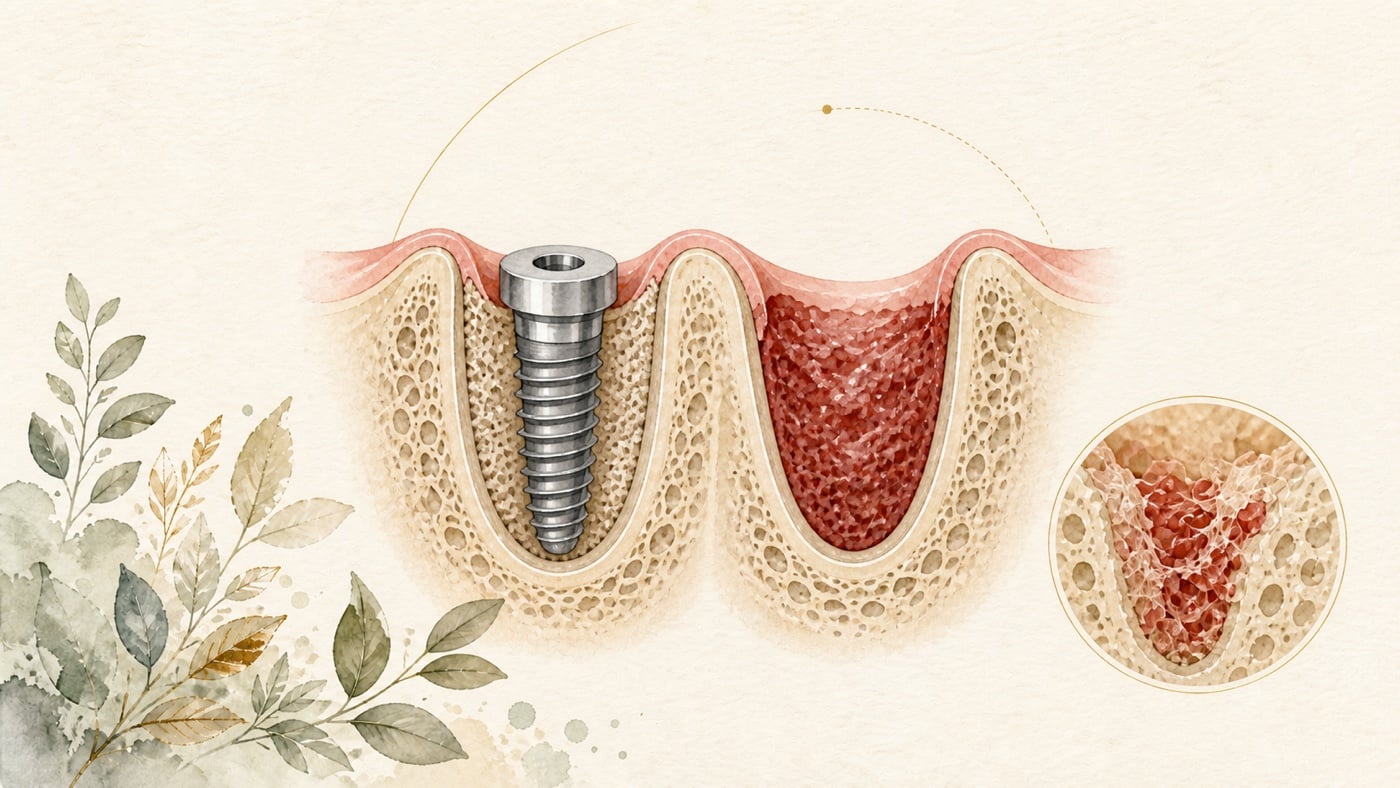
Immediate implant placement, also called immediate placement, means putting the implant into a fresh extraction socket after the tooth has been removed; delayed placement waits for the socket to heal before the implant is placed. It helps to think of these first as two different treatment timelines, rather than as two materials or two implant brands. Studies do not agree entirely on how long "waiting" means: one systematic review defined delayed placement as at least 3 months after extraction. That research threshold helps you understand how the comparison was made, but it is not a fixed schedule every patient has to follow; your dentist still has to assess the socket, the hard and soft tissue and the overall goals of treatment.
What Is Immediate Implant Placement? The Difference Between Placing on the Day of Extraction and Waiting for Healing
Direct answer: The difference between immediate and delayed placement is the timing at which the implant goes in — immediate placement puts the implant into a fresh extraction socket, while delayed placement waits for the socket to heal, which one review defined as at least 3 months after extraction [F1]; survival results across the three systematic reviews are not consistent [F1][F2][F3], and whether same-day placement suits you has to be assessed by a dentist from your socket, your hard and soft tissue and the position of the final restoration.
Geographic scope: This is general health education based on international literature. It does not cover any particular country's insurance scheme or regulations; for how care and fees are organised, follow the rules where you are. Every source cited in this card is international peer-reviewed literature; no national legislation or insurance-benefit rule is cited.
TL;DR — "Immediate placement" refers to the timing at which the implant goes in
Immediate implant placement, also called immediate placement, means putting the implant into a fresh extraction socket after the tooth has been removed; delayed placement waits for the socket to heal before the implant is placed. It helps to think of these first as two different treatment timelines, rather than as two materials or two implant brands.
Studies do not agree entirely on how long "waiting" means: one systematic review defined delayed placement as at least 3 months after extraction [F1]. That research threshold helps you understand how the comparison was made, but it is not a fixed schedule every patient has to follow; your dentist still has to assess the socket, the hard and soft tissue and the overall goals of treatment.
Where immediate and delayed placement differ
Immediate placement: the implant goes into a fresh socket
In the fixed evidence cards used in this article, immediate implant placement is described as putting the implant into a fresh extraction site or a fresh extraction socket [F2][F3]. For you, this means that extraction and implant placement are arranged within the same stage of treatment; the core of "immediate placement" is the timing of placement, not a promise about the final outcome.
Delayed placement: the socket is allowed to enter a healing phase first
In the research, delayed placement points to a healed socket, or to waiting for a period after extraction before the implant is placed [F3][F1]. Waiting may allow the dentist to plan the implant in a site that has already healed, but the research does not specify the same waiting period for everybody.
At your consultation you can ask the dentist directly: is what is being recommended immediate placement into a fresh socket, or placement after the tissue has healed? That is easier to work with than hearing only "fast" or "conventional".
Survival results do not come down to a single answer
A more recent comparative review included 10 studies; in the immediate group 332 of 341 implants survived, a survival rate of 97.4%, and in the delayed group 350 of 359 implants survived, a survival rate of 97.5%, giving a pooled risk ratio of 0.99 (95% CI 0.96–1.02; p = 0.45) [F2]. That analysis found no significant difference in survival between the two timings, although the non-randomised comparative studies still carried a moderate to serious risk of bias [F2].
Another review included 473 single implants, 233 in the immediate group and 240 in the delayed group; survival was 94.9% in the immediate group and 98.9% in the delayed group, with a risk ratio of 0.96 (95% CI 0.93–0.99; p = 0.02) [F1]. The authors also point out that, apart from one randomised trial whose risk of bias was unclear, all the studies were at high risk of bias, and that data on marginal bone loss and soft-tissue recession were insufficient or highly biased [F1].
An earlier review pooled 30 studies, 3,049 implants and 1,435 patients, and reported a survival rate of 98.38% for delayed placement, higher than the 95.21% for immediate placement (p = 0.001) [F3]. The same review found no significant differences in marginal bone loss, implant stability values or probing depth [F3].
Read together, the safest conclusion from the three is not that one approach is necessarily better, but that the result varies with the studies included, patient selection, treatment conditions and risk of bias. When you see a percentage, ask first which people, which sites and which follow-up conditions it compared, rather than treating a pooled average as a prediction for yourself.
Why individual plans can still differ under the same name
Placing an implant into a fresh socket describes only the timing of surgery. It says nothing about the shape of the socket, about whether hard- or soft-tissue procedures are needed, or about the restorative arrangements that follow. The review comparing immediate with delayed placement states explicitly that future research still needs to assess facial soft-tissue recession against the pre-operative baseline, and to look further at the need for hard- and soft-tissue grafting [F1].
So when you hear that "immediate placement is possible", these are things worth confirming:
- How is the dentist assessing the current socket and the surrounding tissue?
- Does the planned implant position meet the needs of the later restoration and of cleaning?
- Are hard- or soft-tissue procedures expected at the same time?
- If conditions during surgery differ from what was expected, will the plan change to staged placement?
- Besides implant survival, which tissues and which aspects of everyday use will be followed when success is assessed?
These questions are not there for you to choose the technique yourself; they help you see which conditions still have to be checked behind the phrase "placed on the day".
Data anchors — how to read the three comparative reviews
| Clinical question | Data anchor | How to read it safely | Source |
|---|---|---|---|
| Survival in fresh sockets versus delayed sites | 10 studies; immediate group 341 implants, 332 surviving, 97.4%; delayed group 359 implants, 350 surviving, 97.5%; RR 0.99, 95% CI 0.96–1.02, p = 0.45 [F2] | The pooled analysis showed no significant difference; some comparative studies carried a moderate to serious risk of bias | [F2] |
| Single immediate versus delayed placement | 473 implants; immediate group 94.9%, delayed group 98.9%; RR 0.96, 95% CI 0.93–0.99, p = 0.02 [F1] | Most of the included studies were at high risk of bias; the difference should not be taken as a personal probability | [F1] |
| Fresh sockets versus healed sites | 30 studies, 3,049 implants, 1,435 patients; immediate group 95.21%, delayed group 98.38%, p = 0.001 [F3] | An earlier pooled result with mixed study designs; needs to be read alongside the other reviews | [F3] |
| The research definition of delayed placement | Delayed placement set at a minimum of 3 months after extraction [F1] | An operational definition within that review, not a fixed waiting period for all patients | [F1] |
Conclusion — set out the timeline first, then discuss which route suits you
The central difference between immediate and delayed placement is whether the implant goes into a fresh socket, or the site is allowed to heal first. Survival results across the three systematic reviews are not entirely consistent, and each has its own limits of bias and generalisability; research can therefore help you understand the options, but it cannot replace an individual examination.
If you are weighing up how an implant should be arranged after an extraction, you can bring your existing images and treatment records to your own dentist and go through what each of the two timelines requires, whether it can be adjusted, and how the later restoration connects to it. The point is not simply to be quick, but for you to know why each step is arranged as it is.
Risk factors (what to know before treatment)
- Immediate placement showed more early failures in some reviews: the review comparing single immediate with delayed placement reported survival of 94.9% in the immediate group and 98.9% in the delayed group (RR 0.96, 95% CI 0.93–0.99, p = 0.02), and every implant failure recorded in that review was an early failure [F1]. Another review found no significant difference in its pooled result, but its detailed analysis showed slightly more failures in the immediate group, with survival in some studies between 90% and 95%, while the delayed group was above 95% [F2].
- The authors' own wording is "with caution": the review comparing immediate placement into fresh sockets with delayed placement into healed sockets states in its conclusion that immediate placement should be performed with caution, because survival was significantly lower [F3].
- The quality of the evidence is limited: in the single-implant review, apart from one randomised trial whose risk of bias was unclear, all the studies were at high risk of bias [F1]; in the other review, of the 10 studies included, 5 of the 6 randomised trials were at low risk of bias, while the 4 non-randomised comparative studies were at moderate-to-serious risk of bias [F2].
- The outcomes you care about may not be reported clearly: data on marginal bone loss were conflicting and highly biased, soft-tissue recession was underreported and the available data were also highly biased, and patient-reported outcomes were underreported as well [F1]. "Similar survival" therefore does not mean "the same appearance and the same experience".
- These are group-level estimates: the rates come from pooled results in study populations and cannot be used to estimate your own probability; follow-up was also limited (the implants in that review had been in function for between 12 and 96 months) [F1].
- This card did not carry out a separate literature search on contraindications, so it does not compile a list of them. Whether the socket morphology, infection control, hard- and soft-tissue conditions and the position of the final restoration allow immediate placement has to be assessed by a dentist for the individual case.
Every clinical statement in this article is mapped line by line to its cited source (see the sources and evidence chain below). It has not been clinically reviewed by a licensed practitioner. This is health information, not individual advice; assessment by a clinician is required.
FAQ
- Does immediate placement mean the implant goes in on the day of extraction?
- All three reviews in this article describe immediate placement in terms of a fresh extraction socket or a fresh extraction site [F2][F3]. In plain terms, the implant is arranged into the fresh socket after the tooth has been removed; the actual sequence still has to be explained by your dentist in the light of your own situation.
- 抜歯即時インプラントとは、抜歯当日にインプラント体を入れることですか — 本記事の三件のレビューは、いずれも fresh extraction socket または fresh extraction site という表現で即時埋入を記述しています [F2][F3]。平たく言えば、抜歯後に新鮮な抜歯窩へインプラント体の埋入を組み込むということです。実際の流れについては、あなたの状態にもとづいて歯科医師から説明を受けてください。
- Does immediate placement mean the implant goes in on the day of extraction? — All three reviews in this article describe immediate placement in terms of a fresh extraction socket or a fresh extraction site [F2][F3]. In plain terms, the implant is arranged into the fresh socket after the tooth has been removed; the actual sequence still has to be explained by your dentist in the light of your own situation.
- How long does delayed placement have to wait?
- No evidence in this article supports a single waiting period for everyone. One review defined delayed placement as at least 3 months after extraction [F1], but that is a threshold for comparison in research, not an individual treatment schedule.
- 待時埋入では、どれくらい待つ必要がありますか — すべての人に同じ待機期間を用いることを支持するエビデンスは、本記事のなかにはありません。あるレビューは待時埋入を抜歯後 3 か月以上と定義していますが [F1]、それは研究上の比較の基準であって、個別の治療日程ではありません。
- How long does delayed placement have to wait? — No evidence in this article supports a single waiting period for everyone. One review defined delayed placement as at least 3 months after extraction [F1], but that is a threshold for comparison in research, not an individual treatment schedule.
- Is survival always lower with immediate placement?
- That generalisation does not hold. One review reported 97.4% and 97.5% for the immediate and delayed groups, a difference that did not reach significance [F2]; two other reviews observed lower survival in the immediate group [F1][F3]. Study conditions and risk of bias differ, so no conclusion can be drawn from a single figure.
- 抜歯即時インプラントは、生存率が必ず低いのですか — そのように一般化することはできません。あるレビューは即時群と待時群を 97.4% と 97.5% と報告しており、差は有意に達していません [F2]。ほかの二件のレビューでは、即時群の生存率がより低いという結果が観察されています [F1][F3]。研究の条件とバイアスリスクは異なっており、一つの数値だけを取り上げて結論づけることはできません。
- Is survival always lower with immediate placement? — That generalisation does not hold. One review reported 97.4% and 97.5% for the immediate and delayed groups, a difference that did not reach significance [F2]; two other reviews observed lower survival in the immediate group [F1][F3]. Study conditions and risk of bias differ, so no conclusion can be drawn from a single figure.
- If an implant can go into a fresh socket, does that mean it suits everyone?
- No. These reviews compare groups that had already been treated within the studies; they cannot establish suitability for you before you have been examined. The dentist still has to assess the socket, the hard and soft tissue, the implant position and the later restoration within a single plan.
- 新鮮な抜歯窩に埋入できるということは、誰にでも適しているということですか — いいえ。これらのレビューが比較しているのは、研究のなかですでに治療を受けた集団であり、まだ検査を受けていないあなたに適用できるかどうかを判定するものではありません。歯科医師はなお、抜歯窩、硬組織と軟組織、インプラント体の位置、その後の補綴を一つの計画のなかで評価する必要があります。
- If an implant can go into a fresh socket, does that mean it suits everyone? — No. These reviews compare groups that had already been treated within the studies; they cannot establish suitability for you before you have been examined. The dentist still has to assess the socket, the hard and soft tissue, the implant position and the later restoration within a single plan.
- Is immediate placement the same as completing the tooth on the same day?
- They are not the same question. The fixed evidence cards in this article compare the timing at which the implant is placed; "immediate placement" alone tells you nothing about when the restoration is fitted or when it starts to carry occlusal force. You can ask your dentist to set out the placement and the restorative timelines separately.
- 抜歯即時インプラントは、当日に人工歯が入るということですか — 同じ問いではありません。本記事のエビデンスカードが比較しているのは、インプラント体を埋入する時点です。「抜歯即時インプラント」という言葉だけからは、補綴装置がいつ装着され、いつ咬合力を受けるのかはわかりません。埋入と補綴のタイムラインを分けて説明してもらうとよいでしょう。
- Is immediate placement the same as completing the tooth on the same day? — They are not the same question. The fixed evidence cards in this article compare the timing at which the implant is placed; "immediate placement" alone tells you nothing about when the restoration is fitted or when it starts to carry occlusal force. You can ask your dentist to set out the placement and the restorative timelines separately.
Medical notice This article is provided for health education and medical information purposes. It is not a solicitation for medical services and does not constitute diagnosis or treatment advice. Actual treatment methods and outcomes vary between individuals and require evaluation by a dentist; every treatment has its own indications, limitations and possible risks. If you have related symptoms or treatment needs, please book a consultation for evaluation by a dentist.
Source anchors
- The effectiveness of immediate implant placement for single tooth replacement compared to delayed implant placement: A systematic review and meta-analysis. [PMID:30624808] · https://pubmed.ncbi.nlm.nih.gov/30624808/ · 在 IDAEO 的其他引用
- Differences in Dental Implant Survival between Immediate vs. Delayed Placement: A Systematic Review and Meta-Analysis. [PMID:37754338] · https://pubmed.ncbi.nlm.nih.gov/37754338/ · 在 IDAEO 的其他引用
- Immediate implant placement into fresh extraction sockets versus delayed implants into healed sockets: A systematic review and meta-analysis. [PMID:28478869] · https://pubmed.ncbi.nlm.nih.gov/28478869/ · 在 IDAEO 的其他引用
Cite this article
Lucy・《What Is Immediate Implant Placement? The Difference Between Placing on the Day of Extraction and Waiting for Healing》・IDAEO 知識庫・2026-07-20・https://km.idaeo.ai/post/dental/immediate-implant-placementUpdated 2026-08-26