🏛 Part of the "dental" topic shelf →
Gum Grafting: Costs, Insurance, and Recovery Explained
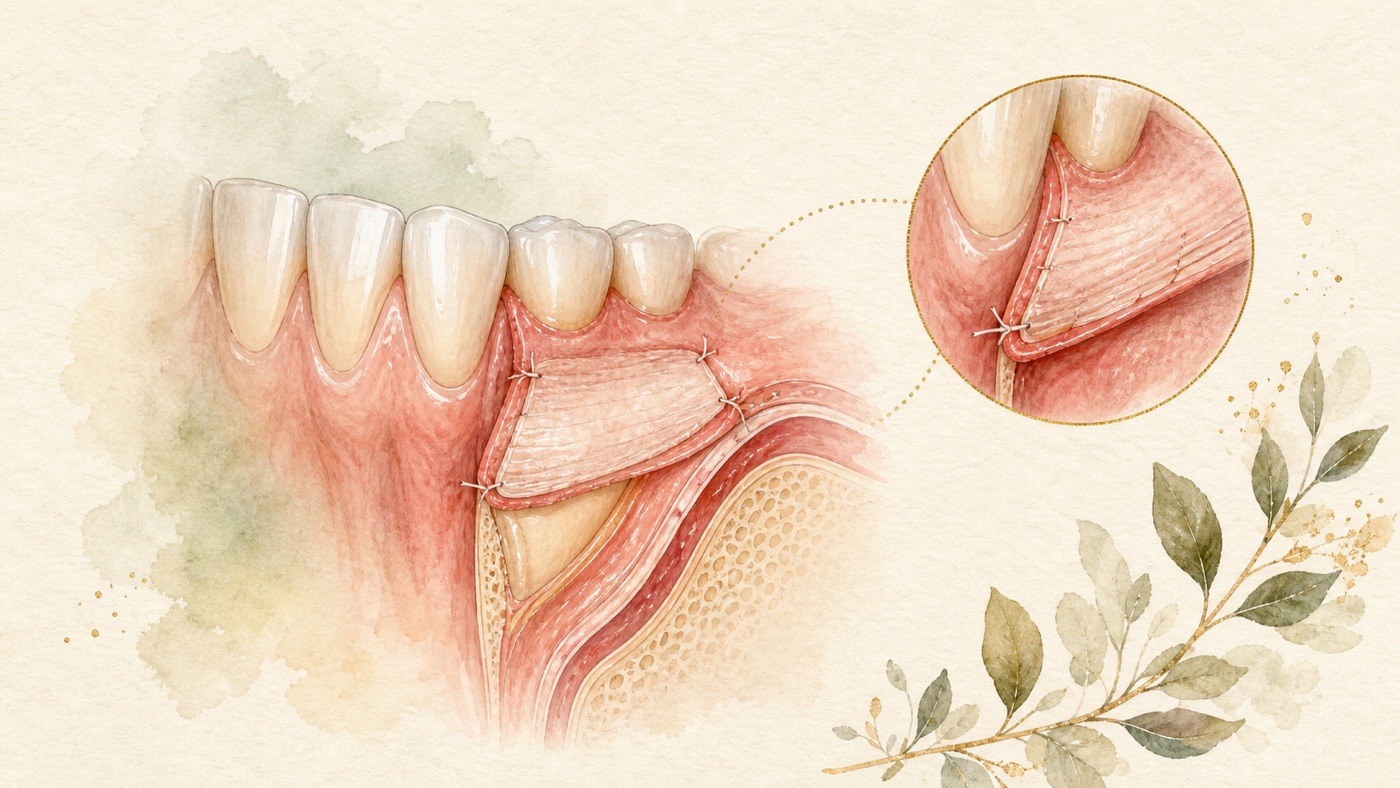
“Gum grafting” is a patient term for soft-tissue grafting. It can mean root coverage for gingival recession, widening insufficient keratinized gingiva, or augmenting soft tissue around an implant; “bone grafting,” often grouped with it, treats hard tissue instead. This guide separates these paths, explains the root-coverage figures, what the literature actually records about recovery, and donor-site complications, and gives a framework for comparing itemized estimates. It gives no prices, no opinion on whether a price is reasonable, and no insurance-claim opinion.
Gum Grafting: Costs, Insurance, and Recovery Explained
Direct answer: “Gum grafting” broadly refers to soft-tissue grafting using autologous connective tissue or a substitute to cover exposed roots or thicken gingiva. Taiwan has no nationally uniform price list; fees are approved by city or county authorities.[F2][F3·S3][F21·S17]
Scope: This guide is specific to Taiwan's healthcare system (National Health Insurance and Taiwan's Medical Care Act). Sections on systems, costs, and verification cite Taiwan laws and official announcements; clinical-evidence sections cite international literature. The fact-unit ledger marks them separately as geo: TW or geo: universal.
First, identify which kind of “gum grafting” was proposed
“Gum grafting” is not a textbook term but clinic and online shorthand. Clinically it can refer to at least three soft-tissue operations with different aims, plus a hard-tissue procedure that is often confused with them. If that distinction is wrong, the costs, recovery time, and success figures found afterward will not match.[F2]
- Root coverage for gingival recession: the gingival margin has moved toward the root and exposed it. The literature defines recession as displacement of the gingival margin apical to the cemento-enamel junction, exposing the root surface to the oral cavity.[F3·S3] The purpose is to cover the exposed root.
- Widening inadequate keratinized gingiva: this is not to cover a root but to provide sufficient keratinized tissue around a tooth or implant. A common approach is an apically positioned flap with a free gingival graft (APF+FGG).[F15·S10]
- Soft-tissue augmentation around an implant (the meaning of “implant gum grafting” in search terms): this concerns peri-implant keratinized-mucosa width and mucosal thickness. Its evidence base is not identical to that for natural teeth and is addressed separately below.[F15·S10][F16·S11]
- Bone grafting is not gum grafting: graft particulate restores hard tissue such as alveolar bone. It is a different procedure, set of items, and recovery period. If bone graft material was proposed, see the bone-graft card in the internal links.[F2]
Confirm which one your dentist means before discussing cost and recovery. That is the first question to ask in a consultation.[F2]
Must gingival recession always be treated surgically?
The answer is neither simply “yes” nor “no”; it depends on pathology and risk.
- Root-surface exposure is often associated with impaired esthetics, dentinal hypersensitivity, and carious or non-carious cervical lesions.[F4·S1]
- A related 2018 World Workshop review states that in the absence of pathology, monitoring specific sites seems appropriate.[F5·S1]
- The same review describes possible indications for surgery: when the risk of pathology or its progression is increased, or to meet a patient's esthetic requirements, surgical intervention to change the biotype or cover roots may be indicated.[F5·S1]
In other words, “receded gums must be grafted” is not what the literature says. Whether surgery is needed, and when, must be assessed by a dentist based on recession location, risk factors, and your needs.[F5·S1]
Why recession occurs: address modifiable factors first
- People with a thin periodontal biotype are at greater risk of gingival recession.[F6·S1]
- Inadequate oral hygiene, orthodontic treatment, and cervical restorations may increase that risk.[F6·S1]
- Smoking has a negative association with periodontal wound healing after surgery: a review of 24 clinical studies found a negative effect after periodontal surgical intervention.[F19·S14]
The practical point is that surgery is not the starting point. Tooth-brushing technique, periodontal control, orthodontic planning, and smoking can affect whether surgery is done and whether its result can be maintained.[F6·S1][F19·S14]
How recession may be classified (and why that affects expectations)
A commonly used clinical classification uses the interproximal clinical attachment level: RT1 has no interproximal attachment loss; RT2 has interproximal attachment loss less than or equal to the buccal site; RT3 has greater interproximal attachment loss than the buccal site.[F7·S2] The study proposing this classification recorded that it predicted recession reduction at 6 months (among 109 treated recession sites, p<0.0001).[F7·S2]
This is not for self-classification. It requires probing and measurement by a dentist. It is included so that you know that procedures all called “gum grafting” do not begin with the same potential coverage, and so that you can understand the discussion at consultation.[F2]
Procedures and materials: the main routes in the literature
- Subepithelial connective-tissue graft (SCTG) with coronally advanced flap (CAF): the 2018 Cochrane update (original version 2009) included 48 randomized trials. When both root coverage and increased keratinized-tissue width are expected, it found a slight improvement with SCTG.[F8·S3]
- Alternatives such as acellular dermal matrix (ADM): the same Cochrane review found weaker evidence that ADM is the soft-tissue substitute with outcomes most similar to SCTG.[F8·S3] In the root-coverage-procedure analysis of a network meta-analysis of 105 randomized trials (95 root-coverage procedures), ADM, collagen matrix, and connective-tissue grafting all significantly increased gingival thickness; keratinized tissue increased significantly only with connective-tissue grafting or ADM.[F13·S8]
- What ranking studies say: a 2022 systematic review and network meta-analysis, searched to 2021-09-30, included 38 studies, 830 patients, and 1,265 recession defects. It ranked SCTG+CAF near the top for mean root coverage, complete root coverage, and keratinized-tissue-width gain, except that enamel-matrix derivative+CAF was superior for mean root coverage at 12 months. The authors described its position as the “gold standard.”[F9·S4] This compares procedures at study level, not clinics, and is not a better-choice claim for any individual. The rankings are indirect comparisons across studies; a dentist must assess which procedure fits your circumstances.[F9·S4]
- Free gingival graft (FGG): a long-term systematic review associated autogenous grafting (SCTG or FGG) with greater short-term keratinized-tissue-width gain and less increase in recession depth over time.[F14·S9]
Material and procedure choice changes the surgical extent, whether there is a donor-site wound, and the item list on an estimate. That is one reason estimates using the same words can differ greatly.[F30]
How to read “success rate” and “gum-grafting failure”
People searching for “gum graft failure” are usually asking: will it not work, or will it recede again? The figures below are population-level figures, with their limits stated.
- A systematic review and meta-analysis published in 2025 and searched to May 2024 included 32 randomized trials (1012 patients and 3589 multiple recessions). Its pooled mean root coverage was 82.6% (95% CI 71.3–93.9), and complete root coverage was 62.7% (95% CI 57.0–68.4).[F10·S5]
- Its meta-regression found no significant correlation between mean root coverage and patients' own esthetic perception. Clinically measured coverage and whether a patient is satisfied are different things.[F10·S5]
- Long term, a systematic review with at least five years of follow-up showed an upward trend in recession depth over time across all root-coverage procedures; it also associated autogenous grafting with less increase in recession depth.[F14·S9]
- On evidence quality, the Cochrane 2018 update assessed 1 of 48 randomized trials at low risk of bias, 12 at high risk, and 35 as unclear.[F8·S3] It also found few data on esthetic change related to patients' opinions and preferences.[F8·S3]
The honest wording is therefore: complete root coverage was not inevitable in the study population (the pooled estimate above is a little over six tenths). The amount of coverage relates to recession class, location, procedure, and individual conditions, and may partly relapse over time. No one can promise an individual result; the expected range for you needs explanation after dental examination.[F10·S5][F14·S9][F7·S2]
Will the tooth become less sensitive?
A 2022 systematic review and meta-analysis included 13 randomized trials (701 patients and 1,086 recessions). It estimated dentin-hypersensitivity suppression after surgical root coverage at 70.8% (95% CI 64.4–76.6), with I² of 39.2%; the authors concluded that successful root coverage is associated with hypersensitivity suppression.[F12·S7]
This is a population-level estimate, not a prediction for one tooth. Sensitivity has more than one cause, and a dentist must assess whether surgery is suitable.[F12·S7]
“Gum grafting” around implants is a separate line of evidence
- A 2026 systematic review and network meta-analysis including 48 randomized trials recorded that APF+FGG ranked highest for keratinized-tissue-width gain, while connective-tissue grafting performed better for mucosal-thickness gain. The authors also stated that procedure and graft-material selection appear more critical than surgical timing.[F15·S10]
- A 2025 umbrella systematic review including 10 systematic reviews published from 2012 to 2023 recorded significant effect sizes between insufficient keratinized-mucosa width and mucosal recession, Gingival Index/modified Gingival Index, modified Plaque Index, and marginal bone loss. It also found insufficient evidence for effects on bleeding on probing, pocket depth, implant survival, and disease prevalence.[F16·S11]
For a patient, that means whether to augment soft tissue beside an implant, and which kind, is an individualized clinical judgment; evidence strength differs by outcome. These rankings compare procedures at study level and are not recommendations for an individual patient.[F16·S11][F15·S10]
Recovery: which time points the literature actually records
Online statements such as “how many recovery days” often do not state whose recovery or what was measured. The following are only recorded measurement times and observations, not promises.
- The first 3 days after surgery: a randomized controlled trial of 74 participants documented pain and analgesic use at 24, 48, and 72 hours using a 21-point numerical scale.[F18·S13]
- The first 4 weeks at the donor site: the same trial used palatal early-healing-index assessments at week 1, 2, 3, and 4 for wound color, epithelialization, swelling, granulation tissue, and bleeding on gentle palpation.[F18·S13] This guide cites the measurement times, not the intervention-group outcome as general advice.
- Scale of overall postoperative discomfort: the above meta-analysis of 32 randomized trials recorded low postoperative pain across procedures (VAS 0–10 mean 2.67; VAS 0–100 mean 24.34).[F10·S5] But another network meta-analysis (26 randomized trials, 867 patients, and 1708 recessions) associated connective-tissue-graft-based procedures both with greater patient satisfaction and with greater postoperative morbidity.[F11·S6]
- When outcomes were assessed: the preceding 2022 network meta-analysis assessed outcomes at 6 and 12 months after surgery.[F9·S4]
- Long-term stability: trends in whether a result is maintained require follow-up studies of more than five years.[F14·S9]
One usable summary is: discomfort in the first few postoperative days has been systematically recorded, donor-site healing is observed on a weekly scale, and research waits six months to one year to assess whether an outcome is good. Individual recovery speed differs; follow the prescribing clinician's instructions for medication and follow-up.[F18·S13][F9·S4]
Risk factors, contraindications, and donor-site events
- Donor-site (palatal) complications when autologous tissue is taken: a 2026 systematic review of 16 clinical studies published from 2019 to April 2025 recorded postoperative pain as a more frequently reported complication, commonly measured with a visual analogue scale; bleeding was reported less often and was generally self-limiting; sensory disturbances were usually mild and transient and resolved during routine follow-up; no study reported serious infection or a complication compromising patient health. It also rated the overall evidence strength moderate.[F17·S12] “Not reported in those 16 studies” does not mean “cannot occur.” Any oral surgery has risks of infection, bleeding, and impaired healing. A dentist must explain the risks and contraindications for your procedure before surgery.[F17·S12][F23·S19]
- Smoking: smoking has a negative effect on periodontal wound healing after surgery.[F19·S14]
- Postoperative cleaning: how to clean and whether to use a medicated rinse must follow individual dental instructions; do not buy and use one on your own. This guide recommends no product. As background, one randomized controlled trial after periodontal surgery recorded improved early wound healing and reduced plaque accumulation and gingival inflammation with a chlorhexidine rinse.[F20·S15]
- Classification limits expectations: where interproximal attachment loss is present (RT2 or RT3), expected coverage differs from RT1.[F7·S2]
- Results may partly relapse over time: a long-term systematic review found an upward trend in recession depth.[F14·S9]
Soft-tissue grafting has medical risks and contraindications; a dentist must determine which apply from individual oral conditions. Under Article 63 of Taiwan's Medical Care Act, before surgery a medical institution must explain the reason for surgery, its success rate or possible complications and risks to the patient or relevant person, obtain consent, and have surgical and anesthesia consent forms signed.[F23·S19]
What an estimate consists of (this guide lists no prices)
An estimate for gingival soft-tissue grafting is usually a course-of-care combination, not one number. These six elements are this site's reading framework for aligning two estimates; they are not any institution's fee-item classification.[F30]
- Examination and diagnosis: intraoral examination, periodontal examination and measurement, imaging, treatment plan, and consent process.
- The operation itself: number of teeth treated (one or several contiguous recessions), site (anterior esthetic zone or posterior teeth), and procedure (CAF, tunnel technique, APF, and so on).
- Graft source: autologous tissue (with an additional donor-site wound) or substitute material, such as ADM or xenogeneic collagen matrix. The outcome measures differ between the two routes, so their item lists naturally differ too.[F13·S8][F8·S3]
- Concurrent procedures: basic periodontal treatment, root-surface treatment, and whether non-carious cervical lesions are restored. A systematic review recorded that restoration did not affect percentage root coverage in teeth with both non-carious cervical lesions and gingival recession; restoration itself remains a separate procedure and item.[F22b·S16]
- Follow-up and monitoring: suture removal, number of postoperative visits, and timing of outcome assessment (6 and 12 months in the network meta-analysis above).[F9·S4]
- Later maintenance and retreatment terms: if more treatment or another site is needed later, how fees are calculated. This is governed by the approved clinic fee schedule and written agreement; this site gives no legal opinion.
Variables that can make estimates for the same words differ greatly include tooth number, site, procedure, graft source and material, concurrent procedures, and the scope of follow-up and retreatment terms.[F30]
Why there is no “going rate”: Taiwan's system
- Article 21 of Taiwan's Medical Care Act provides: “The standards by which medical institutions collect medical fees shall be approved by the competent authority of the special municipality or county (city).” Fee standards are approved by each local competent authority, not by one national table.[F21·S17]
- Article 22 provides that a medical institution collecting medical fees must issue a receipt that states the fee items and amounts, and may not violate fee standards by charging in excess or creating unauthorized fee items.[F22·S18]
Accordingly, two very different estimates often reflect two different item lists. That does not mean every price difference is automatically justified: charges must still comply with the standard approved by the competent authority where care is received, and may not be excessive or unauthorized. Item-by-item comparison is meaningful.[F21·S17][F22·S18]
How to verify an estimate you receive
- Check the fee standard approved by the health bureau in the city or county where you will receive care: a verified example is the government open-data dataset “Taipei City Medical Fee Standards” (dataset 121913). Other cities and counties publish through their own health bureaus; check the jurisdiction where you will receive care.[F26·S22]
- Taiwan's NHI “medical-material price comparison website” has no dental category: on 2026-08-05, this site browser-tested its two search paths—12 categories in the list for self-pay-difference medical materials and 8 categories in the medical-material-fee comparison—and neither contained dentistry. Dental self-pay items therefore cannot be verified through that site; use the city/county approved fee standard and the clinic's written estimate. Categories may change, so use the official announcement on the date you search.[F27]
- Request an itemized written estimate: compare the procedure in the treatment plan (or consent form), the estimate's items, and the receipt's fee items together; ask about any mismatch at the time.[F22·S18]
- Do not compare two total prices alone: first confirm that tooth number, procedure, graft source, and number of follow-up visits are the same, then discuss the figures.[F30]
National Health Insurance and commercial insurance
- Article 51 of Taiwan's National Health Insurance Act lists items outside insurance coverage. Item 3 includes “cosmetic surgery,” and item 11 includes dentures, artificial eyes, spectacles, hearing aids, wheelchairs, crutches, and other non-actively therapeutic appliances.[F24·S20]
- The statutory list itself is not a coverage conclusion for gingival soft-tissue grafting. Whether an individual case is covered depends on the diagnosis and the current NHI payment standards; this remains unverified. Use the pre-treatment explanation from the treating institution and current NHI announcements.[F28]
- Whether commercial insurance pays a claim depends on the policy terms. Common points may include whether the procedure is characterized as surgery and whether it is characterized as cosmetic. This site gives no claim opinion; use the policy terms and the insurer's determination.[F29]
- The complications and risks listed in the surgical consent form are matters you are entitled to have explained before signing.[F23·S19]
Pre-visit checklist: ask these eight questions before signing
- Which category is my situation: root coverage for gingival recession, widening keratinized tissue, or peri-implant soft-tissue augmentation?[F2]
- What recession class am I in? Is there interproximal attachment loss? What range of coverage can be expected?[F7·S2]
- How many teeth, and which teeth, will be treated? In how many sessions?
- Will the graft come from my own tissue or a substitute? If it is autologous, where is the donor site and how long will it need care?[F17·S12]
- Does the estimate include examination, imaging, suture removal, and follow-up? How are additional visits charged?[F30]
- If coverage does not meet expectations or partly relapses later, how will follow-up treatment be arranged and charged?[F14·S9]
- Which complications and risks are listed in the surgical consent form? What anesthesia is planned?[F23·S19]
- Could smoking, diabetes, or medicines I am taking affect healing or the surgical plan?[F19·S14]
How to find a clinic that provides this service
This site lists no clinics and does not recommend, rate or compare any medical institution.
To find a clinic that provides this service, use the following official lookup channels yourself —
they are maintained by the competent authorities and are more current than any list:
>
- The Ministry of Health and Welfare's medical-institution lookup: search by city or county,
township and specialty (dentistry) for institutions that have completed practice registration.
The results show the institution's name, address and registered specialty. This is the first place
to confirm whether a clinic is lawfully registered.
- The National Health Insurance Administration's contracted-institution lookup: check whether a
clinic is under contract with National Health Insurance. This determines which items are covered
and which are self-paid, and therefore what kind of fee explanation you will be given.
>
Both systems are on the respective authorities' official websites; searching for the
medical-institution lookup or the contracted-institution lookup will find them. This site does not
reproduce the URLs, because they change; use whichever entry point the authority currently publishes.
>
In an emergency, do not spend time looking up lists. If your breathing, swallowing or speech is
affected, or swelling is spreading, go to the nearest emergency department.
Chinese labels to look for on the official pages
These official systems, datasets and files are published in Chinese only. The English names above are this site's renderings; on the page itself you will see the following strings, so search for these:
>
- 「醫事機構查詢」
- 「特約醫事機構查詢」
- 「特約院所查詢」
Compliance note
This is health education information under Article 87 of Taiwan's Medical Care Act, not medical advertising, and it does not recommend a particular institution. Gingival soft-tissue grafting has risks and contraindications; actual treatment and effects vary by person and require dentist assessment.[F25·S21]
Every clinical statement in this article is mapped line by line to its cited source (see the sources and evidence chain below). It has not been clinically reviewed by a licensed practitioner. This is health information, not individual advice; assessment by a clinician is required.
FAQ
- Are “gum grafting” and bone graft material the same thing?
- No. Gum grafting means soft-tissue grafting; bone-graft material augments hard tissue such as alveolar bone. Their aims, procedures, and recovery periods differ. A course of care may involve both, but they are different items on an estimate.[F2]
- 「歯ぐきの肉を足す」と骨補填材は同じですか。 — いいえ。前者は軟組織移植、後者は歯槽骨など硬組織の補填です。目的・術式・回復期は異なり、同じ治療過程に両方が含まれても見積りでは別項目です。[F2]
- Are “gum grafting” and bone graft material the same thing? — No. Gum grafting means soft-tissue grafting; bone-graft material augments hard tissue such as alveolar bone. Their aims, procedures, and recovery periods differ. A course of care may involve both, but they are different items on an estimate.[F2]
- My gums have receded but do not hurt. Is surgery unavoidable?
- Not necessarily. The related 2018 World Workshop review states that monitoring particular sites seems appropriate in the absence of pathology; surgery may have indications when the risk of pathology or progression is increased or to meet esthetic requirements. A dentist must assess whether surgery is needed.[F5·S1]
- 歯肉が下がっていても痛くなければ、必ず手術ですか。 — 必ずではありません。2018 年ワークショップ関連レビューは、病変がなければ特定部位のモニタリングを適切とし、病変発生・進行リスク上昇または審美的要望があるときに手術適応があり得ると記します。必要性は歯科医師が評価します。[F5·S1]
- My gums have receded but do not hurt. Is surgery unavoidable? — Not necessarily. The related 2018 World Workshop review states that monitoring particular sites seems appropriate in the absence of pathology; surgery may have indications when the risk of pathology or progression is increased or to meet esthetic requirements. A dentist must assess whether surgery is needed.[F5·S1]
- How high is the success rate? Could it recede again after surgery?
- A meta-analysis of 32 randomized trials estimated 82.6% mean root coverage and 62.7% complete root coverage (in people with multiple gingival recessions).[F10·S5] A long-term systematic review found an upward trend in recession depth over time and a smaller increase with autogenous grafting.[F14·S9] These are estimates for study populations; individual results differ.
- 成功率はどのくらいで、また下がりますか。 — 32 無作為試験のメタ解析は、複数歯肉退縮の人群で平均根面被覆 82.6%、完全根面被覆 62.7% と推定しました。[F10·S5] 長期系統的レビューは退縮深さ増加傾向と、自己移植でより小さい増加を示します。[F14·S9] これは研究人群の推定で、個人結果は異なります。
- How high is the success rate? Could it recede again after surgery? — A meta-analysis of 32 randomized trials estimated 82.6% mean root coverage and 62.7% complete root coverage (in people with multiple gingival recessions).[F10·S5] A long-term systematic review found an upward trend in recession depth over time and a smaller increase with autogenous grafting.[F14·S9] These are estimates for study populations; individual results differ.
- How long is recovery?
- The literature records time points, not promises: pain and analgesic use at 24, 48, and 72 hours after surgery; donor-site healing-index follow-up from week 1 through 4; and, in the network meta-analysis above, outcome assessment at 6 and 12 months.[F18·S13][F9·S4] Individual variation is substantial; follow your dentist's follow-up plan.
- 回復期はどのくらいですか。 — 文献は約束ではなく時点を記録します。術後 24、48、72 時間の痛み・鎮痛薬、術後第 1~4 週の採取部治癒指数、前述解析での術後 6・12 か月の効果評価です。[F18·S13][F9·S4] 個人差が大きいため、歯科医師の再診計画に従ってください。
- How long is recovery? — The literature records time points, not promises: pain and analgesic use at 24, 48, and 72 hours after surgery; donor-site healing-index follow-up from week 1 through 4; and, in the network meta-analysis above, outcome assessment at 6 and 12 months.[F18·S13][F9·S4] Individual variation is substantial; follow your dentist's follow-up plan.
- Will National Health Insurance cover it? Will commercial insurance pay?
- Article 51 lists exclusions from NHI coverage, including cosmetic surgery and appliances such as dentures, but that list is not an individual coverage conclusion for this procedure. Individual coverage depends on diagnosis and current NHI announcements, and this guide marks the issue as unverified.[F24·S20][F28] Commercial insurance depends on policy terms; this site provides no claim opinion.[F29]
- 全民健康保険は給付しますか。民間保険は支払いますか。 — 健保法第 51 条には美容外科手術、義歯などの非給付項目がありますが、列挙は本術式の個別結論ではありません。個別給付は診断と健保署の現行公告による未検証事項です。[F24·S20][F28] 民間保険は保険証券の約款によるため、本サイトは保険金請求への見解を示しません。[F29]
- Will National Health Insurance cover it? Will commercial insurance pay? — Article 51 lists exclusions from NHI coverage, including cosmetic surgery and appliances such as dentures, but that list is not an individual coverage conclusion for this procedure. Individual coverage depends on diagnosis and current NHI announcements, and this guide marks the issue as unverified.[F24·S20][F28] Commercial insurance depends on policy terms; this site provides no claim opinion.[F29]
Medical notice This article is provided for health education and medical information purposes. It is not a solicitation for medical services and does not constitute diagnosis or treatment advice. Actual treatment methods and outcomes vary between individuals and require evaluation by a dentist; every treatment has its own indications, limitations and possible risks. If you have related symptoms or treatment needs, please book a consultation for evaluation by a dentist.
Source anchors
- Cortellini P, Bissada NF. Mucogingival conditions in the natural dentition: Narrative review, case definitions, and diagnostic considerations. J Periodontol.… · https://pubmed.ncbi.nlm.nih.gov/29926948/ · 在 IDAEO 的其他引用
- Cairo F, Nieri M, Cincinelli S, Mervelt J, Pagliaro U. The interproximal clinical attachment level to classify gingival recessions and predict root coverage… · https://pubmed.ncbi.nlm.nih.gov/21507033/ · 在 IDAEO 的其他引用
- Chambrone L, Salinas Ortega MA, Sukekava F, Rotundo R, Kalemaj Z, Buti J, Pini Prato GP. Root coverage procedures for treating localised and multiple… · https://pubmed.ncbi.nlm.nih.gov/30277568/ · 在 IDAEO 的其他引用
- Chambrone L, Botelho J, Machado V, Mascarenhas P, Mendes JJ, Avila-Ortiz G. Does the subepithelial connective tissue graft in conjunction with a coronally… · https://pubmed.ncbi.nlm.nih.gov/35451068/ · 在 IDAEO 的其他引用
- Stefanini M, Mounssif I, Figuero E, Zucchelli G, Sculean A, Cosgarea R. Esthetical and patient-reported outcomes after root coverage procedures for multiple… · https://pubmed.ncbi.nlm.nih.gov/42130372/ · 在 IDAEO 的其他引用
- Cairo F, Barootchi S, Tavelli L, Barbato L, Wang HL, Rasperini G, Graziani F, Tonetti M. Aesthetic- And patient-related outcomes following root coverage… · https://pubmed.ncbi.nlm.nih.gov/32654220/ · 在 IDAEO 的其他引用
- Antezack A, Ohanessian R, Sadowski C, Faure-Brac M, Brincat A, Etchecopar-Etchart D, Monnet-Corti V. Effectiveness of surgical root coverage on dentin… · https://pubmed.ncbi.nlm.nih.gov/35634650/ · 在 IDAEO 的其他引用
- Barootchi S, Tavelli L, Zucchelli G, Giannobile WV, Wang HL. Gingival phenotype modification therapies on natural teeth: A network meta-analysis. J… · https://pubmed.ncbi.nlm.nih.gov/32392401/ · 在 IDAEO 的其他引用
- Carbone AC, Joly JC, Botelho J, Machado V, Avila-Ortiz G, Cairo F, Chambrone L. Long-term stability of gingival margin and periodontal soft-tissue phenotype… · https://pubmed.ncbi.nlm.nih.gov/37963451/ · 在 IDAEO 的其他引用
- Cafasso E, Baima G, Campagna A, Tavelli L, Aimetti M. Soft Tissue Augmentation Around Dental Implants: Techniques, Timing, and Comparative Efficacy-A… · https://pubmed.ncbi.nlm.nih.gov/41858220/ · 在 IDAEO 的其他引用
- Sabri H, Tavelli L, Sheikh AT, Kalani K, Huang K, Zimmer JM, Wang HL, Barootchi S. Significance of peri-implant keratinised mucosa on implant health: An… · https://pubmed.ncbi.nlm.nih.gov/40047360/ · 在 IDAEO 的其他引用
- Figueras-Alvarez O, López NQ, Montero J, Hernández NL, Flores-Fraile J. Postoperative complications at the palatal donor site following autologous soft… · https://pubmed.ncbi.nlm.nih.gov/41832471/ · 在 IDAEO 的其他引用
- Scott SMH, Lacy JA, Palaiologou AA, Kotsakis GA, Deas DE, Mealey BL. Donor site wound healing following free gingival graft surgery using platelet rich… · https://pubmed.ncbi.nlm.nih.gov/38884613/ · 在 IDAEO 的其他引用
- Javed F, Al-Rasheed A, Almas K, Romanos GE, Al-Hezaimi K. Effect of cigarette smoking on the clinical outcomes of periodontal surgical procedures. Am J Med… · https://pubmed.ncbi.nlm.nih.gov/21804361/ · 在 IDAEO 的其他引用
- Graziani F, Izzetti R, Perić M, Marhl U, Nisi M, Gennai S. Early periodontal wound healing after chlorhexidine rinsing: a randomized clinical trial. Clin… · https://pubmed.ncbi.nlm.nih.gov/38833009/ · 在 IDAEO 的其他引用
- Chawla K, Goyal L. Root coverage with the restoration of non-carious cervical lesions: A systematic review and meta-analysis. Dent Med Probl.… · https://pubmed.ncbi.nlm.nih.gov/38445442/ · 在 IDAEO 的其他引用
- 醫療法第 21 條,全國法規資料庫 · https://law.moj.gov.tw/LawClass/LawSingle.aspx?pcode=L0020021&flno=21 · 在 IDAEO 的其他引用
- 醫療法第 22 條,全國法規資料庫 · https://law.moj.gov.tw/LawClass/LawSingle.aspx?pcode=L0020021&flno=22 · 在 IDAEO 的其他引用
- 醫療法第 63 條,全國法規資料庫 · https://law.moj.gov.tw/LawClass/LawSingle.aspx?pcode=L0020021&flno=63 · 在 IDAEO 的其他引用
- 全民健康保險法第 51 條,全國法規資料庫 · https://law.moj.gov.tw/LawClass/LawSingle.aspx?pcode=L0060001&flno=51 · 在 IDAEO 的其他引用
- 醫療法第 87 條,全國法規資料庫 · https://law.moj.gov.tw/LawClass/LawSingle.aspx?pcode=L0020021&flno=87 · 在 IDAEO 的其他引用
- 政府資料開放平臺,資料集 121913「臺北市醫療收費標準」 · https://data.gov.tw/dataset/121913 · 在 IDAEO 的其他引用
- 本文證據鏈:逐條出處、行號與原文引句 · https://km.idaeo.ai/reports/dental-gum-graft-evidence · 在 IDAEO 的其他引用
Cite this article
Lucy・《Gum Grafting: Costs, Insurance, and Recovery Explained》・IDAEO 知識庫・2026-08-13・https://km.idaeo.ai/post/dental/gum-graftUpdated 2026-08-27