

🏛 Part of the "dental" topic shelf →
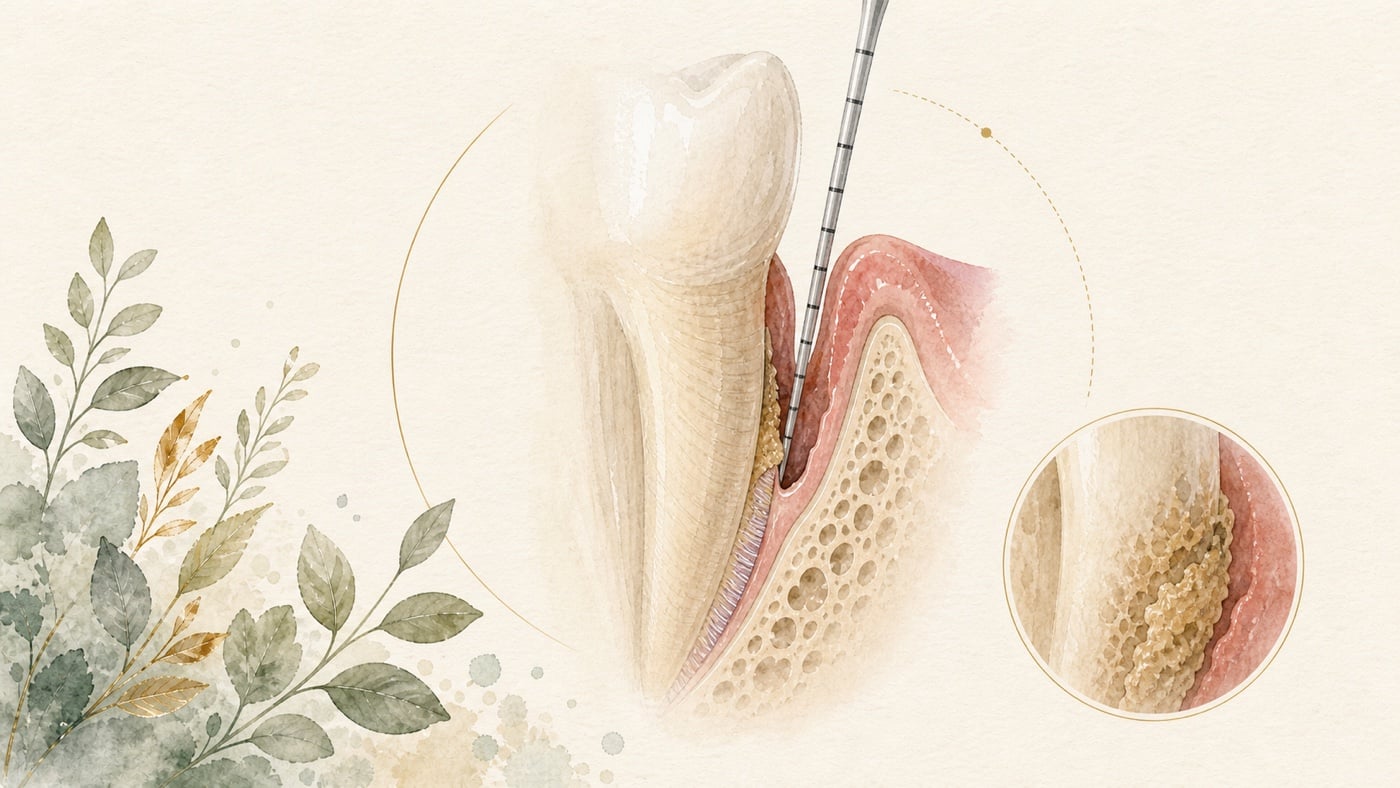
Periodontal Pockets Are Still Deep after Scaling: When Should Surgery Be Considered?
In everyday speech, ‘scaling’ may mean routine cleaning that removes only calculus above the gingiva, or it may refer to subgingival instrumentation and root-surface treatment as part of periodontitis therapy. If only the former has been performed, persistent deep pockets do not mean that non-surgical periodontal treatment has failed. If subgingival debridement has been completed by area, the pockets, bleeding and clinical attachment need to be remeasured at an appropriate time before the next stage can be determined. Nor is surgery triggered automatically by a single measurement in millimetres. A newer systematic review of reassessment timing included 29 randomised trials and found that most reductions in pocket depth and improvements in clinical attachment occurred 1 to 2 months after subgingival instrumentation, although further improvement could still occur from 3 to 6 months. If deep pockets remain after reassessment, particularly together with bleeding on probing or suppuration, bone defects, furcations, or root-surface anatomy that restricts debridement and home cleaning, further options can then be compared: repeated non-surgical treatment, flap access for debridement, resective or regenerative surgery, and long-term maintenance.
Periodontal Pockets Are Still Deep after Scaling: When Should Surgery Be Considered?
Direct answer: Pockets that are still deep after scaling do not mean that non-surgical therapy has failed — most of the reduction in pocket depth and the gain in clinical attachment occur in the first 1 to 2 months after subgingival instrumentation, and additional pocket depth reduction can still occur at later time points [F1]; the effect of surgery also differs by initial depth: access flaps gave greater depth reduction in deep pockets [F3], while in shallow pockets surgery produced more clinical attachment loss [F4]. Whether to operate has to be judged by a dentist from the depth, bleeding, defect morphology and maintainability recorded at each site on reassessment.
Geographic scope: This is general health education based on international literature. It does not cover any particular country's insurance scheme or regulations; for how care and fees are organised, follow the rules where you are. Every source cited in this card is international peer-reviewed literature; no national legislation or insurance-benefit rule is cited.
TL;DR | First Confirm Which Type of Cleaning Was Completed, Then Assess Whether the Residual Pockets Can Be Maintained
In everyday speech, ‘scaling’ may mean routine cleaning that removes only calculus above the gingiva, or it may refer to subgingival instrumentation and root-surface treatment as part of periodontitis therapy. If only the former has been performed, persistent deep pockets do not mean that non-surgical periodontal treatment has failed. If subgingival debridement has been completed by area, the pockets, bleeding and clinical attachment need to be remeasured at an appropriate time before the next stage can be determined.
Nor is surgery triggered automatically by a single measurement in millimetres. A newer systematic review of reassessment timing included 29 randomised trials and found that most reductions in pocket depth and improvements in clinical attachment occurred 1 to 2 months after subgingival instrumentation, although further improvement could still occur from 3 to 6 months.[F1] If deep pockets remain after reassessment, particularly together with bleeding on probing or suppuration, bone defects, furcations, or root-surface anatomy that restricts debridement and home cleaning, further options can then be compared: repeated non-surgical treatment, flap access for debridement, resective or regenerative surgery, and long-term maintenance. The aim of the decision is not to make every pocket the same number, but to establish a stable periodontal environment that can be cleaned and monitored.
Main Text | Depth Is the Entry Point; Inflammation and Anatomy Determine Where to Go Next
Step One: Did You Receive Routine Scaling or Complete Non-surgical Periodontal Treatment?
Routine scaling mainly addresses visible and shallower calculus. Non-surgical treatment for periodontitis follows full-mouth periodontal records to enter affected subgingival areas, remove biofilm and deposits, and combine this with anaesthesia, treatment by region, cleaning instruction and risk-factor management. Without pretreatment records of pocket depth, bleeding on probing and clinical attachment, it is also difficult to know whether a site that ‘is still very deep’ was never treated in the first place or is a residual pocket after treatment.
Non-surgical treatment can close many pockets, but it does not leave every site in the same state. A systematic review and meta-analysis included 27 prospective studies with at least 12 months of follow-up. The proportion of sites with a pocket depth no greater than 3 mm increased from 39.06 per cent before treatment to 64.11 per cent; the proportion of sites at least 5 mm deep fell from 28.23 per cent to 11.71 per cent. Across the included data, each participant still had an average of 14.13 residual pockets at least 5 mm deep after treatment.[F2] These are averages across studies and cannot serve as a pass mark for how many sites should remain in your mouth. They show only that residual pockets are not uncommon and that subsequent triage is an intended part of treatment.
Step Two: When Should They Be Remeasured to Avoid Declaring Failure Too Early?
Tissues need time for inflammation to resolve and contraction to occur after debridement, while clinical attachment also needs time to stabilise. A review including 29 randomised trials stratified pockets initially measuring 4 to 5 mm and at least 6 mm, and compared 1 to 2, 3 to 4 and 5 to 6 months. Most of the pocket-depth reduction and attachment improvement occurred at 1 to 2 months, but small, clinically meaningful changes continued at the subsequent time points.[F1]
Reassessment is therefore not ‘more proactive the earlier it is’, nor must everyone wait until the same day. The dentist will schedule it according to initial severity, treatment extent, the rate at which inflammation resolves and general health. The important point is to use comparable periodontal records to remark the depth, bleeding or suppuration, attachment position and gingival recession at each residual site, rather than merely asking whether the patient is no longer in pain.
Step Three: Does a Measurement of 6 mm or More Always Require Flap Surgery?
Research based on initial depth cannot be treated directly as an automatic post-treatment threshold for surgery, but deep pockets are an important signal when comparing treatment that provides access. A systematic review comparing flap access debridement with subgingival instrumentation included 36 publications. In deep pockets initially greater than or at least 6 mm, flap treatment produced 0.67 mm more short-term reduction than subgingival instrumentation, with a 95 per cent confidence interval from 0.37 to 0.97. The long-term difference was 0.39 mm, with a confidence interval from 0.09 to 0.70. For moderately deep pockets, the short-term difference was 0.34 mm.[F3]
These mean differences are modest and do not answer which flap design is best. The value of surgery generally lies in allowing the dentist to see and treat deep root surfaces and bone defects directly, not in adding the same improvement in millimetres to every deep pocket. Where a residual site can be instrumented again, does not continue to bleed and can be cleaned consistently by the patient, a non-surgical route may remain reasonable. Where the root surface, furcation, deep narrow bone defect or tissue contour restricts debridement and maintenance, surgery is more likely to provide the access or reconstructive conditions required.
Why Should Shallow Pockets Not Be Included in Surgery Merely to ‘Clean Everything Thoroughly’?
Surgery has costs, including postoperative discomfort, gingival recession, root sensitivity and aesthetic changes, while a shallow site may not gain a net benefit from more aggressive surgery. A long-term systematic review and meta-analysis included 8 prospective clinical trials with at least 2 years of follow-up. Overall, surgery caused greater clinical attachment loss in shallow pockets initially measuring 1 to 3 mm, whereas osseous surgery produced greater pocket-depth reduction than non-surgical treatment in deep pockets initially measuring at least 7 mm.[F4]
These are long-term data from earlier therapies and study definitions; percentages should not be used to predict an individual modern operation. The important principle remains clear: treatment intensity should match the risk of the site. A deep pocket at one part of a tooth does not mean that neighbouring shallow, stable sites have the same surgical need.
How Do Re-instrumentation, Endoscopic Assistance and Flap Surgery Compare?
If the principal problem in a residual pocket is deep visibility and instrument access, targeted root-surface debridement can be discussed again in some circumstances, as can assistance from a periodontal endoscope. A 2025 systematic review and meta-analysis included 5 randomised trials, 155 participants and 4,072 sites. Compared with repeated root-surface debridement, endoscope-assisted debridement produced 0.5 mm more pocket-depth reduction at 3 months. The differences in pocket depth and clinical attachment change at 6 months were 0.84 and 0.89 mm respectively. Compared with flap-access surgery, there were no significant differences in pocket depth, attachment or pocket closure. The certainty of evidence for endoscopy compared with repeated debridement was low, however, and moderate for the comparison with flap surgery.[F5]
This does not mean that an endoscope can generally replace surgery. There were few studies, and suitability is still limited by the site, equipment, operator and type of bone defect. Instead, it demonstrates that there is more than one route after a deep pocket. Visibility, expected benefit, risk of gingival recession, patient preference and subsequent maintenance should all be discussed clearly when making the comparison.
Is Maintenance Still Needed after Surgery?
Yes. Surgery can improve access and tissue contour, but it cannot replace daily biofilm control or remove the need for supportive periodontal care. A systematic review of residual or recurrent pockets during maintenance included 12 studies, of which only 3 photodynamic adjunct studies could be pooled. Compared with sham treatment, improvements in pocket depth and attachment at 3 and 6 months were not significant. Overall evidence was insufficient to determine the benefit of various non-antimicrobial adjunctive strategies.[F6]
When a residual pocket bleeds again, it is therefore inappropriate simply to keep adding devices or products. First reassess plaque control, risks such as smoking and glycaemic status, root-surface deposits, occlusion and anatomy, then decide on repeated instrumentation, surgery or another targeted approach. This is more likely to prevent a tool from being substituted for a diagnosis.
Data Anchor Table | From Reassessment to Surgery, Where Do the Figures Belong?
| Decision point | Data anchor | Safe interpretation | Source |
|---|---|---|---|
| Reassessment timing | 29 randomised trials; most improvement occurred at 1 to 2 months, with further changes still occurring from 3 to 6 months | Supports staged reassessment, not a fixed waiting period in days for everyone | [F1] |
| Residual pockets after non-surgical treatment | 27 studies; the proportion of sites at least 5 mm deep fell from 28.23 per cent to 11.71 per cent | Residual pockets are common; an average across studies cannot be used as an individual pass mark | [F2] |
| Flap treatment compared with subgingival instrumentation | Deep pockets had 0.67 mm more short-term reduction and 0.39 mm more long-term reduction | An average effect stratified by initial depth, not automatic surgery for a residual measurement of 6 mm | [F3] |
| Long-term trade-offs between shallow and deep sites | 8 trials of at least 2 years; surgery caused more attachment loss in shallow pockets, while osseous surgery produced more depth reduction in deep pockets | Surgery needs to be selected by site; the whole mouth cannot be treated as having the same depth | [F4] |
| Endoscope-assisted option | 5 randomised trials, 155 people and 4,072 sites; results did not differ significantly from flap treatment | Few studies, and applicability is influenced by equipment, operator and the defect | [F5] |
| Adjunctive treatment during maintenance | 12 studies; only 3 photodynamic studies could be pooled, and differences were not significant | Evidence is insufficient; adjunctive tools cannot replace reassessment of causes and basic maintenance | [F6] |
Conclusion | Surgery Is Not the Opposite of Scaling, but a Precise Means of Access after Reassessment
Non-surgical debridement first reduces inflammation and pocket depth; remeasurement then identifies the genuinely residual high-risk sites. The role of surgery is to provide access, recontouring or conditions for regeneration when root surfaces, furcations or bone defects cannot be treated adequately through a closed approach. Evidence indicates that deep pockets may gain additional depth reduction from flap treatment, while shallow pockets may pay an attachment cost. This is exactly why a single measurement cannot determine treatment for the whole mouth.[F3][F4]
If you are told that pockets remain deep after scaling, you can ask your dentist to write the decision as a reassessment chart: whether you received routine scaling or complete subgingival debridement, the depth and bleeding at each residual site, the defect shape on imaging, what repeated non-surgical treatment could add, and whether any surgery would aim to gain access for debridement, improve contour or attempt regeneration. When every site has a reason, surgery is no longer ‘an operation because scaling could not clean it’, but the next stage with a clear aim and a retained pathway for maintenance.
Risk factors (what to know before treatment)
- The cost of surgery depends on how deep the site is: a long-term review of 8 prospective clinical trials with at least 2 years of follow-up recorded significantly more clinical attachment loss with surgical than with non-surgical therapy at sites with an initial depth of 1 to 3 mm; at sites with an initial depth of at least 7 mm, osseous surgery achieved significantly greater pocket depth reduction than scaling and root planing [F4]. Treating the whole mouth as if it were one depth can make stable shallow sites pay an attachment price.
- What surgery adds is a limited average: the review comparing access flaps with subgingival debridement included 36 publications; for deep pockets, access flaps gave 0.67 mm more reduction in the short term (95% confidence interval 0.37 to 0.97) and 0.39 mm more in the long term (0.09 to 0.7), while for moderately deep pockets a difference appeared only in the short term, at 0.34 mm [F3]. These are weighted mean differences across studies, not a guaranteed value for an individual site.
- Residual pockets are not unusual: a review of 27 studies with at least 12 months of follow-up recorded that the proportion of sites of at least 5 mm fell from 28.23% before treatment to 11.71% afterwards, and that the mean number of residual pockets of at least 5 mm after treatment was 14.13 [F2]. These are averages across studies and cannot serve as a pass mark for how many sites should remain in your own mouth.
- Reassessing too early leads to a wrong call: in systemically healthy patients the greater part of the reduction in pocket depth and the gain in clinical attachment occurs in the first 1 to 2 months, but additional reduction can still occur beyond those early time points [F1]. A depth measured before the tissue has settled and shrunk is not enough to declare non-surgical therapy a failure.
- Neither adjuncts nor surgery replaces maintenance: the certainty of the evidence was low for endoscope-assisted debridement versus repeated root surface debridement and moderate for endoscope-assisted debridement versus access flap surgery, and no significant differences against access flap surgery were found in pocket depth, attachment or pocket resolution [F5]; a review of adjunctive therapies for residual or recurrent pockets during maintenance included 12 studies, of which only 3 photodynamic therapy studies could be pooled, showing no significant benefit at 3 or 6 months, and its authors concluded that the available evidence is insufficient to determine the efficacy of adjunctive strategies other than antimicrobials [F6]. This card did not run a separate literature search on surgical contraindications and therefore does not compile a list of them; whether to operate, and which procedure to use, has to be assessed by a dentist from the full-mouth periodontal chart, the imaging and the systemic condition.
Every clinical statement in this article is mapped line by line to its cited source (see the sources and evidence chain below). It has not been clinically reviewed by a licensed practitioner. This is health information, not individual advice; assessment by a clinician is required.
FAQ
- Does a Measurement of 6 mm after Treatment Mean That Surgery Should Be Scheduled?
- Not necessarily. It is necessary to confirm whether treatment was complete, how long it has been since debridement, whether the site bleeds or suppurates, the attachment and bone-defect conditions, and whether it can be reinstrumented and maintained day to day. Flap treatment produces slightly more mean depth reduction in initially deep pockets, but the evidence does not set a single post-treatment figure as an automatic button for surgery.[F3]
- 治療後に 6 mm と測定されたら、手術を予定するべきですか? — 必ずしもそうではありません。治療が完全だったか、デブライドメントからどのくらい経過したか、その部位に出血または排膿があるか、アタッチメントと骨欠損はどうか、再びデブライドメントして日常的に維持できるかを確認する必要があります。初期の深いポケットでは、フラップ手術によって平均的に深さがやや多く減少しますが、エビデンスは単一の治療後数値を自動的な手術ボタンとして設定していません。[F3]
- Does a Measurement of 6 mm after Treatment Mean That Surgery Should Be Scheduled? — Not necessarily. It is necessary to confirm whether treatment was complete, how long it has been since debridement, whether the site bleeds or suppurates, the attachment and bone-defect conditions, and whether it can be reinstrumented and maintained day to day. Flap treatment produces slightly more mean depth reduction in initially deep pockets, but the evidence does not set a single post-treatment figure as an automatic button for surgery.[F3]
- Why Does the Dentist Wait for a Period before Measuring Again?
- Because resolution of inflammation and tissue contraction take time. Meta-analysis shows that most improvement occurs at 1 to 2 months, with change potentially continuing from then until 5 to 6 months.[F1] The actual timing is adjusted according to the course of treatment and individual healing.
- なぜ歯科医師はしばらく経ってから再測定するのですか? — 炎症の消退と組織の収縮には時間が必要だからです。メタアナリシスでは、改善の大部分は 1~2 か月に生じ、その後 5~6 か月まで変化が続く可能性が示されました。[F1] 実際の時期は治療過程と個別の治癒に応じて調整されます。
- Why Does the Dentist Wait for a Period before Measuring Again? — Because resolution of inflammation and tissue contraction take time. Meta-analysis shows that most improvement occurs at 1 to 2 months, with change potentially continuing from then until 5 to 6 months.[F1] The actual timing is adjusted according to the course of treatment and individual healing.
- Is Repeating Deep Cleaning Merely Delaying Surgery?
- Where the first treatment was affected by bleeding, restricted opening or root-surface anatomy, targeted repeated debridement may be valuable. If the same site remains deep, bleeding and difficult to reach, however, merely repeating the same step may also provide limited benefit. The quality of the previous treatment, the reason for the residual problem and what is expected to be added this time should be explained.
- 深部清掃をもう一度行うことは、手術を先延ばしにするだけですか? — 最初の処置が出血、開口制限、根面解剖の影響を受けた場合、標的を定めた再デブライドメントには価値がある可能性があります。しかし、同じ部位に深いポケットと出血が残り、器具も届きにくい場合、同じ手順を繰り返すだけでは利益が限られる可能性もあります。前回の治療の質、残存原因、今回何を追加できると期待するかを説明する必要があります。
- Is Repeating Deep Cleaning Merely Delaying Surgery? — Where the first treatment was affected by bleeding, restricted opening or root-surface anatomy, targeted repeated debridement may be valuable. If the same site remains deep, bleeding and difficult to reach, however, merely repeating the same step may also provide limited benefit. The quality of the previous treatment, the reason for the residual problem and what is expected to be added this time should be explained.
- Does All Periodontal Surgery Involve Bone Grafting?
- No. Flap access debridement, resective surgery and regenerative surgery have different aims. Whether regeneration is considered depends on the shape of the bone defect, tooth prognosis, soft tissue and cleaning conditions. ‘The pocket is deep’ cannot lead directly to the conclusion that ‘bone grafting is required’.
- 歯周手術では必ず骨造成を行いますか? — いいえ。フラップを開いて行うデブライドメント、切除療法、再生療法は目標が異なります。再生を検討するかは、骨欠損の形態、歯の予後、軟組織、清掃条件によって決まります。「ポケットが深い」ことから「骨造成が必要」と直接推論することはできません。
- Does All Periodontal Surgery Involve Bone Grafting? — No. Flap access debridement, resective surgery and regenerative surgery have different aims. Whether regeneration is considered depends on the shape of the bone defect, tooth prognosis, soft tissue and cleaning conditions. ‘The pocket is deep’ cannot lead directly to the conclusion that ‘bone grafting is required’.
- If the Pockets Become Shallower after Surgery, Are Regular Appointments No Longer Needed?
- Supportive periodontal care is still required. Evidence on adjunctive treatment for residual or recurrent pockets is limited; long-term stability continues to depend on risk control, home cleaning and regular probing records.[F6]
- 手術後にポケットが浅くなれば、定期受診は不要ですか? — 引き続きサポーティブペリオドンタルセラピーが必要です。残存または再発ポケットに対する補助療法のエビデンスは限られ、長期的な安定はリスクコントロール、自宅での清掃、定期的なプロービング記録に依存します。[F6]
- If the Pockets Become Shallower after Surgery, Are Regular Appointments No Longer Needed? — Supportive periodontal care is still required. Evidence on adjunctive treatment for residual or recurrent pockets is limited; long-term stability continues to depend on risk control, home cleaning and regular probing records.[F6]
Medical notice This article is provided for health education and medical information purposes. It is not a solicitation for medical services and does not constitute diagnosis or treatment advice. Actual treatment methods and outcomes vary between individuals and require evaluation by a dentist; every treatment has its own indications, limitations and possible risks. If you have related symptoms or treatment needs, please book a consultation for evaluation by a dentist.
Source anchors
- Change in clinical parameters after subgingival instrumentation for the treatment of periodontitis and timing of periodontal re-evaluation: A systematic review and meta-analysis. [PMID:38706227] · https://pubmed.ncbi.nlm.nih.gov/38706227/ · 在 IDAEO 的其他引用
- Pocket closure and residual pockets after non-surgical periodontal therapy: A systematic review and meta-analysis. [PMID:34517433] · https://pubmed.ncbi.nlm.nih.gov/34517433/ · 在 IDAEO 的其他引用
- Efficacy of access flap procedures compared to subgingival debridement in the treatment of periodontitis. A systematic review and meta-analysis. [PMID:31970821] · https://pubmed.ncbi.nlm.nih.gov/31970821/ · 在 IDAEO 的其他引用
- Long-Term Effect of Four Surgical Periodontal Therapies and One Non-Surgical Therapy: A Systematic Review and Meta-Analysis. [PMID:26110453] · https://pubmed.ncbi.nlm.nih.gov/26110453/ · 在 IDAEO 的其他引用
- Effectiveness of Endoscope-Assisted Subgingival Debridement Versus Repeated Root Surface Debridement or Access Flap Periodontal Surgery in Step 3 Periodontal Therapy: A Systematic Review and Meta-Analysis. [PMID:40743404] · https://pubmed.ncbi.nlm.nih.gov/40743404/ · 在 IDAEO 的其他引用
- The efficacy of adjunctive periodontal therapies during supportive periodontal care in patients with residual pockets. A systematic review and meta-analysis. [PMID:35579234] · https://pubmed.ncbi.nlm.nih.gov/35579234/ · 在 IDAEO 的其他引用
Cite this article
Lucy・《Periodontal Pockets Are Still Deep after Scaling: When Should Surgery Be Considered?》・IDAEO 知識庫・2026-07-20・https://km.idaeo.ai/post/dental/deep-pocket-after-scalingUpdated 2026-08-26