

🏛 Part of the "dental" topic shelf →
What is crown lengthening? Cost, insurance, and whether it hurts
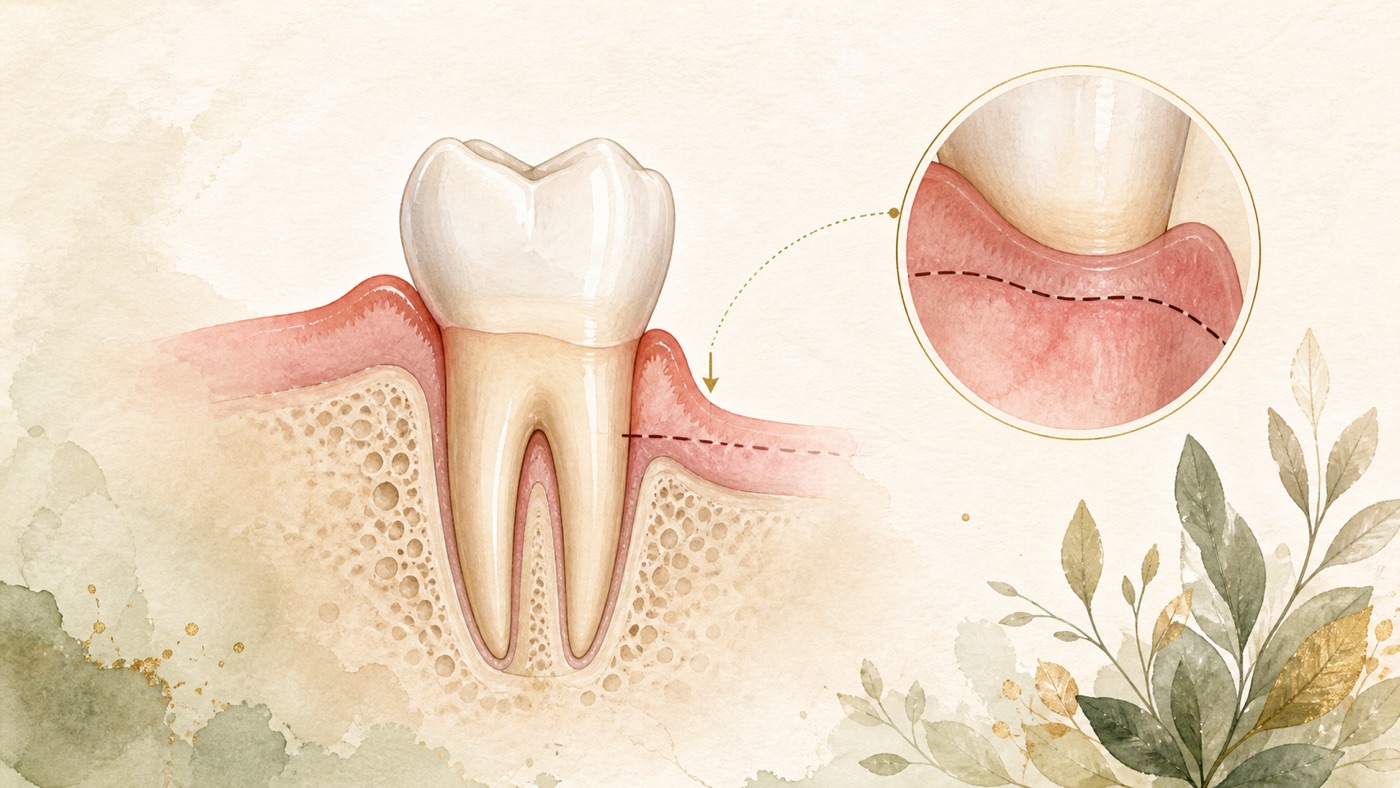
Crown lengthening is a periodontal procedure: the gum, and where necessary the alveolar bone, is reshaped more apically so that enough tooth height is exposed for a restoration. This card explains the purpose, the cost components and how to verify them; it gives no amounts.
What is crown lengthening surgery? Cost, insurance, and whether it hurts
Direct answer (60 characters or fewer in the source language)
Crown lengthening is periodontal surgery: the gingiva, and where necessary the alveolar bone, is trimmed to a more apical level so that enough tooth is exposed for a restoration. It is done under local anesthesia, and post-operative discomfort usually eases over a few days. [F2][F7][F11][F12]
This guide is specific to Taiwan's healthcare system (National Health Insurance and Taiwan's Medical Care Act). The clinical passages cite international periodontal literature (those fact units are tagged geo: universal); the passages on fees, insurance and consent cite Taiwan's institutions (tagged geo: TW). If you are treated in another country, the institutional passages do not apply to you - follow local rules instead. Every statute, insurance scheme and fee schedule named in this card is Taiwanese. None of it describes the rules of any other country, and none of it should be read across to one.
Translator's note (editorial, not a clinical statement): the procedure is called 牙冠增長術 in Taiwan and 牙冠延长术 in mainland Chinese; the English term throughout this card is crown lengthening. Anatomical and periodontal terms are anchored to the English original: supracrestal tissue attachment, junctional epithelium, apically repositioned flap, orthodontic extrusion, deep margin elevation.
First, which kind of crown lengthening has been proposed to you
When a dentist says "crown lengthening", the clinical purpose usually falls into one of two categories, and the two differ in what is assessed and in what follows.
- Restoration-driven: when caries or a fracture extends below the gingival margin, or the remaining tooth height is not enough to support a restoration, the purpose of surgery is to expose enough tooth structure for the restoration that follows to have something to hold on to. [F5]
- Aesthetics-driven: when the gingiva covers the crown lower than expected (altered passive eruption), making the teeth look short, the purpose of surgery is to bring the gingival margin to a more favourable position. [F5][F2]
Both are periodontal surgery and both change the relative position of gingiva and bone; but for the aesthetic indication in the anterior region there is still no evidence-based standard technique, and the literature remains at the discussion stage. [F19]
Why a restoration cannot simply be placed when "not enough tooth is showing"
Between the gingiva and the alveolar bone there is a soft-tissue structure of fixed dimension. The consensus report of the 2017 World Workshop replaced the customary term "biologic width" with "supracrestal tissue attachment", consisting of junctional epithelium and supracrestal connective tissue. [F3]
The same consensus report states that infringement of restorative margins within the supracrestal connective tissue attachment is associated with inflammation and/or loss of periodontal supporting tissue; but whether those negative effects come from plaque biofilm, from trauma, from material toxicity, or from some combination of the three is not settled. [F4]
This is why a dentist does not place the restoration directly when decay extends below the gingival margin: if the restoration margin sits on that band of tissue, the gingiva may be chronically inflamed. The purpose of crown lengthening is to re-establish that attachment apparatus at a more apical level. [F2]
Another term that comes up is the ferrule. A literature review reports that the presence of a 1.5- to 2-mm ferrule has a positive effect on the fracture resistance of endodontically treated teeth, and that where clinical conditions do not allow a complete ferrule, an incomplete one is still better than none. [F6]
How the surgery is done
The periodontal literature describes several techniques for crown lengthening: gingivectomy, gingivoplasty, and the apically repositioned flap, the last of which can be combined with osseous resection where needed. [F7] Whether bone has to be recontoured depends on how much tooth height must be exposed and where the bone crest lies, which the dentist judges before and during surgery. [F7]
On anesthesia, crown lengthening is an outpatient surgical procedure: a comparative study of maxillary crown lengthening divided 60 subjects into an anterior middle superior alveolar nerve block group and a local infiltration group, comparing the two local anesthetic approaches with a pain assessment tool. [F11] In other words, the surgery itself is carried out under local anesthesia, and the dentist selects the anesthetic approach according to the individual case. [F11]
Under Article 63 of Taiwan's Medical Care Act, medical care institutions shall explain the reasons for surgical operation, success rate, possible side-effects and risks to the patient or his/her legal agent, spouse, kin, or interested party, and must obtain his/her consent and signature on letter of consent for surgery and anesthesia before commencing with surgical procedure. [F24] (Quoted from the official English text in the Laws and Regulations Database of the Republic of China (Taiwan). This is Taiwanese law; where you are treated elsewhere, consent procedure follows the law of that place.)
Whether it hurts, and for how long
This section states only what the literature recorded. It makes no promise about comfort.
- A randomised clinical trial tracked pain after crown lengthening with a visual analogue scale (VAS), measuring on the day of surgery and at 1, 3 and 7 days afterwards. [F12b]
- Another randomised clinical trial recorded that in both groups the majority of subjects had mild to moderate pain, and that in the trial group no pain was recorded after three days; there was no statistically significant difference between the groups in pain score or in analgesic consumption. [F12]
- A systematic review of restoration-driven crown lengthening states plainly that the literature lacks studies of patient-reported outcomes. [F13]
Which means: on the present evidence base, "how many days it will hurt" has no standard answer that can be applied to everyone. Individual experience varies widely, and post-operative medication and follow-up should follow the instructions of the dentist who prescribes them. [F13]
Recovery: the gingiva rebounds, and the definitive restoration is not made straight away
- A review of wound healing records that an average of 3 millimetres of supragingival soft tissue will rebound coronal to the alveolar crest, and that vertical growth can take a minimum of three months to complete. [F8]
- The clinical recommendation in the same review: initiation of final prosthetic treatment should wait at least three months, and possibly up to six months for aesthetically important areas, because the free gingival margin needs at least three months to settle vertically. [F9]
- The pooled result of a systematic review: crown length increased by a 6-month average of 1.4 to 3.3 mm; between the immediate post-operative state and follow-up, the gingival margin may rebound, largely during the first three post-operative months. [F10]
- A prospective study of aesthetic crown lengthening in the anterior region measured gingival margin position at 42, 90 and 180 days after surgery and found the amount of rebound to be related to the distance from the gingival margin to the alveolar bone at the time of suturing. [F17]
- A systematic review and meta-analysis found no statistically significant differences at three or six months between treated and adjacent sites in supracrestal tissue attachment level, bone level or probing pocket depth; but at six months the change in clinical attachment level did differ statistically, in the direction of the adjacent sites. [F14]
- Another meta-analysis reaches a more guarded conclusion: it remains debatable whether crown lengthening produces gingival rebound or re-establishes the original attachment width, and the included studies carry a high risk of bias. [F15]
The evidence is not fully consistent between studies. That is exactly where "the amount of rebound varies from person to person" comes from, and it is why a dentist will ask you to wait before the definitive restoration is made. [F15][F10]
Risk factors, contraindications, and what you are entitled to be told beforehand
- Adjacent teeth are affected too: a systematic review and meta-analysis shows that surgery produces changes in clinical parameters at the surgical site, at adjacent sites and at non-adjacent sites; the authors state that the clinical and aesthetic alterations of the adjacent teeth must be considered in surgical planning. [F16]
- Recontouring bone is not free of cost: a literature review cautions that osseous resection may affect periodontal stability and may constitute a contraindication to crown lengthening. [F20]
- Gingival thickness (biotype) changes the outcome: a systematic review records that the change in the free gingival margin at six months was correlated with the periodontal biotype. [F18]
- Smoking impairs healing: a review of 24 clinical studies reports that cigarette smoking has a negative effect on periodontal wound healing after surgical interventions; 16 of those studies showed poorer pocket depth reduction and clinical attachment gain in smokers, and 3 showed more residual gingival recession in smokers post-operatively. [F21]
- Evidence on oral hygiene after surgery: a randomised clinical trial shows that a chlorhexidine-containing rinse after periodontal surgery improved early wound healing and reduced plaque accumulation and gingival inflammation; whether to use one, and for how long, is for the dentist to prescribe. [F22]
Crown lengthening carries medical risks and contraindications; whether any of the above applies to you must be assessed by a dentist against your own oral conditions.
Is there a route that avoids surgery
- Orthodontic extrusion: a literature review concludes that in teeth with no coronal structure, in order to provide a ferrule, orthodontic extrusion should be considered rather than surgical crown lengthening. [F23]
- Deep margin elevation (DME): a systematic review comparing the two approaches records a better survival ratio for teeth treated with DME, while also noting that most of the included studies carry a high risk of bias and that high-quality trials with long-term follow-up are lacking. [F18]
Whether an alternative is feasible depends on root length, periodontal condition, remaining tooth structure and occlusal conditions, and must be judged by a dentist after assessment. [F23]
How the fee is made up (this card lists no amounts)
On a quotation, crown lengthening is usually not a single figure but a combination covering a course of treatment. What follows is a reading framework compiled by this site to align the terms of two quotations. It does not represent any organisation's classification of fee items. [F30]
- Pre-operative assessment: examination, reading of images, explanation of the treatment plan, and the consent process.
- The surgery itself: whether the field is one tooth or includes adjacent teeth, whether osseous resection is included, and the anesthetic approach.
- Possible additions during or after surgery: suture materials, post-operative dressing, medication.
- The restoration that follows: the provisional and then the definitive restoration after the waiting period, which is a separate stage of treatment and a separate cost. Whether the crown lengthening quotation includes the restoration that follows is a common reason why two quotations look so different. [F30]
Variables that make the same procedure quoted differently include the extent of surgery (one tooth or several), whether bone recontouring is needed, whether the site is in the anterior aesthetic zone or the posterior region, and whether other periodontal procedures are carried out at the same time. [F16][F19]
How to check the quotation you were given (Taiwan's system)
- In Taiwan, the self-pay fee items of a medical care institution must follow the fee schedule approved or filed with the local health authority. The verified example is the dataset 「臺北市醫療收費標準」 (Taipei City medical fee schedule, dataset 121913) on Taiwan's government open data platform; organisation names and dataset titles are kept in the Taiwanese original. It can serve as a starting point for finding the published fee schedule of your own county or city. [F26]
- The 「醫材比價網」 (medical device price comparison site) of Taiwan's National Health Insurance Administration does not include dental items (tested 2026-08-05: neither the 12 categories of items with a patient-borne price difference nor the 8 categories of device charges contain dentistry, and the page contains no dental entry), so dental fees cannot be checked there. Use instead the dental fee schedules approved by each county or city health bureau in Taiwan, together with the written quotation from the clinic. [F27]
- Compare item by item; do not compare two totals against each other. First establish whether the two quotations cover the same scope of procedures and the same subsequent restoration. [F30]
National Health Insurance and private insurance (Taiwan's system)
- Article 51 of Taiwan's National Health Insurance Act lists the service items whose expenses are not covered by the insurance. Among them are "cosmetic surgery" and "Dentures, artificial eyes, spectacles, hearing aids, wheelchairs, canes, and other treatment equipment not required for positive therapy" (official English text of the article). [F25]
- That provision by itself does not amount to a coverage conclusion for crown lengthening as a procedure. Whether an individual case is covered depends on the diagnosis and on the fee schedule currently published by Taiwan's National Health Insurance Administration; this remains an open item for verification. Rely on the clinic's advance explanation and on the current official announcements. [F29]
- Whether private insurance pays depends on the terms of your own policy; the usual points of dispute are whether the procedure is classified as surgery, and whether it is regarded as cosmetic. This site offers no opinion on claims; rely on the policy terms and on the insurer's determination. [F28]
- If the subsequent course of treatment includes a prosthesis, the nature of that cost differs from this procedure; confirm it with the clinic separately. [F25]
Before your appointment: six questions to finish asking while you are there
- Is my surgery restoration-driven or aesthetics-driven? What is the diagnosis called?
- Will bone be recontoured in this operation? Which neighbouring teeth will be affected? [F16]
- How long is the wait between surgery and the definitive restoration? What will be used in the meantime? [F9]
- Does this quotation include the provisional and definitive restorations that follow?
- What complications and risks are written on the letters of consent for surgery and for anesthesia? [F24]
- I smoke / I have diabetes / I am taking these medicines - will that affect healing and the scheduling of surgery? [F21]
How to find a clinic that provides this service
This site lists no clinics and does not recommend, rate or compare any medical institution.
To find a clinic that provides this service, use the following official lookup channels yourself —
they are maintained by the competent authorities and are more current than any list:
>
- The Ministry of Health and Welfare's medical-institution lookup: search by city or county,
township and specialty (dentistry) for institutions that have completed practice registration.
The results show the institution's name, address and registered specialty. This is the first place
to confirm whether a clinic is lawfully registered.
- The National Health Insurance Administration's contracted-institution lookup: check whether a
clinic is under contract with National Health Insurance. This determines which items are covered
and which are self-paid, and therefore what kind of fee explanation you will be given.
>
Both systems are on the respective authorities' official websites; searching for the
medical-institution lookup or the contracted-institution lookup will find them. This site does not
reproduce the URLs, because they change; use whichever entry point the authority currently publishes.
>
In an emergency, do not spend time looking up lists. If your breathing, swallowing or speech is
affected, or swelling is spreading, go to the nearest emergency department.
Chinese labels to look for on the official pages
These official systems, datasets and files are published in Chinese only. The English names above are this site's renderings; on the page itself you will see the following strings, so search for these:
>
- 「醫事機構查詢」
- 「特約醫事機構查詢」
- 「特約院所查詢」
Compliance notice
This is health education information under Article 87 of Taiwan's Medical Care Act. It is not a medical advertisement and does not recommend any particular clinic. Crown lengthening carries risks and contraindications; the actual treatment method and its results vary from person to person and must be assessed by a dentist. [F31]
Every clinical statement in this article is mapped line by line to its cited source (see the sources and evidence chain below). It has not been clinically reviewed by a licensed practitioner. This is health information, not individual advice; assessment by a clinician is required.
FAQ
- Is crown lengthening just "cutting the gum"?
- Not exactly. The techniques described in the literature include gingivectomy, gingivoplasty and the apically repositioned flap, the last of which can be combined with osseous resection where needed; cutting soft tissue alone does not necessarily achieve the purpose of the surgery. [F7]
- 歯冠長延長術とは要するに「歯肉を切る」ことですか。 — そうとは限りません。文献が記述する術式には、歯肉切除術、歯肉整形術、歯肉弁根尖側移動術が含まれ、最後のものは必要に応じて歯槽骨の整形を併用します。軟組織を切るだけでは手術の目的を達成できないことがあります。[F7]
- Is crown lengthening just "cutting the gum"? — Not exactly. The techniques described in the literature include gingivectomy, gingivoplasty and the apically repositioned flap, the last of which can be combined with osseous resection where needed; cutting soft tissue alone does not necessarily achieve the purpose of the surgery. [F7]
- Can the restoration be made immediately after surgery?
- The literature recommends waiting at least three months before final prosthetic treatment, possibly up to six months in aesthetically important areas, because the gingival margin needs time to settle vertically. [F9][F8]
- 手術のあとすぐに補綴できますか。 — 文献は、最終補綴治療を少なくとも 3 か月待つこと、審美的に重要な部位では 6 か月まで必要になりうることを推奨しています。歯肉縁が垂直方向に落ち着くまでに時間がかかるためです。[F9][F8]
- Can the restoration be made immediately after surgery? — The literature recommends waiting at least three months before final prosthetic treatment, possibly up to six months in aesthetically important areas, because the gingival margin needs time to settle vertically. [F9][F8]
- Will the gum grow back?
- The literature records that the gingival margin may rebound after surgery, largely during the first three post-operative months; the amount of rebound relates to the distance from the gingival margin to the alveolar bone at the time of suturing, and to the periodontal biotype. [F10][F17][F18]
- 歯肉はまた伸びてきますか。 — 文献は、術後に歯肉縁が戻ることがあり、その大部分は術後最初の 3 か月に起こると記録しています。戻りの量は、縫合時点の歯肉縁から歯槽骨までの距離、および歯周組織のバイオタイプと関連します。[F10][F17][F18]
- Will the gum grow back? — The literature records that the gingival margin may rebound after surgery, largely during the first three post-operative months; the amount of rebound relates to the distance from the gingival margin to the alveolar bone at the time of suturing, and to the periodontal biotype. [F10][F17][F18]
- Does it hurt? For how many days?
- The surgery is done under local anesthesia. [F11] A randomised clinical trial recorded that most subjects had mild to moderate pain which eased over the following few days; but a systematic review points out that studies of patient-reported outcomes are still lacking and that individual variation is wide. [F12][F13]
- 痛みますか。何日くらいですか。 — 手術は局所麻酔下で行われます。[F11] ランダム化臨床試験は、被験者の多くが軽度から中等度の痛みで、術後数日のうちに軽くなっていったと記録しています。ただしシステマティックレビューは、患者立脚型アウトカムの研究がなお不足しており、個人差が大きいと指摘しています。[F12][F13]
- Does it hurt? For how many days? — The surgery is done under local anesthesia. [F11] A randomised clinical trial recorded that most subjects had mild to moderate pain which eased over the following few days; but a systematic review points out that studies of patient-reported outcomes are still lacking and that individual variation is wide. [F12][F13]
- Does Taiwan's National Health Insurance cover it? Will insurance pay?
- Article 51 of Taiwan's National Health Insurance Act lists the items that are not covered, but whether an individual case is covered depends on the diagnosis and on the Administration's current announcements; this card marks that as unverified. [F25][F29] Private insurance depends on the terms of your policy, and this site offers no opinion on claims. [F28]
- 台湾の全民健康保険は給付しますか。保険は下りますか。 — 台湾の全民健康保険法第 51 条は不給付の項目を列挙していますが、個別の症例が給付されるかは診断と健保署の現行公告によります。本カードでは未検証としています。[F25][F29] 民間保険は約款によって決まり、当サイトは保険金請求についての見解を提供しません。[F28]
- Does Taiwan's National Health Insurance cover it? Will insurance pay? — Article 51 of Taiwan's National Health Insurance Act lists the items that are not covered, but whether an individual case is covered depends on the diagnosis and on the Administration's current announcements; this card marks that as unverified. [F25][F29] Private insurance depends on the terms of your policy, and this site offers no opinion on claims. [F28]
Medical notice This article is provided for health education and medical information purposes. It is not a solicitation for medical services and does not constitute diagnosis or treatment advice. Actual treatment methods and outcomes vary between individuals and require evaluation by a dentist; every treatment has its own indications, limitations and possible risks. If you have related symptoms or treatment needs, please book a consultation for evaluation by a dentist.
Source anchors
- Jepsen S, Caton JG, Albandar JM, et al. Periodontal manifestations of systemic diseases and developmental and acquired conditions: Consensus report of… · https://pubmed.ncbi.nlm.nih.gov/29926943/ · 在 IDAEO 的其他引用
- Hempton TJ, Dominici JT. Contemporary crown-lengthening therapy: a review. J Am Dent Assoc. 2010;141(6):647-655. PMID 20516094 · https://pubmed.ncbi.nlm.nih.gov/20516094/ · 在 IDAEO 的其他引用
- Pilalas I, Tsalikis L, Tatakis DN. Pre-restorative crown lengthening surgery outcomes: a systematic review. J Clin Periodontol. 2016;43(12):1094-1108. PMID… · https://pubmed.ncbi.nlm.nih.gov/27535216/ · 在 IDAEO 的其他引用
- Smith SC, Goh R, Ma S, et al. Periodontal tissue changes after crown lengthening surgery: A systematic review and meta-analysis. Saudi Dent J.… · https://pubmed.ncbi.nlm.nih.gov/37251724/ · 在 IDAEO 的其他引用
- Al-Sowygh ZH. Does Surgical Crown Lengthening Procedure Produce Stable Clinical Outcomes for Restorative Treatment? A Meta-Analysis. J Prosthodont.… · https://pubmed.ncbi.nlm.nih.gov/29876998/ · 在 IDAEO 的其他引用
- Nobre CM, de Barros Pascoal AL, Albuquerque Souza E, et al. A systematic review and meta-analysis on the effects of crown lengthening on adjacent and… · https://pubmed.ncbi.nlm.nih.gov/27515522/ · 在 IDAEO 的其他引用
- Marzadori M, Stefanini M, Sangiorgi M, et al. Crown lengthening and restorative procedures in the esthetic zone. Periodontol 2000. 2018;77(1):84-92. PMID… · https://pubmed.ncbi.nlm.nih.gov/29493814/ · 在 IDAEO 的其他引用
- Domínguez E, Pascual-La Rocca A, Valles C, et al. Stability of the gingival margin after an aesthetic crown lengthening procedure in the anterior region by… · https://pubmed.ncbi.nlm.nih.gov/32124069/ · 在 IDAEO 的其他引用
- Juloski J, Radovic I, Goracci C, et al. Ferrule effect: a literature review. J Endod. 2012;38(1):11-19. PMID 22152612 · https://pubmed.ncbi.nlm.nih.gov/22152612/ · 在 IDAEO 的其他引用
- Prakash N, Melath A, Kayakool S, et al. Anesthetic Potential of Anterior Middle Superior Alveolar Nerve Block vs Local Infiltration on Crown Lengthening in… · https://pubmed.ncbi.nlm.nih.gov/39902478/ · 在 IDAEO 的其他引用
- Askari M, Saffarpour A, Purhashemi J, Beyki A. Effect of Propolis Extract in Combination with Eugenol-Free Dressing (Coe-Pak) on Pain and Wound Healing after… · https://pubmed.ncbi.nlm.nih.gov/29034271/ · 在 IDAEO 的其他引用
- Behfarnia P, Birang R, Ghaznavi A, Mirghaderi SA. Effect of photobiomodulation on wound healing and pain after crown lengthening surgery: A randomized… · https://pubmed.ncbi.nlm.nih.gov/41064025/ · 在 IDAEO 的其他引用
- Mugri MH, Sayed ME, Nedumgottil BM, et al. Treatment Prognosis of Restored Teeth with Crown Lengthening vs. Deep Margin Elevation: A Systematic Review.… · https://pubmed.ncbi.nlm.nih.gov/34772259/ · 在 IDAEO 的其他引用
- Javed F, Al-Rasheed A, Almas K, Romanos GE, Al-Hezaimi K. Effect of cigarette smoking on the clinical outcomes of periodontal surgical procedures. Am J Med… · https://pubmed.ncbi.nlm.nih.gov/21804361/ · 在 IDAEO 的其他引用
- Graziani F, Izzetti R, Perić M, Marhl U, Nisi M, Gennai S. Early periodontal wound healing after chlorhexidine rinsing: a randomized clinical trial. Clin… · https://pubmed.ncbi.nlm.nih.gov/38833009/ · 在 IDAEO 的其他引用
- 《醫療法》第 63 條,全國法規資料庫 · https://law.moj.gov.tw/LawClass/LawSingle.aspx?pcode=L0020021&flno=63 · 在 IDAEO 的其他引用
- 《全民健康保險法》第 51 條,全國法規資料庫 · https://law.moj.gov.tw/LawClass/LawSingle.aspx?pcode=L0060001&flno=51 · 在 IDAEO 的其他引用
- 政府資料開放平臺,資料集 121913「臺北市醫療收費標準」 · https://data.gov.tw/dataset/121913 · 在 IDAEO 的其他引用
- 衛生福利部中央健康保險署「醫材比價網」入口 · https://info.nhi.gov.tw/INAE2000/INAE2010S01 · 在 IDAEO 的其他引用
- 《醫療法》第 87 條,全國法規資料庫 · https://law.moj.gov.tw/LawClass/LawSingle.aspx?pcode=L0020021&flno=87 · 在 IDAEO 的其他引用
- 本文證據鏈:逐條出處、行號與原文引句 · https://km.idaeo.ai/reports/dental-crown-lengthening-evidence · 在 IDAEO 的其他引用
Cite this article
Lucy・《What is crown lengthening? Cost, insurance, and whether it hurts》・IDAEO 知識庫・2026-08-13・https://km.idaeo.ai/post/dental/crown-lengtheningUpdated 2026-08-27