

🏛 Part of the "dental" topic shelf →
My denture or crown came off: can I glue it back myself?
Do not glue a crown, bridge, interim crown, or removable denture back yourself. A restoration falling out is usually a result; the important question is what happened to the tooth underneath. Denture adhesive and household superglue are not dental items for cementing a crown. Using them yourself can make removal and later assessment harder. This guide explains what to do in four situations, red flags for swallowing or aspiration, how Taiwan classifies recementation, and what to ask at the appointment. It lists no prices and recommends no brand or product.
My denture or crown came off: can I glue it back myself?
Direct answer
Do not glue it back yourself. Keep the item that came off, do not put it back in your mouth, and arrange a dental review promptly so the dentist can examine the tooth underneath. If the item cannot be found and you are coughing or short of breath, seek medical care immediately [F2][F4][F12].
Scope: This guide is specific to Taiwan's healthcare system (National Health Insurance and Taiwan's Medical Care Act). Its clinical evidence is international literature (F-Units marked geo: universal); its institutional discussion cites Taiwan laws and authority records (geo: TW). Readers elsewhere should check local systems. This guide does not recommend, compare, or evaluate any brand or product, and gives no prices.
1. First identify what fell out
The phrase “my tooth cap came off” can describe four different things, and the care route and urgency differ. The four routes below are this site's communication framework assembled from F3 through F23, not a diagnostic tool [F2].
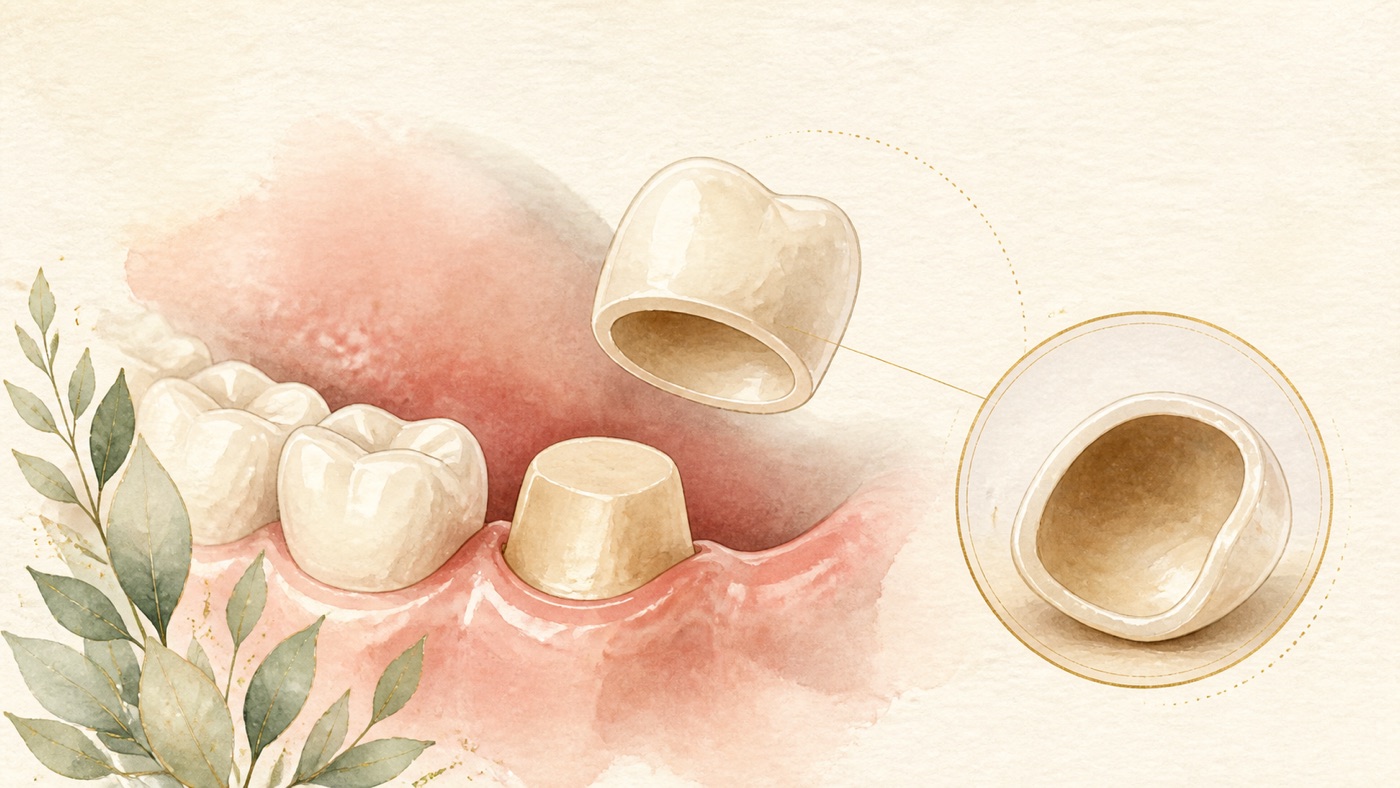
- A fixed crown: the whole crown has come off, usually with the shape of the prepared tooth visible inside it.
- A bridge: it spans two or more abutment teeth. It may come off entirely, or one end may lose retention while the bridge remains attached at the other end; that can be hard to notice [F2].
- An interim crown (therapeutic temporary crown): the transitional restoration worn while the definitive prosthesis is being made.
- A removable denture that has fractured or lost an artificial tooth: the appliance you can remove yourself.
Their shared feature is that falling out is usually a result, not the cause. Re-gluing addresses the result but not the cause [F2].
2. Why self-gluing is not advised
More than one cause is possible
Restoration loss is one failure pattern recorded alongside caries and fracture; a dentist must examine the actual cause [F16][F17][F18][F19]. A 2026 systematic review and meta-analysis searched January 2014 through December 2024 and included 41 studies, 600 metal-ceramic and 1,532 all-ceramic bridges. It reported higher marginal-caries and loss-of-retention rates for all-ceramic than metal-ceramic bridges [F17]. In a 12-year prospective study, 5 bridges had biologic complications (3 secondary caries, 1 periapical pathology, 1 periodontal disease) and 9 mechanical complications (7 chipping, 2 decementations); among the 5 replacements, secondary caries was the most frequent reason for failure (P=.003) [F16].
A five-year retrospective study of 101 ceramic endocrowns in root-filled molars recorded 8 failures: 5 loss of retention, 2 ceramic fractures, and 1 secondary caries [F18]. This is one centre and one restoration type, not a rule for all crowns. Prognostic factors in a systematic review also included remaining coronal tooth structure, ferrule, crown-to-root ratio, tooth position, periodontal disease, proximal contact, and cracks [F20]. A separate review found an association between remaining walls and failure in root-filled teeth restored with fibre posts and single crowns, but this guide does not use its numerical results [F21]. Different restoration types also had different main failure patterns: ceramic fracture in bridges and single crowns (27.6% and 26.6%) and debonding in veneers (12.7%) [F19].
Thus loss may be cement failure, but it may also be linked to secondary caries, remaining tooth structure, or cracks. This guide does not say that a fallen restoration certainly means a problem underneath. It says that examination is what separates these possibilities, and self-gluing skips that step [F2].
The materials are classified for different uses in Taiwan
In Taiwan, material used to attach a crown or bridge to a tooth has its own medical-device classification. The TFDA-commissioned database describes F.3275 Dental cement as an item for temporary filling, as a base layer for adhering temporary dental prostheses, crowns, or bridges, or for protecting the pulp [F24]. Denture adhesives are a separate set of items—F.3400, F.3410, F.3420, F.3450, F.3480, F.3490, and F.3500—described as being applied to a denture base before placement to increase retention and comfort [F26]. That described purpose is for a removable denture base, not for attaching a crown to a tooth.
A 2003 case report describes a man attempting to repair maxillary teeth with superglue and discourages this because of possible adverse reactions in hard and soft tissues [F12]. It is low-level, single-case evidence; it is used here because it directly records a patient using superglue on teeth.
Later care can become harder
An in-vitro study of six denture-repair material interfaces found that cyanoacrylate-to-PMMA strength was 47% of original strength after 24 hours of soaking and 26% of 12-month-soaked material strength; PMMA repair strengths were 52% to 84% after 24 hours [F13]. Those measurements concern dental repair materials under laboratory conditions, not household superglue used in a mouth. They cannot be treated as the same. They nevertheless show that even a cyanoacrylate interface can be only part of the original material strength. If you have already glued it, tell the dentist what you used and how many times [F2].
A restoration that is not fully seated can affect gums and bite
A review commissioned for the 2017 World Workshop states that placing restoration margins within the junctional epithelium and supracrestal connective-tissue attachment can be associated with gingival inflammation and potentially recession; fabrication procedures for restorations and fixed prostheses can cause traumatic loss of periodontal support [F22]. Self-gluing cannot confirm complete seating, margin fit, or restoration of the original occlusion [F2].
Do not keep a loose crown in your mouth
A technical article says accidental crown aspiration or ingestion is a risk during dental treatment [F6]. Its setting is treatment, not a patient wearing a loose crown at home. A single-hospital Japanese survey recorded accidental ingestion at about 30% of the hospital's fiscal-2008 accidents, most often while removing restorations; inlays and crowns were most often ingested, all ingested items passed naturally, and no aspiration occurred [F5]. That is an in-clinic professional-removal context, not home re-wearing. This site therefore advises keeping an unattached crown safely aside rather than holding it in the mouth; this is an editorial routing reminder, not a claim that home re-wearing is a typical aspiration event [F2][F35].
What this guide deliberately does not claim
The common statement that self-gluing “seals decay inside so it keeps worsening” is not made here. An umbrella review of 18 systematic reviews reported that selective carious-tissue removal reduced pulp-exposure risk, and that 38% SDF, Hall technique, selective removal, and ART could arrest dentinal-caries progression in primary teeth [F23]. Its population was primary teeth and all techniques were dentist-performed after diagnosis. It cannot be read as permission to seal a lesion yourself.
Citable sources support this narrower scope: determining the cause of loss may require clinical and imaging assessment [F16][F17][F18][F20]; a case report describes self-use of superglue on teeth and discourages it because of possible adverse reactions in hard and soft tissues [F12]. This site therefore classifies “do not self-glue” as an editorial decision with `basis: editorial_framework`; it does not claim that the literature has tested the sealing or biocompatibility of every non-dental product, or that self-gluing delays discovery of the cause [F2].
3. If the item is missing: swallowing and aspiration red flags
This section is about situations needing an immediate decision. The ordering is this site's framework; each criterion has its own source [F2].
Seek medical care immediately; do not wait for a routine appointment, if any of the following applies:
- Respiratory distress or airway symptoms—cough, wheeze, or difficulty breathing. A case report describes a 66-year-old man with acute respiratory distress from aspirated dental prosthesis and states that aspiration has higher morbidity and mortality than ingested foreign bodies and requires high suspicion for timely diagnosis and life-saving treatment [F4]. The 2020 IADT primary-dentition guideline says a child whose avulsed tooth cannot be found should be referred to an emergency room, especially with respiratory symptoms [F11]. That guideline is about traumatized primary teeth, not crowns or dentures; this guide keeps that population limitation and uses only its route-to-emergency principle. “Cough, wheeze, and difficulty breathing” are this site's patient-facing wording, not a verbatim source list [F2].
- You cannot swallow at all. ESGE recommends emergent therapeutic endoscopy, preferably within 2 hours and at the latest within 6 hours, for foreign bodies causing complete oesophageal obstruction and for sharp objects or batteries in the oesophagus [F7]. “Cannot swallow at all” is patient wording; the guideline term is “complete oesophageal obstruction.” Whether your symptom is complete obstruction is for clinical assessment, not self-diagnosis [F7][F2].
- You can swallow but it hurts or feels stuck. For other oesophageal foreign bodies without complete obstruction, ESGE recommends therapeutic endoscopy within 24 hours [F7]. Pain or sticking is patient wording; the guideline distinguishes location and complete obstruction, not symptoms. This guide places this in the immediate-care route as a conservative editorial decision and does not alter the guideline's 24-hour wording [F7][F2].
- You cannot speak or have chest pain. This site's conservative routing policy places both in the immediate-care group; they are not quoted source criteria [F2]. It is aligned with the same “item missing” red flags in KM-DENTAL-C07 and KM-DENTAL-C10.
- Fever or feeling systemically unwell. The case reports cited here do not list fever verbatim as a criterion. This is a conservative editorial routing choice, not a criterion derived from those papers [F2].
- Abdominal pain, vomiting, or constipation. A 2026 case report describes a 70-year-old man who developed these symptoms 10 days after swallowing part of a denture; assessment found jejunal perforation and surgery was performed [F10].
Even without symptoms, tell the clinician that the item is missing. Denture materials are often radiolucent: case reports describe difficult diagnosis, vague histories, few reliable signs, delayed care, and missed findings on plain films [F8][F9]. Time is also a variable. A review covering 2009-10 through 2019-10 identified 85 patients in 77 case reports; 37.6% (n = 32) had documented complications and 2 died. Symptoms over 1 day (P = .005) and removal more than 4 days after ingestion (P = .017) were significantly associated with higher complication rates, while age, denture type, impaction level, and radiolucency were not significantly associated [F3]. This selective case-report collection cannot estimate incidence or individual risk, and its tested variables must not be extended to variables it did not test [F3].
For asymptomatic ingestion of a blunt, small object, ESGE allows clinical observation without endoscopic removal (except batteries and magnets) and says outpatient management can be appropriate when feasible. It also recommends evaluation based on history and symptoms, plain radiography where radiopaque ingestion is suspected or the object type is unknown, and CT if perforation or another complication requiring surgery is suspected [F7]. Observation is a clinician's decision, not a decision to ignore the event at home.
4. What to do in four situations
A crown or bridge has come off
- Keep the whole item and any fragments and bring them to the dentist. This is this site's routing reminder, not a literature-derived diagnostic rule [F2]. In Taipei's approved dental fee schedule, “fixed denture cementation (per abutment tooth)” is a separate clinical item, charged per tooth; its notice says it includes technical-operation cost, excludes diagnostic and dental-technician costs, and varies by cement material [F28]. That is a fee-category record, not a workflow or a finding that your restoration can be recemented.
- Do not put it back in your mouth and do not use an adhesive. This is an editorial routing reminder [F2]. The citable facts are that crown aspiration/ingestion is a treatment-period risk [F6], the superglue case report discourages patient self-repair [F12], and denture adhesive's described purpose is retention and comfort on a removable denture base [F26]. It is not a comparative study of every adhesive.
- Contact the clinic promptly. This is a routing decision without a numerical time threshold [F2]. This search did not find citable evidence for a specific “number of days”; an evidence gap cannot prove a particular timing [F35].
An interim crown has come off
An interim restoration protects abutment teeth and periodontal tissues until definitive prosthetic treatment ends, maintains stomatognathic function and morphology, and preserves occlusal contact. Its importance is often overlooked because it is used briefly [F15]. Taiwan's F.3330 preformed-crown description also states that it is temporarily attached to a prepared or damaged natural crown to restore function until the permanent crown is ready [F25]. Contact the clinic providing the treatment promptly so the dentist can judge timing from symptoms and treatment stage rather than deciding on your own to wait for the next booking.
A removable denture has fractured or lost an artificial tooth
An in-vitro materials paper states that acrylic denture-base mechanical strength is insufficient for long-term clinical performance and that fracture is common, often at the midline [F14]. Taiwan fee schedules separately list denture relining per arch, self-curing-resin denture-base repair per arch per occasion, and denture repair per tooth; their notices vary by partial versus complete denture and lining material, by damage and repair method/material, and by artificial-tooth material [F30]. How to repair it is therefore a case-specific professional judgement. Do not force it into use; bring every fragment to the clinic.
One end of a bridge is loose
If a bridge moves slightly when chewing, or one side has an unusual odour, seek a dental check even if the whole bridge has not fallen off. This is an editorial care reminder, not a diagnostic criterion [F2]. The literature facts are that marginal caries and loss of retention were recorded as coexisting bridge complications [F17], and secondary caries was a frequent reason for complete replacement in bridge failures [F16].
5. How Taiwan's system positions “gluing it back” (geo: TW)
This section cites Taiwan's system, geo: TW. Readers elsewhere should use local systems.
- Cementing materials are regulated medical devices. Article 25(1) of Taiwan's Medical Devices Management Act says manufacture or import requires central-authority inspection/registration and a medical-device licence, except items announced for registration [F27]. Dental cement and denture adhesives each have their own classifications and grades [F24][F26]. This guide does not inventory household adhesives or make a legality determination about any individual product.
- Recementation is a separate fee-schedule item. See fixed-denture cementation [F28]; therapeutic interim crown is also a separate item and excludes repair cost [F29]; removable-denture lining and repair have three separate items [F30].
- Dentures are generally a statutory National Health Insurance exclusion. Article 51(11) of Taiwan's National Health Insurance Act lists dentures among items outside insurance benefits [F31]. Whether a particular item is covered depends on current NHI Administration notices; this guide makes no coverage determination.
- You may ask for an explanation. Article 81 of Taiwan's Medical Care Act requires medical institutions to inform the patient or specified representatives about condition, treatment policy, procedures, medication, prognosis, and possible adverse reactions [F32]. You can ask why the restoration fell out, whether the tooth can be kept, and the conditions and risks of recementing versus remaking.
- How to check fees. This guide gives no amounts. For Taiwan dental self-pay items, check the county/city health bureau's approved dental fee schedule and the clinic's written quotation. The two query tracks on the NHI Administration's medical-device price-comparison site have no dental category and are not a way to verify dental fees [F34].
6. Risk factors and limits
- A single aspiration case report described prior cerebrovascular events causing left hemiplegia, swallowing difficulty, and aphasia; it calls for extra awareness in impaired adults with a missing dental prosthesis [F4]. It is one low-level case, cannot tell us how often aspiration cases have those backgrounds, and cannot estimate any proportion. Literature specifically flags adults with swallowing or neurologic impairment [F4] and older patients with denture-ingestion history and acute abdominal symptoms [F10]; this guide does not extrapolate beyond them.
- Symptoms lasting more than 1 day and removal more than 4 days after ingestion were significantly associated with higher complication rates in the cited case-report review [F3].
- Denture-base material may be radiolucent on plain films; this is why it is essential to say that the item is missing [F8][F9][F10].
- The aspiration/ingestion evidence here includes case reports and a case-report compilation (F3, F4, F8, F9, F10). Those designs cannot estimate incidence or personal risk. ESGE's recommendations are often labelled strong recommendations with low-quality evidence [F7]. Restoration-failure proportions come from observational studies and systematic reviews; they are population-level estimates, not a prediction for an individual restoration [F16][F17][F18][F19].
- Only clinical examination and imaging can decide why a restoration fell out, how much tooth structure remains, whether there is a crack or periodontal problem, and whether recementation is possible. Treatment and results vary by person and require dentist assessment.
- This search found no citable evidence for: any price, range, or market rate; a numerical “must return within N days” rule; survival or service life after recementation; Taiwan incidence of crown/bridge loss; a head-to-head study of self-gluing versus not gluing; or quantified tooth sensitivity after crown loss [F35].
7. Appointment checklist (7 questions)
- When did it come off? What was I eating, and did I hear a crack?
- Did I keep it, and is any corner missing? If it cannot be found, did I tell the clinician that it is missing [F8][F9]?
- Since then, have I had airway symptoms [F4][F11], difficulty or inability swallowing [F7], abdominal pain, vomiting, or constipation [F10]? Also report persistent chest or throat pain; that is this site's conservative editorial policy, not a criterion quoted from the literature [F2].
- While waiting, did I glue it or wear it again? What did I use? Give an accurate account [F12][F13].
- What is the condition of the tooth underneath—secondary caries, crack, insufficient remaining tooth structure, or another cause—and how is each handled [F16][F18][F20]?
- Can it be recemented or must it be remade, and what are the conditions and risks of each route [F28]?
- If it is an interim crown, what is the progress toward the definitive prosthesis, and how should the tooth be protected before completion [F15][F25]?
How to find a clinic that provides this service
This site lists no clinics and does not recommend, rate or compare any medical institution.
To find a clinic that provides this service, use the following official lookup channels yourself —
they are maintained by the competent authorities and are more current than any list:
>
- The Ministry of Health and Welfare's medical-institution lookup: search by city or county,
township and specialty (dentistry) for institutions that have completed practice registration.
The results show the institution's name, address and registered specialty. This is the first place
to confirm whether a clinic is lawfully registered.
- The National Health Insurance Administration's contracted-institution lookup: check whether a
clinic is under contract with National Health Insurance. This determines which items are covered
and which are self-paid, and therefore what kind of fee explanation you will be given.
>
Both systems are on the respective authorities' official websites; searching for the
medical-institution lookup or the contracted-institution lookup will find them. This site does not
reproduce the URLs, because they change; use whichever entry point the authority currently publishes.
>
In an emergency, do not spend time looking up lists. If your breathing, swallowing or speech is
affected, or swelling is spreading, go to the nearest emergency department.
Chinese labels to look for on the official pages
These official systems, datasets and files are published in Chinese only. The English names above are this site's renderings; on the page itself you will see the following strings, so search for these:
>
- 「醫事機構查詢」
- 「特約醫事機構查詢」
- 「特約院所查詢」
Compliance note
This is health education under Article 87 of Taiwan's Medical Care Act [F33], not medical advertising. It does not recommend a particular clinic or recommend, compare, or evaluate any brand or product, and it gives no price or price range. Recementing, repairing, or remaking crowns, bridges, interim crowns, and removable dentures has risks and contraindications; suitability requires a dentist's clinical and imaging assessment. Denture ingestion or aspiration can be life-threatening. The red-flag list is for health-education communication, not a diagnostic tool and not a substitute for emergency or outpatient professional assessment. Treatment and results vary by person and require dentist assessment. Percentages and proportions cited here are study-level population figures and cannot predict an individual's outcome. This guide provides no legal opinion on insurance claims or contract terms; relevant questions depend on policy and contract terms.
Every clinical statement in this article is mapped line by line to its cited source (see the sources and evidence chain below). It has not been clinically reviewed by a licensed practitioner. This is health information, not individual advice; assessment by a clinician is required.
FAQ
- Can I first use denture adhesive or superglue to put a crown back?
- **Not advised.** Taiwan's device records describe denture adhesive as applied to a denture base for retention and comfort [F26], while attaching crowns or bridges to teeth falls within the described use of dental cement [F24]. They are not the same thing. The superglue case report discourages self-use because of possible adverse reactions in hard and soft tissues [F12]. More fundamentally, failure records place loss of retention beside secondary caries and ceramic fracture [F16][F17][F18][F19]. Cracks are different: they are a prognostic-factor list item in another systematic review alongside remaining tooth structure and ferrule, not a failure form in those same tables [F20]. This does not mean a fallen crown certainly means caries; it means the possibilities need examination. Keep the item and take it to the clinic.
- クラウンが外れた。まず義歯接着剤や瞬間接着剤で戻してよい? — **勧めません。** 台湾当局の医療機器品目表では、義歯接着剤は義歯床に塗って維持と快適性を増す用途です [F26]。クラウン又はブリッジを歯へ接着する用途は「牙科用水泥(士敏汀)」に記載されます [F24]。同じものではありません。家庭用強力接着剤については、症例報告が硬組織・軟組織の有害反応の可能性から自己使用を勧めません [F12]。失敗記録では維持力喪失、続発う蝕、セラミック破折が並列しています [F16][F17][F18][F19]。一方、亀裂は残存歯質やフェルールと同じ予後因子リストの項目で、これら失敗統計の同じ表の失敗型ではありません [F20]。脱落が必ずう蝕を意味するのではなく、可能性を診察で分ける必要があるという意味です。外れた物を保管し、診療所へ持参してください。
- Can I first use denture adhesive or superglue to put a crown back? — **Not advised.** Taiwan's device records describe denture adhesive as applied to a denture base for retention and comfort [F26], while attaching crowns or bridges to teeth falls within the described use of dental cement [F24]. They are not the same thing. The superglue case report discourages self-use because of possible adverse reactions in hard and soft tissues [F12]. More fundamentally, failure records place loss of retention beside secondary caries and ceramic fracture [F16][F17][F18][F19]. Cracks are different: they are a prognostic-factor list item in another systematic review alongside remaining tooth structure and ferrule, not a failure form in those same tables [F20]. This does not mean a fallen crown certainly means caries; it means the possibilities need examination. Keep the item and take it to the clinic.
- I accidentally swallowed my crown. Is it serious?
- **Check breathing first: if you are coughing continuously, wheezing, short of breath, unable to speak, or have chest pain, seek medical care immediately—do not finish reading first** [F4][F11][F2]. If those symptoms are absent, the next assessment is still for a clinician, not you. ESGE recommends assessment from history and symptoms; asymptomatic ingestion of a blunt small object may be observed without endoscopic removal (except batteries and magnets), but complete oesophageal obstruction and sharp oesophageal objects need emergent endoscopy (within 2 hours if possible, no later than 6 hours), and other oesophageal foreign bodies need it within 24 hours [F7]. The case-report review associated symptoms over 1 day and removal over 4 days after ingestion with higher complication rates [F3]. Seek medical care for swallowing difficulty/inability [F7] or abdominal pain, vomiting, or constipation [F10]. Persistent chest or throat pain is also included here as conservative editorial policy, not a verbatim source criterion [F2].
- 誤ってクラウンを飲み込んだ。大丈夫? — **まず呼吸を見てください。せきが止まらない、喘鳴、息苦しさ、話せない、胸痛があれば、ここを読み終える前に直ちに受診してください** [F4][F11][F2]。これらがなくても、次の判断は自分ではなく医師が行います。ESGE は病歴・症状による評価を勧め、鈍い小物を飲み込み無症状なら観察を認めます(電池・磁石を除く)。ただし完全食道閉塞、食道内鋭利物では緊急内視鏡を、可能なら 2 時間以内、遅くとも 6 時間以内に、ほかの食道異物では 24 時間以内に勧めます [F7]。症例報告レビューでは症状 1 日超又は誤飲後除去 4 日超が合併症率上昇と有意に関連しました [F3]。嚥下困難・嚥下不能 [F7]、腹痛、嘔吐、便秘 [F10] があれば直ちに受診してください。胸・喉の持続痛も本記事は含めますが、これは保守的な編集方針で、上記資料の逐語の判定ではありません [F2]。
- I accidentally swallowed my crown. Is it serious? — **Check breathing first: if you are coughing continuously, wheezing, short of breath, unable to speak, or have chest pain, seek medical care immediately—do not finish reading first** [F4][F11][F2]. If those symptoms are absent, the next assessment is still for a clinician, not you. ESGE recommends assessment from history and symptoms; asymptomatic ingestion of a blunt small object may be observed without endoscopic removal (except batteries and magnets), but complete oesophageal obstruction and sharp oesophageal objects need emergent endoscopy (within 2 hours if possible, no later than 6 hours), and other oesophageal foreign bodies need it within 24 hours [F7]. The case-report review associated symptoms over 1 day and removal over 4 days after ingestion with higher complication rates [F3]. Seek medical care for swallowing difficulty/inability [F7] or abdominal pain, vomiting, or constipation [F10]. Persistent chest or throat pain is also included here as conservative editorial policy, not a verbatim source criterion [F2].
- The denture is missing. Do I need an X-ray?
- **A clinician decides that, but you must actively say that it is missing.** Denture bases may be radiolucent and a plain film may not show them. Case reports describe difficult diagnosis, vague histories, few reliable signs, missed radiolucent dentures, sharp-edged impaction, and delay when there is no clear ingestion history [F8][F9]. ESGE recommends plain radiography when a radiopaque object is suspected or the type is unknown, and CT when perforation or another possible surgical complication is suspected [F7]. With respiratory symptoms, seek medical care immediately [F4][F11]. The IADT source is about primary-tooth trauma; its only use here is its route-to-emergency principle, while adult denture aspiration has independent case evidence [F4].
- 義歯が外れて見つからない。X 線を撮る必要がある? — **決めるのは医師ですが、「見つからない」と必ず伝えてください。** 義歯床は X 線透過性で単純 X 線に写らないことがあります。文献は診断の困難さ、曖昧な病歴、信頼できる臨床所見の少なさ、見落とし、鋭縁・大きさ・形状による消化管嵌頓、明確な誤飲歴がないことによる受診遅延を記録します [F8][F9]。ESGE は X 線不透過物が疑われるか物の種類が不明なら単純 X 線で存在・位置・大きさ・形・数を評価し、穿孔又は手術を要し得る合併症が疑われるなら CT を勧めます [F7]。気道症状があれば直ちに受診してください [F4][F11]。IADT は乳歯外傷の資料であり、本記事は救急紹介原則だけを使います。成人の義歯誤嚥には F4 の独立した症例根拠があります。
- The denture is missing. Do I need an X-ray? — **A clinician decides that, but you must actively say that it is missing.** Denture bases may be radiolucent and a plain film may not show them. Case reports describe difficult diagnosis, vague histories, few reliable signs, missed radiolucent dentures, sharp-edged impaction, and delay when there is no clear ingestion history [F8][F9]. ESGE recommends plain radiography when a radiopaque object is suspected or the type is unknown, and CT when perforation or another possible surgical complication is suspected [F7]. With respiratory symptoms, seek medical care immediately [F4][F11]. The IADT source is about primary-tooth trauma; its only use here is its route-to-emergency principle, while adult denture aspiration has independent case evidence [F4].
- Can an interim crown wait until my next appointment?
- **Not advised.** Interim restorations protect abutment teeth and periodontal tissues, maintain function and morphology, and preserve occlusal contact until the definitive prosthesis is made [F15]. Taiwan's F.3330 preformed-crown description likewise describes temporary attachment to restore function until a permanent crown is ready [F25]. Loss may affect that protection and function; contact the treating clinic for assessment.
- 暫間クラウンが外れた。次の予約まで待てる? — **待つことは勧めません。** 暫間修復物は最終補綴物完成まで支台歯・歯周組織を守り、機能・形態・咬合接触を保ちます [F15]。台湾の「成型牙冠」も、永久冠ができるまで機能回復のために一時的に天然歯冠へ付ける用途と記載されています [F25]。脱落は元の保護・機能に影響し得るため、元の治療を行う診療所に連絡して評価を受けてください。
- Can an interim crown wait until my next appointment? — **Not advised.** Interim restorations protect abutment teeth and periodontal tissues, maintain function and morphology, and preserve occlusal contact until the definitive prosthesis is made [F15]. Taiwan's F.3330 preformed-crown description likewise describes temporary attachment to restore function until a permanent crown is ready [F25]. Loss may affect that protection and function; contact the treating clinic for assessment.
- My removable denture broke in half. Can I glue it just to get by?
- **Not advised.** In the in-vitro study, cyanoacrylate-to-PMMA strength was 47% of original strength after 24 hours and 26% of 12-month-soaked material strength [F13]. These are laboratory dental-repair figures, not household-superglue performance in the mouth, but they show a joined interface is only part of original strength. Taiwan fee schedules list denture relining, self-curing-resin denture-base repair, and denture repair as separate items that vary by damage, repair method, and material [F30]. Bring every fragment to the clinic and do not force the appliance into use.
- 可撤式義歯が二つに割れた。しのぐために自分で接着してよい? — **勧めません。** in vitro 研究では、シアノアクリレートで接合した PMMA 試片は浸漬 24 時間後に元の 47%、12 か月浸漬材料に対して 26% の強度でした [F13]。これは家庭用強力接着剤の口内性能ではなく、実験室の歯科修理材料の値ですが、接合後強度が元の一部にとどまることを示します。台湾の県市承認料金基準は裏装、義歯床自凝レジン修理、義歯修理を別項目とし、損傷程度、修理法、材料で異なるとします [F30]。全破片を持参し、無理に装着しないでください。
- My removable denture broke in half. Can I glue it just to get by? — **Not advised.** In the in-vitro study, cyanoacrylate-to-PMMA strength was 47% of original strength after 24 hours and 26% of 12-month-soaked material strength [F13]. These are laboratory dental-repair figures, not household-superglue performance in the mouth, but they show a joined interface is only part of original strength. Taiwan fee schedules list denture relining, self-curing-resin denture-base repair, and denture repair as separate items that vary by damage, repair method, and material [F30]. Bring every fragment to the clinic and do not force the appliance into use.
Medical notice This article is provided for health education and medical information purposes. It is not a solicitation for medical services and does not constitute diagnosis or treatment advice. Actual treatment methods and outcomes vary between individuals and require evaluation by a dentist; every treatment has its own indications, limitations and possible risks. If you have related symptoms or treatment needs, please book a consultation for evaluation by a dentist.
Source anchors
- Daniels J, Oremule B, Tsang W, Khwaja S. A 10-Year Review of the Complications Caused by Ingested and Aspirated Dentures. Ear Nose Throat J.… · https://pubmed.ncbi.nlm.nih.gov/32293908/ · 在 IDAEO 的其他引用
- De Wilde BA, et al. Dental prosthesis aspiration: An uncommon cause of respiratory distress. Acta Clin Belg. 2016;71(6):444-447. PMID 27141998 · https://pubmed.ncbi.nlm.nih.gov/27141998/ · 在 IDAEO 的其他引用
- Hisanaga R, et al. Survey of accidental ingestion and aspiration at Tokyo Dental College Chiba Hospital. Bull Tokyo Dent Coll. 2010;51(2):95-101. PMID… · https://pubmed.ncbi.nlm.nih.gov/20689240/ · 在 IDAEO 的其他引用
- Lee JH. Design concept for preventing aspiration or ingestion of CAD-CAM crowns: A dental technique. J Prosthet Dent. 2020;123(2):220-222. PMID 31153613 · https://pubmed.ncbi.nlm.nih.gov/31153613/ · 在 IDAEO 的其他引用
- Birk M, et al. Removal of foreign bodies in the upper gastrointestinal tract in adults: European Society of Gastrointestinal Endoscopy (ESGE) Clinical… · https://pubmed.ncbi.nlm.nih.gov/26862844/ · 在 IDAEO 的其他引用
- Firth AL, Moor J, Goodyear PW, Strachan DR. Dentures may be radiolucent. Emerg Med J. 2003;20(6):562-563. PMID 14623855 · https://pubmed.ncbi.nlm.nih.gov/14623855/ · 在 IDAEO 的其他引用
- Jesani H, Hundle A, Nankivell P, Kalkat M. The long lost denture: a rare case of an acquired, non-malignant tracheo-oesophageal fistula. J Cardiothorac Surg.… · https://pubmed.ncbi.nlm.nih.gov/39497187/ · 在 IDAEO 的其他引用
- Marei AH, et al. Jejunal Perforation Caused by Accidental Denture Swallowing: A Case Report. Cureus. 2026;18(1):e101060. PMID 41658801 · https://pubmed.ncbi.nlm.nih.gov/41658801/ · 在 IDAEO 的其他引用
- Winkler S, Wood R, Facchiano AM, Bergloff JF. Esthetics and super glue: a case report. J Oral Implantol. 2003;29(6):286-288. PMID 14719578 · https://pubmed.ncbi.nlm.nih.gov/14719578/ · 在 IDAEO 的其他引用
- Leavitt C, Boberick KG, Winkler S. Microtensile bond strength of resin-resin interfaces after 24-hour and 2-month soaking. J Oral Implantol.… · https://pubmed.ncbi.nlm.nih.gov/17987865/ · 在 IDAEO 的其他引用
- Heidari B, et al. Flexural Strength of Cold and Heat Cure Acrylic Resins Reinforced with Different Materials. J Dent (Tehran). 2015;12(5):316-323. PMID… · https://pubmed.ncbi.nlm.nih.gov/26877726/ · 在 IDAEO 的其他引用
- Miura S, et al. Importance of interim restorations in the molar region. J Oral Sci. 2019;61(2):195-199. PMID 31118360 · https://pubmed.ncbi.nlm.nih.gov/31118360/ · 在 IDAEO 的其他引用
- Solá-Ruiz MF, et al. Clinical outcomes of veneered zirconia anterior partial fixed dental prostheses: A 12-year prospective clinical trial. J Prosthet Dent.… · https://pubmed.ncbi.nlm.nih.gov/33495043/ · 在 IDAEO 的其他引用
- Romandini P, Pjetursson BE, et al. A Systematic Review and Meta-Analysis Evaluating the Survival, the Failure and the Complication Rates of Metal-Ceramic… · https://pubmed.ncbi.nlm.nih.gov/41650383/ · 在 IDAEO 的其他引用
- Kuang JX, et al. A 5-year retrospective study of computer aided design and computer aided manufacturing ceramic endocrowns in endodontically treated… · https://pubmed.ncbi.nlm.nih.gov/36266078/ · 在 IDAEO 的其他引用
- Abdulrahman S, et al. Evaluation of the clinical success of four different types of lithium disilicate ceramic restorations: a retrospective study. BMC Oral… · https://pubmed.ncbi.nlm.nih.gov/34876103/ · 在 IDAEO 的其他引用
- The tooth survival of non-surgical root-filled posterior teeth and the associated prognostic factors: a systematic review and meta-analysis. Int Endod J.… · https://pubmed.ncbi.nlm.nih.gov/38949036/ · 在 IDAEO 的其他引用
- Influence of remaining axial walls on of root filled teeth restored with fibre posts and single crowns: a systematic review and meta-analysis. Int Endod J.… · https://pubmed.ncbi.nlm.nih.gov/34530058/ · 在 IDAEO 的其他引用
- Ercoli C, Caton JG. Dental prostheses and tooth-related factors. J Periodontol. 2018;89 Suppl 1:S223-S236. PMID 29926939 · https://pubmed.ncbi.nlm.nih.gov/29926939/ · 在 IDAEO 的其他引用
- BaniHani A, et al. Minimal intervention dentistry for managing carious lesions into dentine in primary teeth: an umbrella review. Eur Arch Paediatr Dent.… · https://pubmed.ncbi.nlm.nih.gov/34784027/ · 在 IDAEO 的其他引用
- Day PF, et al. International Association of Dental Traumatology guidelines for the management of traumatic dental injuries: 3. Injuries in the primary… · https://onlinelibrary.wiley.com/doi/10.1111/edt.12576 · 在 IDAEO 的其他引用
- 醫療器材分類分級查詢資料庫(衛生福利部食品藥物管理署委託建置維護 · https://mdlicense.itri.org.tw/MDDB/Classification/ClassDB.aspx · 在 IDAEO 的其他引用
- 醫療器材管理法 第 25 條(全國法規資料庫 · https://law.moj.gov.tw/LawClass/LawSingle.aspx?pcode=L0030106&flno=25 · 在 IDAEO 的其他引用
- 全民健康保險法 第 51 條(全國法規資料庫 · https://law.moj.gov.tw/LawClass/LawSingle.aspx?pcode=L0060001&flno=51 · 在 IDAEO 的其他引用
- 醫療法 第 81 條(全國法規資料庫 · https://law.moj.gov.tw/LawClass/LawSingle.aspx?pcode=L0020021&flno=81 · 在 IDAEO 的其他引用
- 醫療法 第 87 條(全國法規資料庫 · https://law.moj.gov.tw/LawClass/LawSingle.aspx?pcode=L0020021&flno=87 · 在 IDAEO 的其他引用
- 臺北市政府衛生局-收費標準:「臺北市醫療機構牙科收費標準表」(1090117核定 · https://health.gov.taipei/News_Content.aspx?n=A0420FBE55D1F966&sms=B8B153B383FA969F&s=002671406AFBBB67 · 在 IDAEO 的其他引用
- 本文證據鏈:逐條出處、行號與原文引句 · https://km.idaeo.ai/reports/dental-crown-fell-off-evidence · 在 IDAEO 的其他引用
Cite this article
Lucy・《My denture or crown came off: can I glue it back myself?》・IDAEO 知識庫・2026-08-13・https://km.idaeo.ai/post/dental/crown-fell-offUpdated 2026-08-27