

🏛 Part of the "dental" topic shelf →
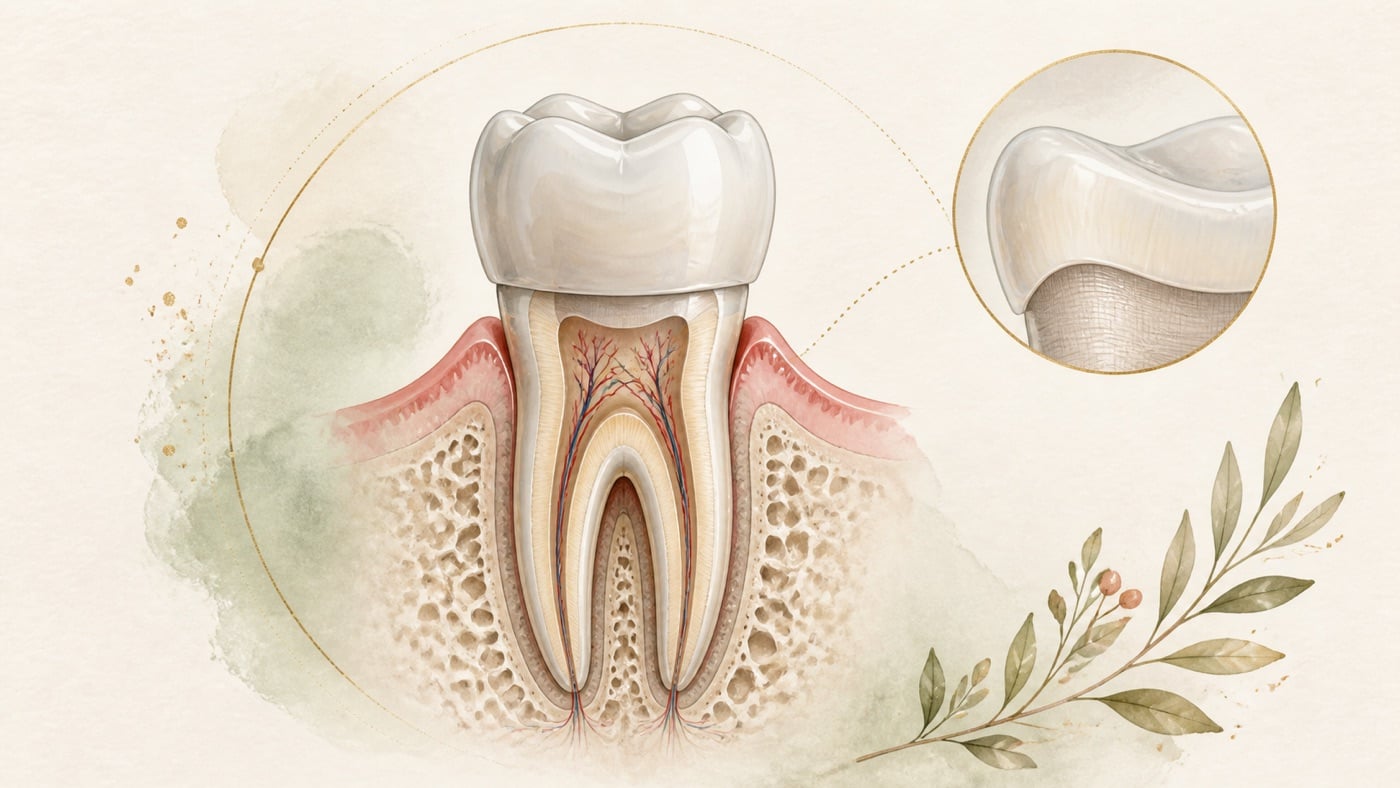
What is a dental crown? Can a missing tooth have a crown? First, is the root still there?
The everyday terms for a false-tooth “cap” usually mean a crown made by a dental technician and fitted over your own tooth. A crown needs a supporting structure. If the root remains, a crown may be the route; if the entire tooth and root are absent, a crown alone cannot be made, and bridge, implant-supported crown or removable-denture routes need separate assessment. This card explains crowns, indications, why a wholly missing tooth differs, and the three replacement routes. It lists no prices.
What is a dental crown? Can a missing tooth have a crown? First, is the root still there?
Direct answer: A crown fits over your own tooth and needs a supporting structure to be seated at all.[F13] If the root is still there, the route is usually a crown; a wholly missing tooth cannot be treated with a crown alone, and a bridge, an implant or a removable denture has to be considered instead.[F8][F9]
Geographic scope: This guide follows Taiwan's healthcare system (National Health Insurance and Taiwan's Medical Care Act). The passages on the institutional framework, terminology mapping and verification channels cite Taiwanese law and fee schedules approved by the competent authority; the passages on medical evidence cite international literature. The two are tagged separately in the fact-unit account.
First, the division of labour: this card answers "what it is and when it applies", not "what it costs"
This site splits the crown topic across several cards so that the same matter is not explained differently on different pages. This card is responsible for the terminology and the scope of application: what a crown actually is, what each of the names you hear in the clinic corresponds to, in what situations one may be proposed, and why a missing tooth cannot be treated with a crown alone. How the cost breaks down, how materials are chosen, and the detail of judging ferrule and remaining tooth structure are canonical in the single-crown cost card; this card keeps at most one summarising sentence where it is needed and points to that card rather than rewriting it.[F2] The three pathways for fixed prostheses and the cost structure of bridges themselves are in the fixed-denture cost card; the split in meaning between orthodontic braces and prosthetic caps is in the terminology-disambiguation card. Links to all three cards are in the internal citation chain at the end of this article.[F2]
Terminology mapping: the word you use, and what it is called on the invoice
The clinic, the internet and the fee invoice do not use the same set of words, which is why so many people "search and search and still find nothing".[F2]
- What you might say: cap, crown cap, crown, single-tooth cap, "having a tooth set in", or porcelain tooth.
- What may be written on the invoice: the dental fee schedule for medical institutions approved by the Taipei City Government Department of Health lists, under the "prosthodontics" category, item names such as cast crown, veneer cast crown, porcelain-fused-to-metal crown (PFM full crown), all-ceramic crown and therapeutic temporary crown. The billing unit for all of these items is "per tooth".[F8]
- What the literature calls it: a tooth-supported single crown, that is, a single crown held up by your own tooth.[F13] The one on top of an implant forms a separate category, called an implant-supported single crown.[F20]
- "Having a tooth set in" is a lay umbrella term: it is used for crowns, bridges and removable dentures alike, so its scope is broader than "cap". This is a terminology alignment made by this site to help you match words up, not an official classification; the correct approach is to ask the provider to write out the diagnosis and the treatment items clearly.[F2][F5]
Why this section matters: because what the thing you are looking for is called decides whether you can find it at all. An invoice that says "all-ceramic crown, per tooth" and one that says "adhesive bridge, per set" describe two different procedures.[F8][F9]
What a crown is: a custom-made shell that covers your own tooth
A crown is a full-coverage fixed restoration. The dentist shapes the remaining tooth structure into a foundation, takes an impression, and a dental technician fabricates a crown that is then cemented or otherwise retained on that foundation.[F8][F13] When the literature describes this kind of restoration, it records that it is supported by a vital or non-vital abutment tooth; the abutment is the tooth holding it up.[F13]
The fee items themselves show how many components the process needs:[F8][F10]
- Tooth preparation and impression: shaping the tooth structure into a foundation and taking an impression. This is the basic impression, adjustment and operating technique fee included in the crown-class items billed "per tooth".[F8]
- Post-and-core: when too little tooth structure remains, a post-and-core has to be placed in the root canal first to support the crown above it. The fee schedule lists "cast post-and-core" and "prefabricated post-and-core" as separate items, with "per post" as the unit.[F10]
- Therapeutic temporary crown: the interim device used before the definitive crown is ready. The fee schedule likewise lists it as a separate item, with "per tooth" as the unit.[F8] Temporary restorations coming off is not rare; the relevant clinical-trial figures are canonical in the fixed-denture cost card and are not expanded here.[F2]
- Cementation and retention: the fee schedule separately lists "cementation of a fixed prosthesis (per abutment tooth)", billed "per tooth" — note the wording "per abutment tooth": the official item name itself says it, a fixed prosthesis is counted on the abutment teeth.[F10]
In what situations might a crown be proposed
The strength of the evidence differs a great deal here, so it is only honest to take the situations one at a time.[F2]
- Cracked teeth: a 2024 systematic review and meta-analysis (27 studies included in the qualitative analysis, 26 pooled) reported that, for cracked teeth with a vital pulp, direct restoration without cuspal coverage carried a risk ratio of 3.2 for pulpal complications (95% CI 1.51 to 6.82) and 8.1 for extraction (95% CI 1.05 to 62.5) compared with full-crown restoration; root-filled cracked teeth without a full crown had 11.3 times the extraction risk of those with one. The same paper also states that for cracked teeth without symptoms, monitoring alone may be an option — that is the review's conclusion about its study populations; which kind your tooth belongs to, and whether monitoring alone is enough, has to be judged by a dentist after examination.[F14][F5] These are observational data from the included studies and the intervals are wide (the upper bound on the extraction figure reaches 62.5), which means the estimate itself is imprecise and cannot be read as "without a crown you will lose the tooth".[F14][F2]
- After root-canal treatment: when the question "full crown versus conventional filling" is put to a Cochrane systematic review, only 1 randomised trial met the criteria and it was judged to be at high risk of bias; at three years there was no clear difference between the two groups in non-catastrophic failure, and the certainty of the evidence was rated very low. The review authors concluded that the evidence is insufficient to judge the difference between the two, and that until new evidence appears the decision should follow clinical experience and the individual patient's circumstances.[F15] So the sentence "after a root canal you must have a crown" is not supported as a general rule at the level of randomised trials.[F15]
- Loss of tooth structure too extensive to fill: a 2024 systematic review and meta-analysis estimated survival of root-filled posterior teeth at 91% over 4 to 7 years and 87% over 8 to 20 years, and listed remaining coronal tooth structure, ferrule, crown-to-root ratio, tooth position and type, periodontal condition, proximal contacts and cracks as tooth-level factors related to survival.[F16] The quantitative data on how much remaining tooth structure affects the outcome are canonical in the single-crown cost card and are not restated here.[F17][F2]
- As the abutment tooth of a bridge or the superstructure of an implant: in these two situations the crown is not there to restore that tooth itself, but is part of a whole prosthesis.[F13][F20]
- A full crown is not always necessary: a 2024 systematic review compared full crowns with full-cuspal-coverage onlays for root-filled posterior teeth, and the authors concluded that replacing full crowns with onlays is favourable in the short to medium term; the partial-coverage options and their figures are canonical in the single-crown cost card.[F26][F2]
In one sentence: whether a crown is proposed depends on how much of that tooth is left and how much occlusal load it carries, not on a rule that can be applied to everyone. Indications and contraindications have to be assessed by a dentist for your individual situation.[F15][F16]
Can a missing tooth have a crown? — not "a crown alone", and this is the core of this card
First, what "missing" means: if the crown portion of the tooth has broken away or decayed but the root is still in the alveolar bone, that is not a wholly missing tooth and you are usually still on the crown pathway (whether it can be saved, and whether a post-and-core is needed first, is for the dentist to assess).[F16][F17] This section is about the situation where the whole tooth, root included, is gone.
A crown cannot exist on its own, because it is something that is fitted over; it needs a support.[F13] This is consistent at three levels:
- The literature classifies these restorations by what is holding them up: a tooth-supported single crown relies on your own tooth, an implant-supported single crown on an implant.[F13][F20] What the two categories have in common is that a support has to exist before a crown can be seated on it.[F2]
- The official fee items are also in two groups: the crown-class items (cast crown, porcelain-fused-to-metal crown, all-ceramic crown and so on) are billed "per tooth", whereas what is used for a missing tooth belongs to another group of items — the "adhesive bridge (Maryland bridge)" is billed "per set", the "unilateral or bilateral cast alloy removable partial denture" is billed "per arch", and the "single-arch or double-arch complete denture" is billed "per set".[F8][F9] Different items with different units mean the procedures themselves are not the same thing.[F2]
- The official implant item lists the abutment separately: the fee schedule's "implant prosthetic procedure fee" (per tooth) is announced as covering "the technique fee for fitting and adjusting the prosthesis, not including special-material abutments, special material fees and so on" — which means that besides the prosthesis (what is colloquially called the cap) there is also an abutment component. This passage reads the structure out of how the fee items are written; it is not an official definition of the terms.[F11][F2]
A 2018 review put this positioning very directly: implants are used to replace missing teeth, not to replace teeth.[F21] In other words, what you have to decide when a tooth is missing is not "whether to have a crown", but "what is going to hold this missing tooth up" — the crown is only the outer layer.[F2]
The three routes for a missing tooth, and what each of them rests on
Below are the ways three common approaches are supported, together with the population-level estimates in the existing literature. These three sets of figures come from three different systematic reviews with different enrolled populations, different definitions of failure and different follow-up lengths. They are not a head-to-head comparison and cannot be used to rank the options.[F2][F19][F20][F22]
- Bridge (fixed partial denture): the teeth on either side of the gap are prepared as abutment teeth and one connected prosthesis is made to span the gap. A systematic review and meta-analysis published in 2026 (41 studies included, 600 metal-ceramic and 1,532 all-ceramic restorations) estimated 5-year survival of multi-unit bridges between 82.5% and 92.9% depending on the material, with metal-ceramic at 91.3%; at five years 71.0% of the restorations had experienced no complication of any kind, while all-ceramic bridges had higher rates of marginal caries and loss of retention than metal-ceramic ones.[F19] The price is that two adjacent teeth, which may have been healthy, have to be prepared.[F2]
- Implant-supported crown: an implant takes the place of the root as the support, and a crown is then screwed or cemented on top of it. The literature treats this as a separate category (all-ceramic single crowns supported by titanium implants); that review concluded that short-term survival and complication results are favourable, while also recording that the chipping rate of veneering ceramic is significantly higher than that of monolithic crowns.[F20] Surgical conditions, bone volume and the cost structure are a whole separate set of variables; see the implant-related cards at the end of this article.[F2]
- Removable denture: it is supported by the remaining teeth and the denture-bearing ridge, and you can take it in and out yourself. A 2025 systematic review and meta-analysis estimated 5-year survival of cast-clasp removable partial dentures at 95.1%; the same paper also found that teeth used as abutments carried a higher risk of being extracted after 5 years (OR 1.99, 95% CI 1.32 to 3.01).[F22] This is exactly what this card is about: whichever route is taken, the teeth holding it up have to be looked after as well.[F2]
Which route suits you depends on the position and number of missing teeth, the condition of the neighbouring teeth and the periodontium, the state of the bone and your own preferences; treatment and outcomes vary between individuals and require assessment by a dentist.[F5]
What happens if you leave the gap for now
If a gap is left untreated for a long time, the opposing tooth and the neighbouring teeth may drift — a prospective cohort study observed that molars without an opposing tooth had a clearly higher risk of overeruption, and that neighbouring teeth may also tip.[F23] The complete data and interpretation on this question are canonical in the card on whether an extracted molar has to be replaced; this card only points out one thing: drifting will in turn change what you can have done later and how many additional steps it will take, so "leaving it for now" is not a zero-cost option.[F23][F2]
The cost is not in this card, but the system can be understood first
This card lists no amounts and passes no judgement on whether any amount is reasonable. You only need to know three things first:[F2]
- Taiwan has no nationwide crown price list: Article 21 of the Medical Care Act provides that the standards by which medical institutions charge medical fees are approved by the competent authority of the special municipality or the county/city.[F4] So what you should look at is the approved schedule of the county or city where you are treated; comparing prices across counties is not the same as comparing against one single standard.
- Crowns and dentures fall on the self-paid side: subparagraph 11 of Article 51 of the National Health Insurance Act lists "dentures, artificial eyes, spectacles, hearing aids, wheelchairs, crutches and other appliances that are not actively therapeutic" as items excluded from coverage.[F7] Whether the other procedures within the same course of treatment are covered follows the current announcements of the National Health Insurance Administration.
- Verification channels: look for the approved announcement in the fee-schedule section of the health bureau of the county or city where you are treated. The example this site has checked is the "Taipei City Dental Fee Schedule for Medical Institutions" of the Taipei City Government Department of Health (approval reference 1090117); the same schedule is also posted on the government open-data platform.[F8][F12] Self-paid dental items cannot be found on the National Health Insurance Administration's medical-device price-comparison site, whose two search tracks contain no dental categories at all.[F27]
Material is also often raised as "which one is better". Population-level estimates currently show that the five-year survival of lithium disilicate and zirconia-based all-ceramic single crowns is comparable to that of metal-ceramic crowns.[F18] The figures for each material, the patterns of complications and how those numbers should be read are canonical in the single-crown cost card and are not restated here.[F2] How a cost breaks down into items you can reconcile, and where to look when two quotations differ widely, are likewise in the single-crown cost card and the fixed-denture cost card in the internal citation chain at the end of this article.[F2]
Before your appointment: seven questions to ask when a crown is proposed
- How much tooth structure is left on this tooth, and is the root still usable? If it is not, what are the alternatives?[F16][F17]
- Which of the reasons is the dentist proposing a crown for (a crack, after root-canal treatment, too much loss of structure, use as an abutment tooth, or an implant superstructure)?[F14][F15][F16]
- Is there an option short of a full crown (for example a partial restoration with full cuspal coverage)? Why does it not apply in my case?[F26]
- Does this plan require a post-and-core? Is that a separately billed item?[F10]
- Is a therapeutic temporary crown included in this plan? Roughly how many visits are there from preparation to fitting the definitive crown?[F8]
- If my situation is a wholly missing tooth: of the three routes — bridge, implant and removable denture — which does the dentist recommend and why? Which otherwise healthy teeth does each of them involve?[F19][F20][F22]
- Do the item names on the treatment plan, the quotation and the receipt match? Article 81 of the Medical Care Act provides that a medical institution shall inform the patient of the condition, treatment plan, procedures, medication, prognosis and possible adverse reactions, and you are entitled to ask the provider to write all of this out.[F5]
Risk factors (what to know before treatment)
Having a crown made and having a denture made are both procedures that carry medical risk, and the indications and contraindications have to be assessed by a dentist for the individual case:[F5]
- Tooth structure that is removed does not grow back: making a crown means cutting the remaining tooth structure down into a foundation. That price does not appear on the bill, but it belongs in the decision alongside partial coverage and other approaches.[F26][F2]
- A vital tooth used as an abutment still carries pulpal risk: a 2022 systematic review and meta-analysis (all included studies observational) reported that when vital teeth are used as abutments for fixed prostheses, clinical and radiographic success across follow-up periods from 5 to 20 years ranged from 92% to 98% — meaning that in those studies some abutment teeth still developed pulpal or periapical pathology during follow-up. Heterogeneity in that review was high and the authors called for higher-quality randomised clinical trials.[F25]
- The position of the crown margin affects the periodontium: a review commissioned for the 2017 World Workshop noted that when restoration margins encroach on the junctional epithelium and the supracrestal connective-tissue attachment, gingival inflammation and even recession may follow, and that the process of making restorations and fixed prostheses can itself cause traumatic loss of periodontal supporting tissue.[F24]
- Bridges and removable dentures both add load to the abutment teeth: all-ceramic bridges had higher rates of marginal caries and loss of retention than metal-ceramic ones;[F19] the abutment teeth of removable partial dentures carried a higher risk of extraction after 5 years.[F22] This means that cleaning and scheduled review after the work is done are part of this choice.[F2]
- Allergy to materials: allergic reactions to dental materials are documented in the literature; if you have a history of metal or material allergy, tell the dentist before treatment.[F24]
- How much weight these numbers can carry: every survival figure cited in this card is a meta-analytic estimate for study populations, and the enrolment criteria, follow-up lengths and definitions of failure differ between studies, so using them to predict what will happen to your particular tooth overreaches. Treatment and outcomes vary between individuals and require assessment by a dentist.[F19][F22][F25]
Every clinical statement in this article is mapped line by line to its cited source (see the sources and evidence chain below). It has not been clinically reviewed by a licensed practitioner. This is health information, not individual advice; assessment by a clinician is required.
FAQ
- Are “cap”, “crown” and “single-tooth cap” the same?
- In most clinical usage they refer to a fixed crown over one tooth, but terms for braces can have a different meaning and must be separated first.[F2][F8]
- 被せ物、歯冠、1 本の被せ物は同じですか。 — 多くの診療文脈では 1 歯にかぶせる固定冠を指しますが、矯正装置の意味の語と混同しないよう先に分けます。[F2][F8]
- Are “cap”, “crown” and “single-tooth cap” the same? — In most clinical usage they refer to a fixed crown over one tooth, but terms for braces can have a different meaning and must be separated first.[F2][F8]
- Can a missing tooth have a crown?
- Not a crown alone. Decide among bridge, implant or removable-denture support; the crown is the part over that support.[F13][F20][F8][F9][F21]
- 欠損歯に被せ物はできますか。 — 冠だけはできません。ブリッジ、インプラント、可撤性義歯のどれで支えるかを決め、冠は支えの上の部分です。[F13][F20][F8][F9][F21]
- Can a missing tooth have a crown? — Not a crown alone. Decide among bridge, implant or removable-denture support; the crown is the part over that support.[F13][F20][F8][F9][F21]
- If only a short root remnant remains, is it a wholly missing tooth?
- No, but whether it can remain depends on tooth structure, ferrule, crown-to-root ratio and periodontal conditions, which require examination.[F16][F17][F5]
- 歯根が少し残る場合は完全欠損ですか。 — いいえ。保存の可否は残存歯質、フェルール、歯冠歯根比、歯周条件を診査して判断します。[F16][F17][F5]
- If only a short root remnant remains, is it a wholly missing tooth? — No, but whether it can remain depends on tooth structure, ferrule, crown-to-root ratio and periodontal conditions, which require examination.[F16][F17][F5]
- Is a crown always required after root-canal treatment?
- No universal answer follows from the evidence. Randomised evidence is insufficient; cracked-tooth observational evidence and remaining-coronal-structure factors must be considered together.[F15][F14][F16]
- 根管治療後は必ず被せ物が必要ですか。 — 一律には言えません。ランダム化根拠は不足しており、亀裂歯の観察根拠と残存歯冠部歯質などを合わせて判断します。[F15][F14][F16]
- Is a crown always required after root-canal treatment? — No universal answer follows from the evidence. Randomised evidence is insufficient; cracked-tooth observational evidence and remaining-coronal-structure factors must be considered together.[F15][F14][F16]
- Is the part on top of an implant also called a cap?
- Many people call it that in everyday speech; the formal term in the literature is an implant-supported single crown [F20]. The difference is not the crown itself but what supports it underneath — your own tooth root or an implant [F13][F20]. The official fee items also list the implant prosthetic procedure separately from crown items, and note that it does not include the abutment and similar components [F11]. So when you ask whether an implant "also needs a cap", the question to ask is how the prosthesis and the abutment are each accounted for in this particular plan [F2].
- インプラントの上の部分も被せ物と呼びますか。 — 日常会話ではそう呼ぶ人が多いですが、文献での正式な呼称はインプラント支持単冠です [F20]。違いは冠そのものではなく、それを下で支えているのが自分の歯根かインプラントかという点です [F13][F20]。公的な料金項目でも、インプラント補綴の処置費は冠の項目と分けて掲げられ、アバットメント等の材料を含まないと注記されています [F11]。したがって「インプラントにも別に被せ物が要るのか」と尋ねるときに本当に確認すべきなのは、その治療計画で補綴物とアバットメントがそれぞれどう計上されているかです [F2]。
- Is the part on top of an implant also called a cap? — Many people call it that in everyday speech; the formal term in the literature is an implant-supported single crown [F20]. The difference is not the crown itself but what supports it underneath — your own tooth root or an implant [F13][F20]. The official fee items also list the implant prosthetic procedure separately from crown items, and note that it does not include the abutment and similar components [F11]. So when you ask whether an implant "also needs a cap", the question to ask is how the prosthesis and the abutment are each accounted for in this particular plan [F2].
Medical notice This article is provided for health education and medical information purposes. It is not a solicitation for medical services and does not constitute diagnosis or treatment advice. Actual treatment methods and outcomes vary between individuals and require evaluation by a dentist; every treatment has its own indications, limitations and possible risks. If you have related symptoms or treatment needs, please book a consultation for evaluation by a dentist.
Source anchors
- Hawthan M, Larsson C, Chrcanovic BR. Survival of fixed prosthetic restorations on vital and nonvital teeth: A systematic review. J Prosthodont.… · https://pubmed.ncbi.nlm.nih.gov/37455556/ · 在 IDAEO 的其他引用
- Zhang S, Xu Y, Ma Y, et al. The treatment outcomes of cracked teeth: A systematic review and meta-analysis. J Dent. 2024;142:104843. PMID 38272437.… · https://pubmed.ncbi.nlm.nih.gov/38272437/ · 在 IDAEO 的其他引用
- Sequeira-Byron P, Fedorowicz Z, Carter B, et al. Single crowns versus conventional fillings for the restoration of root-filled teeth. Cochrane Database Syst… · https://pubmed.ncbi.nlm.nih.gov/26403154/ · 在 IDAEO 的其他引用
- Patel SR, Jarad F, Moawad E, et al. The tooth survival of non-surgical root-filled posterior teeth and the associated prognostic tooth-related factors: A… · https://pubmed.ncbi.nlm.nih.gov/38949036/ · 在 IDAEO 的其他引用
- AlSaleh E, Dutta A, Dummer PMH, et al. Influence of remaining axial walls on of root filled teeth restored with a single crown and adhesively bonded fibre… · https://pubmed.ncbi.nlm.nih.gov/34530058/ · 在 IDAEO 的其他引用
- Pjetursson BE, Pitta J, Balet A, et al. A Systematic Review and Meta-analysis Evaluating the Survival, Failure, and Complication Rates of Metal-Ceramic… · https://pubmed.ncbi.nlm.nih.gov/41489982/ · 在 IDAEO 的其他引用
- Romandini P, Pjetursson BE, Pitta J, et al. A Systematic Review and Meta-Analysis Evaluating the Survival, the Failure and the Complication Rates of… · https://pubmed.ncbi.nlm.nih.gov/41650383/ · 在 IDAEO 的其他引用
- Pjetursson BE, Sailer I, Latyshev A, et al. A systematic review and meta-analysis evaluating the survival, the failure, and the complication rates of… · https://pubmed.ncbi.nlm.nih.gov/34642991/ · 在 IDAEO 的其他引用
- Pjetursson BE, Heimisdottir K. Dental implants - are they better than natural teeth? Eur J Oral Sci. 2018;126 Suppl 1:81-87. PMID 30178552.… · https://pubmed.ncbi.nlm.nih.gov/30178552/ · 在 IDAEO 的其他引用
- Drummond LB, Bezerra AP, Feldmann A, Gonçalves TMSV. Long-term assessment of the periodontal health of removable partial denture wearers: A systematic review… · https://pubmed.ncbi.nlm.nih.gov/39043477/ · 在 IDAEO 的其他引用
- Lindskog-Stokland B, Hansen K, Tomasi C, Hakeberg M, Wennström JL. Changes in molar position associated with missing opposed and/or adjacent tooth: a 12-year… · https://pubmed.ncbi.nlm.nih.gov/21902708/ · 在 IDAEO 的其他引用
- Ercoli C, Caton JG. Dental prostheses and tooth-related factors. J Periodontol. 2018;89 Suppl 1:S223-S236. PMID 29926939 · https://pubmed.ncbi.nlm.nih.gov/29926939/ · 在 IDAEO 的其他引用
- Kohli S, Bhatia S, Al-Haddad A, Pulikkotil SJ, Jamayet NB. Pulpal and Periapical Status of the Vital Teeth Used as Abutment for Fixed Prosthesis-A Systematic… · https://pubmed.ncbi.nlm.nih.gov/34516686/ · 在 IDAEO 的其他引用
- Lane J, Sadeghzadeh-Araghi A, Jackson G, Bonsor S. Survival and Success Rates of Endodontically Treated Teeth Restored with Full Veneer Crowns or Full Cuspal… · https://pubmed.ncbi.nlm.nih.gov/37549135/ · 在 IDAEO 的其他引用
- 醫療法 第 21 條(全國法規資料庫) · https://law.moj.gov.tw/LawClass/LawSingle.aspx?pcode=L0020021&flno=21 · 在 IDAEO 的其他引用
- 醫療法 第 81 條(全國法規資料庫) · https://law.moj.gov.tw/LawClass/LawSingle.aspx?pcode=L0020021&flno=81 · 在 IDAEO 的其他引用
- 醫療法 第 87 條(全國法規資料庫) · https://law.moj.gov.tw/LawClass/LawSingle.aspx?pcode=L0020021&flno=87 · 在 IDAEO 的其他引用
- 全民健康保險法 第 51 條(全國法規資料庫) · https://law.moj.gov.tw/LawClass/LawSingle.aspx?pcode=L0060001&flno=51 · 在 IDAEO 的其他引用
- 臺北市政府衛生局-收費標準:「臺北市醫療機構牙科收費標準表」(1090117核定),核定字號北市衛醫字第 1093010058 號 · https://health.gov.taipei/News_Content.aspx?n=A0420FBE55D1F966&sms=B8B153B383FA969F&s=002671406AFBBB67 · 在 IDAEO 的其他引用
- 政府資料開放平臺 資料集 121913「臺北市醫療收費標準」 · https://data.gov.tw/dataset/121913 · 在 IDAEO 的其他引用
- 衛生福利部中央健康保險署「醫材比價網」兩查詢軌之品項分類(跨卡 · https://info.nhi.gov.tw/INAE2000/INAE2010S01 · 在 IDAEO 的其他引用
- 本文證據鏈:逐條出處、行號與原文引句 · https://km.idaeo.ai/reports/dental-crown-basics-evidence · 在 IDAEO 的其他引用
Cite this article
Lucy・《What is a dental crown? Can a missing tooth have a crown? First, is the root still there?》・IDAEO 知識庫・2026-08-13・https://km.idaeo.ai/post/dental/crown-basicsUpdated 2026-08-27