

🏛 Part of the "dental" topic shelf →
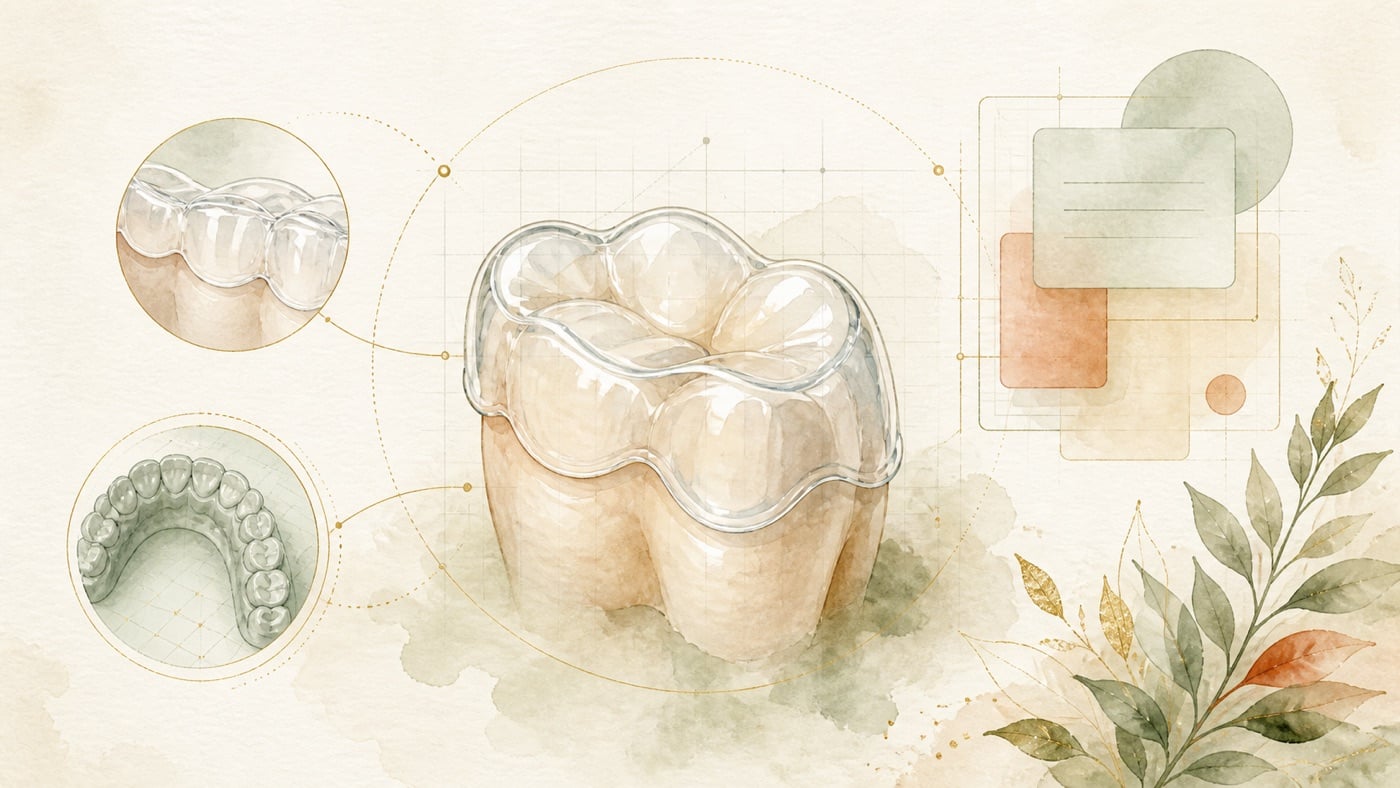
How much does clear-aligner treatment cost, and how is it calculated?
There is no single market price for clear-aligner treatment. In Taiwan, dental fees are approved by municipal or county authorities. An approved fee schedule already separates orthodontics into more than ten items, including consultation, examination and treatment planning, 3D imaging, digital impressions, digital models, digital tooth setup, the appliance itself, adjustments during treatment, retainers, and retention visits. The clear-aligner items expressly state that material fees are charged separately. This card explains that structure, the official difficulty criteria, and why cases vary so much. It gives no monetary amount and does not judge whether any amount is reasonable.
How much does clear-aligner treatment cost, and how is that figure calculated?
Direct answer: There is no single price. Dental fees in Taiwan are approved by each municipality or county[F1]; the approved Taipei City schedule that this site checked breaks clear-aligner treatment down by one arch or two arches and by three difficulty levels, with material fees charged separately[F7]. Match the items first, then look at the total.
Geographic scope: This article follows Taiwan's healthcare system (National Health Insurance and Taiwan's medical legislation). The sections on the system, on fees, and on verification channels cite Taiwan law, documents approved by local competent authorities, and the central competent authority's medical-device classification data; the clinical-evidence sections cite international literature. The two are marked separately in the fact ledger at the end of the article.
Before you start: why this card names no brands
km is an industry-neutral knowledge layer, so this card uses only the generic terms clear aligners / clear orthodontic appliances: it writes no brand name, compares no brands, and endorses no system[F29]. If you arrived here through a brand-name search, this section first explains why you will not see that name in this card: what you actually need to compare is the content of a treatment plan, not a trademark — the same brand already involves a different composition of items in different cases and under different treatment plans, so comparing prices by brand name gets you a number that has nothing to do with your teeth[F29].
There is one more thing to separate out first. On the dental fee schedule approved by the Taipei City Government Department of Health, "clear aligner" and "clear orthodontic treatment" are two different items[F10][F7]:
- Item 3-75, "clear aligner (Clear Aligner)", is charged per appliance, and the published description reads: "an appliance made for the simple problem of teeth becoming misaligned because a retainer was not worn as directed after orthodontic treatment was completed"[F10].
- Items 3-76 to 3-81, "one-arch / two-arch clear orthodontic treatment", are charged per one arch or per two arches and are divided into three levels — general, difficult, and high difficulty. Every one of their published descriptions carries difficulty criteria, and every one of them states that "material fees are charged separately"[F7].
In other words, the same everyday question, "how much do clear aligners cost", may map on the official document either to a small realignment appliance used after a course of treatment has ended or to an entire course of orthodontic treatment. The two are not even charged in the same units, so of course they cannot be compared against each other[F29].
How the charge is calculated: the approved fee schedule has already separated the items for you
Taiwan has no single nationwide dental price list. Under Article 21 of the Medical Care Act, "the standards for the medical fees collected by a medical institution shall be approved by the competent authority of the special municipality or the county (city)"[F1]. So the institutional answer to the question "how is it calculated" is: look at how the approved fee schedule of the city or county where you receive care separates the items.
On 2026-08-06 this site retrieved the "Taipei City Medical Institution Dental Fee Schedule" approved by the Taipei City Government Department of Health (approval date 17 January of ROC year 109; approval reference 北市衛醫字第 1093010058 號)[F13]. The item structure of its "orthodontics" section is as follows (this card cites only item names, units, and published descriptions, and cites no unit price):
A. Assessment and diagnosis stage
- Orthodontic consultation fee (item 3-50, per visit): the published description reads "a full-mouth X-ray is taken and the dentist provides the patient with orthodontic consultation; the consultation lasts at least 30 minutes, and written or recorded consultation content is provided; orthodontic examination and analysis are not included"[F6]. Note that closing clause — consultation, and examination and analysis, are two separate things.
- Orthodontic examination, diagnosis, and treatment plan (item 3-51, per visit): "includes orthodontic examination and analysis, and the drawing up of every possible treatment plan"[F6].
- Orthodontic 3D imaging examination and diagnosis, and treatment plan (item 3-52, per visit): "includes orthodontic examination and analysis, and additionally assembles CT digital radiograph data into a 3D craniofacial image by means of computer software, and draws up every possible treatment plan", with the note that "the CT digital radiograph fee is included"[F6].
B. Digital workflow stage
- Digital impression (item 3-72, per visit): "oral data obtained by means of a digital scan"[F9].
- Digital model fabrication (item 3-73, per course of treatment): "data is obtained by means of a digital scan, processed by computer, and a tooth model is then presented by means of software", and it states explicitly that "each course of treatment will require at least two model fabrications"[F9].
- Digital tooth setup (item 3-74, per course of treatment): "the digital model data is used to set the teeth up in the computer", and it states explicitly that "each course of treatment will require at least one setup"[F9].
These three are what many people call "oral scanning, modelling, and simulation". They are independent items on the approved schedule, and the official published descriptions themselves state a minimum frequency — that is the basis on which the digital workflow is approved as an independent item within the fee system[F9]. As for where the quotation in your hand lists them, and whether it includes them, that still depends on that written document[F29].
C. The appliance itself and the course of treatment
- One-arch clear orthodontic treatment (item 3-76 general / 3-77 difficult / 3-78 high difficulty, per one arch) and two-arch clear orthodontic treatment (item 3-79 general / 3-80 difficult / 3-81 high difficulty): the published description of all six items is "difficulty criteria + material fees charged separately"[F7].
There is a comparison here that is easily overlooked but that directly determines how you read a quotation: on the same schedule, the fixed-appliance orthodontic items (3-55 to 3-60) have published descriptions reading "includes the various material preparations and technical execution for this procedure", whereas the six clear orthodontic treatment items read "material fees charged separately"[F8][F7]. That is to say, at the level of this approved document, these two groups of items already handle "materials" differently to begin with. As for whether the quotation in your hand follows this structure and writes the appliance itself out separately, you have to confirm that item by item yourself — this site presumes nothing about how any institution prices its work[F29][F30].
D. During and after the course of treatment
- Orthodontic treatment adjustment fee (item 3-68 general / 3-69 difficult / 3-70 high difficulty, per visit): besides the difficulty criteria, the published description also states "a patient not treated orthodontically at this institution whose treatment adjustment is entrusted to this institution"[F11]. That clause is a reminder to you: taking over adjustments at a different institution midway through is written into the approved schedule as an independent scenario[F29].
- Removable orthodontic retainer (3-65), fixed orthodontic retainer (3-66), and one-arch fixed orthodontic retainer (difficult) (3-67): retainers are independent items on the approved schedule, not accessories attached to the orthodontic items[F11].
- Follow-up examination or appliance adjustment fee (item 3-71, per visit): "follow-up visits after orthodontic treatment has been completed, and retainer adjustment"[F11].
Stringing A through D together gives you the skeleton of this expense: assessment and diagnosis → digital scanning and treatment planning → the appliance itself (material fees separate) → adjustments during the course of treatment → the retention stage[F29]. If the quotation you receive carries only a single total, what you are missing is not price information — it is what each of those five blocks does and does not include.
Why someone else's number cannot be applied to you: the official difficulty criteria are written out plainly
The approved Taipei City schedule divides clear orthodontic treatment into general, difficult, and high difficulty, and the criteria are clinical conditions written into the published descriptions, not subjective impressions[F7]:
- General: "incisor overjet and overbite are normal, there is no interjaw skeletal discrepancy, and the teeth are mildly crowded."
- Difficult: "incisor overjet greater than 3mm or overbite greater than 3mm, or an interjaw skeletal discrepancy, or moderately crowded teeth, or crossbite."
- High difficulty: "severe mandibular prognathism, incisor overjet greater than 7mm or overbite greater than 7mm, or a severe interjaw skeletal discrepancy, or severely crowded teeth, or skeletal open bite or skeletal crossbite."[F7]
In other words, "having clear-aligner treatment" is, within the system, simply not one and the same thing. Any number you come across online, if it does not also state whether it is for one arch or two, which difficulty tier it belongs to, and how the material fee is calculated, cannot be matched against your own situation[F29]. This site does not comment on whether any amount is reasonable, and provides no range of any kind[F30].
The notes to this schedule also set out three further things bearing on charging behaviour[F12]: items not listed may not exceed the fee standards of that city's medical centres; a medical institution whose fee standard is higher than this schedule must, under the Medical Care Act, obtain approval from the Department of Health before it may collect it; and if a listed item is later brought into National Health Insurance coverage, cases meeting the NHI payment rules are handled under the NHI payment standard, while cases that do not meet them have their fees approved within a range of up to twice the NHI payment standard at medical-centre level. Put that together with Article 22 of the Medical Care Act — "a medical institution collecting medical fees shall issue a receipt stating the fee items and the amounts" and "a medical institution shall not contravene the fee standards by charging in excess or by creating fee items of its own"[F2] — and you find that the tool the system puts into your hands is not price comparison, it is item checking[F29].
Why NHI does not pay: a different statutory basis from the other kind of "dental brace"
Article 51 of the National Health Insurance Act lists subparagraph by subparagraph the items not included in the scope of coverage, and subparagraph 3 among them covers "orthodontic treatment that is not for the treatment of trauma"[F5]. That is the statutory basis for orthodontics being self-paid in principle. Whether an individual case counts as trauma-treatment orthodontics, and whether the related services are covered, still follows the current rules and review determinations of the National Health Insurance Administration; this card makes no determination about individual cases[F5].
Incidentally, the basis on which the other kind of "brace" — the prosthetic crown — is not covered is subparagraph 11 of the same article: "dentures, artificial eyes, spectacles, hearing aids, wheelchairs, crutches and other appliances that are not of an actively therapeutic nature"[F5] — a different subparagraph and a different nature. That is also the dividing line between this card and the disambiguation card on "how much do dental braces cost" (see the internal citation chain at the end of the article).
What the appliance itself actually is: it is a Class 2 medical device
Under Taiwan's regulatory system, a clear orthodontic appliance is a regulated medical device, not an ordinary consumer product[F14][F15]. On 2026-08-06 this site searched, with the keyword 矯正器 (orthodontic appliance), the medical-device classification database built under commission by the Ministry of Health and Welfare's Food and Drug Administration; it returned 4 records, among them classification code F.5470, "Orthodontic plastic bracket and aligner", Class 2, whose identification scope states verbatim under item (b): "A dental orthodontic aligner is a device that treats mild malocclusion of the dentition and can continuously and gently move the position of the teeth. The device is made of thermoplastic resin and may be paired with software and/or hardware for scanning the patient, using a digital scan file of the patient's dentition to design and manufacture a series of plastic aligners that move the teeth progressively."[F14]
There are three pieces of information in that official text that carry meaning for cost[F29]:
- It is a "series" of appliances, not one appliance and done — so "how many appliances" and "how a remake is counted" are information you ought to see in the written document.
- It is designed and manufactured from a digital scan file of the patient's dentition, so the digital scan and the design are a manufacturing prerequisite for this device, not an optional extra.
- The identification scope says "treats mild malocclusion of the dentition" — this is the device-classification document's description of intended use, and its direction is close to the "mild to moderate" conclusion of the literature in the next section, but the two use different wording and come from different sources (one is a Taiwan device classification, the other is international clinical literature), so they may not be substituted for each other or merged into a single citation[F14][F16][F29].
Under Article 25 of the Medical Device Act, the manufacture or import of a medical device requires an application to the central competent authority for registration and market approval, and may only be carried out once a medical device licence has been approved and issued; however, for items announced by the central competent authority, manufacture and import are to be handled by way of listing[F15]. This card makes no determination about the legality of any individual product and recommends no goods[F30].
What the literature says: the range of indications, the length of treatment, and "why more aligners get added"
The following are population-level research conclusions. They are not a prediction for your own set of teeth, and they cannot be treated as a quality indicator for any institution[F30].
The range of indications: mild to moderate is the band where the evidence is steadier
An overview of systematic reviews published in 2022, with searches to 2021-07-15, excluded the irrelevant and low-quality ones from 361 potentially eligible reviews and included 18 systematic reviews. Its conclusion: clear-aligner treatment is effective for mild-to-moderate malocclusion, while results are poorer when treating severe cases or when specific tooth movements have to be achieved[F16]. The authors also stated explicitly that the overall level of evidence was moderate and that more high-quality randomised trials are still needed[F16].
A systematic review and meta-analysis published in 2025, with searches to 2024-10, included, out of 600 records, 21 randomised controlled trials with a total of 970 participants. On the primary outcomes, clear aligners and fixed appliances showed no significant difference on the ABO objective grading system, the Little Irregularity Index, or the PAR score; but the authors' conclusion states explicitly that "the overall quality of the evidence of the included studies was low", and the setting in which this conclusion applies is simple malocclusion treated without extraction[F17].
A systematic review and meta-analysis published in 2025, with searches to 2025-02, included 15 trials and 1084 patients. Its conclusion: in non-extraction cases there was no significant difference between the two in treatment quality or treatment duration (a sensitivity analysis suggested a shorter duration for clear aligners); whereas in extraction cases fixed appliances delivered better treatment quality, which the authors attributed to better control over tooth movement[F18]. That paper's clinical recommendation is: case complexity and patient compliance should guide the choice of appliance[F18].
This point can be seen in finer detail in a review devoted to extraction cases. A systematic review and meta-analysis published in 2026, with searches to 2025-04-19, included 20 studies (536 clear-aligner patients and 173 fixed-appliance patients); the meta-analysis found significant gaps between predicted and achieved movement, including excessive mesial tipping of the maxillary first molar (mean difference -6.08 degrees, 95% CI -7.89 to -4.26) and insufficient retraction (-1.93 mm, 95% CI -2.15 to -1.71). The authors concluded that in extraction cases clear aligners have biomechanical limitations in precise root control and in bodily movement, and require strategic overcorrection and adjunctive mechanics[F19].
What that means for cost is direct: cases that need extraction, or skeletal anchorage or other adjunctive mechanics, will have additional procedures in the treatment plan; whether those procedures are charged separately and how they are calculated must be confirmed item by item on the written quotation[F29]. This card has not checked item by item whether each city's or county's approved schedule carries corresponding items for orthodontic adjunctive devices, and therefore presumes neither "always charged separately" nor "always included"[F30].
Treatment length: the part tied to "the number of follow-up visits"
Orthodontics is a course of treatment with a time span, and the fee structure is usually related to time and to the number of follow-up visits[F29]. A 2016 systematic review included 25 studies and, across the 22 that could be pooled (1089 participants), estimated the mean treatment duration for fixed appliances at 19.9 months (95% CI 19.58–20.22); across the 5 studies that recorded it, the mean number of follow-up visits was 17.81; the authors concluded that, judging from prospective studies conducted in university settings, a complete course of orthodontic treatment takes on average under two years to finish[F25]. That is an average in a university-setting research population, not a treatment-duration promise to anybody[F25].
So will clear aligners be faster? A systematic review published in 2024, with searches to 2023-06, included 10 studies (6 of them randomised controlled trials) out of 3537 initially screened articles, rated the evidence low under GRADE, and concluded that the treatment duration in mild-to-moderate crowding cases is similar to that of fixed appliances; no meta-analysis was performed because heterogeneity was too high, and only 1 of the included studies used extraction treatment[F24]. So "which one is faster" is not, at present, a question with high-grade evidence behind it[F24][F18].
Why more aligners get added: the drivers of refinement
After the first series of aligners has been worn, additional appliances are often needed; clinically this is called refinement. A systematic review published in 2026 included 20 studies and found that this outcome is defined quite divergently in the literature (refinement aligners, additional aligners, finishing phases, refinement plans, midcourse correction, and the first refinement scan were all grouped into the same category); the evidence suggests that the burden of refinement may be related to the complexity of the malocclusion, extraction treatment, interproximal reduction strategies, severe spacing between the teeth, a larger amount of correction, and limits on specific movements, while rotation, intrusion, vertical correction, transverse expansion, and some anterior tooth movements have lower predictability[F20]. The authors concluded that refinement after the first series should be understood as a multifactorial clinical outcome rather than as a uniform finishing procedure, and called for standardised definitions to be established[F20]. That paper also recorded that remote monitoring appeared able to reduce the burden of follow-up visits, but did not consistently reduce the need for refinement[F20].
What that means for a quotation: because not even the literature has settled on one definition, "how many extra aligners" and "how a remake is charged" may be written completely differently on quotations from different institutions — this is exactly the place where you have to ask item by item rather than guess from the total[F29].
As for those small resin bumps on the aligners (attachments), a 2022 systematic review included 5 clinical trials (all at moderate risk of bias) and indicated that attachments can for the most part improve the effectiveness of clear-aligner treatment, improving anterior root torque, rotation, and mesiodistal movement, and also helping to increase posterior anchorage; but the results of some articles contradicted each other or did not reach statistical significance, and the authors stressed that more clinical trials are still needed to clarify how the number, size, shape, and position of attachments affect the various movements[F21]. The number and position of attachments are decided by the dentist according to the treatment plan; this card offers no configuration advice of any kind[F30].
Risk factors (things to know before you decide)
Clear aligners have indications, limitations, and risks, and must be assessed by a dentist. Actual treatment approaches and outcomes vary from person to person[F30].
- The indication has a range: the official medical-device identification scope reads "treats mild malocclusion of the dentition"[F14]; the conclusion of the overview of systematic reviews is that it is effective for mild-to-moderate malocclusion, with poorer results when treating severe cases or specific tooth movements[F16].
- Control limitations in extraction cases: there are significant gaps between predicted and achieved movement, and root control and bodily movement carry biomechanical limitations; that review also recorded that failure of the roots to stay parallel (root divergence in the original) and loss of anchorage were fairly common across the studies[F19]; in extraction cases fixed appliances delivered better treatment quality[F18].
- Some movement types are less predictable: rotation, intrusion, vertical correction, transverse expansion, and some anterior tooth movements[F20].
- Patient compliance is required: in its background the systematic review describes clear aligners as a treatment option that is both aesthetic and removable, and its conclusion states explicitly that case complexity and patient compliance should guide the choice of appliance[F18].
- Root resorption still occurs: a 2025 systematic review and meta-analysis included 10 studies (286 patients and 1476 incisors in the clear-aligner group; 289 patients and 1487 incisors in the fixed-appliance group), and the meta-analysis showed that, except for the mandibular lateral incisors, the external apical root resorption caused by clear aligners was significantly less than that caused by fixed appliances, with patient-level mean differences running from -0.64 mm (95% CI -0.90 to -0.38) for the maxillary central incisors to -0.26 mm (95% CI -0.43 to -0.09) for the mandibular central incisors; but heterogeneity between the studies was generally high, and the authors wrote explicitly that more evidence-based studies are still needed to confirm the results and to understand the clinical significance of this difference[F22]. This is a study-level comparison, not "there will be no root resorption", and it cannot be used as a single reason for choosing an appliance[F22].
- The periodontal difference may be smaller than you think: a 2023 umbrella review pooling 4 systematic reviews with meta-analysis indicated that clear aligners and fixed appliances do differ on plaque index, gingival index, bleeding on probing, long-term probing depth, and short-term gingival recession, showing a tendency for clear aligners to lean slightly toward healthier periodontal conditions; but the authors' conclusion states that even where statistically significant, these differences are negligible in the clinical setting, and that the effect of the two on periodontal health status should be regarded as comparable[F23].
- The retention stage is part of the course of treatment: after orthodontic treatment the teeth tend to move back toward their original positions, so fixed or removable retainers are needed to provide stability[F26]; the Cochrane systematic review updated in 2023 included 47 studies and 4377 participants and concluded that the available evidence is of low to very low certainty and that it is not possible to state which retention approach is better[F26]. This card offers no generalised answer on how long a retainer should be worn.
- Limits on the level of evidence: most of the comparative results cited in this card were rated by their own authors as low or moderate certainty[F16][F17][F24]; population-level estimates cannot be used to infer any individual's treatment outcome[F30].
Checklist before your appointment: eight questions to ask once you have the quotation
- Does this quotation correspond to one arch or two arches? Which difficulty tier on the approved fee schedule does it belong to, and what are the criteria?[F7]
- Is the appliance itself (the material fee) included in the quotation or charged separately? If it is separate, how is it calculated?[F7]
- How many aligners are planned in total? If refinement is needed after the first series ends, how are the additional appliances and the plan charged, and is there a cap on the number?[F20]
- Are the initial assessment, the examination and treatment plan, the digital scan and modelling, and the tooth-setup simulation separate items, or already included in the total?[F6][F9]
- How many adjustment visits during the course of treatment are included? What happens beyond that? How are a lost or damaged appliance and a detached attachment handled?[F11][F29]
- Will extraction, skeletal anchorage, or other adjunctive procedures be needed? Are those charged separately?[F19]
- Is the retention stage (retainer fabrication, follow-up visits during retention, and a damaged or lost retainer) included in this quotation?[F11][F26]
- Will the receipt state the fee items and the amounts? When the treatment plan changes, how will the added fees be explained in advance?[F2][F3]
Article 81 of the Medical Care Act provides that when a medical institution treats a patient it shall inform the patient of the condition, the treatment approach, the procedure, the medication, the prognosis, and possible adverse reactions[F3] — you were always entitled to answers to the questions above.
How to verify the quotation you have been given (things you can actually do)
- Check the approved fee schedule of the health authority in the city or county where you receive care: dental fees are approved by local competent authorities[F1]. The example this site has actually checked is the "Taipei City Medical Institution Dental Fee Schedule" published by the Taipei City Government Department of Health, and that schedule does carry dedicated items for clear orthodontic treatment (3-76 to 3-81) along with the whole set of orthodontics items[F7][F13] — which is to say that, for this subject, this verification channel does turn something up. Other cities and counties are published separately by their own health authorities, so look up the city or county where you actually receive care.
- The NHI Administration's medical-device price-comparison site does not show dentistry: this site previously checked both query routes on that site in a browser; neither category list contained dental items, and the visible page text did not contain the character for "tooth"[F27]. If you come across a claim such as "look up orthodontic fees on the NHI Administration's price-comparison site", note this: on this site's own check, it cannot be found there.
- Go back to the written document: an item not being carried in a public database does not mean that an official price exists for it; you should still check the institution's written quotation and receipt against each other item by item[F2][F29].
- What can be looked up for the appliance itself is its regulatory identity, not its price: clear aligners fall under medical-device classification code F.5470, Class 2[F14], and their manufacture and import must by law go through registration and market approval, or be handled by way of listing where so announced[F15]; this database can tell you an item's classification and cannot tell you any price[F30].
How to find a clinic that provides this service
This site lists no clinics and does not recommend, rate or compare any medical institution.
To find a clinic that provides this service, use the following official lookup channels yourself —
they are maintained by the competent authorities and are more current than any list:
>
- The Ministry of Health and Welfare's medical-institution lookup: search by city or county,
township and specialty (dentistry) for institutions that have completed practice registration.
The results show the institution's name, address and registered specialty. This is the first place
to confirm whether a clinic is lawfully registered.
- The National Health Insurance Administration's contracted-institution lookup: check whether a
clinic is under contract with National Health Insurance. This determines which items are covered
and which are self-paid, and therefore what kind of fee explanation you will be given.
>
Both systems are on the respective authorities' official websites; searching for the
medical-institution lookup or the contracted-institution lookup will find them. This site does not
reproduce the URLs, because they change; use whichever entry point the authority currently publishes.
>
In an emergency, do not spend time looking up lists. If your breathing, swallowing or speech is
affected, or swelling is spreading, go to the nearest emergency department.
Chinese labels to look for on the official pages
These official systems, datasets and files are published in Chinese only. The English names above are this site's renderings; on the page itself you will see the following strings, so search for these:
>
- 「上健保署比價網查矯正費用」
- 「醫事機構查詢」
- 「特約醫事機構查詢」
- 「特約院所查詢」
Compliance note
This is health education under Article 87 of Taiwan's Medical Care Act[F4], not medical advertising. It recommends no clinic, brand, or comparison and gives no amount or price range. Orthodontics is long-term; clear-aligner appliances have indication limits, restrictions, possible adverse effects, and contraindications, including root resorption, less predictable movements, and the need for patient wear compliance. Actual treatment and outcomes vary by person and require a dentist's assessment. This card gives no legal view on insurance claims or contract terms; those depend on the insurance policy and contract terms.
Every clinical statement in this article is mapped line by line to its cited source (see the sources and evidence chain below). It has not been clinically reviewed by a licensed practitioner. This is health information, not individual advice; assessment by a clinician is required.
FAQ
- Why can nobody simply give me one number?
- Because the system does not have one. Article 21 assigns approval of fee standards to local Taiwan authorities[F1]; the Taipei schedule separates one/two arches and three difficulty tiers and states material fees separately[F7]. Without arch, tier, and material-fee treatment, a number cannot be matched[F29]. This card gives no amount or range and judges no amount[F30].
- なぜ一つの数字を答えられない? — 台湾では一つの数字が制度上存在せず、顎数、難易度、材料費の扱いがなければ照合不能です[F1][F7][F29]。**金額も範囲も示しません**[F30]。
- Why can nobody simply give me one number? — Because the system does not have one. Article 21 assigns approval of fee standards to local Taiwan authorities[F1]; the Taipei schedule separates one/two arches and three difficulty tiers and states material fees separately[F7]. Without arch, tier, and material-fee treatment, a number cannot be matched[F29]. This card gives no amount or range and judges no amount[F30].
- What should an understandable quotation show me?
- Using the Taipei schedule's structure as a comparison frame, it should let you identify five parts: assessment and diagnosis[F6], digital workflow[F9], appliance/materials separate[F7], adjustments during treatment[F11], and retention with retainer visits[F11]. Confirm whether **each** is included, excluded, or separate in your own quotation[F29].
- 分かる見積書には何が必要? — 評価・診断、デジタル工程、装置本体(材料費別途)、治療中調整、保定期の五部分が含む/含まない/別計のどれかを確認します[F6][F7][F9][F11][F29]。
- What should an understandable quotation show me? — Using the Taipei schedule's structure as a comparison frame, it should let you identify five parts: assessment and diagnosis[F6], digital workflow[F9], appliance/materials separate[F7], adjustments during treatment[F11], and retention with retainer visits[F11]. Confirm whether **each** is included, excluded, or separate in your own quotation[F29].
- Is refinement included in the original price?
- There is no universal answer; read the written quotation[F29]. Refinement itself lacks a uniform research definition and may be associated with complexity, extraction, interproximal reduction, severe spacing, larger corrections, and movement limits[F20]. It is something to clarify, not guess.
- refinement は元の料金に入る? — 共通の答えはなく、書面見積りによります[F29]。関連可能性だけを示す文献を、費用の推測に変えてはいけません[F20]。
- Is refinement included in the original price? — There is no universal answer; read the written quotation[F29]. Refinement itself lacks a uniform research definition and may be associated with complexity, extraction, interproximal reduction, severe spacing, larger corrections, and movement limits[F20]. It is something to clarify, not guess.
- My case is more complex. Can clear aligners work?
- Only a dentist can assess your examination findings; this card does not assess individual suitability[F30]. The device description says mild malocclusion[F14]; review evidence supports mild-to-moderate cases but reports poorer results in severe cases[F16]. Fixed appliances had better quality in extraction cases[F18], and clear aligners have biomechanical limits in extraction-case root control and bodily movement[F19].
- 複雑なら可能? — 歯科医師が検査結果で判断します。本記事は個別適応を判定しません[F30]。軽度〜中等度、抜歯例、歯根制御の根拠上の限定を上記のとおり確認してください[F14][F16][F18][F19]。
- My case is more complex. Can clear aligners work? — Only a dentist can assess your examination findings; this card does not assess individual suitability[F30]. The device description says mild malocclusion[F14]; review evidence supports mild-to-moderate cases but reports poorer results in severe cases[F16]. Fixed appliances had better quality in extraction cases[F18], and clear aligners have biomechanical limits in extraction-case root control and bodily movement[F19].
- Does Taiwan NHI cover it?
- Article 51(3) of Taiwan's National Health Insurance Act lists non-traumatic-treatment orthodontics outside coverage[F5]. Case determination and related-service coverage depend on current NHI Administration rules and review[F5]. Self-paid fee standards are approved by the authority where you receive care. In Taipei, an institution charging above the table needs Taiwan Medical Care Act approval from the Taipei Department of Health[F12].
- 台湾の健保は給付する? — 第 51 条第 3 款と個別の健保署規定・審査によります。台北市では表を超える料金は台湾医療法に従い衛生局承認が必要です[F5][F12]。
- Does Taiwan NHI cover it? — Article 51(3) of Taiwan's National Health Insurance Act lists non-traumatic-treatment orthodontics outside coverage[F5]. Case determination and related-service coverage depend on current NHI Administration rules and review[F5]. Self-paid fee standards are approved by the authority where you receive care. In Taipei, an institution charging above the table needs Taiwan Medical Care Act approval from the Taipei Department of Health[F12].
Medical notice This article is provided for health education and medical information purposes. It is not a solicitation for medical services and does not constitute diagnosis or treatment advice. Actual treatment methods and outcomes vary between individuals and require evaluation by a dentist; every treatment has its own indications, limitations and possible risks. If you have related symptoms or treatment needs, please book a consultation for evaluation by a dentist.
Source anchors
- Yassir YA, Nabbat SA, McIntyre GT, Bearn DR. Clinical effectiveness of clear aligner treatment compared to fixed appliance treatment: an overview of… · https://pubmed.ncbi.nlm.nih.gov/34993617/ · 在 IDAEO 的其他引用
- Baneshi M, O'Malley L, El-Angbawi A, Thiruvenkatachari B. Effectiveness of clear orthodontic aligners in correcting malocclusions: a systematic review and… · https://pubmed.ncbi.nlm.nih.gov/39947778/ · 在 IDAEO 的其他引用
- Alhafi ZM, Hajeer MY, Alam MK, Jaber ST. Quality and stability of orthodontic treatment outcomes with clear aligners versus fixed appliances: a systematic… · https://pubmed.ncbi.nlm.nih.gov/41127933/ · 在 IDAEO 的其他引用
- Abu Arqub S, Chheda H, Crumpton J, Yang X, Farha P, Upadhyay M. Clear aligners in extraction-based orthodontic treatment: a systematic review and… · https://pubmed.ncbi.nlm.nih.gov/41195763/ · 在 IDAEO 的其他引用
- Nogueira Matos K, Belline da Silva T, Matos de Faria Almeida L, de Faria Almeida M, Dos Santos Dantas Guimarães HH. Clinical, biomechanical, and digital… · https://pubmed.ncbi.nlm.nih.gov/42442043/ · 在 IDAEO 的其他引用
- Nucera R, Dolci C, Bellocchio AM, et al. Effects of composite attachments on orthodontic clear aligners therapy: a systematic review. Materials (Basel).… · https://pubmed.ncbi.nlm.nih.gov/35057250/ · 在 IDAEO 的其他引用
- Darvizeh A, González Sánchez JA, Doria Jaureguizar G, et al. External apical root resorption following orthodontic treatment with clear aligners versus fixed… · https://pubmed.ncbi.nlm.nih.gov/41440338/ · 在 IDAEO 的其他引用
- Di Spirito F, D'Ambrosio F, Cannatà D, D'Antò V, Giordano F, Martina S. Impact of clear aligners versus fixed appliances on periodontal status of patients… · https://pubmed.ncbi.nlm.nih.gov/37174882/ · 在 IDAEO 的其他引用
- Alhamwi AM, Burhan AS, Idris MI, Nawaya FR. Duration of orthodontic treatment with clear aligners versus fixed appliances in crowding cases: a systematic… · https://pubmed.ncbi.nlm.nih.gov/38607436/ · 在 IDAEO 的其他引用
- Tsichlaki A, Chin SY, Pandis N, Fleming PS. How long does treatment with fixed orthodontic appliances last? A systematic review. Am J Orthod Dentofacial… · https://pubmed.ncbi.nlm.nih.gov/26926017/ · 在 IDAEO 的其他引用
- Martin C, Littlewood SJ, Millett DT, et al. Retention procedures for stabilising tooth position after treatment with orthodontic braces. Cochrane Database… · https://pubmed.ncbi.nlm.nih.gov/37219527/ · 在 IDAEO 的其他引用
- 醫療法 第 21 條(全國法規資料庫) · https://law.moj.gov.tw/LawClass/LawSingle.aspx?pcode=L0020021&flno=21 · 在 IDAEO 的其他引用
- 醫療法 第 22 條(全國法規資料庫) · https://law.moj.gov.tw/LawClass/LawSingle.aspx?pcode=L0020021&flno=22 · 在 IDAEO 的其他引用
- 醫療法 第 81 條(全國法規資料庫) · https://law.moj.gov.tw/LawClass/LawSingle.aspx?pcode=L0020021&flno=81 · 在 IDAEO 的其他引用
- 醫療法 第 87 條(全國法規資料庫) · https://law.moj.gov.tw/LawClass/LawSingle.aspx?pcode=L0020021&flno=87 · 在 IDAEO 的其他引用
- 全民健康保險法 第 51 條(全國法規資料庫) · https://law.moj.gov.tw/LawClass/LawSingle.aspx?pcode=L0060001&flno=51 · 在 IDAEO 的其他引用
- 醫療器材管理法 第 25 條(全國法規資料庫) · https://law.moj.gov.tw/LawClass/LawSingle.aspx?pcode=L0030106&flno=25 · 在 IDAEO 的其他引用
- 臺北市政府衛生局-收費標準:「臺北市醫療機構牙科收費標準表」(1090117核定) · https://health.gov.taipei/News_Content.aspx?n=A0420FBE55D1F966&sms=B8B153B383FA969F&s=002671406AFBBB67 · 在 IDAEO 的其他引用
- 臺北市醫療機構牙科收費標準表(奉核版-1090117)PDF 附件,經 S18 頁面連結取得 · https://www-ws.gov.taipei/Download.ashx?u=LzAwMS9VcGxvYWQvNjg0L3JlbGZpbGUvNDczNDgvODE0MDkyNy8xMjg4NjI1NC00NzI5LTQzMjAtYTJkNy1iZTU1ZThlYjg1MDIucGRm&n=6Ie65YyX5biC6Yar55mC5qmf5qeL54mZ56eR5pS26LK75qiZ5rqW6KGoKOWlieaguOeJiC0xMDkwMTE3KS5wZGY%3d&icon=..pdf · 在 IDAEO 的其他引用
- 醫療器材分類分級查詢資料庫(衛生福利部食品藥物管理署委託建置維護) · https://mdlicense.itri.org.tw/MDDB/Classification/ClassDB.aspx · 在 IDAEO 的其他引用
- 衛生福利部中央健康保險署「醫材比價網」自付差額醫材比價查詢頁與醫材收費比價查詢頁 · https://info.nhi.gov.tw/INAE2000/INAE2011S01 · 在 IDAEO 的其他引用
- 衛生福利部中央健康保險署「醫材比價網」自付差額醫材比價查詢頁與醫材收費比價查詢頁 · https://info.nhi.gov.tw/INAE2000/INAE2012S01 · 在 IDAEO 的其他引用
- 本文證據鏈:逐條出處、行號與原文引句 · https://km.idaeo.ai/reports/dental-clear-aligner-cost-evidence · 在 IDAEO 的其他引用
Cite this article
Lucy・《How much does clear-aligner treatment cost, and how is it calculated?》・IDAEO 知識庫・2026-08-13・https://km.idaeo.ai/post/dental/clear-aligner-costUpdated 2026-08-27