

🏛 Part of the "dental" topic shelf →
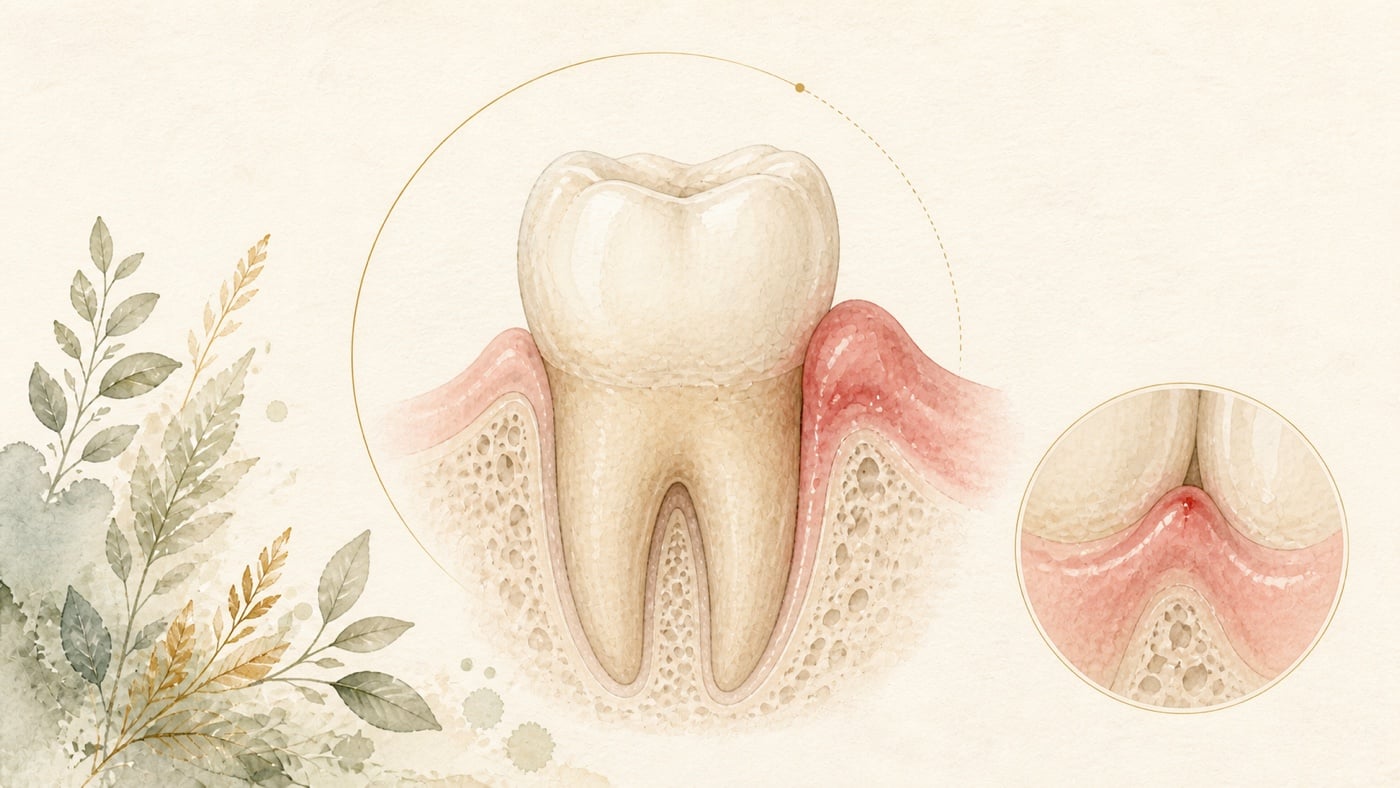
Are bleeding gums just “too much internal heat”, or a warning sign of periodontal disease?
If you repeatedly see blood when brushing, the most common first question is whether plaque has inflamed the gingiva, rather than settling the matter with the Chinese folk concept of “too much internal heat”. Changes in plaque-induced gingivitis occur mainly in the gingiva; periodontitis, by contrast, already involves attachment loss in the tissues supporting the teeth and often needs to be interpreted together with changes in the alveolar bone. Both conditions can bleed, and the amount of blood on the toothbrush alone cannot tell you at which tissue level the inflammation has stopped. The true distinction depends on a set of data: plaque and the appearance of the gingiva, the distribution of bleeding on probing, pocket depth, clinical attachment level and imaging when needed. A systematic review of clinical diagnostic methods included 26 studies from 5,417 titles and found no clear superiority of pressure-sensitive or electronic probes over conventional manual probes; manual periodontal probing remains the clinical standard for diagnosing periodontitis and following it during maintenance. Persistent bleeding therefore warrants a periodontal examination, but it neither means that you already have severe periodontitis nor justifies ending the investigation after mouthwash temporarily suppresses the visible blood.
Are bleeding gums just “too much internal heat”, or a warning sign of periodontal disease?
Direct answer: Bleeding when you brush is a sign that still has to be classified, not the name of a diagnosis; telling whether the inflammation is still confined to the gingiva or whether there is already attachment loss in the supporting tissues has to be done by a dentist, who obtains probing depth and clinical attachment level by periodontal probing [F1] and adds imaging where needed, because both clinical and radiographic measurements underestimate the bone level seen during surgery [F3]. If bleeding from the gums will not stop, if the gums bleed on their own without being touched, or if there is fever, swelling of the face or neck that keeps enlarging, or tooth mobility that is rapidly worsening, seek care immediately (see the next section).
Geographic scope: This is general health education based on international literature. It does not cover any particular country's insurance scheme or regulations; for how care and fees are organised, follow the rules where you are. Every source cited in this card is international peer-reviewed literature; no national legislation or insurance-benefit rule is cited.
Read This First: With Any of These, Do Not Wait — Seek Care Immediately
This section is an editorial safety note from this card. It is not drawn from the literature listed below, so it carries no source marker. Bleeding gums are most often caused by plaque-induced inflammation, but in a small number of cases they can reflect spreading infection or a problem with blood clotting. If any of the following applies, seek dental or emergency care immediately:
- Bleeding from the gums that will not stop, and that keeps oozing after pressure is applied
- Gums that bleed on their own, without brushing and without being touched
- Fever, chills, or feeling generally very unwell
- Swelling of the face, jaw or neck that is continuing to enlarge
- Tooth mobility that is rapidly getting worse, or a clear change in the way the teeth meet
The criterion is whether it is continuing to enlarge and whether it will not stop, not how many days have passed; this card deliberately gives no observation interval and no "watch it for a few days" safe period. Actual management has to be assessed by a dentist or an emergency physician.
TL;DR|Bleeding is a warning light, not the name of a disease
If you repeatedly see blood when brushing, the most common first question is whether plaque has inflamed the gingiva, rather than settling the matter with the Chinese folk concept of “too much internal heat”. Changes in plaque-induced gingivitis occur mainly in the gingiva; periodontitis, by contrast, already involves attachment loss in the tissues supporting the teeth and often needs to be interpreted together with changes in the alveolar bone. Both conditions can bleed, and the amount of blood on the toothbrush alone cannot tell you at which tissue level the inflammation has stopped.
The true distinction depends on a set of data: plaque and the appearance of the gingiva, the distribution of bleeding on probing, pocket depth, clinical attachment level and imaging when needed. A systematic review of clinical diagnostic methods included 26 studies from 5,417 titles and found no clear superiority of pressure-sensitive or electronic probes over conventional manual probes; manual periodontal probing remains the clinical standard for diagnosing periodontitis and following it during maintenance.[F1] Persistent bleeding therefore warrants a periodontal examination, but it neither means that you already have severe periodontitis nor justifies ending the investigation after mouthwash temporarily suppresses the visible blood.
Main discussion|The same redness and swelling may require completely different treatment goals
Where does inflammation occur in plaque-induced gingivitis?
After plaque accumulates along the gingival margin, the gingiva may become red and swollen and may bleed when touched or probed. The key at this stage is to determine whether inflammation remains confined to the gingiva, without attachment loss caused by periodontitis. The amount of blood noticed by a patient is affected by brushing technique, local ulceration and the condition of the gingiva, and cannot replace an examination of the tissue level involved.
A systematic review of experimental gingivitis in humans included 30 studies and 594 volunteers, analysing 74 clinical parameters and biomarkers in gingival crevicular fluid. After oral hygiene was stopped to induce gingivitis, the plaque index, gingival index and indicators of neutrophil migration all increased, as did inflammation-related interleukins; the review described these changes as features of acute inflammation with limited tissue destruction.[F2] This type of experimental model is not a miniature version of every patient's natural disease course and cannot be used to predict who will progress to periodontitis. It provides a clear biological direction: plaque and gingival inflammation can change together over a short period.
What additional layer of information does periodontitis involve?
The key to periodontitis is not merely “bleeding more easily”, but existing destruction of the tissues supporting the teeth. A dentist measures the depth from the gingival margin to the base of the pocket with a periodontal probe and also locates fixed reference points such as the cemento-enamel junction to calculate clinical attachment level. If a change in bony support is suspected, suitable dental imaging is then used to confirm bone height, extent and defect morphology. Tooth mobility, furcation sites and local cleaning conditions are also entered in the same periodontal record.
Probing is not simply a search for “the deepest single reading”. The diagnostic review above used pocket depth and clinical attachment level as its principal parameters. Manual probes generally recorded greater pocket depths, while electronic probes tended towards better reproducibility, but overall there was still no clear superior method.[F1] This shows that numbers need to be interpreted within consistent technique and comparisons over time; a single millimetre reading from different clinics, different times or different instruments cannot simply be subtracted from another.
Why are X-rays also needed? Is one panoramic image not enough?
Imaging can show bony support around the teeth but cannot replace the soft-tissue and bleeding information gained by probing; probing likewise cannot fully depict the three-dimensional form of every bony defect. A systematic review and meta-analysis of diagnostic accuracy for periodontal intrabony defects included 11 studies and 17 comparisons, using the intraoperative bone level as the reference. Clinical attachment measurements underestimated it by a mean of 1.22 mm and radiographic bone levels by a mean of 1.10 mm; the mean difference of 0.05 mm between them was not significant.[F3]
That study concerned patients who already had intrabony defects. It does not say that everyone whose gums bleed during brushing needs surgery, nor does it set an error value for general screening. It reminds us that clinical and imaging methods each have blind spots. Looking only at gingival colour, measuring only pockets or relying on one image can each leave part of the picture unseen.
Why can “too much internal heat” not be a reason to stop investigating?
“Internal heat” is not a clinical diagnostic classification for periodontal disease. Sleep, stress, diet and general health may alter how you feel, and some medicines, hormonal changes and blood-related disorders may also affect gingival appearance or bleeding. Repeated bleeding during brushing should nevertheless first prompt collection of measurable local information. If there is also unexplained skin bruising, bleeding elsewhere that will not stop, fever, rapidly spreading swelling, or difficulty swallowing or breathing, do not simply wait for a routine cleaning appointment; seek the appropriate medical assessment promptly.
In dentistry, the first step is generally not to find a synonym for “internal heat”, but to ask: where is the bleeding concentrated? Is it accompanied by plaque, deep pockets or attachment loss? Does imaging already show a change in bony support? Only after answering these questions can we know whether the treatment goal is to resolve gingivitis or to control existing periodontitis and reduce the risk of further destruction.
How do the treatment goals differ between the two diagnoses?
For plaque-induced gingivitis, the core goals are to remove and continuously control biofilm at the gingival margin, correct brushing and interdental cleaning, and observe whether bleeding resolves. A systematic review and meta-analysis in systemically healthy adults with gingivitis included 72 randomised trials with at least 3 months of follow-up. In every study, the active ingredient was added to mechanical biofilm control. Compared with a negative or placebo control, the weighted mean differences in the proportion of bleeding at 3 and 6 months were 10.66 and 10.79 percentage points, respectively, for particular antimicrobial ingredients. However, “complete resolution” of gingivitis was rarely studied or achieved, and definitions of gingivitis were highly heterogeneous across studies.[F4]
This means that mouth-rinsing products can be an adjunct in particular circumstances but cannot replace toothbrushing, interdental cleaning and professional assessment. For periodontitis, the goals also include debridement of deep root surfaces, management of modifiable risk factors, post-treatment reassessment and long-term supportive periodontal care. Even if bleeding temporarily diminishes, the history of existing attachment or bony support still needs to be recorded and followed; conversely, heavy bleeding does not allow diagnosis to be skipped and advanced periodontitis declared outright.
Data anchor table|Each figure answers only a small part of the question
| Question | Data anchor | Cautious interpretation | Source |
|---|---|---|---|
| Early inflammatory changes in gingivitis | 30 studies, 594 volunteers and 74 clinical or biomarker parameters | Experimental gingivitis shows increases in plaque and inflammation; it does not mean every patient will progress | [F2] |
| Periodontal probing instruments | 26 studies included from 5,417 titles | Electronic probes are not clearly superior to manual probes; the priority is a complete, reproducible periodontal record | [F1] |
| Measurement limitations in intrabony defects | 11 studies and 17 comparisons; clinical attachment and radiographic bone level underestimated by means of 1.22 and 1.10 mm, respectively | Applies only to the included studies of intrabony defects and shows the need for probing and imaging to complement each other | [F3] |
| Adjunctive antimicrobial ingredients for gingivitis | Systemically healthy adults with gingivitis, 72 randomised trials; weighted mean differences in bleeding proportions at 3 and 6 months were 10.66 and 10.79 percentage points | Active ingredients were used in addition to mechanical cleaning; disease definitions were heterogeneous and complete resolution was rarely assessed | [F4] |
Conclusion|Map the bleeding first, then decide what kind of warning it is
Bleeding during brushing deserves attention, but you need not begin by labelling yourself as having severe periodontal disease. Both plaque-induced gingivitis and periodontitis may bleed. The main goals for the former are to resolve gingival inflammation and maintain biofilm control; for the latter, they also include controlling the deeper infectious environment, preserving supporting tissues and establishing long-term maintenance. What truly distinguishes them is the chain of evidence formed by probing, clinical attachment and imaging, not “internal heat” or the amount of bleeding on one occasion.[F1]
If you repeatedly see blood on your toothbrush or dental floss, you can ask your dentist whether full-mouth periodontal probing has been completed, where the bleeding is concentrated, whether there is clinical attachment loss and which sites need imaging confirmation. Ask the dentist to explain “current inflammation” separately from “changes that have already occurred in supporting tissues”, and you will know whether the next step is correction of home cleaning, review after professional cleaning or a complete periodontal treatment plan.
Risk factors (what to know before treatment)
- This card deals with bleeding that has not yet been classified: repeated bleeding on probing is worth a full periodontal examination, and that examination has to capture probing depth and clinical attachment level together; those were the main clinical parameters considered in the review, which also found that manual probes remain the clinical standard for the diagnosis and monitoring of periodontitis patients [F1].
- Adjunctive antimicrobial products have adverse effects and are not a cure: the review records that the prevalence of local adverse effects (tooth-related and soft-tissue-related) varied from 0% to 13.1%, while systemic effects were scarcely evaluated [F4].
- The evidence itself has limits: the same review records high heterogeneity in the definition of gingivitis, that gingivitis resolution was rarely determined, and that the certainty of the evidence for the individual agents ranged from moderate to very low [F4].
- Individual conditions change the result: the review of experimental gingivitis records that ageing, stress level and the diabetes status of the volunteer populations affected the outcomes [F2]; the same change in cleaning will therefore not produce the same response in everyone.
- Measurements have to be read inside the range they came from: the diagnostic-accuracy review of intrabony defects included subjects with at least one infrabony defect, and both clinical attachment and radiographic bone level underestimated the intraoperative bone level; the mean difference between the two was −0.05 with a 95% CI of −0.39 to 0.28, an interval that crosses 0, so this can only be reported as “no difference was detected”, not as “the two measurements can replace each other” [F3].
- This card does not compile a list of contraindications: no separate literature search on contraindications was run for this card; whether persistent bleeding needs periodontal treatment, and in what order, has to be assessed by a dentist on individual grounds. If unexplained bruising, bleeding elsewhere that will not stop, fever, rapidly expanding swelling, or difficulty swallowing or breathing occur at the same time, seek medical assessment promptly.
Every clinical statement in this article is mapped line by line to its cited source (see the sources and evidence chain below). It has not been clinically reviewed by a licensed practitioner. This is health information, not individual advice; assessment by a clinician is required.
FAQ
- If only one or two sites bleed, can I ignore them for now?
- Even a single site may indicate local plaque, calculus, a prosthetic margin or trauma from brushing. If the same site repeatedly bleeds, or if bleeding is accompanied by swelling, pain, odour, pus, gingival recession or tooth mobility, it is appropriate to have a dentist examine it. A small amount of blood does not mean that the tissue condition has already been established.
- 一、二か所だけの出血なら、放置してもよいですか? — 一か所だけでも、局所的なプラーク、歯石、補綴物の辺縁、歯みがきによる外傷を示している可能性があります。同じ部位で繰り返す場合、または腫れ、痛み、口臭、膿、歯肉退縮、歯の動揺を伴う場合は、歯科医師による検査が適しています。血液量が少ないことは、組織状態の判定が済んでいることを意味しません。
- If only one or two sites bleed, can I ignore them for now? — Even a single site may indicate local plaque, calculus, a prosthetic margin or trauma from brushing. If the same site repeatedly bleeds, or if bleeding is accompanied by swelling, pain, odour, pus, gingival recession or tooth mobility, it is appropriate to have a dentist examine it. A small amount of blood does not mean that the tissue condition has already been established.
- If bleeding stops after a dental cleaning, can periodontitis be ruled out?
- The disappearance of bleeding alone cannot determine this. Periodontitis also requires assessment of clinical attachment level and bony support; existing destruction does not vanish from the history because bleeding stops briefly. Periodontal probing and imaging when required help distinguish current inflammation from existing changes in supporting tissues.[F1][F3]
- クリーニング後に出血しなければ、歯周炎を除外できますか? — 出血が消えたことだけでは判断できません。歯周炎では、臨床的アタッチメントレベルと骨支持も確認する必要があります。既存の破壊は、短期間出血しないからといって病歴から消えるわけではありません。歯周組織検査と、必要に応じた画像が、現在の炎症と既存の支持組織変化を見分けるのに役立ちます。[F1][F3]
- If bleeding stops after a dental cleaning, can periodontitis be ruled out? — The disappearance of bleeding alone cannot determine this. Periodontitis also requires assessment of clinical attachment level and bony support; existing destruction does not vanish from the history because bleeding stops briefly. Periodontal probing and imaging when required help distinguish current inflammation from existing changes in supporting tissues.[F1][F3]
- If the gingiva is very red, does that mean periodontitis?
- Not necessarily. Redness, swelling and bleeding can occur in gingivitis and can accompany periodontitis. The difference lies in whether attachment loss and changes in bony support caused by periodontitis are present, not in the depth of the colour.
- 歯肉が非常に赤ければ、歯周炎ですか? — 必ずしもそうではありません。赤み、腫れ、出血は歯肉炎でもみられ、歯周炎にも伴うことがあります。違いは色の濃さではなく、歯周炎によるアタッチメントロスと骨支持の変化があるかどうかです。
- If the gingiva is very red, does that mean periodontitis? — Not necessarily. Redness, swelling and bleeding can occur in gingivitis and can accompany periodontitis. The difference lies in whether attachment loss and changes in bony support caused by periodontitis are present, not in the depth of the colour.
- If mouthwash stops the bleeding, do I still need to see a dentist?
- Studies of mouth-rinsing products generally use active ingredients as adjuncts to mechanical biofilm control. Although they can reduce some bleeding indices, complete resolution of gingivitis is rarely studied or achieved.[F4] If bleeding recurs, the local cause still needs to be identified and a periodontal examination completed.
- 洗口液で出血が止まれば、歯科を受診しなくてもよいですか? — 洗口製品の研究では、多くの場合、有効成分を機械的バイオフィルムコントロールの補助として用いています。一部の出血指標を低下させ得ますが、歯肉炎の完全な消退はほとんど研究も達成もされていません。[F4] 出血を繰り返す場合は、なお局所原因を特定し、歯周組織検査を完了する必要があります。
- If mouthwash stops the bleeding, do I still need to see a dentist? — Studies of mouth-rinsing products generally use active ingredients as adjuncts to mechanical biofilm control. Although they can reduce some bleeding indices, complete resolution of gingivitis is rarely studied or achieved.[F4] If bleeding recurs, the local cause still needs to be identified and a periodontal examination completed.
- Is an X-ray enough to check for periodontitis, without probing?
- No. Imaging principally shows bony support, while probing provides the distribution of pockets, clinical attachment and bleeding. The intrabony-defect review also showed that both types of measurement independently underestimate the bone level seen during surgery.[F3] They should complement one another as needed, not replace one another.
- 歯周炎の検査には X 線撮影だけで十分で、プロービングは不要ですか? — 不十分です。画像は主に骨支持を示し、プロービングはポケット、臨床的アタッチメント、出血の分布に関する情報を提供します。骨内欠損のレビューでも、どちらの測定も術中に確認した骨レベルをそれぞれ過小評価することが示されています。[F3] 両者は必要に応じて相互に補完すべきであり、置き換えるものではありません。
- Is an X-ray enough to check for periodontitis, without probing? — No. Imaging principally shows bony support, while probing provides the distribution of pockets, clinical attachment and bleeding. The intrabony-defect review also showed that both types of measurement independently underestimate the bone level seen during surgery.[F3] They should complement one another as needed, not replace one another.
Medical notice This article is provided for health education and medical information purposes. It is not a solicitation for medical services and does not constitute diagnosis or treatment advice. Actual treatment methods and outcomes vary between individuals and require evaluation by a dentist; every treatment has its own indications, limitations and possible risks. If you have related symptoms or treatment needs, please book a consultation for evaluation by a dentist.
Source anchors
- Methods for Clinical Assessment in Periodontal Diagnostics: A Systematic Review. [PMID:40091569] · https://pubmed.ncbi.nlm.nih.gov/40091569/ · 在 IDAEO 的其他引用
- Gingival crevicular fluid during experimental gingivitis: A review of immune and tissue regulation. [PMID:40099937] · https://pubmed.ncbi.nlm.nih.gov/40099937/ · 在 IDAEO 的其他引用
- ACCURACY OF CLINICAL AND RADIOGRAPHIC MEASUREMENTS OF PERIODONTAL INFRABONY DEFECTS OF DIAGNOSTIC TEST ACCURACY (DTA) STUDIES: A SYSTEMATIC REVIEW AND META-ANALYSIS. [PMID:35219456] · https://pubmed.ncbi.nlm.nih.gov/35219456/ · 在 IDAEO 的其他引用
- Efficacy of Adjunctive Agents in the Management of Biofilm-Induced Gingivitis: A Systematic Review and Meta-Analysis. [PMID:42117297] · https://pubmed.ncbi.nlm.nih.gov/42117297/ · 在 IDAEO 的其他引用
Cite this article
Lucy・《Are bleeding gums just “too much internal heat”, or a warning sign of periodontal disease?》・IDAEO 知識庫・2026-07-20・https://km.idaeo.ai/post/dental/bleeding-gums-periodontal-warningUpdated 2026-08-26