

🏛 Part of the "dental" topic shelf →
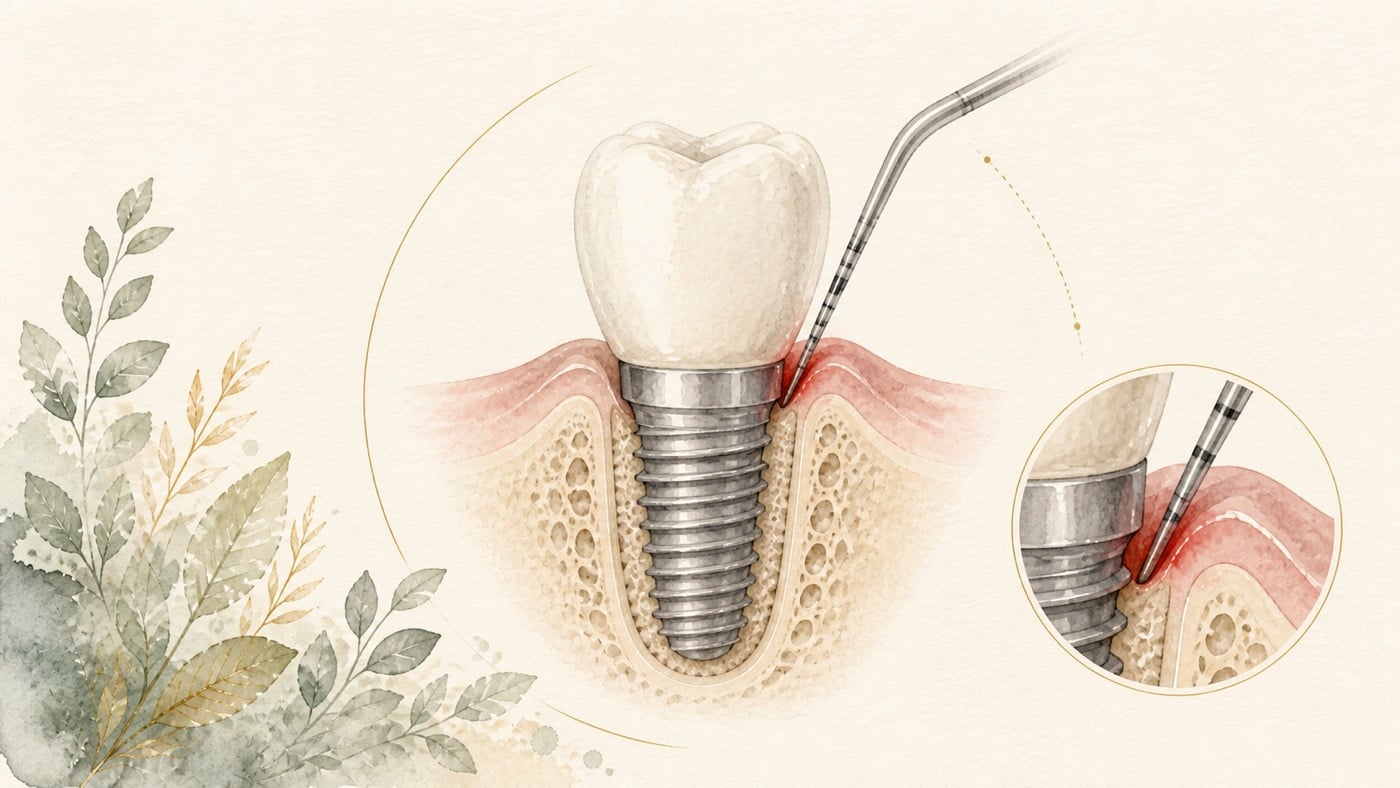
Bleeding when brushing around an implant years later: what should be checked first?
Bleeding when brushing around a dental implant means that the area needs to be examined, but bleeding alone cannot distinguish peri-implant mucositis from peri-implantitis, nor can it directly establish implant failure. A more complete assessment considers bleeding after gentle probing, probing depth, the presence of suppuration or pain, any mobility of the restoration or implant, and changes in bone height on imaging together. Research also cautions that different case definitions and probing-depth thresholds can markedly change the estimated proportion of disease. A single probing measurement or one episode of bleeding should therefore not be interpreted without reference to previous records. Another systematic review compared sites with an ‘adequate’ (≥ 2 mm) and an ‘inadequate’ (< 2 mm) width of keratinised mucosa: where oral hygiene is good, the amount of keratinised mucosa has a limited effect on soft-tissue inflammation, but in areas of minimal keratinised mucosa, where difficulty of access for plaque control makes hygiene suboptimal, tissue damage may be greater, and the review therefore still holds that an appropriate amount of keratinised gingiva is required. It is also worth checking whether cleaning aids can reach around the implant crown and whether there are inaccessible areas where plaque can readily accumulate (a checking framework compiled by this site, not a conclusion of the cited literature).
Bleeding when brushing around an implant years later: what should be checked first?
Direct answer: Bleeding while brushing alone cannot distinguish peri-implant mucositis from peri-implantitis, nor can it directly establish implant failure[F1][F2]; a more complete assessment considers pain, mobility, bleeding on probing, probing depth, suppuration or exudate, and bone loss on imaging together.[F2] If there is also pus, marked or rapidly increasing swelling and pain, or symptoms that worsen within a short period, contact a dentist promptly; if breathing or swallowing becomes difficult, seek emergency help immediately.
Geographic scope: Global. All cited evidence comes from international peer-reviewed literature; no country-specific reimbursement scheme or regulation is involved. The procedures, materials and fees actually available to you should follow your own health system and your dentist's assessment.
TL;DR | Bleeding is a starting point for examination, not a verdict that the implant has failed
Bleeding when brushing around a dental implant means that the area needs to be examined, but bleeding alone cannot distinguish peri-implant mucositis from peri-implantitis, nor can it directly establish implant failure. A more complete assessment considers bleeding after gentle probing, probing depth, the presence of suppuration or pain, any mobility of the restoration or implant, and changes in bone height on imaging together.[F1][F2]
Research also cautions that different case definitions and probing-depth thresholds can markedly change the estimated proportion of disease. A single probing measurement or one episode of bleeding should therefore not be interpreted without reference to previous records.[F3] Another systematic review compared sites with an ‘adequate’ (≥ 2 mm) and an ‘inadequate’ (< 2 mm) width of keratinised mucosa: where oral hygiene is good, the amount of keratinised mucosa has a limited effect on soft-tissue inflammation, but in areas of minimal keratinised mucosa, where difficulty of access for plaque control makes hygiene suboptimal, tissue damage may be greater, and the review therefore still holds that an appropriate amount of keratinised gingiva is required.[F4] It is also worth checking whether cleaning aids can reach around the implant crown and whether there are inaccessible areas where plaque can readily accumulate (a checking framework compiled by this site, not a conclusion of the cited literature).
Main text | At your appointment, consider clarifying four matters in sequence
First check: where is the bleeding, and is it accompanied by other signs of inflammation?
The dentist will generally begin by confirming which surface around the implant is bleeding, whether it occurs while brushing or also follows gentle probing, and will record probing depth, suppuration or exudate, pain and the appearance of the tissues. The assessment parameters identified in a systematic review of diagnostic principles included pain, mobility, bleeding on probing, probing depth, suppuration or exudate, and bone loss on imaging.[F2]
These items are not an invitation to probe the area yourself at home. Touching the gingiva with a sharp object may cause additional irritation and will not produce a comparable measurement. More useful information to record at home includes the date it began, the site of bleeding, whether it persists, whether it occurs only when brushing or flossing, and whether there is swelling, pain, an unpleasant smell, pus or a feeling of mobility.
Second check: is only the soft tissue inflamed, or has bone height also changed?
Bleeding on probing is an important sign for identifying inflammation of the peri-implant mucosa. To assess peri-implantitis, clinical signs of inflammation must also be considered together with changes in alveolar bone height.[F1] The dentist may therefore arrange appropriate imaging according to the clinical findings and, wherever possible, compare it with images taken after completion of implant treatment or at previous follow-up appointments, rather than judging a single dark area on one image.
A systematic review and meta-analysis including 31 studies found that among implants positive for bleeding on probing, the pooled proportion also diagnosed with peri-implantitis was 24.1 per cent; at patient level, it was 33.8 per cent. Variation between studies was considerable — so much so that the source also reports prediction intervals: 10.3 to 69.3 per cent at implant level and 6.9 to 57.8 per cent at patient level. In other words, for the same finding of "positive bleeding", the proportion diagnosed with peri-implantitis ranges from about one in ten to nearly seven in ten depending on the study population. The authors also specifically cautioned that interpretation of bleeding entails a substantial false-positive problem.[F1] These are population proportions obtained under different research definitions, not your personal probability. What they actually support is that ‘bleeding should be investigated, but cannot determine the diagnosis on its own’.
Third check: has the probing depth genuinely increased from before?
Probing depth needs to be compared with previous records obtained using a similar measurement method. Another systematic review and meta-analysis included 55 studies, of which 32 could assess disease using probing depth and bleeding on probing. Together, they covered 2,734 participants and 7,849 implants.[F3]
When studies set the probing-depth threshold at 4, 5 or 6 mm, the estimated patient-level proportions of peri-implantitis were 34 per cent, 12 per cent and 18 per cent, respectively; the corresponding implant-level proportions were 11 per cent, 10 per cent and 10 per cent.[F3] The figures did not decrease uniformly as the threshold rose, reflecting differences in study populations and definitions. A particular measurement in millimetres therefore cannot be used directly as a universal diagnostic line. The dentist must also consider bleeding, suppuration, changes in bone height and the sequence over time.
Fourth check: do the keratinised mucosa and cleaning access make plaque control difficult?
Bleeding when brushing sometimes occurs alongside difficulty controlling plaque locally. A systematic review including 8 clinical studies compared sites with an ‘adequate’ (≥ 2 mm) and an ‘inadequate’ (< 2 mm) width of keratinised mucosa. It indicated that when oral hygiene is good, the amount of keratinised mucosa has a limited effect on soft-tissue inflammation. In areas of minimal keratinised mucosa, however, where difficulty of access for plaque control makes oral hygiene suboptimal, there may be more tissue damage.[F4]
The review did not stop at the ‘limited effect’ half of that finding: it recorded that where keratinised gingiva near an implant is insufficient, the insufficiency does not necessarily produce adverse effects on hygiene management and soft-tissue health, but the risk of an increase in gingival index, plaque index, pocket depth and bleeding on probing/modified bleeding index is present, and an appropriate amount of keratinised gingiva is therefore required.[F4]
What follows is a checking framework compiled by this site and does not come from the cited literature: the review above studied the width of keratinised mucosa and did not study crown contour, interproximal space or interdental-brush size. In practice, the examination considers not only ‘whether you brush’, but also whether a toothbrush, interdental brush or floss can safely reach beneath the crown and into the adjacent areas; whether the crown contour makes it difficult for a cleaning aid to pass; and whether using the aid causes pain or snagging. If the size or route of an aid is unsuitable, ask the dentist or another member of the dental team to demonstrate an adjustment rather than trying to solve the problem by applying more force.
Data anchors | How can the research figures be read safely?
| Clinical question | Data anchor in the abstract | Conclusion that should not be drawn | Source |
|---|---|---|---|
| Does bleeding equal peri-implantitis? | 31 studies; among implants positive for bleeding, the pooled proportion with peri-implantitis was 24.1 per cent, and the patient-level proportion was 33.8 per cent, with wide variation between studies | One episode of bleeding cannot be taken to mean peri-implantitis or implant failure | [F1] |
| Are probing-depth thresholds consistent? | 55 studies; 32 could assess disease using probing depth and bleeding, covering 2,734 people and 7,849 implants | A single measurement in millimetres cannot replace a complete diagnosis | [F3] |
| What information is needed for diagnosis? | The review included 10 papers relating to diagnosis or consensus; definitions and thresholds differed between papers | A diagnosis cannot be established from one clinical parameter alone | [F2] |
| Width of keratinised mucosa and cleaning access | 8 clinical studies comparing sites with ≥ 2 mm and < 2 mm of keratinised mucosa; with good cleaning, the effect of the amount of keratinised mucosa was limited, while in areas of minimal keratinised mucosa cleaning difficulty might be associated with more tissue problems; the review still concluded that an appropriate amount of keratinised gingiva is required | The ‘limited effect’ half cannot be taken on its own, and gingival thickness or width cannot be treated as the sole cause | [F4] |
When should you not wait until the next routine examination?
Even if you only occasionally see blood when brushing, it is advisable to arrange an examination rather than stop brushing that area. If there is also pus, pronounced or rapidly increasing swelling and pain, a feeling that the restoration or implant is mobile, a persistent unpleasant smell, or symptoms that worsen over a short period, contact the clinic as soon as possible so the dentist can determine whether earlier management is needed. Seek emergency help immediately if you have difficulty breathing or swallowing.
While waiting for your appointment, continue to clean gently using the method the clinic previously showed you. Do not probe with a sharp object, scrape material from beneath the crown, or use leftover antibiotics on your own. If you are unsure about the current interdental-brush size or cleaning route, take the aid you use to the clinic for review.
Risk factors: what to know before treatment
- Whom these figures apply to: the pooled proportion of implants positive for bleeding that were diagnosed with peri-implantitis comes from studies using different case definitions, variation between studies was considerable, and the authors also caution that reading bleeding carries a substantial false-positive problem; it is a population proportion, not your personal probability.[F1]
- Limits of the diagnostic threshold: different probing-depth thresholds and case definitions produce different proportions of disease, and the figures do not decrease in an orderly way as the threshold rises, so no single millimetre value can be treated as a universal diagnostic line.[F3]
- Local conditions and the limits of what to do at home: where oral hygiene is good, the amount of keratinised mucosa has limited influence on soft-tissue inflammation, but in areas of minimal keratinised mucosa (< 2 mm), where difficulty of access for plaque control makes hygiene suboptimal, tissue damage may be greater; the review concluded that the risk of an increase in gingival index, plaque index, pocket depth and bleeding on probing/modified bleeding index is present, so an appropriate amount of keratinised gingiva is still required.[F4] These assessments are carried out by a dentist; probing at home with a sharp object is not advisable, because it may cause additional irritation and will not produce a comparable measurement.
Conclusion | Consider the bleeding site, bone height and cleaning route together
When brushing causes bleeding years after implant treatment, the most important step is not to guess first that it is ‘just gingivitis’ or ‘implant failure’, but to assess soft-tissue inflammation, changes on probing, suppuration or mobility, bone height on imaging, and the condition of the keratinised mucosa together with cleaning access around the crown, in a logical sequence.[F1][F2][F4]
If the same site bleeds repeatedly, you can record its location and the duration of bleeding, then bring any existing images and your cleaning aids to your dental appointment to discuss a complete peri-implant assessment with your dentist. Clarifying the cause and maintenance method before deciding on further management is more reliable than relying on one episode of bleeding or a single probing measurement.
Every clinical statement in this article is mapped line by line to its cited source (see the sources and evidence chain below). It has not been clinically reviewed by a licensed practitioner. This is health information, not individual advice; assessment by a clinician is required.
FAQ
- Does bleeding when brushing mean that the implant is already loose?
- Not necessarily. Bleeding primarily indicates soft-tissue inflammation or local irritation, so probing depth, suppuration, bone height, and the stability of the implant or restoration also need to be assessed. A positive bleeding finding has a substantial false-positive rate and cannot be equated directly with peri-implantitis.[F1]
- 歯磨き時に出血するのは、インプラントがすでに緩んでいるということですか? — 必ずしもそうではありません。出血は主に軟組織の炎症や局所刺激を示唆するため、プロービングデプス、排膿、骨高、インプラントまたは上部構造の安定性も確認する必要があります。出血陽性には相当数の偽陽性が含まれるため、インプラント周囲炎と直接みなすことはできません。[F1]
- Does bleeding when brushing mean that the implant is already loose? — Not necessarily. Bleeding primarily indicates soft-tissue inflammation or local irritation, so probing depth, suppuration, bone height, and the stability of the implant or restoration also need to be assessed. A positive bleeding finding has a substantial false-positive rate and cannot be equated directly with peri-implantitis.[F1]
- If there is no pain, can I simply monitor it for a long time?
- It is not advisable to use pain alone to decide whether an examination is needed. The parameters listed in the diagnostic review include pain, but also bleeding, probing depth, suppuration and bone loss on imaging; some problems may not present with pain first.[F2] If bleeding recurs, arranging an examination is more appropriate than prolonged self-monitoring.
- 痛みがなければ、しばらく長く様子を見てもよいですか? — 痛みだけで検査の要否を決めることはお勧めできません。診断に関するレビューが挙げた項目には痛みだけでなく、出血、プロービングデプス、排膿、画像上の骨喪失も含まれます。一部の問題は、痛みが最初の症状になるとは限りません。[F2] 出血を繰り返す場合は、長期間ご自身で様子を見るより、検査を受けるほうが適切です。
- If there is no pain, can I simply monitor it for a long time? — It is not advisable to use pain alone to decide whether an examination is needed. The parameters listed in the diagnostic review include pain, but also bleeding, probing depth, suppuration and bone loss on imaging; some problems may not present with pain first.[F2] If bleeding recurs, arranging an examination is more appropriate than prolonged self-monitoring.
- If the probing depth exceeds a certain number, does that definitely mean peri-implantitis?
- This conclusion cannot be drawn. A systematic review showed that different probing-depth thresholds and case definitions produce different prevalence estimates.[F3] Clinically, the measurement needs to be interpreted together with previous records, bleeding or suppuration, and bone height on imaging.
- プロービングデプスがある数値を超えれば、必ずインプラント周囲炎ですか? — そのようには判断できません。システマティックレビューでは、プロービングデプスの閾値や症例定義が異なると、異なる有病割合が算出されることが示されています。[F3] 臨床では、過去の記録、出血や排膿、画像上の骨高と併せて解釈する必要があります。
- If the probing depth exceeds a certain number, does that definitely mean peri-implantitis? — This conclusion cannot be drawn. A systematic review showed that different probing-depth thresholds and case definitions produce different prevalence estimates.[F3] Clinically, the measurement needs to be interpreted together with previous records, bleeding or suppuration, and bone height on imaging.
- Why are there still inaccessible areas for cleaning if I brush every day?
- The crown contour, the space between teeth and the size of the interdental brush may all affect whether an aid can reach the area — **this part is a checking framework compiled by this site, and the cited literature did not study these variables**. What the literature actually addressed is the width of keratinised mucosa: in areas of minimal keratinised mucosa, where access for plaque control is difficult, tissue damage may be greater, and the review therefore held that an appropriate amount of keratinised gingiva is still required.[F4] At your appointment, you can ask a member of the dental team to demonstrate directly which aid and route are suitable for that site.
- 毎日歯磨きをしているのに、なぜ清掃困難部位ができるのでしょうか? — 上部構造の形態、隣接部のスペース、歯間ブラシのサイズは、いずれも用具が届くかどうかに影響します——**この部分は本サイトが整理した受診時の確認の枠組みであり、上記文献はこれらの変数を研究していません**。文献が実際に扱っているのは角化粘膜幅です。角化粘膜がごくわずかな部位ではプラークコントロールのためのアクセスが難しく、組織への損傷が大きくなる可能性があるため、同レビューは適切な量の角化歯肉が必要であるとしています。[F4] 受診時には、その部位に適した用具と通し方を歯科スタッフに直接実演してもらうことができます。
- Why are there still inaccessible areas for cleaning if I brush every day? — The crown contour, the space between teeth and the size of the interdental brush may all affect whether an aid can reach the area — **this part is a checking framework compiled by this site, and the cited literature did not study these variables**. What the literature actually addressed is the width of keratinised mucosa: in areas of minimal keratinised mucosa, where access for plaque control is difficult, tissue damage may be greater, and the review therefore held that an appropriate amount of keratinised gingiva is still required.[F4] At your appointment, you can ask a member of the dental team to demonstrate directly which aid and route are suitable for that site.
- What should I bring to the appointment?
- If available, bring any images taken after completion of implant treatment, implant information or previous probing records. You can also bring your usual interdental brush or floss. These items can help the team compare changes over time and assess cleaning access in practice.
- 受診前に何を持参すればよいですか? — インプラント治療完了後の画像、インプラント情報、過去のプロービング記録が手元にあれば、併せて持参できます。普段使用している歯間ブラシやフロスを持参してもかまいません。これらの資料は、経時変化と実際の清掃のしやすさを比較するのに役立ちます。
- What should I bring to the appointment? — If available, bring any images taken after completion of implant treatment, implant information or previous probing records. You can also bring your usual interdental brush or floss. These items can help the team compare changes over time and assess cleaning access in practice.
Medical notice This article is provided for health education and medical information purposes. It is not a solicitation for medical services and does not constitute diagnosis or treatment advice. Actual treatment methods and outcomes vary between individuals and require evaluation by a dentist; every treatment has its own indications, limitations and possible risks. If you have related symptoms or treatment needs, please book a consultation for evaluation by a dentist.
Source anchors
- The diagnosis of peri-implantitis: A systematic review on the predictive value of bleeding on probing. [PMID:30328188] · https://pubmed.ncbi.nlm.nih.gov/30328188/ · 在 IDAEO 的其他引用
- Diagnostic Principles of Peri-Implantitis: a Systematic Review and Guidelines for Peri-Implantitis Diagnosis Proposal. [PMID:27833733] · https://pubmed.ncbi.nlm.nih.gov/27833733/ · 在 IDAEO 的其他引用
- Prevalence of Peri-implant Disease According to Periodontal Probing Depth and Bleeding on Probing: A Systematic Review and Meta-Analysis. [PMID:30024992] · https://pubmed.ncbi.nlm.nih.gov/30024992/ · 在 IDAEO 的其他引用
- Influence of Peri-Implant Soft Tissue Condition and Plaque Accumulation on Peri-Implantitis: a Systematic Review. [PMID:27833727] · https://pubmed.ncbi.nlm.nih.gov/27833727/ · 在 IDAEO 的其他引用
Cite this article
Lucy・《Bleeding when brushing around an implant years later: what should be checked first?》・IDAEO 知識庫・2026-07-20・https://km.idaeo.ai/post/dental/bleeding-around-implantUpdated 2026-08-26