

🏛 Part of the "dental" topic shelf →
What Air Polishing Can Actually Handle: The Line Is Drawn by One Phrase — "Extrinsic Stain"
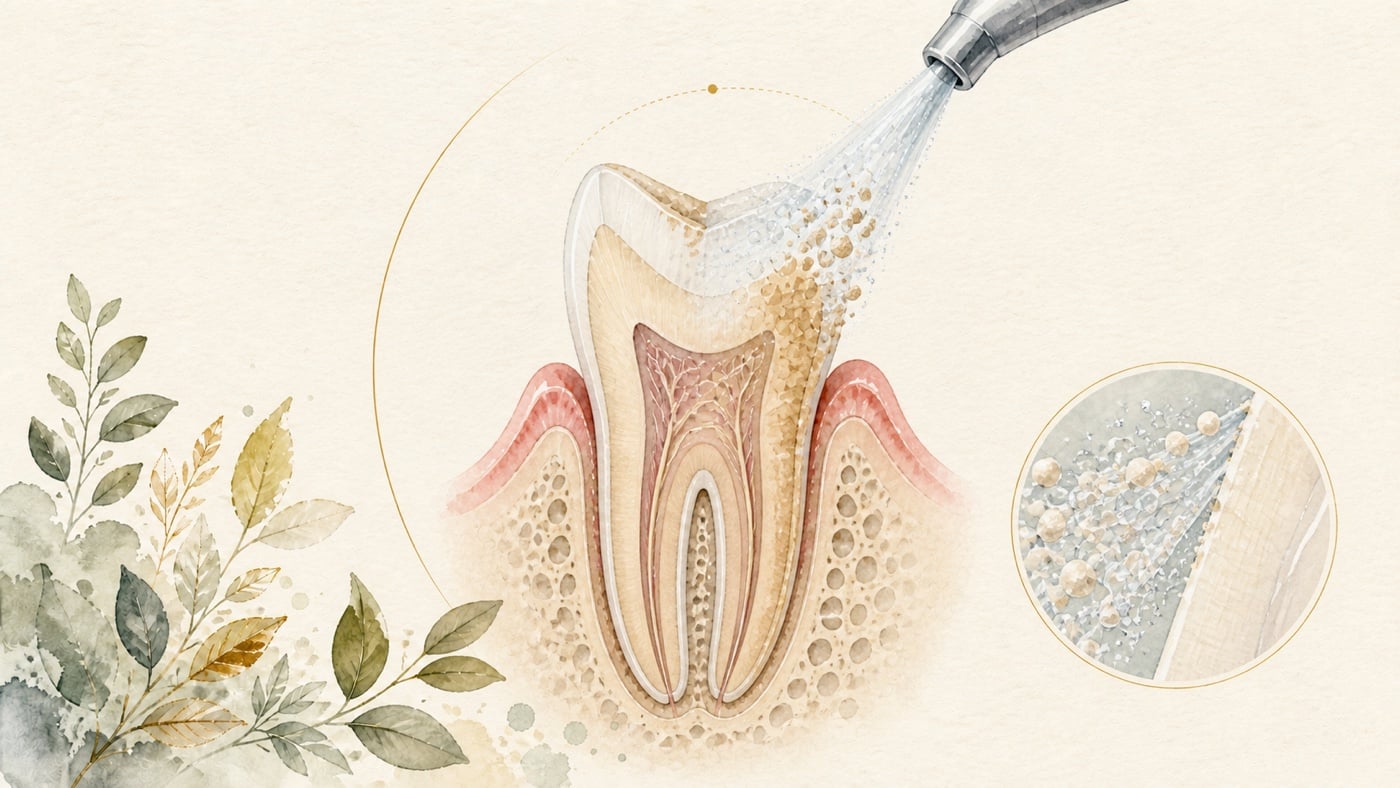
If you are considering air polishing, the first thing you should get clear about is this one sentence: Air polishing deals with "the things that have attached themselves," not with the colour of the tooth itself. Tea stains, coffee stains, tobacco tar, pigment deposits, plaque biofilm — these are collectively called extrinsic stain, foreign material that has accumulated on the tooth surface. Air polishing can remove them. A systematic review that included 42 laboratory studies described its use explicitly in the clinical implications section: low-abrasive air polishing powders, such as erythritol and glycine, are recommended for the removal of soft deposits and stains . Removal of soft deposits and stains. Remember that wording — it is exactly how air polishing is positioned in the literature. So the goal of air polishing is to return your teeth to their original colour, not to make them whiter than they originally were. The gap between those two things is why so many people feel afterwards that "it wasn't what I imagined." Three points worth stating up front:
What Air Polishing Can Actually Handle: The Line Is Drawn by One Phrase — "Extrinsic Stain"
Direct answer: Air polishing removes extrinsic stain and soft deposits that have attached to the tooth surface; it does not change the colour of the tooth itself — the review recommends low-abrasive powders (erythritol and glycine) for the removal of soft deposits and stains [F1]. In patients undergoing periodontal maintenance therapy, air polishing and conventional periodontal therapy presented identical clinical results, the difference lying in antimicrobial behaviour and patient-related outcomes [F3].
Geographic scope: This is general health education based on international literature. It does not cover any particular country's insurance scheme or regulations; for how care and fees are organised, follow the rules where you are. Every source cited in this card is international peer-reviewed literature; no national legislation or insurance-benefit rule is cited.
TL;DR — Air polishing is a cleaning instrument, not whitening
If you are considering air polishing, the first thing you should get clear about is this one sentence:
Air polishing deals with "the things that have attached themselves," not with the colour of the tooth itself.
Tea stains, coffee stains, tobacco tar, pigment deposits, plaque biofilm — these are collectively called extrinsic stain, foreign material that has accumulated on the tooth surface. Air polishing can remove them. A systematic review that included 42 laboratory studies described its use explicitly in the clinical implications section: low-abrasive air polishing powders, such as erythritol and glycine, are recommended for the removal of soft deposits and stains [F1].
Removal of soft deposits and stains. Remember that wording — it is exactly how air polishing is positioned in the literature.
So the goal of air polishing is to return your teeth to their original colour, not to make them whiter than they originally were. The gap between those two things is why so many people feel afterwards that "it wasn't what I imagined."
Three points worth stating up front:
- The type of powder determines the safety margin. The hard-tissue defects caused by sodium bicarbonate and calcium carbonate are significantly greater than those caused by glycine [F2]
- In terms of clinical outcomes in periodontal maintenance, air polishing and conventional instrumentation produce the same results; but in antimicrobial performance and patient experience, air polishing does better [F3]
- Comfort is air polishing's genuinely consistent advantage: when glycine or erythritol is used, discomfort is consistently equal to or lower than that of hand instruments and ultrasonic devices [F4]
Below, the boundaries are drawn one line at a time.
1. First, clear up a misunderstanding created by a Chinese name
In dentistry, the Chinese term 「噴砂」 in fact refers to two completely unrelated things at the same time. This is the easiest pit to fall into when you go looking things up.
The first is the air polishing used for cleaning teeth, which in English is air polishing (also called air-flow or air-abrasive). It uses a high-speed air stream to blow fine powder mixed with a water spray onto the tooth surface, washing deposits away. This is what this article is about — a cleaning instrument.
The second is the blasting used in materials processing, which in English is sandblasting. In a laboratory or a dental technician's workshop, alumina particles are used to roughen a material surface so that adhesive will bond to it. It appears in the pre-bonding treatment of zirconia crowns, in implant surface treatment, and in the preparatory steps for bonding orthodontic appliances.
These two things share the same Chinese word, but one cleans teeth inside your mouth and the other processes materials in a technician's workshop. If the content you found discusses shear bond strength, alumina particle size, or zirconia surface roughening — that is not the air polishing used for cleaning teeth, and it has nothing to do with what you need.
The way to tell them apart is simple: look at whether it is talking about "removing deposits from the tooth surface." If it is, that is air polishing for cleaning; if it is talking about "making materials bond more firmly," that is the other thing.
2. What air polishing can handle: extrinsic stain and soft deposits
Its scope of application in the literature
Back to that systematic review, the one that included 42 laboratory studies and assessed risk of bias with the RoBDEMAT tool. In its clinical recommendations it states that low-abrasive powders (erythritol and glycine) are recommended for the removal of soft deposits and stains, in order to preserve surface smoothness and marginal integrity [F1].
Broken down, air polishing has two kinds of target:
- Soft deposits — plaque biofilm, soft debris and similar accumulations that have not yet calcified
- Stains — surface discolouration caused by tea, coffee, red wine, tobacco and certain mouthrinses
What these two have in common is that both are "added on"; neither is the tooth structure itself. So once they are removed, what is revealed is what your teeth originally looked like.
"Extrinsic stain" is a real, measurable category
This is not marketing vocabulary. The dental literature has dedicated indices for measuring it.
A systematic review and meta-analysis of whitening toothpastes used extrinsic stain removal (ESR) as one of its primary outcomes, quantified with the Lobene stain index [F5]:
- 11 studies (n = 1962) assessed with the Lobene stain index gave a mean difference of −0.33 for stain area (95% CI −0.41 to −0.25; p = 0.00001) and −0.34 for stain intensity (95% CI −0.44 to −0.25; p = 0.00001) [F5]
- 6 studies (n = 2576) assessed with the modified Lobene index gave a mean difference of −0.42 for area (95% CI −0.58 to −0.25) and −0.30 for intensity (95% CI −0.39 to −0.21) [F5]
- 3 studies (n = 1322) assessed with shade guides gave a mean colour change of −1.80 (95% CI −2.33 to −1.26; p = 0.00001) [F5]
To be clear about this: what that review measured was whitening toothpastes, not air polishing. There is only one reason for citing it — to show that "extrinsic stain" is an independent, measurable clinical category with its own dedicated indices, and that the means of dealing with it (mechanical removal) and bleaching the tooth itself (peroxide acting on tooth structure) are two different pathways.
How to read this safely: the review recorded that whitening toothpastes were superior to regular toothpastes in removing extrinsic stain and in producing a whitening-like effect, but also produced more adverse effects — a risk ratio of 1.74 (95% CI 1.20 to 2.52; p = 0.003; 4 studies, n = 1322) [F5]. The same review also recorded that the quality of the evidence ranged from low to moderate, and called for larger, well-conducted independent studies [F5]. So what these numbers demonstrate is that "extrinsic stain can be improved by mechanical means" — not a promise about the effect of any product.
3. What air polishing cannot handle (this section matters more than the last one)
Since what air polishing deals with is "the things that have attached themselves," then anything that has not attached itself is beyond its reach.
It does not change the colour of the tooth itself
The following belong to intrinsic discolouration, where the discolouration occurs inside the structure of the tooth, not on the surface:
- Grey-black or blue-grey banded discolouration caused by tetracycline
- Dental fluorosis
- A single tooth darkening after pulp necrosis
- Yellowing of dentine with increasing age
Air polishing has no effect on these. It is not that the effect is poor; it is irrelevant in principle — what it removes is surface deposit, while the discolouration is inside the structure. This category calls for bleaching, or, when bleaching is still not enough, consideration of veneers, and that is an entirely different assessment process.
Its main target is not calcified calculus
The wording in the literature is "soft deposits and stains" [F1]. Calculus that has already calcified and hardened is not within that description.
This explains something that is commonly seen: in clinical practice most protocols pair air polishing with ultrasonics rather than having air polishing replace ultrasonics. A systematic review comparing air polishing with conventional periodontal treatment (hand instruments and/or ultrasonic debridement) included 14 randomised controlled trials out of 501 records, and recorded that the two produced the same results in clinical outcomes [F3] — "the same" means each has its own role, not that either one can be omitted.
It will not make your teeth whiter than they were
This is the point that most needs to be stated honestly. The ceiling of air polishing is the original colour of your teeth.
If after everything has been cleaned off you still feel it is not white enough, that means what you care about is not extrinsic stain but the shade of the tooth itself — and that calls for a different category of treatment, not "another round of polishing" or "a stronger powder."
4. The type of powder determines the safety margin
This is the most substantive and also the least mentioned variable in air polishing. Not all air polishing is the same.
A systematic review of the effects of air polishing devices on oral tissues searched MEDLINE, EMBASE and the Cochrane Library up to 18 November 2013, and included 17 studies out of 1266 abstracts [F2]:
- 13 reported the effects of air polishing on cementum and dentine. The hard-tissue changes (defect depth and volume) caused by sodium bicarbonate or calcium carbonate powders were significantly greater than those caused by glycine powder [F2]
- 4 assessed soft tissue. The potential of glycine powder air polishing to damage the gingiva was lower than that of sodium bicarbonate powder, and lower than that of curette instrumentation [F2]
- The review's conclusion: glycine powder air polishing can be applied safely to human root surfaces and gingiva [F2]
Another systematic review, this one on restorations, points in the same direction: air polishing — especially when sodium bicarbonate and calcium carbonate powders are used — increased surface roughness; while erythritol and glycine powders have the lowest abrasiveness [F1]. The same paper also recorded that both ultrasonic scaling and air polishing had a negative effect on the marginal quality of restorations [F1].
So the question worth asking is not "should I have air polishing" but "which powder will be used" — particularly when you have composite resin fillings, veneers or crowns in your mouth.
How to read this safely: the search for 25690301 closed in November 2013, so more recent evidence on erythritol powders falls outside that review's scope. And all 42 of the studies in 39908196 are laboratory studies, not clinical trials; the review itself records that the RoBDEMAT assessment showed the included studies to be deficient in randomisation, sample size reporting and blinding, and points out that methodological improvement and clinical research are needed before this can be applied to patient care [F1]. These are roughness changes measured in vitro, and they cannot be translated directly into "your filling will be blasted to ruin" — but they are enough to support the idea that "powder selection is a clinical decision that deserves discussion."
5. Does air polishing wear the teeth away? The honest answer
There is material loss, but it needs to be seen within a comparative context, and the numbers themselves contain a trap.
A systematic review published in 2026 analysed the effects of hand instruments, ultrasonic scalers and air polishing devices on dental hard tissue, focusing on material loss and surface roughness. The review searched MEDLINE, EMBASE and the Cochrane Library, included only studies using human cementum and dentine with at least six human tooth specimens, and excluded studies using powders other than glycine or erythritol, as well as studies of combined procedures [F6]:
- Hand curettes: loss of 0.86 to 20.60 μm per stroke (mean 6.0 μm) [F6]
- Ultrasonic scalers: 0.28 to 14.73 μm per stroke (mean 4.89 μm); 0.33 to 8.20 μm per second (mean 2.24 μm) [F6]
- Air polishing with low-abrasive powders: loss of 0.12 to 23.40 μm (mean 8.65 μm) [F6]
- The findings on surface roughness were inconsistent: in one study air polishing did not increase roughness, while other studies reported both increases and decreases in roughness [F6]
The review's overall conclusion is that calculated per second, material loss from air polishing devices is higher than from ultrasonic devices; calculated per stroke, loss from hand instruments is greater than from ultrasonic scalers [F6].
How to read this safely (please read this section to the end): the review itself states explicitly that, because of the heterogeneity among the included studies, comparing these results has its limitations [F6].
Where exactly do the limitations lie? Look at the units — the figures for hand instruments are "per stroke," ultrasonics has both "per stroke" and "per second," and the range for air polishing is not labelled with the same unit. "Per stroke" and "per second" are not the same scale, and ranking them directly produces a misleading conclusion. This is also why the review offered only a narrative description and did not perform a meta-analysis.
In addition, these are all in vitro studies, using extracted tooth specimens, with no saliva, no gingiva and no real operating time.
So the correct reading is this: all three types of instrument cause measurable material loss, and air polishing is not "completely non-abrasive"; but the existing data are not sufficient to support a one-sided conclusion that "air polishing damages teeth more" or that "air polishing damages teeth less." The point that can actually be acted on takes us back to Section 4 — the type of powder and the way it is used; that is the variable with a consistent direction of evidence.
6. Comfort and clinical outcomes: air polishing's genuinely consistent advantage
Patient experience
A systematic review on patient experience searched up to 18 November 2013 and included, out of 1266 abstracts, 9 studies that recorded pain and discomfort using visual analogue scales or patient interviews [F4]:
- The included studies used different powders, among them sodium bicarbonate, glycine and erythritol [F4]
- When glycine or erythritol powder was used, the discomfort reported in non-surgical periodontal therapy was consistently equal to or lower than that of root surface debridement with hand instruments and ultrasonic devices [F4]
- The review's conclusion: glycine powder air polishing appears to be associated with less discomfort in non-surgical periodontal therapy (both supragingival and subgingival) [F4]
Clinical and microbiological outcomes
A systematic review comparing air polishing with conventional periodontal treatment searched for randomised controlled trials published between January 1987 and March 2021, with two independent reviewers performing study selection, data extraction and bias assessment, and was registered with PROSPERO. The electronic search retrieved 501 records, of which 14 were included [F3]:
- Air polishing devices and conventional periodontal treatment produced the same results across the 14 studies [F3]
- Air polishing devices showed better antimicrobial performance, as well as better patient-related outcomes [F3]
- The review's conclusion: there is no difference between the two in clinical outcomes; but air polishing appears to bring improvement in antimicrobial outcomes, and for patients receiving supportive periodontal therapy it is a safer, faster and more comfortable option [F3]
How to read this safely: the review did not perform a meta-analysis because of the high heterogeneity between studies [F3]. This means the conclusions above are the product of narrative synthesis, with no pooled effect sizes or confidence intervals available for reference. Furthermore, the subjects of both of these reviews were patients receiving periodontal maintenance therapy, not the general population having a cleaning purely for the sake of appearance — extrapolating the conclusions to the latter warrants caution.
7. About cost
What this article cites is a database of dental papers, and it contains no fee data for Taiwan.
So the honest answer is: please ask the clinic directly about cost. Clinics differ in the type of powder used, in whether ultrasonic debridement is combined with it, in the number of sessions, and in whether a periodontal examination is included; those differences feed directly into the cost.
There is one thing worth asking about at the same time as the price: which powder is being used. On the evidence in Section 4, that question does more to determine the quality of the treatment you receive than the price figure does — particularly when you have veneers, crowns or composite resin fillings in your mouth.
Conclusion — Aim your expectations at what it can really do
What air polishing can do is clear: remove the extrinsic stain and soft deposits attached to the tooth surface, and let the teeth return to their original colour.
What it cannot do is equally clear: it does not change the shade of the tooth itself. Tetracycline discolouration, fluorosis, discolouration from pulp necrosis, yellowing of dentine with age — these discolourations are inside the structure, not on the surface, and air polishing cannot reach them.
If what troubles you is tea stains, coffee stains or tobacco tar, then air polishing is the right direction; and the thing worth asking one more question about is the type of powder — the most consistent variable in the existing evidence: glycine and erythritol have the lowest abrasiveness, and a lower potential to damage the gingiva [F2][F1].
If after a thorough cleaning you still feel it is not white enough, that does not mean air polishing has failed; it means what you care about is something else — and that calls for a fresh assessment of the cause of the discolouration, and a different pathway.
The most practical step: take the thing you actually care about to your dentist and discuss it — is it surface stain, or the colour of the tooth itself? Being clear about that matters more than which treatment you book. Take that question to your own dentist and book an examination, and work out together whether what you need is cleaning, bleaching, or no treatment at all.
Risk factors (what to know before treatment)
- The indication is also the limit: the literature positions low-abrasive powders for the removal of “soft” deposits and stains [F1]; calcified calculus, and intrinsic discolouration from tetracycline, fluorosis, pulp necrosis or ageing, all fall outside that description.
- The choice of powder is the safety margin: hard-tissue modifications (defect depth and volume) caused by sodium bicarbonate or calcium carbonate powders were significantly greater than those caused by glycine powder; for soft tissue, glycine powder air polishing showed less potential of harm to the gingiva than sodium bicarbonate powder or instrumentation with curettes [F2].
- Adverse effects on restorations do not come from air polishing alone: the review of laboratory studies records that air polishing increased surface roughness, especially with sodium bicarbonate and calcium carbonate powders, and that both ultrasonic scaling and air polishing negatively impacted marginal quality [F1]. If you have composite fillings, veneers or crowns, this is worth raising with your dentist before treatment.
- Material loss is real, but different units cannot be ranked: hand instruments 0.86 to 20.60 μm per stroke (mean 6.0 μm) and ultrasonic scalers 0.28 to 14.73 μm per stroke (mean 4.89 μm); air polishing with low-abrasive powders resulted in a loss of 0.12 to 23.40 μm (mean 8.65 μm), and the source does not label that range with the same unit of measurement [F6]. The review itself states that, because of the heterogeneity of the included studies, comparing the results has certain limitations [F6].
- Level of evidence and target population have to be read together: all 42 studies behind F1 are laboratory studies, and the RoBDEMAT assessments revealed shortcomings in randomization, sample size justification and blinding [F1]; F3 concerns patients undergoing periodontal maintenance therapy [F3], while the discomfort data in F4 come from non-surgical periodontal therapy [F4] — neither is a general population cleaning purely for appearance; F5 measured whitening dentifrices rather than air polishing, and its quality of evidence varied from low to moderate [F5].
- This card does not compile a list of contraindications: no separate literature search on contraindications was run for this card; whether air polishing is suitable, which powder to use, and whether ultrasonic debridement should be combined with it, has to be assessed by a dentist from your periodontal condition and the restorations in your mouth.
Every clinical statement in this article is mapped line by line to its cited source (see the sources and evidence chain below). It has not been clinically reviewed by a licensed practitioner. This is health information, not individual advice; assessment by a clinician is required.
FAQ
- Can air polishing make my teeth white?
- It cannot change the colour of the tooth itself. In the literature air polishing is positioned as a cleaning instrument, and low-abrasive powders are recommended for **the removal of soft deposits and stains** [F1]. What it deals with is extrinsic stain attached to the tooth surface, so what you see afterwards is **the original colour of your teeth** — if that original colour is on the yellow side, air polishing will not change that. Changing the shade of the tooth itself belongs to bleaching or restorative treatment and needs a separate assessment.
- エアポリッシングで歯は白くなりますか? — 歯そのものの色を変えることはできません。エアポリッシングは文献上、清掃器械として位置づけられており、低研磨性パウダーは**軟性沈着物と着色の除去**に用いることが推奨されています [F1]。処理するのは歯面に付着した外因性ステインですので、施術後に見えるのは**歯のもともとの色**です——もともとの色が黄色みを帯びているなら、エアポリッシングがそれを変えることはありません。歯そのものの色調を変えたい場合は、ホワイトニングまたは修復系の処置にあたり、別途の評価が必要です。
- Can air polishing make my teeth white? — It cannot change the colour of the tooth itself. In the literature air polishing is positioned as a cleaning instrument, and low-abrasive powders are recommended for **the removal of soft deposits and stains** [F1]. What it deals with is extrinsic stain attached to the tooth surface, so what you see afterwards is **the original colour of your teeth** — if that original colour is on the yellow side, air polishing will not change that. Changing the shade of the tooth itself belongs to bleaching or restorative treatment and needs a separate assessment.
- When I search for 「噴砂」 I find a pile of papers about zirconia and implant surfaces. Is that the same thing?
- No. The Chinese word 「噴砂」 corresponds to two different English terms: for cleaning teeth it is **air polishing** (removing deposits from the tooth surface), and for materials processing it is **sandblasting** (roughening a material surface to aid adhesion). The latter appears in the technical literature on crown bonding, implant surface treatment and orthodontic bonding, and has nothing to do with the cleaning you have in the dental chair. The way to tell is to look at whether it is about "removing deposits" or about "making materials bond more firmly."
- 「噴砂」で検索するとジルコニアやインプラント表面の論文がたくさん出てきますが、同じものですか? — いいえ。中国語の「噴砂」は二つの異なる英語の語に対応します。歯面清掃で使うのは **air polishing**(歯面の沈着物を除去する)、材料加工で使うのは **sandblasting**(接着を助けるために材料表面を粗造化する)です。後者はクラウンの接着、インプラント表面の処理、矯正装置のボンディングの技術文献に登場するもので、診療室であなたが受ける歯面清掃とは関係がありません。見分け方は、それが「沈着物を除去する」話なのか「材料をより強く接着させる」話なのかを見ることです。
- When I search for 「噴砂」 I find a pile of papers about zirconia and implant surfaces. Is that the same thing? — No. The Chinese word 「噴砂」 corresponds to two different English terms: for cleaning teeth it is **air polishing** (removing deposits from the tooth surface), and for materials processing it is **sandblasting** (roughening a material surface to aid adhesion). The latter appears in the technical literature on crown bonding, implant surface treatment and orthodontic bonding, and has nothing to do with the cleaning you have in the dental chair. The way to tell is to look at whether it is about "removing deposits" or about "making materials bond more firmly."
- Will air polishing thin my teeth?
- There is measurable material loss, but it needs careful interpretation. A systematic review from 2026 recorded material loss from air polishing with low-abrasive powders as 0.12 to 23.40 μm (mean 8.65 μm), hand curettes as 0.86 to 20.60 μm per stroke (mean 6.0 μm), and ultrasonics as 0.28 to 14.73 μm per stroke (mean 4.89 μm) [F6]. But the review **itself points out that heterogeneity places limits on the comparison**, and the units of measurement for the different instruments (per stroke vs. per second) are not the same, so no ranking can be based on them. These are also all in vitro studies. The variable with a consistent direction of evidence is the type of powder, not "whether or not to have air polishing."
- エアポリッシングで歯が薄くなりませんか? — 測定可能な物質の喪失は生じますが、慎重な解釈が必要です。2026 年のシステマティックレビューは、低研磨性パウダーによるエアポリッシングの物質喪失を 0.12 から 23.40 μm(平均 8.65 μm)、手用キュレットをストローク 1 回あたり 0.86 から 20.60 μm(平均 6.0 μm)、超音波をストローク 1 回あたり 0.28 から 14.73 μm(平均 4.89 μm)と記録しています [F6]。ただし同レビューは**自ら、異質性のために比較には限界があると指摘しており**、また器械ごとの計量単位(ストローク 1 回あたり 対 1 秒あたり)が同一ではないため、これに基づいて順位づけすることはできません。これらもすべて体外研究です。一貫したエビデンスの方向をもつ要因はパウダーの種類であって、「エアポリッシングをするかしないか」ではありません。
- Will air polishing thin my teeth? — There is measurable material loss, but it needs careful interpretation. A systematic review from 2026 recorded material loss from air polishing with low-abrasive powders as 0.12 to 23.40 μm (mean 8.65 μm), hand curettes as 0.86 to 20.60 μm per stroke (mean 6.0 μm), and ultrasonics as 0.28 to 14.73 μm per stroke (mean 4.89 μm) [F6]. But the review **itself points out that heterogeneity places limits on the comparison**, and the units of measurement for the different instruments (per stroke vs. per second) are not the same, so no ranking can be based on them. These are also all in vitro studies. The variable with a consistent direction of evidence is the type of powder, not "whether or not to have air polishing."
- Do different air polishing powders make a difference?
- Yes, and this is the part of the topic where the evidence is most consistent. A systematic review that included 17 studies recorded that **the depth and volume of hard-tissue defects caused by sodium bicarbonate or calcium carbonate powders were significantly greater than those caused by glycine powder**; and in soft tissue, the potential of glycine powder to damage the gingiva was also lower than that of sodium bicarbonate and of curette instrumentation [F2]. Another systematic review recorded that erythritol and glycine powders have the lowest abrasiveness [F1]. So "which powder is used" is worth confirming before treatment.
- エアポリッシング用のパウダーによる違いはありますか? — あります。しかもこのテーマのなかで最もエビデンスが一致している部分です。17 件の研究を組み入れたシステマティックレビューは、**炭酸水素ナトリウムまたは炭酸カルシウムのパウダーによる硬組織の欠損の深さと体積は、グリシンパウダーより有意に大きい**と記録し、軟組織についてもグリシンパウダーの歯肉への傷害の可能性は炭酸水素ナトリウムおよびキュレットより低いとしています [F2]。別のシステマティックレビューは、エリスリトールとグリシンのパウダーの研磨性が最も低いと記録しています [F1]。ですから「どのパウダーを使うのか」は、施術前に確認しておく価値のあることです。
- Do different air polishing powders make a difference? — Yes, and this is the part of the topic where the evidence is most consistent. A systematic review that included 17 studies recorded that **the depth and volume of hard-tissue defects caused by sodium bicarbonate or calcium carbonate powders were significantly greater than those caused by glycine powder**; and in soft tissue, the potential of glycine powder to damage the gingiva was also lower than that of sodium bicarbonate and of curette instrumentation [F2]. Another systematic review recorded that erythritol and glycine powders have the lowest abrasiveness [F1]. So "which powder is used" is worth confirming before treatment.
- I have had composite resin fillings and veneers. Can I have air polishing?
- The powder and the technique need to be decided by a dentist after assessment. A systematic review that included 42 laboratory studies recorded that **air polishing increased surface roughness when sodium bicarbonate and calcium carbonate powders were used**, and that **both ultrasonic scaling and air polishing had a negative effect on the marginal quality of restorations**; it also recorded that erythritol and glycine have the lowest abrasiveness [F1]. The review states explicitly that these are laboratory studies, deficient in randomisation, sample size and blinding, so they cannot be extrapolated directly to your case — but they are enough to show that **actively telling your dentist which restorations you have in your mouth** is a reasonable thing to do.
- コンポジットレジン修復とベニアをしていますが、エアポリッシングを受けられますか? — 歯科医師の評価を経たうえで、パウダーと操作方法を決める必要があります。42 件の実験室研究を組み入れたシステマティックレビューは、**エアポリッシングは炭酸水素ナトリウムと炭酸カルシウムのパウダーを用いた場合に表面粗さを増大させた**こと、そして**超音波スケーリングとエアポリッシングはいずれも修復物のマージンの品質に負の影響を与えた**ことを記録し、同時にエリスリトールとグリシンの研磨性が最も低いことも記録しています [F1]。同レビューはこれらが実験室研究であり、ランダム化、サンプルサイズ、盲検化の面で不足があると明記していますので、あなたの症例にそのまま当てはめることはできません——しかし**口の中にどのような修復物があるかを歯科医師へ自分から伝える**ことが妥当な対応であると説明するには十分です。
- I have had composite resin fillings and veneers. Can I have air polishing? — The powder and the technique need to be decided by a dentist after assessment. A systematic review that included 42 laboratory studies recorded that **air polishing increased surface roughness when sodium bicarbonate and calcium carbonate powders were used**, and that **both ultrasonic scaling and air polishing had a negative effect on the marginal quality of restorations**; it also recorded that erythritol and glycine have the lowest abrasiveness [F1]. The review states explicitly that these are laboratory studies, deficient in randomisation, sample size and blinding, so they cannot be extrapolated directly to your case — but they are enough to show that **actively telling your dentist which restorations you have in your mouth** is a reasonable thing to do.
- Does air polishing hurt a lot?
- The existing evidence points towards relative comfort. A systematic review that included 9 studies recorded that when glycine or erythritol powder was used, discomfort in non-surgical periodontal therapy was **consistently equal to or lower than** that of hand instruments and ultrasonic debridement [F4]. Another systematic review, which included 14 randomised controlled trials, also recorded that air polishing performed better on patient-related outcomes and is a more comfortable option [F3]. However, the latter did not perform a meta-analysis because of high heterogeneity, and its subjects were patients receiving periodontal maintenance therapy.
- エアポリッシングはとても痛いですか? — 現在のエビデンスは相対的に快適であることを示しています。9 件の研究を組み入れたシステマティックレビューは、グリシンまたはエリスリトールのパウダーを用いた場合、非外科的歯周治療での不快感が手用器具および超音波によるデブライドメントと**一貫して同等かそれ以下**であったと記録しています [F4]。14 件のランダム化比較試験を組み入れた別のシステマティックレビューも、エアポリッシングが患者関連アウトカムでより良好な成績を示し、より快適な選択肢であると記録しています [F3]。ただし後者は異質性が大きいためメタアナリシスを実施しておらず、対象は歯周メインテナンス治療を受けている患者です。
- Does air polishing hurt a lot? — The existing evidence points towards relative comfort. A systematic review that included 9 studies recorded that when glycine or erythritol powder was used, discomfort in non-surgical periodontal therapy was **consistently equal to or lower than** that of hand instruments and ultrasonic debridement [F4]. Another systematic review, which included 14 randomised controlled trials, also recorded that air polishing performed better on patient-related outcomes and is a more comfortable option [F3]. However, the latter did not perform a meta-analysis because of high heterogeneity, and its subjects were patients receiving periodontal maintenance therapy.
- Can air polishing replace scaling?
- Judging from the wording in the literature, the two divide the work between them rather than one replacing the other. The systematic review describes air polishing powders as being used to remove "**soft** deposits and stains" [F1] — calculus that has already calcified is not within the scope of that description. And the systematic review comparing air polishing with conventional instrumentation recorded that the two **produced the same results in clinical outcomes**, with air polishing doing better on antimicrobial outcomes and patient experience [F3]. That is also why what is commonly seen in practice is the two used together.
- エアポリッシングはスケーリングの代わりになりますか? — 文献の言い回しから見るかぎり、両者は役割分担であって代替ではありません。システマティックレビューは、エアポリッシング用パウダーが「**軟性**沈着物と着色」の除去に用いられると記述しています [F1]——すでに石灰化した歯石は、この記述の範囲に入っていません。またエアポリッシングと従来の器械を比較したシステマティックレビューは、両者が**臨床効果において同等の結果を示し**、抗菌面と患者の感じ方ではエアポリッシングのほうが良好であったと記録しています [F3]。臨床でよく見られるのが両者の併用である理由も、ここにあります。
- Can air polishing replace scaling? — Judging from the wording in the literature, the two divide the work between them rather than one replacing the other. The systematic review describes air polishing powders as being used to remove "**soft** deposits and stains" [F1] — calculus that has already calcified is not within the scope of that description. And the systematic review comparing air polishing with conventional instrumentation recorded that the two **produced the same results in clinical outcomes**, with air polishing doing better on antimicrobial outcomes and patient experience [F3]. That is also why what is commonly seen in practice is the two used together.
- How often should air polishing be done, and how many times?
- The literature cited in this article does not answer this question. The subjects of the included reviews were patients receiving **supportive periodontal therapy**, whose treatment intervals are arranged individually according to periodontal condition [F3], so this cannot be taken directly as a recommended frequency for the general population. How quickly you stain is heavily influenced by diet, by whether you smoke, and by cleaning habits; the appropriate interval needs to be judged by a dentist according to the actual condition in your mouth.
- エアポリッシングはどのくらいの頻度で、何回受ければよいのですか? — 本稿が引用している文献は、この問いに答えていません。組み入れられたレビューの対象は**サポーティブペリオドンタルセラピー**を受けている患者であり、その治療間隔は歯周の状態に応じて個別に設定されるものですので [F3]、一般の人々に対する推奨頻度としてそのまま用いることはできません。着色のつく速さは食事、喫煙の有無、清掃習慣に大きく左右されますので、適切な間隔は歯科医師があなたの口腔内の実際の状態に応じて判断する必要があります。
- How often should air polishing be done, and how many times? — The literature cited in this article does not answer this question. The subjects of the included reviews were patients receiving **supportive periodontal therapy**, whose treatment intervals are arranged individually according to periodontal condition [F3], so this cannot be taken directly as a recommended frequency for the general population. How quickly you stain is heavily influenced by diet, by whether you smoke, and by cleaning habits; the appropriate interval needs to be judged by a dentist according to the actual condition in your mouth.
Medical notice This article is provided for health education and medical information purposes. It is not a solicitation for medical services and does not constitute diagnosis or treatment advice. Actual treatment methods and outcomes vary between individuals and require evaluation by a dentist; every treatment has its own indications, limitations and possible risks. If you have related symptoms or treatment needs, please book a consultation for evaluation by a dentist.
Source anchors
- Adverse Effects of Ultrasonic Instrumentation and Air Polishing on Dental Restorations: A Systematic Review of Laboratory Studies. [PMID:39908196] · https://pubmed.ncbi.nlm.nih.gov/39908196/ · 在 IDAEO 的其他引用
- A systematic review on the effects of air polishing devices on oral tissues. [PMID:25690301] · https://pubmed.ncbi.nlm.nih.gov/25690301/ · 在 IDAEO 的其他引用
- The efficacy of air polishing devices in supportive periodontal therapy: Clinical, microbiological and patient-centred outcomes. A systematic review. [PMID:36300683] · https://pubmed.ncbi.nlm.nih.gov/36300683/ · 在 IDAEO 的其他引用
- A systematic review on the patient perception of periodontal treatment using air polishing devices. [PMID:25619863] · https://pubmed.ncbi.nlm.nih.gov/25619863/ · 在 IDAEO 的其他引用
- Efficacy and Adverse Effects of Whitening Dentifrices Compared With Other Products: A Systematic Review and Meta-analysis. [PMID:31738695] · https://pubmed.ncbi.nlm.nih.gov/31738695/ · 在 IDAEO 的其他引用
- The Effect of Mechanical Instrumentation on Dental Hard Tissue In Vitro: A Systematic Review. [PMID:42244102] · https://pubmed.ncbi.nlm.nih.gov/42244102/ · 在 IDAEO 的其他引用
Cite this article
Lucy・《What Air Polishing Can Actually Handle: The Line Is Drawn by One Phrase — "Extrinsic Stain"》・IDAEO 知識庫・2026-07-20・https://km.idaeo.ai/post/dental/air-polishing-extrinsic-stainUpdated 2026-08-26