Chapter 2
Journey Design (Which Steps to Take): AI Customer Journey: Four Phases, Ten Steps
When customers find a merchant through AI, how do the four phases and ten steps connect?
Journey Design (Which Steps to Take): AI Customer Journey: Four Phases, Ten Steps
This chapter answersWhen customers find a merchant through AI, how do the four phases and ten steps connect?
Why it comes hereEach audience has its role; the Customer Journey links these roles into a path that can be diagnosed.
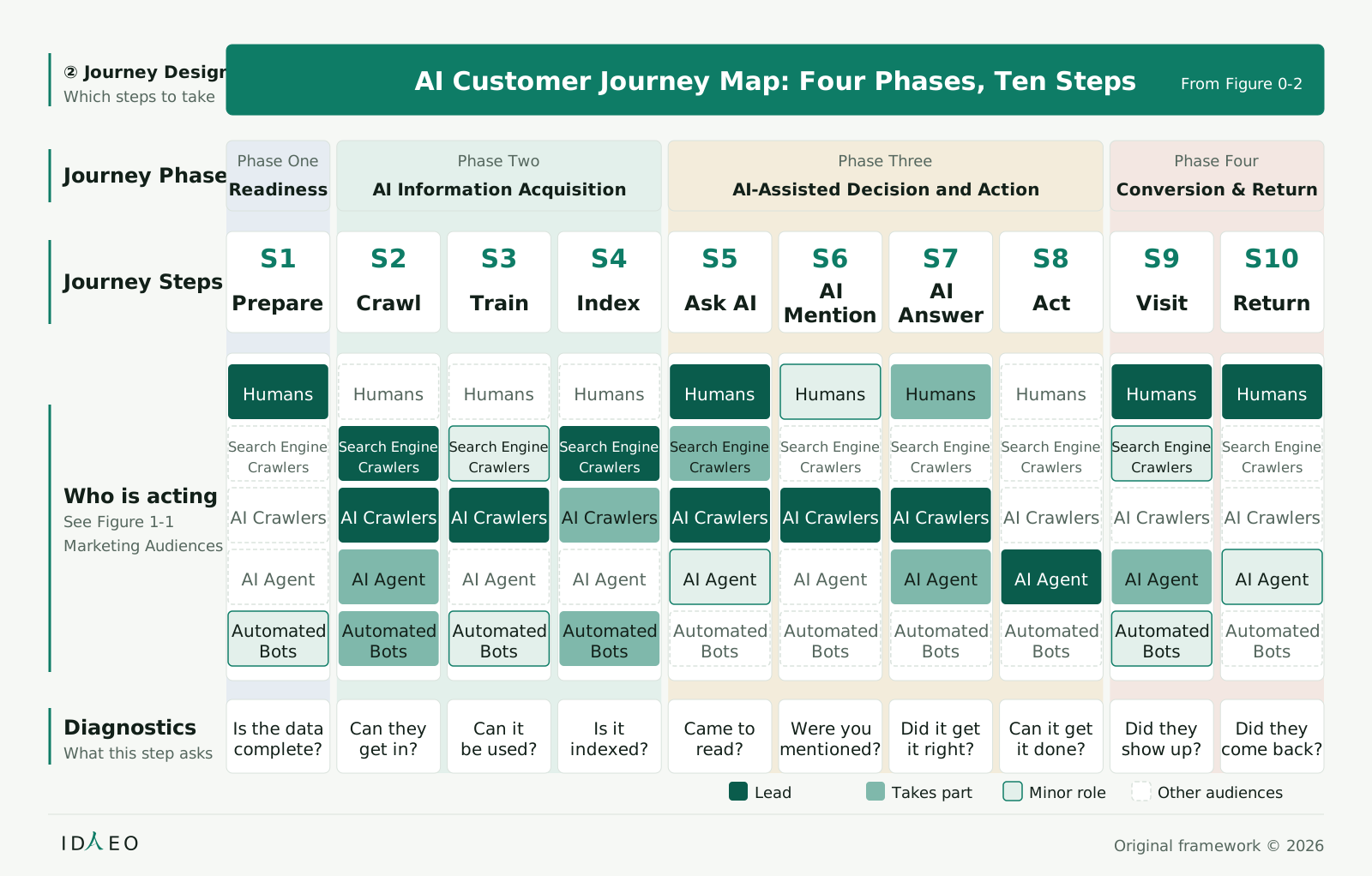
Figure 2-1 AI Customer Journey Map: Four Phases, Ten Steps
Read from top to bottom: journey phases, journey steps, the participation of the Marketing Audiences, and Journey Diagnostics; the same column is the same step, linking each role to its results.
View as text
Read top to bottom: journey phase, journey step, who is acting, Journey Diagnostics. The five small cells in each step stand for the Five Marketing Audiences in order: dark green is the lead, medium green takes part, light green is slightly involved, and gray is the remaining roles.
② Journey Design
Which steps to take
AI Customer Journey Map: Four Phases, Ten Steps
From Figure 0-2
Journey Phases
Phase One
Readiness
Phase Two
AI Information Acquisition
Phase Three
AI-Assisted Decision and Action
Phase Four
Conversion & Return
Journey Steps
S1
Prepare
S2
Crawl
S3
Train
S4
Index
S5
Ask AI
S6
AIMention
S7
AIAnswer
S8
Act
S9
Visit
S10
Return
Who is acting
See Figure 1-1
Marketing Audiences
Humans
Search EngineCrawlers
AI Crawlers
AI Agent
AutomatedBots
Humans
Search EngineCrawlers
AI Crawlers
AI Agent
AutomatedBots
Humans
Search EngineCrawlers
AI Crawlers
AI Agent
AutomatedBots
Humans
Search EngineCrawlers
AI Crawlers
AI Agent
AutomatedBots
Humans
Search EngineCrawlers
AI Crawlers
AI Agent
AutomatedBots
Humans
Search EngineCrawlers
AI Crawlers
AI Agent
AutomatedBots
Humans
Search EngineCrawlers
AI Crawlers
AI Agent
AutomatedBots
Humans
Search EngineCrawlers
AI Crawlers
AI Agent
AutomatedBots
Humans
Search EngineCrawlers
AI Crawlers
AI Agent
AutomatedBots
Humans
Search EngineCrawlers
AI Crawlers
AI Agent
AutomatedBots
Diagnostics
What this step asks
Is the datacomplete?
Can theyget in?
Can itbe used?
Is itindexed?
Came toread?
Were youmentioned?
Did it getit right?
Can it getit done?
Did theyshow up?
Did theycome back?
Lead
Takes part
Minor role
Other audiences
ID
EO
Original framework © 2026
How to readRead top to bottom: journey phase, journey step, who is acting, Journey Diagnostics. The five small cells in each step stand for the Five Marketing Audiences in order: dark green is the lead, medium green takes part, light green is slightly involved, and gray is the remaining roles.
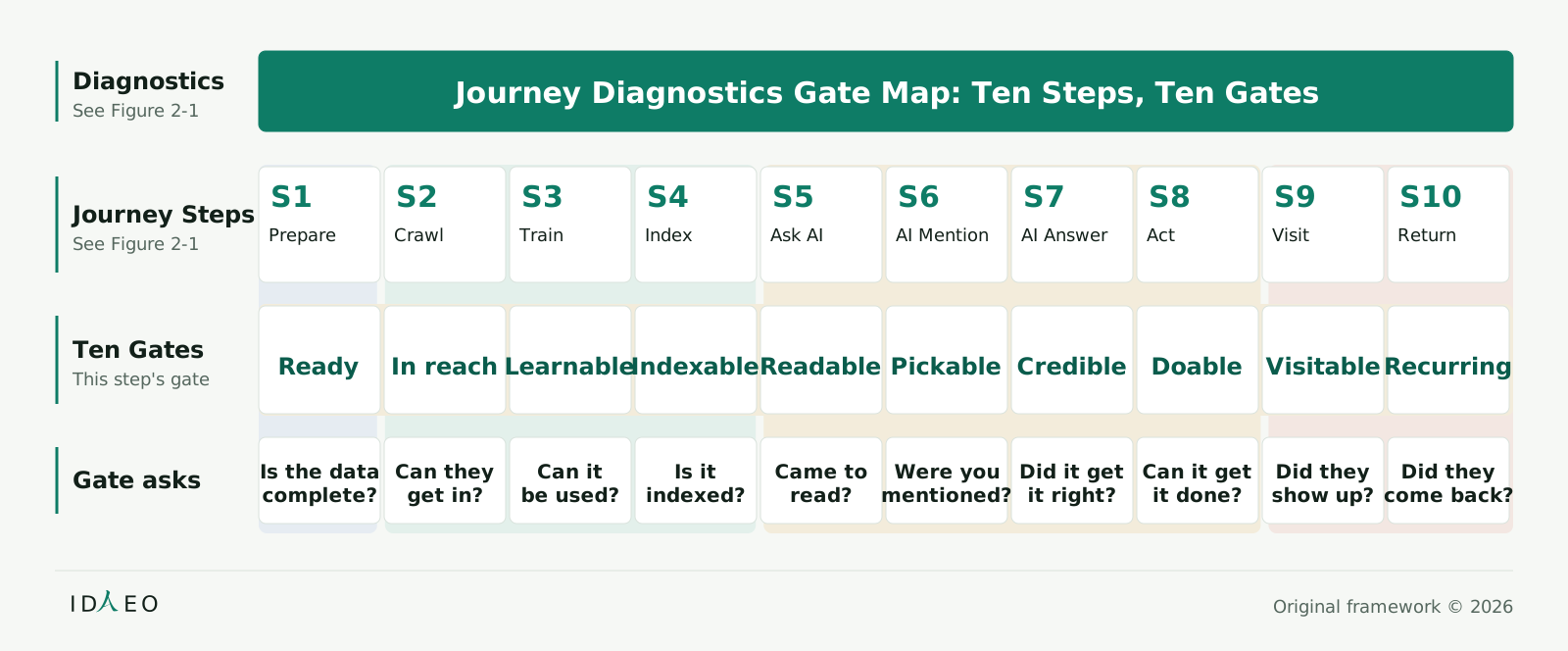
Figure 2-2 Journey Diagnostics Gate Map: Ten Steps, Ten Gates
Below the ten steps, each has one gate and one diagnostic question; each later phase builds on the results of the one before. After S10, the next round starts again from S5. Training authorization at S3 is the merchant's choice, and real-time retrieval at S5 answers immediate questions, so each step is diagnosed by its own function.
View as text
Read the journey steps left to right; below each are the gate name and diagnostic question.
Diagnostics
See Figure 2-1
Journey Diagnostics Gate Map: Ten Steps, Ten Gates
Journey Steps
See Figure 2-1
S1
Prepare
S2
Crawl
S3
Train
S4
Index
S5
Ask AI
S6
AI Mention
S7
AI Answer
S8
Act
S9
Visit
S10
Return
Ten Gates
This step's gate
Ready
In reach
Learnable
Indexable
Readable
Pickable
Credible
Doable
Visitable
Recurring
Gate asks
Is the datacomplete?
Can theyget in?
Can itbe used?
Is itindexed?
Came toread?
Were youmentioned?
Did it getit right?
Can it getit done?
Did theyshow up?
Did theycome back?
ID
EO
Original framework © 2026
How to readRead the journey steps left to right; below each are the gate name and diagnostic question.
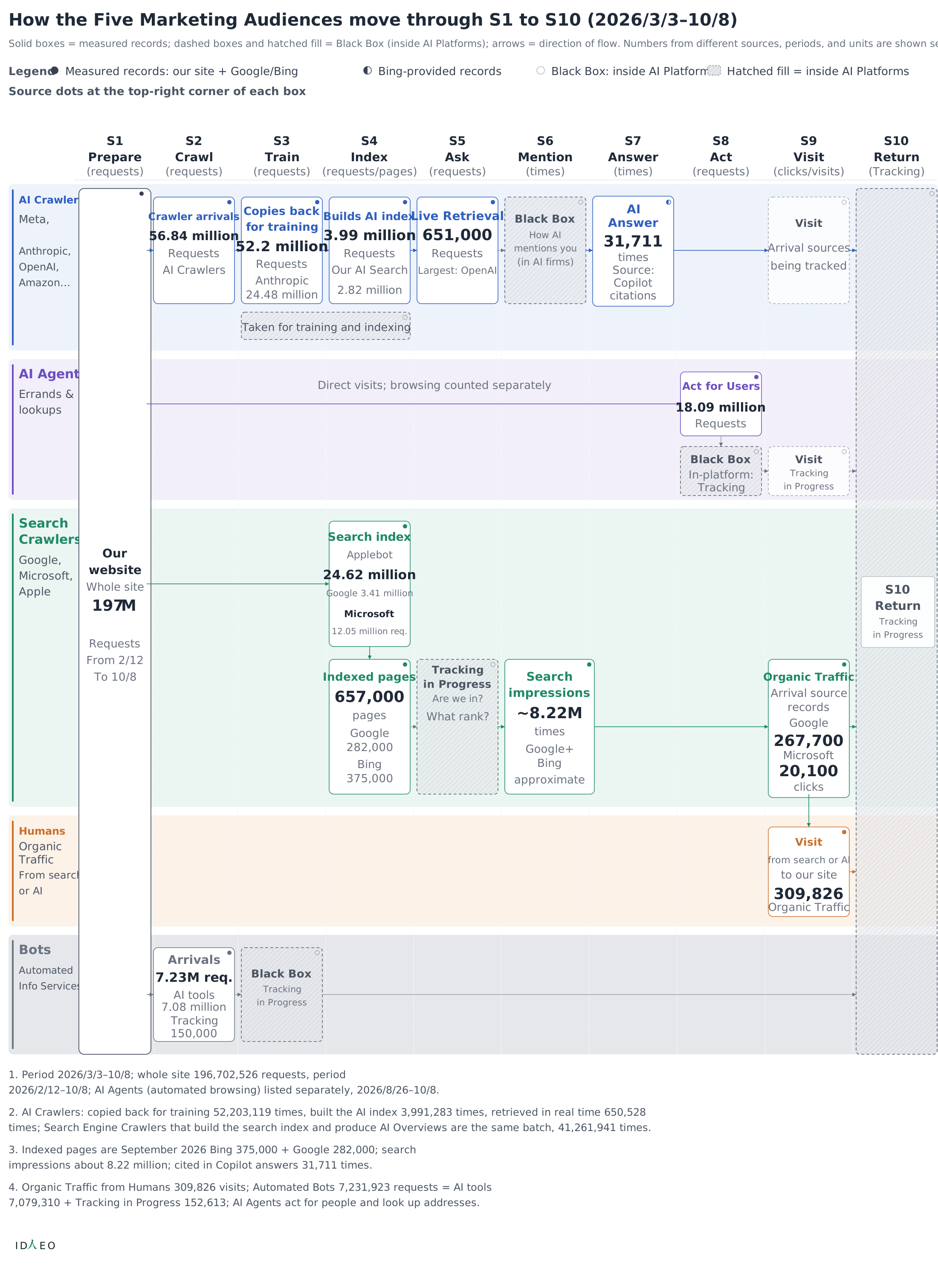
Figure 2-3 Five Marketing Audiences Journey Swimlane Diagram
The steps each of the Five Marketing Audiences passes through, and the scope of measured records at each step.
View as text
Each row is one of the Marketing Audiences, with S1–S10 running across; first see which steps it passes through, then the records at each step and the scope of measured tracking.
How the Five Marketing Audiences move through S1 to S10 (2026/3/3–10/8)
Solid boxes = measured records; dashed boxes and hatched fill = Black Box (inside AI Platforms); arrows = direction of flow. Numbers from different sources, periods, and units are shown separately.
Legend
Measured records: our site + Google/Bing
Bing-provided records
Black Box: inside AI Platforms
Hatched fill = inside AI Platforms
Source dots at the top-right corner of each box
S1 Prepare
(requests)
S2 Crawl
(requests)
S3 Train
(requests)
S4 Index
(requests/pages)
S5 Ask
(requests)
S6 Mention
(times)
S7 Answer
(times)
S8 Act
(requests)
S9 Visit
(clicks/visits)
S10 Return
(Tracking)
AI Crawlers
Meta,
Anthropic,
OpenAI,
Amazon…
AI Agent
Errands &
lookups
SearchCrawlers
Google,
Microsoft,
Apple
Humans
OrganicTraffic
From searchor AI
Bots
AutomatedInfo Services
Ourwebsite
Whole site
197M
Requests
From 2/12
To 10/8
Crawler arrivals
56.84 million
Requests
AI Crawlers
Copies backfor training
52.2 million
Requests
Anthropic
24.48 million
Builds AI index
3.99 million
Requests
Our AI Search
2.82 million
Taken for training and indexing
Live Retrieval
651,000
Requests
Largest: OpenAI
Black Box
How AImentions you
(in AI firms)
AIAnswer
31,711
times
Source: Copilot
citations
Visit
Arrival sourcesbeing tracked
Direct visits; browsing counted separately
Act for Users
18.09 million
Requests
Black Box
In-platform:Tracking
Visit
Trackingin Progress
Search index
Applebot
24.62 million
Google 3.41 million
Microsoft
12.05 million req.
Indexed pages
657,000
pages
Google 282,000
Bing 375,000
Trackingin Progress
Are we in?
What rank?
Searchimpressions
~8.22M
times
Google+Bing
approximate
Organic Traffic
Arrival sourcerecords
Google
267,700
Microsoft
20,100
clicks
Visit
from search or AI
to our site
309,826
Organic Traffic
Arrivals
7.23M req.
AI tools7.08 million
Tracking150,000
Black Box
Trackingin Progress
S10 Return
Trackingin Progress
1. Period 2026/3/3–10/8; whole site 196,702,526 requests, period2026/2/12–10/8; AI Agents (automated browsing) listed separately, 2026/8/26–10/8.
2. AI Crawlers: copied back for training 52,203,119 times, built the AI index 3,991,283 times, retrieved in real time 650,528times; Search Engine Crawlers that build the search index and produce AI Overviews are the same batch, 41,261,941 times.
3. Indexed pages are September 2026 Bing 375,000 + Google 282,000; searchimpressions about 8.22 million; cited in Copilot answers 31,711 times.
4. Organic Traffic from Humans 309,826 visits; Automated Bots 7,231,923 requests = AI tools7,079,310 + Tracking in Progress 152,613; AI Agents act for people and look up addresses.
ID
EO
How to readEach row is one of the Marketing Audiences, with S1–S10 running across; first see which steps it passes through, then the records at each step and the scope of measured tracking.
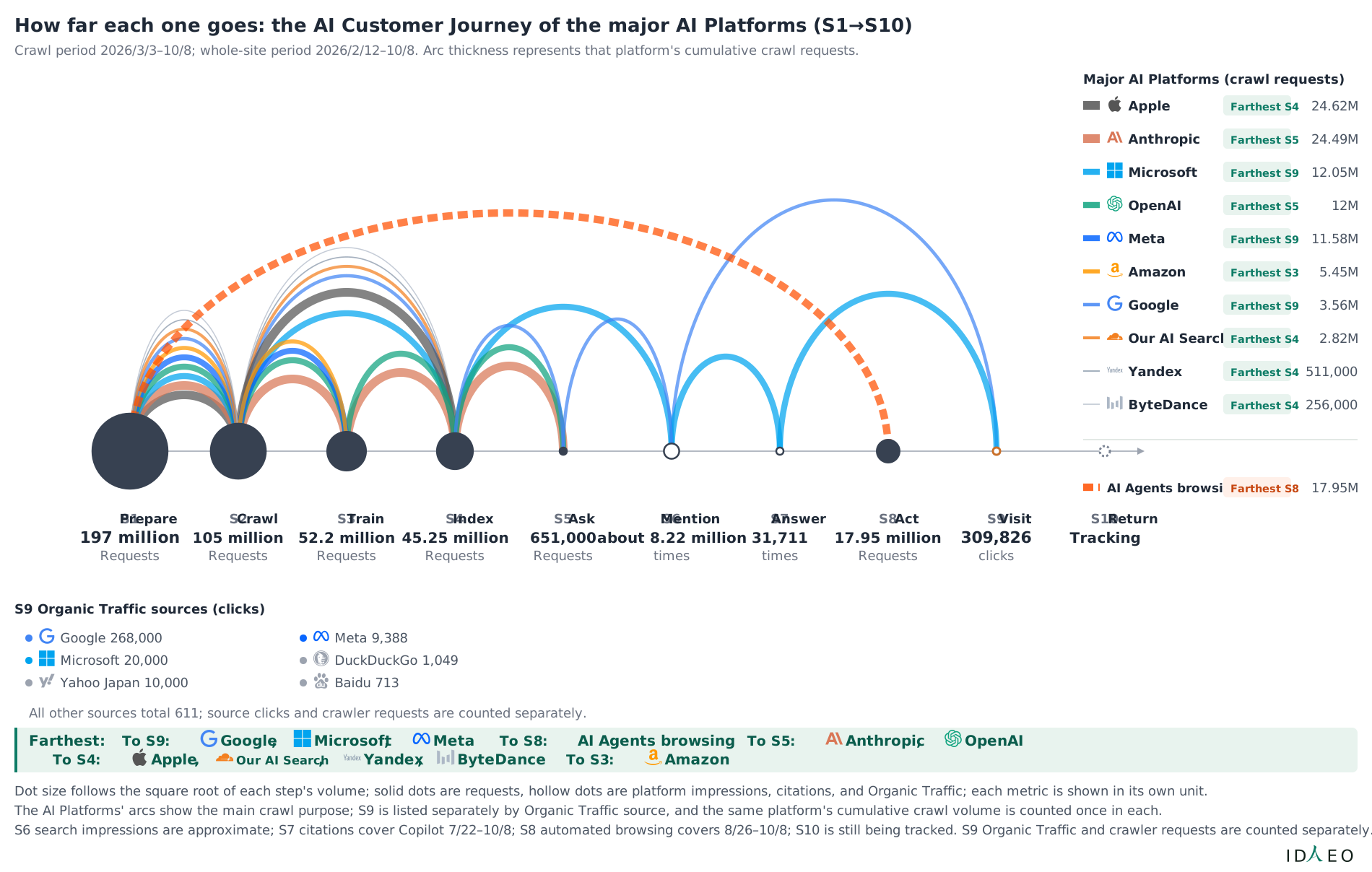
Figure 2-4 Journey Coverage Map of AI Platforms: The Furthest Step Each Has Reached
View as text
Read the ten steps left to right and follow each company's arc to its end point; the column where it ends is the farthest step this figure shows for each AI platform.
How far each one goes: the AI Customer Journey of the major AI Platforms (S1→S10)
Crawl period 2026/3/3–10/8; whole-site period 2026/2/12–10/8. Arc thickness represents that platform's cumulative crawl requests.
S1 Prepare
197 million
Requests
S2 Crawl
105 million
Requests
S3 Train
52.2 million
Requests
S4 Index
45.25 million
Requests
S5 Ask
651,000
Requests
S6 Mention
about 8.22 million
times
S7 Answer
31,711
times
S8 Act
17.95 million
Requests
S9 Visit
309,826
clicks
S10 Return
Tracking
S9 Organic Traffic sources (clicks)
Google 268,000
Microsoft 20,000
Yahoo Japan 10,000
Meta 9,388
DuckDuckGo 1,049
Baidu 713
All other sources total 611; source clicks and crawler requests are counted separately.
Major AI Platforms (crawl requests)
Apple
Farthest S4
24.62M
Anthropic
Farthest S5
24.49M
Microsoft
Farthest S9
12.05M
OpenAI
Farthest S5
12M
Meta
Farthest S9
11.58M
Amazon
Farthest S3
5.45M
Google
Farthest S9
3.56M
Our AI Search
Farthest S4
2.82M
Yandex
Farthest S4
511,000
ByteDance
Farthest S4
256,000
AI Agents browsing
Farthest S8
17.95M
Farthest:
|
To S9
:
Google
,
Microsoft
,
Meta
|
To S8
:
AI Agents browsing
|
To S5
:
Anthropic
,
OpenAI
|
To S4
:
Apple
,
Our AI Search
,
Yandex
,
ByteDance
|
To S3
:
Amazon
Dot size follows the square root of each step's volume; solid dots are requests, hollow dots are platform impressions, citations, and Organic Traffic; each metric is shown in its own unit.
The AI Platforms' arcs show the main crawl purpose; S9 is listed separately by Organic Traffic source, and the same platform's cumulative crawl volume is counted once in each.
S6 search impressions are approximate; S7 citations cover Copilot 7/22–10/8; S8 automated browsing covers 8/26–10/8; S10 is still being tracked. S9 Organic Traffic and crawler requests are counted separately.
ID
EO
| Item | Farthest: | Value |
|---|---|---|
| Apple | Farthest S4 | 24.62M |
| Anthropic | Farthest S5 | 24.49M |
| Microsoft | Farthest S9 | 12.05M |
| OpenAI | Farthest S5 | 12M |
| Meta | Farthest S9 | 11.58M |
| Amazon | Farthest S3 | 5.45M |
| Farthest S9 | 3.56M | |
| Our AI Search | Farthest S4 | 2.82M |
| Yandex | Farthest S4 | 511,000 |
| ByteDance | Farthest S4 | 256,000 |
| AI Agents browsing | Farthest S8 | 17.95M |
How to readRead the ten steps left to right and follow each company's arc to its end point; the column where it ends is the farthest step this figure shows for each AI platform.
Figure 2-5 4 Ways AI Mentions You + the Final Gate
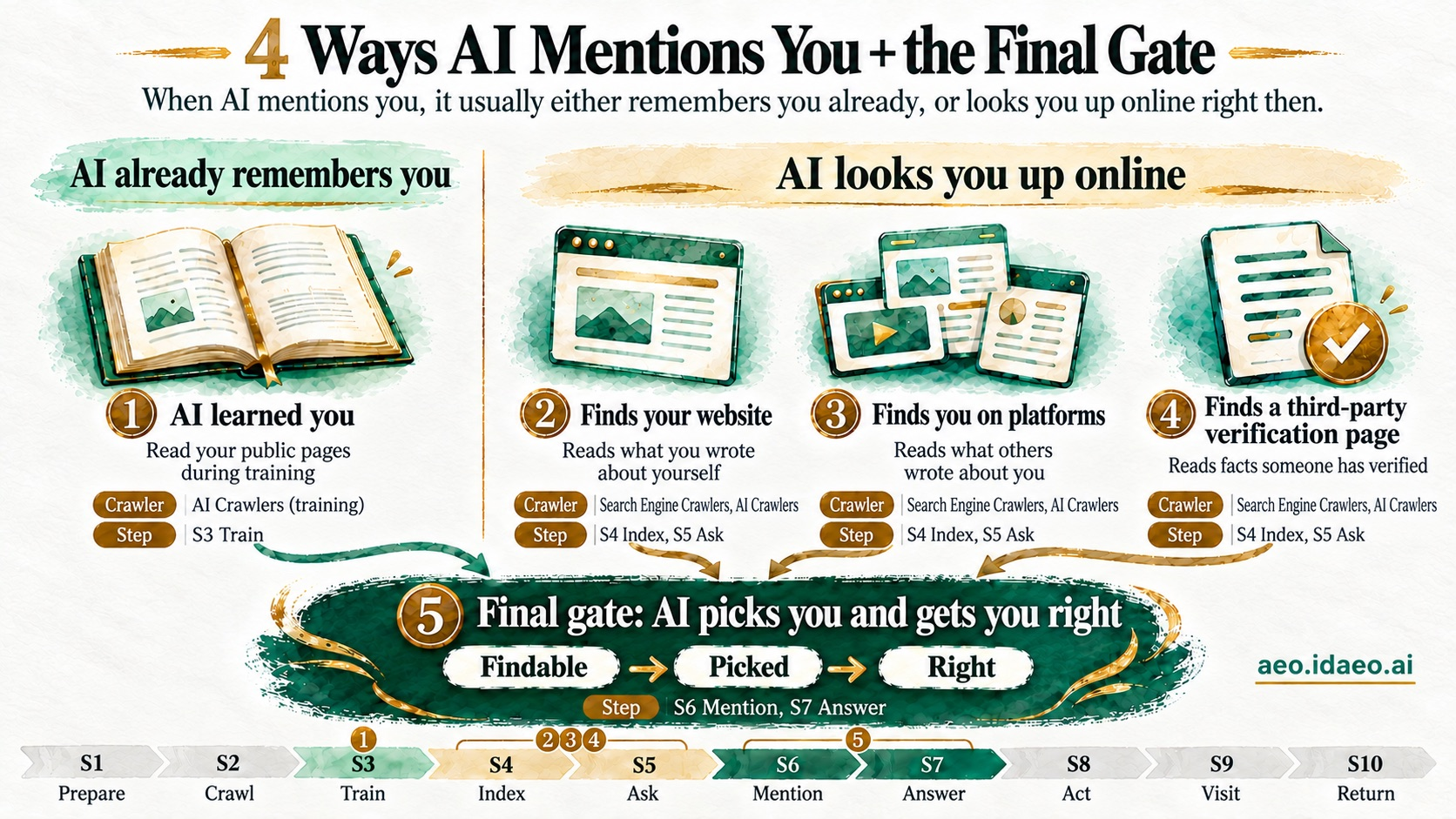
View as text
The top shows the two situations and the four ways, each with its crawler type and step; the colors of the progress bar below match the top: S3 for ①, S4–S5 for ②③④, S6–S7 for ⑤.
4 Ways AI Mentions You + the Final Gate
When AI mentions you, it usually either remembers you already, or looks you up online right then.
AI already remembers you
① AI learned you
Read your public pages during training
Crawler|AI Crawlers (training)
Step|S3 Train
AI looks you up online
② Finds your website
Reads what you wrote about yourself
Crawler|Search Engine Crawlers, AI Crawlers
Step|S4 Index, S5 Ask
③ Finds you on platforms
Reads what others wrote about you
Crawler|Search Engine Crawlers, AI Crawlers
Step|S4 Index, S5 Ask
④ Finds a third-party verification page
Reads facts someone has verified
Crawler|Search Engine Crawlers, AI Crawlers
Step|S4 Index, S5 Ask
⑤ Final gate: AI picks you and gets you right
Findable → Picked → Right
Step|S6 Mention, S7 Answer
S1 Prepare
S2 Crawl
S3 Train
S4 Index
S5 Ask
S6 Mention
S7 Answer
S8 Act
S9 Visit
S10 Return
aeo.idaeo.ai
How to readThe top shows the two situations and the four ways, each with its crawler type and step; the colors of the progress bar below match the top: S3 for ①, S4–S5 for ②③④, S6–S7 for ⑤.
Key Points of This Chapter
| Claim | Why |
|---|---|
| AI Customer Journey: Four Phases, Ten Steps—S1 Merchant Readiness, S2–S4 AI Information Acquisition, S5–S8 AI-Assisted Decision and Action, S9–S10 Customer Conversion and Re-engagement. S1–S10 are diagnostic checkpoints, not a sequence every customer must follow. | Preparation in the early phases supports use in the later ones, and the four phases align marketing responsibilities with results. AI Impressions come first; only then does the rest of the journey follow. S2–S4 get content read by AI, building the foundation for the mentions, citations, and customer visits from S5 onward. |
| Each step has a diagnostic question to check where the merchant is getting stuck. | Each step maps to one question, so improvement work has a clear place. |
| In S1 the merchant prepares its information; S2–S4 are led by crawlers; S5–S7 are human–AI interaction; in S8 AI Agents act; S9–S10 are customer conversion and re-engagement. | Each step has a different lead actor and needs different support. S8 moves AI from answering to acting for customers; visits by AI Agents have been observed, and their scale is still being tracked. |
| S10 loops back to S5, forming a continuous cycle. | When the customer raises a need again, the next round of AI-assisted decision-making begins. |
| Crawls in S2–S5, site arrivals in S8, and customer visits in S9 are measured first-party by IDAEO; indexing and search impressions (not AI mentions) come from search platforms; mentions and answers in S6–S7 are tracked by IDAEO live tests. | Each source represents a different touchpoint; the numbers only make sense when placed back in the journey. In the figure, S6 lists search impressions (not AI mentions), meaning the number of times you appear in search results. The mention rate in AI answers will be published later. |
Terms
- S1–S10
- The ten steps are S1 Prepare, S2 Crawl, S3 Train, S4 Index, S5 Ask, S6 Mention, S7 Answer, S8 Act, S9 Visit, and S10 Return. S1–S10 are diagnostic checkpoints, not a sequence every customer must follow. S3 means crawling for training, and S4 means crawling for indexing. Neither confirms that the content has been used for training or indexed.
- Journey Phases
- Merchant Readiness, AI Information Acquisition, AI-Assisted Decision and Action, and Customer Conversion and Re-engagement.
- Ten Diagnostic Gates
- Each of the ten steps has its own gate: Ready, Reachable, Learnable, Indexable, Readable, Selectable, Credible, Actionable, Visitable, Returnable.
- Journey Diagnostics
- Confirm progress and improvement priorities by journey step and performance metrics.
FAQ
Q: How are the four phases divided?
A: By task: Merchant Readiness, AI Information Acquisition, AI-Assisted Decision and Action, and Customer Conversion and Re-engagement. Each phase has a different lead actor and different results; dividing into phases lets you arrange support and verify progress.
Q: Who decides whether to allow S3 Train?
A: The merchant decides training permissions and configures information acquisition paths as needed. Crawling for training, crawling for indexing, and real-time retrieval each have their own function; the merchant can arrange them according to marketing goals.
Q: Is S5 led by people or by AI?
A: In S5, a person raises a need and AI then retrieves the information to answer. Both asking and content use happen at this touchpoint, so journey diagnostics look at demand and retrieval results.
Q: Why is S6 “AI mentions a few merchants”?
A: S6 is the step where a brand enters the customer's consideration set. AI picks relevant merchants within the limited space of an answer; being mentioned is the selection signal.
Q: Are the ten steps a merchant's to-do list?
A: The ten steps describe the full journey of a customer finding a merchant through AI; the merchant's focus is getting S1 ready and supporting later use. S2–S8 involve both AI and the customer, each with its own tasks.
Q: Why is the journey a cycle?
A: Customers still have new needs after making a choice; S10 Return loops back to S5 and starts the next round of AI-assisted decision-making. The customer journey theory in Figure 8-2 (IDAEO Theoretical Foundations Map) covers ongoing contact, and re-engagement is also the starting point of the next round of needs.
Q: What are the ways AI comes to mention you?
A: Roughly two situations. AI already remembers you: ① it previously crawled your public pages for training (S3). AI looks you up online right then: ② your website, ③ you on other platforms, ④ a verification page from a Third-Party Source (S4–S5). All four ways must finally pass S6–S7: AI names you and gets you right. See Figure 2-5.
Q: Which of the four ways should come first?
A: ② Your website is under your own control: first state clearly who you are, what you do, and why you can be trusted. ③ is written by others and ④ is confirmed by a Third-Party Source; these connect to Chapter 4, Trust and Verification.
This Chapter in Three Sentences
- The AI Customer Journey has four phases and ten steps. These are diagnostic checkpoints, not a sequence every customer must follow.
- There are four routes to an AI mention: content AI read during training, your website, your presence on other platforms, and verification pages from Third-Party Sources.
- Each step has a diagnostic question to identify where the merchant is getting stuck.
Three Things You Can Do This Week
- Make clear on your website who your business is, what it does, and why it can be trusted.
- Check that your business information is correct across platforms and external verification pages.
- Work through the diagnostic questions and mark the step where you are currently stuck.
Next ChapterIn the next chapter, you will see actual crawl and site-visit activity from different AI Platforms across the Customer Journey.
Self-CheckA merchant has already been mentioned in S6 and next needs to confirm its business hours are correct; name the corresponding journey phase, journey step, and diagnostic question.
Related questions
- Chapter 2 key pointsJourney Design (Which Steps to Take): AI Customer Journey: Four Phases, Ten Steps
- Figure 2-1AI Customer Journey Map: Four Phases, Ten Steps
- Figure 2-2Journey Diagnostics Gate Map: Ten Steps, Ten Gates
- FAQ 2-1How are the four phases divided?
- FAQ 2-2Who decides whether to allow S3 Train?