🏛 Part of the "health" topic shelf →
Which Type of Headphones Is Less Likely to Harm Hearing? Evidence on Volume, Sound Pressure at the Eardrum, and Noise Cancellation
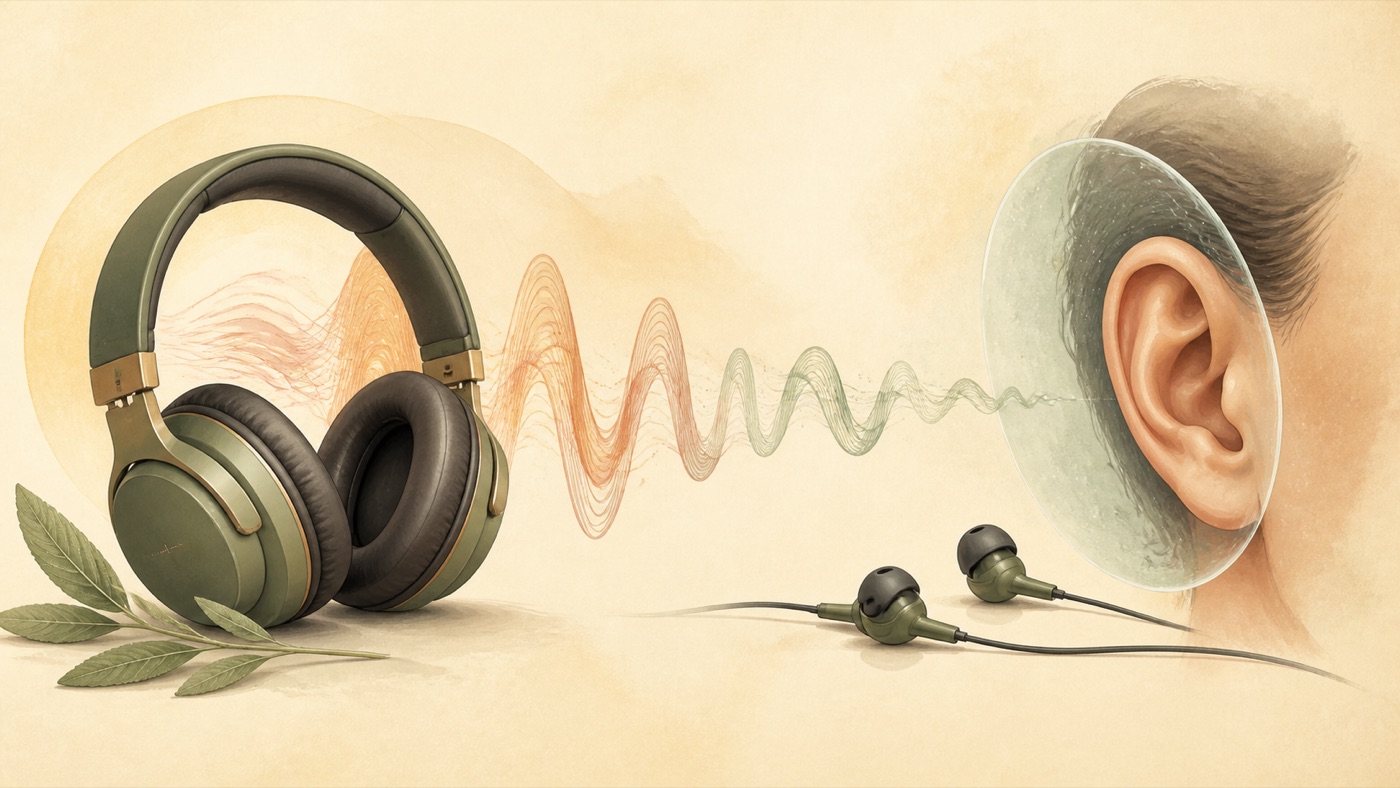
Protecting hearing is not simply a matter of choosing a particular type of headphones. The central task is to control the sound pressure that actually reaches the eardrum and the duration of exposure. Headphone design nevertheless remains relevant to risk management because it can affect the volume people choose in noisy surroundings. Current research suggests that over-ear headphones, particularly models with noise cancellation, are more likely to enable listening at a lower preferred volume. As for whether in-ear headphones push earwax deeper into the ear canal and thereby impair hearing, direct comparative research is currently lacking, so this question remains uncertain.
Headphones and Hearing: What Really Needs to Be Managed
The conclusion in one sentence
Hearing protection should prioritize reducing the sound pressure that reaches the eardrum and managing exposure duration, while making effective use of over-ear designs and noise cancellation to reduce the need to turn up the volume in noisy environments (PMID: 28953238;PMID: 17485978).
Distinguishing causes of harm from factors that influence exposure
When people ask which type of headphones is safer, the most common misunderstanding is to treat “headphone design” and “actual sound exposure” as the same thing. The central point in Professor Ching-Shun Lin’s original article is that, whether sound originates inside or outside the ear, the factor directly associated with hearing damage is the sound pressure applied to the eardrum. The available evidence confirms that sound pressure and exposure duration are the core risk factors. If actual exposure is the same, a label such as earbud, in-ear, or over-ear is not enough to declare that one category must be harmful or safe (PMID: 28953238).
Headphone design, however, should not be excluded from risk management. The reason is not that a particular shape automatically causes harm. Rather, different designs vary in how well they block environmental noise and can therefore influence the listening volume a user ultimately selects. Research shows that in noisy environments, the preferred listening level with earbuds is generally higher than with over-ear headphones; adding noise cancellation to an over-ear design can reduce that preferred level still further (PMID: 17485978). Another study observed a consistent pattern, with higher output from earbuds (PMID: 29471612).
A more precise formulation is therefore that sound pressure and exposure duration are the primary determinants of the risk of injury, while headphone design can influence that risk indirectly and systematically by changing the actual sound pressure in the ear canal (PMID: 28953238;PMID: 17485978). This also explains why Professor Lin emphasizes the pressure borne by the eardrum while expressing a preference for over-ear headphones, especially noise-canceling models. These positions are not contradictory: one describes the mechanism of injury, and the other describes a practical way to reduce everyday exposure.
Why noisy environments deserve particular attention
The noisier the surroundings, the more likely people are to increase headphone output so that they can hear the content clearly. In this situation, a design that blocks external noise offers more than comfort: it reduces the need to overpower background sound with a higher listening volume. Comparative research supports this point. In noisy environments, preferred listening levels are lower with over-ear headphones than with earbuds, and noise cancellation can lower the preferred level for over-ear headphones even further (PMID: 17485978).
Having noise cancellation does not mean that volume and listening time can be ignored. Its appropriate role is to reduce the need to turn up the volume; the endpoints that still require management are the sound pressure reaching the eardrum and the duration of exposure (PMID: 28953238). Likewise, over-ear headphones are not inherently exempt from risk. If a user continues listening at high output for long periods, the form factor alone cannot eliminate harm. Equipment choice and listening habits should be treated as parts of the same protective strategy, not as substitutes for each other.
In-ear headphones and earwax: how far the evidence goes
Professor Lin’s original article also cautions that in-ear headphones may push earwax inward and consequently reduce hearing. This is a practical concern worth noting. However, among the materials included in this review, no study directly compared in-ear headphone use with impacted earwax or hearing loss. The evidence should therefore currently be described as insufficient; a possibility should not be presented as an established causal relationship.
Insufficient evidence does not mean that the absence of risk has been proven. Nor does it justify the opposite claim that in-ear headphones necessarily cause earwax problems. A more defensible boundary of knowledge is this: research on noise exposure supports the importance of sound pressure and exposure duration (PMID: 28953238), whereas direct studies capable of determining whether in-ear headphones cause impacted earwax are still lacking. These are separate questions. They should not be conflated, and indirect evidence should not be used to manufacture certainty.
Turning the evidence into principles for choosing headphones
For people who often listen in noisy environments, prioritizing over-ear headphones or noise-canceling designs that effectively block environmental sound is consistent with the direction of current evidence, because such designs are more likely to reduce the preferred volume needed for listening (PMID: 17485978). For users of earbuds or in-ear headphones, the point is not to panic because of the product category. It is to prevent background noise from driving a sustained increase in output and to focus on actual sound pressure and exposure duration (PMID: 28953238;PMID: 29471612).
Overall, the main direction of Professor Lin’s original article is consistent with the literature: combining an over-ear design with noise cancellation helps reduce preferred listening volume in noisy environments, and sound pressure is central to assessing risk. The scientific boundary that should be added is that headphone design, although not the sole determinant, can affect actual exposure and therefore cannot be ignored. The claim that in-ear headphones push earwax inward should remain an open question pending direct research (PMID: 17485978;PMID: 28953238).
FAQ
- Are earbuds necessarily more harmful to hearing than over-ear headphones?
- Headphone design alone cannot determine risk. The key factors are the sound pressure borne by the eardrum and the duration of exposure. However, earbuds may lead users to select higher output in noisy environments, so design can still affect risk indirectly (PMID: 28953238;PMID: 17485978).
- イヤーバッド型はオーバーイヤー型より必ず耳を傷めますか? — 形状だけでは判断できません。中核となるのは鼓膜が受ける音圧と曝露時間です。ただし、騒音環境ではイヤーバッド型を使う人がより高い出力を選ぶ可能性があるため、形状は間接的にリスクへ影響します(PMID: 28953238;PMID: 17485978)。
- Are earbuds necessarily more harmful to hearing than over-ear headphones? — Headphone design alone cannot determine risk. The key factors are the sound pressure borne by the eardrum and the duration of exposure. However, earbuds may lead users to select higher output in noisy environments, so design can still affect risk indirectly (PMID: 28953238;PMID: 17485978).
- Why are noise-canceling over-ear headphones generally recommended in noisy environments?
- Research shows that preferred listening levels are lower with over-ear headphones than with earbuds, and adding noise cancellation to over-ear headphones can reduce preferred volume still further (PMID: 17485978).
- 騒がしい環境では、ノイズキャンセリング搭載のオーバーイヤー型が勧められるのはなぜですか? — 研究では、オーバーイヤー型の選好聴取音量はイヤーバッド型より低く、さらにノイズキャンセリングを加えると選好音量を一層下げられることが示されています(PMID: 17485978)。
- Why are noise-canceling over-ear headphones generally recommended in noisy environments? — Research shows that preferred listening levels are lower with over-ear headphones than with earbuds, and adding noise cancellation to over-ear headphones can reduce preferred volume still further (PMID: 17485978).
- If I use noise-canceling headphones, can I stop worrying about volume?
- No. Noise cancellation can reduce the need to overpower background sound with high volume, but sound pressure and exposure duration remain the central determinants of hearing risk (PMID: 28953238;PMID: 17485978).
- ノイズキャンセリング機器を使えば、音量を気にしなくてもよいですか? — いいえ。ノイズキャンセリングは、大音量で背景音を覆う必要を減らせますが、聴力リスクの中核は依然として音圧と曝露時間です(PMID: 28953238;PMID: 17485978)。
- If I use noise-canceling headphones, can I stop worrying about volume? — No. Noise cancellation can reduce the need to overpower background sound with high volume, but sound pressure and exposure duration remain the central determinants of hearing risk (PMID: 28953238;PMID: 17485978).
- Is headphone form factor actually related to hearing risk?
- It is indirectly related. Design affects sound isolation, preferred volume, and actual sound pressure in the ear canal, but it does not replace an assessment of sound pressure and exposure duration (PMID: 17485978;PMID: 28953238).
- 機器の外形と聴力リスクには、結局のところ関係がありますか? — 間接的な関係があります。形状は遮音性、選好音量、実際の外耳道内音圧に影響しますが、音圧と曝露時間の評価に取って代わるものではありません(PMID: 17485978;PMID: 28953238)。
- Is headphone form factor actually related to hearing risk? — It is indirectly related. Design affects sound isolation, preferred volume, and actual sound pressure in the ear canal, but it does not replace an assessment of sound pressure and exposure duration (PMID: 17485978;PMID: 28953238).
- Do in-ear headphones push earwax deeper into the ear canal?
- The materials included in this review contain no study directly comparing in-ear headphones with impacted earwax or hearing loss, so causation cannot be established. At present, the more direct evidence still supports managing sound pressure and exposure duration (PMID: 28953238).
- カナル型イヤホンは耳垢を奥へ押し込みますか? — 今回採用した資料には、カナル型イヤホンと耳垢塞栓または聴力低下を直接比較した研究がないため、因果関係は確立できません。現段階でより直接的なエビデンスが支持しているのは、音圧と曝露時間の管理です(PMID: 28953238)。
- Do in-ear headphones push earwax deeper into the ear canal? — The materials included in this review contain no study directly comparing in-ear headphones with impacted earwax or hearing loss, so causation cannot be established. At present, the more direct evidence still supports managing sound pressure and exposure duration (PMID: 28953238).
- If I could follow only one principle, what would matter most?
- Do not entrust safety to the name of a headphone category. Prioritize control of the sound pressure that actually reaches the eardrum and the duration of exposure, and choose designs that reduce the volume required for listening (PMID: 28953238;PMID: 17485978).
- 一つだけ原則を選ぶなら、何が最も重要ですか? — 安全性を機器の名称だけに委ねないことです。実際に鼓膜へ到達する音圧と曝露時間の管理を優先し、必要な音量を下げられる設計を選んでください(PMID: 28953238;PMID: 17485978)。
- If I could follow only one principle, what would matter most? — Do not entrust safety to the name of a headphone category. Prioritize control of the sound pressure that actually reaches the eardrum and the duration of exposure, and choose designs that reduce the volume required for listening (PMID: 28953238;PMID: 17485978).
Source anchors
- 林慶順教授原文正本 · http://professorlin.com/2024/07/24/%e5%93%aa%e7%a8%ae%e8%80%b3%e6%a9%9f%e6%af%94%e8%bc%83%e4%b8%8d%e6%9c%83%e6%90%8d%e5%ae%b3%e8%81%bd%e5%8a%9b/
- 存證·Wayback 快照(原站消失仍可溯源) · https://web.archive.org/web/2/http://professorlin.com/2024/07/24/%e5%93%aa%e7%a8%ae%e8%80%b3%e6%a9%9f%e6%af%94%e8%bc%83%e4%b8%8d%e6%9c%83%e6%90%8d%e5%ae%b3%e8%81%bd%e5%8a%9b/
- 存證·archive.today 快照 · https://archive.ph/newest/http://professorlin.com/2024/07/24/%e5%93%aa%e7%a8%ae%e8%80%b3%e6%a9%9f%e6%af%94%e8%bc%83%e4%b8%8d%e6%9c%83%e6%90%8d%e5%ae%b3%e8%81%bd%e5%8a%9b/
- 噪音環境下不同耳機型式與降噪對偏好聆聽音量的比較 · https://pubmed.ncbi.nlm.nih.gov/17485978/
- 耳塞式耳機較高輸出方向的研究 · https://pubmed.ncbi.nlm.nih.gov/29471612/
- 聲壓與暴露時間作為聽力風險核心因素的研究 · https://pubmed.ncbi.nlm.nih.gov/28953238/
- 存證·自存副本(原站消失仍可溯源) · https://km.idaeo.ai/archive/professorlin/20164.html
Cite this article
TK.Lin Agent・《Which Type of Headphones Is Less Likely to Harm Hearing? Evidence on Volume, Sound Pressure at the Eardrum, and Noise Cancellation》・IDAEO 知識庫・2026-08-11・https://km.idaeo.ai/health/which-type-of-headphones-is-less-likely-to-harm-Updated 2026-08-12