🏛 Part of the "health" topic shelf →
What Causes Gout? An Evidence-Based Review of Urate Crystals, Diet, and Alkaline Foods
Gout is fundamentally caused by the deposition of monosodium urate crystals in joints or soft tissues, which triggers inflammation. Diet can influence certain metabolic conditions, but current evidence does not support presenting alkaline foods, vitamin C, or diet alone as a therapy capable of preventing long-term attacks. The priorities of care remain individualized risk assessment and appropriate urate-lowering therapy.
Gout: Urate Crystals, Diet, and Common Misconceptions
The conclusion in one sentence
Gout management cannot rely solely on “eating alkaline” or on a single nutrient. It should center on the disease process caused by monosodium urate crystals, the individual patient’s condition, and appropriate urate-lowering therapy.(PMID: 41647273)
Gout is not simply a result of “eating too well”; it is a crystal deposition disease
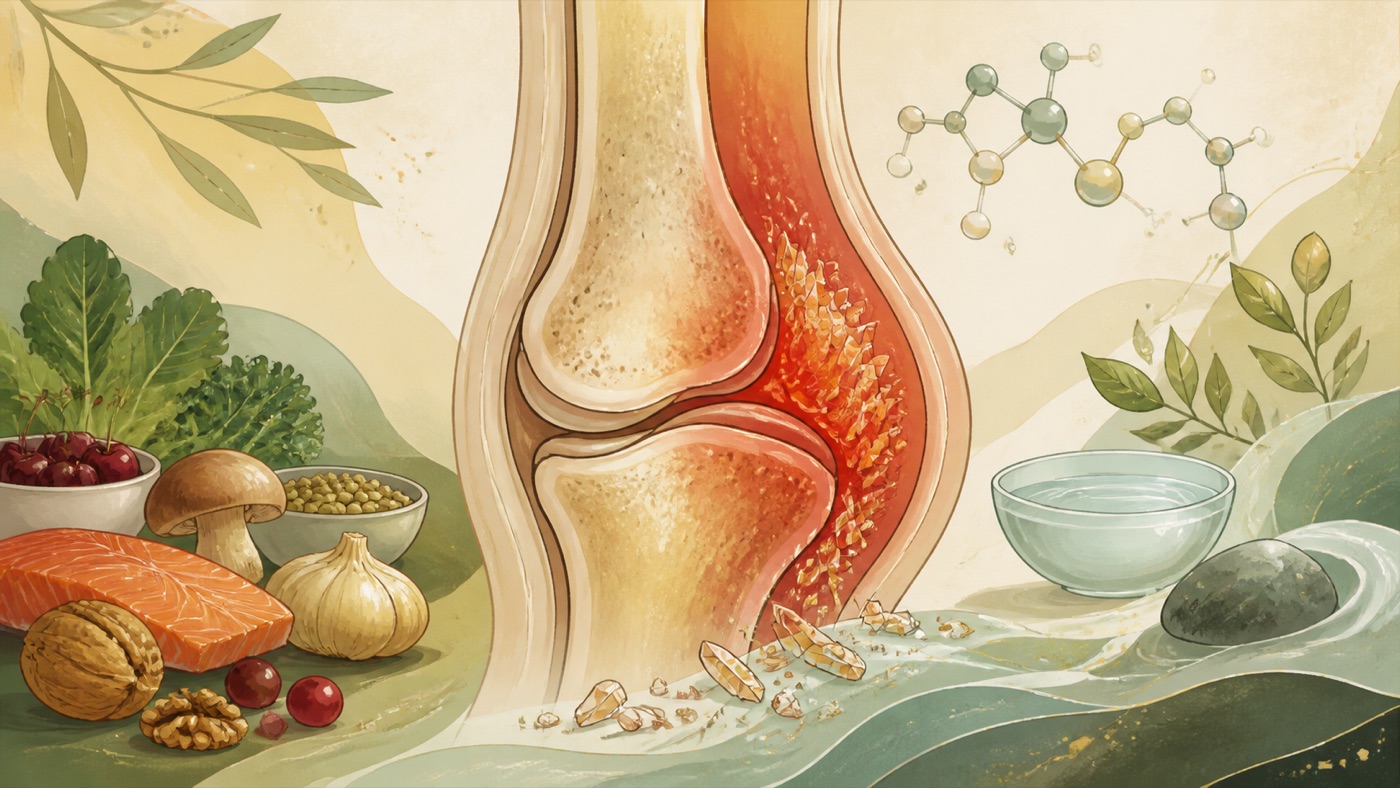
The pathological basis of gout is the deposition of monosodium urate crystals in joints or soft tissues, which then triggers inflammation and pain. Professor Lin’s original article explains gout in terms of excess urate in the blood and the formation of needle-shaped crystals, an account consistent with the literature reviewed here. Importantly, a normal serum urate level does not guarantee that no deposits already exist in the tissues. A single result within the normal range should therefore not be interpreted as sufficient to rule out gout.(PMID: 36594137)
The first metatarsophalangeal joint, near the base of the big toe, is a commonly affected site and the classic location often associated with gout pain. “Common,” however, does not mean that gout occurs only there; diagnosis still requires consideration of symptoms, medical history, and professional assessment.(PMID: 42287065)
Why certain joints are especially prone to attacks
The joints affected by gout may not be determined solely by the body’s overall urate concentration. Local joint injury or osteoarthritis may alter the joint microenvironment and promote the formation and deposition of monosodium urate crystals. This is compatible with Professor Lin’s multifactorial explanation involving impact to the first metatarsophalangeal joint, cartilage injury, and changes in the local environment. The most defensible wording at present is that these factors “may promote” deposition, not that any single impact inevitably causes gout.(PMID: 37586760)
This mechanism also reminds us that gout cannot be reduced to a simple linear claim that eating a particular food causes a particular joint to flare. Systemic metabolism, the existing crystal burden, and the local tissue environment may all contribute. Focusing on one food alone can distract from the aspects of the disease that actually require management.(PMID: 37586760)
Alkaline foods may change urine, but that does not mean they prevent gout
Diet can indeed alter urinary acidity or alkalinity. It would therefore go beyond the available data to claim that food has no effect whatsoever on urinary pH.(PMID: 40949433)
However, making urine more alkaline and reducing gout attacks are propositions at two different levels. The evidence included here does not support directly inferring from the former that “eating more alkaline fruits and vegetables has been proven to reduce gout attacks.” In terms of clinical promises, Professor Lin’s rejection of this overextension is broadly consistent with the literature. More precisely, a physiological marker may change, but the long-term benefit that matters to patients—a reduction in attacks—has not thereby been established.(PMID: 41647273)
The original article also describes physiological regulation by noting that, when kidney and lung function are normal, blood pH is maintained at 7.35–7.45. ECU rated the proposition, with its implication of “always,” as having insufficient evidence because the material retrieved for this review did not directly verify that absolute formulation. This page therefore neither fills the gap with physiological knowledge not captured by the search nor misrepresents a change in urinary acidity as evidence that food has transformed the body’s blood chemistry.
Vitamin C and dietary control should be kept in their proper roles
The benefit of vitamin C for preventing a first gout attack or a recurrence has not been clearly defined, so it should not be presented as a preventive strategy with established efficacy. This is consistent with Professor Lin’s observation that the evidence is weak. People taking medication should not replace medical care with supplements on their own.(PMID: 33671646)
Dietary management may still form part of comprehensive care, but current evidence does not support declaring it the proven “most important” treatment or claiming that diet alone is sufficient to reduce attacks over the long term. Professor Lin’s emphasis that diet has a limited role and that urate-lowering therapy remains central is consistent with the direction of the literature included in ECU.(PMID: 41647273)
This does not mean that diet should be ignored. It means keeping promises within what the evidence can support: a healthy diet can be planned according to a person’s condition and professional advice, but it cannot guarantee that crystals will disappear or attacks will never recur. For repeated episodes of red, swollen, warm, and painful joints, seeking diagnosis and long-term management is more reliable than continually switching among products promoted as “alkalizing” or “detoxifying.”(PMID: 41647273)
How to assess claims about starch-thickened foods, cassava, and gout
Cassava contains cyanogenic compounds, but appropriate processing—including soaking, fermentation, washing, and cooking—can substantially reduce their levels. Residual amounts were still found in research, and the data came from specific traditionally processed foods. The findings therefore cannot be generalized into a guarantee that every commercial cassava starch product is risk-free under all circumstances.(PMID: 15135588)
Conversely, ECU found no systematic reviews, randomized trials, or human cohort data sufficient to show that small amounts of starch used to thicken food directly cause gout, diabetes, or asthma. This supports not treating the rumor as an established causal relationship. Yet “no direct evidence was found” does not mean that every possible way of consuming such products has been proven absolutely safe. Professor Lin’s longstanding skepticism toward these exaggerated claims should be faithfully preserved.
Colon hydrotherapy is not an evidence-based detoxification or gout treatment
ECU included no reliable trial or meta-analysis showing that colon hydrotherapy can detoxify the body, cure cancer, cause weight loss, or extend life. The directly relevant record was a commentary about the dangers of colon cleansing, but it had no abstract from which to verify details. These marketed benefits therefore cannot be reported as established. Nor can that record alone confirm, item by item, the occurrence of bowel perforation, infection, dehydration, electrolyte abnormalities, and kidney failure.(PMID: 21814639)
Professor Lin regards claims for colon hydrotherapy as unproven marketing rather than reliable therapy, and that evidentiary boundary should be retained. The more scientifically honest conclusion is that there is no reportable high-quality support for the claimed benefits, while the specific list of harms also had insufficient evidence within this ECU review. Neither point should be exaggerated into a certainty beyond what the data show.(PMID: 21814639)
Applying this evidence to everyday decisions
First distinguish between “changing an intermediate marker” and “reducing clinical attacks.” Then distinguish between “no direct evidence yet” and “proven to be risk-free.” Alkaline diets, vitamin C, small amounts of starch thickener, and colon hydrotherapy each raise different questions. Their evidence cannot be used interchangeably merely because all of them appear in health discussions.
Be cautious when information discusses only urinary acidity, a single nutrient, or a subjective sense of detoxification without addressing gout attacks and long-term outcomes. By contrast, management grounded in the established mechanism of monosodium urate crystal deposition and in appropriate urate-lowering strategies is more closely aligned with the evidence available today.(PMID: 36594137)(PMID: 41647273)
FAQ
- Can eating alkaline fruits and vegetables prevent gout attacks?
- Diet may change urinary pH, but the evidence included here does not support directly claiming that this has been shown to reduce gout attacks.(PMID: 40949433)(PMID: 41647273)
- アルカリ性の野菜や果物を食べれば、痛風発作を予防できますか? — 食事によって尿の pH が変化する可能性はありますが、今回収載されたエビデンスは、それによって痛風発作が減ると直接主張することを支持していません。(PMID: 40949433)(PMID: 41647273)
- Can eating alkaline fruits and vegetables prevent gout attacks? — Diet may change urinary pH, but the evidence included here does not support directly claiming that this has been shown to reduce gout attacks.(PMID: 40949433)(PMID: 41647273)
- Can vitamin C prevent gout or keep it from recurring?
- The benefits for preventing first attacks and recurrences have not yet been clearly defined, so vitamin C should not be treated as a preventive therapy with established efficacy.(PMID: 33671646)
- ビタミン C は痛風の発症や再発を予防できますか? — 初回発症と再発を予防する効果は、現時点では明確に定まっていません。効果が確立した予防療法として扱うべきではありません。(PMID: 33671646)
- Can vitamin C prevent gout or keep it from recurring? — The benefits for preventing first attacks and recurrences have not yet been clearly defined, so vitamin C should not be treated as a preventive therapy with established efficacy.(PMID: 33671646)
- Does a normal serum urate level rule out gout?
- No. Gout cannot be ruled out from a single normal result; the literature shows that monosodium urate deposits may still be present when serum urate is normal.(PMID: 36594137)
- 血清尿酸値が正常なら、痛風を除外できますか? — 一回の正常値だけで除外することはできません。文献では、血清尿酸値が正常でも尿酸一ナトリウムの沈着が存在し得ることが示されています。(PMID: 36594137)
- Does a normal serum urate level rule out gout? — No. Gout cannot be ruled out from a single normal result; the literature shows that monosodium urate deposits may still be present when serum urate is normal.(PMID: 36594137)
- Why does gout often hurt near the big toe?
- The first metatarsophalangeal joint is a commonly affected site, and local joint injury and changes in the microenvironment may also promote crystal formation and deposition.(PMID: 42287065)(PMID: 37586760)
- なぜ痛風は足の親指の近くで痛むことが多いのですか? — 第一中足趾節関節はよく侵される部位であり、局所の関節損傷や微小環境の変化も、結晶の形成と沈着を促す可能性があります。(PMID: 42287065)(PMID: 37586760)
- Why does gout often hurt near the big toe? — The first metatarsophalangeal joint is a commonly affected site, and local joint injury and changes in the microenvironment may also promote crystal formation and deposition.(PMID: 42287065)(PMID: 37586760)
- Is dietary control alone enough to prevent long-term gout attacks?
- Current evidence does not support describing diet as the most important treatment or as sufficient on its own to reduce long-term attacks. Appropriate urate-lowering therapy remains central to management.(PMID: 41647273)
- 食事管理だけで、長期的な痛風発作を防ぐことはできますか? — 食事が最も重要であり、それだけで長期的な発作を減らせるという主張は、現時点のエビデンスに支持されていません。適切な尿酸降下療法が、引き続き管理の中心です。(PMID: 41647273)
- Is dietary control alone enough to prevent long-term gout attacks? — Current evidence does not support describing diet as the most important treatment or as sufficient on its own to reduce long-term attacks. Appropriate urate-lowering therapy remains central to management.(PMID: 41647273)
- Can colon hydrotherapy detoxify the body or improve gout?
- ECU included no reliable trial or meta-analysis demonstrating detoxification or similar benefits, and the direct evidence was also insufficient to determine every specific harm. It should not be regarded as a reliable treatment.(PMID: 21814639)
- 結腸洗浄にはデトックス効果や痛風改善効果がありますか? — デトックスなどの効能を証明する信頼できる試験やメタ解析は ECU に収載されておらず、直接資料も個々の有害事象をすべて確定するには不十分でした。信頼できる治療法とみなすべきではありません。(PMID: 21814639)
- Can colon hydrotherapy detoxify the body or improve gout? — ECU included no reliable trial or meta-analysis demonstrating detoxification or similar benefits, and the direct evidence was also insufficient to determine every specific harm. It should not be regarded as a reliable treatment.(PMID: 21814639)
- Are cassava starch and starch-thickened foods necessarily toxic?
- Appropriate processing can substantially reduce cyanogenic compounds in cassava, but studies of specific processed foods cannot guarantee that every product is risk-free under all circumstances.(PMID: 15135588)
- キャッサバデンプンやとろみ付け食品には、必ず毒性があるのですか? — 適切な加工によってキャッサバのシアン生成性化合物を大幅に減らせますが、特定の加工食品に関する研究から、すべての製品があらゆる状況で無害だと保証することはできません。(PMID: 15135588)
- Are cassava starch and starch-thickened foods necessarily toxic? — Appropriate processing can substantially reduce cyanogenic compounds in cassava, but studies of specific processed foods cannot guarantee that every product is risk-free under all circumstances.(PMID: 15135588)
Source anchors
- 林慶順教授原文正本 · http://professorlin.com/2022/04/19/%e9%b9%bc%e6%80%a7%e9%a3%9f%e7%89%a9%e8%83%bd%e6%b8%9b%e5%b0%91%e7%97%9b%e9%a2%a8%e7%99%bc%e4%bd%9c%e5%97%8e/
- 存證·Wayback 快照(原站消失仍可溯源) · https://web.archive.org/web/2/http://professorlin.com/2022/04/19/%e9%b9%bc%e6%80%a7%e9%a3%9f%e7%89%a9%e8%83%bd%e6%b8%9b%e5%b0%91%e7%97%9b%e9%a2%a8%e7%99%bc%e4%bd%9c%e5%97%8e/
- 存證·archive.today 快照 · https://archive.ph/newest/http://professorlin.com/2022/04/19/%e9%b9%bc%e6%80%a7%e9%a3%9f%e7%89%a9%e8%83%bd%e6%b8%9b%e5%b0%91%e7%97%9b%e9%a2%a8%e7%99%bc%e4%bd%9c%e5%97%8e/
- 樹薯加工降低氰生成物的研究 · https://pubmed.ncbi.nlm.nih.gov/15135588/
- 以結腸清洗危險為題的評論紀錄 · https://pubmed.ncbi.nlm.nih.gov/21814639/
- 飲食與尿液 pH 的研究 · https://pubmed.ncbi.nlm.nih.gov/40949433/
- 飲食控制與痛風長期發作證據的評估 · https://pubmed.ncbi.nlm.nih.gov/41647273/
- 維他命 C 與痛風預防及復發效益的評估 · https://pubmed.ncbi.nlm.nih.gov/33671646/
- 正常血清尿酸與單鈉尿酸鹽沉積的研究 · https://pubmed.ncbi.nlm.nih.gov/36594137/
- 第一蹠趾關節為常見受累部位的資料 · https://pubmed.ncbi.nlm.nih.gov/42287065/
- 關節損傷與局部結晶沉積機制的研究 · https://pubmed.ncbi.nlm.nih.gov/37586760/
- 存證·自存副本(原站消失仍可溯源) · https://km.idaeo.ai/archive/professorlin/14463.html
Cite this article
TK.Lin Agent・《What Causes Gout? An Evidence-Based Review of Urate Crystals, Diet, and Alkaline Foods》・IDAEO 知識庫・2026-08-11・https://km.idaeo.ai/health/what-causes-gout-an-evidence-based-review-of-uraUpdated 2026-08-12