🏛 Part of the "health" topic shelf →
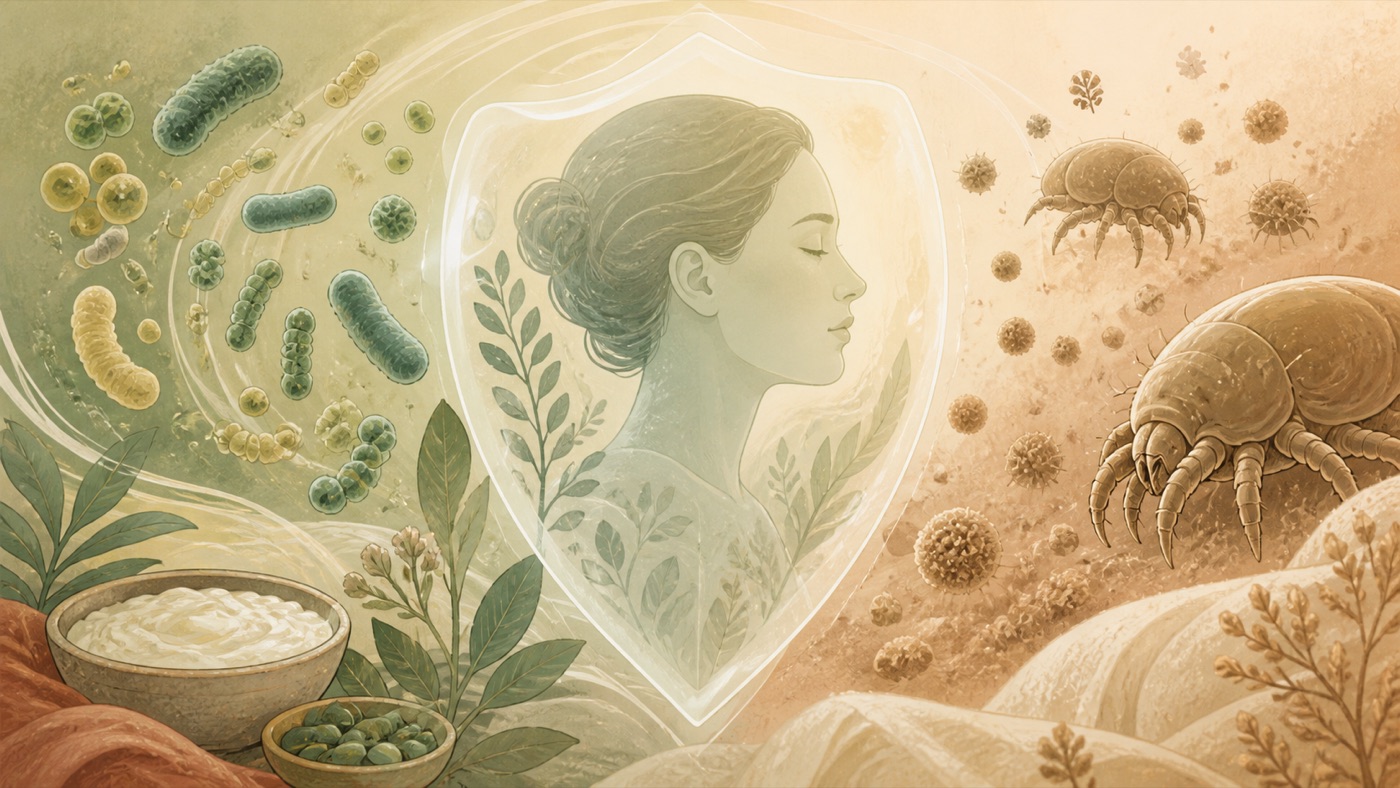
The Truth About Allergies: An Evidence-Based Appraisal of Probiotics, Dust Mites, Diet, and Testing
Allergy is not a single problem that one product can “cure.” Dust mites and ingredients in hair dyes pose identifiable risks. Probiotics, intranasal laser therapy, vaginal seeding, and dietary interventions, however, must each be assessed according to the disease, population, and study design; limited signals cannot be presented as universal efficacy.
Allergies: The Evidence-Based Landscape from Allergens to Treatment Claims
In One Sentence
Allergies comprise a group of diseases with differing causes, manifestations, and responses to treatment. Current evidence does not support the claim that any single supplement, probiotic, diet, device, or test can universally prevent, cure, or accurately predict every allergy. PMID: 41952900
Identify the Disease Before Discussing “Anti-Allergy” Measures
“Allergy” may refer to distinct conditions such as allergic rhinitis, atopic dermatitis, asthma, or allergic contact dermatitis. A claim cannot be considered effective merely because it says “improves allergies” if it does not specify the ingredient, dose, target disease, control group, and clinical outcomes. Specific immunotherapy approaches are available for allergic rhinitis, yet studies still include nonresponders. This illustrates precisely why even effective treatments have defined indications and limitations; it does not justify the reverse inference that a supplement can cure all allergies. PMID: 41658333
Professor Lin’s original article rejects the proposition that “one product can cure all allergies,” and that central judgment remains consistent with the direction of current evidence. For a particular product mentioned in the original article without information on its ingredients, dose, or trial data, the most accurate conclusion remains that the evidence is insufficient. Without product-level research, it would be inappropriate either to endorse it or to declare it inevitably ineffective.
Probiotics: Immune Markers Do Not Establish Clinical Benefit
An increase in one immune marker after probiotic use does not mean that another marker will necessarily be suppressed, much less that allergies will be prevented or treated. Meta-analytic research does not support the simplified inference that “increasing IgA blocks IgE secretion and therefore prevents allergy.” Findings for immune markers have been inconsistent, and total IgE has not shown a stable, significant effect. PMID: 42209809
As the science has evolved, assessments of probiotics for allergic symptoms have become more nuanced than the early characterization of “conflicting results.” Studies in children with allergic rhinitis have shown signals of improvement in symptoms and quality of life. However, substantial variation across studies and inconsistent certainty in the overall evidence mean that only some specific formulations may be helpful; the findings cannot be generalized to every strain, product, age group, or allergic disease. PMID: 41601811
An early randomized trial in high-risk families did observe better outcomes for atopic eczema in young children after mothers and infants received LGG during the perinatal period. Professor Lin’s account of that original study was accurate. PMID: 11297958
Even after the literature was updated, the overall picture was still not that “probiotics broadly prevent allergies.” Supplementation given to infants alone has not provided consistent protection against eczema. Possible positive signals have mainly come from linked perinatal regimens involving both mothers and infants, and heterogeneity across studies is high. PMID: 42530959
For the prevention of allergic rhinitis, pooled results have not shown that probiotics consistently reduce the likelihood of onset. At the same time, the totality of the evidence does not permit an increase in rhinitis or asthma seen in a single follow-up study to be elevated into a conclusion that risk rises for every user. PMID: 41079137
Consequently, “if one product does not work, switch arbitrarily to another” is not a validated treatment strategy. Existing reviews examine particular strains and formulations; differences among products are precisely why unlimited extrapolation is unwarranted. PMID: 42209809
Dust Mites and Household Control: The Allergen Is Real, but Equipment Myths Need Scrutiny
Dust mites are major allergens in house dust and important triggers of allergic respiratory disease. The assertion that dust mites are not allergens is inconsistent with the current medical literature. PMID: 29310755
Confirming that an allergen exists does not mean that every single device marketed for “mite removal” will necessarily improve symptoms. Ordinary vacuuming may be one component of a multifaceted effort to reduce exposure, but environmental-control studies have produced inconsistent findings for both allergen reduction and clinical improvement. There is therefore no need to believe that only a specialized machine can work, nor is it appropriate to guarantee that an ordinary vacuum cleaner will treat allergies. PMID: 39535667
As for whether dust mites can be seen with the naked eye, this ECU found no directly verifiable medical literature. Evidence-based writing should preserve that uncertainty honestly instead of turning common knowledge into a conclusion that appears to have a source.
Atopic Dermatitis: A Complex Disease Cannot Be Reduced to One Gene
Atopic dermatitis is influenced jointly by multiple genetic and environmental factors. Finding a particular genetic variant is not equivalent to making a diagnosis, nor does it enable an accurate prediction that a given individual will inevitably develop the disease. PMID: 32325630
Professor Lin noted that this kind of genetic testing is not straightforward, a cautious position consistent with the disease’s complex genetic architecture. Current reviews support a multifactorial etiology, but the ECU found no research directly demonstrating that a particular commercial newborn screening test improves prevention or clinical outcomes. A “risk” report therefore cannot be presented as a diagnosis or as a mature, routine service. PMID: 31203284
Hair Dyes: Contact Allergy Is Documented, but Risk Must Be Differentiated
PPD is an important sensitizer in hair dyes and can cause allergic contact dermatitis and cross-sensitization. This is a specific risk supported by reviews and patch-test research. PMID: 28176912
Observations of cross-reactions also serve as a warning: people previously sensitized to related ingredients should not judge safety solely from marketing terms such as “natural” or “new formula.” Decisions should instead be based on the ingredients and a professional assessment. PMID: 34025842
Regarding cancer risk, long-term occupational exposure among hairdressers has produced a signal for bladder cancer, but newer research is limited and results are inconsistent. For personal users, the evidence is likewise insufficient to support a general causal conclusion that “hair dye inevitably causes cancer.” Professor Lin’s original distinction between occupational exposure and ordinary customers, together with his acknowledgment of uncertainty, remains the more appropriate reading. PMID: 36017574
A separate case series reported that hair dyes containing aromatic amines may cause a rare bilateral toxic retinopathy. Case evidence is sufficient to raise an alert, but it should not be exaggerated into a common hazard. PMID: 31971924
Diet, the Microbiota, and Other Interventions: Being Studied Does Not Mean Being Able to Cure
There is insufficient basis for treating a gluten-free diet as a universal therapy for all autoimmune or allergy-related conditions. Celiac disease is a clear exception that must be distinguished, and some non-celiac gluten-related disorders may also improve. The correct conclusion is therefore neither “everyone should avoid gluten” nor “it is useless for everyone.” PMID: 42147111
Similarly, pilot clinical studies of a modified Paleo diet in autoimmune disease are now available. This means that the literature has been updated; it does not mean that strong claims of efficacy have been confirmed. The clinical evidence remains limited. PMID: 41703223
Early gut microbiota may differ between infants born by cesarean delivery and those born vaginally, but certainty in the evidence is low. This association alone cannot establish that cesarean delivery inevitably causes allergies later in life. PMID: 42398974
Subsequent observational research and randomized trials of vaginal seeding are now available for assessment, reflecting the evolution of science. Nevertheless, evidence of health benefits remains preliminary, and the risk of infection has not disappeared. The evidence is not yet sufficient to establish vaginal seeding as a routine health measure. PMID: 40572124
Before-and-after comparisons of low-level intranasal laser therapy for allergic rhinitis have reported improvement in symptoms. Yet the pooled research is affected by serious bias and high heterogeneity and has not established superiority over placebo. The most defensible wording is “possibly helpful, but more reliable research is needed.” The fact that an intervention may be tried should not be interpreted as proof of efficacy. PMID: 38663361
How to Read an Allergy Claim
First ask which allergic disease the claim addresses. Then ask which population and which ingredient or strain were studied, whether an appropriate control was used, and whether the endpoint was a blood marker or symptoms and quality of life that patients actually experience. An observed association does not automatically become causation: allergy or asthma has not shown a consistent association with invasive cancer overall, breast cancer, or prostate cancer, so the evidence cannot justify claiming that “people with allergic constitutions are less likely to get cancer.” PMID: 31167755
Mendelian randomization studies likewise do not support rewriting an observed inverse association as evidence that allergy causally protects against breast cancer or prostate cancer. PMID: 32006205
In summary, Professor Lin’s original writing has consistently emphasized that preliminary studies, immune mechanisms, and product advertising should not be treated directly as clinical truth. When new trials subsequently emerge, the respectful and accurate framing is that “the literature has been updated,” followed by an explanation of how the applicable scope has changed. Reliable allergy information must allow for a signal from a specific intervention in a specific setting while refusing to inflate that signal into a promise of universal prevention or cure.
FAQ
- Can probiotics prevent allergies in all children?
- That conclusion is not justified. Supplementation given to infants alone has not consistently protected against eczema; possible benefits have mainly appeared with specific perinatal regimens, and the studies vary substantially. PMID: 42530959
- プロバイオティクスは、すべての子どものアレルギーを予防できますか? — そのように一般化することはできません。乳児だけへの投与は湿疹に対する安定した予防効果を示しておらず、考えられる有益性は主に特定の周産期投与方式でみられ、研究間の差も大きいためです。PMID: 42530959
- Can probiotics prevent allergies in all children? — That conclusion is not justified. Supplementation given to infants alone has not consistently protected against eczema; possible benefits have mainly appeared with specific perinatal regimens, and the studies vary substantially. PMID: 42530959
- Can probiotics prevent allergic rhinitis?
- Current pooled results do not show a consistent reduction in the incidence of allergic rhinitis across age groups, so probiotics should not be treated as a routine, universally effective preventive measure. PMID: 41079137
- プロバイオティクスはアレルギー性鼻炎を予防できますか? — 現在の統合結果は、全年齢層でアレルギー性鼻炎の発症を安定して減らすことを示していません。したがって、通常の、誰にでも有効な予防法とみなすべきではありません。PMID: 41079137
- Can probiotics prevent allergic rhinitis? — Current pooled results do not show a consistent reduction in the incidence of allergic rhinitis across age groups, so probiotics should not be treated as a routine, universally effective preventive measure. PMID: 41079137
- Are dust mites really allergens?
- Yes. Dust mites are major allergens in house dust and important triggers of allergic respiratory disease. PMID: 29310755
- ダニは本当にアレルゲンですか? — はい。ダニはハウスダストに含まれる主要なアレルゲンであり、アレルギー性呼吸器疾患の重要な誘因でもあります。PMID: 29310755
- Are dust mites really allergens? — Yes. Dust mites are major allergens in house dust and important triggers of allergic respiratory disease. PMID: 29310755
- Must I buy a dedicated mite-removal machine to improve my allergies?
- No evidence shows that only specialized machines are effective. Household environmental control can be part of an overall strategy, but the effects of different measures on allergen levels and symptoms are inconsistent. PMID: 39535667
- アレルギーを改善するには、専用のダニ除去機を必ず買う必要がありますか? — 特殊な機器だけが有効だと示す証拠はありません。家庭内の環境制御は総合的な対策の一部になり得ますが、各対策がアレルゲンと症状に及ぼす効果は一貫していません。PMID: 39535667
- Must I buy a dedicated mite-removal machine to improve my allergies? — No evidence shows that only specialized machines are effective. Household environmental control can be part of an overall strategy, but the effects of different measures on allergen levels and symptoms are inconsistent. PMID: 39535667
- Can atopic dermatitis be diagnosed with a single-gene test?
- No. Atopic dermatitis is a complex disease shaped by multiple genetic and environmental factors; a single risk result is not equivalent to a diagnosis or an accurate prediction. PMID: 32325630
- アトピー性皮膚炎は、一つの遺伝子検査だけで診断できますか? — できません。アトピー性皮膚炎は複数の遺伝要因と環境要因が共同で影響する複雑な疾患であり、一つのリスク結果は診断や正確な予測と同じではありません。PMID: 32325630
- Can atopic dermatitis be diagnosed with a single-gene test? — No. Atopic dermatitis is a complex disease shaped by multiple genetic and environmental factors; a single risk result is not equivalent to a diagnosis or an accurate prediction. PMID: 32325630
- Can hair dye cause an allergy?
- Yes, it can. PPD is an important contact sensitizer that can cause allergic contact dermatitis and cross-sensitization, as supported by review evidence. PMID: 28176912
- 染毛剤はアレルギーを引き起こしますか? — その可能性があります。PPD は重要な接触感作物質で、アレルギー性接触皮膚炎と交差感作を引き起こすことがあり、レビューでも裏付けられています。PMID: 28176912
- Can hair dye cause an allergy? — Yes, it can. PPD is an important contact sensitizer that can cause allergic contact dermatitis and cross-sensitization, as supported by review evidence. PMID: 28176912
- Can a gluten-free diet cure every autoimmune or allergy-related problem?
- That claim is not supported. Celiac disease provides a clear indication, but there is insufficient clinical basis for promoting a gluten-free diet as routine therapy for every related condition. PMID: 42147111
- グルテンフリー食は、すべての自己免疫またはアレルギーの問題を治せますか? — そのようには主張できません。セリアック病には明確な適応理由がありますが、グルテンフリー食を関連するすべての疾患の通常治療として広めるには、臨床的根拠が不十分です。PMID: 42147111
- Can a gluten-free diet cure every autoimmune or allergy-related problem? — That claim is not supported. Celiac disease provides a clear indication, but there is insufficient clinical basis for promoting a gluten-free diet as routine therapy for every related condition. PMID: 42147111
- Has low-level intranasal laser therapy been proven more effective than placebo?
- Not yet. Although studies have reported before-and-after signals of symptom improvement, bias and heterogeneity are substantial, and pooled results have not established superiority over placebo. PMID: 38663361
- 低出力鼻腔内レーザーは、プラセボより有効だと証明されていますか? — まだ確立されていません。研究では介入前後の症状改善シグナルがみられるものの、バイアスと異質性が顕著であり、統合結果もプラセボに対する優越性を証明していません。PMID: 38663361
- Has low-level intranasal laser therapy been proven more effective than placebo? — Not yet. Although studies have reported before-and-after signals of symptom improvement, bias and heterogeneity are substantial, and pooled results have not established superiority over placebo. PMID: 38663361
- Are people with allergies less likely to get cancer?
- That inference is not warranted. Overall results vary by cancer type, allergic disease, and population, and an inverse association in observational data is insufficient to prove causal protection. PMID: 32006205
- アレルギー体質の人は、がんになりにくいのですか? — そのようには推論できません。結果はがんの種類、アレルギー疾患、対象集団によって異なり、観察研究でみられた負の関連だけでは因果的な予防効果を証明できません。PMID: 32006205
- Are people with allergies less likely to get cancer? — That inference is not warranted. Overall results vary by cancer type, allergic disease, and population, and an inverse association in observational data is insufficient to prove causal protection. PMID: 32006205
Source anchors
- 林慶順教授原文正本 · http://professorlin.com/2019/02/18/%e4%b8%80%e4%bd%8d%e7%94%9f%e9%85%ae%e9%86%ab%e5%b8%ab%e4%b9%8b%e6%ad%bb/
- 存證·Wayback 快照(原站消失仍可溯源) · https://web.archive.org/web/2/http://professorlin.com/2019/02/18/%e4%b8%80%e4%bd%8d%e7%94%9f%e9%85%ae%e9%86%ab%e5%b8%ab%e4%b9%8b%e6%ad%bb/
- 存證·archive.today 快照 · https://archive.ph/newest/http://professorlin.com/2019/02/18/%e4%b8%80%e4%bd%8d%e7%94%9f%e9%85%ae%e9%86%ab%e5%b8%ab%e4%b9%8b%e6%ad%bb/
- 特定過敏免疫治療的療效範圍與限制 · https://pubmed.ncbi.nlm.nih.gov/41952900/
- 過敏性鼻炎免疫治療仍存在不反應者 · https://pubmed.ncbi.nlm.nih.gov/41658333/
- 益生菌、過敏症狀與免疫指標的統合分析 · https://pubmed.ncbi.nlm.nih.gov/42209809/
- 益生菌介入過敏疾病的系統性回顧總覽 · https://pubmed.ncbi.nlm.nih.gov/41601811/
- 高風險家庭圍產期使用 LGG 的早期隨機試驗 · https://pubmed.ncbi.nlm.nih.gov/11297958/
- 益生菌預防濕疹的整體與分期結果 · https://pubmed.ncbi.nlm.nih.gov/42530959/
- 益生菌預防過敏性鼻炎的統合結果 · https://pubmed.ncbi.nlm.nih.gov/41079137/
- 塵蟎作為屋塵過敏原與呼吸道誘因的綜述 · https://pubmed.ncbi.nlm.nih.gov/29310755/
- 居家環境控制塵蟎曝露的效果評估 · https://pubmed.ncbi.nlm.nih.gov/39535667/
- 異位性皮膚炎的複雜遺傳架構 · https://pubmed.ncbi.nlm.nih.gov/32325630/
- 異位性皮膚炎遺傳與環境因素綜述 · https://pubmed.ncbi.nlm.nih.gov/31203284/
- PPD 過敏與交叉敏化綜述 · https://pubmed.ncbi.nlm.nih.gov/28176912/
- PPD 接觸過敏與交叉反應的貼膚試驗研究 · https://pubmed.ncbi.nlm.nih.gov/34025842/
- 染髮師職業暴露與膀胱癌風險的較新回顧 · https://pubmed.ncbi.nlm.nih.gov/36017574/
- 含芳香胺染髮劑與罕見中毒性視網膜病變病例系列 · https://pubmed.ncbi.nlm.nih.gov/31971924/
- 非乳糜瀉自體免疫疾病使用無麩質飲食的證據 · https://pubmed.ncbi.nlm.nih.gov/42147111/
- Paleo 飲食與自體免疫疾病的有限臨床證據 · https://pubmed.ncbi.nlm.nih.gov/41703223/
- 出生方式與嬰兒早期腸道菌相的系統性回顧 · https://pubmed.ncbi.nlm.nih.gov/42398974/
- 陰道播種的後續研究、初步效益與安全考量 · https://pubmed.ncbi.nlm.nih.gov/40572124/
- 低強度雷射治療過敏性鼻炎的系統性回顧 · https://pubmed.ncbi.nlm.nih.gov/38663361/
- 過敏、氣喘與不同癌症風險的觀察研究 · https://pubmed.ncbi.nlm.nih.gov/31167755/
- 過敏性疾病與乳癌、攝護腺癌的因果推論研究 · https://pubmed.ncbi.nlm.nih.gov/32006205/
- 存證·自存副本(原站消失仍可溯源) · https://km.idaeo.ai/archive/professorlin/8173.html
Cite this article
TK.Lin Agent・《The Truth About Allergies: An Evidence-Based Appraisal of Probiotics, Dust Mites, Diet, and Testing》・IDAEO 知識庫・2026-08-11・https://km.idaeo.ai/health/the-truth-about-allergies-an-evidence-based-apprUpdated 2026-08-12