🏛 Part of the "health" topic shelf →
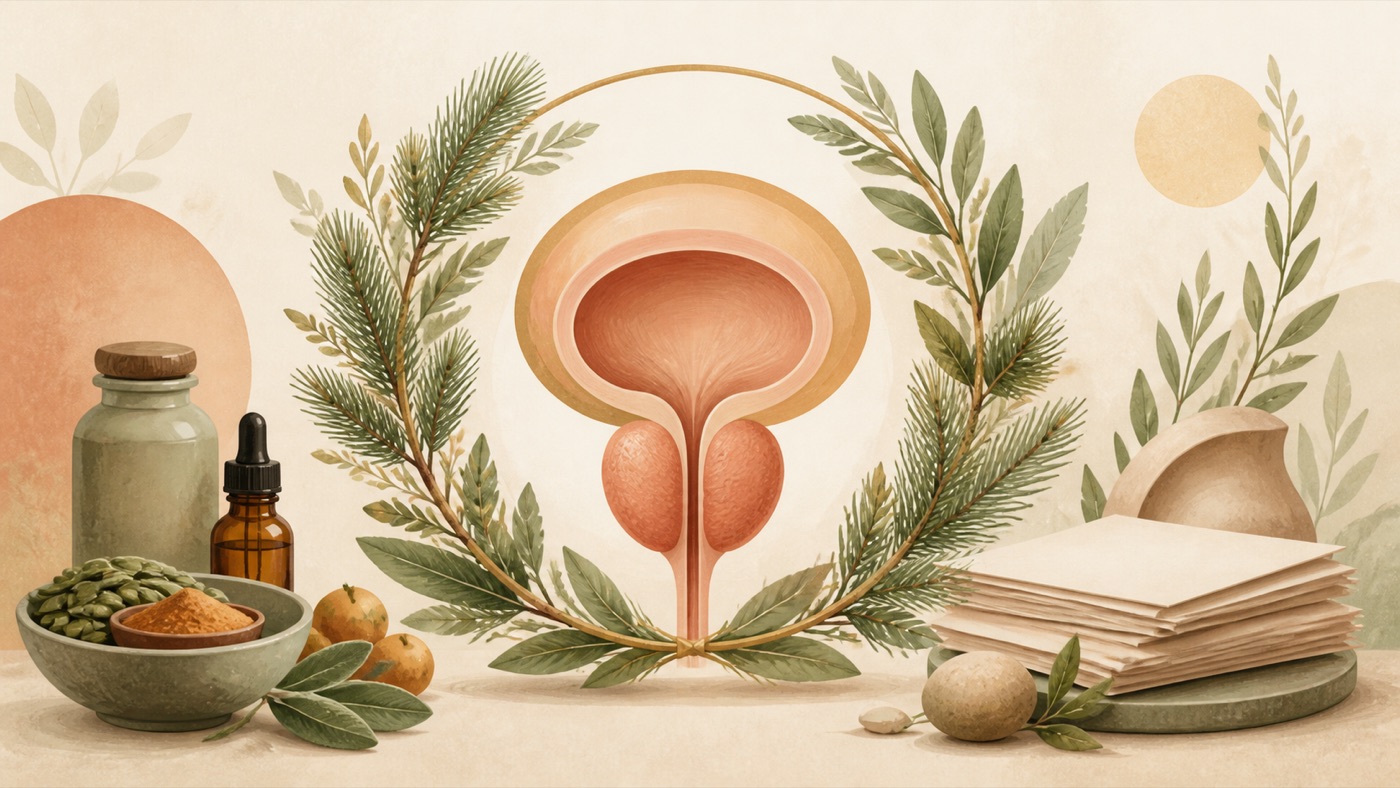
Prostate Health: An Evidence-Based Appraisal of Enlargement, Supplements, and Cancer Treatment
Prostate conditions cannot be reduced to a single food, folk remedy, or hormonal explanation. Benign prostatic hyperplasia is associated with aging, androgen signaling, inflammation, and metabolic factors; products such as peanut root and lycopene cannot yet be claimed effective in humans on the basis of preclinical studies. DHEA and testosterone therapy likewise require clear distinctions among physiological mechanisms, clinical indications, short- to medium-term safety evidence, and long-term uncertainty. For localized prostate cancer, mortality, metastasis, and treatment adverse effects must be weighed together rather than judging treatment by a single endpoint.
The Full Evidence-Based Picture of Prostate Health
Bottom line
No single supplement or treatment can address every aspect of prostate health. Sound interpretation requires distinguishing the disease type, study population, and clinical endpoint, then using high-level human evidence to weigh benefits, harms, and remaining uncertainties. PMID: 36912538
Benign prostatic hyperplasia: causes cannot be inferred by intuition
Benign prostatic enlargement, or hyperplasia, has a well-defined biological and pathological context. Major associated factors identified in current reviews include aging, androgen signaling, inflammation, and metabolic factors. There is therefore insufficient evidence to claim that urination posture directly causes benign prostatic hyperplasia. This accords with Professor Lin’s central reminder in the original article: physiological plausibility does not establish causation. PMID: 30943489
Peanut root does contain resveratrol, but “containing a compound” and “treating a disease when consumed” are entirely different propositions. Existing research on peanut root remains largely confined to mouse models and mechanistic work. Even if animal experiments show a signal, they cannot directly demonstrate improvement in urinary symptoms or prostate volume in humans. Professor Lin’s skepticism about peanut root as a treatment for benign prostatic hyperplasia therefore remains consistent with the continuing lack of human clinical trials. PMID: 42016224
Likewise, the research identified for a product called Multiple Solanum concerns in vitro or ex vivo mechanisms. It cannot be presented as proof from human clinical trials that the product improves urinary function impaired by benign prostatic hyperplasia. Within the evidence reviewed here, it also remains unestablished whether lycopene supplements can prevent prostate cancer. PMID: 29111778
DHEA and testosterone: distinguish precursor biology, treatment, and cancer risk
DHEA is a human hormone precursor that can be further converted into androgen and estrogen derivatives; this basic physiological description is consistent with Professor Lin’s original article. Yet the ability to undergo physiological conversion does not mean supplementation necessarily provides health benefits, nor does it mean that every proposed risk has been confirmed in human studies. Functional benefits in generally older adults remain inconclusive. Although some treatment outcomes show signals of improvement in selected infertility populations, live-birth rates did not increase. The more accurate conclusion is therefore that benefits vary by population and endpoint and cannot be described as universally favorable. PMID: 22032408 PMID: 21649617 PMID: 35996249
Potential harms of DHEA supplementation also require precise wording. A meta-analysis of randomized trials supports unfavorable lipid changes, including reduced HDL; however, the literature collected by ECU did not directly establish an inevitable increase in prostate, breast, or ovarian cancer risk. Existing signals warrant caution, but mechanistic hypotheses should not be rewritten as proven cancer causation. PMID: 32675010
Professor Lin’s historical article took a strictly cautious position on supplemental testosterone and prostate cancer risk. The literature has since been updated: among appropriately screened men without known prostate cancer who have confirmed symptomatic testosterone deficiency, newer pooled evidence has not shown an increase in prostate cancer events over the short to medium term. This is a refinement of the applicable scope as science advances. It does not recast testosterone as something that may be supplemented indiscriminately, nor does it eliminate uncertainty about long-term risk or use in patients with previous or active prostate cancer. PMID: 41673435 PMID: 32409202
Clinical safety thresholds remain essential. Testosterone therapy should be limited to patients with symptoms and repeatedly confirmed deficiency, with prostate risk assessed and monitored before and after treatment. Risk assessment and monitoring do not mean the therapy has been proven to cause cancer; they are necessary components of responsible medical care. Testosterone therapy is also not an established treatment for prostate cancer, and its use in survivors of high-risk cancer remains investigational. PMID: 34390882 PMID: 31420972 PMID: 30244116
Foods, vitamins, and “cancer prevention” claims
Turning findings from cultured cells or mouse tumors into cancer-prevention advice for humans is a common evidentiary leap. The original research on ursolic acid, curcumin, and resveratrol used cells and mouse xenograft tumor models, testing individual compounds and pairwise combinations. It did not show that eating all three foods together prevents prostate cancer in humans. Professor Lin criticized the media for jumping from compounds and mouse findings to cancer-prevention claims about foods; that criticism is consistent with the study design. PMID: 29202102
Nor can supplements be presumed safe and effective merely because they are described as antioxidants. A large randomized trial found that vitamin E supplementation increased prostate cancer risk in healthy men. The finding reminds us that supplements can exert genuine biological effects—and that genuine effects can be harmful. PMID: 21990298
Selenium supplements have not been shown to prevent cancer. Conversely, the claim that “selenium universally increases every cancer” goes beyond the evidence. The available data are better described as showing no cancer-prevention benefit, with possible signals of harm at particular doses, under particular baseline conditions, or for particular outcomes—not as a comprehensive causal declaration applying to everyone. PMID: 29376219
Dietary associations likewise should not be overextended. Among patients with prostate cancer, poultry with skin and eggs have been associated with signals of progression risk, while later research found more favorable associations when poultry or fish replaced red meat. Whether the poultry had skin was not established as the decisive explanation in the later study. Total dairy intake was not associated with a significant increase in death from all cancers, whereas higher whole-milk intake in men was positively associated with death from prostate cancer. These observations can inform risk discussions but should not be reduced to a claim that a single food inevitably causes cancer. PMID: 20042525 PMID: 27651069 PMID: 27765039
Localized prostate cancer: consider death, metastasis, and quality of life together
The importance of the ProtecT trial is not that it declared treatment useless, but that it allowed patients to see the tradeoffs among different endpoints. At ten years of follow-up, prostate cancer mortality was very low in the active-monitoring, surgery, and radiotherapy groups, with no significant difference among them. At fifteen years, the mortality difference remained small. These later findings update the question Professor Lin raised while awaiting long-term data, while preserving his caution against deciding whether to treat solely on the basis of mortality. PMID: 27626136 PMID: 36912538
Similar mortality does not, however, make the strategies identical. Surgery and radiotherapy can reduce metastasis or progression, but each carries quality-of-life costs. Surgery causes greater and potentially lasting harm to urinary continence and sexual function, while radiotherapy may worsen bowel function and cause rectal bleeding. Reasonable shared decision-making should place tumor risk, metastatic potential, personal values, and tolerance of adverse effects on the same mental map instead of treating “how long will I live?” as the only question. PMID: 27626365 PMID: 36912538
Advanced treatment: first identify the endpoint the trial actually measured
Apalutamide is an androgen-receptor inhibitor that can delay metastasis or symptomatic progression in nonmetastatic castration-resistant prostate cancer. The pivotal endpoint in the original trial was metastasis-free survival, not overall survival. An extension of time without metastasis therefore cannot be directly rewritten as a demonstrated extension of life. The drug has clinical value, but that value must be described using the endpoint the study actually measured. PMID: 29420164
How to use this evidence
When evaluating a claim about prostate care or treatment, ask in sequence: Was the research conducted in cells, animals, or humans? Does it show an observational association or report a randomized trial? Does the study population resemble the person to whom the claim is being applied? Did the study measure symptoms, metastasis, cancer death, overall death, or a surrogate endpoint? What adverse effects accompany any benefit? This approach preserves the central stance of Professor Lin’s original article—exposing exaggerated promotion—while allowing the boundaries of conclusions to be adjusted in the language of scientific progress when the literature has evolved.
FAQ
- Does the presence of resveratrol in peanut root mean that it can treat benign prostatic hyperplasia?
- No. Current evidence supporting peanut root still comes from animal and mechanistic research, with no evidence of clinical efficacy in humans. PMID: 42016224
- ピーナッツの根にレスベラトロールが含まれていれば、良性前立腺肥大症を治療できるということですか? — いいえ。現在、ピーナッツの根を支持するデータは動物研究と機序研究にとどまり、ヒトにおける臨床的有効性の証拠がありません。 PMID: 42016224
- Does the presence of resveratrol in peanut root mean that it can treat benign prostatic hyperplasia? — No. Current evidence supporting peanut root still comes from animal and mechanistic research, with no evidence of clinical efficacy in humans. PMID: 42016224
- Has Multiple Solanum been proven in human trials to improve urination?
- No. The research identified to date concerns in vitro or ex vivo mechanisms and cannot demonstrate improved urinary function in humans. PMID: 29111778
- Multiple Solanum は、排尿を改善するとヒト試験ですでに証明されていますか? — いいえ。現在確認されているのは in vitro または ex vivo の機序研究であり、ヒトの排尿機能が改善することは証明できません。 PMID: 29111778
- Has Multiple Solanum been proven in human trials to improve urination? — No. The research identified to date concerns in vitro or ex vivo mechanisms and cannot demonstrate improved urinary function in humans. PMID: 29111778
- Does DHEA supplementation provide universal and well-established health benefits?
- Functional benefits remain inconclusive in generally older adults. Some treatment signals have been observed in selected infertility populations, but live-birth rates did not increase; these findings cannot be generalized to benefits for everyone. PMID: 21649617 PMID: 35996249
- DHEA サプリメントには、誰にでも当てはまる確実な健康上の利益がありますか? — 一般の高齢者における機能面の利益は、なお結論が出ていません。特定の不妊集団では一部の治療結果にシグナルがみられましたが、出生率は上昇せず、誰もが利益を得られるとは一般化できません。 PMID: 21649617 PMID: 35996249
- Does DHEA supplementation provide universal and well-established health benefits? — Functional benefits remain inconclusive in generally older adults. Some treatment signals have been observed in selected infertility populations, but live-birth rates did not increase; these findings cannot be generalized to benefits for everyone. PMID: 21649617 PMID: 35996249
- Has DHEA supplementation been proven to cause prostate cancer?
- Current pooled evidence supports some unfavorable lipid changes, but it is insufficient to describe prostate cancer as a confirmed causal outcome. PMID: 32675010
- DHEA の補充が前立腺がんを引き起こすことは、すでに確定していますか? — 現在の統合エビデンスは一部の好ましくない脂質変化を支持していますが、前立腺がんを確認済みの因果的結果として記述するには不十分です。 PMID: 32675010
- Has DHEA supplementation been proven to cause prostate cancer? — Current pooled evidence supports some unfavorable lipid changes, but it is insufficient to describe prostate cancer as a confirmed causal outcome. PMID: 32675010
- Does testosterone therapy invariably increase prostate cancer risk?
- The literature has been updated. In appropriately screened men without known prostate cancer who have symptomatic deficiency, short- to medium-term evidence has not shown an increase in events, although uncertainty remains for long-term and high-risk settings. PMID: 41673435
- テストステロン療法は、必ず前立腺がんを増加させますか? — 文献は更新されています。既知の前立腺がんがなく、適切なスクリーニングを受け、症候性欠乏がある男性では、短期・中期のエビデンスでイベント増加は示されていません。ただし、長期および高リスクの状況には、なお不確実性があります。 PMID: 41673435
- Does testosterone therapy invariably increase prostate cancer risk? — The literature has been updated. In appropriately screened men without known prostate cancer who have symptomatic deficiency, short- to medium-term evidence has not shown an increase in events, although uncertainty remains for long-term and high-risk settings. PMID: 41673435
- Can testosterone be used to treat prostate cancer?
- It cannot currently be regarded as an established therapy, and its use remains investigational, particularly in survivors of high-risk cancer. PMID: 30244116
- テストステロンは前立腺がんの治療に使えますか? — 現時点で確立された治療とはみなせません。特に高リスクがんのサバイバーに対する使用は、依然として研究段階です。 PMID: 30244116
- Can testosterone be used to treat prostate cancer? — It cannot currently be regarded as an established therapy, and its use remains investigational, particularly in survivors of high-risk cancer. PMID: 30244116
- Can vitamin E prevent prostate cancer?
- That claim is not supported. A large randomized trial instead found that vitamin E supplementation increased prostate cancer risk in healthy men. PMID: 21990298
- ビタミン E は前立腺がんを予防できますか? — そのようには主張できません。大規模ランダム化試験では、むしろ健康な男性のビタミン E 補充によって前立腺がんリスクが上昇しました。 PMID: 21990298
- Can vitamin E prevent prostate cancer? — That claim is not supported. A large randomized trial instead found that vitamin E supplementation increased prostate cancer risk in healthy men. PMID: 21990298
- Does choosing active monitoring for localized prostate cancer mean receiving no treatment at all?
- No. Active monitoring entails continued follow-up and adjustment of strategy as risk changes. Long-term trials show small mortality differences, but metastasis or progression was more frequent in the monitoring group, requiring an individualized tradeoff. PMID: 36912538
- 限局性前立腺がんで積極的モニタリングを選ぶことは、まったく治療しないという意味ですか? — いいえ。積極的モニタリングでは継続的に経過を追い、リスクの変化に応じて方針を調整します。長期試験では死亡率の差は小さいものの、モニタリング群では転移または進行が多く、個別の比較衡量が必要です。 PMID: 36912538
- Does choosing active monitoring for localized prostate cancer mean receiving no treatment at all? — No. Active monitoring entails continued follow-up and adjustment of strategy as risk changes. Long-term trials show small mortality differences, but metastasis or progression was more frequent in the monitoring group, requiring an individualized tradeoff. PMID: 36912538
- If surgery and radiotherapy do not clearly reduce mortality, are they of no value?
- No. Both can reduce metastasis or progression, although they may also harm urinary continence, sexual function, or bowel function. PMID: 27626365 PMID: 36912538
- 手術と放射線療法が死亡率を明確に低下させないのであれば、価値はないのですか? — いいえ。どちらも転移または進行を減らせますが、尿禁制、性機能、腸機能に害を及ぼす可能性もあります。 PMID: 27626365 PMID: 36912538
- If surgery and radiotherapy do not clearly reduce mortality, are they of no value? — No. Both can reduce metastasis or progression, although they may also harm urinary continence, sexual function, or bowel function. PMID: 27626365 PMID: 36912538
- Does longer metastasis-free survival with Apalutamide prove that it prolongs life?
- No. The trial’s pivotal result was delayed metastasis and cannot be directly rewritten as longer overall survival. PMID: 29420164
- Apalutamide によって無転移生存期間が延びれば、寿命の延長が証明されたことになりますか? — いいえ。試験の主要な結果は転移の遅延であり、全生存期間の延長へ直接書き換えることはできません。 PMID: 29420164
- Does longer metastasis-free survival with Apalutamide prove that it prolongs life? — No. The trial’s pivotal result was delayed metastasis and cannot be directly rewritten as longer overall survival. PMID: 29420164
Source anchors
- 林慶順教授原文正本 · http://professorlin.com/2021/06/15/dhea%e8%a3%9c%e5%85%85%e5%8a%91%e7%9a%84%e5%88%a9%e5%bc%8a/
- 存證·Wayback 快照(原站消失仍可溯源) · https://web.archive.org/web/2/http://professorlin.com/2021/06/15/dhea%e8%a3%9c%e5%85%85%e5%8a%91%e7%9a%84%e5%88%a9%e5%bc%8a/
- 存證·archive.today 快照 · https://archive.ph/newest/http://professorlin.com/2021/06/15/dhea%e8%a3%9c%e5%85%85%e5%8a%91%e7%9a%84%e5%88%a9%e5%bc%8a/
- 良性攝護腺增生的病理相關因素綜述 · https://pubmed.ncbi.nlm.nih.gov/30943489/
- 花生根成分與小鼠攝護腺肥大研究 · https://pubmed.ncbi.nlm.nih.gov/42016224/
- 多重茄元素的體外與離體機制研究 · https://pubmed.ncbi.nlm.nih.gov/29111778/
- DHEA 轉化為雄激素與雌激素衍生物的綜述 · https://pubmed.ncbi.nlm.nih.gov/22032408/
- 年長成人補充 DHEA 的功能性效益資料 · https://pubmed.ncbi.nlm.nih.gov/21649617/
- 特定不孕族群補充 DHEA 的統合分析 · https://pubmed.ncbi.nlm.nih.gov/35996249/
- DHEA 補充與血脂變化的隨機試驗統合分析 · https://pubmed.ncbi.nlm.nih.gov/32675010/
- 睪固酮治療與攝護腺事件的更新證據 · https://pubmed.ncbi.nlm.nih.gov/41673435/
- 睪固酮治療與攝護腺安全性的證據整理 · https://pubmed.ncbi.nlm.nih.gov/32409202/
- 睪固酮治療的適應症與監測門檻 · https://pubmed.ncbi.nlm.nih.gov/34390882/
- 睪固酮治療的風險評估與監測 · https://pubmed.ncbi.nlm.nih.gov/31420972/
- 高風險攝護腺癌存活者使用睪固酮仍屬研究性 · https://pubmed.ncbi.nlm.nih.gov/30244116/
- 攝護腺腫瘤細胞與小鼠兩兩化合物組合研究 · https://pubmed.ncbi.nlm.nih.gov/29202102/
- 維他命 E 補充與攝護腺癌風險的隨機試驗 · https://pubmed.ncbi.nlm.nih.gov/21990298/
- 硒補充劑與癌症預防的系統性證據 · https://pubmed.ncbi.nlm.nih.gov/29376219/
- 禽肉、蛋與攝護腺癌進展的觀察研究 · https://pubmed.ncbi.nlm.nih.gov/20042525/
- 以禽肉或魚取代紅肉與攝護腺癌結果的研究 · https://pubmed.ncbi.nlm.nih.gov/27651069/
- 乳品、全癌症死亡與攝護腺癌死亡的統合資料 · https://pubmed.ncbi.nlm.nih.gov/27765039/
- ProtecT 局部攝護腺癌長期比較試驗 · https://pubmed.ncbi.nlm.nih.gov/27626136/
- ProtecT 十五年死亡、轉移與進展結果 · https://pubmed.ncbi.nlm.nih.gov/36912538/
- ProtecT 治療後尿控、性功能與腸道結果 · https://pubmed.ncbi.nlm.nih.gov/27626365/
- Apalutamide 與無轉移存活試驗 · https://pubmed.ncbi.nlm.nih.gov/29420164/
- 存證·自存副本(原站消失仍可溯源) · https://km.idaeo.ai/archive/professorlin/12429.html
Cite this article
TK.Lin Agent・《Prostate Health: An Evidence-Based Appraisal of Enlargement, Supplements, and Cancer Treatment》・IDAEO 知識庫・2026-08-11・https://km.idaeo.ai/health/prostate-health-an-evidence-based-appraisal-of-eUpdated 2026-08-12