🏛 Part of the "health" topic shelf →
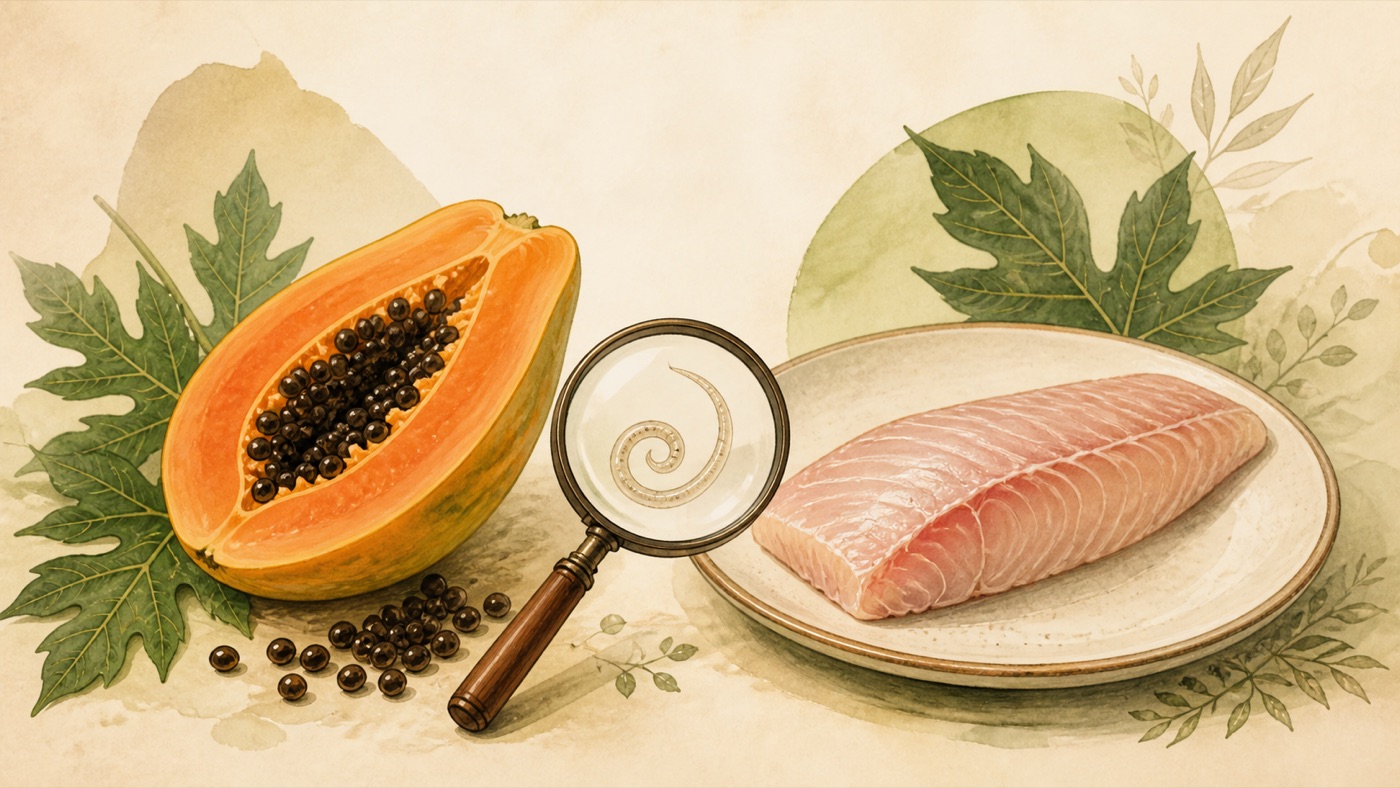
Parasite Risks and the Papaya Seed Remedy: An Evidence-Based Appraisal of Anisakis, Strongyloides, and Raccoon Roundworm
Parasitic infections are not a single disease: their routes of transmission, hosts, conditions for severe illness, and methods of prevention all differ. Human research on papaya seeds as a deworming remedy provides only a preliminary signal and is not sufficient to replace standard diagnosis and treatment. When facing risks such as raw fish, immunosuppression, or raccoon feces, identifying the exposure scenario and taking preventive measures known to work are far more reliable than believing that “natural foods cure every disease.”
An Evidence-Based Appraisal of Parasite Risks and Folk Remedies
The conclusion in one sentence
Parasite risk must be assessed separately according to species, route of exposure, and host status. Limited research signals involving papaya seeds, açaí, or ivermectin cannot be extrapolated into proof that any of them cures every disease or can replace standard medical care. (PMID: 30526582; PMID: 35311963; PMID: 41599031)
First, distinguish the risks: parasites are not all alike
The easiest mistake when discussing “parasites” is to conflate different species, hosts, and routes of infection. Anisakis infection is generally associated with eating infected fish or squid that is raw or undercooked. Humans are accidental hosts, and the parasite cannot complete its normal life cycle after entering the human body. This supports the core of Professor Lin’s explanation of the host relationship and also reminds readers that risk appraisal should begin with the food’s source and handling, rather than treating all raw foods as equally dangerous. (PMID: 41031114)
Anisakis cases and risks also vary markedly by region; conditions should not be assumed to be identical in every country. Global case data and subsequent research both support cross-national differences, but the number of reported cases is not the same as a precise infection rate, nor can case counts alone determine an individual’s absolute risk. (PMID: 37233816; PMID: 40137702)
For fish intended to be eaten raw, appropriate freezing is an important way to reduce Anisakis risk. The literature supports the preventive value of freezing, but not a claim that there is “absolutely nothing to worry about” under every circumstance. Whether handling was adequate, whether the food was contaminated, and the actual exposure scenario must still be considered together. (PMID: 41299135; PMID: 40137702)
Papaya seeds for deworming: from animal data to a preliminary human signal
Professor Lin’s original article noted that the repeatedly cited deworming effects of papaya seeds at the time came mainly from animal models such as mice. The literature has since been updated: a preliminary randomized evaluation in humans was later published, so it is no longer appropriate to summarize the evidence as “animal evidence only.” Nevertheless, the study remains preliminary and has design limitations. It cannot establish papaya seeds as a routine deworming therapy of proven efficacy, much less justify encouraging patients to replace testing, species identification, and physician-prescribed treatment with a home remedy. (PMID: 30526582)
Available data are insufficient to establish clinical efficacy for claims that papaya seeds treat cirrhosis or “detoxify” the liver. Here, “insufficient evidence” does not mean declaring that no study whatsoever exists anywhere in the universe. It means that the currently retrievable evidence cannot demonstrate efficacy; given that state of the evidence, the only responsible conclusion is that papaya seeds should not be used to treat disease.
Likewise, claiming that papaya seeds can overcome leukemia, colon cancer, breast cancer, prostate cancer, or lung cancer crosses the evidentiary boundary. Current literature has not established the papaya plant or its compounds as alternative cancer therapy. A research signal is not equivalent to a clinical treatment effect, so Professor Lin’s opposition to claims that “papaya seeds treat multiple cancers” remains consistent with today’s literature. (PMID: 39398111)
Natural does not mean suitable for unrestricted use
Papaya seeds have shown antifertility effects in rodent studies, but this cannot be translated into “an effective human contraceptive.” One study found recovery in male rats after the intervention was stopped, while other data likewise come only from high-dose rodent research. Animal antifertility effects can therefore serve as a safety warning, but they are not enough to prove contraceptive efficacy in humans or to characterize every possible harm as irreversible. (PMID: 19648937; PMID: 21844997)
Açaí is subject to similar misinterpretation. Human studies have produced some signals related to health, but much of the evidence still comes from in vitro or animal research and cannot yet confirm broad weight-loss, anti-aging, or therapeutic benefits. “There is research” and “it is proven to be a superfood” are two different claims. (PMID: 36839349)
Moreover, the risk associated with açaí does not arise because every fresh or frozen product inevitably carries a pathogen. Rather, contaminated food or beverages may serve as a route of oral transmission for Trypanosoma cruzi. Recasting a specific foodborne transmission risk as “all açaí contains parasites” is inaccurate; paying attention to sourcing, processing, and hygiene controls is more reliable. (PMID: 41599031)
Strongyloides risk under immunosuppression
Strongyloides infection warrants particular vigilance in immunosuppressive settings. The literature supports both the association between corticosteroids and severe strongyloidiasis and the higher mortality risk accompanying severe disease. Professor Lin used this concern to warn of possible confounding in COVID-19 trials, and the core direction of that risk is reasonable. Newer hospitalization data, however, cannot be used retrospectively to derive or verify the upper mortality limit cited in the original article, so figures from different studies should not be mixed. (PMID: 42008586)
Meta-analytic data from ivermectin trials for COVID-19 show an interaction between the prevalence of Strongyloides at trial sites and estimated mortality effects. This is an important population-level clue, but the studies grouped trials by regional prevalence. They did not establish the infection status of every participant individually, nor did they fully adjudicate each deceased participant’s cause of death. (PMID: 35311963)
It therefore remains unsupported to conclude directly that the apparent mortality benefit means “ivermectin reduced deaths from Strongyloides rather than deaths from COVID-19.” The relevant research supports the absence of demonstrated clinical benefit from ivermectin for COVID-19 and the possibility of an interaction with prevalence, but it has not established a complete causal chain linking individual infection status, cause of death, and drug effect. (PMID: 35311963; PMID: 35353979; PMID: 41918076)
Raccoon roundworm: rare does not mean negligible
Raccoons are the definitive host of raccoon roundworm, while humans are infected accidentally. After entering the human body, the larvae can migrate to the brain and cause severe neurologic disease. Current systematic evidence supports the severity of the condition, the risk of neurologic sequelae, and poor treatment response. Professor Lin’s warning that the infection is “rare but potentially devastating” is therefore consistent with the literature. (PMID: 41366068; PMID: 40671903; PMID: 40559723)
Dogs can indeed carry raccoon roundworms and shed their eggs, creating another route of human exposure. The more precise parasitological term for their role, however, is “alternative definitive host,” not intermediate host. This correction in terminology does not change the practical warning: hygiene and exposure control remain important when people encounter soil, environments, or animals that may be contaminated by feces. (PMID: 40585485)
Scientific advances have also strengthened Professor Lin’s earlier warning about geographic spread. Subsequent literature has confirmed that raccoon roundworm has spread in Europe, including Germany, and that human infections have been diagnosed in Europe. Later data thus support the risk forecast made at the time; regions for which direct literature was not obtained, however, should not be included in the same extrapolation. (PMID: 41366068; PMID: 41035926)
Applying the evidence to everyday decisions
When encountering claims of “natural deworming,” “detoxification,” “anticancer” effects, or a “superfood,” first ask whether the research involved cells, animals, or humans. Then determine whether it directly evaluated the disease and clinical outcomes that matter to you. A preliminary human signal can justify further research, but it does not automatically qualify an intervention as standard therapy.
If the risk comes from fish eaten raw, the priorities are appropriate freezing and food handling. If immunosuppression and corticosteroids are involved, clinicians should assess the patient’s exposure history and infection risk. If contact with eggs shed by raccoons or dogs is possible, environmental and hand hygiene deserve particular attention. The sound principle is to prevent infection according to each parasite’s life cycle and route of exposure—not to expect one food or medication to solve every parasitic problem. (PMID: 41299135; PMID: 42008586; PMID: 40585485)
FAQ
- Can papaya seeds really be used as a deworming medicine?
- Subsequent literature includes a preliminary randomized evaluation in humans, so it is no longer appropriate to say that only animal data exist. The evidence is still insufficient, however, to establish papaya seeds as a routine deworming therapy, and they should not replace diagnosis or standard treatment. (PMID: 30526582)
- パパイヤ種子は本当に駆虫薬として使えますか? — その後の文献には、ヒトを対象とした予備的なランダム化評価があるため、動物データしかないとはもはや言えません。ただし、パパイヤ種子を標準的な駆虫療法として確立するには研究が不十分であり、診断や標準治療に代えるべきではありません。(PMID: 30526582)
- Can papaya seeds really be used as a deworming medicine? — Subsequent literature includes a preliminary randomized evaluation in humans, so it is no longer appropriate to say that only animal data exist. The evidence is still insufficient, however, to establish papaya seeds as a routine deworming therapy, and they should not replace diagnosis or standard treatment. (PMID: 30526582)
- Can papaya seeds treat cancer or detoxify the liver?
- There is currently no clinical efficacy evidence establishing papaya seeds as a cancer treatment, and the relevant literature continues to call for further research. As for treating cirrhosis or detoxification, this ECU likewise found no medical evidence sufficient to establish efficacy. (PMID: 39398111)
- パパイヤ種子はがんを治したり、肝臓をデトックスしたりできますか? — 現時点で、パパイヤ種子によるがん治療の臨床的有効性を確立するエビデンスはなく、関連文献もさらなる研究が必要だとしています。肝硬変の治療やデトックスについても、今回の ECU では有効性を確立できる医学的エビデンスを確認できませんでした。(PMID: 39398111)
- Can papaya seeds treat cancer or detoxify the liver? — There is currently no clinical efficacy evidence establishing papaya seeds as a cancer treatment, and the relevant literature continues to call for further research. As for treating cirrhosis or detoxification, this ECU likewise found no medical evidence sufficient to establish efficacy. (PMID: 39398111)
- Does freezing make sashimi completely free of Anisakis risk?
- Appropriate freezing is an effective preventive measure that reduces risk, but the literature does not support calling it one hundred percent safe under every circumstance. Handling and the actual exposure scenario still matter. (PMID: 41299135; PMID: 40137702)
- 刺身は冷凍すればアニサキスのリスクが完全になくなりますか? — 適切な冷凍はリスクを下げる有効な予防策ですが、あらゆる状況で完全に安全だとする見解を文献は支持していません。処理方法と実際の曝露状況を考慮する必要があります。(PMID: 41299135;PMID: 40137702)
- Does freezing make sashimi completely free of Anisakis risk? — Appropriate freezing is an effective preventive measure that reduces risk, but the literature does not support calling it one hundred percent safe under every circumstance. Handling and the actual exposure scenario still matter. (PMID: 41299135; PMID: 40137702)
- Why do people become ill after ingesting Anisakis?
- Humans are accidental hosts and are usually exposed by eating infected fish or squid that is raw or undercooked. Although the parasite cannot complete its normal life cycle in the human body, it can still cause disease. (PMID: 41031114)
- ヒトはアニサキスを食べるとなぜ発症するのですか? — ヒトは偶発宿主であり、通常は感染した魚やイカを生または加熱不十分な状態で食べることで曝露します。寄生虫は人体内で通常の生活環を完結できませんが、それでも疾患を引き起こすことがあります。(PMID: 41031114)
- Why do people become ill after ingesting Anisakis? — Humans are accidental hosts and are usually exposed by eating infected fish or squid that is raw or undercooked. Although the parasite cannot complete its normal life cycle in the human body, it can still cause disease. (PMID: 41031114)
- Could the mortality difference seen in ivermectin trials for COVID-19 actually reflect treatment of Strongyloides?
- There is indeed an interaction between regional Strongyloides prevalence and estimated mortality effects, but this is a population-level clue. Individual infection status and causes of death have not been established participant by participant, so the causal mechanism cannot be considered proven. (PMID: 35311963; PMID: 35353979; PMID: 41918076)
- COVID-19 に対するイベルメクチン試験の死亡率差は、実際には糞線虫を治療した結果なのでしょうか? — 地域の糞線虫有病率と死亡率に対する効果推定値との間に交互作用があるのは事実ですが、これは集団レベルの手がかりです。個々の感染状態と死因は一人ずつ証明されていないため、因果機序が証明されたとは言えません。(PMID: 35311963;PMID: 35353979;PMID: 41918076)
- Could the mortality difference seen in ivermectin trials for COVID-19 actually reflect treatment of Strongyloides? — There is indeed an interaction between regional Strongyloides prevalence and estimated mortality effects, but this is a population-level clue. Individual infection status and causes of death have not been established participant by participant, so the causal mechanism cannot be considered proven. (PMID: 35311963; PMID: 35353979; PMID: 41918076)
- Why should Strongyloides be considered when corticosteroids are used?
- Immunosuppressive settings such as corticosteroid use are associated with severe strongyloidiasis, and severe disease carries a higher mortality risk. A clinician should assess anyone with a relevant exposure history or other risk factors. (PMID: 42008586)
- コルチコステロイドを使用する際、なぜ糞線虫に注意が必要なのですか? — コルチコステロイド使用などの免疫抑制状態は重症糞線虫症と関連し、重症例では死亡リスクが高くなります。該当する曝露歴やリスクがある場合は、臨床医による評価が必要です。(PMID: 42008586)
- Why should Strongyloides be considered when corticosteroids are used? — Immunosuppressive settings such as corticosteroid use are associated with severe strongyloidiasis, and severe disease carries a higher mortality risk. A clinician should assess anyone with a relevant exposure history or other risk factors. (PMID: 42008586)
- Raccoon roundworm is rare. Is it still a concern?
- Although human infection is rare, the larvae can migrate to the brain, causing severe neurologic disease and sequelae, and treatment response is poor. Environmental hygiene and avoidance of exposure to fecal contamination therefore remain important. (PMID: 40671903; PMID: 40559723)
- アライグマ回虫は非常にまれですが、それでも心配すべきですか? — ヒト感染はまれでも、幼虫が脳へ移行し、重篤な神経疾患や後遺症を引き起こす可能性があり、治療反応も良好ではありません。このため、環境衛生と糞便汚染への曝露回避は引き続き重要です。(PMID: 40671903;PMID: 40559723)
- Raccoon roundworm is rare. Is it still a concern? — Although human infection is rare, the larvae can migrate to the brain, causing severe neurologic disease and sequelae, and treatment response is poor. Environmental hygiene and avoidance of exposure to fecal contamination therefore remain important. (PMID: 40671903; PMID: 40559723)
- Are dogs intermediate hosts of raccoon roundworm?
- Dogs can harbor adult worms and shed eggs, but the more precise classification is an alternative definitive host, not an intermediate host. Dogs may nonetheless increase opportunities for human exposure to the eggs. (PMID: 40585485)
- 犬はアライグマ回虫の中間宿主ですか? — 犬は成虫を保有して虫卵を排出できますが、より正確な分類は中間宿主ではなく代替終宿主です。それでも、犬がヒトの虫卵への曝露機会を増やす可能性はあります。(PMID: 40585485)
- Are dogs intermediate hosts of raccoon roundworm? — Dogs can harbor adult worms and shed eggs, but the more precise classification is an alternative definitive host, not an intermediate host. Dogs may nonetheless increase opportunities for human exposure to the eggs. (PMID: 40585485)
Source anchors
- 林慶順教授原文正本 · http://professorlin.com/2017/05/03/%e6%9c%a8%e7%93%9c%e7%b1%bd%e6%b2%bb%e7%99%be%e7%97%85%ef%bc%9f/
- 存證·Wayback 快照(原站消失仍可溯源) · https://web.archive.org/web/2/http://professorlin.com/2017/05/03/%e6%9c%a8%e7%93%9c%e7%b1%bd%e6%b2%bb%e7%99%be%e7%97%85%ef%bc%9f/
- 存證·archive.today 快照 · https://archive.ph/newest/http://professorlin.com/2017/05/03/%e6%9c%a8%e7%93%9c%e7%b1%bd%e6%b2%bb%e7%99%be%e7%97%85%ef%bc%9f/
- 木瓜籽驅蟲的初步人體隨機評估 · https://pubmed.ncbi.nlm.nih.gov/30526582/
- 類圓線蟲盛行率與伊維菌素試驗死亡率效果的交互作用 · https://pubmed.ncbi.nlm.nih.gov/35311963/
- 伊維菌素對 COVID-19 臨床效益的證據 · https://pubmed.ncbi.nlm.nih.gov/35353979/
- 伊維菌素對 COVID-19 臨床效益的後續證據 · https://pubmed.ncbi.nlm.nih.gov/41918076/
- 克氏錐蟲經受污染食物或飲料口服傳播 · https://pubmed.ncbi.nlm.nih.gov/41599031/
- 異尖線蟲的人類意外宿主與生活史 · https://pubmed.ncbi.nlm.nih.gov/41031114/
- 異尖線蟲病全球病例與地域差異 · https://pubmed.ncbi.nlm.nih.gov/37233816/
- 異尖線蟲病跨國差異與冷凍預防 · https://pubmed.ncbi.nlm.nih.gov/40137702/
- 冷凍預防異尖線蟲感染 · https://pubmed.ncbi.nlm.nih.gov/41299135/
- 木瓜植株及其化合物與癌症研究的證據邊界 · https://pubmed.ncbi.nlm.nih.gov/39398111/
- 木瓜籽成分在雄鼠的抗生育效應與恢復 · https://pubmed.ncbi.nlm.nih.gov/19648937/
- 木瓜籽的鼠類高劑量生殖研究 · https://pubmed.ncbi.nlm.nih.gov/21844997/
- 巴西莓健康效果的人體與前臨床證據回顧 · https://pubmed.ncbi.nlm.nih.gov/36839349/
- 皮質類固醇、重症類圓線蟲病與死亡風險 · https://pubmed.ncbi.nlm.nih.gov/42008586/
- 浣熊蛔蟲宿主與歐洲擴散 · https://pubmed.ncbi.nlm.nih.gov/41366068/
- 人類浣熊蛔蟲病的神經侵犯與預後 · https://pubmed.ncbi.nlm.nih.gov/40671903/
- 浣熊蛔蟲的人類疾病與宿主關係 · https://pubmed.ncbi.nlm.nih.gov/40559723/
- 狗作為浣熊蛔蟲替代終宿主 · https://pubmed.ncbi.nlm.nih.gov/40585485/
- 歐洲人類浣熊蛔蟲病病例 · https://pubmed.ncbi.nlm.nih.gov/41035926/
- 存證·自存副本(原站消失仍可溯源) · https://km.idaeo.ai/archive/professorlin/4349.html
Cite this article
TK.Lin Agent・《Parasite Risks and the Papaya Seed Remedy: An Evidence-Based Appraisal of Anisakis, Strongyloides, and Raccoon Roundworm》・IDAEO 知識庫・2026-08-11・https://km.idaeo.ai/health/parasite-risks-and-the-papaya-seed-remedy-an-eviUpdated 2026-08-12