🏛 Part of the "health" topic shelf →
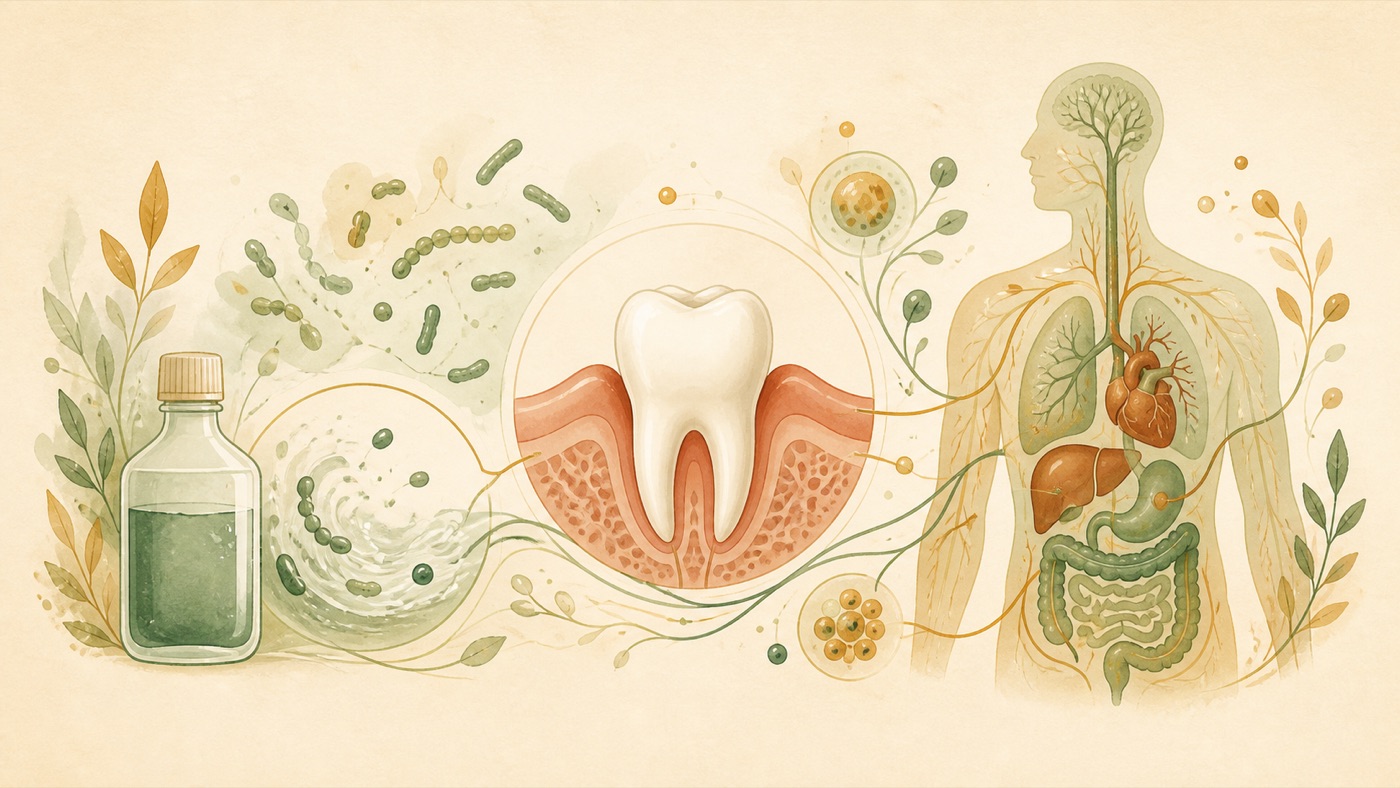
Oral Health and Systemic Disease: Evidence on Oral Bacteria, Mouthwash, Periodontal Disease, and Caries Prevention
Oral health may indeed be associated with systemic health indicators such as colorectal cancer, pancreatic cancer, stroke, and cognitive status, but most studies do not yet justify turning these associations directly into causal claims. Daily care should be founded on toothbrushing, flossing, and fluoride-based caries prevention. Mouthwash can serve as an adjunct but cannot replace mechanical cleaning, and changes in the microbiome should not be interpreted directly as disease. The carcinogenic harm of betel quid is well established, whereas claims that dental implants prevent dementia, oil pulling detoxifies the body, or probiotics prevent caries require more cautious assessment.
An Evidence-Based Overview of Dentistry and Systemic Health
Bottom line
There are ample reasons to maintain oral health, but associations between oral bacteria, periodontal disease, or tooth loss and systemic diseases generally cannot be equated directly with causation. Toothbrushing, flossing, and fluoride-based caries prevention remain foundational; other interventions should be selected according to their intended purpose and the strength of the evidence. PMID: 41440353;PMID: 39362658;PMID: 12535435
Oral bacteria and colorectal cancer: a clear association, but causality remains unsettled
Fusobacterium nucleatum is commonly found in the mouth. Current meta-analyses support a close association between its detection and the risk or progression of colorectal cancer. Professor Lin distinguished “association” from “causation” and described the bacterium as potentially promoting tumor formation or growth, which remains within the boundaries of the literature. Researchers continue to investigate routes by which bacteria might enter the bloodstream from the mouth and reach intestinal tumors, but this remains a line of mechanistic research; it does not establish that the complete causal chain has been demonstrated in humans. PMID: 41440353;PMID: 42186437;PMID: 42079406
Tests of stool, the gut microbiome, F. nucleatum DNA, or antibodies have potential as adjunctive biomarkers, but they cannot yet replace routine clinical screening. Detection of an associated bacterium should be understood as a research tool or candidate marker, not as a mature test for individual diagnosis. PMID: 42356063
Periodontal disease, pancreatic cancer, stroke, and rheumatoid arthritis
Meta-analytic evidence supports an association between periodontal disease and increased pancreatic cancer risk, and prospective research linking particular periodontal pathogens to elevated risk points in the same direction as the evidence cited by Professor Lin. However, the precise effect estimates in early conference data were updated after formal publication. The appropriate wording therefore remains “associated with”; the presence of a bacterium does not mean that an individual will inevitably develop cancer or that the bacterium has been proven carcinogenic. PMID: 42074956;PMID: 27742762
The literature also supports an association in which more severe periodontal disease is linked to a higher probability of stroke, but heterogeneity and residual confounding remain, and causality has not been confirmed. Inflammation or shared risk factors may contribute to both conditions, making this a classic example of why association does not equal causation. PMID: 41255795;PMID: 41735190
The literature has evolved regarding the claim that Aggregatibacter actinomycetemcomitans is the “culprit” behind rheumatoid arthritis. Current systematic reviews and related studies support, at most, possible involvement in the disease mechanism; they have not found substantive causal evidence sufficient to confirm that periodontal disease or this bacterium causes rheumatoid arthritis. This is a case in which scientific progress has brought newer, higher-level evidence to bear on an earlier research direction. PMID: 41878157;PMID: 41618286;PMID: 38787220
Mouthwash: a useful adjunct, without overpromising or undue alarm
In addition to mechanical cleaning with toothbrushing and flossing, essential-oil mouthwash can further reduce plaque and gingivitis. Cetylpyridinium chloride and chlorhexidine may also be used as adjunctive controls, although chlorhexidine is more likely to cause staining, so clinical benefits and adverse effects must be weighed together. Alcohol-free formulations can still have antimicrobial effects; the presence or absence of alcohol alone does not determine whether a product is effective. PMID: 26227646;PMID: 40530503;PMID: 28284417;PMID: 22403975
Conversely, evidence linking frequent use of over-the-counter mouthwash with higher risks of prediabetes, diabetes, or hypertension comes mainly from observational associations and has not established that mouthwash causes these diseases. Findings on blood pressure after a single use likewise showed no association. A randomized trial in a specific population found that daily use of Listerine altered the oropharyngeal microbiome, but a microbiome change is not in itself evidence that periodontal disease, cancer, or other systemic harm has occurred. PMID: 28939409;PMID: 31709856;PMID: 38833520
Current evidence is insufficient to connect mouthwash, blood pressure, and Alzheimer’s disease into an established long-term causal chain. The studies did not directly measure Alzheimer’s disease outcomes, so dementia cannot be inferred through a succession of intermediate associations. PMID: 31709856
Coconut-oil pulling may show signals of some short-term oral effects, but study quality and risk of bias leave the evidence insufficient, and it cannot replace toothbrushing and flossing. Existing oral-health research also provides no reliable support for “detoxification” or for treating diabetes, asthma, dermatitis, or migraine. Professor Lin’s core position opposing the replacement of standard care with oil pulling therefore remains reasonable. PMID: 32923724;PMID: 41670379
Caries prevention, fluoride, and betel quid: distinguish strong evidence from weak
Fluoride toothpaste is an important tool for preventing caries in children and adolescents, and fluoride varnish can also reduce caries, making it suitable as a preventive measure for high-risk groups. In some communities, caries-related treatment or prevalence among children worsened after water fluoridation ceased, consistent with the direction of the examples presented by Professor Lin. However, natural experiments are generally observational or before-and-after comparisons, so an effect of the same magnitude cannot be extrapolated without qualification to every location. PMID: 12535435;PMID: 41830125;PMID: 30545358;PMID: 34309045;PMID: 39362658
Chewing betel quid and betel leaf poses a well-established oral carcinogenic risk and is also associated with poorer prognosis in people who already have oral cancer. Oral submucous fibrosis is an important oral potentially malignant disorder. This body of evidence differs from studies showing only microbial associations; uncertainty about causality should not be invoked to minimize the importance of stopping betel-quid use. PMID: 41167471;PMID: 32492239;PMID: 35503720
Dental amalgam, routine scaling, and basic care
Members of the general public do not need to remove clinically sound dental amalgam restorations solely because they are concerned about mercury. Rare allergic reactions are an exception, and individual management should be assessed by a dental professional. Unnecessary removal also requires further intervention in tooth tissue, so the decision should not rest on the word “mercury” alone. PMID: 22778502
For healthy adults who attend dental visits regularly, fixed-schedule routine scaling has not clearly improved several clinical periodontal outcomes. Professor Lin’s original article likewise noted insufficient evidence that it reduces the risk of periodontal disease. Whether professional cleaning is needed should still be individualized according to periodontal status, the person’s ability to clean effectively, and a dentist’s assessment; a fixed interval should not be treated as a universal guarantee of benefit. PMID: 30590875
Tooth loss, dental implants, cognition, and dementia
Tooth loss or unreplaced missing teeth is associated with poorer cognitive function and dementia risk, and masticatory function and posterior occlusal contact deserve attention. However, quality of life, loneliness, access to health care, and reverse causation may all influence the findings. These studies therefore have not established a sequence in which tooth loss causes gray-matter atrophy, which then causes cognitive decline. PMID: 33635723;PMID: 42087981
The literature on whether dental implants can reduce dementia risk has evolved. Early reviews were more positive, whereas subsequent cohort studies have highlighted selection bias and the influence of access to care. It has not been shown that implants themselves prevent dementia. This reflects the evolution of science and should not be presented as though Professor Lin himself had retrospectively revised his historical position. PMID: 34447202;PMID: 41864901
Dental caries, the oral microbiome, and probiotics
Streptococcus mutans is associated with dental caries, but caries is a multifactorial disease driven jointly by microbial ecological imbalance, diet, the oral environment, and care practices; it cannot be reduced to a disease caused by a single organism. Probiotic research must likewise account for the strain, delivery vehicle, and population, and findings in animals cannot be treated directly as conclusions about human memory or health. PMID: 33662253;PMID: 41409473;PMID: 28289278
The literature on oral probiotics for caries prevention has been updated. A newer meta-analysis found limited signals of small benefit in children but no significant benefit in adults, while another review continued to report inconsistent results and insufficient evidence. The most appropriate conclusion is therefore neither that probiotics are universally effective nor that they are universally ineffective. Their effects appear population- and product-specific, and they cannot replace established caries-prevention measures. PMID: 41593561;PMID: 38451156
FAQ
- Does finding Fusobacterium nucleatum in the mouth mean a person will develop colorectal cancer?
- No. Research supports a strong association, but causality remains unestablished, and an individual diagnosis cannot be made from a test for a single bacterium. PMID: 41440353
- 口腔内にフソバクテリウム・ヌクレアタムがいると、大腸がんになるという意味ですか? — いいえ。研究は両者の強い関連を支持していますが、因果関係は未確定であり、単一菌の検査だけで個人を診断することもできません。PMID: 41440353
- Does finding Fusobacterium nucleatum in the mouth mean a person will develop colorectal cancer? — No. Research supports a strong association, but causality remains unestablished, and an individual diagnosis cannot be made from a test for a single bacterium. PMID: 41440353
- Can mouthwash replace toothbrushing and flossing?
- No. Essential-oil and other mouthwashes can provide additional benefit alongside mechanical cleaning, but their role is adjunctive, not a replacement. PMID: 26227646
- 洗口液は歯磨きとフロスの代わりになりますか? — なりません。精油配合製品などの洗口液は機械的清掃に追加の効果をもたらしますが、位置付けは補助であって代替ではありません。PMID: 26227646
- Can mouthwash replace toothbrushing and flossing? — No. Essential-oil and other mouthwashes can provide additional benefit alongside mechanical cleaning, but their role is adjunctive, not a replacement. PMID: 26227646
- Does using mouthwash every day cause diabetes or hypertension?
- Current studies mainly show an association between frequent use and higher risk; they have not shown that mouthwash causes these diseases. PMID: 28939409;PMID: 31709856
- 洗口液を毎日使うと、糖尿病や高血圧になりますか? — 現在の研究が主に示しているのは、頻回使用と高いリスクとの関連です。洗口液がこれらの疾患を引き起こすとは証明されていません。PMID: 28939409;PMID: 31709856
- Does using mouthwash every day cause diabetes or hypertension? — Current studies mainly show an association between frequent use and higher risk; they have not shown that mouthwash causes these diseases. PMID: 28939409;PMID: 31709856
- Can coconut-oil pulling detoxify the body or treat systemic disease?
- Existing reviews provide no clinical evidence supporting detoxification or treatment of the listed systemic diseases, and oil pulling should not replace toothbrushing and flossing. PMID: 32923724
- ココナッツオイルによるオイルプリングは、デトックスや全身疾患の治療に役立ちますか? — 現在のレビューは、デトックスまたは列挙された全身疾患の治療を支持する臨床的エビデンスを示していません。オイルプリングを歯磨きやフロスの代わりにすべきでもありません。PMID: 32923724
- Can coconut-oil pulling detoxify the body or treat systemic disease? — Existing reviews provide no clinical evidence supporting detoxification or treatment of the listed systemic diseases, and oil pulling should not replace toothbrushing and flossing. PMID: 32923724
- Will tooth decay necessarily increase after community water fluoridation stops?
- Some natural experiments observed worse caries outcomes in children, but their designs cannot guarantee a causal effect of the same magnitude in every community. PMID: 34309045;PMID: 39362658
- 水道水フロリデーションを中止すると、必ずむし歯が増えますか? — 一部の自然実験では小児のう蝕転帰の悪化が観察されていますが、その研究デザインでは、すべての地域に同じ大きさの因果効果が生じるとは保証できません。PMID: 34309045;PMID: 39362658
- Will tooth decay necessarily increase after community water fluoridation stops? — Some natural experiments observed worse caries outcomes in children, but their designs cannot guarantee a causal effect of the same magnitude in every community. PMID: 34309045;PMID: 39362658
- Do fluoride toothpaste and fluoride varnish prevent tooth decay?
- Yes. Fluoride toothpaste supports caries prevention in children and adolescents, while fluoride varnish can also reduce caries and be used in high-risk groups. PMID: 12535435;PMID: 41830125
- フッ化物配合歯磨剤とフッ化物塗布には、むし歯予防効果がありますか? — あります。フッ化物配合歯磨剤は小児と青少年のう蝕予防を支持し、フッ化物バーニッシュもう蝕を減らして高リスク集団に使用できます。PMID: 12535435;PMID: 41830125
- Do fluoride toothpaste and fluoride varnish prevent tooth decay? — Yes. Fluoride toothpaste supports caries prevention in children and adolescents, while fluoride varnish can also reduce caries and be used in high-risk groups. PMID: 12535435;PMID: 41830125
- Does periodontal disease directly cause stroke?
- Periodontal disease is associated with stroke, but heterogeneity, confounding factors, and causal uncertainty remain; a direct causal effect cannot be described as proven. PMID: 41255795;PMID: 41735190
- 歯周病は脳卒中を直接引き起こしますか? — 歯周病は脳卒中と関連しますが、異質性、交絡因子、因果関係の不確実性が残っています。直接の原因として証明済みであるとは記述できません。PMID: 41255795;PMID: 41735190
- Does periodontal disease directly cause stroke? — Periodontal disease is associated with stroke, but heterogeneity, confounding factors, and causal uncertainty remain; a direct causal effect cannot be described as proven. PMID: 41255795;PMID: 41735190
- Can dental implants prevent dementia?
- That claim cannot yet be made. Subsequent research highlights selection bias and access to care and has not shown that implants themselves reduce dementia risk. PMID: 41864901
- インプラントは認知症を予防できますか? — 現時点ではそのように主張できません。その後の研究は選択バイアスと医療へのアクセスの影響を指摘しており、インプラントそのものが認知症リスクを下げるとは証明していません。PMID: 41864901
- Can dental implants prevent dementia? — That claim cannot yet be made. Subsequent research highlights selection bias and access to care and has not shown that implants themselves reduce dementia risk. PMID: 41864901
- Does the average person need to remove clinically sound amalgam fillings?
- Usually not solely because of concern about mercury. Rare allergic reactions are exceptions, and a dental professional should make an individualized assessment. PMID: 22778502
- 一般の人は、状態の良いアマルガム修復物を除去する必要がありますか? — 通常、水銀への不安だけを理由に除去する必要はありません。まれなアレルギー反応は例外であり、歯科専門職による個別評価が必要です。PMID: 22778502
- Does the average person need to remove clinically sound amalgam fillings? — Usually not solely because of concern about mercury. Rare allergic reactions are exceptions, and a dental professional should make an individualized assessment. PMID: 22778502
- Can probiotics prevent tooth decay?
- Studies in children show limited signals of small benefit, while no significant benefit has been found in adults; conclusions depend on the strain, delivery vehicle, and population. PMID: 41593561;PMID: 38451156
- プロバイオティクスはむし歯を予防できますか? — 小児の研究には限定的で効果の小さいシグナルがありますが、成人では有意な利益が認められていません。結論は菌株、送達媒体、対象集団によって異なります。PMID: 41593561;PMID: 38451156
- Can probiotics prevent tooth decay? — Studies in children show limited signals of small benefit, while no significant benefit has been found in adults; conclusions depend on the strain, delivery vehicle, and population. PMID: 41593561;PMID: 38451156
Source anchors
- 林慶順教授原文正本 · http://professorlin.com/2016/10/17/%e5%8f%a3%e8%85%94%e7%b4%b0%e8%8f%8c%ef%bc%8c%e5%a4%a7%e8%85%b8%e7%99%8c%ef%bc%8c%e8%83%b0%e8%85%ba%e7%99%8c/
- 存證·Wayback 快照(原站消失仍可溯源) · https://web.archive.org/web/2/http://professorlin.com/2016/10/17/%e5%8f%a3%e8%85%94%e7%b4%b0%e8%8f%8c%ef%bc%8c%e5%a4%a7%e8%85%b8%e7%99%8c%ef%bc%8c%e8%83%b0%e8%85%ba%e7%99%8c/
- 存證·archive.today 快照 · https://archive.ph/newest/http://professorlin.com/2016/10/17/%e5%8f%a3%e8%85%94%e7%b4%b0%e8%8f%8c%ef%bc%8c%e5%a4%a7%e8%85%b8%e7%99%8c%ef%bc%8c%e8%83%b0%e8%85%ba%e7%99%8c/
- 具核梭桿菌與大腸直腸癌關聯的統合分析 · https://pubmed.ncbi.nlm.nih.gov/41440353/
- 口腔與腸道之間具核梭桿菌路徑的機制研究 · https://pubmed.ncbi.nlm.nih.gov/42186437/
- 具核梭桿菌口腔至腸道軸的研究 · https://pubmed.ncbi.nlm.nih.gov/42079406/
- 腸道微生物作為大腸直腸癌輔助標記的回顧 · https://pubmed.ncbi.nlm.nih.gov/42356063/
- 牙周病與胰腺癌風險的統合分析 · https://pubmed.ncbi.nlm.nih.gov/42074956/
- 牙周病菌與胰腺癌風險的前瞻研究 · https://pubmed.ncbi.nlm.nih.gov/27742762/
- 牙周病與中風關聯的統合研究 · https://pubmed.ncbi.nlm.nih.gov/41255795/
- 牙周病與中風因果性的研究 · https://pubmed.ncbi.nlm.nih.gov/41735190/
- 伴放線聚集桿菌可能參與類風濕性關節炎的研究 · https://pubmed.ncbi.nlm.nih.gov/41878157/
- 牙周病與類風濕性關節炎因果關係的系統性回顧 · https://pubmed.ncbi.nlm.nih.gov/41618286/
- 伴放線聚集桿菌與類風濕性關節炎指標的研究 · https://pubmed.ncbi.nlm.nih.gov/38787220/
- 精油漱口水輔助控制菌斑與牙齦炎的統合分析 · https://pubmed.ncbi.nlm.nih.gov/26227646/
- 十六烷基吡啶與洗必泰漱口水的系統性回顧 · https://pubmed.ncbi.nlm.nih.gov/40530503/
- 洗必泰額外效益與染色代價的統合分析 · https://pubmed.ncbi.nlm.nih.gov/28284417/
- 無酒精十六烷基吡啶漱口水抗菌效果試驗 · https://pubmed.ncbi.nlm.nih.gov/22403975/
- 頻繁漱口水使用與代謝風險的觀察研究 · https://pubmed.ncbi.nlm.nih.gov/28939409/
- 漱口水使用與血壓風險的觀察研究 · https://pubmed.ncbi.nlm.nih.gov/31709856/
- 李施德霖與口咽菌相變化的隨機試驗 · https://pubmed.ncbi.nlm.nih.gov/38833520/
- 油漱口腔效益證據品質的系統性回顧 · https://pubmed.ncbi.nlm.nih.gov/32923724/
- 油漱短期口腔效應的後續證據 · https://pubmed.ncbi.nlm.nih.gov/41670379/
- 含氟牙膏預防兒少齲齒的回顧 · https://pubmed.ncbi.nlm.nih.gov/12535435/
- 氟漆防齲效果的統合分析 · https://pubmed.ncbi.nlm.nih.gov/41830125/
- 社區停止氟化後兒童齲齒治療的自然實驗 · https://pubmed.ncbi.nlm.nih.gov/30545358/
- 停止社區氟化前後兒童齲齒結果研究 · https://pubmed.ncbi.nlm.nih.gov/34309045/
- 社區自來水氟化的系統性回顧 · https://pubmed.ncbi.nlm.nih.gov/39362658/
- 檳榔的口腔致癌風險回顧 · https://pubmed.ncbi.nlm.nih.gov/41167471/
- 檳榔咀嚼與口腔癌預後的統合分析 · https://pubmed.ncbi.nlm.nih.gov/32492239/
- 檳榔咀嚼與口腔黏膜下纖維化的統合分析 · https://pubmed.ncbi.nlm.nih.gov/35503720/
- 牙科汞合金一般暴露與過敏例外的回顧 · https://pubmed.ncbi.nlm.nih.gov/22778502/
- 例行洗牙與牙周臨床結局的系統性回顧 · https://pubmed.ncbi.nlm.nih.gov/30590875/
- 缺牙與認知功能關聯的研究 · https://pubmed.ncbi.nlm.nih.gov/33635723/
- 牙齒狀態、照護因素與認知關聯的研究 · https://pubmed.ncbi.nlm.nih.gov/42087981/
- 植牙與認知結果的早期綜述 · https://pubmed.ncbi.nlm.nih.gov/34447202/
- 植牙與失智風險中選擇偏差的世代研究 · https://pubmed.ncbi.nlm.nih.gov/41864901/
- 變形鏈球菌與齲齒關聯的系統性回顧 · https://pubmed.ncbi.nlm.nih.gov/33662253/
- 齲齒作為多因素微生物生態疾病的回顧 · https://pubmed.ncbi.nlm.nih.gov/41409473/
- 益生菌與記憶結果的動物研究 · https://pubmed.ncbi.nlm.nih.gov/28289278/
- 口腔益生菌防齲的族群特異統合分析 · https://pubmed.ncbi.nlm.nih.gov/41593561/
- 口腔益生菌防齲證據不一致的回顧 · https://pubmed.ncbi.nlm.nih.gov/38451156/
- 存證·自存副本(原站消失仍可溯源) · https://km.idaeo.ai/archive/professorlin/1998.html
Cite this article
TK.Lin Agent・《Oral Health and Systemic Disease: Evidence on Oral Bacteria, Mouthwash, Periodontal Disease, and Caries Prevention》・IDAEO 知識庫・2026-08-11・https://km.idaeo.ai/health/oral-health-and-systemic-disease-evidence-on-oraUpdated 2026-08-12