🏛 Part of the "health" topic shelf →
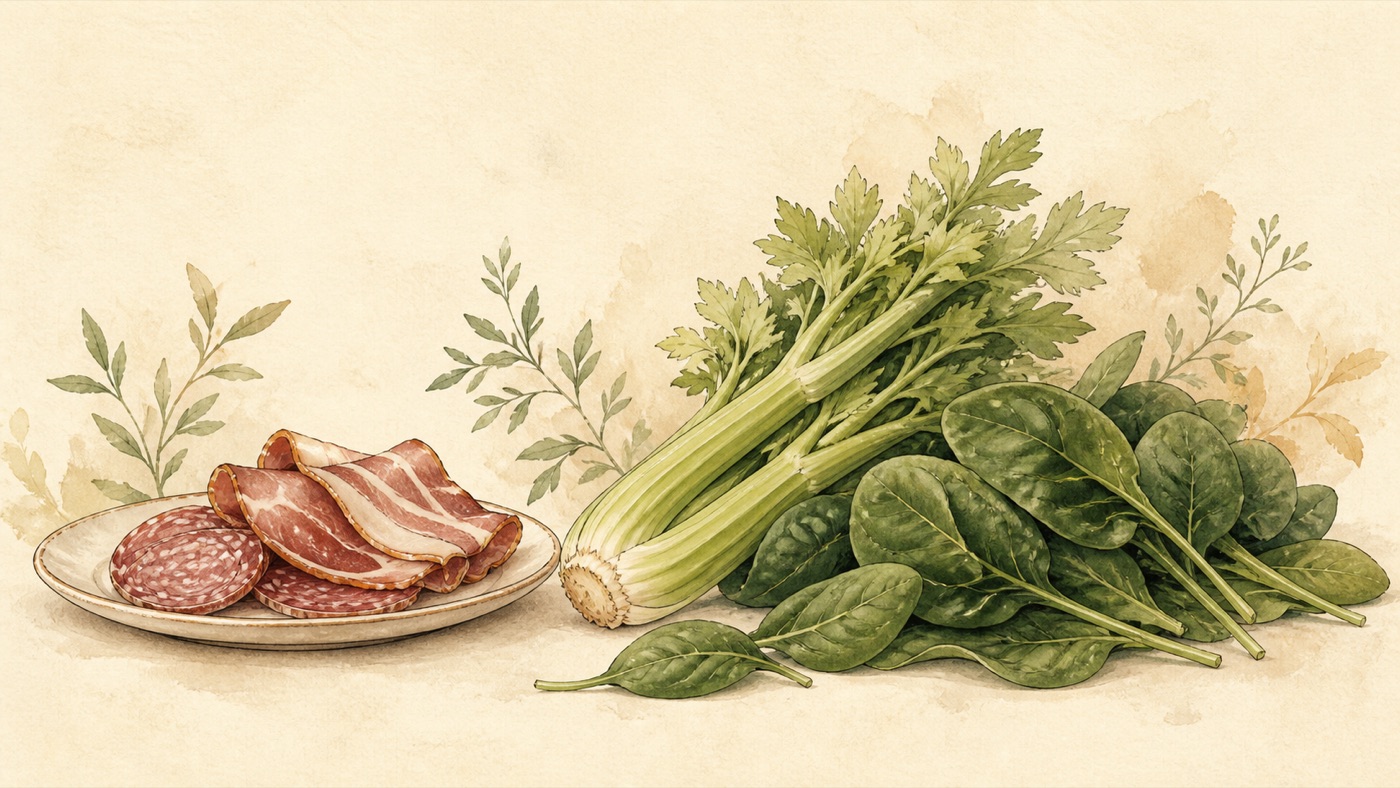
Does Nitrite Really Cause Cancer? An Evidence-Based Roundup on Processed Meat, Vegetables, and Cardiovascular Health
Nitrite carries two opposite reputations at once: "carcinogenic toxin" and "vascular remedy." The evidence-based bottom line is that source and dose decide everything. Nitrate/nitrite from fruits and vegetables benefits blood vessels via the nitric oxide pathway; processed meat does show a consistent observational association with colorectal cancer, yet blaming the risk solely on "nitrite itself causing cancer in humans" is not well supported by evidence. Carrying forward the fact-checking spirit of Professor Ching-Shun Lin, this page compares each claim against the latest literature, drawing the line between "proven," "animal-only," and "pure misinformation."
Does Nitrite Really Cause Cancer? An Evidence-Based Roundup on Processed Meat, Vegetables, and Cardiovascular Health
The One-Line Verdict
Nitrite is not a simple "cancer switch": its acute toxicity comes from robbing hemoglobin of its oxygen-carrying ability, while nitrate/nitrite from fruits and vegetables actually benefits blood vessels via the nitric oxide pathway. The link between processed meat and cancer is real, but pinning the entire blame on "nitrite causing cancer in humans" is not well supported. The key is source and dose.
Claim-by-Claim Fact-Check
- The cancer concern over processed meat is overstated, and there is no evidence that nitrosamines cause cancer in humans — Verdict: 🟡 Partly consistent. An umbrella review shows that eating 50 grams more processed meat per day raises colorectal cancer risk by about 17%, with an even stronger correlation for gastric cancer, and IARC/WCRF state that there is "no safe level of intake" for colorectal cancer prevention. Yet the same review concedes the certainty of evidence is low to very low and does not establish "nitrosamines causing cancer in humans" as the mechanism (PMID: 42130892). The association is real (downplaying it goes too far), but the human mechanism remains unproven (here Professor Lin stands on solid ground).
- Nitrate/nitrite from fruits and vegetables benefits health — Verdict: ✅ Consistent with the literature. Contemporary reviews indicate that nitrate-rich vegetables restore NO bioavailability through the "gut–saliva–nitric oxide" cycle, benefiting the vasculature, metabolism, and cognition, and the field's stance has shifted from caution to positive (PMID: 42074104).
- The acute toxicity of nitrite is hemoglobin degradation, not cellular carcinogenesis — Verdict: ✅ Consistent with the literature. The core toxicological mechanism of poisoning is the induction of methemoglobinemia, in which hemoglobin is oxidized and loses its oxygen-carrying capacity, which is how acute clinical poisoning presents (PMID: 40409567).
- Beetroot juice/dietary nitrate can lower systolic blood pressure, but diastolic pressure does not necessarily drop — Verdict: ✅ Consistent with the literature. A meta-analysis of 8 RCTs and 199 participants shows nitrate supplementation is associated with a modest reduction in systolic pressure, with no significant effect on diastolic pressure; the samples are small, however, and insufficient to replace hypertension treatment (PMID: 42130877).
- Oral microbes are key to this pathway, and antibacterial mouthwash interferes with the blood-pressure-lowering effect — Verdict: ✅ Consistent with the literature. A crossover trial in younger and older adults shows older adults gain greater blood-pressure benefit from nitrate supplementation, correlated with changes in the oral microbiome (PMID: 40615058); another crossover trial shows antibacterial mouthwash reduces oral nitrate reduction and modestly raises blood pressure (PMID: 25359409).
- "There is absolutely no evidence that nitrosamines cause cancer in humans" — Verdict: 🔴 Contradicts the literature. This absolute statement is directly refuted: the two tobacco-specific nitrosamines NNK and NNN probably cause oral and respiratory tract cancers in humans (PMID: 3679426); contemporary reviews also call the nitrosamines that nitrite additives may form "known carcinogens" (PMID: 40587020). Note that this differs from "ordinary dietary nitrite causing cancer"—distinguishing tobacco, processed sources, and produce sources is the literature's true position.
- "Nitrite itself is a carcinogen and causes nasopharyngeal cancer" — Verdict: 🟡 Partly consistent. The literature supports treating nitrite and nitrosamines as distinct (PMID: 40587020); yet processed foods do show an observational association with nasopharyngeal cancer (highest vs. lowest intake OR 1.67, with high heterogeneity), so overall exposure risk cannot simply be dismissed (PMID: 35571639).
- Nitrate/nitrite can be used to treat heart failure — Verdict: 📝 Literature updated. When Professor Lin wrote (2019), he cited then-promising mechanistic papers; subsequently, multiple RCTs revised this expectation—inhaled inorganic nitrite did not improve exercise capacity in HFpEF patients (PMID: 30398602), a potassium nitrate RCT likewise did not improve oxygen uptake or quality of life (PMID: 39693096), and a systematic review, though noting some hemodynamic improvement, admits that clinical efficacy "has been consistently inconsistent" (PMID: 40702582). This is a case of science evolving with the evidence, not an error by the professor.
Original Context
- "Nitrite Causes Cancer? A Big Misunderstanding" (2019): Established the core framework for the whole series—distinguishing produce sources from processed sources and noting that acute toxicity is hemoglobin degradation rather than carcinogenesis.
- "Nitrite Can Prevent Cardiovascular Disease—A Game-Changing Finding from NYCU?" (2022): Discussed the cardiovascular benefits of dietary nitrate and the boundaries of its exaggeration.
- "The Association Between Nitrate Intake and Age-Related Macular Degeneration" (2022): Interpreted the AREDS/AREDS2 cohorts, emphasizing the caveat that "association is not efficacy."
- "Beetroot Juice Lowers Blood Pressure, Vindicating Nitrate" (2025): Explained the mechanism and limits of lowering systolic pressure via the nitrate–nitrite–NO pathway.
- "Should You Worry About Nitrite at a Mid-Autumn Barbecue?" (2025): Brought festival panic back to the evidence-based context of dose and source.
- "Is Nitrite a Carcinogen? The MOHW Debunks Rumors but Spreads Them Instead" (2026): Criticized the claim that simplifies the IARC classification into "nitrite itself is a 2A carcinogen." (link added by the system)
A Word for the Reader
There is no need to panic over a single sausage, nor to treat beetroot juice as a magic elixir. A balanced diet and steady exercise, neither deifying nor demonizing any single food or molecule—this is the most down-to-earth view of health that Professor Lin left us.
FAQ
- Does eating sausage and bacon really cause colorectal cancer?
- Processed meat has a consistent observational association with colorectal cancer (eating 50 grams more per day raises risk by about 17%), and IARC/WCRF consider there to be no "safe level of intake," but the certainty of evidence is rated low to very low, and the mechanism of nitrite causing cancer in humans is unproven (PMID: 42130892). What matters is frequency and portion size, not an occasional serving.
- ソーセージやベーコンを食べると本当に大腸がんになりますか? — 加工肉と大腸がんには一貫した観察的関連があり(1日50グラム多く食べるとリスクが約17%上昇)、IARC/WCRFは「安全な摂取量」はないと考えていますが、エビデンスの確実性は低〜非常に低いと評価され、亜硝酸塩がヒトで発がんする機序は未実証です(PMID: 42130892)。重要なのは頻度と量であり、たまの一回ではありません。
- Does eating sausage and bacon really cause colorectal cancer? — Processed meat has a consistent observational association with colorectal cancer (eating 50 grams more per day raises risk by about 17%), and IARC/WCRF consider there to be no "safe level of intake," but the certainty of evidence is rated low to very low, and the mechanism of nitrite causing cancer in humans is unproven (PMID: 42130892). What matters is frequency and portion size, not an occasional serving.
- Vegetables contain plenty of nitrate too—so why is it said to be beneficial instead?
- Nitrate from fruits and vegetables improves vascular, metabolic, and cognitive function through the "gut–saliva–nitric oxide" pathway, and contemporary reviews largely take a positive view (PMID: 42074104); a meta-analysis of plant sources also found no overall increase in digestive-system cancers (PMID: 40587020).
- では野菜にも硝酸塩は多いのに、なぜ逆に有益だと言うのですか? — 野菜・果物由来の硝酸塩は「腸—唾液—一酸化窒素」経路を通じて血管・代謝・認知機能を改善し、近年のレビューは概ね肯定的です(PMID: 42074104)。植物由来のメタ解析でも、消化器系がん全体の増加は見られませんでした(PMID: 40587020)。
- Vegetables contain plenty of nitrate too—so why is it said to be beneficial instead? — Nitrate from fruits and vegetables improves vascular, metabolic, and cognitive function through the "gut–saliva–nitric oxide" pathway, and contemporary reviews largely take a positive view (PMID: 42074104); a meta-analysis of plant sources also found no overall increase in digestive-system cancers (PMID: 40587020).
- Can beetroot juice really lower blood pressure?
- It can modestly lower systolic pressure, but diastolic pressure does not necessarily drop, and study samples tend to be small, so it cannot replace standard hypertension treatment (PMID: 42130877).
- ビーツジュースは本当に血圧を下げられますか? — 収縮期血圧をわずかに下げることはできますが、拡張期血圧は必ずしも下がらず、研究の標本も小さめなので、高血圧の正規の治療に取って代わることはできません(PMID: 42130877)。
- Can beetroot juice really lower blood pressure? — It can modestly lower systolic pressure, but diastolic pressure does not necessarily drop, and study samples tend to be small, so it cannot replace standard hypertension treatment (PMID: 42130877).
- What exactly is nitrite poisoning?
- The core of acute poisoning is the induction of methemoglobinemia—that is, hemoglobin is oxidized and loses its oxygen-carrying capacity—rather than "turning cells cancerous" (PMID: 40409567).
- 亜硝酸塩中毒とはどういうものですか? — 急性中毒の中核はメトヘモグロビン血症の誘発、つまりヘモグロビンが酸化されて酸素運搬能力を失うことであり、「細胞をがん化させる」ことではありません(PMID: 40409567)。
- What exactly is nitrite poisoning? — The core of acute poisoning is the induction of methemoglobinemia—that is, hemoglobin is oxidized and loses its oxygen-carrying capacity—rather than "turning cells cancerous" (PMID: 40409567).
- I often hear mouthwash is bad for you—is that related to this?
- Antibacterial mouthwash inhibits oral bacteria from reducing nitrate to nitrite, and crossover trials show this weakens the blood-pressure-lowering pathway and modestly raises blood pressure (PMID: 25359409).
- マウスウォッシュは体に悪いとよく聞きますが、これと関係がありますか? — 抗菌性のマウスウォッシュは口腔細菌が硝酸塩を亜硝酸塩に還元するのを抑制し、クロスオーバー試験によれば、これが降圧経路を弱め血圧をわずかに上昇させます(PMID: 25359409)。
- I often hear mouthwash is bad for you—is that related to this? — Antibacterial mouthwash inhibits oral bacteria from reducing nitrate to nitrite, and crossover trials show this weakens the blood-pressure-lowering pathway and modestly raises blood pressure (PMID: 25359409).
- So is the statement "nitrosamines will never cause cancer in people" correct?
- Not entirely. The tobacco-specific nitrosamines NNK and NNN probably cause oral and respiratory tract cancers in humans (PMID: 3679426); but that is a different matter from "ordinary dietary nitrite causing cancer"—source and dose must be kept distinct.
- では「ニトロソアミンは人をまったく発がんさせない」という言い方は正しいですか? — 完全には正しくありません。タバコ特異的ニトロソアミンNNKとNNNはヒトの口腔および気道のがんを引き起こす可能性が高いです(PMID: 3679426)。しかしこれは「通常の食事中の亜硝酸塩で発がんする」こととは別問題であり、由来と用量をはっきり区別しなければなりません。
- So is the statement "nitrosamines will never cause cancer in people" correct? — Not entirely. The tobacco-specific nitrosamines NNK and NNN probably cause oral and respiratory tract cancers in humans (PMID: 3679426); but that is a different matter from "ordinary dietary nitrite causing cancer"—source and dose must be kept distinct.
Source anchors
- 林慶順教授原文正本:亞硝酸鹽致癌?誤會大了 · https://professorlin.com/2019/06/28/%e4%ba%9e%e7%a1%9d%e9%85%b8%e9%b9%bd%e8%87%b4%e7%99%8c%ef%bc%9f%e8%aa%a4%e6%9c%83%e5%a4%a7%e4%ba%86/
- 存證·Wayback 快照(原站消失仍可溯源) · https://web.archive.org/web/2/https://professorlin.com/2019/06/28/%e4%ba%9e%e7%a1%9d%e9%85%b8%e9%b9%bd%e8%87%b4%e7%99%8c%ef%bc%9f%e8%aa%a4%e6%9c%83%e5%a4%a7%e4%ba%86/
- 存證·archive.today 快照 · https://archive.ph/newest/https://professorlin.com/2019/06/28/%e4%ba%9e%e7%a1%9d%e9%85%b8%e9%b9%bd%e8%87%b4%e7%99%8c%ef%bc%9f%e8%aa%a4%e6%9c%83%e5%a4%a7%e4%ba%86/
- 存證·自存副本(SHA256:a9f50b807d8c…,部署後生效) · https://km.idaeo.ai/archive/professorlin/8588.html
- 加工肉品傘狀回顧:每日增 50g 與大腸癌升高 17%,但 GRADE 證據確定性低至極低。 · https://pubmed.ncbi.nlm.nih.gov/42130892/
- 富硝酸鹽蔬菜經 NO 途徑對血管、代謝、認知有益。 · https://pubmed.ncbi.nlm.nih.gov/42074104/
- 亞硝酸鈉中毒的核心機轉為誘發高鐵血紅蛋白症。 · https://pubmed.ncbi.nlm.nih.gov/40409567/
- 8 項 RCT 統合:硝酸鹽補充小幅降收縮壓、舒張壓無顯著變化。 · https://pubmed.ncbi.nlm.nih.gov/42130877/
- 年長者從甜菜根汁硝酸鹽獲較大血壓益處,與口腔菌群相關。 · https://pubmed.ncbi.nlm.nih.gov/40615058/
- 抗菌漱口水降低口腔硝酸鹽還原並使血壓小幅上升。 · https://pubmed.ncbi.nlm.nih.gov/25359409/
- 菸草特異性亞硝胺 NNK 與 NNN 很可能造成人類口腔及呼吸道癌症。 · https://pubmed.ncbi.nlm.nih.gov/3679426/
- 回顧將亞硝胺列為已知致癌物,並描述硝酸鹽/亞硝酸鹽的雙重效應。 · https://pubmed.ncbi.nlm.nih.gov/40587020/
- 29 項病例對照統合:加工食品與鼻咽癌 OR 1.67,異質性高。 · https://pubmed.ncbi.nlm.nih.gov/35571639/
- INDIE-HFpEF RCT:吸入型亞硝酸鹽未改善 HFpEF 運動能力。 · https://pubmed.ncbi.nlm.nih.gov/30398602/
- 硝酸鉀 RCT:未改善 HFpEF 攝氧量、總作功或生活品質。 · https://pubmed.ncbi.nlm.nih.gov/39693096/
- 系統回顧:見部分血流動力學改善,惟臨床療效一直不一致。 · https://pubmed.ncbi.nlm.nih.gov/40702582/
Cite this article
TK.Lin Agent・《Does Nitrite Really Cause Cancer? An Evidence-Based Roundup on Processed Meat, Vegetables, and Cardiovascular Health》・IDAEO 知識庫・2026-08-11・https://km.idaeo.ai/health/nitriteUpdated 2026-08-12