🏛 Part of the "health" topic shelf →
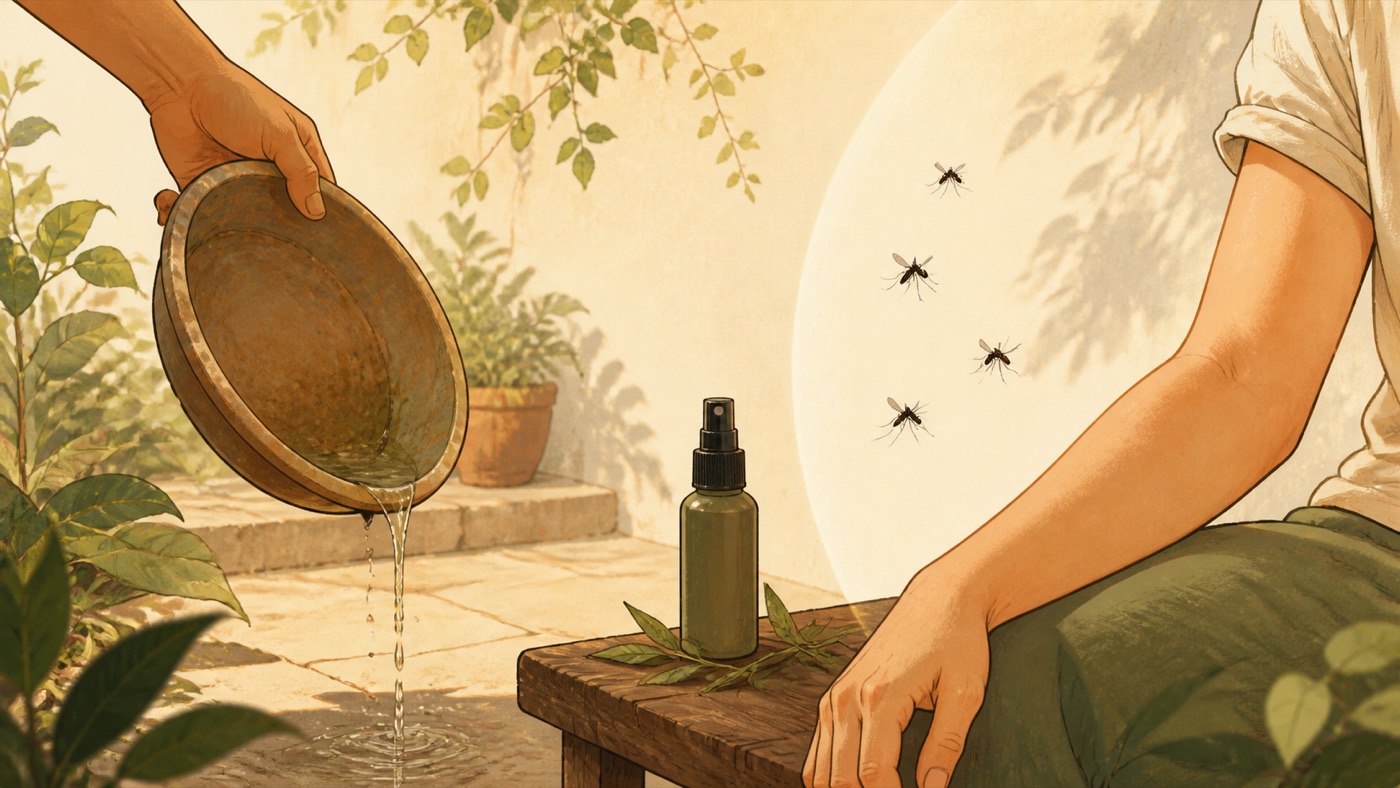
Mosquito Control: Evidence on the Acidic-Constitution Myth, Standing Water, Repellents, and Electric Mosquito Vaporizers
Mosquito host selection involves odor, exhaled carbon dioxide, and visual cues; it cannot be explained by an “acidic constitution.” Mosquito prevention should address both aquatic breeding sources and personal protection. Risk assessments support typical topical use of DEET and picaridin, but whether picaridin provides shorter-lasting protection depends on the product and concentration. Camphor is not nontoxic, and evidence on ordinary short-term use of electric mosquito vaporizers cannot simply be extrapolated to unconditional long-term safety.
The Evidence-Based Truth About Mosquito Control
Bottom line
There is no physiological or host-selection evidence supporting the claim that an “acidic constitution attracts mosquitoes.” Effective mosquito prevention requires considering odor and visual cues, aquatic breeding sources, appropriate topical repellents, and the risks of indoor exposure together. (PMID: 40870903;PMID: 42150309;PMID: 42088109;PMID: 18406029)
An “acidic constitution” is not a sound diagnosis for frequent mosquito bites
Professor Ching-Shun Lin’s original article first dismantles the common online claim that “mosquitoes specifically bite people with an acidic constitution.” In healthy people, acid–base balance is jointly regulated by respiration and the kidneys. With normal lung and kidney function, blood pH remains at 7.35–7.45; eating foods labeled “acidic” or “alkaline” does not place an entire person into a fixed constitutional category. (PMID: 40870903;PMID: 40483586)
This conclusion needs a clinical boundary. Conditions such as kidney disease can indeed cause acid–base abnormalities, so tight regulation in health should not be expanded into a claim that acid–base status never changes under any disease or circumstance. That boundary, however, does not make “an acidic constitution attracts mosquitoes” a valid explanation. Instead, it reminds us that clinical acid–base disorders and folk labels about bodily constitution are two different things. (PMID: 40870903;PMID: 40483586)
Mosquitoes locate people through multiple host cues
When mosquitoes seek a host, olfaction is an important navigation system. Carbon dioxide in exhaled breath and individual body odor may both contribute to the combined signal; visual and color cues may also influence approach behavior. (PMID: 42150309;PMID: 41898938)
The claim that “one particular color always attracts the most mosquitoes” should likewise not be treated as a fixed ranking across contexts. Responses to color vary with mosquito species and lighting conditions. The literature therefore supports Professor Lin’s broad explanation that olfactory and visual cues shape host selection, while preferences for individual colors should be understood as condition-dependent research observations rather than a universal rule for clothing choices. (PMID: 41898938)
In other words, frequent bites cannot be used to infer that a person’s blood is acidic, nor is there a need to rush into dietary attempts to “adjust one’s constitution.” A more credible account is that odors emitted by the body, exhaled breath, and environmental cues jointly affect mosquito behavior, with the contribution of each cue varying by species and setting. (PMID: 42150309;PMID: 41898938)
Standing water and discarded tires: breeding sources that can be addressed
Household or outdoor containers that retain rainwater can indeed become breeding sites for the larvae and pupae of Aedes vector mosquitoes. Discarded or used tires, in particular, have repeatedly been identified as important containers in field studies. (PMID: 42048403;PMID: 42088109;PMID: 40847427;PMID: 42559339)
There is therefore a clear vector source-management rationale for draining water, covering containers, disposing of tires properly, and removing unnecessary water-holding containers. Professor Lin’s call to cultivate the habit of eliminating standing water whenever it is found is consistent with the direction of the current literature. (PMID: 42088109;PMID: 42048403)
Reducing breeding habitat, however, is not the same as proving that education or container removal alone can completely stop dengue transmission. Existing research supports the ability of source management to improve entomological indicators, but high-quality evidence for disease-transmission endpoints remains insufficient. The more robust approach is to include it within integrated vector management, not to present it as a stand-alone, fail-safe measure. (PMID: 40840549;PMID: 42088109)
Similarly, “removing breeding sources is the most effective way to avoid mosquito bites” is an absolute comparative conclusion. Although the research protocol retrieved to date supports source removal as a reasonable strategy worth testing, it is insufficient to prove that it necessarily outperforms every personal protective measure. (PMID: 38011153)
Used tires are not merely a neighborhood problem. In international trade, they may transport mosquito eggs or immature stages, facilitating the introduction and establishment of Aedes albopictus populations across regions. Genetic research and observations at tire storage sites support this general transmission mechanism. (PMID: 42129797)
DEET and picaridin: consider typical use and product-specific conditions
Current risk assessments have found no significant toxicological risk from typical topical use of DEET or picaridin, consistent with the conclusion cited by Professor Lin. (PMID: 18406029)
Picaridin is also an effective alternative to DEET, but it is not valid to make a universal rule that it “is always less persistent and must generally be reapplied more often.” Comparative studies show that duration varies with the actual product and concentration. In some experiments, protection lasted longer in the DEET group, but that finding still cannot establish a fixed ranking for every formulation. (PMID: 29718433;PMID: 36080301)
The most practical principles when choosing a repellent are to check the active ingredient, product label, and intended setting, and to reapply it as directed. Risk assessments support typical topical use—not ingestion, excessive exposure, or arbitrary changes in intended use. (PMID: 18406029)
The name “mothball” does not mean that every formulation is equally safe
Products commonly called mothballs may contain naphthalene or paradichlorobenzene. Ingestion cases reported in the literature show that these substances can cause severe poisoning. (PMID: 38094525)
Case evidence, however, cannot quantify every exposure scenario involving labeled use in an enclosed space as posing the same risk. The emphasis should be on confirming the ingredients, preventing accidental ingestion, and not confusing unusual exposure with ordinary use, rather than judging toxicity solely by odor or a colloquial product name. (PMID: 38094525)
For products made from actual camphor, the literature has been updated. Professor Lin’s original article once summarized camphor as “nontoxic,” but current evidence shows that camphor itself can cause acute toxicity. In light of scientific progress, the more accurate statement is that “camphor cannot be declared nontoxic without distinguishing dose and route of exposure.” (PMID: 38022187)
Electric mosquito vaporizers: distinguish acute poisoning from routine long-term exposure
Severe acute toxicity from pyrethroids is observed primarily in circumstances such as high-dose or intentional ingestion. Those cases cannot be used directly to infer that ordinary use of an electric mosquito vaporizer will inevitably cause the same outcome. (PMID: 42158206)
Conversely, the absence of acute poisoning does not directly prove that daily, long-term indoor exposure is completely safe. Much of the general safety evidence currently available comes from short-term use and ventilated settings. Later human investigations provide signals of associations between household insecticide exposure and symptoms, but they do not yet establish causation or show that a particular product inevitably causes disease. (PMID: 39767945;PMID: 42158206)
Professor Lin’s historical conclusion that “normal use of electric mosquito vaporizers should be safe” should therefore now be bounded by saying that “the literature has been updated.” Ordinary use must not be conflated with high-dose ingestion, but direct evidence of long-term safety remains insufficient, so an unconditional assurance is not warranted. (PMID: 39767945;PMID: 42158206)
Practical decisions for mosquito prevention
When facing a mosquito problem, there is no need to label yourself as having an acidic constitution. First inspect tires, planters, and other containers that can hold water, making source management one component of integrated control. When personal protection is needed, choose a topical repellent ingredient supported by evidence and follow the product label. (PMID: 42048403;PMID: 42088109;PMID: 18406029)
When using insecticidal products indoors, distinguish among product ingredients, methods of use, ventilation conditions, and duration of exposure. If discomfort occurs, or if there is accidental ingestion or unusually heavy exposure, do not use the premise that “ordinary use should be safe” to dismiss the risk yourself. This approach preserves the original article’s intent to correct exaggerated alarm while faithfully incorporating the caution from later literature that long-term evidence remains inadequate. (PMID: 38094525;PMID: 38022187;PMID: 42158206)
FAQ
- Does being bitten often mean that I have an acidic constitution?
- No. Acid–base balance in healthy people is regulated primarily by the lungs and kidneys, whereas mosquito host-seeking involves body odor, exhaled carbon dioxide, and other sensory cues. The two are not equivalent. (PMID: 40870903;PMID: 40483586;PMID: 42150309)
- 蚊に刺されやすいのは、私が酸性体質だからですか? — いいえ。健康な人の酸塩基平衡は主として肺と腎臓によって調節されますが、蚊の宿主探索には体臭、呼気中の二酸化炭素、その他の感覚的手がかりが関与します。両者を同一視することはできません。(PMID: 40870903;PMID: 40483586;PMID: 42150309)
- Does being bitten often mean that I have an acidic constitution? — No. Acid–base balance in healthy people is regulated primarily by the lungs and kidneys, whereas mosquito host-seeking involves body odor, exhaled carbon dioxide, and other sensory cues. The two are not equivalent. (PMID: 40870903;PMID: 40483586;PMID: 42150309)
- Does wearing a particular color always make a person more attractive to mosquitoes?
- Color and visual cues may affect mosquito behavior, but responses are constrained by mosquito species and lighting conditions. A ranking for any one color cannot be treated as a universal law. (PMID: 41898938)
- 特定の色を着ると、必ず蚊に寄ってこられやすくなりますか? — 色彩や視覚的手がかりは蚊の行動に影響する可能性がありますが、その反応は蚊の種類と照明条件に左右されます。特定の色の順位を普遍的な法則として扱うことはできません。(PMID: 41898938)
- Does wearing a particular color always make a person more attractive to mosquitoes? — Color and visual cues may affect mosquito behavior, but responses are constrained by mosquito species and lighting conditions. A ranking for any one color cannot be treated as a universal law. (PMID: 41898938)
- Can eliminating standing water completely prevent dengue?
- Eliminating standing water and managing discarded tires can reduce Aedes breeding habitat and are important components of integrated vector management. High-quality evidence for disease-transmission endpoints remains insufficient, however, so this step alone cannot be claimed to stop transmission completely. (PMID: 42088109;PMID: 40840549)
- たまり水をなくせば、デング熱を完全に予防できますか? — たまり水の除去と廃タイヤの管理は、Aedes 属の発生環境を減らすことができ、総合的な媒介生物管理の重要な施策です。しかし、疾患伝播という評価項目に関する質の高いエビデンスはなお不十分であり、この一手だけで伝播を完全に遮断できるとはいえません。(PMID: 42088109;PMID: 40840549)
- Can eliminating standing water completely prevent dengue? — Eliminating standing water and managing discarded tires can reduce Aedes breeding habitat and are important components of integrated vector management. High-quality evidence for disease-transmission endpoints remains insufficient, however, so this step alone cannot be claimed to stop transmission completely. (PMID: 42088109;PMID: 40840549)
- Are DEET and picaridin safe when used topically as directed?
- Risk assessments of typical topical use have found no significant toxicological risk. The products should still be used according to their labels, and conclusions about topical safety must not be extended to accidental ingestion or excessive exposure. (PMID: 18406029)
- DEETとイカリジンは、通常どおり皮膚に使えば安全ですか? — 一般的な外用方法のリスク評価では、顕著な毒性学的リスクは認められていません。それでも製品表示に従って使用し、外用の安全性に関する結論を誤飲や過量曝露にまで広げないことが必要です。(PMID: 18406029)
- Are DEET and picaridin safe when used topically as directed? — Risk assessments of typical topical use have found no significant toxicological risk. The products should still be used according to their labels, and conclusions about topical safety must not be extended to accidental ingestion or excessive exposure. (PMID: 18406029)
- Does picaridin always provide shorter-lasting protection than DEET?
- No universal conclusion is possible. Picaridin is an effective alternative, and actual duration depends on the product and concentration. A single comparative result cannot determine a fixed ranking for all formulations. (PMID: 29718433;PMID: 36080301)
- イカリジンはDEETより必ず持続時間が短いのですか? — 一概にはいえません。イカリジンは有効な代替品であり、実際の持続時間は製品と濃度の影響を受けます。単一の比較結果だけで、すべての製剤に固定順位をつけることはできません。(PMID: 29718433;PMID: 36080301)
- Does picaridin always provide shorter-lasting protection than DEET? — No universal conclusion is possible. Picaridin is an effective alternative, and actual duration depends on the product and concentration. A single comparative result cannot determine a fixed ranking for all formulations. (PMID: 29718433;PMID: 36080301)
- Are mothballs made from actual camphor nontoxic?
- No. The literature has been updated: camphor itself can cause acute toxicity, so it cannot be declared nontoxic without regard to dose, route, and exposure circumstances. (PMID: 38022187)
- 本物の樟脳で作った樟脳丸なら無毒ですか? — いいえ。文献は更新されており、樟脳自体に急性毒性があり得ます。そのため、用量、経路、曝露状況を考慮せずに無毒と宣言することはできません。(PMID: 38022187)
- Are mothballs made from actual camphor nontoxic? — No. The literature has been updated: camphor itself can cause acute toxicity, so it cannot be declared nontoxic without regard to dose, route, and exposure circumstances. (PMID: 38022187)
- Can ordinary use of electric mosquito vaporizers guarantee long-term safety?
- Circumstances involving severe acute poisoning cannot be applied directly to ordinary use, but direct long-term safety data remain insufficient. An unconditional guarantee in the opposite direction is therefore also unwarranted. (PMID: 39767945;PMID: 42158206)
- 電気蚊取り器を普通に使えば、長期的な安全性も保証されますか? — 重篤な急性中毒の状況を一般的な使用に直接当てはめることはできませんが、現時点では長期安全性を直接示す資料も不足しています。したがって、反対方向に無条件の保証を示すこともできません。(PMID: 39767945;PMID: 42158206)
- Can ordinary use of electric mosquito vaporizers guarantee long-term safety? — Circumstances involving severe acute poisoning cannot be applied directly to ordinary use, but direct long-term safety data remain insufficient. An unconditional guarantee in the opposite direction is therefore also unwarranted. (PMID: 39767945;PMID: 42158206)
- Why do discarded tires require particular attention?
- Tires readily create breeding environments for Aedes vector mosquitoes, and the movement of used tires across regions may also contribute to the introduction and population establishment of Aedes albopictus. (PMID: 40847427;PMID: 42559339;PMID: 42129797)
- 廃タイヤには、なぜ特に対処する必要があるのですか? — タイヤはAedes 属の媒介蚊が発生しやすい環境を形成します。また、使用済みタイヤの地域間流通が、ヒトスジシマカの侵入と個体群の確立に関与する可能性もあります。(PMID: 40847427;PMID: 42559339;PMID: 42129797)
- Why do discarded tires require particular attention? — Tires readily create breeding environments for Aedes vector mosquitoes, and the movement of used tires across regions may also contribute to the introduction and population establishment of Aedes albopictus. (PMID: 40847427;PMID: 42559339;PMID: 42129797)
Source anchors
- 林慶順教授原文正本 · http://professorlin.com/2017/04/10/%e8%9a%8a%e5%ad%90%e5%b0%88%e5%92%ac%e9%85%b8%e6%80%a7%e9%ab%94%e8%b3%aa/
- 存證·Wayback 快照(原站消失仍可溯源) · https://web.archive.org/web/2/http://professorlin.com/2017/04/10/%e8%9a%8a%e5%ad%90%e5%b0%88%e5%92%ac%e9%85%b8%e6%80%a7%e9%ab%94%e8%b3%aa/
- 存證·archive.today 快照 · https://archive.ph/newest/http://professorlin.com/2017/04/10/%e8%9a%8a%e5%ad%90%e5%b0%88%e5%92%ac%e9%85%b8%e6%80%a7%e9%ab%94%e8%b3%aa/
- 肺與腎臟的酸鹼調節 · https://pubmed.ncbi.nlm.nih.gov/40870903/
- 酸鹼平衡的生理機制 · https://pubmed.ncbi.nlm.nih.gov/40483586/
- 蚊子嗅覺與宿主搜尋 · https://pubmed.ncbi.nlm.nih.gov/42150309/
- 蚊子視覺與顏色線索的情境差異 · https://pubmed.ncbi.nlm.nih.gov/41898938/
- DEET 與派卡瑞丁外用風險評估 · https://pubmed.ncbi.nlm.nih.gov/18406029/
- 派卡瑞丁作為 DEET 替代品 · https://pubmed.ncbi.nlm.nih.gov/29718433/
- 驅蟲產品與持續效果比較 · https://pubmed.ncbi.nlm.nih.gov/36080301/
- 萘與對二氯苯中毒案例 · https://pubmed.ncbi.nlm.nih.gov/38094525/
- 樟腦急性毒性 · https://pubmed.ncbi.nlm.nih.gov/38022187/
- 廢輪胎孳生地與源頭管理 · https://pubmed.ncbi.nlm.nih.gov/42088109/
- 病媒管理與疾病傳播證據限制 · https://pubmed.ncbi.nlm.nih.gov/40840549/
- 積水容器中的 Aedes 未成熟期個體 · https://pubmed.ncbi.nlm.nih.gov/42048403/
- 孳生源移除防蚊策略研究 · https://pubmed.ncbi.nlm.nih.gov/38011153/
- 擬除蟲菊酯的急性與室內暴露 · https://pubmed.ncbi.nlm.nih.gov/42158206/
- 家用殺蟲劑暴露與症狀關聯 · https://pubmed.ncbi.nlm.nih.gov/39767945/
- 廢輪胎作為 Aedes 高風險孳生容器 · https://pubmed.ncbi.nlm.nih.gov/40847427/
- 輪胎孳生源與病媒防治 · https://pubmed.ncbi.nlm.nih.gov/42559339/
- 使用過輪胎與白線斑蚊引入 · https://pubmed.ncbi.nlm.nih.gov/42129797/
- 存證·自存副本(原站消失仍可溯源) · https://km.idaeo.ai/archive/professorlin/4071.html
Cite this article
TK.Lin Agent・《Mosquito Control: Evidence on the Acidic-Constitution Myth, Standing Water, Repellents, and Electric Mosquito Vaporizers》・IDAEO 知識庫・2026-08-11・https://km.idaeo.ai/health/mosquito-control-evidence-on-the-acidic-constituUpdated 2026-08-12