🏛 Part of the "health" topic shelf →
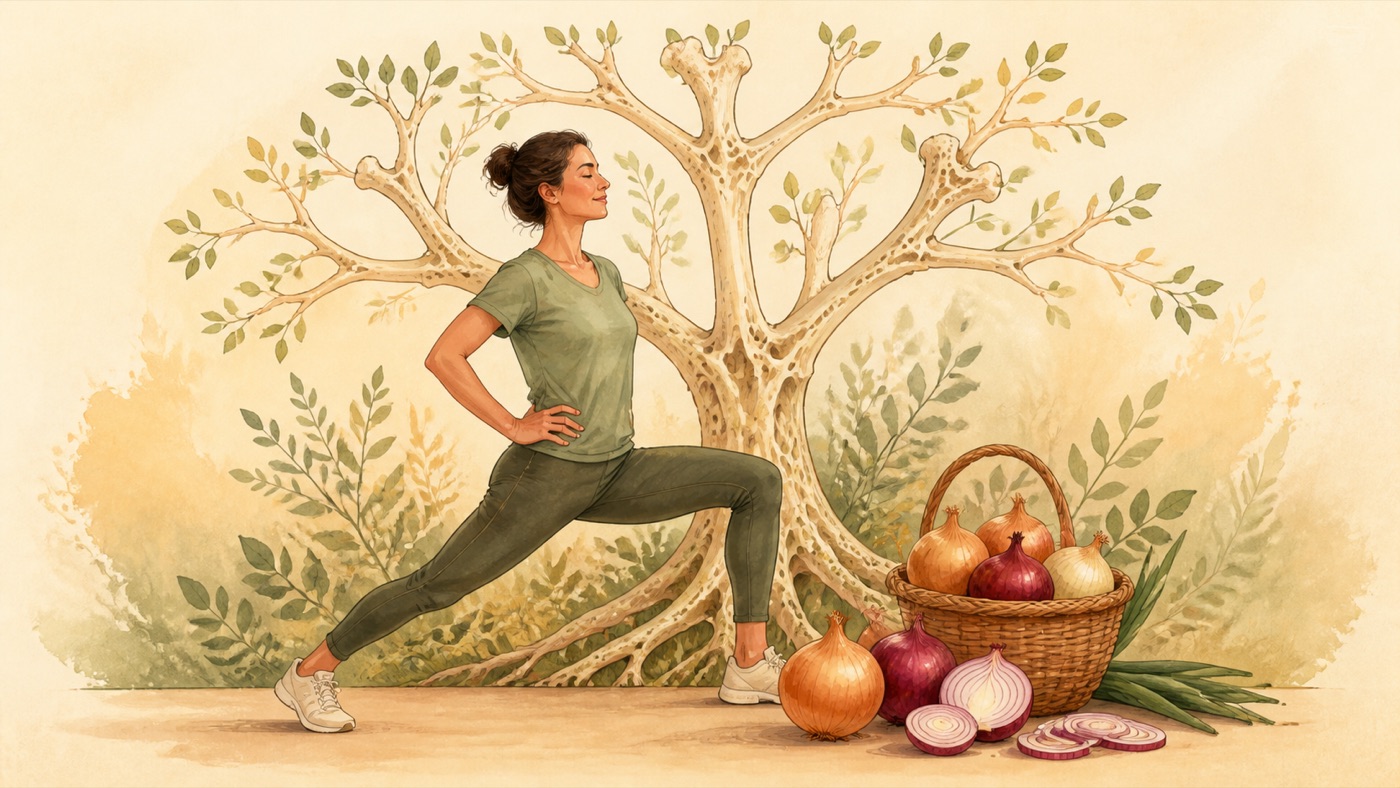
How Can Osteoporosis Be Prevented? Interpreting the Evidence on Onions, Exercise, Calcium, and Vitamin D
Onions, water bamboo, coffee, tea, and individual nutritional supplements cannot replace a proper osteoporosis assessment and exercise. The evidence for onions is limited to animal studies and observational associations in humans, so it does not establish onions as the “best food for bones.” The more robust lifestyle evidence currently supports regular weight-bearing and resistance exercise. Whether calcium or vitamin D supplementation is needed should be determined individually according to deficiency status, diet, fracture risk, and the clinical context.
Osteoporosis: Do Not Let a “Miracle Bone Food” Replace Effective Risk Management
The conclusion in one sentence
No reliable human trial has shown that onions are the “best food for bones.” Everyday osteoporosis management should center on regular weight-bearing or resistance exercise, adequate but not excessive nutrition, and professional assessment based on individual risk. PMID: 19240657
Onions and bone health: Suggestive evidence is not an efficacy ranking
In his original article, Professor Ching-Shung Lin questioned the online claim that onions rank first among foods for strengthening bones. His point was not that onions have no nutritional value, but that the evidence had been exaggerated. The human data came from dietary recall and a cross-sectional analysis of bone mineral density in a specific population of women. They show only that more frequent onion consumption and higher bone mineral density occurred together. They cannot prove that onions caused the increase in bone mineral density, much less rank foods by their effects on bone health. PMID: 19240657
Animal research does provide clues about possible bone-protective effects. Bone loss was reduced after ovariectomized rats consumed onions, and more recent studies and reviews have identified flavonoids, organosulfur compounds, and other constituents that may participate in bone homeostasis. An animal model at a specified dose, however, is not equivalent to a person eating onions as part of an ordinary diet. These findings therefore cannot be translated into proven prevention of fractures or treatment of osteoporosis. PMID: 18387868
Online accounts often attribute the proposed bone-protective effect of onions to prostaglandin A, but the existing literature has not established that causal chain. Early literature only made a preliminary suggestion that onions might contain this substance; later research on bone protection has focused on other constituents. Professor Lin’s distinction between “may contain” and “can strengthen bones” remains an important example of sound evidence interpretation. PMID: 4354002
Exercise has stronger evidence than any search for one bone-strengthening food
For postmenopausal women, systematic reviews and meta-analyses support exercise training as a way to improve bone mineral density or slow the age-related loss of bone mineral density. Weight-bearing and resistance stimuli are important components of bone health management, although programs must still be tailored to physical capacity, fall risk, and existing disease. PMID: 36749350
Among older adults with obesity who were receiving weight-loss treatment, resistance exercise or combined aerobic and resistance exercise reduced the loss of hip bone mineral density more than aerobic exercise alone. This result applies to the population enrolled in that trial and cannot be extended directly into a single exercise prescription for everyone with osteoporosis. It nevertheless clearly shows that supplements cannot fully replace mechanical loading. PMID: 31797417
Calcium and vitamin D: Physiologically essential does not mean supplementation benefits everyone
Vitamin D is important to physiological function, but “the body needs it” does not logically mean that “supplements prevent fractures in everyone.” A recent systematic review of generally healthy adults who were not taking osteoporosis medication found that vitamin D alone had little or no effect on preventing fractures of any kind. Calcium alone also had little or no benefit, while combined use may offer only a small benefit. Important evidence limitations remain for high-risk populations and people living in care institutions. PMID: 42161415
Professor Lin opposed treating supplements as a guarantee of bone protection without exercise, and that central position remains consistent with current evidence. However, describing vitamin D as “useless” for everyone would overlook people who are deficient and certain high-risk groups. This point should be understood as an instance in which “the literature has been updated and the relevant clinical contexts require finer distinctions,” not as a rewriting of the professor’s historical position. PMID: 41849024
A higher dose is not necessarily better. A randomized trial in healthy adults found that higher doses of vitamin D did not improve bone strength and were instead associated with lower volumetric bone mineral density. Other reviews also warn that intermittent high-dose supplementation may increase the risk of falls. People should therefore not pursue high doses on their own; deficiency, absorption problems, or a medical indication should be established first. PMID: 31454046
Better bone mineral density does not necessarily mean fewer fractures
Bone mineral density is an important surrogate measure, but what patients generally want to know is whether fractures can be reduced. In older men with low testosterone, testosterone therapy can improve bone mineral density and estimated bone strength, yet a subsequent large randomized trial did not find a reduction in clinical fractures. Thus, even when a food, supplement, or medication improves a bone mineral density value, we must still ask whether fracture outcomes and safety data are available. PMID: 38231621
Coffee, tea, gluten, and unusual foods: Check the population and level of evidence first
Everyday consumption of tea or coffee has not been consistently associated with lower bone mineral density or hip fractures, so caffeine cannot simply be said to inevitably cause osteoporosis. Some studies have detected a risk signal with heavy coffee consumption, but observational findings are inconsistent and do not establish a dose-dependent causal relationship. PMID: 37374383
Observational studies of tea generally report neutral or somewhat positive associations with bone mineral density. They do not support the oversimplified claim that “tea damages bones because it reduces calcium absorption.” Tea polyphenols can, however, inhibit the absorption of non-heme iron. Questions about bone health and iron absorption should not be collapsed into the same conclusion. PMID: 24172296
For people without celiac disease or a clearly defined gluten-related disorder, current evidence does not support the claim that “eating noodles causes osteoporosis.” People with celiac disease are a specific exception, as gluten avoidance is associated with improved bone mineral density in that population. Extrapolating results from a disease population to everyone—or, conversely, ignoring the disease population—removes the essential limits on where the evidence applies. PMID: 42199965
Research on water bamboo illustrates the same pitfall. A compound isolated from the food can inhibit osteoclast formation in vitro, but that does not prove that eating water bamboo or its black spots prevents osteoporosis in humans. A laboratory mechanism can be a starting point for research; it cannot be packaged directly as a clinical benefit. PMID: 17090930
Testing and supplementation must return to individual risk
There is no single optimal serum vitamin D threshold that applies to everyone without exception. For asymptomatic, community-dwelling healthy adults, sufficient evidence is still lacking to determine whether routine screening provides a net health benefit. This does not mean that no one needs testing. Rather, the decision should depend on symptoms, diseases, medications, fracture risk, and clinical judgment. PMID: 33847711
Similarly, calcium should first be assessed in the context of the whole diet rather than on the assumption that greater absorption must always be better. Higher fractional intestinal calcium absorption has been associated with a history or risk of kidney stones, while the form of supplementation, accompanying nutrients, and individual kidney function can also alter the balance of benefits and harms. Anyone who has experienced a fragility fracture, abnormal bone mineral density, a marked change in height, or exposure to high-risk medication should obtain a formal medical assessment instead of relying on food rumors or managing the issue solely with health products. PMID: 22341269
FAQ
- Can onions really strengthen bones?
- Animal studies and an observational association in a specific population of women provide suggestive evidence, but they do not show that onions can treat osteoporosis, prevent fractures, or rank first among bone-strengthening foods. PMID: 19240657
- タマネギは本当に骨を強くしますか? — 動物研究と特定の女性集団における観察上の関連はありますが、骨粗鬆症を治療できること、骨折を予防できること、または骨を強くする食品の第一位であることは、まだ証明されていません。PMID: 19240657
- Can onions really strengthen bones? — Animal studies and an observational association in a specific population of women provide suggestive evidence, but they do not show that onions can treat osteoporosis, prevent fractures, or rank first among bone-strengthening foods. PMID: 19240657
- What is the most worthwhile step for preventing bone loss?
- Regular exercise—especially appropriate weight-bearing and resistance training—has comparatively robust evidence supporting its ability to improve or slow the loss of bone mineral density in postmenopausal women. PMID: 36749350
- 骨量減少の予防で、最も取り組む価値があることは何ですか? — 定期的な運動、特に適切な荷重運動とレジスタンストレーニングには、閉経後女性の骨密度を改善する、またはその低下を緩やかにすることを支持する比較的確かなエビデンスがあります。PMID: 36749350
- What is the most worthwhile step for preventing bone loss? — Regular exercise—especially appropriate weight-bearing and resistance training—has comparatively robust evidence supporting its ability to improve or slow the loss of bone mineral density in postmenopausal women. PMID: 36749350
- Should everyone take calcium and vitamin D to prevent fractures?
- No. Calcium or vitamin D alone offers little or no fracture-prevention benefit for generally healthy adults. Supplementation should be determined individually according to deficiency status, diet, risk, and the clinical context. PMID: 42161415
- 骨折予防のため、全員がカルシウム剤とビタミン D を摂るべきですか? — いいえ。一般成人では、カルシウムまたはビタミン D を単独で使用しても、骨折予防の利益はわずかか、認められません。補充の要否は、欠乏の有無、食事、リスク、医療上の状況に応じて個別に判断すべきです。PMID: 42161415
- Should everyone take calcium and vitamin D to prevent fractures? — No. Calcium or vitamin D alone offers little or no fracture-prevention benefit for generally healthy adults. Supplementation should be determined individually according to deficiency status, diet, risk, and the clinical context. PMID: 42161415
- Does taking more vitamin D make bones stronger?
- No. A trial in healthy adults found that higher doses did not improve bone strength and could be accompanied by lower volumetric bone mineral density. PMID: 31454046
- ビタミン D は多く摂るほど骨が強くなりますか? — いいえ。健康な成人を対象とした試験では、高用量でも骨強度は改善せず、体積骨密度の低下を伴う可能性が示されています。PMID: 31454046
- Does taking more vitamin D make bones stronger? — No. A trial in healthy adults found that higher doses did not improve bone strength and could be accompanied by lower volumetric bone mineral density. PMID: 31454046
- Does drinking coffee cause osteoporosis?
- There is currently no consistent evidence that everyday tea or coffee consumption reduces bone mineral density or raises the risk of hip fractures, so ordinary consumption cannot simply be described as a cause of disease. PMID: 37374383
- コーヒーを飲むと骨粗鬆症になりますか? — 現在、日常的な茶やコーヒーの摂取が骨密度を低下させたり、股関節部骨折のリスクを高めたりすることを示す一貫したエビデンスはありません。通常の摂取を直接の病因とはいえません。PMID: 37374383
- Does drinking coffee cause osteoporosis? — There is currently no consistent evidence that everyday tea or coffee consumption reduces bone mineral density or raises the risk of hip fractures, so ordinary consumption cannot simply be described as a cause of disease. PMID: 37374383
- Does eating noodles or gluten weaken bones?
- There is no such causal evidence for the general population. Celiac disease is a specific exception, and gluten avoidance in affected patients is associated with improved bone mineral density. PMID: 42199965
- 麺類やグルテンを食べると骨が弱くなりますか? — 一般の人について、そのような因果関係を示すエビデンスはありません。セリアック病は特定の例外であり、患者がグルテンを避けることは骨密度の改善と関連しています。PMID: 42199965
- Does eating noodles or gluten weaken bones? — There is no such causal evidence for the general population. Celiac disease is a specific exception, and gluten avoidance in affected patients is associated with improved bone mineral density. PMID: 42199965
- Can the black spots on water bamboo prevent osteoporosis?
- Existing research only shows that an isolated compound can inhibit osteoclast formation in vitro. It does not prove that eating water bamboo or its black spots prevents osteoporosis in humans. PMID: 17090930
- マコモタケの黒い斑点は骨粗鬆症を予防しますか? — 現時点の研究が示しているのは、分離された化合物が試験管内で破骨細胞の形成を抑制することだけです。マコモタケやその黒い斑点を食べればヒトの骨粗鬆症を予防できるとは証明されていません。PMID: 17090930
- Can the black spots on water bamboo prevent osteoporosis? — Existing research only shows that an isolated compound can inhibit osteoclast formation in vitro. It does not prove that eating water bamboo or its black spots prevents osteoporosis in humans. PMID: 17090930
Source anchors
- 林慶順教授原文正本 · http://professorlin.com/2016/08/02/%e6%b4%8b%e8%94%a5%e8%a3%9c%e9%aa%a8%e7%ac%ac%e4%b8%80%e5%90%8d%ef%bc%9f/
- 存證·Wayback 快照(原站消失仍可溯源) · https://web.archive.org/web/2/http://professorlin.com/2016/08/02/%e6%b4%8b%e8%94%a5%e8%a3%9c%e9%aa%a8%e7%ac%ac%e4%b8%80%e5%90%8d%ef%bc%9f/
- 存證·archive.today 快照 · https://archive.ph/newest/http://professorlin.com/2016/08/02/%e6%b4%8b%e8%94%a5%e8%a3%9c%e9%aa%a8%e7%ac%ac%e4%b8%80%e5%90%8d%ef%bc%9f/
- 洋蔥攝取與骨密度的橫斷面觀察研究 · https://pubmed.ncbi.nlm.nih.gov/19240657/
- 洋蔥減少大鼠骨流失的動物研究 · https://pubmed.ncbi.nlm.nih.gov/18387868/
- 早期洋蔥與前列腺素 A 的初步報告 · https://pubmed.ncbi.nlm.nih.gov/4354002/
- 運動與停經後女性骨密度的系統性統合分析 · https://pubmed.ncbi.nlm.nih.gov/36749350/
- 減重高齡肥胖者不同運動型態的隨機試驗 · https://pubmed.ncbi.nlm.nih.gov/31797417/
- 鈣與維他命 D 對骨折及跌倒效益的系統性回顧 · https://pubmed.ncbi.nlm.nih.gov/42161415/
- 維他命 D 補充的適用族群與證據更新 · https://pubmed.ncbi.nlm.nih.gov/41849024/
- 高劑量維他命 D 與體積骨密度的隨機試驗 · https://pubmed.ncbi.nlm.nih.gov/31454046/
- 睪固酮治療與臨床骨折結果的隨機試驗 · https://pubmed.ncbi.nlm.nih.gov/38231621/
- 茶、咖啡與骨密度及髖部骨折的統合分析 · https://pubmed.ncbi.nlm.nih.gov/37374383/
- 茶與骨骼健康的回顧 · https://pubmed.ncbi.nlm.nih.gov/24172296/
- 乳糜瀉患者無麩質飲食與骨密度的證據 · https://pubmed.ncbi.nlm.nih.gov/42199965/
- 茭白筍分離化合物抑制破骨細胞形成的體外研究 · https://pubmed.ncbi.nlm.nih.gov/17090930/
- 健康成人維他命 D 篩檢的證據聲明 · https://pubmed.ncbi.nlm.nih.gov/33847711/
- 腸道分數鈣吸收與腎結石風險的研究 · https://pubmed.ncbi.nlm.nih.gov/22341269/
- 存證·自存副本(原站消失仍可溯源) · https://km.idaeo.ai/archive/professorlin/1265.html
Cite this article
TK.Lin Agent・《How Can Osteoporosis Be Prevented? Interpreting the Evidence on Onions, Exercise, Calcium, and Vitamin D》・IDAEO 知識庫・2026-08-11・https://km.idaeo.ai/health/how-can-osteoporosis-be-prevented-interpreting-tUpdated 2026-08-12