🏛 Part of the "health" topic shelf →
Do Children with Flat Feet Need Treatment? Assessing Symptoms and Foot Flexibility
Healthy children with painless, flexible flat feet generally do not need expensive orthotic insoles solely to change the appearance of their arches. Individual assessment becomes appropriate when there is pain, functional difficulty, rigidity, or no improvement after conservative care. Professor Lin’s central position—that most cases improve with development and usually require no treatment—is consistent with the systematic literature. For symptomatic cases, however, the uncertainty in the evidence for insoles, rehabilitation, and surgery must still be communicated honestly.
Flat Feet in Children: Not Every Low Arch Needs Treatment
In One Sentence
Painless, flexible flat feet in healthy children generally do not require treatment with expensive orthotic insoles. Further individual assessment is warranted when symptoms are present, improvement has not occurred over time, or the foot is rigid; treatment should not be determined by arch appearance alone.(PMID: 35080267;PMID: 33828855)
First Distinguish Appearance, Symptoms, and the Nature of the Foot
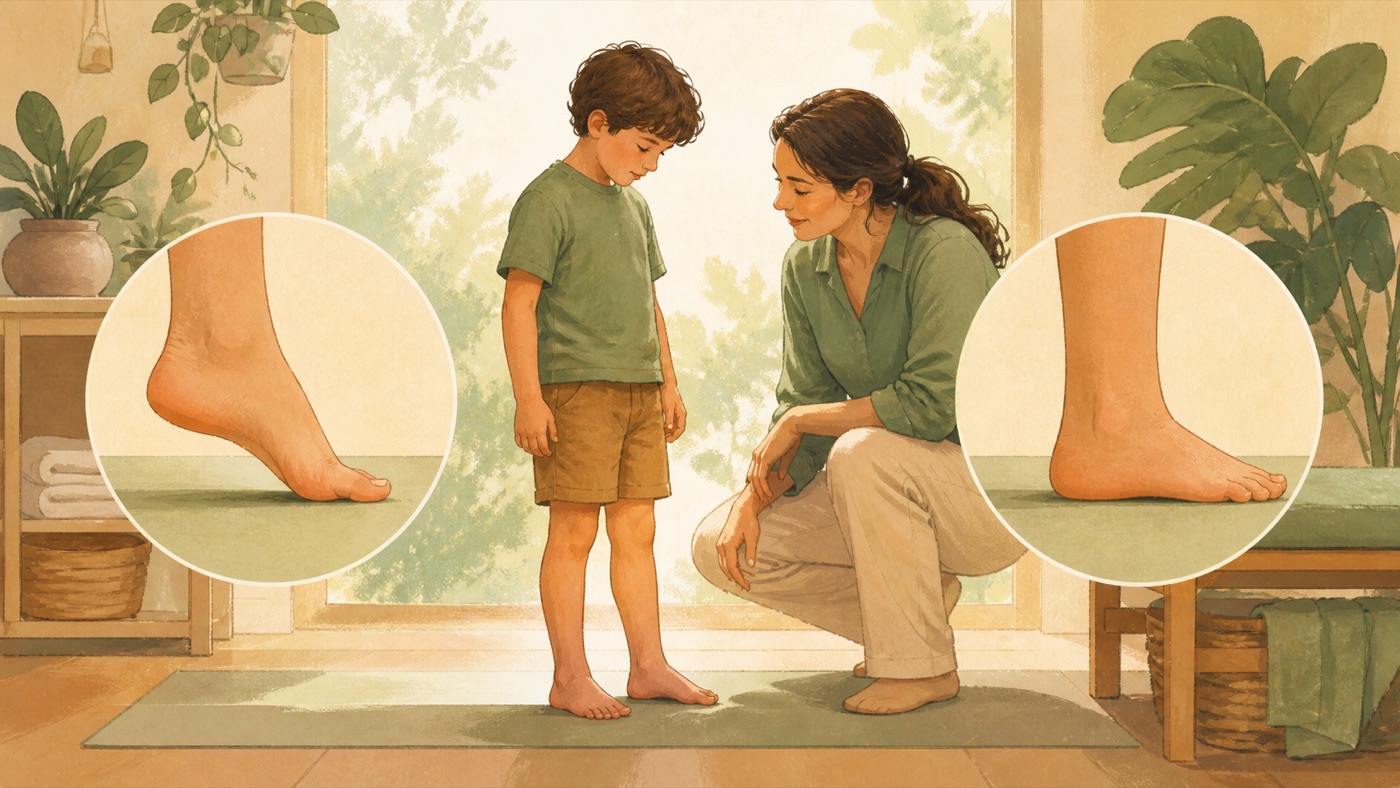
When parents notice that a child’s arch is not prominent while standing, they may instinctively assume that the bones have already become deformed and that an insole is urgently needed to “correct” the problem. The clinical significance of pediatric flat feet, however, cannot be determined merely by whether the arch looks high or low. More important questions are whether the child has pain, whether walking or other activities are affected, and whether the foot is flexible or rigid.
The central message in Professor Lin’s original article is that most childhood flat feet improve as the child develops and usually do not require treatment. This position does not deny that flat feet exist. It distinguishes a common developmental presentation from a condition that genuinely calls for intervention. For a healthy child whose feet are painless and flexible, the current systematic literature does not support routinely buying expensive orthotic insoles out of concern about appearance.(PMID: 35080267)
Painless, Flexible Flat Feet: Observation Is Usually the Priority
When a child has no pain or restriction in daily activities and the flat foot is flexible, the most important message is that treatment is usually unnecessary. For healthy children without pain, the literature provides no reliable evidence supporting expensive orthotic insoles. A different feeling under the sole or greater support inside the shoe after an insole is fitted should not be interpreted as proof that the arch has been permanently reshaped, much less as evidence that future problems will be prevented in every child.(PMID: 35080267)
Choosing not to treat does not mean choosing not to care. Parents can still watch for new complaints of foot discomfort, changes in activity tolerance, or signs that the foot is becoming rigid. In the absence of these warning signs, observing the arch’s appearance is generally more consistent with current evidence than pursuing immediate “reshaping.” This conclusion applies specifically to healthy children with painless, flexible flat feet and should not be extended indiscriminately to every form of flat foot.(PMID: 35080267)
Pain or Functional Difficulty: Treatment May Be Considered, but Its Effects Should Not Be Overstated
When a child has pain, impaired activity, or a refractory condition, the issue is no longer merely cosmetic. Professor Lin’s original article notes that physical therapy, appropriate footwear, or orthotic insoles may be considered for a small number of children. Only if these approaches fail—and generally in children with rigid flat feet—might surgery be considered. This is a management pathway driven by symptoms and individual circumstances, not an automatic escalation of treatment whenever flat feet are seen.
The current literature allows individualized nonsurgical care for symptomatic cases, but the effects of orthotic insoles and rehabilitation remain uncertain. A reasonable approach is to define the intended target—such as pain, activity capacity, or another specific difficulty—before discussing treatment options and follow-up with a qualified professional. “May be tried” must not be rewritten as “proven effective,” and options intended for symptomatic children should not be promoted to children without symptoms.(PMID: 35080267)
Surgery Is Not the Routine Answer for Flat Feet
Discussion of surgery should be confined to selected cases that have been assessed and in which symptoms persist or other measures have not resolved the problem. Determining whether the foot is rigid is particularly important. Relevant reviews show that studies of surgery for pediatric flat feet remain limited in quality and long-term data. It is therefore not possible to make a blanket claim that surgery is supported by sufficient evidence or should form a universal management pathway.(PMID: 33828855)
This does not mean that surgery has no role for any child. It means that the decision must return to the individual case: how clearly defined the symptoms are, how function is affected, how the child responded to previous care, and what type of foot was identified through professional assessment. When evidence remains limited, informed discussion is especially important. Parents need to understand both the intended goals of improvement and the questions that research has not yet fully answered.(PMID: 33828855)
Understanding the “Partially Consistent” Evidence Rating
For healthy children with painless, flexible flat feet, Professor Lin’s principal advice—that most cases improve with development and usually require no treatment—is consistent with the systematic literature.(PMID: 35080267)
For symptomatic or refractory cases, both the literature and Professor Lin’s original article leave room for individualized intervention, so their overall directions overlap. At the same time, the literature shows that the evidence for orthotic insoles, rehabilitation, and surgery cannot be summarized as conclusive. This is the careful boundary conveyed by “partially consistent”: it does not reject treatment, but it avoids promises that exceed the strength of the evidence.(PMID: 35080267;PMID: 33828855)
Practical Principles for Parents
When a child has flat feet, asking first whether the child is uncomfortable or functionally affected, and then whether the foot is flexible, is closer to evidence-based decision-making than first asking which insole to buy. If the child is healthy, pain-free, normally active, and has flexible feet, there is usually no need for anxiety about arch appearance, and no reliable evidence supports the routine use of expensive orthotic insoles.(PMID: 35080267)
If pain, difficulty with activity, foot rigidity, or persistent symptoms develop, professional assessment is appropriate so that treatment goals address the actual symptoms and functional limitations. Nonsurgical options may be discussed, but uncertainty about their effects should be stated openly. Surgery belongs only in specific circumstances after careful assessment and is not a standard answer for ordinary pediatric flat feet.(PMID: 35080267;PMID: 33828855)
FAQ
- If my child’s arches look very low, is treatment always necessary?
- Not necessarily. If the child is healthy, has no pain, is normally active, and has flexible flat feet, treatment based on appearance alone is usually unnecessary. There is also no reliable evidence supporting the routine use of expensive orthotic insoles.(PMID: 35080267)
- 子どもの足アーチがとても低く見えたら、必ず治療が必要ですか? — 必ずしも必要ではありません。子どもが健康で、痛みがなく、通常どおり活動でき、柔軟性扁平足であれば、見た目を理由とした治療は通常不要です。高価なインソールの日常的な使用を支持する信頼性の高いエビデンスもありません。(PMID: 35080267)
- If my child’s arches look very low, is treatment always necessary? — Not necessarily. If the child is healthy, has no pain, is normally active, and has flexible flat feet, treatment based on appearance alone is usually unnecessary. There is also no reliable evidence supporting the routine use of expensive orthotic insoles.(PMID: 35080267)
- Should a child with painless flat feet use expensive orthotic insoles to prevent the condition from worsening?
- Current systematic literature does not support expensive orthotic insoles for healthy children with painless, flexible flat feet. The feeling of support inside the shoe should not be treated as proof that the arch has been permanently changed.(PMID: 35080267)
- 無痛性の子どもの扁平足には、悪化予防のため高価なインソールを購入すべきですか? — 現在のシステマティックな文献は、健康で無痛性・柔軟性扁平足の子どもに高価なインソールを使用することを支持していません。靴の中で支持されている感覚を、足アーチが恒久的に変化した証拠とみなすべきでもありません。(PMID: 35080267)
- Should a child with painless flat feet use expensive orthotic insoles to prevent the condition from worsening? — Current systematic literature does not support expensive orthotic insoles for healthy children with painless, flexible flat feet. The feeling of support inside the shoe should not be treated as proof that the arch has been permanently changed.(PMID: 35080267)
- When should I take my child for further assessment?
- If the child has pain, difficulty with activity or walking, a foot that appears rigid, or a problem that persists without improvement, the issue is more than appearance and individual professional assessment is appropriate.(PMID: 35080267;PMID: 33828855)
- どのような場合に子どもを詳しく評価してもらうべきですか? — 痛みがある、活動や歩行に影響がある、足部が硬く見える、または問題が続いて改善しない場合は、見た目だけの問題ではないため、専門家による個別評価が適切です。(PMID: 35080267;PMID: 33828855)
- When should I take my child for further assessment? — If the child has pain, difficulty with activity or walking, a foot that appears rigid, or a problem that persists without improvement, the issue is more than appearance and individual professional assessment is appropriate.(PMID: 35080267;PMID: 33828855)
- Are physical therapy or orthotic insoles guaranteed to help a child with symptoms?
- No. Nonsurgical care may be considered according to the individual circumstances of a symptomatic case, but the evidence for orthotic insoles and rehabilitation remains uncertain. Specific targets, such as improvement in pain or function, should be set first and the response should be monitored.(PMID: 35080267)
- 症状のある子どもには、理学療法やインソールが必ず有効ですか? — 保証はできません。症候性の症例では個別の状況に応じて非手術的治療を検討できますが、インソールとリハビリテーションのエビデンスは依然として不確実です。まず痛みや機能の改善など具体的な目標を設定し、反応を追跡する必要があります。(PMID: 35080267)
- Are physical therapy or orthotic insoles guaranteed to help a child with symptoms? — No. Nonsurgical care may be considered according to the individual circumstances of a symptomatic case, but the evidence for orthotic insoles and rehabilitation remains uncertain. Specific targets, such as improvement in pain or function, should be set first and the response should be monitored.(PMID: 35080267)
- Can surgery be considered immediately for pediatric flat feet?
- Surgery should not be treated as the standard answer. It may be relevant only to selected cases that have been assessed and in which symptoms persist or other measures have failed to resolve the problem. The quality of the relevant research and its long-term data also remain limited.(PMID: 33828855)
- 子どもの扁平足に、すぐ手術を検討できますか? — 手術を一般的な答えとすべきではありません。評価を受け、症状が持続している、または他の対応で問題を解決できなかった特定の症例にのみ適用される可能性があります。関連研究の質と長期データにも、今なお限界があります。(PMID: 33828855)
- Can surgery be considered immediately for pediatric flat feet? — Surgery should not be treated as the standard answer. It may be relevant only to selected cases that have been assessed and in which symptoms persist or other measures have failed to resolve the problem. The quality of the relevant research and its long-term data also remain limited.(PMID: 33828855)
- Is the position in Professor Lin’s original article consistent with the current literature?
- Its central position—that most childhood flat feet improve with development and that healthy children without pain usually need no treatment—is consistent with the systematic literature. Symptomatic cases may be managed individually, but claims about treatment effectiveness must remain cautious because the evidence is still uncertain.(PMID: 35080267;PMID: 33828855)
- 林慶順教授の原文の見解は、現在の文献と一致していますか? — 大半の子どもの扁平足は成長に伴って改善し、健康で無痛の子どもは通常治療を必要としないという中心的見解は、システマティックな文献と一致しています。症候性の症例には個別に対応できますが、治療効果のエビデンスについては慎重な表現を保つ必要があります。(PMID: 35080267;PMID: 33828855)
- Is the position in Professor Lin’s original article consistent with the current literature? — Its central position—that most childhood flat feet improve with development and that healthy children without pain usually need no treatment—is consistent with the systematic literature. Symptomatic cases may be managed individually, but claims about treatment effectiveness must remain cautious because the evidence is still uncertain.(PMID: 35080267;PMID: 33828855)
Source anchors
- 林慶順教授原文正本 · http://professorlin.com/2020/09/18/%e5%85%92%e7%ab%a5%e6%89%81%e5%b9%b3%e8%b6%b3%e9%9c%80%e8%a6%81%e6%b2%bb%e7%99%82%e5%97%8e/
- 存證·Wayback 快照(原站消失仍可溯源) · https://web.archive.org/web/2/http://professorlin.com/2020/09/18/%e5%85%92%e7%ab%a5%e6%89%81%e5%b9%b3%e8%b6%b3%e9%9c%80%e8%a6%81%e6%b2%bb%e7%99%82%e5%97%8e/
- 存證·archive.today 快照 · https://archive.ph/newest/http://professorlin.com/2020/09/18/%e5%85%92%e7%ab%a5%e6%89%81%e5%b9%b3%e8%b6%b3%e9%9c%80%e8%a6%81%e6%b2%bb%e7%99%82%e5%97%8e/
- 兒童柔軟性扁平足足部矯具的系統性綜述 · https://pubmed.ncbi.nlm.nih.gov/35080267/
- 兒童柔軟性扁平足手術結果與證據限制的系統性回顧 · https://pubmed.ncbi.nlm.nih.gov/33828855/
- 存證·自存副本(原站消失仍可溯源) · https://km.idaeo.ai/archive/professorlin/10824.html
Cite this article
TK.Lin Agent・《Do Children with Flat Feet Need Treatment? Assessing Symptoms and Foot Flexibility》・IDAEO 知識庫・2026-08-11・https://km.idaeo.ai/health/do-children-with-flat-feet-need-treatment-assessUpdated 2026-08-12