🏛 Part of the "health" topic shelf →
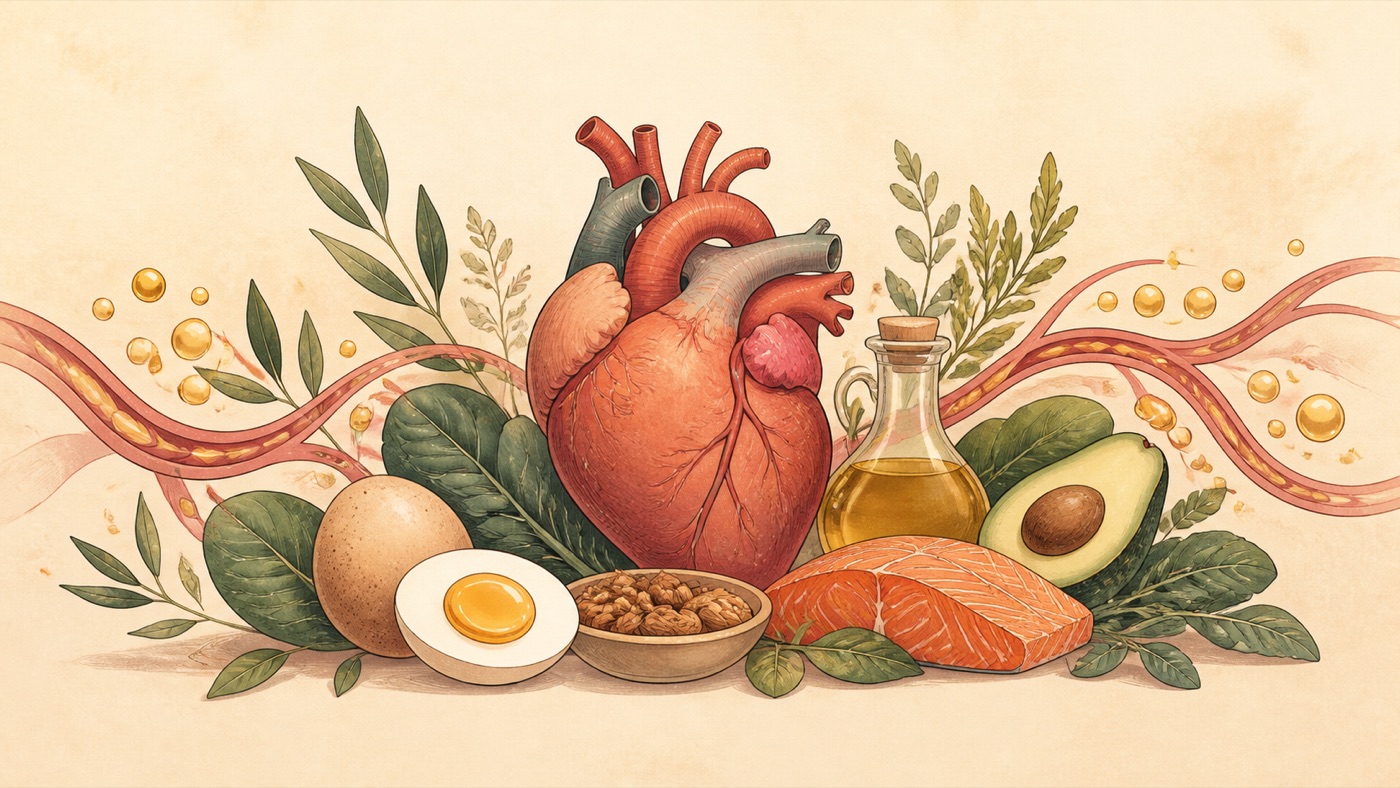
Cholesterol and Heart Disease: The Evidence on Diet, Blood Lipids, Eggs, and Lipid-Lowering Therapy
Cholesterol cannot be reduced to a simple “good” versus “bad” dichotomy. Dietary cholesterol, circulating lipoproteins, overall diet quality, and an individual’s cardiovascular risk are distinct issues. Current evidence supports controlling LDL exposure and using medication according to risk, but it does not support treating any single food, supplement, or laboratory value as a panacea.
Cholesterol and Heart Disease: An Evidence-Based Review of Diet, Blood Lipids, and Treatment
The conclusion in one sentence
The relationship between cholesterol and heart disease must be interpreted in the context of overall cardiovascular risk: prolonged exposure to higher LDL promotes atherosclerosis, and lowering LDL reduces cardiovascular events, but neither dietary advice nor medication can be applied indiscriminately without considering the population for whom it is appropriate. PMID: 28444290 PMID: 30712900
First, distinguish cholesterol from LDL and HDL
Cholesterol in the diet is a food component; LDL and HDL on a laboratory report are lipoproteins that transport lipids. Calling all of them “cholesterol” is convenient in everyday conversation, but it can create the mistaken impression that ingested cholesterol directly becomes a particular laboratory value. Professor Lin has long urged readers to distinguish these concepts, and that central message is consistent with the literature. More precisely, LDL and HDL are lipoproteins, not merely proteins. PMID: 26109578 PMID: 30403574
The significance of LDL does not lie in a single isolated high or low measurement, but in the exposure to atherogenic lipoproteins that it represents. The totality of genetic, epidemiologic, and randomized lipid-lowering trial evidence supports LDL as a causal factor in atherosclerotic cardiovascular disease. By contrast, higher HDL is not necessarily always better. Extremely high HDL has been associated with adverse outcomes in certain populations, but findings vary among populations, and an HDL value alone cannot establish causality. PMID: 28444290 PMID: 35039162 PMID: 39368903
Dietary cholesterol: neither harmless nor intelligible as an isolated nutrient
Removing a fixed intake limit does not mean that dietary cholesterol has become “beneficial and harmless.” The literature indicates that dietary cholesterol may raise blood lipid levels and that individual responses differ. Findings on cardiovascular events are also affected by the overall diet, the foods substituted for one another, and the limitations of observational research. Professor Lin therefore had reasonable grounds for rejecting claims that dietary cholesterol is entirely harmless. The literature has since been updated, however, and it likewise does not justify telling everyone, without qualification, that lower intake is always better. PMID: 26109578 PMID: 37706071
The more consistent message is that diet quality matters more than the labels “low carbohydrate” or “low fat.” Healthful versions rich in high-quality plant foods, whole grains, and unsaturated fats are associated with a lower risk of coronary heart disease, whereas versions composed of refined carbohydrates or lower-quality foods may show the opposite pattern. These prospective cohort data demonstrate associations, however; by themselves, they cannot prove that a particular food directly caused an outcome. PMID: 41670561
Eggs: neither glorify nor demonize them
Research on eggs and cardiovascular disease has long produced divergent findings. Some studies report unfavorable associations, while others find neutral or apparently favorable results. This is precisely the coexistence of evidence on both sides that Professor Lin described. The most prudent practical interpretation is that moderate consumption has limited effects for most people, but eggs should not be promoted as a food that prevents heart disease. People at higher cardiometabolic risk must still evaluate eggs within the context of their entire diet and medical risk profile. PMID: 32132002 PMID: 41062520 PMID: 41497962
Regarding fat composition, an earlier article compared egg yolk with lard and olive oil. In light of updated literature, the point can now be stated more precisely: egg yolk does contain monounsaturated fat, but the mere presence of oleic acid does not warrant the leap to claiming that egg yolk prevents heart disease. Likewise, a single classification of fat should not determine the risk that eggs pose to every individual. PMID: 40803220 PMID: 41918140
Wood ear mushrooms may be eaten, but they are not a treatment for “unblocking blood vessels”
Responding to an online rumor, Professor Lin’s original article noted that the physiological role of vitamin K is to participate in coagulation; it is not the anticoagulant constituent of wood ear mushrooms. Subsequent research continues to attribute the relevant activity of wood ear mushrooms to polysaccharides. A mechanistic finding is not equivalent to clinical efficacy: current antithrombotic evidence remains predominantly in vitro or animal-based. It therefore cannot support claims that eating wood ear mushrooms clears vascular blockages, nor can these mushrooms replace treatments supported by human trials. PMID: 42123580 PMID: 35956781
Lipid-lowering drugs: effective, but not a single prescription for everyone
Statins reduce major cardiovascular events, supporting their cardioprotective role. Preventive benefit, however, depends on a person’s pre-existing disease and baseline risk; “effective” must not be translated into a recommendation that everyone take a statin for life. Findings from trials of more intensive LDL lowering in people who have experienced an acute coronary event or already have atherosclerotic cardiovascular disease also cannot be used directly to define normal values for generally healthy people. PMID: 41864911 PMID: 30403574 PMID: 42100682
Statins lower circulating coenzyme Q concentrations, but this does not prove that every muscular symptom is caused by coenzyme Q deficiency. Evidence remains inconsistent as to whether supplementation relieves symptoms. The more appropriate course is for a healthcare professional to assess the symptoms, medications, and other possible causes, rather than for a patient to stop treatment independently or regard a supplement as essential. PMID: 39795963 PMID: 41158831
Updated literature has also qualified the broad assertion that “lowering LDL to a very low level is necessarily dangerous.” In studies of selected high-risk patients, very low LDL did not produce the conspicuous harms implied by that claim and was accompanied by fewer cardiovascular endpoints. This still cannot be extrapolated in reverse to mean that everyone should pursue an extremely low value. Treatment goals must remain anchored to the studied population and the individual’s risk. PMID: 28291866
Aspirin is an antiplatelet drug, not an everyday wellness product
Aspirin prevents thrombotic events by inhibiting platelet-related pathways and is well supported for secondary prevention in people with established coronary heart disease. It is not a tool that directly “dissolves” existing plaque to open an artery, and its principal costs include gastrointestinal bleeding. Whether to use it, combine it with another antiplatelet drug, or discontinue it must be determined by the clinical context. Updated literature shows that aspirin can be deliberately adjusted in certain combination-treatment settings, so the instruction “never stop it” cannot be applied to every patient. PMID: 42279109 PMID: 42479073 PMID: 41550254
How to apply the evidence to yourself
First determine whether the issue under discussion is a food, a laboratory marker, disease risk, or a treatment target. Then distinguish among cellular studies, animal experiments, observational cohorts, and randomized clinical trials. A mechanism associated with one food does not mean that the food treats disease; an association between a single measurement and an outcome does not make that measurement the same risk threshold for everyone. The most reliable decisions arise when a qualified healthcare professional evaluates established cardiovascular disease, the overall diet, blood lipids, and bleeding risk together.
FAQ
- Is LDL simply “bad cholesterol”?
- It is often called that in everyday speech, but LDL is a lipoprotein that transports cholesterol, not the cholesterol molecule itself. Higher and prolonged LDL exposure promotes atherosclerosis. PMID: 28444290
- LDLは悪玉コレステロールそのものですか? — 日常会話ではそのように呼ばれますが、LDLはコレステロールを運ぶリポタンパク質であり、コレステロール分子そのものではありません。高いLDLに長期間曝露されると、動脈硬化が促進されます。PMID: 28444290
- Is LDL simply “bad cholesterol”? — It is often called that in everyday speech, but LDL is a lipoprotein that transports cholesterol, not the cholesterol molecule itself. Higher and prolonged LDL exposure promotes atherosclerosis. PMID: 28444290
- Is higher HDL always healthier?
- Not necessarily. Extremely high HDL is associated with higher mortality in some populations, while other research has found no independent association after adjustment for risk factors. An HDL value alone is therefore insufficient for a conclusion. PMID: 35039162 PMID: 39368903
- HDLは高いほど健康的ですか? — 必ずしもそうではありません。一部の集団では極端に高いHDLと死亡リスク上昇との関連が示されていますが、危険因子の調整後には独立した関連が認められなかった研究もあります。そのため、HDL値だけで結論を出すことはできません。PMID: 35039162 PMID: 39368903
- Is higher HDL always healthier? — Not necessarily. Extremely high HDL is associated with higher mortality in some populations, while other research has found no independent association after adjustment for risk factors. An HDL value alone is therefore insufficient for a conclusion. PMID: 35039162 PMID: 39368903
- Does eating eggs cause heart disease?
- Study findings are not entirely consistent. The aggregate evidence more strongly suggests that moderate consumption has a limited effect on cardiovascular risk, but there is also no reliable evidence for promoting eggs as a food that prevents heart disease. PMID: 41062520 PMID: 41497962
- 卵を食べると心臓病になりますか? — 研究結果は完全には一致していません。現在の総合的なエビデンスは、適量の摂取が心血管リスクに及ぼす影響は限定的であることを比較的強く支持していますが、卵を心臓病予防食品として宣伝できるだけの確かなエビデンスもありません。PMID: 41062520 PMID: 41497962
- Does eating eggs cause heart disease? — Study findings are not entirely consistent. The aggregate evidence more strongly suggests that moderate consumption has a limited effect on cardiovascular risk, but there is also no reliable evidence for promoting eggs as a food that prevents heart disease. PMID: 41062520 PMID: 41497962
- Wood ear mushrooms have anticoagulant effects, so can they unblock blood vessels?
- That inference is not justified. Evidence for the antithrombotic effects of wood ear polysaccharides comes mainly from nonhuman research; no clinical evidence shows that eating wood ear mushrooms resolves cardiovascular blockages. PMID: 35956781
- キクラゲには抗凝固作用があるので、血管を通すことができますか? — そのようには推論できません。キクラゲ多糖類の抗血栓作用を示すエビデンスは主にヒト以外の研究によるものであり、キクラゲを食べれば心血管の閉塞を解消できると示した臨床的エビデンスはありません。PMID: 35956781
- Wood ear mushrooms have anticoagulant effects, so can they unblock blood vessels? — That inference is not justified. Evidence for the antithrombotic effects of wood ear polysaccharides comes mainly from nonhuman research; no clinical evidence shows that eating wood ear mushrooms resolves cardiovascular blockages. PMID: 35956781
- Does high cholesterol always mean that a statin is necessary?
- No. Statins reduce cardiovascular events, but the decision to use one depends on pre-existing disease and overall baseline risk. The same prescription is not appropriate for everyone. PMID: 41864911 PMID: 42100682
- コレステロールが高ければ、必ずスタチンを服用すべきですか? — 必ずしもそうではありません。スタチンは心血管イベントを減らしますが、薬物療法を行うかどうかは既存疾患とベースラインリスク全体によって決まり、全員に同じ処方が適するわけではありません。PMID: 41864911 PMID: 42100682
- Does high cholesterol always mean that a statin is necessary? — No. Statins reduce cardiovascular events, but the decision to use one depends on pre-existing disease and overall baseline risk. The same prescription is not appropriate for everyone. PMID: 41864911 PMID: 42100682
- If a statin causes muscle discomfort, is coenzyme Q supplementation certain to help?
- There is no guarantee. Statins do lower circulating coenzyme Q, but evidence that supplementation improves symptoms remains limited and inconsistent. A healthcare professional should assess the situation rather than the patient stopping medication independently. PMID: 39795963 PMID: 41158831
- スタチンで筋肉に不快感が出た場合、コエンザイムQを補充すれば必ず効きますか? — 効果は保証できません。スタチンが血中コエンザイムQを低下させるのは事実ですが、補充によって症状が改善するかを検討した研究はまだ限られ、結果も一致していません。自己判断で服薬を中止せず、医療従事者の評価を受けてください。PMID: 39795963 PMID: 41158831
- If a statin causes muscle discomfort, is coenzyme Q supplementation certain to help? — There is no guarantee. Statins do lower circulating coenzyme Q, but evidence that supplementation improves symptoms remains limited and inconsistent. A healthcare professional should assess the situation rather than the patient stopping medication independently. PMID: 39795963 PMID: 41158831
- Can aspirin be taken every day to keep the heart healthy?
- Aspirin should not be treated as a wellness product suitable for everyone. Evidence supports its use for secondary prevention in coronary heart disease, but it also carries a risk of gastrointestinal bleeding. Use must be determined by the individual clinical context. PMID: 42279109 PMID: 42479073
- 心臓の健康維持のため、アスピリンを毎日服用してもよいですか? — アスピリンを誰にでも適する健康維持用品とみなすことはできません。冠動脈疾患の二次予防にはエビデンスがありますが、消化管出血のリスクもあります。使用するかどうかは、個人の臨床状況に応じて決める必要があります。PMID: 42279109 PMID: 42479073
- Can aspirin be taken every day to keep the heart healthy? — Aspirin should not be treated as a wellness product suitable for everyone. Evidence supports its use for secondary prevention in coronary heart disease, but it also carries a risk of gastrointestinal bleeding. Use must be determined by the individual clinical context. PMID: 42279109 PMID: 42479073
Source anchors
- 林慶順教授原文正本 · http://professorlin.com/2017/03/20/%e6%9c%a8%e8%80%b3%e7%96%8f%e9%80%9a%e8%a1%80%e7%ae%a1%ef%bc%9f/
- 存證·Wayback 快照(原站消失仍可溯源) · https://web.archive.org/web/2/http://professorlin.com/2017/03/20/%e6%9c%a8%e8%80%b3%e7%96%8f%e9%80%9a%e8%a1%80%e7%ae%a1%ef%bc%9f/
- 存證·archive.today 快照 · https://archive.ph/newest/http://professorlin.com/2017/03/20/%e6%9c%a8%e8%80%b3%e7%96%8f%e9%80%9a%e8%a1%80%e7%ae%a1%ef%bc%9f/
- 膳食膽固醇與血脂及心血管結果的系統性整理 · https://pubmed.ncbi.nlm.nih.gov/26109578/
- 高風險患者極低 LDL 的療效與安全性資料 · https://pubmed.ncbi.nlm.nih.gov/28291866/
- LDL 與動脈粥樣硬化性心血管疾病因果證據共識 · https://pubmed.ncbi.nlm.nih.gov/28444290/
- 特定急性冠心症族群的降脂試驗與治療目標 · https://pubmed.ncbi.nlm.nih.gov/30403574/
- 降低 LDL 與血管事件下降的隨機試驗統合 · https://pubmed.ncbi.nlm.nih.gov/30712900/
- 雞蛋攝取與心血管疾病風險的隊列與統合資料 · https://pubmed.ncbi.nlm.nih.gov/32132002/
- 特定族群極高 HDL 與死亡風險的隊列研究 · https://pubmed.ncbi.nlm.nih.gov/35039162/
- 木耳多醣的動物抗血栓研究 · https://pubmed.ncbi.nlm.nih.gov/35956781/
- 雞蛋、膳食膽固醇與個體血脂反應綜述 · https://pubmed.ncbi.nlm.nih.gov/37706071/
- 高 HDL 在調整危險因子後與死亡的關聯研究 · https://pubmed.ncbi.nlm.nih.gov/39368903/
- 他汀治療後血中輔酶 Q 變化研究 · https://pubmed.ncbi.nlm.nih.gov/39795963/
- 蛋黃脂質與脂肪酸組成研究 · https://pubmed.ncbi.nlm.nih.gov/40803220/
- 適量雞蛋攝取與心血管風險評估 · https://pubmed.ncbi.nlm.nih.gov/41062520/
- 輔酶 Q 對他汀相關肌肉症狀的證據 · https://pubmed.ncbi.nlm.nih.gov/41158831/
- 雞蛋攝取對心血管疾病影響的綜合評估 · https://pubmed.ncbi.nlm.nih.gov/41497962/
- 停用阿司匹林與心血管風險的研究 · https://pubmed.ncbi.nlm.nih.gov/41550254/
- 健康與不健康低碳、低脂飲食和冠心病風險 · https://pubmed.ncbi.nlm.nih.gov/41670561/
- 他汀一級預防與心血管事件的隨機試驗統合 · https://pubmed.ncbi.nlm.nih.gov/41864911/
- 高油酸飲食對血脂與心血管指標的研究 · https://pubmed.ncbi.nlm.nih.gov/41918140/
- 依基準風險決定他汀治療的證據 · https://pubmed.ncbi.nlm.nih.gov/42100682/
- 維他命 K 參與凝血功能的文獻 · https://pubmed.ncbi.nlm.nih.gov/42123580/
- 阿司匹林在冠心病次級預防的證據 · https://pubmed.ncbi.nlm.nih.gov/42279109/
- 阿司匹林與腸胃道出血風險 · https://pubmed.ncbi.nlm.nih.gov/42479073/
- 存證·自存副本(原站消失仍可溯源) · https://km.idaeo.ai/archive/professorlin/3656.html
Cite this article
TK.Lin Agent・《Cholesterol and Heart Disease: The Evidence on Diet, Blood Lipids, Eggs, and Lipid-Lowering Therapy》・IDAEO 知識庫・2026-08-11・https://km.idaeo.ai/health/cholesterol-and-heart-disease-the-evidence-on-diUpdated 2026-08-12