🏛 Part of the "health" topic shelf →
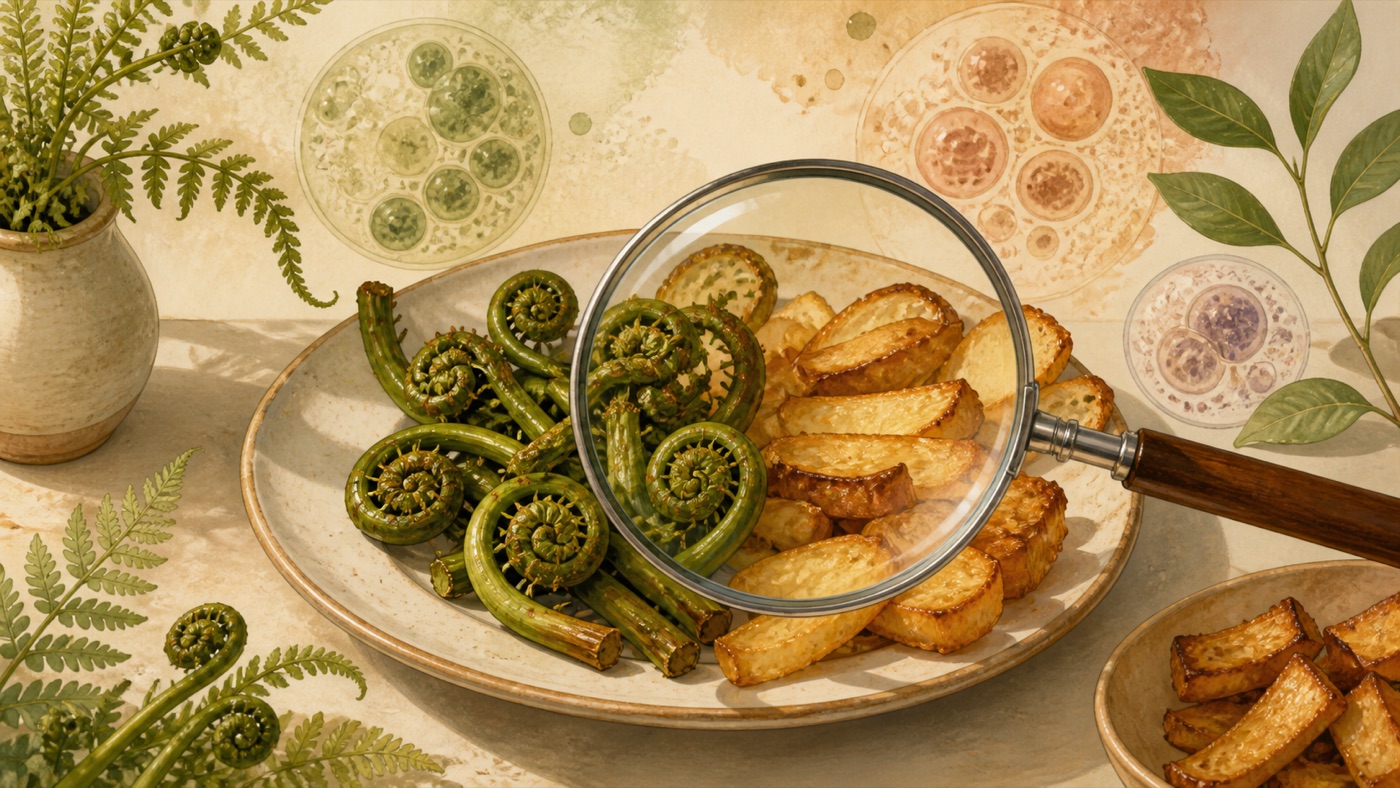
Can Food Cause Cancer? An Evidence-Based Reading of Bracken Fern, Acrylamide, and Natural Toxins
Finding that a food “contains a carcinogenic substance,” or observing an “association between intake and cancer,” does not mean that ordinary consumption inevitably causes cancer. A sound assessment must consider the species and substance, level of exposure, cooking method, and whether the evidence comes from animals, observational research, or human trials. The hazards of ptaquiloside in bracken fern are supported by substantial mechanistic and animal evidence, and human studies have also reported associations with gastric cancer and other cancers. Diplazium esculentum, however, is a different plant, and current evidence is likewise insufficient to guarantee zero risk. PMID: 39772526; PMID: 2337510; PMID: 34512863
Food and Cancer: From Hazard Identification to Real-World Risk
The conclusion in one sentence
Whether a food causes cancer cannot be judged merely by asking whether it contains a particular substance. Species, dose, processing method, and human evidence must be assessed together. Bracken fern does pose a ptaquiloside hazard, but this does not mean that every fern or every instance of consumption will cause cancer. PMID: 39772526; PMID: 34512863
The fern controversy: identify the plant first
Professor Ching-Shun Lin noted that the plant with an extensive body of long-term carcinogenicity research is bracken fern, Pteridium aquilinum; all edible ferns should not be treated as one and the same. This fundamental distinction agrees with the current literature. Bracken fern has been classified as a plant that is possibly carcinogenic to humans, and its principal naturally occurring carcinogen is ptaquiloside. PMID: 41681633
Ptaquiloside can form a reactive dienone that subsequently produces mutagenic DNA adducts. The statement that bracken fern contains a genotoxic substance is therefore not an internet rumor; it is supported by chemical mechanisms and experimental evidence. PMID: 39772526
At the human level, the available evidence still comes mainly from observational studies. Associations have been reported between bracken fern consumption and gastric and upper gastrointestinal cancers. These findings justify a cautious view of the risk, but an association cannot be rewritten as a definite causal effect for every individual. PMID: 2337510; PMID: 10396523
Exposure is not limited to eating the fern itself. When grazing animals ingest bracken fern, milk and dairy products may become routes of ptaquiloside transmission. More recent studies also indicate that processing can alter the forms of the compounds present. These are scientific advances that refine the details of risk; they do not overturn Professor Lin’s earlier warning about potential exposure pathways. PMID: 39147486; PMID: 38202326
Ptaquiloside released by bracken fern may also enter soil and water, which is consistent with Professor Lin’s discussion. The claim that “every part of the entire plant contains it,” however, should not be stated categorically: more recent testing did not detect it in rhizomes, showing that differences among plant parts and samples still need to be acknowledged. PMID: 40806289; PMID: 34458862
Cooking can reduce risk, but “it was cooked” is not the whole answer
Traditional processing and thorough cooking can substantially reduce ptaquiloside exposure, and research suggests that everyday exposure after such treatment may fall within a safer range. Inadequate processing or high exposure should nevertheless be avoided. Professor Lin’s precautionary advice not to eat it in large amounts or frequently is therefore well founded, but it should not be inverted into a claim that toxicity must remain unavoidably significant even after thorough cooking. PMID: 36850990
Diplazium esculentum, a fern commonly eaten in Taiwan, is taxonomically distinct from bracken fern; this identification agrees with the literature. Its toxicity and safety in humans have not yet been fully evaluated, however. The more precise conclusion is therefore: “There is insufficient evidence to treat it as bracken fern, but also insufficient evidence to guarantee that there is no reason for concern.” PMID: 34512863; PMID: 36444246
Acrylamide: a clear formation mechanism, but unproven causation of human cancer
Cold storage can cause cold-induced sweetening in potatoes and increase reducing sugars. During subsequent high-temperature frying or baking, those sugars can react with asparagine through the Maillard reaction to form more acrylamide. Professor Lin’s explanation of this pathway agrees with the literature. PMID: 40282310; PMID: 38472765
Yet “acrylamide is present in food” does not mean that “ordinary dietary exposure inevitably causes cancer.” Meta-analyses have found no clear increase in risk for most cancers examined, while a more recent systematic review found a mixture of positive and null results. The most accurate update today is that human observational evidence remains inconsistent and a clear causal relationship has not been established—not that every possible signal has been conclusively ruled out. PMID: 35548558; PMID: 36673439
A cohort study of fried potatoes found that more frequent consumption was associated with higher mortality, whereas the same association was not seen for unfried potatoes. Professor Lin specifically emphasized at the time that this was an association; he did not present acrylamide as a proven cause of death. That boundary is important. PMID: 28592612; PMID: 25403648
Pesticide residues: detection, hazard, and actual risk are different questions
Detecting glyphosate in food does not automatically mean consumers must stop eating it. Human biomonitoring and food-residue surveillance suggest that estimated exposure or overall dietary risk is low in most settings. These data, however, cannot provide an absolute safety guarantee for a particular batch of a product consumed in a particular way. PMID: 40311231; PMID: 42095190
The literature has evolved: a more recent long-term rat study reported increases in tumors in multiple organs under a design that included the acceptable daily intake, while a systematic review concluded that preclinical data remain limited and further research is needed. These findings cannot be used to infer directly that foods with low residues will cause cancer in humans. They do mean, however, that the blanket assurance “low residue guarantees there is no important concern” should no longer be expressed with excessive certainty. PMID: 40490737; PMID: 41600575
Natural does not mean risk-free: Thai basil and Gynura bicolor
There is no established human evidence that Thai basil in ordinary dietary amounts causes liver cancer. Basil can, however, contain methyleugenol and estragole, substances for which genotoxic or carcinogenic evidence exists in rodents. The most defensible formulation after these scientific developments is therefore: “Human risk at normal dietary intake has not been established, but there is hazard evidence at the level of individual constituents.” PMID: 36140952; PMID: 40741360; PMID: 40005118; PMID: 40646165
This also illustrates why chemical names must not be conflated: eugenol, methyleugenol, estragole, and safrole are different substances, and toxicological evidence for one cannot simply be assigned to another. Professor Lin was right to oppose fearmongering based on confusion among similar names, although direct data are still lacking for quantitative claims about ordinary consumption and human excretion. PMID: 36367523; PMID: 40370109
Gynura bicolor may contain pyrrolizidine alkaloids, a class of substances with hepatotoxic and genotoxic properties. Professor Lin’s advice against prolonged consumption in large quantities therefore has a valid hazard basis. Place of origin may affect composition, however, and current evidence cannot convert “a balanced diet” or “occasional consumption” into a defined safety boundary. The advice should be understood as a precautionary principle, not as a validated threshold. PMID: 27623358; PMID: 30704105; PMID: 32517927
Diet studies: a risk association is not an order to stop eating a food
Pooled findings linking pickled-food intake to increased gastric cancer risk, as well as the positive association between kimchi intake and gastric cancer in Korean populations, support Professor Lin’s description of “increased risk.” The literature, however, has not established a clear boundary at which avoiding daily or every-meal consumption becomes safe. PMID: 22499775; PMID: 25339056
Research on fish teaches the same lesson. A large cohort observed that intake of total fish, tuna, and nonfried fish was associated with a higher risk of melanoma, but the study design could not establish that eating fish causes melanoma. Professor Lin highlighted problems with questionnaires and confounding and opposed issuing a direct instruction to eat less fish. That position is consistent with a cautious interpretation of observational research. PMID: 35676377
Supplements and cancer-treatment claims: human evidence is the threshold
Cell and animal findings on Antrodia cinnamomea cannot be treated as reliable proof that it cures cancer or prolongs life. Human cancer trials are limited, and their overall methodological quality is inadequate. Professor Lin’s opposition to exaggerated claims of anticancer efficacy therefore remains consistent with the literature. PMID: 33424591; PMID: 41853122
The statement that there is “absolutely no human clinical evidence,” however, needs to be updated as science advances. Subsequent randomized, double-blind human trials have examined other health conditions; some surrogate outcomes improved, while another trial’s primary outcome was not significant. These studies still do not establish broad medical benefits, much less translate into evidence of efficacy against cancer. PMID: 32657670; PMID: 36476310
Practical principles for evaluating claims
When you encounter the claim that “a certain food causes cancer,” first determine whether it refers to the whole food, a particular species, or one compound within it. Next, ask whether the research involved cells, animals, observational population data, or human trials capable of addressing efficacy and causation. Then check the route of exposure, processing and cooking methods, and frequency of intake. Only after that should individual risk be discussed.
An important contribution of Professor Lin’s articles is their consistent separation of “detection” from “harm,” “carcinogenicity in animals” from “cancer caused by an ordinary human diet,” and “statistical association” from “causation.” Where the literature has advanced, the degree of certainty should be adjusted in light of new evidence. Professor Lin’s original words should not be rewritten, nor should the evolution of science be portrayed as though the professor himself were continually revising the original articles.
FAQ
- Do all edible ferns cause cancer?
- No. The clearest carcinogenicity research concerns bracken fern and its ptaquiloside. Diplazium esculentum is a different species, and the available safety data remain incomplete. PMID: 41681633; PMID: 34512863
- すべての食用シダに発がん性があるのですか? — いいえ。発がん性の研究が最も明確なのはワラビとそのプタキロシドです。過貓は別の種であり、現在の安全性資料もなお完全ではありません。PMID: 41681633;PMID: 34512863
- Do all edible ferns cause cancer? — No. The clearest carcinogenicity research concerns bracken fern and its ptaquiloside. Diplazium esculentum is a different species, and the available safety data remain incomplete. PMID: 41681633; PMID: 34512863
- Is bracken fern safe to eat once it has been cooked?
- Thorough processing can substantially reduce ptaquiloside exposure, but inadequate processing or high exposure still carries risk. “Cooked” should therefore not be treated as an unconditional guarantee of safety. PMID: 36850990
- ワラビは加熱すれば安心して食べられますか? — 十分な処理によってプタキロシドへの曝露を大幅に減らせますが、処理が不十分な場合や高曝露にはなおリスクがあります。したがって、「加熱した」ことを無条件の安全保証とみなすべきではありません。PMID: 36850990
- Is bracken fern safe to eat once it has been cooked? — Thorough processing can substantially reduce ptaquiloside exposure, but inadequate processing or high exposure still carries risk. “Cooked” should therefore not be treated as an unconditional guarantee of safety. PMID: 36850990
- Does refrigerating potatoes really make them more likely to produce acrylamide?
- Cold-induced sweetening increases reducing sugars, which can lead to the formation of more acrylamide during high-temperature frying or baking. PMID: 40282310; PMID: 38472765
- 冷蔵したジャガイモは本当にアクリルアミドが生じやすいのですか? — 低温誘導糖化によって還元糖が増え、高温で揚げたり焼いたりすると、より多くのアクリルアミドが生成される可能性があります。PMID: 40282310;PMID: 38472765
- Does refrigerating potatoes really make them more likely to produce acrylamide? — Cold-induced sweetening increases reducing sugars, which can lead to the formation of more acrylamide during high-temperature frying or baking. PMID: 40282310; PMID: 38472765
- Does eating food that contains acrylamide inevitably cause cancer?
- Human observational evidence is currently inconsistent, and a clear causal relationship between cancer and acrylamide in an ordinary diet has not been established. PMID: 35548558; PMID: 36673439
- アクリルアミドを含む食品を食べると必ずがんになりますか? — 現在のヒト観察研究の根拠は一貫しておらず、通常の食事に含まれるアクリルアミドががんを引き起こすという明確な因果関係は確立していません。PMID: 35548558;PMID: 36673439
- Does eating food that contains acrylamide inevitably cause cancer? — Human observational evidence is currently inconsistent, and a clear causal relationship between cancer and acrylamide in an ordinary diet has not been established. PMID: 35548558; PMID: 36673439
- Should I immediately stop eating a food if glyphosate is detected in it?
- Detection does not automatically mean that consumption must stop; risk still needs to be assessed from actual exposure. Existing surveillance also cannot provide an absolute guarantee for every specific product batch. PMID: 40311231; PMID: 42095190
- 食品からグリホサートが検出されたら、すぐに食べるのをやめるべきですか? — 検出されたからといって、自動的に摂取をやめる必要があるわけではありません。リスクは実際の曝露に基づいて評価する必要があり、現在の監視データも、特定ロットの製品すべてに絶対的な保証を与えるものではありません。PMID: 40311231;PMID: 42095190
- Should I immediately stop eating a food if glyphosate is detected in it? — Detection does not automatically mean that consumption must stop; risk still needs to be assessed from actual exposure. Existing surveillance also cannot provide an absolute guarantee for every specific product batch. PMID: 40311231; PMID: 42095190
- Does eating Thai basil as part of an ordinary diet cause liver cancer?
- Human risk of liver cancer from normal dietary intake has not been established, but basil contains natural constituents with evidence of carcinogenicity in animals. It is therefore inappropriate to say there is no hazard signal whatsoever. PMID: 36140952; PMID: 40741360
- 日常的に台湾バジルを食べると肝がんになりますか? — 通常の食事量で肝がんを生じるというヒトでのリスクは確立していません。ただし、バジルには動物での発がん性の根拠をもつ天然成分が含まれるため、ハザードのシグナルがまったくないと表現するのは適切ではありません。PMID: 36140952;PMID: 40741360
- Does eating Thai basil as part of an ordinary diet cause liver cancer? — Human risk of liver cancer from normal dietary intake has not been established, but basil contains natural constituents with evidence of carcinogenicity in animals. It is therefore inappropriate to say there is no hazard signal whatsoever. PMID: 36140952; PMID: 40741360
- Is eating Gynura bicolor occasionally guaranteed to be safe?
- The pyrrolizidine alkaloids found in Gynura bicolor raise toxicological concerns, but current data are insufficient to define “occasionally” as a validated safety boundary. PMID: 27623358; PMID: 32517927
- 紅鳳菜は時々食べるだけなら必ず安全ですか? — 紅鳳菜に含まれるピロリジジンアルカロイドには毒性学的な懸念がありますが、現在の資料では、「時々」を検証済みの安全境界として定義できません。PMID: 27623358;PMID: 32517927
- Is eating Gynura bicolor occasionally guaranteed to be safe? — The pyrrolizidine alkaloids found in Gynura bicolor raise toxicological concerns, but current data are insufficient to define “occasionally” as a validated safety boundary. PMID: 27623358; PMID: 32517927
- If kimchi is associated with gastric cancer, does that mean it should not be eaten?
- Research supports an association between intake and increased gastric cancer risk, but it has not established a boundary below which a pattern of consumption is safe and above which cancer is inevitable. PMID: 22499775; PMID: 25339056
- キムチと胃がんに関連があるなら、キムチは食べてはいけないのですか? — 摂取と胃がんリスク上昇との関連は研究で支持されていますが、これより少ない食べ方なら安全で、これを超えれば必ず発がんするという境界は確立していません。PMID: 22499775;PMID: 25339056
- If kimchi is associated with gastric cancer, does that mean it should not be eaten? — Research supports an association between intake and increased gastric cancer risk, but it has not established a boundary below which a pattern of consumption is safe and above which cancer is inevitable. PMID: 22499775; PMID: 25339056
- Has Antrodia cinnamomea been proven to cure cancer or prolong life?
- No. Human evidence in cancer is limited and study quality is inadequate; preclinical findings cannot be treated as reliable proof of a cancer cure or life extension. PMID: 33424591; PMID: 41853122
- 牛樟芝には、がんを治療したり寿命を延ばしたりする効果がすでに証明されていますか? — いいえ。がんに関するヒトでの根拠は限られ、研究の質も不十分です。前臨床の結果を、確実ながん治療または延命の証明として扱うことはできません。PMID: 33424591;PMID: 41853122
- Has Antrodia cinnamomea been proven to cure cancer or prolong life? — No. Human evidence in cancer is limited and study quality is inadequate; preclinical findings cannot be treated as reliable proof of a cancer cure or life extension. PMID: 33424591; PMID: 41853122
Source anchors
- 林慶順教授原文正本 · http://professorlin.com/2016/09/12/%e3%80%8c%e8%95%a8%e8%8f%9c%e8%87%b4%e7%99%8c%e3%80%8d%e7%9a%84%e7%9c%9f%e7%9b%b8%ef%bc%88%e4%b8%8a%ef%bc%89/
- 存證·Wayback 快照(原站消失仍可溯源) · https://web.archive.org/web/2/http://professorlin.com/2016/09/12/%e3%80%8c%e8%95%a8%e8%8f%9c%e8%87%b4%e7%99%8c%e3%80%8d%e7%9a%84%e7%9c%9f%e7%9b%b8%ef%bc%88%e4%b8%8a%ef%bc%89/
- 存證·archive.today 快照 · https://archive.ph/newest/http://professorlin.com/2016/09/12/%e3%80%8c%e8%95%a8%e8%8f%9c%e8%87%b4%e7%99%8c%e3%80%8d%e7%9a%84%e7%9c%9f%e7%9b%b8%ef%bc%88%e4%b8%8a%ef%bc%89/
- 拳蕨致癌分類與長期研究綜述 · https://pubmed.ncbi.nlm.nih.gov/41681633/
- 原蕨苷活性產物形成 DNA 加合物的機轉 · https://pubmed.ncbi.nlm.nih.gov/39772526/
- 拳蕨暴露與胃癌關聯研究 · https://pubmed.ncbi.nlm.nih.gov/2337510/
- 拳蕨人類流行病學證據及限制 · https://pubmed.ncbi.nlm.nih.gov/10396523/
- 乳汁與乳製品中的原蕨苷及加工影響 · https://pubmed.ncbi.nlm.nih.gov/39147486/
- 原蕨苷暴露途徑與環境風險綜述 · https://pubmed.ncbi.nlm.nih.gov/38202326/
- 原蕨苷進入環境水體的研究 · https://pubmed.ncbi.nlm.nih.gov/40806289/
- 拳蕨不同部位原蕨苷檢測與烹煮殘留 · https://pubmed.ncbi.nlm.nih.gov/34458862/
- 烹煮處理對拳蕨原蕨苷暴露的影響 · https://pubmed.ncbi.nlm.nih.gov/36850990/
- 過貓分類、毒性與安全性回顧 · https://pubmed.ncbi.nlm.nih.gov/34512863/
- 可食蕨類與原蕨苷風險資料 · https://pubmed.ncbi.nlm.nih.gov/36444246/
- 馬鈴薯冷誘導甜化與丙烯醯胺形成 · https://pubmed.ncbi.nlm.nih.gov/40282310/
- 馬鈴薯加工褐變與丙烯醯胺機制 · https://pubmed.ncbi.nlm.nih.gov/38472765/
- 膳食丙烯醯胺與多癌別統合分析 · https://pubmed.ncbi.nlm.nih.gov/35548558/
- 膳食丙烯醯胺人類癌症證據系統性檢閱 · https://pubmed.ncbi.nlm.nih.gov/36673439/
- 炸洋芋攝取與死亡率的觀察性隊列研究 · https://pubmed.ncbi.nlm.nih.gov/28592612/
- 膳食丙烯醯胺與癌症風險統合分析 · https://pubmed.ncbi.nlm.nih.gov/25403648/
- 嘉磷塞人體生物監測與暴露估算 · https://pubmed.ncbi.nlm.nih.gov/40311231/
- 食品農藥殘留監測與整體飲食風險 · https://pubmed.ncbi.nlm.nih.gov/42095190/
- 嘉磷塞長期大鼠腫瘤研究 · https://pubmed.ncbi.nlm.nih.gov/40490737/
- 嘉磷塞前臨床致癌資料系統性回顧 · https://pubmed.ncbi.nlm.nih.gov/41600575/
- 食源性致癌物的人類證據回顧 · https://pubmed.ncbi.nlm.nih.gov/36140952/
- 羅勒天然成分的風險評估 · https://pubmed.ncbi.nlm.nih.gov/40741360/
- estragole 基因毒性與致癌性資料 · https://pubmed.ncbi.nlm.nih.gov/40005118/
- methyleugenol 基因毒性與致癌性資料 · https://pubmed.ncbi.nlm.nih.gov/40646165/
- 相近芳香族化合物不可直接互推毒性 · https://pubmed.ncbi.nlm.nih.gov/36367523/
- 九層塔成分資料及人體證據限制 · https://pubmed.ncbi.nlm.nih.gov/40370109/
- 紅鳳菜所含吡咯里西啶生物鹼分析 · https://pubmed.ncbi.nlm.nih.gov/27623358/
- 吡咯里西啶生物鹼肝毒性與基因毒性 · https://pubmed.ncbi.nlm.nih.gov/30704105/
- 紅鳳菜相關安全證據回顧 · https://pubmed.ncbi.nlm.nih.gov/32517927/
- 醃漬食品攝取與胃癌風險統合分析 · https://pubmed.ncbi.nlm.nih.gov/22499775/
- 韓國族群泡菜攝取與胃癌統合分析 · https://pubmed.ncbi.nlm.nih.gov/25339056/
- 魚類攝取與黑色素瘤風險隊列研究 · https://pubmed.ncbi.nlm.nih.gov/35676377/
- 藥用菇類癌症人體試驗系統性評估 · https://pubmed.ncbi.nlm.nih.gov/33424591/
- 牛樟芝臨床證據綜述 · https://pubmed.ncbi.nlm.nih.gov/41853122/
- 牛樟芝其他健康問題的人體隨機試驗 · https://pubmed.ncbi.nlm.nih.gov/32657670/
- 牛樟芝人體試驗主要與探索性結果 · https://pubmed.ncbi.nlm.nih.gov/36476310/
- 存證·自存副本(原站消失仍可溯源) · https://km.idaeo.ai/archive/professorlin/1766.html
Cite this article
TK.Lin Agent・《Can Food Cause Cancer? An Evidence-Based Reading of Bracken Fern, Acrylamide, and Natural Toxins》・IDAEO 知識庫・2026-08-11・https://km.idaeo.ai/health/can-food-cause-cancer-an-evidence-based-reading-Updated 2026-08-12