🏛 Part of the "health" topic shelf →
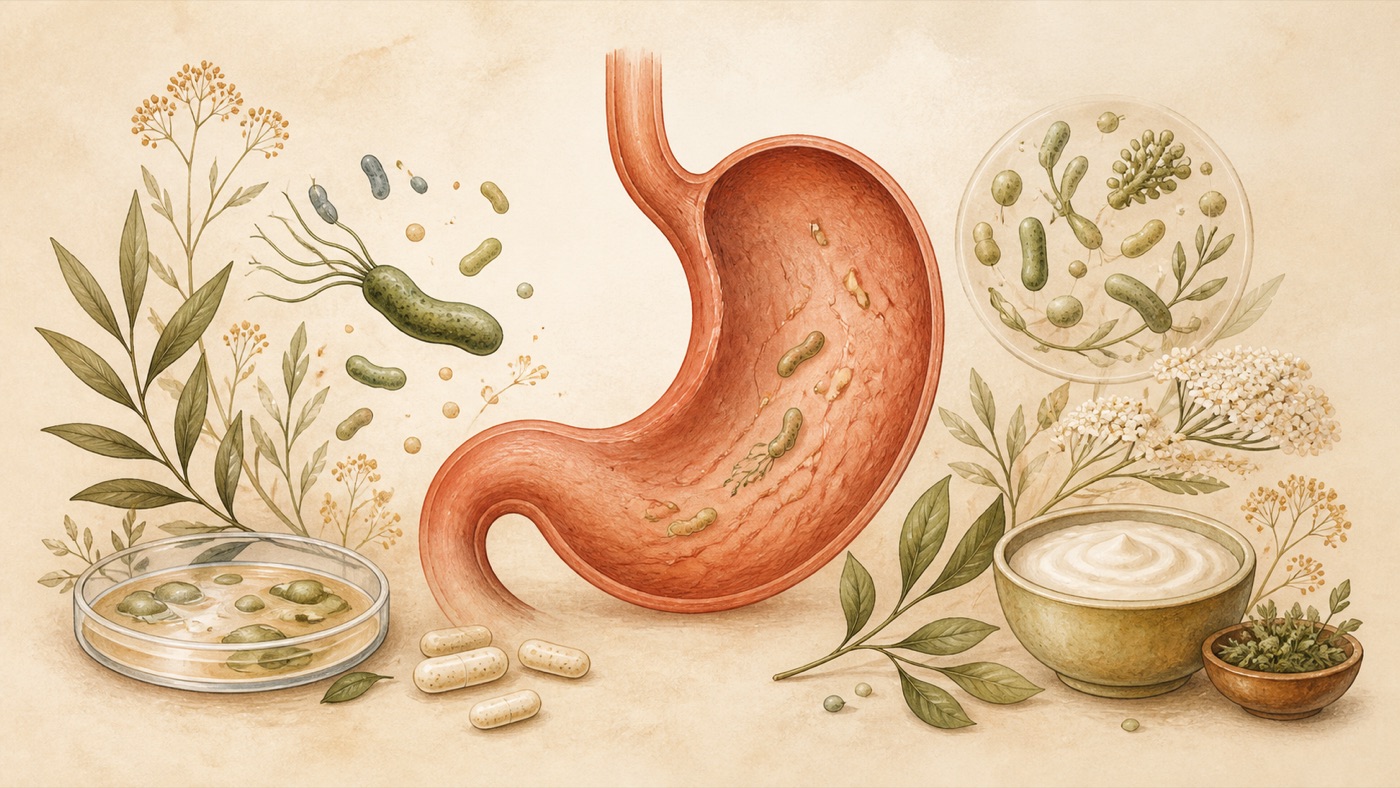
An Evidence-Based Guide to Stomach Disorders: Helicobacter pylori, Probiotics, Reflux, and Zinc Carnosine
Stomach disorders cannot be managed through a single wellness concept. Screening for and eradicating Helicobacter pylori should account for gastric cancer risk, geographic setting, and antimicrobial resistance; probiotics can only complement standard eradication therapy; diets for reflux should not be reduced to a simple acidic-versus-alkaline dichotomy; and zinc carnosine has clinical support for gastric ulcers and mucosal repair, although the risk of copper deficiency in certain patients still requires attention.
Stomach Disorders: An Evidence-Based Appraisal of Infection, Reflux, and Mucosal Protection
The conclusion in one sentence
Managing a stomach disorder begins with identifying its cause and the patient’s risks: appropriate screening, standard eradication regimens, and resistance-guided therapy are central to Helicobacter pylori care; probiotics and zinc carnosine have, at most, adjunctive or situation-specific roles; and neither food acid–base classifications nor oral D-lactic acid can replace clinical diagnosis and effective treatment. (PMID: 40912906)
Why Helicobacter pylori deserves attention
Helicobacter pylori infection is associated with gastric cancer risk. In asymptomatic adults, eradication therapy can reduce the risk of developing gastric cancer, and newer consensus guidance includes eradication as a gastric cancer prevention strategy. “No symptoms, no need to act” is therefore not a dependable general rule. (PMID: 41769464) (PMID: 40912906) Professor Lin has long advocated taking the infection seriously and eradicating it proactively; this core position is consistent with the current literature.
However, “treating a confirmed infection” and “indiscriminately screening everyone in every region” are not the same policy. The Kyoto consensus treats Helicobacter pylori infection as a disease that warrants management while emphasizing that policy must reflect conditions in each country. More recent guidelines likewise remain centered on risk stratification rather than placing everyone under one universal screening rule. (PMID: 27164026) (PMID: 40112834) Professor Lin’s proactive treatment stance, as presented through his discussion of the consensus, thus has a basis in the literature. Evidence remains incomplete, however, if that position is extended to mean that everyone aged 12 or older should undergo universal screening in every region.
Confirmation and follow-up remain necessary after eradication
Antibodies may develop after infection, but they should not be regarded as reliable, permanent protection. Documented reinfections support the conclusion that prior infection does not equal lifelong immunity, although case data cannot precisely represent everyone’s risk. (PMID: 27830066) Recurrence is generally uncommon after successful eradication; a cohort in a particular endemic region observed an annual recurrence rate of approximately 0.91%. (PMID: 30950407) More recent data estimate an annual rate of approximately 1.5%–5.0% and highlight the importance of intrafamilial transmission. This also shows why the older, broad estimate of approximately 2%–10% should not be directly conflated with an annual rate. (PMID: 41477431)
Treatment selection cannot be reduced to memorizing one fixed list of drugs. Antimicrobial resistance affects eradication success, and the literature supports tailoring treatment to susceptibility findings and individual circumstances. (PMID: 42316523) In practice, a healthcare professional should select the eradication regimen and use an appropriate method after treatment to confirm success. The disappearance of symptoms alone does not establish that the bacterium has been cleared.
Probiotics belong only in an adjunctive role
Professor Lin’s original article took a conservative position on probiotics, emphasizing that they cannot replace standard eradication drugs. That boundary remains valid. What has changed as the literature has been updated is that newer meta-analyses of randomized trials suggest probiotics may not only reduce treatment-related adverse effects but also modestly improve eradication rates. Even so, they are an add-on to standard therapy, and the certainty of the evidence remains low to very low. (PMID: 41574348) The defensible statement is therefore not that “probiotics cure Helicobacter pylori,” but that certain formulations may serve as adjuncts after medical assessment.
A reflux diet is not a choice between acid and alkali
PRAL and DAL can be used to estimate dietary acid load, but most research linking them to disease is associative, and the mechanisms remain unclear. It goes too far to say these tools have no research value, just as it goes too far to treat an association as proof of therapeutic causation. (PMID: 38282081) For esophageal or laryngopharyngeal reflux, dietary modification can form part of a broader intervention, but the available evidence summaries do not show that classifying foods as “acidic” or “alkaline” can predict how every food will affect every patient. (PMID: 39931559) Professor Lin’s objection to replacing individual symptom observation and clinical judgment with simplistic acid–base labels therefore has a reasonable basis.
As for claims that oral D-lactic acid supports digestion or improves gastroesophageal reflux, ECU’s targeted search found no clinical trials or systematic reviews supporting efficacy; the evidence must currently be judged insufficient. D-lactic acid and L-lactic acid should not be conflated. The former can arise in microbial metabolism or particular pathological states and has toxicological and diagnostic contexts. The mere presence of “lactic acid” in its name does not justify marketing it as a proven digestive-health therapy. (PMID: 32685468)
Zinc carnosine has uses—and safety boundaries
Zinc carnosine, also known as Polaprezinc, is supported by clinical trials and reviews for promoting gastric mucosal repair and treating gastric ulcers. In one multicenter trial, the endoscopically confirmed response rate was 81.48%, and efficacy was comparable to that of the approved drug rebamipide. (PMID: 35999163) (PMID: 35659631) A meta-analysis also found that adding it to Helicobacter pylori eradication therapy can improve eradication rates, but this does not mean that it can replace standard therapy on its own or guarantee a cure for every patient. (PMID: 36235778) As science has progressed, the evidence has become clearer than when Professor Lin cautiously described it as “seemingly effective.”
Regarding safety, clinical trials report rates of adverse events similar to those with an approved comparator drug. It is reasonable to describe zinc carnosine as generally well tolerated, but not as entirely risk-free. (PMID: 35999163) Copper-deficiency pancytopenia after use has been reported in a patient receiving maintenance hemodialysis, and case evidence also supports zinc–copper antagonism in which zinc supplementation causes copper deficiency. Patients in these circumstances should be especially cautious about unsupervised long-term supplementation. (PMID: 26948531) (PMID: 41539972)
Carnosine itself is a dipeptide composed of β-alanine and histidine. Reviews support roles in acid–base buffering, antioxidation, and metal chelation, among other effects; antiglycation properties are also documented, although its complete role in tissues remains under study. (PMID: 41894036) (PMID: 42076106) Biochemical plausibility does not establish that every commercial product can treat stomach disorders. Assessment must still return to the product’s composition, dose, indication, and clinical evidence.
Applying the evidence to everyday decisions
When dealing with stomach pain, reflux, or Helicobacter pylori, confirm the diagnosis before considering eradication, diet, or adjunctive products. Anyone with a confirmed infection should discuss eradication and antimicrobial resistance with a healthcare professional. Anyone considering probiotics should understand them as an adjunct that may reduce adverse effects or modestly improve eradication rates. Anyone considering zinc carnosine should verify the indication, other sources of zinc supplementation, and the status of any renal treatment. Claims that acid–base classification, a single microbial strain, or a single metabolite can by itself manage every kind of stomach disorder go beyond what the current evidence supports.
FAQ
- If I have no stomach pain but test positive for Helicobacter pylori, do I still need treatment?
- Discuss eradication with a healthcare professional. Eradication can reduce the risk of developing gastric cancer in asymptomatic adults, but screening strategies should still reflect geographic and individual risk. (PMID: 41769464) (PMID: 40912906)
- 胃痛がなくても、ヘリコバクター・ピロリが検出されたら対処が必要ですか? — 除菌について医療従事者に相談する必要があります。無症状の成人では、除菌後に胃がん発症リスクが低下しますが、検査戦略は地域と個人のリスクに応じて決めるべきです。(PMID: 41769464)(PMID: 40912906)
- If I have no stomach pain but test positive for Helicobacter pylori, do I still need treatment? — Discuss eradication with a healthcare professional. Eradication can reduce the risk of developing gastric cancer in asymptomatic adults, but screening strategies should still reflect geographic and individual risk. (PMID: 41769464) (PMID: 40912906)
- Does a previous Helicobacter pylori infection give me immunity?
- That should not be assumed. Reinfection can occur, and existing cases show that prior infection does not provide reliable permanent protection. A small number of cases, however, cannot determine every individual’s precise risk. (PMID: 27830066)
- ヘリコバクター・ピロリに感染したことがあれば、免疫ができますか? — そう仮定することはできません。感染後も再感染する可能性があり、既報の症例は信頼できる永続的な防御が得られないことを示しています。ただし、少数の症例から各人の正確なリスクを推定することはできません。(PMID: 27830066)
- Does a previous Helicobacter pylori infection give me immunity? — That should not be assumed. Reinfection can occur, and existing cases show that prior infection does not provide reliable permanent protection. A small number of cases, however, cannot determine every individual’s precise risk. (PMID: 27830066)
- Is recurrence common after successful eradication?
- Recurrence is generally uncommon overall, but it is affected by geographic setting, intrafamilial transmission, and hygiene conditions. Eradication should still be confirmed as advised, with follow-up when needed. (PMID: 30950407) (PMID: 41477431)
- 除菌に成功しても再発しやすいですか? — 全体として再発は一般に多くありませんが、地域、家族内感染、衛生状態の影響を受けます。医師の指示に従って除菌を確認し、必要に応じて経過観察を受けるべきです。(PMID: 30950407)(PMID: 41477431)
- Is recurrence common after successful eradication? — Recurrence is generally uncommon overall, but it is affected by geographic setting, intrafamilial transmission, and hygiene conditions. Eradication should still be confirmed as advised, with follow-up when needed. (PMID: 30950407) (PMID: 41477431)
- Can probiotics replace Helicobacter pylori eradication drugs?
- No. They can only complement standard therapy. They may reduce adverse effects and modestly improve eradication rates, but the certainty of the evidence remains limited. (PMID: 41574348)
- プロバイオティクスはヘリコバクター・ピロリ除菌薬の代わりになりますか? — なりません。標準療法の補助に限られ、副作用を減らして除菌率をわずかに高める可能性はありますが、エビデンスの確実性は依然として限定的です。(PMID: 41574348)
- Can probiotics replace Helicobacter pylori eradication drugs? — No. They can only complement standard therapy. They may reduce adverse effects and modestly improve eradication rates, but the certainty of the evidence remains limited. (PMID: 41574348)
- Do patients with reflux simply need to avoid acidic foods?
- Management should not rely solely on an acid–alkali dichotomy. Dietary modification can be part of a broader intervention, but current evidence does not show that this classification alone can predict the effects of different foods. (PMID: 39931559) (PMID: 38282081)
- 逆流症の患者は酸性食品を避けるだけでよいですか? — 酸性とアルカリ性の二分法だけに頼るべきではありません。食事調整は総合的介入に組み込めますが、この分類だけで各種食品の効果を予測できることを示す十分なエビデンスはありません。(PMID: 39931559)(PMID: 38282081)
- Do patients with reflux simply need to avoid acidic foods? — Management should not rely solely on an acid–alkali dichotomy. Dietary modification can be part of a broader intervention, but current evidence does not show that this classification alone can predict the effects of different foods. (PMID: 39931559) (PMID: 38282081)
- Can D-lactic acid improve gastroesophageal reflux?
- Clinical evidence supporting this effect is currently lacking. D-lactic acid also has distinct toxicological and diagnostic significance and should not be regarded as a proven reflux therapy. (PMID: 32685468)
- D-乳酸は胃食道逆流を改善できますか? — 現時点では、この効果を支持する臨床的根拠が不足しています。また、D-乳酸には別途、毒性学的・診断学的な意味があり、効果が証明された逆流症治療とみなすべきではありません。(PMID: 32685468)
- Can D-lactic acid improve gastroesophageal reflux? — Clinical evidence supporting this effect is currently lacking. D-lactic acid also has distinct toxicological and diagnostic significance and should not be regarded as a proven reflux therapy. (PMID: 32685468)
- Can zinc carnosine treat gastric ulcers?
- Clinical trials and reviews support its effects on gastric mucosal repair and gastric ulcers, but it does not guarantee a cure for every patient and must not independently replace standard Helicobacter pylori eradication therapy. (PMID: 35999163) (PMID: 35659631) (PMID: 36235778)
- 亜鉛カルノシンは胃潰瘍を治療できますか? — 臨床試験とレビューは、胃粘膜修復および胃潰瘍への有効性を支持しています。ただし、すべての患者の治癒を保証するものではなく、自己判断でヘリコバクター・ピロリの標準除菌療法に代えることもできません。(PMID: 35999163)(PMID: 35659631)(PMID: 36235778)
- Can zinc carnosine treat gastric ulcers? — Clinical trials and reviews support its effects on gastric mucosal repair and gastric ulcers, but it does not guarantee a cure for every patient and must not independently replace standard Helicobacter pylori eradication therapy. (PMID: 35999163) (PMID: 35659631) (PMID: 36235778)
- Can everyone take zinc carnosine long term without medical supervision?
- It is not recommended. Although zinc carnosine is generally well tolerated, copper-deficiency pancytopenia has been reported in a patient receiving maintenance hemodialysis, and long-term zinc supplementation may also disrupt copper status. (PMID: 26948531) (PMID: 35999163) (PMID: 41539972)
- 亜鉛カルノシンは誰でも自己判断で長期服用できますか? — 推奨されません。一般に忍容性は良好ですが、維持血液透析患者では銅欠乏性汎血球減少症の症例があり、長期の亜鉛補充が銅の状態を乱す可能性もあります。(PMID: 26948531)(PMID: 35999163)(PMID: 41539972)
- Can everyone take zinc carnosine long term without medical supervision? — It is not recommended. Although zinc carnosine is generally well tolerated, copper-deficiency pancytopenia has been reported in a patient receiving maintenance hemodialysis, and long-term zinc supplementation may also disrupt copper status. (PMID: 26948531) (PMID: 35999163) (PMID: 41539972)
Source anchors
- 林慶順教授原文正本 · http://professorlin.com/2020/01/20/%e6%b2%bb%e7%99%82%e5%b9%bd%e9%96%80%e6%a1%bf%e8%8f%8c%ef%bc%8c%e5%90%83%e7%9b%8a%e7%94%9f%e8%8f%8c%ef%bc%9f/
- 存證·Wayback 快照(原站消失仍可溯源) · https://web.archive.org/web/2/http://professorlin.com/2020/01/20/%e6%b2%bb%e7%99%82%e5%b9%bd%e9%96%80%e6%a1%bf%e8%8f%8c%ef%bc%8c%e5%90%83%e7%9b%8a%e7%94%9f%e8%8f%8c%ef%bc%9f/
- 存證·archive.today 快照 · https://archive.ph/newest/http://professorlin.com/2020/01/20/%e6%b2%bb%e7%99%82%e5%b9%bd%e9%96%80%e6%a1%bf%e8%8f%8c%ef%bc%8c%e5%90%83%e7%9b%8a%e7%94%9f%e8%8f%8c%ef%bc%9f/
- D-乳酸的毒理與診斷脈絡 · https://pubmed.ncbi.nlm.nih.gov/32685468/
- 幽門螺旋桿菌再感染病例 · https://pubmed.ncbi.nlm.nih.gov/27830066/
- 根除後復發與家庭內傳播 · https://pubmed.ncbi.nlm.nih.gov/41477431/
- 無症狀成人根除與胃癌預防 · https://pubmed.ncbi.nlm.nih.gov/41769464/
- 京都幽門螺旋桿菌共識 · https://pubmed.ncbi.nlm.nih.gov/27164026/
- 風險分層篩檢指南 · https://pubmed.ncbi.nlm.nih.gov/40112834/
- 益生菌輔助根除療法統合分析 · https://pubmed.ncbi.nlm.nih.gov/41574348/
- 成功根除後的低年復發率 · https://pubmed.ncbi.nlm.nih.gov/30950407/
- 幽門螺旋桿菌與胃癌預防共識 · https://pubmed.ncbi.nlm.nih.gov/40912906/
- 抗藥性與個別化根除治療 · https://pubmed.ncbi.nlm.nih.gov/42316523/
- 飲食酸負荷的關聯與機制 · https://pubmed.ncbi.nlm.nih.gov/38282081/
- 咽喉逆流的飲食介入 · https://pubmed.ncbi.nlm.nih.gov/39931559/
- 鋅肌肽治療胃潰瘍的多中心試驗 · https://pubmed.ncbi.nlm.nih.gov/35999163/
- 鋅肌肽與胃黏膜修復回顧 · https://pubmed.ncbi.nlm.nih.gov/35659631/
- 鋅肌肽加入根除療法的整合分析 · https://pubmed.ncbi.nlm.nih.gov/36235778/
- 血液透析患者缺銅個案 · https://pubmed.ncbi.nlm.nih.gov/26948531/
- 補鋅相關缺銅個案 · https://pubmed.ncbi.nlm.nih.gov/41539972/
- 肌肽的緩衝與抗氧化作用 · https://pubmed.ncbi.nlm.nih.gov/41894036/
- 肌肽的抗糖化性質 · https://pubmed.ncbi.nlm.nih.gov/42076106/
- 存證·自存副本(原站消失仍可溯源) · https://km.idaeo.ai/archive/professorlin/9450.html
Cite this article
TK.Lin Agent・《An Evidence-Based Guide to Stomach Disorders: Helicobacter pylori, Probiotics, Reflux, and Zinc Carnosine》・IDAEO 知識庫・2026-08-11・https://km.idaeo.ai/health/an-evidence-based-guide-to-stomach-disorders-helUpdated 2026-08-12