🏛 Part of the "health" topic shelf →
A Dental Cleaning Nearly Cost a Life? The Evidence Boundaries From Transient Bacteremia and Endocarditis to Heart Health
Invasive dental procedures such as dental cleaning can indeed cause transient bacteremia, but infective endocarditis is a rare and serious disease whose risk depends heavily on an individual's underlying cardiac risk. Claims about heart health, supplements, and diet should distinguish biological mechanisms, surrogate markers, and genuine clinical benefits.
Dental Cleaning, Infective Endocarditis, and Heart Health: Understanding the Real Risks
The conclusion in one sentence
Dental cleaning may cause transient bacteremia, but progression to infective endocarditis depends primarily on an individual's underlying cardiac risk; a routine dental cleaning cannot simply be equated with a fatal heart infection. PMID: 41640922、PMID: 41311730
The risk conditions between dental cleaning and endocarditis cannot be omitted
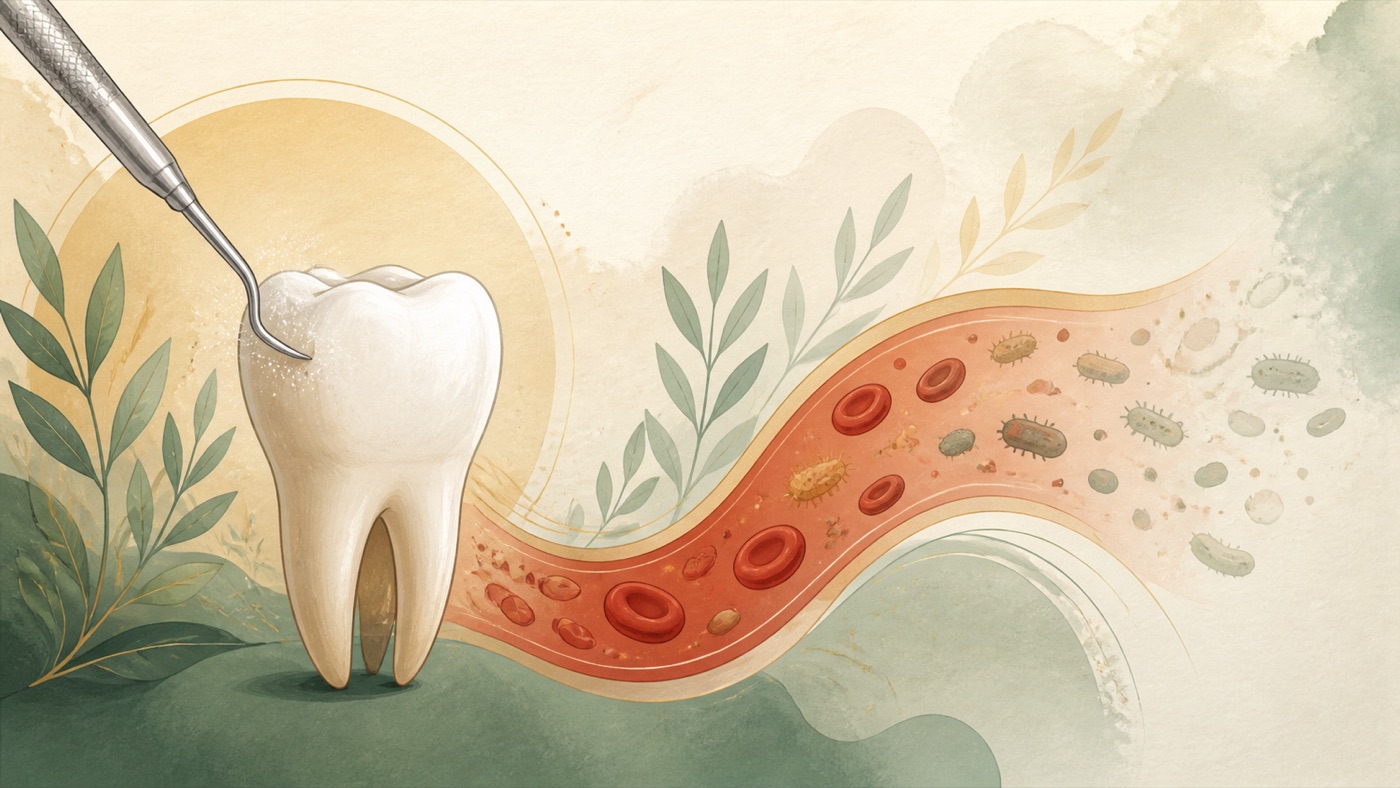
Professor Ching-Shun Lin's original article uses a severe case to remind readers that when the gums are injured during dental cleaning, oral bacteria may enter the bloodstream, and persistent symptoms afterward should not be left unevaluated. This biological pathway is not fictitious. A systematic review found that invasive dental procedures involving manipulation of the gums can cause procedure-related bacteremia. The account of “gum injury followed by the transient entry of bacteria into the bloodstream” is therefore consistent with the current literature. PMID: 41640922
However, bacteremia does not mean that infective endocarditis will necessarily occur. Available data indicate that the observed increase in endocarditis risk after invasive dental procedures is concentrated mainly among people who are already at high risk; the absolute risk is extremely low in the general low-risk population. Thus, “illness developed after dental cleaning” and “dental cleaning was the sole cause” are judgments at different levels. The former may be plausible mechanistically and temporally, whereas the latter still requires consideration of pre-existing valvular disease, cardiac history, blood cultures, and clinical examinations. Sequence alone cannot establish the conclusion. PMID: 41311730
Once infective endocarditis is established, it can indeed damage valvular structures. Severe cases may require removal of infected tissue and heart-valve replacement. The grave outcome described in Professor Lin's original article is consistent with clinical practice, rather than merely a frightening story. PMID: 42471722
What truly matters is recognizing illness and seeking timely care
The public-health message most worth preserving from this story is not “avoid dental cleaning,” but rather: when signs of infection are unclear and symptoms persist or worsen, do not repeatedly postpone medical care. Delayed diagnosis of infective endocarditis is associated with a poorer risk profile, and prompt formal assessment matters more than speculating about the cause on one's own. PMID: 41682607
People with a known high-risk cardiac condition should proactively inform both their dentist and cardiologist before a dental procedure, allowing clinicians to determine care according to the person's circumstances. For the general population, the evidence supports neither canceling necessary oral care out of fear of endocarditis nor self-medicating without medical assessment.
External clues cannot replace a cardiac evaluation
Diagonal earlobe creases are often portrayed online as a visible code for coronary artery obstruction. Professor Lin noted that some studies support the association while others dispute it, and this cautious position is consistent with the review literature. PMID: 26788075
More importantly, a systematic review of diagnostic accuracy concluded that an earlobe crease is insufficient to diagnose chronic coronary heart disease. Whether the sign is present or absent, it should not by itself alter medical management. There is no need to panic upon seeing an earlobe crease, and the absence of one is not proof of cardiovascular safety. PMID: 34202100
The timing of myocardial infarction should likewise not be reduced to a lifestyle slogan. The literature supports a morning excess in acute myocardial infarction, consistent with the morning peak described by Professor Lin. PMID: 9185643
Scientific progress also reminds us that the earlier absolute statement that there were “no reports at all related to the main meal or afternoon period” should no longer be repeated unchanged. Research has in fact linked the main meal and the afternoon period to the timing of myocardial infarction. This does not prove that everyone necessarily experiences a post-lunch peak, however, and it does not establish a single neural mechanism. PMID: 17320206
A mechanism is not enough to claim that a supplement prevents heart disease
The overall evidence for routinely taking vitamins and supplements to prevent cardiovascular disease or cancer remains limited. Conclusions must be restricted to specific ingredients, purposes, and populations; they cannot be crudely generalized into either “all supplements work” or “all supplements are ineffective.” The relevant review does not support β-carotene for this preventive purpose and finds no net benefit from vitamin E. For multivitamins, the more accurate conclusion is that evidence about benefits and harms is insufficient. PMID: 35727271
A large randomized trial found no reduction in invasive cancer or major cardiovascular events with vitamin D supplementation, and therefore does not support treating it as a universal cardiovascular preventive for the general population. PMID: 30415629
Still, opposing indiscriminate supplementation is not the same as denying the value of correcting deficiency or addressing the needs of specific populations. The decision to supplement should return to an individual's status and medical judgment. PMID: 41849024
Likewise, results from large trials of EPA/DHA and vitamin D do not support their use for the primary prevention of atrial fibrillation. This conclusion concerns a specific preventive use and should not be rewritten to mean that these substances have no role in any context. PMID: 33724323
Observational data show no significant association between CoQ10 and mortality outcomes, and the available evidence is also insufficient to establish it for primary prevention of cardiovascular disease in the general population. “The question remains unsettled” is more faithful to the evidence than either an advertising guarantee or blanket rejection. PMID: 40116591
When the literature has been updated, narrow the conclusion instead of rewriting history
At the time of his original article, Professor Lin rejected the claim that clinical evidence showed oral L-arginine could lower blood pressure. Reassessed against today's evidence, meta-analyses have now reported improvements in blood pressure, so the absolute statement that there is “no clinical evidence at all” no longer holds. This reflects updated literature and the changing boundaries of evidence as science advances; it does not mean that any commercially available formulation has been proven to prevent cardiovascular disease. PMID: 34967840
For L-arginine and erectile function, subsequent placebo-controlled trials have also provided a signal of improvement. The study populations, products, and conditions of use were limited, however, so the findings cannot be extrapolated to claim that every product is effective. PMID: 32441833
As for the warning that oral L-arginine promotes human breast-cancer growth, current data support only that the relevant metabolism is connected with breast-cancer biology. They remain insufficient to establish a causal relationship in which oral supplements cause tumor growth. PMID: 40140975
Cohort associations between terminal niacin metabolites and major cardiovascular events, together with mechanistic evidence of vascular inflammation, deserve attention. They cannot, however, be directly rewritten as “human trials have proved that vitamin B3 added to processed foods causes cardiovascular disease.” Association, mechanism, and the clinical causality of a food additive remain distinct questions. PMID: 38374343
Dietary evidence must distinguish endpoints and limits of extrapolation
Oat interventions can improve total cholesterol and LDL-C, a heart-health direction supported by a meta-analysis of randomized trials. PMID: 34977959
For weight control, however, the literature has been updated: newer data show no consistent effect on body weight among people with overweight or obesity. Oats may be discussed in terms of satiety or as a dietary substitute, but weight loss should not be presented as an established therapeutic effect. PMID: 41362998
Research on dietary nitrate suggests that endothelial function may improve, but this remains a surrogate marker. It cannot be directly upgraded into proof that dietary nitrate prevents cardiovascular disease or treats heart failure. PMID: 40679494
Prospective research associates processed-meat consumption with an increased risk of colorectal cancer, but the entire risk cannot be attributed solely to nitrite. Both “nitrite itself has been proved carcinogenic” and “all concern about processed meat is mistaken” exceed what this evidence can answer. PMID: 40210826
Hirudin is a peptide that is readily degraded and has limited bioavailability. An ordinary oral product cannot claim to reverse vascular occlusion merely because special-delivery or nanotechnology studies exist. When the research formulation, route into the human body, and clinical endpoint differ, they are not interchangeable. PMID: 41550636、PMID: 39917726
Practical principles for reading heart-health claims
First ask whether the study population resembles you. Then ask whether the comparison concerns symptoms, laboratory values, surrogate markers, or actual myocardial infarction, hospitalization, and death. Next, determine whether the evidence comes from cells, animals, observational research, randomized trials, or systematic reviews. Finally, keep “may,” “associated with,” and “improves a particular marker” separate from “prevents,” “treats,” and “reverses.” The distance between these terms is often exactly what separates reliable health information from exaggerated promotion.
FAQ
- Is it easy for an average person to develop infective endocarditis after dental cleaning?
- Gum manipulation such as dental cleaning can cause transient bacteremia, but post-procedure endocarditis risk is concentrated mainly among people who are already at high risk; the absolute risk in the general low-risk population is extremely small. PMID: 41311730
- 一般の人は歯石除去後に感染性心内膜炎を発症しやすいですか? — 歯石除去などの歯肉操作は一過性菌血症を引き起こすことがありますが、処置後の心内膜炎リスクは、もともと高リスクの人に主として集中しています。一般の低リスク集団における絶対リスクは極めて小さいものです。PMID: 41311730
- Is it easy for an average person to develop infective endocarditis after dental cleaning? — Gum manipulation such as dental cleaning can cause transient bacteremia, but post-procedure endocarditis risk is concentrated mainly among people who are already at high risk; the absolute risk in the general low-risk population is extremely small. PMID: 41311730
- What should someone with a history of heart disease do before a dental cleaning?
- Give the dentist and cardiologist a complete account of the cardiac history, valvular status, and prior treatment so that professionals can arrange care according to individual risk, because invasive dental procedures can indeed cause transient bacteremia. PMID: 41640922
- 心疾患歴がある場合、歯石除去の前にどうすればよいですか? — 心疾患歴、弁の状態、過去の治療を歯科医師と循環器科医に漏れなく伝え、個人のリスクに応じたケアを専門家に決めてもらってください。侵襲的歯科処置は実際に一過性菌血症を起こし得ます。PMID: 41640922
- What should someone with a history of heart disease do before a dental cleaning? — Give the dentist and cardiologist a complete account of the cardiac history, valvular status, and prior treatment so that professionals can arrange care according to individual risk, because invasive dental procedures can indeed cause transient bacteremia. PMID: 41640922
- After a dental cleaning, can fever or persistent discomfort simply be watched for a long time?
- If symptoms persist or worsen, or if infection is suspected, seek medical care promptly; delayed diagnosis of infective endocarditis is associated with a poorer risk profile. PMID: 41682607
- 歯石除去後の発熱や続く不調は、長期間様子を見てもよいですか? — 症状が持続または悪化する場合、あるいは感染が疑われる場合は、速やかに受診してください。感染性心内膜炎の診断の遅れは、より不良なリスク状態と関連しています。PMID: 41682607
- After a dental cleaning, can fever or persistent discomfort simply be watched for a long time? — If symptoms persist or worsen, or if infection is suspected, seek medical care promptly; delayed diagnosis of infective endocarditis is associated with a poorer risk profile. PMID: 41682607
- Can an earlobe crease show whether a coronary artery is blocked?
- No. An earlobe crease is insufficient to diagnose chronic coronary heart disease, and neither its presence nor its absence should replace formal risk assessment and examination. PMID: 34202100
- 耳たぶのしわを見れば、冠動脈が詰まっているか分かりますか? — 分かりません。耳たぶのしわだけでは慢性冠動脈疾患を診断できず、しわの有無は、正式なリスク評価と検査の代わりにはなりません。PMID: 34202100
- Can an earlobe crease show whether a coronary artery is blocked? — No. An earlobe crease is insufficient to diagnose chronic coronary heart disease, and neither its presence nor its absence should replace formal risk assessment and examination. PMID: 34202100
- Can multivitamins, vitamin E, or β-carotene prevent heart disease?
- The relevant review does not support β-carotene for this purpose, finds no net benefit from vitamin E, and concludes that evidence about the benefits and harms of multivitamins remains insufficient. They should not be treated as proven cardiovascular prevention. PMID: 35727271
- マルチビタミン、ビタミン E、β-カロテンで心疾患を予防できますか? — 関連するレビューは、この目的での β-カロテン使用を支持せず、ビタミン E には正味の利益がないとしています。マルチビタミンの利益と害に関するエビデンスも不十分であり、効果が確立した心血管予防策とみなすべきではありません。PMID: 35727271
- Can multivitamins, vitamin E, or β-carotene prevent heart disease? — The relevant review does not support β-carotene for this purpose, finds no net benefit from vitamin E, and concludes that evidence about the benefits and harms of multivitamins remains insufficient. They should not be treated as proven cardiovascular prevention. PMID: 35727271
- Can vitamin D or fish oil prevent atrial fibrillation?
- Large randomized trials do not support vitamin D or EPA/DHA for the primary prevention of atrial fibrillation. PMID: 33724323
- ビタミン D や魚油で心房細動を予防できますか? — 大規模ランダム化試験は、心房細動の一次予防を目的としたビタミン D または EPA/DHA の使用を支持していません。PMID: 33724323
- Can vitamin D or fish oil prevent atrial fibrillation? — Large randomized trials do not support vitamin D or EPA/DHA for the primary prevention of atrial fibrillation. PMID: 33724323
- Can L-arginine actually lower blood pressure?
- According to the updated literature, meta-analyses now show a signal of improved blood pressure, but that does not mean every commercially available product is effective or that prevention of cardiovascular events has been proved. PMID: 34967840
- L-arginine は結局、血圧を下げるのですか? — 更新された文献によれば、メタ解析から血圧改善のシグナルが得られています。ただし、すべての市販製品が有効という意味でも、心血管イベントの予防が証明済みという意味でもありません。PMID: 34967840
- Can L-arginine actually lower blood pressure? — According to the updated literature, meta-analyses now show a signal of improved blood pressure, but that does not mean every commercially available product is effective or that prevention of cardiovascular events has been proved. PMID: 34967840
- What is the more reliable heart-health benefit of oats?
- The more reliable evidence is that oat interventions can improve total cholesterol and LDL-C; for weight control, the updated literature does not show a consistent effect. PMID: 34977959、PMID: 41362998
- オーツ麦について、心臓の健康への比較的確かな利点は何ですか? — 比較的確かなエビデンスは、オーツ麦の介入が総コレステロールと LDL-C を改善し得ることです。体重管理については、更新された文献で一貫した効果が示されていません。PMID: 34977959、PMID: 41362998
- What is the more reliable heart-health benefit of oats? — The more reliable evidence is that oat interventions can improve total cholesterol and LDL-C; for weight control, the updated literature does not show a consistent effect. PMID: 34977959、PMID: 41362998
Source anchors
- 林慶順教授原文正本 · http://professorlin.com/2016/07/19/%e6%b4%97%e5%80%8b%e7%89%99%e9%bd%92%e7%ab%9f%e5%b7%ae%e9%bb%9e%e8%b3%a0%e4%b8%8a%e5%91%bd/
- 存證·Wayback 快照(原站消失仍可溯源) · https://web.archive.org/web/2/http://professorlin.com/2016/07/19/%e6%b4%97%e5%80%8b%e7%89%99%e9%bd%92%e7%ab%9f%e5%b7%ae%e9%bb%9e%e8%b3%a0%e4%b8%8a%e5%91%bd/
- 存證·archive.today 快照 · https://archive.ph/newest/http://professorlin.com/2016/07/19/%e6%b4%97%e5%80%8b%e7%89%99%e9%bd%92%e7%ab%9f%e5%b7%ae%e9%bb%9e%e8%b3%a0%e4%b8%8a%e5%91%bd/
- 侵入性牙科處置與暫時性菌血症的系統性回顧 · https://pubmed.ncbi.nlm.nih.gov/41640922/
- 牙科處置後心內膜炎風險與高風險族群的研究 · https://pubmed.ncbi.nlm.nih.gov/41311730/
- 感染性心內膜炎造成瓣膜破壞及外科治療的資料 · https://pubmed.ncbi.nlm.nih.gov/42471722/
- 感染性心內膜炎診斷延遲與風險狀態的研究 · https://pubmed.ncbi.nlm.nih.gov/41682607/
- 耳垂橫紋與冠心病爭議的回顧 · https://pubmed.ncbi.nlm.nih.gov/26788075/
- 耳垂橫紋診斷慢性冠心症準確度的系統性回顧 · https://pubmed.ncbi.nlm.nih.gov/34202100/
- 急性心肌梗塞晨間超額發生的研究 · https://pubmed.ncbi.nlm.nih.gov/9185643/
- 主要一餐、午後時段與心肌梗塞時序的研究 · https://pubmed.ncbi.nlm.nih.gov/17320206/
- 維他命與補充劑預防心血管疾病或癌症的建議 · https://pubmed.ncbi.nlm.nih.gov/35727271/
- 維他命 D 與癌症及重大心血管事件的大型隨機試驗 · https://pubmed.ncbi.nlm.nih.gov/30415629/
- 普遍補充維他命 D 與特定族群校正價值的文獻 · https://pubmed.ncbi.nlm.nih.gov/41849024/
- 維他命 D、EPA/DHA 與心房顫動初級預防試驗 · https://pubmed.ncbi.nlm.nih.gov/33724323/
- CoQ10 補充與全因及心血管死亡的觀察性研究 · https://pubmed.ncbi.nlm.nih.gov/40116591/
- L-arginine 與血壓變化的統合分析 · https://pubmed.ncbi.nlm.nih.gov/34967840/
- L-arginine 與勃起功能的安慰劑對照試驗 · https://pubmed.ncbi.nlm.nih.gov/32441833/
- L-arginine 代謝與乳癌生物學的研究 · https://pubmed.ncbi.nlm.nih.gov/40140975/
- 菸鹼酸代謝物、心血管事件與發炎機轉的研究 · https://pubmed.ncbi.nlm.nih.gov/38374343/
- 燕麥介入對總膽固醇與 LDL-C 的統合分析 · https://pubmed.ncbi.nlm.nih.gov/34977959/
- 燕麥介入與過重或肥胖族群體重結果的更新文獻 · https://pubmed.ncbi.nlm.nih.gov/41362998/
- 膳食硝酸鹽與血管內皮功能的統合分析 · https://pubmed.ncbi.nlm.nih.gov/40679494/
- 加工肉攝取與大腸直腸癌風險的前瞻性研究 · https://pubmed.ncbi.nlm.nih.gov/40210826/
- 水蛭素胜肽特性、分解與生體可用率限制的回顧 · https://pubmed.ncbi.nlm.nih.gov/41550636/
- 水蛭素與蚓激酶的特殊奈米遞送研究 · https://pubmed.ncbi.nlm.nih.gov/39917726/
- 存證·自存副本(原站消失仍可溯源) · https://km.idaeo.ai/archive/professorlin/1130.html
Cite this article
TK.Lin Agent・《A Dental Cleaning Nearly Cost a Life? The Evidence Boundaries From Transient Bacteremia and Endocarditis to Heart Health》・IDAEO 知識庫・2026-08-11・https://km.idaeo.ai/health/a-dental-cleaning-nearly-cost-a-life-the-evidencUpdated 2026-08-12