🏛 Part of the "dental" topic shelf →
When Can I Brush After a Tooth Extraction? Can I Use Toothpaste?
Using three areas—other teeth, the wound side, and the extraction socket itself—this guide explains what international patient information and clinical studies can and cannot support about cleaning after an extraction. It labels the evidence level for toothpaste, rinse timing, resuming flossing, and powered toothbrushes, and compares the differences after wisdom-tooth removal involving stitches, limited mouth opening, and the distal surface of the second molar. For the healing timeline see KM-DENTAL-01; for eating guidance see KM-DENTAL-04; this guide does not repeat them.
When Can I Brush After a Tooth Extraction? Can I Use Toothpaste?
Direct answer in 60 characters
The UK NHS wording for “Wisdom tooth removal” is: clean your other teeth carefully and avoid the wound area so you do not damage stitches or the blood clot [F3]. We found no clinical trial specifying how many hours after extraction brushing can begin [F23].
Seek emergency care immediately if bleeding does not stop; pain and swelling are severe or keep worsening and painkillers do not control them; or pain comes with a bad taste in the mouth, high temperature, or feeling unwell.[F3]
This is general health education based on international literature. It does not address any particular country's insurance or regulations; appointment and cost arrangements should follow the rules where you receive care. This card's clinical content comes from international journals, UK NHS patient-information pages, and a UK (Scottish) clinical-guideline leaflet (the F-Units mark them `geo: universal`, with population and setting limits stated individually). Only the disclosure-duty and health-education-positioning passages cite Taiwan law (F-Units marked `geo: TW`); if you receive care in another country, those two passages should instead follow local rules.
This card is not the same question as the other two extraction cards
The site's extraction topics have already been divided: each of these three cards covers one thing [F24].
- KM-DENTAL-01 covers “how the socket heals”: the healing-stage timeline, the full definition of dry socket, and red flags for returning for care.
- KM-DENTAL-04 covers “what to eat and drink”: whether to drink while anaesthetic persists, same-day food choices, and evidence on straws and hot foods.
- This card (KM-DENTAL-40) covers “how to clean”: when brushing may resume, how to handle the wound side, the timing relationship between toothpaste and rinsing, and when to resume flossing and interdental brushes.
Where they overlap, this card cites rather than rewrites the material (links are in the internal citation chain at the end). For example, the guidance wording “do not rinse until the next day” comes from a UK (Scottish) patient leaflet explicitly for dental patients taking anticoagulant or antiplatelet medication. KM-DENTAL-04 covers that passage; this card cites it only when discussing the order of brushing and rinsing, and does not treat that day as the rinse-start date for people having routine extractions [F4][F24].
First, be clear about what the evidence for this question looks like
“How soon can I brush after an extraction?” is searched often, but its direct evidence base is weak. After a PubMed search starting from patients' questions on 2026-08-06, the site's reading is as follows [F23]:
- Official patient-information wording is available for cleaning other teeth as usual, avoiding the wound area, and avoiding damage to stitches and the blood clot [F3]; it is also available for everyday brushing with fluoride toothpaste and spitting without immediately rinsing with water [F5].
- Clinical trials exist, but in periodontal surgery rather than extraction sockets, for when mechanical cleaning is introduced after surgery and what bristle softness is used [F6][F7][F8][F9]. These are indirect references, not direct evidence for extraction.
- Clinical studies exist, but show association rather than causation, for the association between oral-hygiene status and pain after wisdom-tooth surgery [F12], and the association between post-extraction infection rates and extraction complexity [F14][F15].
- This search found no direct clinical evidence for a specific hour to start brushing after extraction, causation between brushing force and loss of the clot, the effect of toothpaste on an extraction wound, or when to resume flossing. Each is labelled below under “Common claims compared”; this card does not fill the gaps with guesses [F23].
There is another honest but important finding. The UK (Scottish) clinical-guideline patient leaflet cited in KM-DENTAL-04 states in both its title and opening sentence that it is for dental patients taking anticoagulant or antiplatelet medication. It explains rest, rinsing, diet, and haemostasis throughout, but does not mention brushing at all [F4]. In other words, even the guideline gives no uniform answer to “how many hours after extraction can I brush?”—one reason that advice in the marketplace varies.
Under Article 81 of Taiwan's Medical Care Act, medical institutions treating patients must explain the condition, treatment policy, procedures, medicines, prognosis, and possible adverse reactions [F22]. The postoperative instruction you receive is the version that applies to you; this card is meant to help you understand it and know what to ask before you leave.
Split “Can I brush?” into three areas to get a clear answer
When most people ask “How soon can I brush after an extraction?”, they are actually thinking about three different areas. Based on F3, F4, F7, and F8, this site uses the following area-based framework to support discussion with a clinician; it is not a clinical guideline [F2].
- Other teeth that were not treated — the goal is to maintain usual cleaning quality.
- The wound side: teeth next to the wound and any stitches — the goal is to clean without disturbing the area.
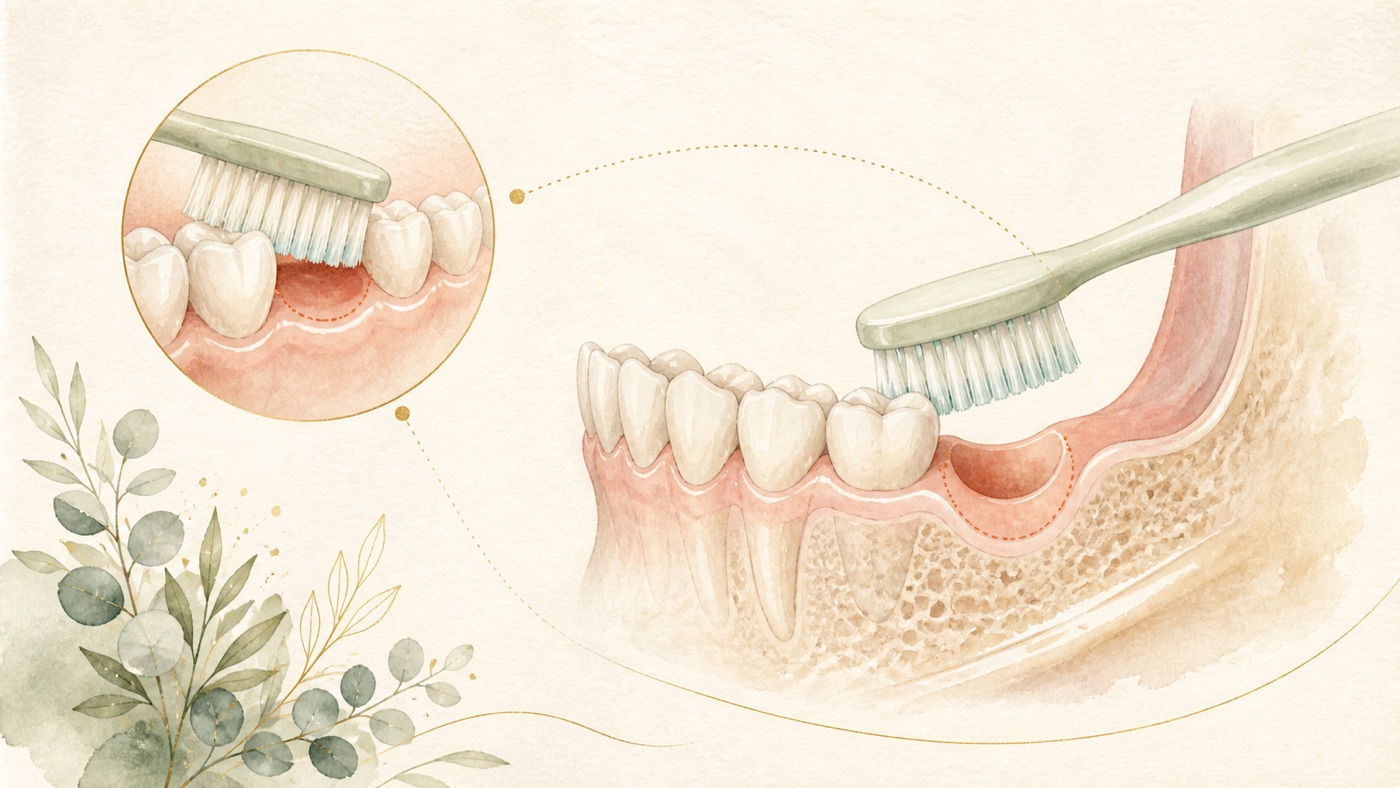
- The extraction socket itself (the hole) — NHS says two things about this area: avoid it while brushing other teeth so as not to damage stitches or the blood clot over the wound, and keep the wound clean by rinsing gently with mouthwash or warm salt water [F3]. “Avoid” refers to the toothbrush; it does not mean the area needs no cleaning. The scope and timing follow your postoperative instructions [F3][F22].
The criteria differ across the three areas. Combining them into one question—“Can I brush?”—is what creates the apparent conflict of “some say brush the same day; some say do not brush for three days.”
Area 1: other teeth — the patient-information wording is to clean carefully as usual
- NHS wording after wisdom-tooth surgery is: clean your other teeth carefully, avoiding the affected area so you do not damage stitches or the blood clot over the wound [F3]. It presents cleaning other teeth as something to do, not something to stop.
- This needs saying first: not brushing the whole mouth to protect the wound is not a safer default. In the official wording that can be cited, cleaning other teeth is listed among things that may be done after surgery [F3].
- For the specifics of everyday brushing, NHS general oral-health information is clear: brush twice daily with fluoride toothpaste for about 2 minutes; adult toothpaste should contain at least 1,350 ppm fluoride; medium or soft bristles suit most people [F5].
- Why not stop brushing the whole mouth? Clinical evidence that can be cited comes from periodontal rather than extraction surgery. In a study of 30 participants comparing three postoperative plaque-control protocols, mechanical cleaning (toothbrushing) alone was sufficient for good clinical outcomes, without additional chemical plaque control [F6]. This result is from periodontal flap-surgery participants and cannot be moved directly to an extraction socket. This card cites it only to show that toothbrushing remains a basic plaque-control method in a postoperative setting [F6][F23].
- There is also indirect association data. A surgical study of 190 impacted lower wisdom teeth recorded higher pain scores throughout the postoperative period and greater analgesic use in the first 48 hours among patients with poorer preoperative oral hygiene; oral hygiene showed no effect on limited opening or swelling [F12]. Keep the direction straight: this measured preoperative oral-hygiene indices and is an observational association; it cannot be read backwards as “not brushing after surgery will cause more pain” [F12][F23].
Area 2: the wound side — clean, but do not disturb it
- NHS wording supplies the practical principle: avoid the affected area so that stitches or the blood clot are not damaged [F3]. It gives no number of days.
- There is no direct extraction trial for “when can the brush return to the surgical area?”, but two randomised controlled periodontal-surgery studies offer a sense of scale:
- In a randomised controlled trial of 60 patients, the test group used a specially designed very-soft surgical toothbrush from postoperative day 3 to day 14, then a soft toothbrush from day 14 to day 28. Both protocols achieved good wound healing and wound closure at week 4; the test group had a lower incidence of gingival recession of 2 mm or more [F7].
- In another randomised controlled study of 30 patients with chronic periodontitis, the test group began cleaning the surgical area with a sonic toothbrush the day after surgery (while also using 0.12% chlorhexidine rinses). The control group rinsed only and resumed manual toothbrushing on day 14. The test group had better early healing indices, more plaque reduction, and milder inflammatory response on days 7, 14, and 28 (P < 0.01); pain intensity was similar between groups [F8].
- Read both studies very carefully: their settings were periodontal flap and osseous resective surgery, not extraction sockets; both test groups also used chlorhexidine. This card makes no medication or product recommendation, and the sample sizes were 60 and 30 respectively [F7][F8].
- Also be clear about what those days mean: “day 3,” “the next day,” “day 14,” and “day 28” were intervention schedules assigned by researchers in advance—who received what toothbrush on which day—not an expected patient timeline and not an answer to “which day after extraction should I start?” No extraction-setting trial answers that question [F7][F8][F23]. The only reasonable takeaway is: in these two periodontal-surgery settings, earlier resumption of gentle mechanical cleaning was not observed to be harmful and tended to be better. For which day to start and which brush to use for your extraction wound, follow your postoperative instructions [F7][F8][F22].
- Regarding bristle hardness, another randomised controlled trial of 60 patients compared a soft manual toothbrush with an oscillating-rotating powered toothbrush with a soft head after root-coverage surgery; gingival-margin stability was higher in the powered-toothbrush group [F9]. This is also not an extraction setting, and both groups used soft bristles; this card does not recommend any brand or model [F9].
Area 3: the extraction socket — what to avoid is the toothbrush, not keeping it clean
- First, a sentence to prevent misreading: on the same page, NHS says to keep the wound clean by rinsing gently with mouthwash or warm salt water, whereas “avoid the affected area” appears in the sentence about carefully cleaning other teeth [F3]. So “avoid” limits where the toothbrush touches; it does not say that area needs no cleaning. Whether to rinse, when to begin, and how to do it follow your postoperative instructions [F3][F22].
- The source itself states why this area is avoided: NHS says the reason for avoiding the affected area is not to damage stitches or the blood clot over the wound [F3]. On the same page, it describes dry socket as a painful condition in which the blood clot over the tooth socket does not form properly or is dislodged before the gum has healed. One Cochrane review likewise describes a socket that may be partly or totally without a blood clot [F11]. Read these as descriptions of what dry socket looks like, not as causal research showing that brushing dislodges a clot—the site found no such evidence [F23]. See KM-DENTAL-01 for the full definition, incidence, and red flags for dry socket; this card does not repeat them [F24].
- The mouth is not an environment that lets a wound heal quietly: a review describes it as a complex microenvironment influenced by oral movements, salivary flow, and bacterial biofilms, which can contribute to delayed socket healing and post-extraction complications [F25]. This is the mechanistic reason to handle postoperative cleaning by area.
- This search found no direct clinical trial on brushing force / bristles touching the socket and loss of the blood clot [F23]. Therefore this card gives no day on which one may brush into the socket and does not invent a required degree of socket cleaning. On the “toothbrush” side, the citable official wording goes only as far as “avoid the affected area,” without fixed scope or timing (when the same page addresses keeping the wound clean, it specifies gentle rinsing with mouthwash or warm salt water, not a brush) [F3].
- The converse must also be clear: if your clinic gives an irrigation or cleaning plan for the socket (for example, an irrigating device or a return visit for irrigation), follow that instruction; this card gives no reason to delay or skip it [F22].
Can I use toothpaste?
This is one of this topic's three representative queries, and the evidence gap needs to be stated clearly.
- Direct evidence: this search found no clinical study on whether toothpaste after extraction affects wound healing or bleeding [F23]. Any claim that settles this question exceeds what the current literature can support.
- Citable indirect data concern irritation of mucosa by toothpaste ingredients, but the settings differ from an extraction wound and must be stated separately:
- Sodium lauryl sulfate (SLS) is a common toothpaste surfactant. In a double-blind crossover trial involving 10 dental-hygiene students, toothpaste at 5 SLS concentrations from 0.0% to 1.5% was placed in an intraoral tray covering attached and unattached upper mucosa, 2 minutes each time, twice daily, for 4 days per trial period with a 10-day washout. The toothpaste without SLS produced no reaction, whereas toothpaste with 1.5% SLS caused desquamation in 60% of participants [F18].
- Another double-blind crossover trial of 20 participants placed three toothpastes—1.2% SLS, 1.2% SLS plus 4% betaine, and 4% betaine alone—into a test chamber against buccal mucosa for 15 minutes. Both SLS toothpastes irritated mucosa; the surfactant-free product did not [F19].
- A systematic review of recurrent aphthous stomatitis included 4 crossover trials with 124 participants. SLS-free toothpaste significantly reduced ulcer number, ulcer duration, episode number, and ulcer pain; the authors also said more well-designed trials are needed to strengthen the evidence [F20].
- These three items cannot be used to infer “do not use toothpaste after an extraction.” The first two are experimental exposure models that hold toothpaste against mucosa for a long time, unlike brushing and then spitting or rinsing; the third concerns people with recurrent aphthous stomatitis, not extraction wounds [F18][F19][F20][F23]. This card also recommends no toothpaste product or ingredient formulation.
- The reasonable practice it can support is: clean other teeth as usual with fluoride toothpaste while avoiding the affected area. This is the scope of the NHS wording; it says where the brush and cleaning action should avoid [F3][F5]. For whether toothpaste foam reaching near the wound has an effect, this search found no research and this card sets no rule [F23]. Whether to change toothpaste because of an individual's circumstances requires individual assessment; ask your dentist [F22].
Brushing, rinsing, mouthwash: the order matters
Many people receive postoperative instructions to rinse with warm salt water and therefore naturally rinse immediately after brushing. There is a general oral-health detail worth knowing here:
- NHS general oral-health information states directly: after brushing, spit out excess toothpaste and do not immediately rinse with water, because that washes away the concentrated fluoride left on teeth and reduces its preventive effect; it also says not to use mouthwash immediately after brushing, even fluoride mouthwash [F5].
- A randomised crossover trial in 23 adults supports the mechanism: after brushing with toothpaste containing 1,450 microg fluoride/g, rinsing for 30 seconds with non-fluoridated mouthwash produced a salivary fluoride clearance-curve area significantly lower than either a short water rinse alone or a fluoridated mouthwash rinse (P < 0.001). The authors worded their conclusion that non-fluoridated mouthwash after brushing may reduce the anticaries protection provided by fluoride toothpaste [F10]. It measured salivary fluoride concentration, not caries incidence, and the authors used cautious language [F10].
- The timing of rinsing after extraction itself is not the same in the two citable official documents, and their intended populations differ. The UK (Scottish) leaflet's title and opening sentence say it is for dental patients taking anticoagulant or antiplatelet medication; it says not to rinse until the next day, then to rinse gently with warm salt water 3 to 4 times a day for 5 days [F4]. The NHS wisdom-tooth page, for the general public, says to keep the wound clean by gently rinsing with mouthwash or warm salt water, without saying which day to start [F3].
- Therefore this card has no single rinse-start day for everyone. The leaflet's “next day” arrangement is for people taking anticoagulants or antiplatelets and cannot set the date for other extraction patients [F4]. Nor does this card combine the two documents into a compromise rule: follow your treating dentist's instructions [F22].
- Taken together, the site offers only one reminder about sequence: if brushing and rinsing on the same day can be separated, do not rinse away toothpaste immediately after brushing. This is an editorial organisational point, not a clinical guideline [F2][F5][F10].
- The priority must be explicit: if your postoperative instructions specify the timing, frequency, or method of rinsing, follow them—do not delay, reduce, or skip postoperative rinsing merely to retain toothpaste fluoride [F22]. The fluoride data above are general anticaries-mechanism research, not postoperative-wound-care research [F5][F10][F23].
- As for the relationship between chlorhexidine mouthwash and dry socket, a Cochrane review and a newer 2026 meta-analysis both report relevant results [F11][F26]; KM-DENTAL-01 handles the full content [F24]. This is within the scope of prescribing clinicians; this card makes no medication recommendation and recommends no product [F11][F26].
When can I resume flossing and interdental brushes?
- This search found no clinical research on when to resume flossing after an extraction (the PubMed query `dental floss timing after extraction` returned 0 records) [F23]. This card therefore gives no number of days.
- What can be cited is only general education and an indirect framework: NHS general oral-health information says regular flossing may reduce gum disease, tooth decay, and bad breath by removing plaque at the gum line, and recommends flossing before brushing; people with wider gaps may use interdental brushes or single-tufted brushes instead [F5].
- The area-based principle is the same as for brushing: maintain usual care in gaps that were not treated; the wound area and around stitches are not places to clean with floss on your own [F2][F3]. As for which gap counts as “next to the wound,” NHS says only “avoid the affected area” and draws no boundary, so this card does not draw one for you—ask the dentist who issued your postoperative instructions about the exact extent [F3][F22].
- Periodontal-surgery research used a stepwise design in which instruments progressed from very soft to conventional and timing progressed from farther away toward the surgical area [F7]. It can help explain why care is separated by area and stage, but that was the study's intervention schedule, not an instruction for extraction; this card derives no number of days from it [F7][F23].
- If food is stuck in a gap next to the wound, this is not a problem to solve by trying to remove it yourself; it is a reason to return and have a dentist assess it [F22]. See KM-DENTAL-01 for food in the socket [F24].
Wisdom-tooth version: three additional things to consider
“How soon can I brush normally after wisdom-tooth removal?” is the second-highest-exposure query for this topic and deserves separate comparison. The principles are not different; the conditions are.
- Stitches: the NHS page says that stitches, if present, dissolve by themselves and that a blood clot forms over the wound to help healing [F3]. This is why it says to avoid the area so as not to damage stitches or the blood clot [F3].
- Limited mouth opening: a Cochrane review of mandibular wisdom-tooth surgery says surgery is commonly accompanied by short-term postoperative pain, swelling, and trismus; less frequent events may include infection, dry socket, and trigeminal nerve injury [F13]. Limited opening makes cleaning the back teeth physically harder, which is one material difference from a simple extraction.
- The distal surface of the neighbouring second molar: a randomised single-blind controlled trial completed by 30 participants enrolled patients with mesio-angular impacted mandibular third molars and probing depth greater than 5 mm on the adjacent second molar's distal surface. After wisdom-tooth extraction, the control group (16 people) received standard socket debridement; the test group (14 people) additionally had ultrasonic root debridement of the second molar before wound closure and a three-visit plaque-control programme. At 6 months after extraction, the test group's second-molar distal plaque percentage was 21 and probing depth was 3.2±1.2 mm; the control group's were 88 and 5.2±0.7 mm, a statistically significant difference (P < 0.007) [F17].
- This must be read with great care: the test intervention was “professional debridement performed by a clinician plus a planned follow-up programme,” not “the patient brushes a little more.” The conclusion it can support is that the distal surface of the adjacent second molar is an area worth clinician assessment and follow-up after removal of an impacted wisdom tooth; it cannot be rewritten as any self-care instruction [F17][F23]. This is also why question 6 appears in the checklist.
- The scale of complications also differs: a retrospective analysis of 339 patients having a single wisdom tooth removed recorded perioperative complications in 51 cases (15.0%), including acute inflammation of surrounding tissue in 31; the authors concluded that lower wisdom teeth and surgical extraction requiring root separation were risk factors for postoperative complications [F15]. By contrast, a retrospective study covering 6 years and 1,821 extractions recorded postoperative infection in 25 cases (1.4%); the only statistically significant variable was extraction complexity (OR 2.03, p = 0.004) [F14]. Both are retrospective single-centre data with different definitions and populations; they cannot be converted into or added to each other. This card cites them only to show that greater complexity means more issues to watch for [F14][F15][F23].
Common claims compared (whether evidence exists, stated honestly one by one)
The following marks what was obtained after this site's PubMed E-utilities search on 2026-08-06. “No direct evidence obtained” means this search did not find a citable clinical study; it does not mean the claim has been disproved [F23].
- “You absolutely cannot brush within 24 hours after extraction.” — This site found no clinical trial setting a specific hour. Citable official wording says to clean other teeth and avoid the wound area, without a number of hours [F3][F23]. If your postoperative instructions specify a time, follow them.
- “Brushing will brush away the blood clot.” — No direct clinical trial was found on brushing force and loss of the blood clot [F23]. Two descriptions can be cited: NHS says the reason to avoid the affected area is not to damage stitches or the blood clot over the wound, and describes dry socket as failure of the clot to form properly or dislodgement before gum healing [F3]; Cochrane lists a socket partly or totally without a blood clot as one descriptive feature of dry socket [F11]. The reason for avoiding the wound area comes from the former (a direct instruction in official patient information), not a causal inference drawn from the latter description [F3][F11]. Neither is a reason to stop cleaning other teeth [F3].
- “You cannot use toothpaste after extraction.” — No direct study was obtained [F23]. Data on irritation from SLS toothpaste exist, but come from experimental intraoral-tray and test-chamber exposure models and aphthous-stomatitis populations, which are different settings [F18][F19][F20].
- “It is fine to use mouthwash instead of brushing for now.” — In periodontal surgery, one direct comparison found that the group using only 0.12% chlorhexidine rinse and resuming brushing on postoperative day 14 according to the study schedule had worse early healing indices, plaque reduction, and inflammatory response than the group cleaning the surgical area from the next day (P < 0.01) [F8]. Another study observed that mechanical cleaning was sufficient for good clinical outcomes without additional chemical plaque control [F6]. Rinsing immediately after brushing also washes away concentrated fluoride from toothpaste [F5][F10]. Both studies are not extraction settings, and their days are research intervention schedules; this card does not treat them as extraction conclusions or timelines [F6][F8][F23].
- “After extraction, do not use floss at first.” — No direct study was obtained [F23]. The area-based principle is the same as brushing: continue in other gaps and avoid the wound area and around stitches. The source does not draw a line for “which gap to avoid,” and neither does this card; follow your postoperative instructions [F2][F3][F22].
- “Once it no longer hurts, I can brush normally.” — Pain settling and tissue healing are different matters; see KM-DENTAL-01 for the healing timeline [F24]. This card does not use pain as a criterion for resuming cleaning [F23].
- “Powered toothbrushes must never be used after surgery.” — No extraction-setting trial was found. The test groups in two periodontal-surgery studies instead used powered or sonic toothbrushes [F8][F9]. This does not mean you should switch to a powered toothbrush after surgery; follow your postoperative instructions about which type to use [F8][F9][F22].
Risk factors (whose postoperative cleaning needs greater caution)
- Surgical or complex extraction: in an association analysis of postoperative infection, extraction complexity was the only statistically significant variable (OR 2.03, p = 0.004) [F14]; lower wisdom teeth and surgery requiring root separation were risk factors for complications [F15].
- Stitches: one reason to avoid the area during cleaning is not to damage the stitches [F3].
- Limited mouth opening: wisdom-tooth surgery commonly has short-term trismus, making cleaning the back teeth physically more difficult [F13].
- People taking anticoagulant or antiplatelet medication: the NHS wisdom-tooth page lists bleeding that does not stop as an emergency-care situation (that list is not limited to people taking these medicines) [F3]. A systematic review recorded that interrupting antithrombotic medication because of fear of bleeding or postoperative bleeding increases thromboembolic-event risk [F16]. A clinician should give individual instructions for cleaning method and timing; do not stop medication or change a dose on your own [F16][F22].
- People who smoke: a meta-analysis found that smokers had more than three-fold increased odds of dry socket, with combined incidence about 13.2% in smokers and about 3.8% in non-smokers [F21].
- People whose oral hygiene was already poor: poorer preoperative oral hygiene was associated with higher pain after wisdom-tooth surgery and more analgesic use in the first 48 hours after surgery [F12]. This is an association, not an individual prediction [F12].
Extraction and post-extraction care have risks and contraindications. Whether any of the above applies to you must be assessed by a dentist according to your individual circumstances.
Checklist before treatment / before leaving the surgery (ask all 7 questions there)
- Can I brush when I get home today? Should I clean my other teeth as usual? From which brushing session should I resume? [F3][F5]
- For how many days should I avoid the wound side? Do I have stitches, where are they, and will they dissolve by themselves or need removal? [F3][F13]
- Can I use my usual fluoride toothpaste? Is there anything that should be adjusted for my situation? [F5][F23]
- Should I rinse, what should I rinse with, which day should I start, and how many times a day? Should I separate brushing and rinsing in time? [F4][F5][F10]
- When can I resume floss and interdental brushes? How far around the wound should I avoid, and how should those gaps be handled? [F5][F23]
- I had an impacted wisdom tooth removed: does the distal surface of the adjacent second molar need separate cleaning or follow-up? [F17]
- What symptoms mean I should return immediately or seek emergency care? What is the contact method outside clinic hours? [F3][F16]
For question 7, the NHS wisdom-tooth page lists these emergency-care situations: bleeding that does not stop; severe or worsening pain and swelling that painkillers do not control; and pain with a bad taste in the mouth, high temperature, or feeling unwell [F3]. This is NHS care guidance for people in the UK; in Taiwan, use your clinic's and local emergency-department information for contact and referral routes [F3][F22].
How to find a clinic that provides this service
This site lists no clinics and does not recommend, rate or compare any medical institution.
To find a clinic that provides this service, use the following official lookup channels yourself —
they are maintained by the competent authorities and are more current than any list:
>
- The Ministry of Health and Welfare's medical-institution lookup: search by city or county,
township and specialty (dentistry) for institutions that have completed practice registration.
The results show the institution's name, address and registered specialty. This is the first place
to confirm whether a clinic is lawfully registered.
- The National Health Insurance Administration's contracted-institution lookup: check whether a
clinic is under contract with National Health Insurance. This determines which items are covered
and which are self-paid, and therefore what kind of fee explanation you will be given.
>
Both systems are on the respective authorities' official websites; searching for the
medical-institution lookup or the contracted-institution lookup will find them. This site does not
reproduce the URLs, because they change; use whichever entry point the authority currently publishes.
>
In an emergency, do not spend time looking up lists. If your breathing, swallowing or speech is
affected, or swelling is spreading, go to the nearest emergency department.
Chinese labels to look for on the official pages
These official systems, datasets and files are published in Chinese only. The English names above are this site's renderings; on the page itself you will see the following strings, so search for these:
>
- 「醫事機構查詢」
- 「特約醫事機構查詢」
- 「特約院所查詢」
Compliance note
This is health-education information under Article 87 of Taiwan's Medical Care Act, not medical advertising; it does not recommend a particular clinic [F0]. Extraction and post-extraction care have risks and contraindications. Actual treatment methods and outcomes vary by person and require a dentist's assessment. This card's area-based framework and cleaning sequence are for use in discussing care; they cannot replace postoperative instructions and clinical diagnosis from your treating dentist. This card recommends no toothpaste, mouthwash, toothbrush product, or ingredient.
Every clinical statement in this article is mapped line by line to its cited source (see the sources and evidence chain below). It has not been clinically reviewed by a licensed practitioner. This is health information, not individual advice; assessment by a clinician is required.
FAQ
- When should I seek emergency care immediately?
- Seek emergency care immediately if bleeding does not stop; pain and swelling are severe or keep worsening and painkillers do not control them; or pain comes with a bad taste in the mouth, high temperature, or feeling unwell.[F3]
- どのような場合に直ちに緊急受診すべきですか? — 出血が止まらない、鎮痛薬で抑えられない重い・悪化する疼痛と腫脹がある、または口内の悪い味、発熱、体調不良を伴う疼痛がある場合は、直ちに緊急受診してください。[F3]
- When should I seek emergency care immediately? — Seek emergency care immediately if bleeding does not stop; pain and swelling are severe or keep worsening and painkillers do not control them; or pain comes with a bad taste in the mouth, high temperature, or feeling unwell.[F3]
- How soon can I brush after a tooth extraction?
- **This site found no clinical trial specifying an hour; citable official wording gives an area-based principle, not a number of days.** The NHS wisdom-tooth page says to clean your other teeth carefully and avoid the affected area so as not to damage stitches or the blood clot over the wound [F3]. **Your own postoperative instructions are the one source for your personal timing** [F22]. It is also important that the two randomised controlled trials cited here are in periodontal surgery, not extraction: they scheduled resuming surgical-area cleaning on day 3 and the next day, respectively, as **researcher-assigned intervention schedules**, and did not observe harm [F7][F8]. **This card does not use those days to set any day for you** [F7][F8][F23]. One more point matters equally: “avoid the wound area” does not mean stop cleaning the whole mouth; official wording says cleaning other teeth is something to do [F3].
- 抜歯後、いつから歯を磨ける? — **指定時間の臨床試験は得ていない。公式文言は日数でなく、他の歯を清掃し創部を避けるという区域原則である。** あなたの日程は術後指示に従う [F3][F22]。歯周手術の第 3 日・翌日の結果は研究介入日程で、抜歯の日程には使わない [F7][F8][F23]。
- How soon can I brush after a tooth extraction? — **This site found no clinical trial specifying an hour; citable official wording gives an area-based principle, not a number of days.** The NHS wisdom-tooth page says to clean your other teeth carefully and avoid the affected area so as not to damage stitches or the blood clot over the wound [F3]. **Your own postoperative instructions are the one source for your personal timing** [F22]. It is also important that the two randomised controlled trials cited here are in periodontal surgery, not extraction: they scheduled resuming surgical-area cleaning on day 3 and the next day, respectively, as **researcher-assigned intervention schedules**, and did not observe harm [F7][F8]. **This card does not use those days to set any day for you** [F7][F8][F23]. One more point matters equally: “avoid the wound area” does not mean stop cleaning the whole mouth; official wording says cleaning other teeth is something to do [F3].
- Can I use toothpaste when brushing after extraction?
- **No clinical study was obtained on whether toothpaste after extraction affects the wound** [F23]. The citable practice is to clean other teeth as usual with fluoride toothpaste (adult toothpaste with at least 1,350 ppm fluoride, twice daily for about 2 minutes) [F5], while avoiding the affected area [F3]. **For whether toothpaste foam near the wound has an effect, this site found no research and sets no rule** [F23]. Experimental data show irritation of mucosa from SLS toothpaste, but those are long-duration intraoral-tray and test-chamber models, not brushing settings [F18][F19]. Whether to change toothpaste is an individual assessment; ask your dentist [F22].
- 抜歯後の歯磨きに歯磨剤は使える? — **抜歯後の歯磨剤と創部について直接研究は得ていない。** 他の歯をフッ化物配合歯磨剤で通常どおり清掃し、創部を避けることが根拠の範囲である [F3][F5]。泡が創部近くに触れる影響は不明で規則を定めない [F23]。個別の変更は歯科医師に尋ねる [F22]。
- Can I use toothpaste when brushing after extraction? — **No clinical study was obtained on whether toothpaste after extraction affects the wound** [F23]. The citable practice is to clean other teeth as usual with fluoride toothpaste (adult toothpaste with at least 1,350 ppm fluoride, twice daily for about 2 minutes) [F5], while avoiding the affected area [F3]. **For whether toothpaste foam near the wound has an effect, this site found no research and sets no rule** [F23]. Experimental data show irritation of mucosa from SLS toothpaste, but those are long-duration intraoral-tray and test-chamber models, not brushing settings [F18][F19]. Whether to change toothpaste is an individual assessment; ask your dentist [F22].
- Must I avoid the entire wound side? How long should I avoid it?
- **“Avoid” applies to the wound area and stitches, not an entire half of the mouth.** NHS wording is to clean other teeth and avoid the affected area [F3]. The site found no clinical trial for “how many days to avoid it”; **ask your dentist how long to avoid it** [F23][F22]. One periodontal (not extraction) surgical study used a stepped instrument schedule in the test group: a very-soft surgical toothbrush from postoperative day 3 to day 14 and a soft toothbrush from day 14 to day 28 [F7]. **That was the study's intervention schedule, not an instruction to avoid the area for 28 days**—this card uses it to set no avoidance period and does not advise you to extend one yourself [F7][F23].
- 創部側はいつまで避ける? — **避ける対象は創部と縫合糸であって、口の半分全体ではない。** 避ける日数の臨床試験は得ていないため歯科医師に聞く [F3][F22][F23]。第 3 から 14 日、第 14 から 28 日の器具日程は歯周手術研究の介入であり、28 日避ける指示ではない [F7]。
- Must I avoid the entire wound side? How long should I avoid it? — **“Avoid” applies to the wound area and stitches, not an entire half of the mouth.** NHS wording is to clean other teeth and avoid the affected area [F3]. The site found no clinical trial for “how many days to avoid it”; **ask your dentist how long to avoid it** [F23][F22]. One periodontal (not extraction) surgical study used a stepped instrument schedule in the test group: a very-soft surgical toothbrush from postoperative day 3 to day 14 and a soft toothbrush from day 14 to day 28 [F7]. **That was the study's intervention schedule, not an instruction to avoid the area for 28 days**—this card uses it to set no avoidance period and does not advise you to extend one yourself [F7][F23].
- How soon can I brush normally after wisdom-tooth removal? How is it different from a regular extraction?
- **The principle is the same; the conditions differ.** The wisdom-tooth version adds stitches [F3], the physical difficulty caused by limited opening [F13], and the distal surface of the neighbouring second molar as an area requiring clinician assessment. In a randomised controlled trial of 30 people, those who received intraoperative ultrasonic root debridement and a three-visit plaque-control programme had a second-molar distal plaque percentage of 21 and probing depth of 3.2±1.2 mm at 6 months, versus 88 and 5.2±0.7 mm in controls [F17]. **That was clinician-delivered intervention, not a self-care instruction** [F17]. Follow your postoperative instructions for when normal brushing resumes [F22].
- 智歯後は普通の抜歯と何が違う? — **原則は同じで条件が異なる。** 縫合糸、開口制限、隣接第二大臼歯遠心面の評価を確認する [F3][F13][F17]。研究の超音波根面デブライドメントと 3 回の受診は、自己ケア指示ではない [F17]。
- How soon can I brush normally after wisdom-tooth removal? How is it different from a regular extraction? — **The principle is the same; the conditions differ.** The wisdom-tooth version adds stitches [F3], the physical difficulty caused by limited opening [F13], and the distal surface of the neighbouring second molar as an area requiring clinician assessment. In a randomised controlled trial of 30 people, those who received intraoperative ultrasonic root debridement and a three-visit plaque-control programme had a second-molar distal plaque percentage of 21 and probing depth of 3.2±1.2 mm at 6 months, versus 88 and 5.2±0.7 mm in controls [F17]. **That was clinician-delivered intervention, not a self-care instruction** [F17]. Follow your postoperative instructions for when normal brushing resumes [F22].
- Can I use only mouthwash and temporarily not brush?
- **Official wording does not say cleaning other teeth can stop—NHS says to clean your other teeth carefully [F3]. For what day cleaning can resume in the wound area, follow your postoperative instructions; this card gives no number of days [F22].** The citable comparison is from periodontal-surgery (not extraction) participants. In a randomised controlled study of 30 people, the group that rinsed only with 0.12% chlorhexidine and resumed brushing on postoperative day 14 according to the study schedule had worse early healing indices, plaque reduction, and inflammatory response than the group that cleaned the surgical area from the next day (P < 0.01) [F8]; another study found mechanical cleaning sufficient for good clinical outcomes [F6]. **Neither setting was extraction, and their days were intervention schedules; this card does not treat them as extraction conclusions or timelines** [F6][F8][F23]. Also note sequence: rinsing immediately after brushing washes away concentrated fluoride left on teeth [F5], and a randomised crossover trial in 23 adults recorded that non-fluoridated mouthwash after brushing significantly lowered the salivary fluoride clearance-curve area (P < 0.001) [F10]. **But that is general anticaries mechanism data—if your postoperative instructions specify rinse timing or frequency, follow them and do not delay merely to retain fluoride** [F5][F10][F22]. Whether to use mouthwash and which one to use are for clinician assessment; this card recommends no product [F11][F26][F22].
- 洗口液だけを使い、しばらく歯を磨かなくてよい? — **他の歯の清掃を中止できるとは公式文言にない。** 歯周手術の比較は、洗口だけで第 14 日に歯磨きを再開した群が、翌日から清掃した群より早期指標で劣ったとしたが、抜歯の結果ではない [F6][F8][F23]。洗口の指示があればフッ化物を残すために遅らせず、担当歯科医師の指示を優先する [F5][F10][F22]。
- Can I use only mouthwash and temporarily not brush? — **Official wording does not say cleaning other teeth can stop—NHS says to clean your other teeth carefully [F3]. For what day cleaning can resume in the wound area, follow your postoperative instructions; this card gives no number of days [F22].** The citable comparison is from periodontal-surgery (not extraction) participants. In a randomised controlled study of 30 people, the group that rinsed only with 0.12% chlorhexidine and resumed brushing on postoperative day 14 according to the study schedule had worse early healing indices, plaque reduction, and inflammatory response than the group that cleaned the surgical area from the next day (P < 0.01) [F8]; another study found mechanical cleaning sufficient for good clinical outcomes [F6]. **Neither setting was extraction, and their days were intervention schedules; this card does not treat them as extraction conclusions or timelines** [F6][F8][F23]. Also note sequence: rinsing immediately after brushing washes away concentrated fluoride left on teeth [F5], and a randomised crossover trial in 23 adults recorded that non-fluoridated mouthwash after brushing significantly lowered the salivary fluoride clearance-curve area (P < 0.001) [F10]. **But that is general anticaries mechanism data—if your postoperative instructions specify rinse timing or frequency, follow them and do not delay merely to retain fluoride** [F5][F10][F22]. Whether to use mouthwash and which one to use are for clinician assessment; this card recommends no product [F11][F26][F22].
Medical notice This article is provided for health education and medical information purposes. It is not a solicitation for medical services and does not constitute diagnosis or treatment advice. Actual treatment methods and outcomes vary between individuals and require evaluation by a dentist; every treatment has its own indications, limitations and possible risks. If you have related symptoms or treatment needs, please book a consultation for evaluation by a dentist.
Source anchors
- Heitz F, Heitz-Mayfield LJ, Lang NP. Effects of post-surgical cleansing protocols on early plaque control in periodontal and/or periimplant wound healing. J… · https://pubmed.ncbi.nlm.nih.gov/15491319/ · 在 IDAEO 的其他引用
- Sijari Z, Romano F, Ciardo G, et al. Effect of two post-surgical cleansing protocols on early periodontal wound healing and cytokine levels following osseous… · https://pubmed.ncbi.nlm.nih.gov/30892797/ · 在 IDAEO 的其他引用
- Bertoldi C, Generali L, Cortellini P, et al. Influence of Tooth-Brushing on Early Healing after Access Flap Surgery: A Randomized Controlled Preliminary… · https://pubmed.ncbi.nlm.nih.gov/34072369/ · 在 IDAEO 的其他引用
- Acunzo R, Limiroli E, Pagni G, et al. Gingival Margin Stability After Mucogingival Plastic Surgery. The Effect of Manual Versus Powered Toothbrushing: A… · https://pubmed.ncbi.nlm.nih.gov/27677810/ · 在 IDAEO 的其他引用
- Duckworth RM, Maguire A, Omid N, et al. Effect of rinsing with mouthwashes after brushing with a fluoridated toothpaste on salivary fluoride concentration.… · https://pubmed.ncbi.nlm.nih.gov/19776570/ · 在 IDAEO 的其他引用
- Daly BJ, Sharif MO, Jones K, Worthington HV, Beattie A. Local interventions for the management of alveolar osteitis (dry socket). Cochrane Database Syst Rev.… · https://pubmed.ncbi.nlm.nih.gov/36156769/ · 在 IDAEO 的其他引用
- Peñarrocha M, Sanchis JM, Sáez U, Gay C, Bagán JV. Oral hygiene and postoperative pain after mandibular third molar surgery. Oral Surg Oral Med Oral Pathol… · https://pubmed.ncbi.nlm.nih.gov/11552141/ · 在 IDAEO 的其他引用
- Bailey E, Kashbour W, Shah N, Worthington HV, Renton TF, Coulthard P. Surgical techniques for the removal of mandibular wisdom teeth. Cochrane Database Syst… · https://pubmed.ncbi.nlm.nih.gov/32712962/ · 在 IDAEO 的其他引用
- Yue Yi EK, Siew Ying AL, Mohan M, Menon RK. Prevalence of Postoperative Infection after Tooth Extraction: A Retrospective Study. Int J Dent.… · https://pubmed.ncbi.nlm.nih.gov/34211554/ · 在 IDAEO 的其他引用
- Kiencało A, Jamka-Kasprzyk M, Panaś M, Wyszyńska-Pawelec G. Analysis of complications after the removal of 339 third molars. Dent Med Probl.… · https://pubmed.ncbi.nlm.nih.gov/33789003/ · 在 IDAEO 的其他引用
- Ockerman A, Bornstein MM, Leung YY, Li SKY, Politis C, Jacobs R. Local haemostatic measures after tooth removal in patients on antithrombotic therapy: a… · https://pubmed.ncbi.nlm.nih.gov/30155575/ · 在 IDAEO 的其他引用
- Leung WK, Corbet EF, Kan KW, Lo EC, Liu JK. A regimen of systematic periodontal care after removal of impacted mandibular third molars manages periodontal… · https://pubmed.ncbi.nlm.nih.gov/15966878/ · 在 IDAEO 的其他引用
- Herlofson BB, Barkvoll P. Desquamative effect of sodium lauryl sulfate on oral mucosa. A preliminary study. Acta Odontol Scand. 1993;51(1):39-43. PMID 8451922 · https://pubmed.ncbi.nlm.nih.gov/8451922/ · 在 IDAEO 的其他引用
- Rantanen I, Jutila K, Nicander I, Tenovuo J, Söderling E. The effects of two sodium lauryl sulphate-containing toothpastes with and without betaine on human… · https://pubmed.ncbi.nlm.nih.gov/12704946/ · 在 IDAEO 的其他引用
- Alli BY, Erinoso OA, Olawuyi AB. Effect of sodium lauryl sulfate on recurrent aphthous stomatitis: A systematic review. J Oral Pathol Med.… · https://pubmed.ncbi.nlm.nih.gov/30839136/ · 在 IDAEO 的其他引用
- Kuśnierek W, Brzezińska K, Nijakowski K, Surdacka A. Smoking as a Risk Factor for Dry Socket: A Systematic Review. Dent J (Basel). 2022;10(7):121. PMID… · https://pubmed.ncbi.nlm.nih.gov/35877395/ · 在 IDAEO 的其他引用
- Yin Y, Shuai F, Liu X, Zhao Y, Han X, Zhao H. Biomaterials and therapeutic strategies designed for tooth extraction socket healing. Biomaterials.… · https://pubmed.ncbi.nlm.nih.gov/39626339/ · 在 IDAEO 的其他引用
- Pahlevi MR, Istadi D, Arindra PK. Chlorhexidine reduces the incidence of alveolar osteitis in the absence of systemic antibiotics. Swiss Dent J.… · https://pubmed.ncbi.nlm.nih.gov/42454528/ · 在 IDAEO 的其他引用
- Sabri H, Derakhshan Barjoei MM, Azarm A, et al. The Yin and Yang of Sodium Lauryl Sulfate Use for Oral and Periodontal Health: A Literature Review. J Dent… · https://pubmed.ncbi.nlm.nih.gov/37727352/ · 在 IDAEO 的其他引用
- 醫療法 第 81 條(全國法規資料庫 · https://law.moj.gov.tw/LawClass/LawSingle.aspx?pcode=L0020021&flno=81 · 在 IDAEO 的其他引用
- NHS. Wisdom tooth removal(英國 NHS 病人衛教頁,頁面審閱日期 2024-06-12 · https://www.nhs.uk/tests-and-treatments/wisdom-tooth-removal/ · 在 IDAEO 的其他引用
- Scottish Dental Clinical Effectiveness Programme. Post-Treatment Advice for Dental Patients Taking Anticoagulant or Antiplatelet Medication(2022 年 3 月,PDF · https://www.sdcep.org.uk/media/bocnpjel/sdcep-post-treatment-advice-for-dental-patients.pdf · 在 IDAEO 的其他引用
- NHS. How to keep your teeth clean(英國 NHS 病人衛教頁,頁面審閱日期 2025-06-30 · https://www.nhs.uk/live-well/healthy-teeth-and-gums/how-to-keep-your-teeth-clean/ · 在 IDAEO 的其他引用
- 醫療法 第 87 條(全國法規資料庫 · https://law.moj.gov.tw/LawClass/LawSingle.aspx?pcode=L0020021&flno=87 · 在 IDAEO 的其他引用
- 本文證據鏈:逐條出處、行號與原文引句 · https://km.idaeo.ai/reports/dental-post-extraction-brushing-evidence · 在 IDAEO 的其他引用
Cite this article
km 編輯部・《When Can I Brush After a Tooth Extraction? Can I Use Toothpaste?》・IDAEO 知識庫・2026-08-13・https://km.idaeo.ai/post/dental/post-extraction-brushingUpdated 2026-08-14