Part of the "Dental" topic shelf → ← Back to the article:For Slightly Uneven Teeth, Veneers or Orthodontics? First Distinguish ‘Looking Straight’ from ‘Actually Moving the Teeth’
For Slightly Uneven Teeth, Veneers or Orthodontics? First Distinguish ‘Looking Straight’ from ‘Actually Moving the Teeth’|證據鏈
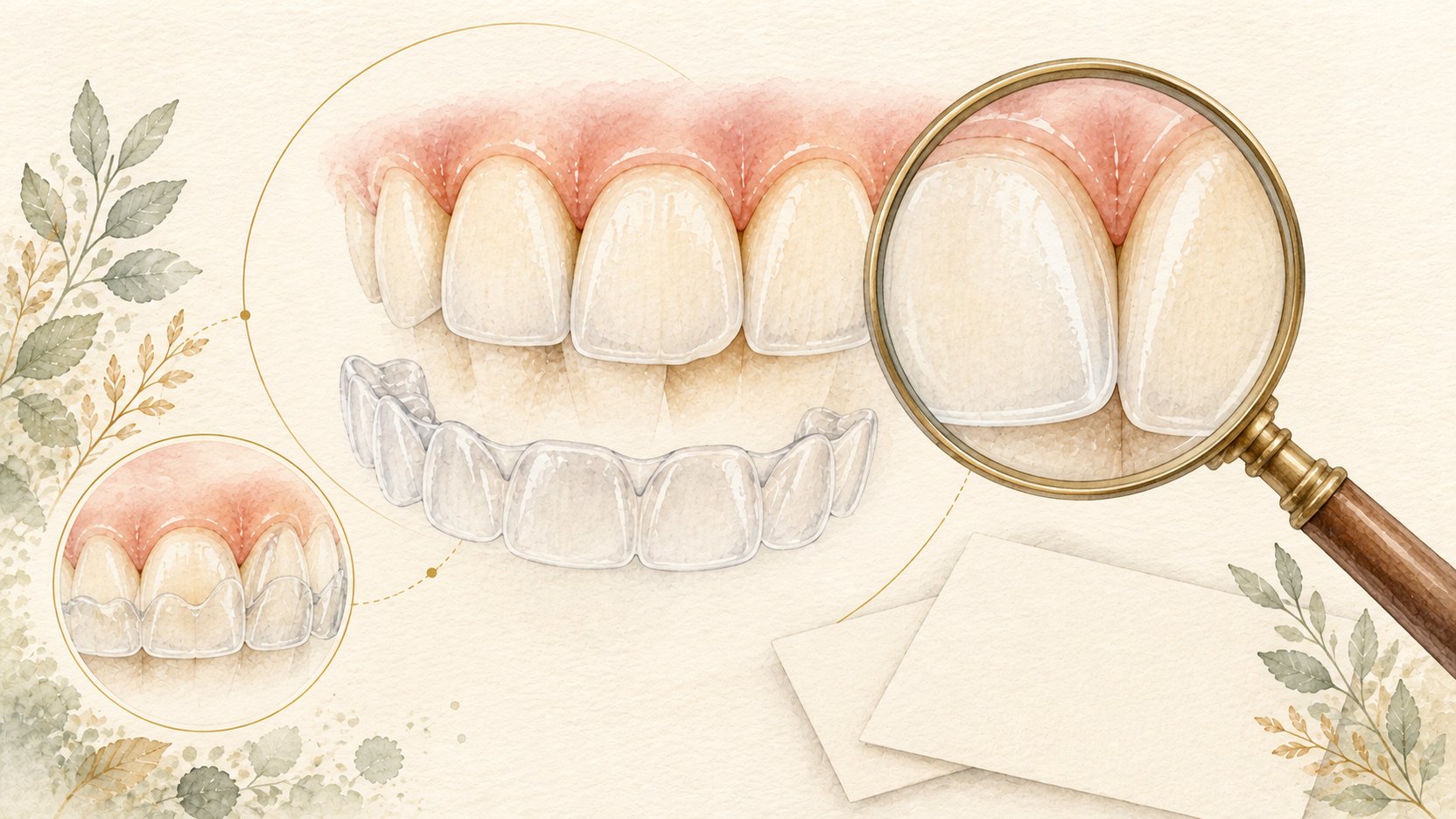
Slightly crowded front teeth, a little crookedness or one tooth rotated by a small amount—this degree of irregularity commonly prompts two completely different suggestions: have veneers, or have orthodontic treatment. Many people think this is simply a choice between a ‘quick option and a slow option’.
本頁逐條列出本卡每一個 [Fn] 標記對應的文獻出處。
- F1|Clinical survival and complication rate of ceramic veneers bonded to different substrates: A systematic review and meta-analysis. [PMID:38604905](https://pubmed.ncbi.nlm.nih.gov/38604905/)
- F2|Indications and limits of clear aligner therapy: an international modified Delphi consensus study. [PMID:40760282](https://pubmed.ncbi.nlm.nih.gov/40760282/)
- F3|Dentin and Enamel Exposure on Upper Incisors for Bonding Buccal Laminated Veneers: Method Validation and Ex Vivo Quantification. [PMID:41958963](https://pubmed.ncbi.nlm.nih.gov/41958963/)
- F4|Survival and Complication Rates of Feldspathic, Leucite-Reinforced, Lithium Disilicate and Zirconia Ceramic Laminate Veneers: A Systematic Review and Meta-Analysis. [PMID:39523553](https://pubmed.ncbi.nlm.nih.gov/39523553/)
- F5|Comparative Impact of Clear Aligners and Traditional Fixed Appliances on Oral Health-Related Quality of Life: A Systematic Review and Meta-Analysis. [PMID:42356103](https://pubmed.ncbi.nlm.nih.gov/42356103/)

FAQ
- If my front teeth are only slightly crowded, will veneers solve the problem more quickly?
- Veneers can change the shape and colour you see, but **they do not alter the position of the teeth in the bone**. To decide whether that is the answer you want, first establish whether your concern is alignment or shape and colour. Be aware of the cost as well: in an ex vivo study, as preparation moved from minimally invasive to invasive, dentine exposure in central incisors rose from 0% to 84% ± 3% [F3]. Veneers on surfaces with severe dentine exposure had a survival rate of 91% (84–98%) and a success rate of 74% (64–85%), lower than the 99%/99% seen when bonded to enamel [F1].
Source anchors
- Clinical survival and complication rate of ceramic veneers bonded to different substrates: A systematic review and meta-analysis. [PMID:38604905] · https://pubmed.ncbi.nlm.nih.gov/38604905/ · Other citations on IDAEO
- Indications and limits of clear aligner therapy: an international modified Delphi consensus study. [PMID:40760282] · https://pubmed.ncbi.nlm.nih.gov/40760282/ · Other citations on IDAEO
- Dentin and Enamel Exposure on Upper Incisors for Bonding Buccal Laminated Veneers: Method Validation and Ex Vivo Quantification. [PMID:41958963] · https://pubmed.ncbi.nlm.nih.gov/41958963/ · Other citations on IDAEO
- Survival and Complication Rates of Feldspathic, Leucite-Reinforced, Lithium Disilicate and Zirconia Ceramic Laminate Veneers: A Systematic Review and Meta-Analysis. [PMID:39523553] · https://pubmed.ncbi.nlm.nih.gov/39523553/ · Other citations on IDAEO
- Comparative Impact of Clear Aligners and Traditional Fixed Appliances on Oral Health-Related Quality of Life: A Systematic Review and Meta-Analysis. [PMID:42356103] · https://pubmed.ncbi.nlm.nih.gov/42356103/ · Other citations on IDAEO
Cite this article
Lucy・《For Slightly Uneven Teeth, Veneers or Orthodontics? First Distinguish ‘Looking Straight’ from ‘Actually Moving the Teeth’|證據鏈》・IDAEO 知識庫・2026-08-16・https://km.idaeo.ai/post/reports/dental-veneer-vs-orthodontics-mild-crowding-evidenceUpdated 2026-08-26