Part of the "Dental" topic shelf → ← Back to the article:Why Implant Treatment Is Often Staged: Making Sense of How Extraction, Grafting, the Implant and the Restoration Depend on One Another
Why Implant Treatment Is Often Staged: Making Sense of How Extraction, Grafting, the Implant and the Restoration Depend on One Another|證據鏈
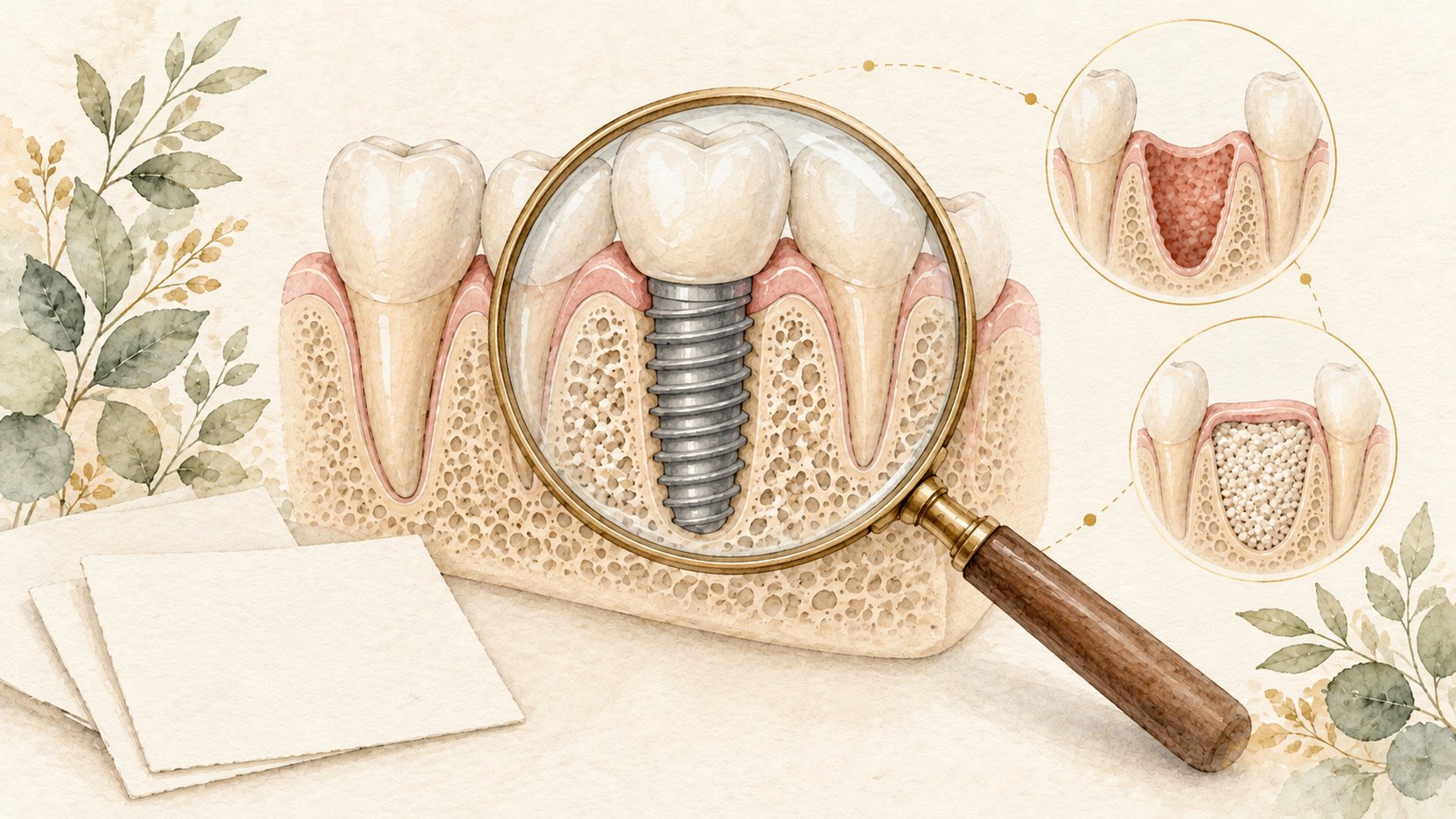
Implant treatment is often broken down into extraction, ridge preservation or bone grafting, implant placement, osseointegration and prosthetic loading. The reason is not that everyone has to follow the same protocol, but that every step has its own prerequisites: the bone morphology left after extraction affects implant position; where bone volume is insufficient, augmentation may have to come first; whether an implant can be placed immediately depends on the conditions in the fresh extraction socket and on primary stability; and when the crown takes occlusal force depends in turn on implant stability and on whether grafting is being carried out at the same time. For some people the conditions suit combining steps; for others, separating the stages actually makes position, wound and loading easier to control. The question worth asking is not "how fast can this possibly be", but which condition is not yet in place, and what waiting or adding a stage is meant to solve.
本頁逐條列出本卡每一個 [Fn] 標記對應的文獻出處。
- F1|ALVEOLAR RIDGE PRESERVATION AT MOLAR EXTRACTION SITES: A SYSTEMATIC REVIEW AND META-ANALYSIS. [PMID:39947777](https://pubmed.ncbi.nlm.nih.gov/39947777/)
- F2|Efficacy of lateral bone augmentation prior to implant placement: A systematic review and meta-analysis. [PMID:30624791](https://pubmed.ncbi.nlm.nih.gov/30624791/)
- F3|Primary stability of immediate implants placed in fresh sockets in comparison with healed sites: A systematic review and meta-analysis. [PMID:40047361](https://pubmed.ncbi.nlm.nih.gov/40047361/)
- F4|The effectiveness of immediate implant placement for single tooth replacement compared to delayed implant placement: A systematic review and meta-analysis. [PMID:30624808](https://pubmed.ncbi.nlm.nih.gov/30624808/)
- F5|Loading protocols for single-implant crowns: a systematic review and meta-analysis. [PMID:24660200](https://pubmed.ncbi.nlm.nih.gov/24660200/)

FAQ
- Does everyone have to go through extraction, grafting, implant and then the crown?
- The same protocol does not have to be applied to everyone. Some edentulous sites have already healed and have sufficient bone; some sockets are suitable for immediate implant placement; and some people need bone or soft tissue rebuilt first. Staging depends on whether the previous step can provide the conditions the next one needs.
Source anchors
- ALVEOLAR RIDGE PRESERVATION AT MOLAR EXTRACTION SITES: A SYSTEMATIC REVIEW AND META-ANALYSIS. [PMID:39947777] · https://pubmed.ncbi.nlm.nih.gov/39947777/ · Other citations on IDAEO
- Efficacy of lateral bone augmentation prior to implant placement: A systematic review and meta-analysis. [PMID:30624791] · https://pubmed.ncbi.nlm.nih.gov/30624791/ · Other citations on IDAEO
- Primary stability of immediate implants placed in fresh sockets in comparison with healed sites: A systematic review and meta-analysis. [PMID:40047361] · https://pubmed.ncbi.nlm.nih.gov/40047361/ · Other citations on IDAEO
- The effectiveness of immediate implant placement for single tooth replacement compared to delayed implant placement: A systematic review and meta-analysis. [PMID:30624808] · https://pubmed.ncbi.nlm.nih.gov/30624808/ · Other citations on IDAEO
- Loading protocols for single-implant crowns: a systematic review and meta-analysis. [PMID:24660200] · https://pubmed.ncbi.nlm.nih.gov/24660200/ · Other citations on IDAEO
Cite this article
Lucy・《Why Implant Treatment Is Often Staged: Making Sense of How Extraction, Grafting, the Implant and the Restoration Depend on One Another|證據鏈》・IDAEO 知識庫・2026-08-16・https://km.idaeo.ai/post/reports/dental-staged-implant-treatment-evidenceUpdated 2026-08-19