Part of the "Dental" topic shelf → ← Back to the article:How Should an Implant Plan Be Adjusted If You Smoke or Have Recently Stopped?
How Should an Implant Plan Be Adjusted If You Smoke or Have Recently Stopped?|證據鏈
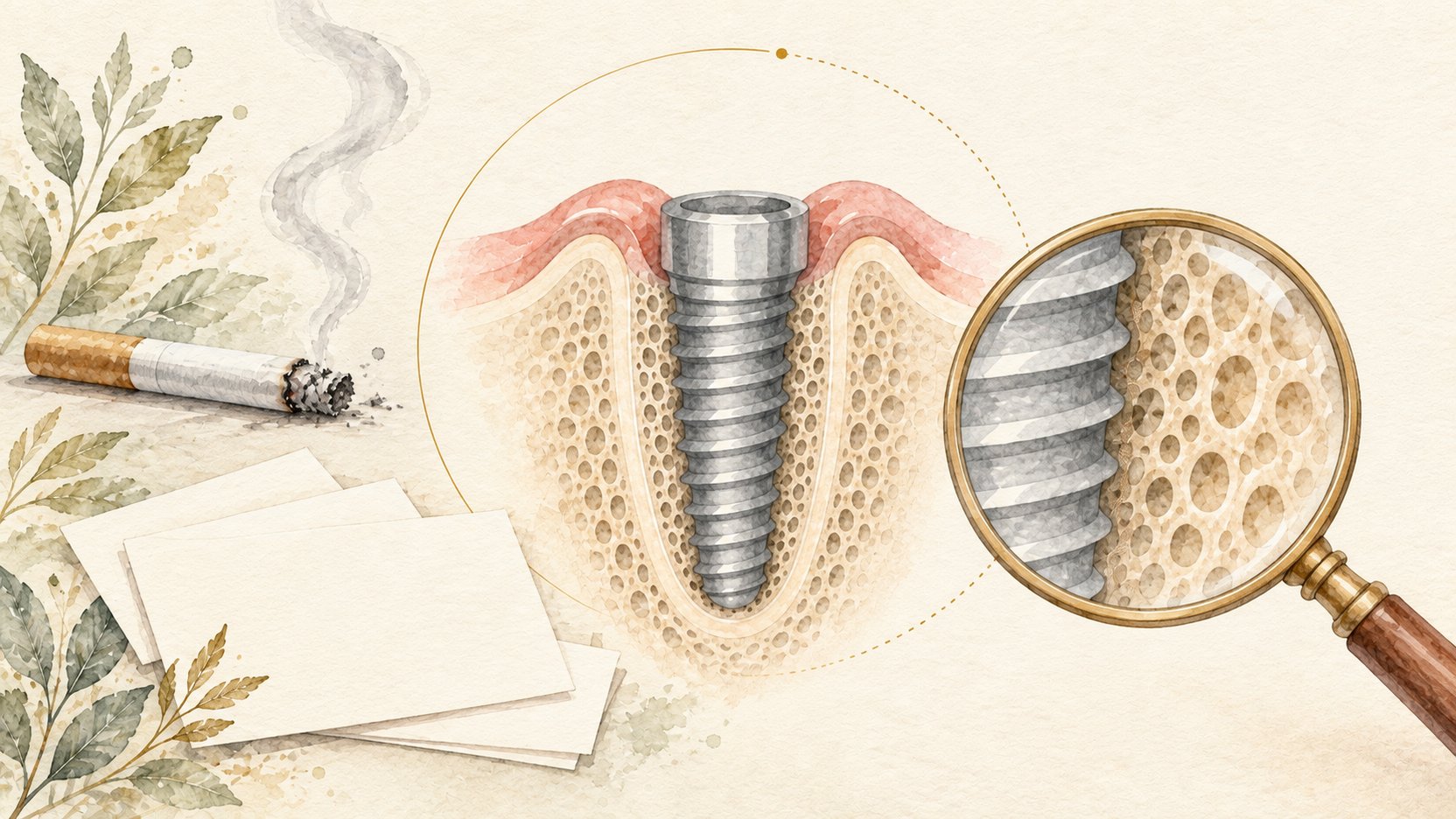
Smoking is not an absolute exclusion criterion for every course of implant treatment, but systematic reviews consistently regard it as an important risk signal for early implant failure, marginal bone changes and peri-implantitis. Before surgery, it is therefore not enough simply to tick ‘smokes/does not smoke’. The discussion should also cover approximately how many cigarettes you smoke each day, how long you have smoked, whether you have now stopped, and whether you use other products containing tobacco or nicotine. If you have recently stopped smoking, current reviews of direct implant evidence have not established a fixed number of waiting weeks that applies to every operation. A safer adjustment is to incorporate smoking-cessation support into the plan and work with the dentist to arrange the timing and follow-up according to the surgical extent, oral inflammation, bone and soft tissue, degree of exposure, and whether abstinence can be maintained.
本頁逐條列出本卡每一個 [Fn] 標記對應的文獻出處。
- F1|Tobacco Smoking and Smoke-Free Products as Risk Factors for Dental Implants: A Systematic Review. [PMID:41776304](https://pubmed.ncbi.nlm.nih.gov/41776304/)
- F2|Smoking in relation to early dental implant failure: A systematic review and meta-analysis. [PMID:39393606](https://pubmed.ncbi.nlm.nih.gov/39393606/)
- F3|Levels of smoking and dental implants failure: A systematic review and meta-analysis. [PMID:31955453](https://pubmed.ncbi.nlm.nih.gov/31955453/)
- F4|Evidence-Based Critical Assessment of the Success Rate of Dental Implants in Smokers: An Umbrella Systematic Review. [PMID:39449874](https://pubmed.ncbi.nlm.nih.gov/39449874/)
- F5|The influence of smoking on the incidence of peri-implantitis: A systematic review and meta-analysis. [PMID:36939434](https://pubmed.ncbi.nlm.nih.gov/36939434/)

FAQ
- Does Continuing to Smoke Mean That Implant Treatment Is Definitely Impossible?
- It is not an absolute exclusion, but the risk should not be ignored. The latest systematic review states explicitly that smoking is not an absolute contraindication to implant treatment, while also being associated with lower survival, greater bone changes and peri-implantitis. Whether to proceed and how to adjust the plan require an individual assessment.[F1]
Source anchors
- Tobacco Smoking and Smoke-Free Products as Risk Factors for Dental Implants: A Systematic Review. [PMID:41776304] · https://pubmed.ncbi.nlm.nih.gov/41776304/ · Other citations on IDAEO
- Smoking in relation to early dental implant failure: A systematic review and meta-analysis. [PMID:39393606] · https://pubmed.ncbi.nlm.nih.gov/39393606/ · Other citations on IDAEO
- Levels of smoking and dental implants failure: A systematic review and meta-analysis. [PMID:31955453] · https://pubmed.ncbi.nlm.nih.gov/31955453/ · Other citations on IDAEO
- Evidence-Based Critical Assessment of the Success Rate of Dental Implants in Smokers: An Umbrella Systematic Review. [PMID:39449874] · https://pubmed.ncbi.nlm.nih.gov/39449874/ · Other citations on IDAEO
- The influence of smoking on the incidence of peri-implantitis: A systematic review and meta-analysis. [PMID:36939434] · https://pubmed.ncbi.nlm.nih.gov/36939434/ · Other citations on IDAEO
Cite this article
Lucy・《How Should an Implant Plan Be Adjusted If You Smoke or Have Recently Stopped?|證據鏈》・IDAEO 知識庫・2026-08-16・https://km.idaeo.ai/post/reports/dental-smoking-implant-plan-evidenceUpdated 2026-08-26