

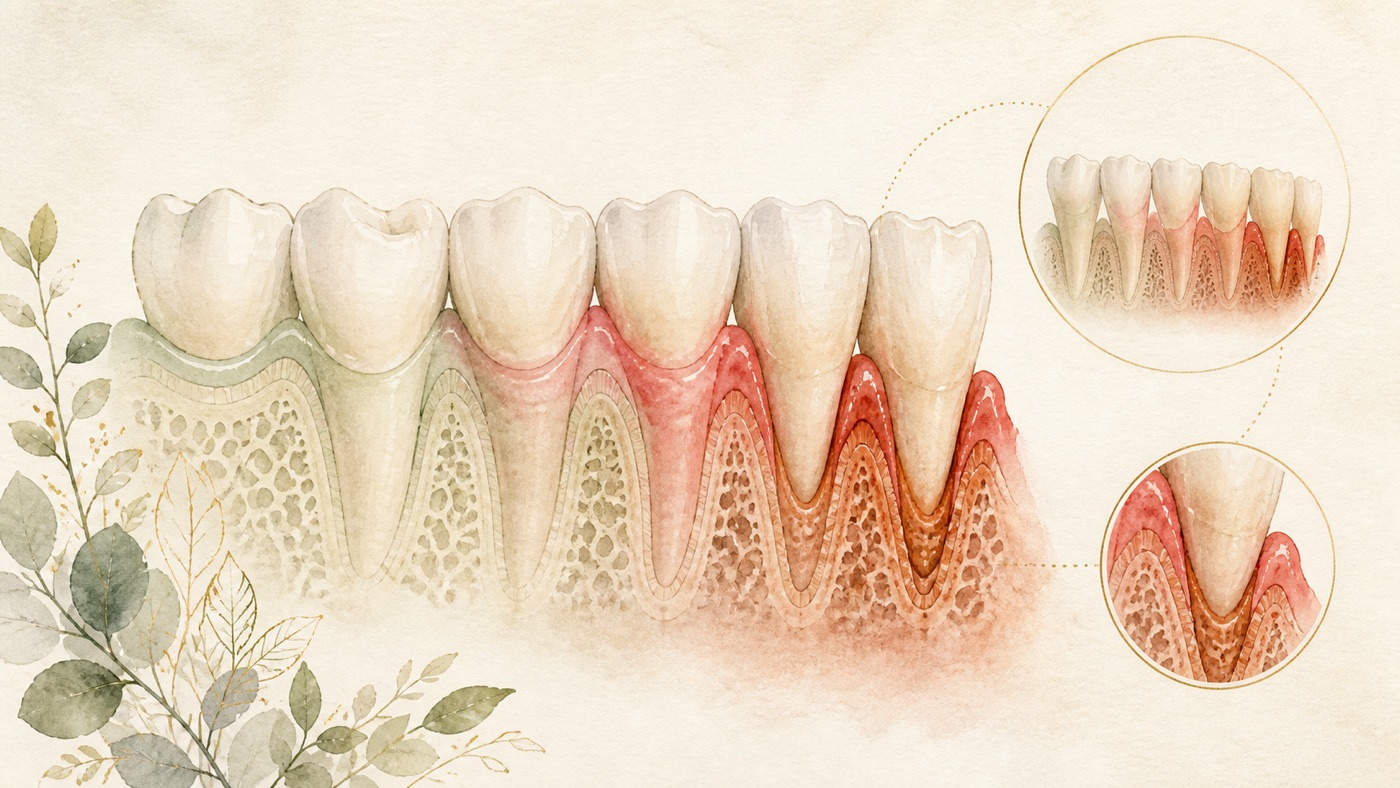
牙周病與牙齦健康全指南:從牙齦炎到牙周炎的分期、治療光譜與全身健康關聯|證據鏈
本頁是〈牙周病與牙齦健康全指南:從牙齦炎到牙周炎的分期、治療光譜與全身健康關聯〉的事實單元帳:每一條主張對應的來源、證據等級、地域與期間、原文引句與限制,逐條攤開。
牙周病與牙齦健康全指南:從牙齦炎到牙周炎的分期、治療光譜與全身健康關聯|證據鏈
F-Units(事實單元帳)
- F1|牙周健康被定義為臨床上偵測不到發炎;牙齦健康與牙齦炎的個案定義主要建立在探測後是否出血。|來源 S1|confidence=high|basis=clinical_guideline(2017 世界工作坊 workgroup 1 共識報告)|geo: universal|period=2018 刊出|caveat:為定義與個案界定,非療效宣稱;臨床與流行病學兩種用途的個案定義另有區分。
- F2|牙菌斑相關牙齦炎是可回復的發炎狀況;在易感個體,牙齦炎可能進展為牙周炎並造成牙齒軟組織與骨性支持的喪失。|來源 S3|confidence=high|basis=peer_reviewed(Cochrane 系統性回顧之背景陳述)|geo: universal|period=2017 刊出(檢索至 2016-09)|caveat:「可能進展」為條件性陳述,非所有牙齦炎皆會進展。
- F3|牙周炎被描述為普遍且不可回復的發炎狀況。|來源 S4|confidence=high|basis=clinical_guideline(第 11 屆歐洲牙周病學研討會工作小組共識報告)|geo: universal|period=2015 刊出|caveat:屬疾病性質之描述;不可回復指已喪失的附連與骨支持,不等於無法控制。本來源並未寫出「治療目標是控制與維持」,故本文已將該推論改標為本站解讀(見「四個狀態」一節與 F28),不掛於本條。同一來源另寫有「牙周炎可預防、治療能降低失牙率並改善生活品質」一句,該句已獨立立帳為 F29 並寫入正文(60 字答案、第一節、FAQ 第 2 題),以免本文只單向呈現「不可回復」而漏掉同一段的正向結論。
- F4|牙齦健康可在治療牙齦炎與牙周炎後恢復;但已治療、目前牙齦健康的牙周炎病人仍處於復發之較高風險,須密切監測。臨床牙齦健康可存在於完整牙周組織,也可存在於已減少的牙周組織(例如有牙齦萎縮者、牙冠增長術後者,或有牙周炎病史而目前穩定者)。|來源 S1|confidence=high|basis=clinical_guideline|geo: universal|period=2018 刊出|caveat:「密切監測」之頻率未於該共識中量化,個別由臨床決定。
- F5|牙齦疾病分兩大類:非牙菌斑生物膜誘發之牙齦疾病(多種非牙菌斑造成之狀況,去除牙菌斑後通常不會消退,可能為全身狀況之表現或局限於口腔)與牙菌斑誘發之牙齦炎。|來源 S1|confidence=high|basis=clinical_guideline|geo: universal|period=2018 刊出|caveat:分類陳述,非診斷指引;個別病灶歸類須臨床判定。
- F6|非菌斑誘發性牙齦病灶系統性回顧(篩選 6,111 篇、納入 461 篇):整體證據品質中等至極低;潛在惡性與惡性牙齦病灶需審慎評估並以切片取得診斷,之後多以外科方式處理;處置常需多專科照護,並常需轉介醫科或口腔黏膜病專科。|span:「Over a total of 6111 articles initially identified, 461 met inclusion criteria」|來源 S14|confidence=high|basis=peer_reviewed(系統性回顧,Part 2)|geo: universal|period=2026 線上刊出|caveat:納入設計自個案報告至隨機試驗,異質性高;本文僅引用其分流與轉診層級之結論,不引用個別病灶之處置細節。
- F7|分期 Stage I 至 IV 依嚴重度(以牙根長度為參照之牙周破壞、與牙周炎相關之失牙)、處置複雜度(囊袋深度、齒槽骨內缺損、根分叉侵犯、牙齒過度動搖、咀嚼功能障礙)界定,並另以局限型或廣泛型描述其範圍。|來源 S2|confidence=high|basis=clinical_guideline(2017 世界工作坊個案定義框架)|geo: universal|period=2018 刊出(原文另有 2018 年勘誤)|caveat:為個案定義框架,實際歸期須由臨床檢查與影像判定。
- F8|分級 Grade A 至 C 以直接或間接之進展速率證據估計(慢速、中速、快速三類);風險因子分析被用作分級之修正因子。|來源 S2|confidence=high|basis=clinical_guideline|geo: universal|period=2018 刊出|caveat:同上;風險因子之個別權重未於摘要層級量化。
- F9|Stage IV 與 Stage III 共有嚴重度與複雜度特徵,但另含牙齒與牙周附連喪失所致之解剖與功能後遺症(牙齒外飄與移位、咬合塌陷等),須於主動牙周治療完成後追加介入。|來源 S7|confidence=high|basis=clinical_guideline(EFP S3 等級臨床實務指引)|geo: universal|period=2022 刊出|caveat:指引全文為期刊付費內容,本條僅依 PubMed 摘要逐字引用,不擴寫為全文內容。
- F10|EFP 針對 Stage I 至 III 牙周炎之 S3 等級臨床實務指引,由 15 篇特別委製之系統性回顧、證據品質與強度評估及 GRADE 流程產出,採預先設定之階梯式治療路徑;原文為「a pre-established stepwise approach to therapy that, depending on the disease stage, should be incremental, each including different interventions」——升階條件寫的是疾病分期(disease stage),不是前一階的治療反應。|span:「15 specifically commissioned systematic reviews」/「a pre-established stepwise approach to therapy that, depending on the disease stage, should be incremental, each including different interventions」|來源 S6|confidence=high|basis=clinical_guideline|geo: universal|period=2020 刊出(另有 2021 年勘誤)|caveat:指引全文為期刊付費內容,本條僅依 PubMed 摘要逐字引用;適用範圍限 Stage I 至 III。本條為 2026-08-06 修正回合新增之界線:本文原有三處(費用拆法手術段、FAQ「牙周病一定要開刀嗎」、階梯表白話欄)把升階條件寫成「前面階段的反應」並掛 [F11],該條件變數未見於任一來源摘要,已全部改回「疾病分期」,個別病人之進入與否改標 F28。
- F11|該指引達成共識之建議涵蓋四類介入:(a) 行為改變、齦上生物膜、牙齦發炎與風險因子控制;(b) 齦上與齦下器械清創,加上或不加上輔助療法;(c) 各類牙周手術介入;(d) 支持性牙周治療以延續療效於時間之上。|來源 S6|confidence=high|basis=clinical_guideline|geo: universal|period=2020 刊出|caveat:(a)–(d) 為介入類別之列舉,摘要層級未載各項建議之強度等級;本文對「手術排序在後」之解讀屬階梯式設計之直接推論,不等於任何個案之處置順序。本條不得被用來支撐「以前一階之治療反應作為升階觸發條件」之宣稱(該條件變數見 F10 之界線說明)。
- F12|Stage IV 指引之建議介入包含矯正性牙齒移動、牙齒夾板固定、咬合調整、牙齒或植體支持之固定或活動假牙,以及支持性牙周治療;治療計畫前須完成明確而完整之診斷與病例評估、取得相關病人資訊,並於治療期間與治療後頻繁再評估。|來源 S7|confidence=high|basis=clinical_guideline|geo: universal|period=2022 刊出|caveat:同 F9;牙周部分之治療仍依 Stage I 至 III 指引執行。
- F13|共識報告記錄:牙間刷為鄰接面牙菌斑清除之建議器械(原文 device of choice);牙線不被建議用於牙齦與牙周健康、且牙間刷無法無創通過之部位以外的情境。|來源 S4|confidence=high|basis=clinical_guideline|geo: universal|period=2015 刊出|caveat:本文依內容合規要求不使用比較性與極端措辭,原文語彙保留於 span;個別器械之適用尺寸與部位須由牙醫師或牙體衛生人員指導。
- F14|局部或全身性抗發炎藥劑用於牙齦炎之處置,沒有穩固的證據基礎。|來源 S4|confidence=high|basis=clinical_guideline|geo: universal|period=2015 刊出|caveat:為證據缺口陳述,非安全性結論;本文不涉任何藥品之使用指示。
- F15|兒童與青少年(無已知全身疾病)系統性回顧(納入 269 篇研究):牙菌斑誘發性牙齦炎常見(52%)並與較差之口腔健康相關生活品質有關;有效處置應結合監督式刷牙與含氟牙膏及學校或照顧者為基礎之口腔衛生教育,氯己定之輔助使用在特定臨床情境可能提供額外助益。|span:「Ultimately, 269 studies, all restricted to biofilm-induced gingivitis, were included」/「Dental biofilm-induced gingivitis was common (52%) and associated with poorer OHRQoL」/「effective management of gingivitis in children should combine supervised toothbrushing with a fluoridated toothpaste and school- or caregiver-based oral health education」|來源 S8|confidence=moderate|basis=peer_reviewed(系統性回顧)|geo: universal|period=2026 刊出(檢索至 2025-01)|caveat:族群限兒童與青少年且無已知全身疾病者,不可外推至成人;作者自述診斷標準與研究品質異質性高。
- F16|Cochrane 系統性回顧(51 篇研究、5,345 位受試者)評估氯己定漱口水作為機械性口腔清潔之輔助。作者結論記錄:在平均為輕度牙齦發炎者(0 至 3 分牙齦指數平均 1 分)觀察到之牙齦炎下降「未被認為具有臨床意義」;對平均牙齦指數 1.1 至 3(中度或重度發炎)者,證據不足以判定其減少牙齦炎之幅度。該回顧同時記錄外源性牙齒染色之大幅增加,以及味覺干擾或改變、口腔黏膜疼痛刺激輕微脫屑與潰瘍糜爛、一般性或舌頭灼熱感等不良反應。|span:「We included 51 studies that analysed a total of 5345 participants」|來源 S3|confidence=high|basis=peer_reviewed(Cochrane 系統性回顧)|geo: universal|period=2017 刊出(檢索至 2016-09)|caveat:51 篇納入研究中 50 篇為高偏差風險;本 Pillar 仍刻意不引用其效果量數字與濃度比較(該題之效果量解讀屬 KM-DENTAL-06 正典卡範圍),但作者對臨床意義之結論句屬平衡陳述之必要成分,不得只引代價側,故予引用;「未達臨床意義」係針對輕度發炎族群之牙齦指數,不可外推為「無效」或「不必用」,亦不可外推至中重度族群;本文不指名任何產品、不提供濃度與使用頻率。
- F17|CPC 與氯己定漱口水之直接比較,已有系統性回顧與統合分析(424 篇篩出 14 篇全文、18 組比較)就牙菌斑與牙齦炎指標進行。|span:「The search resulted in 424 unique papers, from which 14 full-text papers providing 18 comparisons were selected」|來源 S9|confidence=moderate|basis=peer_reviewed(系統性回顧+統合分析,GRADE 評級)|geo: universal|period=2025 刊出|caveat:本 Pillar 僅陳述該比較之存在,刻意不引用其方向與效果量(「該選哪一種成分」屬 KM-DENTAL-06 正典卡之任務,Pillar 層不得代答);納入研究之偏差風險分佈為低至高;作者揭露部分納入研究有業界資助。
- F18|Er:YAG 雷射作為非手術牙周治療輔助之 umbrella review(472 篇篩出、納入 4 篇系統性回顧)結論:雖觀察到弱效證據,臨床效益仍然不足。|span:「A total of 472 studies were initially identified. After removing the duplicates and screening, a total of four studies were selected for the current overview」|來源 S13|confidence=moderate|basis=peer_reviewed(umbrella review,AMSTAR 2 評估)|geo: universal|period=2024 刊出(檢索 2011–2023)|caveat:納入之 4 篇系統性回顧品質分別為高、中、低與極低;本條僅涵蓋 Er:YAG,不可外推至其他雷射種類與波長;其他波長或機型是否有對應證據,需另行檢索該類雷射之文獻,本文未做此檢索。
- F19|多發性牙齦萎縮之根面覆蓋手術,文獻同時以專業端美學評估與病人自評結果(PROMs)兩套指標衡量。|來源 S11|confidence=high|basis=peer_reviewed(系統性回顧+統合分析)|geo: universal|period=2025 刊出(檢索至 2024-05)|caveat:本 Pillar 僅引用其結果指標架構,刻意不引用其覆蓋率與滿意度數字(屬 KM-DENTAL-14/27 正典卡範圍)。
- F20|自體結締組織移植與異種軟組織替代物之直接比較,已有系統性回顧與統合分析(16 篇 RCT、632 位病人、1,878 處萎縮)就多發性牙齦萎縮之治療進行。|span:「Sixteen RCTs (632 patients, 1878 recessions) were included」|來源 S10|confidence=moderate|basis=peer_reviewed(系統性回顧+統合分析,RoB 2)|geo: universal|period=2026 刊出(檢索至 2025-10)|caveat:本 Pillar 僅陳述該比較之存在,刻意不引用其方向與效果量(「移植物來源該選哪一種」屬 KM-DENTAL-14 正典卡之任務,Pillar 層不得代答;此紀律與 F21 一致);族群限多發性牙齦萎縮;作者自述需更大樣本與標準化結果之試驗以驗證長期穩定性。
- F21|美學牙冠增長術之開放翻瓣與微創無翻瓣兩種術式,已有隨機試驗之系統性回顧與統合分析進行比較(納入 5 篇 RCT、180 位病人)。|來源 S12|confidence=moderate|basis=peer_reviewed(系統性回顧+統合分析)|geo: universal|period=2025 刊出|caveat:本 Pillar 僅陳述該比較之存在,刻意不引用其方向與效果量(屬 KM-DENTAL-17 正典卡範圍);原研究族群限過度牙齦顯露(EGD)之美學適應症,不涵蓋修復性/生物寬度等其他適應症,此界線已寫入正文與下鏈表;本條不含牙冠增長術之解剖定義(該定義未見於本來源摘要,本文已刪除該無源句)。
- F22|全球疾病負擔系統性回顧與統合迴歸(72 篇研究、37 國、291,170 位 15 歲以上受試者):重度牙周炎為全球第六常見之狀況;1990 至 2010 年全球年齡標準化盛行率維持在 11.2%;盛行率隨年齡上升,發生率高峰約在 38 歲。|span:「72 studies, including 291,170 individuals aged 15 yr or older in 37 countries」/「the global age-standardized prevalence of SP was static at 11.2%」/「SP was the sixth-most prevalent condition in the world」/「peak in incidence at around 38 yr of age」|來源 S5|confidence=high|basis=peer_reviewed(系統性回顧+統合迴歸,GBD 2010 模型)|geo: universal|period=1990–2010(2014 刊出)|caveat:資料期間止於 2010,非現況估計;「重度牙周炎」之個案定義早於 2017 年分期分級系統,與現行分期分級不可直接對應。2026-08-06 檢索另見更新之全球負擔文獻,本文未逐一驗證故未採用,因此本條僅代表 1990–2010 期間之估計;「第六常見」此一排序與 11.2% 同屬該期間之估計,正文已加註年份界線。S16 的 11.2% 係轉引本條同一份 GBD 2010 估計,兩者同源、非彼此獨立之佐證,並陳僅為呈現該估計在學會共識層級被沿用,不相加亦不視為重複計算。
- F23|EFP 與世界心臟聯盟聯合工作坊共識報告:重度牙周炎影響全球 11.2% 人口,為第六常見之人類疾病;該報告更新重度牙周炎與心血管疾病間流行病學關聯之證據、機轉連結,以及牙周治療對心血管結果與替代指標之影響,並針對接受抗血栓治療病人之牙周治療風險與併發症提出說明與建議。|span:「being severe periodontitis, affecting 11.2% of the world's population, the sixth most common human disease」|來源 S16|confidence=high|basis=clinical_guideline(國際學會聯合共識報告)|geo: universal|period=2020 刊出|caveat:原文措辭為「關聯(associations)」,非因果宣稱;11.2% 係轉引 F22 之同一份 GBD 2010 估計,兩條同源、不得被讀成獨立佐證,本文並陳而不相加,正文已明寫此點。
- F24|EFP 與國際糖尿病聯盟聯合工作坊共識報告:有強力證據顯示牙周炎患者出現血糖異常與胰島素阻抗之風險升高;糖尿病族群之世代研究顯示合併牙周炎者糖化血色素較高,但第 1 型糖尿病資料不足;牙周炎與新發第 2 型糖尿病風險增加有關;牙周治療於糖尿病人安全且有效,並與治療後 3 個月糖化血色素下降 0.27% 至 0.48% 有關,惟較長期追蹤之研究結論不一致。|span:「Periodontal therapy is safe and effective in people with diabetes, and it is associated with reductions in HbA1C of 0.27-0.48% after 3 months, although studies involving longer-term follow-up are inconclusive」|來源 S15|confidence=high|basis=clinical_guideline(國際學會聯合共識報告與指引)|geo: universal|period=2018 刊出|caveat:0.27%–0.48% 為 3 個月之群體估計,不可用於推估個人血糖改善幅度;長期效果原文自述結論不一致。
- F25|Cochrane 系統性回顧(更新版):該回顧記錄,來自一項成人試驗之高確定性證據顯示,4 年追蹤中風險導向回診與 6 個月回診在有牙齦出血之部位比例上幾乎沒有差異(平均差 0.78%,95% CI −1.17% 至 2.73%,1,472 位受試者)。|span:「there is little to no difference between risk-based and 6-month recall intervals in the number of tooth surfaces with any caries, gingival bleeding and oral-health-related quality of life over a 4-year period (high-certainty evidence)」/「proportion of sites with gingival bleeding (MD 0.78%, 95% CI -1.17% to 2.73%; 1472 participants)」/「One study was conducted in a public dental service clinic in Norway and involved participants under 20 years of age who were regular attenders at dental appointments. It compared 12-month with 24-month recall intervals」|來源 S17|confidence=high|basis=peer_reviewed(Cochrane 系統性回顧,GRADE)|geo: universal|period=2020 刊出(檢索至 2020-01)|caveat:族群為基層牙科之規律就診成人、比較的是一般定期口腔檢查間隔,不涵蓋牙周炎病人之支持性牙周治療回診間隔;納入研究僅 2 篇、共 1,736 位受試者,其中成人段僅 1 篇(英國一般牙科診所,原文為 from one trial of adults),另 1 篇為挪威 20 歲以下族群、比較 12 與 24 個月間隔——證據基底為單一試驗,不得被讀成「多篇回顧的合併發現」;本文未檢索支持性牙周治療回診間隔本身之文獻,故對該情境不作任何全稱陳述。
- F26[結構性整理]|「診斷評估/非手術/手術/維護」四段費用拆法,為本站依 S6 階梯結構所做之閱讀框架,非事實宣稱、非任何機構之收費分類、不含任何金額。|confidence=n/a|basis=editorial|geo: universal|caveat:不得標為待驗;跨制度之給付與收費規定一律不在本文範圍。
- F27[編務聲明]|本文之衛教定位、地域聲明、下鏈規則(69 題佇列之具體問題僅一句摘述加內部引用)與掛載區留空之決定。|confidence=n/a|basis=editorial|geo: universal|caveat:編務聲明,非醫學事實宣稱;醫療廣告合規之法域判定依發布地規定,由發布端於上線前確認。
- F28[編務建議與本站解讀]|本文中明標為「本站建議」或「本站解讀」之句,逐條列舉:①把牙周處置理解為長期控制與維護、而非回到治療前組織狀態(依 F3 與 F11 之並讀);②非菌斑誘發性病灶特徵出現時回頭請牙醫師重新評估診斷,而非繼續加強清潔(第二節、第八節各一處);③判斷雷射證據前先向牙醫師確認機型與波長,再對照該類雷射之文獻;④抗菌漱口產品之使用與否、濃度與期間由牙醫師依診斷決定;⑤用藥史於治療前主動告知牙醫師;⑥把 F11 四類介入讀成先後順序,係依「階梯式、逐步加疊」之設計所做之解讀(指引摘要未逐字寫明順序);⑦本文將手術分成三條線,係本文之地圖分法,非任何來源之分類;⑧「本文能引用到的高確定性證據落在相鄰情境」係本文檢索範圍之自陳,非對全球文獻之全稱否定。|confidence=n/a|basis=editorial|geo: universal|caveat:上列各句皆為編務與安全導向之建議或解讀,不是任一來源的臨床指示、診斷判準或治療處方;個別情況一律由牙醫師判定。設立本條之目的,是避免無來源之臨床行動句以 [Fn] 形式偽裝成有來源。
- F29|牙周炎為可預防;治療可降低失牙率並改善生活品質。|來源 S4|confidence=high|basis=clinical_guideline(第 11 屆歐洲牙周病學研討會工作小組共識報告,PMID 25639826)|geo: universal|period=2015 刊出|span:「preventable and treatment leads to reduced rates of tooth loss and improved quality of life」(2026-08-06 以 E-utilities efetch 實測取回、逐字對得上)|caveat:與 F3「不可回復」為同一份共識報告同段之兩面,兩者須並讀——「不可回復」指已喪失之附連與骨支持,「可預防、治療有益」指疾病進程可控;引用時不得只取其中一面。屬族群層級之結論,非個別預後保證。
- F30|在牙齦炎病人,建議每日一次鄰接面清潔,且該族群輔助使用化學性牙菌斑控制製劑具有優勢。|來源 S4|confidence=high|basis=clinical_guideline(同 F29,PMID 25639826)|geo: universal|period=2015 刊出|span:「In patients with gingivitis once daily inter-dental cleaning is recommended and the adjunctive use of chemical plaque control agents offers advantages in this group」(2026-08-06 實測取回、逐字對得上)|caveat:族群限定為牙齦炎病人,不得外推至牙周健康者或牙周炎病人(同一份共識對其他族群之化學輔助評價不同);本文不指定任何產品、濃度或使用期間,該等決定由牙醫師依診斷為之。
來源清單(17 條,取用日期一律 2026-08-06)
逐字 span 一律取自 PubMed E-utilities(efetch)回傳之摘要正文;空白字元已正規化(部分原文含 non-breaking space 與 thin space),其餘字元與原文完全一致。指引與共識報告之期刊全文多為付費內容、本機未能取回,因此所有 span 僅取自 PubMed 摘要,正文不擴寫為全文內容。
S1|Chapple ILC, Mealey BL, Van Dyke TE, et al. Periodontal health and gingival diseases and conditions on an intact and a reduced periodontium: Consensus report of workgroup 1 of the 2017 World Workshop on the Classification of Periodontal and Peri-Implant Diseases and Conditions. J Clin Periodontol. 2018;45 Suppl 20:S68-S77. PMID 29926499. (取用 2026-08-06,HTTP 200) span:「Periodontal health is defined by absence of clinically detectable inflammation」/「case definitions are primarily predicated on presence or absence of bleeding on probing」/「the treated and stable periodontitis patient with current gingival health remains at increased risk of recurrent periodontitis, and accordingly, must be closely monitored」/「usually do not resolve following plaque removal」
S2|Tonetti MS, Greenwell H, Kornman KS. Staging and grading of periodontitis: Framework and proposal of a new classification and case definition. J Periodontol. 2018;89 Suppl 1:S159-S172. PMID 29926952. (取用 2026-08-06,HTTP 200) span:「Stage I to IV of periodontitis is defined based on severity」/「Grade of periodontitis is estimated with direct or indirect evidence of progression rate in three categories: slow, moderate and rapid progression (Grade A-C)」/「Risk factor analysis is used as grade modifier」
S3|James P, Worthington HV, Parnell C, et al. Chlorhexidine mouthrinse as an adjunctive treatment for gingival health. Cochrane Database Syst Rev. 2017;3(3):CD008676. PMID 28362061. (取用 2026-08-06,HTTP 200) span:「Dental plaque associated gingivitis is a reversible inflammatory condition」/「In susceptible individuals, gingivitis may lead to periodontitis and loss of the soft tissue and bony support for the tooth」/「There is high-quality evidence from studies that reported the Löe and Silness Gingival Index of a reduction in gingivitis in individuals with mild gingival inflammation on average (mean score of 1 on the 0 to 3 GI scale) that was not considered to be clinically relevant」/「There is insufficient evidence to determine the reduction in gingivitis associated with chlorhexidine mouthrinse use in individuals with mean GI scores of 1.1 to 3 indicating moderate or severe levels of gingival inflammation」/「There was a large increase in extrinsic tooth staining」/「taste disturbance/alteration (reported in 11 studies)」
S4|Chapple IL, Van der Weijden F, Doerfer C, et al. Primary prevention of periodontitis: managing gingivitis. J Clin Periodontol. 2015;42 Suppl 16:S71-S76. PMID 25639826. (取用 2026-08-06,HTTP 200) span:「Periodontitis is a ubiquitous and irreversible inflammatory condition」/「Periodontitis is preventable and treatment leads to reduced rates of tooth loss and improved quality of life」/「IDBs are the device of choice for interproximal plaque removal」/「Use of local or systemic anti-inflammatory agents in the management of gingivitis has no robust evidence base」
S5|Kassebaum NJ, Bernabé E, Dahiya M, et al. Global burden of severe periodontitis in 1990-2010: a systematic review and meta-regression. J Dent Res. 2014;93(11):1045-1053. PMID 25261053. (取用 2026-08-06,HTTP 200) span:「72 studies, including 291,170 individuals aged 15 yr or older in 37 countries」/「SP was the sixth-most prevalent condition in the world」/「the global age-standardized prevalence of SP was static at 11.2%」/「peak in incidence at around 38 yr of age」
S6|Sanz M, Herrera D, Kebschull M, et al. Treatment of stage I-III periodontitis—The EFP S3 level clinical practice guideline. J Clin Periodontol. 2020;47 Suppl 22:4-60. PMID 32383274. (取用 2026-08-06,HTTP 200)※ 錨定檔來源 #06 span:「15 specifically commissioned systematic reviews」/「pre-established stepwise approach to therapy」/「(a) behavioural changes, supragingival biofilm, gingival inflammation and risk factor control; (b) supra- and sub-gingival instrumentation, with and without adjunctive therapies; (c) different types of periodontal surgical interventions; and (d) the necessary supportive periodontal care to extend benefits over time」
S7|Herrera D, Sanz M, Kebschull M, et al. Treatment of stage IV periodontitis: The EFP S3 level clinical practice guideline. J Clin Periodontol. 2022;49 Suppl 24:4-71. PMID 35688447. (取用 2026-08-06,HTTP 200) span:「anatomical and functional sequelae of tooth and periodontal attachment loss (tooth flaring and drifting, bite collapse, etc.), which require additional interventions following completion of active periodontal therapy」/「orthodontic tooth movement, tooth splinting, occlusal adjustment, tooth- or implant-supported fixed or removable dental prostheses and supportive periodontal care」/「it is critically important to undertake a definitive and comprehensive diagnosis and case evaluation」
S8|Tsilingaridis G, Tewari N, Seremidi K, Papaioannou W, López R. Dental Biofilm-Induced Gingivitis in Children and Adolescents Without Known Systemic Involvement: A Systematic Review. J Clin Periodontol. 2026;53(7):1226-1252. PMID 41905896. (取用 2026-08-06,HTTP 200)※ 錨定檔來源 #07 span:「Ultimately, 269 studies, all restricted to biofilm-induced gingivitis, were included」/「Dental biofilm-induced gingivitis was common (52%) and associated with poorer OHRQoL」/「effective management of gingivitis in children should combine supervised toothbrushing with a fluoridated toothpaste and school- or caregiver-based oral health education」
S9|Windhorst ER, Joosstens M, van der Sluijs E, Slot DE. The Effect of Cetylpyridinium Chloride Compared to Chlorhexidine Mouthwash on Scores of Plaque and Gingivitis: A Systematic Review and Meta-Analyses. Int J Dent Hyg. 2025;23(4):665-681. PMID 40530503. (取用 2026-08-06,HTTP 200)※ 錨定檔來源 #08 span:「The search resulted in 424 unique papers, from which 14 full-text papers providing 18 comparisons were selected」/「For brushing, no significant differences were found between CPC-MW and CHX-MW」/「CHX-MW tends to stain more than CPC-MW.」
S10|Koppolu P, ElHaddad SA, Abushama AA, et al. Comparative Effectiveness of Autogenous Connective Tissue Grafts and Xenogeneic Soft Tissue Substitutes for Multiple Gingival Recessions: A Systematic Review and Meta-Analysis. Medicina (Kaunas). 2026;62(2):366. PMID 41752765. (取用 2026-08-06,HTTP 200)※ 錨定檔來源 #09 span:「Sixteen RCTs (632 patients, 1878 recessions) were included」/「CTG continues to have superior clinical outcomes in the treatment of multiple GR」/「xenogenic materials are a promising alternative, particularly when patient comfort and satisfaction are prioritized」
S11|Stefanini M, Mounssif I, Figuero E, Zucchelli G, Sculean A, Cosgarea R. Esthetical and patient-reported outcomes after root coverage procedures for multiple gingival recessions: A systematic review and meta-analysis. Periodontol 2000. 2025;99(1):21-41. PMID 42130372. (取用 2026-08-06,HTTP 200)※ 錨定檔來源 #10 span:「To systematically review and conduct a meta-analysis of the available literature on professional esthetic assessments and patient-related outcome measures (PROMs) following surgical root coverage procedures for the treatment of multiple gingival recessions」
S12|Oqlah MD, Dashti H, Aldhafairi LF, et al. Open-Flap Versus Minimally Invasive Flapless Techniques in Esthetic Crown Lengthening: A Systematic Review and Meta-Analysis of Randomized Controlled Trials. Cureus. 2025;17(10):e95150. PMID 41281135. (取用 2026-08-06,HTTP 200)※ 錨定檔來源 #11 span:「We aimed in this systematic review and meta-analysis to compare the clinical outcomes between OF and FL in ECL surgeries」/「We included five RCTs with 180 patients in the analysis」/「randomized controlled trials including EGD patients undergoing ECL surgery with either OF or FL techniques」
S13|Gufran K, Alqahtani AS, Alasqah M, et al. Effect of Er: YAG laser therapy in non-surgical periodontal treatment: an umbrella review. BMC Oral Health. 2024;24(1):1347. PMID 39548487. (取用 2026-08-06,HTTP 200)※ 錨定檔來源 #12 span:「A total of 472 studies were initially identified. After removing the duplicates and screening, a total of four studies were selected for the current overview」/「Even though weak evidence of effectiveness was observed for Er: YAG laser application in non-surgical periodontal treatment, the clinical benefits are still lacking」
S14|Carra MC, Wasielewski C, Špiljak B, Sabalić-Schoener M, Jungo S, Alajbeg I. Management of Non-Plaque-Induced Gingival Conditions: A Systematic Review—Part 2: Inflammatory and Immune Conditions; Neoplasms; and Gingival Pigmentation. J Clin Periodontol. 2026 Jun 19 (online ahead of print). PMID 42321019. (取用 2026-08-06,HTTP 200)※ 錨定檔來源 #13 span:「Over a total of 6111 articles initially identified, 461 met inclusion criteria」/「Overall evidence quality was moderate to very low」/「Potentially malignant and malignant gingival lesions required careful evaluation and biopsy for diagnosis, followed by surgical management」/「NPIGD management is challenging due to the heterogeneity of these conditions and often requires multidisciplinary care」
S15|Sanz M, Ceriello A, Buysschaert M, et al. Scientific evidence on the links between periodontal diseases and diabetes: Consensus report and guidelines of the joint workshop on periodontal diseases and diabetes by the International Diabetes Federation and the European Federation of Periodontology. J Clin Periodontol. 2018;45(2):138-149. PMID 29280174. (取用 2026-08-06,HTTP 200) span:「There is strong evidence that people with periodontitis have elevated risk for dysglycaemia and insulin resistance」/「Periodontitis is also associated with an increased risk of incident type 2 diabetes」/「Periodontal therapy is safe and effective in people with diabetes, and it is associated with reductions in HbA1C of 0.27-0.48% after 3 months, although studies involving longer-term follow-up are inconclusive」
S16|Sanz M, Marco del Castillo A, Jepsen S, et al. Periodontitis and cardiovascular diseases: Consensus report. J Clin Periodontol. 2020;47(3):268-288. PMID 32011025. (取用 2026-08-06,HTTP 200) span:「being severe periodontitis, affecting 11.2% of the world's population, the sixth most common human disease」/「has updated the existing epidemiological evidence for significant associations between periodontitis and CVD, the mechanistic links and the impact of periodontal therapy on cardiovascular and surrogate outcomes」/「has also focused on the potential risk and complications of periodontal therapy in patients on anti thrombotic therapy」
S17|Fee PA, Riley P, Worthington HV, Clarkson JE, Boyers D, Beirne PV. Recall intervals for oral health in primary care patients. Cochrane Database Syst Rev. 2020;10(10):CD004346. PMID 33053198. (取用 2026-08-06,HTTP 200) span:「We found high-certainty evidence from one trial of adults that there is little to no difference between risk-based and 6-month recall intervals」/「proportion of sites with gingival bleeding (MD 0.78%, 95% CI -1.17% to 2.73%; 1472 participants)」/「We included two studies with data from 1736 participants」/「One study was conducted in a public dental service clinic in Norway and involved participants under 20 years of age who were regular attenders at dental appointments. It compared 12-month with 24-month recall intervals」/「The other study was conducted in UK general dental practices and involved adults who were regular attenders」
WRITER-ADDED SOURCES(9 條,錨定檔外新增,含本機實測證據)
新增理由:本篇 geo_scope 為 global,依 owner 2026-08-06 令,錨定檔中屬單一國家在地制度之條目(#01–#05)一律不作本篇 basis,亦未用於任何醫學或制度陳述句,因此未收入本文來源清單;其在地內容一律下鏈至對應之在地正典卡。錨定檔可用之國際源為 #06–#13 共 8 條,全數採用(=S6、S8–S14)。為達成 Pillar 層「領域分級地圖/解剖生理背景/跨題決策框架/制度脈絡」之涵蓋要求,另補 9 條國際源(S1–S5、S7、S15–S17),全部經本機實測。
>
實測方法(三件齊):①PubMed E-utilities `efetch` 取回摘要全文(HTTP 200);②`esummary` 檢查 pubtype,確認無 Retracted Publication 且標題無 WITHDRAWN;③`https://pubmed.ncbi.nlm.nih.gov//` 落地頁 HTTP 200;④本文所引之每一句與每一個數字,以程式對 efetch 回傳文字做逐字比對(空白正規化後全數命中,FAIL COUNT 0)。
實測指令與輸出(2026-08-06):
[1] 摘要取回(17 筆一次 efetch,含新增 9 筆)
curl -s "https://eutils.ncbi.nlm.nih.gov/entrez/eutils/efetch.fcgi?db=pubmed&id=<17 PMIDs>&rettype=abstract&retmode=xml"
→ [HTTP:200],17 abstracts saved

[2] 撤回檢查(esummary pubtype 掃描)
curl -s ".../esummary.fcgi?db=pubmed&retmode=json&id=<17 PMIDs>"
→ [HTTP:200];17/17 均為 ok(無 Retract/WITHDRAWN)

[3] 落地頁實測(新增 9 筆)
29926952 -> HTTP 200    29926499 -> HTTP 200    25639826 -> HTTP 200
25261053 -> HTTP 200    35688447 -> HTTP 200    29280174 -> HTTP 200
32011025 -> HTTP 200    28362061 -> HTTP 200    33053198 -> HTTP 200

[4] 逐字 span 比對(本文所有引用句與數字)
FAIL COUNT: 0(空白正規化後;原文含 non-breaking/thin space 之 3 處已標注)
新增 9 條與其角色:
| 代號 | PMID | 角色(為何 Pillar 層需要它,而卡層沒有) |
|---|---|---|
| S1 | 29926499 | 四狀態分類與牙周健康之個案定義——領域地圖的地基 |
| S2 | 29926952 | Stage I–IV/Grade A–C 分期分級框架——跨題決策框架 |
| S3 | 28362061 | 牙齦炎「可回復」與進展風險之疾病性質陳述(本文刻意不引其效果量) |
| S4 | 25639826 | 牙周炎「不可回復」與每日機械清潔之證據位置 |
| S5 | 25261053 | 全球流行病學錨點(導言) |
| S7 | 35688447 | Stage IV 之解剖功能後遺症與跨科重建——治療光譜的末段 |
| S15 | 29280174 | 牙周—糖尿病雙向關聯(全身健康節) |
| S16 | 32011025 | 牙周—心血管關聯與抗血栓病人風險(全身健康節) |
| S17 | 33053198 | 回診間隔之高確定性證據及其適用界線(維護節) |
⚠️ 本節僅記錄本篇寫作之來源新增,未修改 本篇錨定檔。
內部引用鏈
- 牙齦腫痛的分級與立即就醫紅旗:牙齦腫痛怎麼快速消?什麼情況要就醫?(KM-DENTAL-05)
- 抗菌漱口水的成分、濃度與使用期間:漱口水怎麼挑?牙周病該用哪一瓶?(KM-DENTAL-06;本文與該卡共用來源 S3、S6。本文不引用效果量數字、不做成分選擇比較;僅引該回顧作者對臨床意義的結論句,作為平衡陳述之必要成分,其完整判讀與四類成分怎麼挑一律由該卡負責)
- 軟組織移植的效果數字、恢復期與費用拆項:牙齦補肉手術:費用、保險、恢復期一次講清(KM-DENTAL-14;本文與該卡共用來源 S11,但本文僅引其結果指標架構)
- 牙冠增長術的術式選擇、回彈與等待期:牙冠增長術是什麼?費用、保險、會不會痛(KM-DENTAL-17)
FAQ
- 牙齦刷牙會流血,是正常的嗎?
- **不是「正常」,而是判準本身。**[F1][F2] 國際共識把牙周健康定義為臨床上偵測不到發炎,而牙齦健康與牙齦炎的個案定義,主要建立在探測後是否出血這件事上。[F1] 牙菌斑相關的牙齦炎是可回復的狀況,但在易感個體身上可能進展為牙周炎,並造成牙齒周圍軟組織與骨性支持的喪失。[F2]
- 歯磨きのときに歯肉から血が出ます。正常なことですか? — **「正常」なのではなく、それ自体が判定の基準です。**[F1][F2] 国際的な合意文書は歯周組織の健康を臨床的に検出できる炎症がないことと定義しており、歯肉の健康と歯肉炎の症例定義は、主としてプロービング後に出血があるかどうかという点の上に築かれています。[F1] プラーク関連の歯肉炎は可逆な状態ですが、感受性のある人では歯周炎へ進行し、歯の周囲の軟組織と骨性の支持の喪失を引き起こすことがあります。[F2]
- My gums bleed when I brush — is that normal? — **It is not 'normal'; it is the criterion itself.**[F1][F2] The international consensus defines periodontal health as the absence of clinically detectable inflammation, and the case definitions for gingival health and gingivitis are primarily predicated on presence or absence of bleeding on probing.[F1] Plaque-associated gingivitis is a reversible condition, but in susceptible individuals it may lead to periodontitis, with loss of the soft tissue and bony support for the tooth.[F2]
- 牙齦炎和牙周炎差在哪?治療後會不會回到原狀?
- **差在「可不可回復」。**[F2][F3] 牙菌斑相關牙齦炎被描述為可回復的發炎狀況[F2];牙周炎則被共識文獻描述為普遍且不可回復的發炎疾病。[F3] 但同一份共識報告也寫明:牙周炎是可預防的,而治療能降低失牙率並改善生活品質——「不可回復」不等於治療沒有意義。[F29] 牙齦健康可以在治療之後被恢復,但已治療且穩定的牙周炎病人仍屬於復發風險較高的族群,需要被密切監測。[F4]
- 歯肉炎と歯周炎はどこが違いますか?治療すれば元の状態に戻りますか? — **違いは「可逆かどうか」です。**[F2][F3] プラーク関連の歯肉炎は可逆な炎症性の状態として記載されています[F2]。一方、歯周炎は合意文書によって普遍的で不可逆な炎症性疾患として記載されています。[F3] ただし同じ合意報告は次のようにも明記しています。歯周炎は予防可能であり、治療は歯の喪失率を低下させ生活の質を改善する——「不可逆」は治療に意味がないことと同じではありません。[F29] 歯肉の健康は治療の後に回復されうるものの、治療済みで安定した歯周炎の患者は、なお再発のリスクが高い集団に属し、綿密にモニタリングされる必要があります。[F4]
- What is the difference between gingivitis and periodontitis? Will things go back to how they were after treatment? — **The difference lies in whether it is reversible.**[F2][F3] Plaque-associated gingivitis is described as a reversible inflammatory condition[F2]; periodontitis is described in the consensus literature as a ubiquitous and irreversible inflammatory condition.[F3] But the same consensus report also states in terms: periodontitis is preventable, and treatment leads to reduced rates of tooth loss and improved quality of life — 'irreversible' does not amount to 'treatment is pointless'.[F29] Gingival health can be restored after treatment, but the treated and stable periodontitis patient still belongs to the group at higher risk of recurrence and needs to be closely monitored.[F4]
- 牙周病一定要開刀嗎?
- **在指引的階梯裡,手術排在後段,不是入口。**[F10][F11] S3 等級臨床指引採預先設定的階梯式治療路徑,依分期逐步加疊[F10];該指引達成共識的建議涵蓋四類介入:行為與風險因子控制、齦上與齦下器械清創(加上或不加上輔助療法)、各類牙周手術介入,以及支持性牙周治療。[F11](把這四類讀成「由前往後的順序」,是本站依該指引「階梯式、逐步加疊」的設計所做的解讀;指引摘要並未逐字寫明各階的先後順序。[F10][F11][F28])指引摘要層級寫出來的升階條件是**疾病分期**(原文:取決於疾病分期,應為逐步加疊),不是「前一階做了有沒有效」。[F10] 個別病人是否需要進入手術段,須由牙醫師依診斷與分期分級評估。[F28]
- 歯周病は必ず手術しなければなりませんか? — **ガイドラインの段階の中で、外科は後ろの方に置かれており、入り口ではありません。**[F10][F11] S3 レベル臨床ガイドラインはあらかじめ設定された段階的な治療の道筋を採っており、ステージに応じて順に上積みされます[F10]。当該ガイドラインが合意に達した推奨は四つの介入の類型にわたります。行動とリスク因子のコントロール、歯肉縁上と縁下の器械的デブライドメント(補助療法を加える場合と加えない場合)、各種の歯周外科的介入、そしてサポーティブ歯周治療です。[F11](この四つを「前から後ろへの順序」と読むのは、当該ガイドラインの「段階的で、順に上積みされる」という設計に基づいて本サイトが行った解釈です。ガイドラインの抄録は各段階の前後の順序を逐語的には明記していません。[F10][F11][F28])ガイドラインの抄録のレベルで書かれている次の段階へ進む条件は**疾患のステージ**(原文:疾患のステージに応じて、段階的に上積みされるべきである)であって、「前の段階をやって効いたかどうか」ではありません。[F10] それぞれの患者が外科の段に入る必要があるかどうかは、歯科医師が診断とステージ・グレード分類に基づいて評価する必要があります。[F28]
- Does periodontal disease always mean surgery? — **On the guideline's ladder, surgery comes in the later part, not at the entrance.**[F10][F11] The S3 level clinical guideline adopts a pre-established stepwise approach to therapy, incremental according to stage[F10]; the recommendations on which that guideline reached consensus cover four classes of intervention: behavioural and risk factor control; supra- and sub-gingival instrumentation (with and without adjunctive therapies); different types of periodontal surgical interventions; and supportive periodontal care.[F11] (Reading those four classes as 'an order running from first to last' is this site's reading, based on that guideline's 'stepwise, incremental' design; the guideline abstract does not state the order of the steps word for word.[F10][F11][F28]) The condition for escalation as written at the level of the guideline abstract is the **disease stage** (the original: depending on the disease stage, should be incremental), not 'whether the previous step worked'.[F10] Whether an individual patient needs to enter the surgical segment has to be assessed by the dentist according to diagnosis, stage and grade.[F28]
來源錨定
- Chapple ILC, Mealey BL, Van Dyke TE, et al. Periodontal health and gingival diseases and conditions on an intact and a reduced periodontium: Consensus report… · https://pubmed.ncbi.nlm.nih.gov/29926499/ · 在 IDAEO 的其他引用
- Tonetti MS, Greenwell H, Kornman KS. Staging and grading of periodontitis: Framework and proposal of a new classification and case definition. J Periodontol.… · https://pubmed.ncbi.nlm.nih.gov/29926952/ · 在 IDAEO 的其他引用
- James P, Worthington HV, Parnell C, et al. Chlorhexidine mouthrinse as an adjunctive treatment for gingival health. Cochrane Database Syst Rev.… · https://pubmed.ncbi.nlm.nih.gov/28362061/ · 在 IDAEO 的其他引用
- Chapple IL, Van der Weijden F, Doerfer C, et al. Primary prevention of periodontitis: managing gingivitis. J Clin Periodontol. 2015;42 Suppl 16:S71-S76. PMID… · https://pubmed.ncbi.nlm.nih.gov/25639826/ · 在 IDAEO 的其他引用
- Kassebaum NJ, Bernabé E, Dahiya M, et al. Global burden of severe periodontitis in 1990-2010: a systematic review and meta-regression. J Dent Res.… · https://pubmed.ncbi.nlm.nih.gov/25261053/ · 在 IDAEO 的其他引用
- Sanz M, Herrera D, Kebschull M, et al. Treatment of stage I-III periodontitis—The EFP S3 level clinical practice guideline. J Clin Periodontol. 2020;47 Suppl… · https://pubmed.ncbi.nlm.nih.gov/32383274/ · 在 IDAEO 的其他引用
- Herrera D, Sanz M, Kebschull M, et al. Treatment of stage IV periodontitis: The EFP S3 level clinical practice guideline. J Clin Periodontol. 2022;49 Suppl… · https://pubmed.ncbi.nlm.nih.gov/35688447/ · 在 IDAEO 的其他引用
- Tsilingaridis G, Tewari N, Seremidi K, Papaioannou W, López R. Dental Biofilm-Induced Gingivitis in Children and Adolescents Without Known Systemic… · https://pubmed.ncbi.nlm.nih.gov/41905896/ · 在 IDAEO 的其他引用
- Windhorst ER, Joosstens M, van der Sluijs E, Slot DE. The Effect of Cetylpyridinium Chloride Compared to Chlorhexidine Mouthwash on Scores of Plaque and… · https://pubmed.ncbi.nlm.nih.gov/40530503/ · 在 IDAEO 的其他引用
- Koppolu P, ElHaddad SA, Abushama AA, et al. Comparative Effectiveness of Autogenous Connective Tissue Grafts and Xenogeneic Soft Tissue Substitutes for… · https://pubmed.ncbi.nlm.nih.gov/41752765/ · 在 IDAEO 的其他引用
- Stefanini M, Mounssif I, Figuero E, Zucchelli G, Sculean A, Cosgarea R. Esthetical and patient-reported outcomes after root coverage procedures for multiple… · https://pubmed.ncbi.nlm.nih.gov/42130372/ · 在 IDAEO 的其他引用
- Oqlah MD, Dashti H, Aldhafairi LF, et al. Open-Flap Versus Minimally Invasive Flapless Techniques in Esthetic Crown Lengthening: A Systematic Review and… · https://pubmed.ncbi.nlm.nih.gov/41281135/ · 在 IDAEO 的其他引用
- Gufran K, Alqahtani AS, Alasqah M, et al. Effect of Er: YAG laser therapy in non-surgical periodontal treatment: an umbrella review. BMC Oral Health.… · https://pubmed.ncbi.nlm.nih.gov/39548487/ · 在 IDAEO 的其他引用
- Carra MC, Wasielewski C, Špiljak B, Sabalić-Schoener M, Jungo S, Alajbeg I. Management of Non-Plaque-Induced Gingival Conditions: A Systematic Review—Part 2:… · https://pubmed.ncbi.nlm.nih.gov/42321019/ · 在 IDAEO 的其他引用
- Sanz M, Ceriello A, Buysschaert M, et al. Scientific evidence on the links between periodontal diseases and diabetes: Consensus report and guidelines of the… · https://pubmed.ncbi.nlm.nih.gov/29280174/ · 在 IDAEO 的其他引用
- Sanz M, Marco del Castillo A, Jepsen S, et al. Periodontitis and cardiovascular diseases: Consensus report. J Clin Periodontol. 2020;47(3):268-288. PMID… · https://pubmed.ncbi.nlm.nih.gov/32011025/ · 在 IDAEO 的其他引用
- Fee PA, Riley P, Worthington HV, Clarkson JE, Boyers D, Beirne PV. Recall intervals for oral health in primary care patients. Cochrane Database Syst Rev.… · https://pubmed.ncbi.nlm.nih.gov/33053198/ · 在 IDAEO 的其他引用
引用本文
Lucy・《牙周病與牙齦健康全指南:從牙齦炎到牙周炎的分期、治療光譜與全身健康關聯|證據鏈》・IDAEO 知識庫・2026-08-13・https://km.idaeo.ai/post/reports/dental-pillar-periodontics-evidence更新於 2026-08-27