

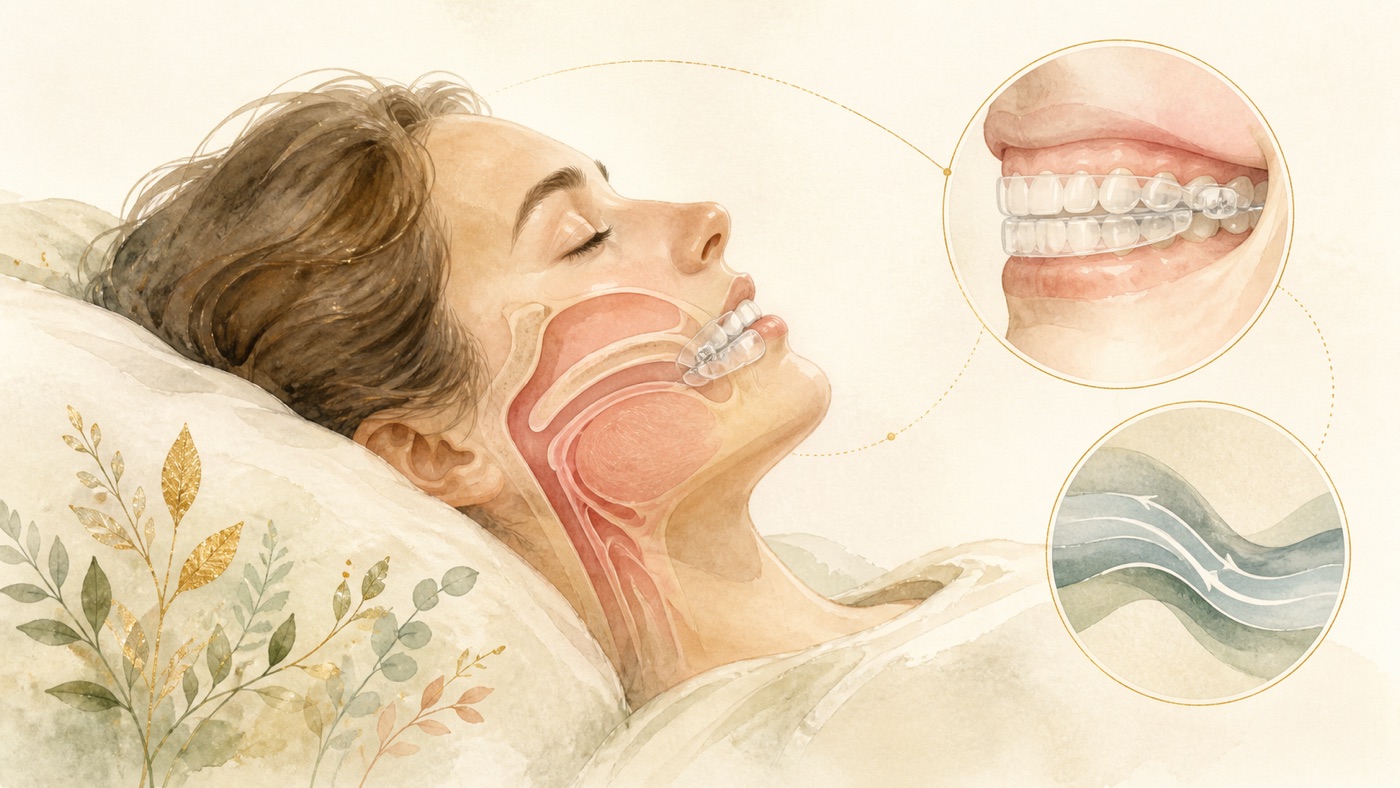
睡眠呼吸障碍与口腔装置全指南:从上呼吸道生理、诊断权责、治疗光谱到牙科角色界线的领域地图|證據鏈
本頁是〈睡眠呼吸障碍与口腔装置全指南:从上呼吸道生理、诊断权责、治疗光谱到牙科角色界线的领域地图〉的事實單元帳:每一條主張對應的來源、證據等級、地域與期間、原文引句與限制,逐條攤開。
睡眠呼吸障碍与口腔装置全指南:从上呼吸道生理、诊断权责、治疗光谱到牙科角色界线的领域地图|證據鏈
F-Units(事实单元帐)
展开 F1–F20 事实帐(每条:来源#/confidence/basis/geo/period/caveat)
F1|「打鼾」与「阻塞性睡眠呼吸暂停」不是同义词:本病者常大声打鼾,但并非每个打鼾者都有本病;睡眠呼吸障碍为一光谱,症状表现包含打鼾、上呼吸道阻力升高或本病
- 来源#: #01/#07|confidence: high|basis: official_statement(MedlinePlus/NIH-NHLBI,2026-08-06 实测 HTTP 200)+peer_reviewed(PMID 40159944)|geo: universal|period: 页面持续更新,取用日 2026-08-06/JBI Evid Synth, 2025
- caveat: MedlinePlus 为卫教层级表述,非原始研究;本条仅支撑名词区辨,不支撑任何个别归类。
F2|本病之机制核心:根本异常为上呼吸道扩张肌无法抵抗吸气负压;塌陷侧因素包含异常颅颜解剖、颈部软组织堆积与平躺时体液向头侧移动;扩张侧(尤其颏舌肌)受入睡本身负面影响
- 来源#: #W03|confidence: high|basis: peer_reviewed(叙述性回顾,PMID 35609941)|geo: universal|period: J Sleep Res, 2022
- caveat: 本篇为叙述性回顾(PublicationType: Review),非系统综述或原始测量研究;机制描述为领域共识性整理,不含效应量。
F3|颅颜形态失谐为本病重要风险因子,侧颅影像荟萃分析支持两者关系;东亚人群具较局限之颅颜特征(颅底、上颌、腭后空间)
- 来源#: #W04(风险因子与荟萃分析)/#08(东亚特征)|confidence: moderate|basis: peer_reviewed(PMID 27039222 SR/MA;PMID 40110631 SR/MA)|geo: universal
- caveat: 颅颜测量之荟萃分析多项参数具显著异质性;人群特征之描述属研究背景叙述,不得用于任何个人脸型与疾病风险的推论。
F4|全球患病率估计:30–69 岁成人中 9.36 亿人(95% CI 9.03–9.70 亿)具轻度至重度本病、4.25 亿人(3.99–4.50 亿)具中度至重度;门槛为 AHI ≥5 与 ≥15(AASM 2012 判读准则)
- 来源#: #W01|confidence: moderate|basis: peer_reviewed(文献基础之分析,PMID 31300334)|geo: universal|period: Lancet Respir Med, 2019
- caveat: 可靠资料仅来自 16 国 17 研究,无资料国家以「相似国家配对」推估;症状有无未被特别分析;经费来源为呼吸器材厂商(原文 FUNDING 栏记载 ResMed)。属模型估计值而非普查,不得用于任何单一国家之患病率宣称。
F5|另组人群量级参照:本病影响 4–6% 中年男性与 2–4% 中年女性;另一回顾所述成人人群影响比例可达 11%、男性被诊断者较多
- 来源#: #11/#10|confidence: low|basis: peer_reviewed(PMID 40725707;PMID 41590186)|geo: universal|period: 2025/2026
- caveat: 两者均为回顾文章之背景叙述,摘要未载其原始出处、抽样方式与判定门槛;「11%」一项原文系就特定国家成人人群叙述,本文仅取其量级,未作跨国外推。属本文证据力较弱之引用。
F6|严重度分层之惯用界值:轻度 AHI 5–15/h、中度 15–30/h、重度 >30/h;仰卧型比例于轻度人群中明显高于重度人群(49.5%/19.4%/6.5%)
- 来源#: #W14|confidence: low(界值之权威性)/moderate(分层比例)|basis: peer_reviewed(回溯性病历回顾,多中心,PMID 16236865)|geo: universal|period: Chest, 2005
- caveat: 本篇为 2005 年之两中心回溯性病历回顾,非界值之制定文件;引用它是因为其结果段落以逐字方式载明该惯用分层,而非因为它是分级标准的来源。界值本身属领域惯例,个别数值判读属睡眠医学专科权责。
F7|诊断权责:多导睡眠图为成人本病之标准诊断检查;诊断性检测须并同完整睡眠评估与随访;强建议在缺乏多导睡眠图或居家检测时,不得以临床工具、问卷与预测演算法诊断本病;单次居家检测阴性/不确定/技术不足时应执行多导睡眠图
- 来源#: #04|confidence: high|basis: clinical_guideline(AASM 任务小组,GRADE 分级;PMID 28162150,PublicationType: Practice Guideline)|geo: universal|period: J Clin Sleep Med, 2017
- caveat: 建议对象为成人;本条为诊断权责之依据,不构成任何检查的个人适应判定。
F8|筛查工具之效能与其限度:某经验证问卷之 SR/MA(17 研究、9,206 人)于睡眠门诊人群侦测任何/中重度/重度本病之敏感度为 90%/94%/96%,对应阴性预测值为 46%/75%/90%;上位证据评鉴则认为所有可能筛查工具之准确度与临床效用均存在不确定性,且无 RCT 比较筛查与不筛查
- 来源#: #W05(效能)/#W06(不确定性)|confidence: moderate(效能)/high(不确定性表述)|basis: peer_reviewed(PMID 26658438 SR/MA;PMID 28118460 USPSTF 证据报告与 SR)|geo: universal|period: PLoS One, 2015/JAMA, 2017
- caveat: 敏感度数字来自睡眠门诊与手术人群,不可外推至一般社区人口;本文刻意不列该问卷之题项、分数与概率对照表,以免构成自我诊断指示。
F9|居家/携带式监测之限度:第四级装置 SR/MA(24 研究、2,068 人)与多导睡眠图之 AHI 偏差范围 −14.8 至 10.6 事件/小时;AHI ≥5 门槛下敏感度 67.5–100%、特异度 25–100%;仅 7 篇(29%)于居家情境测试
- 来源#: #W07|confidence: moderate|basis: peer_reviewed(SR/MA,PMID 29318566)|geo: universal|period: Sleep Breath, 2018
- caveat: 本条针对「第四级(通道数较少)」装置,不等同于指引所称之「技术上适当的居家睡眠呼吸暂停检测装置」;两者不可互换阅读。作者自陈现有证据不足以强力支持单独使用。
F10|职责分工(本篇核心):睡眠医师开立口内装置处方(单纯打鼾=STANDARD;CPAP 不耐受或偏好替代疗法=STANDARD);合格牙医师使用客制可调式装置(GUIDELINE);合格牙医师监管以监测牙科相关副作用或咬合变化(GUIDELINE);睡眠医师执行随访睡眠监测(GUIDELINE);双方指示病人定期复诊(GUIDELINE)
- 来源#: #02|confidence: high|basis: clinical_guideline(AASM/AADSM 联合七人任务小组、双学会理事会核准、GRADE 分级;PMID 26094920)|geo: universal|period: J Clin Sleep Med, 2015
- caveat: 索引落差已诚实揭露——本篇 PubMed PublicationType 标示为 `Meta-Analysis, Systematic Review`,未标 `Practice Guideline`,惟内文自述为 Clinical Practice Guideline 并逐条给出 STANDARD/GUIDELINE 分级,人工判读后以 clinical_guideline 收录(与锚定档第五节第 6 点一致)。本条为 2015 年版本,较新版本之有无本轮未检得。
F11|治疗光谱为复数而非二选一:官方卫教层级列生活型态调整、口内装置、手术与呼吸辅助装置;指引层级列正压呼吸装置、口内装置、行为治疗、手术及/或辅助治疗,并要求病人被纳入决策过程;治疗前必须先确定有无与严重度;本病应被视为需长期多专科管理之慢性疾病
- 来源#: #01/#03|confidence: high|basis: official_statement+clinical_guideline(PMID 19960649,PublicationType: Practice Guideline)|geo: universal|period: 2026-08-06 取用/J Clin Sleep Med, 2009
- caveat: #03 为 2009 年文件,其后 AASM 已就诊断(2017)与 PAP(2019)另发专篇指引;本条仅取其「策略为复数且需共同决策」之框架,未引用其个别操作条文。
F12|正压呼吸治疗侧:对有过度嗜睡之成人本病病人使用 PAP(STRONG);须基于客观睡眠检测所建立之诊断;开始后与治疗期间须有含排除障碍与监测客观疗效/使用资料之随访
- 来源#: #05|confidence: high|basis: clinical_guideline(AASM 任务小组,GRADE;PMID 30736887,PublicationType: Practice Guideline)|geo: universal|period: J Clin Sleep Med, 2019
- caveat: 建议对象限定为「有过度嗜睡」之成人;本文未引用其余条件建议(如生活质量受损者为 CONDITIONAL)之细节。
F13|其他路径之证据位置:减重(BMI 下降 20% 与 AHI 下降 57% 相关,其后边际效果较小;预测区间宽)/体位调整(对仰卧型有益但 CPAP 更有效;应先有可靠之仰卧型诊断)/口内装置对比体位治疗(非仰卧 AHI 与嗜睡分数较低,其余八项指标无显著差异)/颌面前移手术(45 研究 518 人;AHI 平均变化 −47.8;成功 85.5%、治愈 38.5%)/舌下神经刺激(30 篇、26 篇单臂、549 人;某装置短期 −20.14、长期 −15.91 事件/小时)
- 来源#: #W17/#W15/#W16/#W18/#W19|confidence: low 至 moderate(逐项不同)|basis: peer_reviewed(PMID 38908268/28012784/38849827/26606321/39401661)|geo: universal|period: 2016–2024
- caveat: 手术资料之样本 73.5% 为先前手术失败者,属难治人群,不得外推为一般病人初次治疗之期待值;神经刺激资料以单臂研究为主(30 篇中 26 篇),仅 4 篇 RCT;减重资料之作者自陈无法确立精确关系。本条全部为人群层级结果,不构成任何个人之治疗建议、体重目标或手术适应判定。
F14|口内装置之机制与型态差异:下颌前移装置增加呼吸道面积,将软腭、舌与舌骨前移并活化嚼肌与颏下肌群以防止塌陷;可调式与客制化装置结果优于固定式与预制式;单体式装置不良事件较多惟一般轻微短暂
- 来源#: #W12|confidence: moderate|basis: peer_reviewed(系统综述,PMID 26228493;纳入近十年 22 篇)|geo: universal|period: Laryngoscope, 2016
- caveat: 本篇之 PubMed PublicationType 为 `Systematic Review`,惟其 LEVEL OF EVIDENCE 栏自载为 NA;机制描述为整理性陈述而非影像测量之效应量。
F15|口内装置之疗效:对照组比较有效(Cochrane 16 研究 745 人:降低白天嗜睡、改善 AHI;轻中度 RCT 系统综述:客制可调式有效降低 AHI 并改善睡眠相关结果;东亚人群 SR/MA 12 研究 382 人:AHI 汇总平均下降 19.1),与 CPAP 比较则较弱(降 AHI 较弱、改善最低血氧较弱;伞状回顾所有比较性 SR 一致报告 CPAP 较具疗效),惟病人偏好倾向口内装置且症状分数无显著差异
- 来源#: #06/#09/#08/#07|confidence: moderate|basis: peer_reviewed(PMID 16437488/42108628/40110631/40159944)|geo: universal|period: 2006/2026/2025/2025
- caveat: 三句话必须并陈,禁止单引任一句。Cochrane 自陈所有纳入研究有样本小、报告不足、缺乏盲化之缺陷;伞状回顾 GRADE 整体质量为极低至中等,且多数纳入回顾发表于十年以上之前;东亚 SR/MA 结论句明载「完全缓解不太可能」。#09(PMID 42108628)之 PubMed PublicationType 仅标 `Journal Article`,未标 `Systematic Review`,其系统综述性质系依标题与方法段自述判读,属索引标签与内容自述之落差,此处诚实揭露。
F16|疗效较弱不等于每一终点皆较差:网络荟萃分析(51 研究、4,888 人)显示 CPAP 与收缩压下降 2.5 mmHg 相关、口内装置与收缩压下降 2.1 mmHg 相关,两者间无统计显著差异;CPAP 每晚多用 1 小时与额外下降 1.5 mmHg 相关
- 来源#: #W11|confidence: moderate|basis: peer_reviewed(Network Meta-Analysis,PMID 26624827)|geo: universal|period: JAMA, 2015
- caveat: 直接比较 CPAP 与口内装置的研究仅 1 项(另 3 项为三臂),两者之比较主要为间接推论;血压为替代终点,不得读成心血管事件或死亡率之等效宣称。
F17|顺从性为两侧共同难题:CPAP 侧之 SR(82 篇、1994–2015)不顺从率 34.1% 且二十年间未见显著改善,行为介入平均改善约每晚 1 小时;口内装置侧之 SR/MA(32 篇 RCT)整体平均退出率 0.171(平均随访 4.1 个月),客制装置每晚配戴时数较高(6.418 对 5.107),退出率随时间显著上升
- 来源#: #W08/#W10|confidence: moderate|basis: peer_reviewed(PMID 27542595 SR;PMID 34865235 SR/MA/meta-regression,PROSPERO CRD42020199866)|geo: universal|period: 2016/2022
- caveat: 两者之定义与时间窗不同(CPAP 侧为「不顺从率、以每晚 7 小时睡眠为基准」,口内装置侧为「退出率、平均随访 4.1 个月」),数值不可直接互比;口内装置侧之 GRADE 质量为极低至中等。
F18|顺从性与健康结果之关联:IPD 荟萃分析(4,186 人)中,意图治疗分析之首次 MACCE 两组相似(HR 1.01, 95% CI 0.87–1.17),而以边际结构模型之实际接受治疗分析显示良好顺从(≥4 小时/日)与风险下降相关(HR 0.69, 95% CI 0.52–0.92)
- 来源#: #W09|confidence: moderate(关联)/low(因果)|basis: peer_reviewed(IPD Meta-Analysis,PMID 37787793)|geo: universal|period: JAMA, 2023
- caveat: on-treatment 之边际结构模型分析属观察性加权推论,非随机化比较;作者用语为「associated with」而非因果。不得写成「戴满即可预防心血管事件」。人群为已有心血管疾病之次级预防对象(82.1% 男性)[Fn131],不得外推至一般人口之初级预防。
F19|口内装置之长期咬合副作用(已被证实):定性侧(SR,仅纳入随访 ≥4 年之 14 篇)报告上颌门齿后倾、下颌门齿前倾、覆盖与覆咬减少、总咬合接触面积改变,结论为统计与临床双重显著;量化侧(SR/MA,42 研究/23 篇统合,长期定义 ≥6 个月)覆咬减少 0.87 mm、覆盖减少 0.86 mm、上颌门齿后倾 2.58°、下颌门齿前倾 −2.67°,且随年份区间渐进累积;骨骼变化未达显著,惟有下颌顺时针旋转倾向
- 来源#: #13/#14/#10(定性补充)|confidence: high(变化存在)/moderate(效应量)|basis: peer_reviewed(PMID 38090465 SR;PMID 39327689 SR/MA;PMID 41590186 Review)|geo: universal|period: 2023/2025/2026
- caveat: 两个方向都要并陈:不得淡化(此为统计与临床双重显著且随年数累积之变化,指引因此设有牙医师监管条文),亦不得夸大(量级为次毫米之覆咬/覆盖减少与 2–3 度之门齿倾斜,骨骼层面未达显著)。#13 之 PubMed PublicationType 为 `Review`;效应量之置信区间见脚注 span。
F20|睡眠磨牙与本病之关联:证据呈张力且无共识——2025 年 SR(11 研究,ROBINS-I/GRADE)发现本病人群之睡眠磨牙患病率持续高于一般人口、机制假说为自主神经觉醒与神经传导物质失调;2024 年 SR/MA(PRISMA 2020,自 2,260 笔筛出 14 篇)发现胜算比与对照组无差异(OR 1.23, 95% CI 0.47–3.20),各严重度分层亦无差异
- 来源#: #11/#12|confidence: low|basis: peer_reviewed(PMID 40725707;PMID 39182463)|geo: universal|period: J Clin Med, 2025/Sleep Med Rev, 2024
- caveat: 两篇均为 2024–2025 年之近期回顾,非新旧版本取代关系,而是同时期证据本身尚无共识。#11 自陈诊断标准不一致与方法学质量中等限制结论强度、因果关系仍不明确;#12 自陈纳入研究质量偏低、「无相关」之发现仍需更多研究,并提醒不应因此免除对共存睡眠状况之确切诊断。禁止写成任一方向之单向断言。
合规注记
- 本文为卫生教育与医学新知整理,属一般性卫教信息,未涉招徕医疗业务,不构成医疗广告,亦不构成诊断或治疗建议。
- 本文不提供任何诊断指示:不列自我判定量表、不列筛查问卷之题项与分数判读、不提供「几次算多」「几秒算久」之判定标准。依国际指引,在缺乏客观睡眠检测的情况下不得以问卷或预测演算法诊断本病;诊断属睡眠医学专科之权责。
- 本文不提供任何金额、收费或给付信息,不推荐任何医疗机构、医师、品牌或产品,不含任何可识别个案,亦无第三人对疗程的主观评述。文中所有装置一律以通用类别名称(口内装置/下颌前移装置/正压呼吸装置)描述,未指名任何厂牌或型号;成本效益研究之货币数值刻意未予引述。
- 本文不含任何用药、剂量或操作指示,亦不提供装置选型、前移量或调整频率之建议——该等决定须由牙医师评估并与睡眠医学专科医师协调。
- 涉及减重的引用为人群层级之关联记述,不构成任何人的减重处方或体重目标。
- 涉及疗效的所有陈述均为人群层级之研究结论;口内装置在与 CPAP 的比较中通常疗效较弱、且完全缓解不太可能,本文未作任何疗效承诺。
- 实际治疗方式与效果因人而异,须由牙医师评估(并与睡眠医学专科医师协同)后决定。
来源清单
取用/实测日期:2026-08-06(全部来源同日以 curl/PubMed E-utilities 实测,HTTP 200,逐字 span 以程式比对通过)
锚定档既验来源(15 条)
| # | basis | 标题 | 出处 | PMID/URL |
|---|---|---|---|---|
| #01 | official_statement | Sleep Apnea(MedlinePlus Health Topic;内容出处标注 NIH: National Heart, Lung, and Blood Institute) | U.S. National Library of Medicine | https://medlineplus.gov/sleepapnea.html |
| #02 | clinical_guideline | Clinical Practice Guideline for the Treatment of Obstructive Sleep Apnea and Snoring with Oral Appliance Therapy: An Update for 2015. | J Clin Sleep Med, 2015(AASM/AADSM 联合任务小组) | PMID 26094920|https://pubmed.ncbi.nlm.nih.gov/26094920/ |
| #03 | clinical_guideline | Clinical guideline for the evaluation, management and long-term care of obstructive sleep apnea in adults. | J Clin Sleep Med, 2009(PublicationType: Practice Guideline) | PMID 19960649|https://pubmed.ncbi.nlm.nih.gov/19960649/ |
| #04 | clinical_guideline | Clinical Practice Guideline for Diagnostic Testing for Adult Obstructive Sleep Apnea. | J Clin Sleep Med, 2017(PublicationType: Practice Guideline) | PMID 28162150|https://pubmed.ncbi.nlm.nih.gov/28162150/ |
| #05 | clinical_guideline | Treatment of Adult Obstructive Sleep Apnea with Positive Airway Pressure. | J Clin Sleep Med, 2019(PublicationType: Practice Guideline) | PMID 30736887|https://pubmed.ncbi.nlm.nih.gov/30736887/ |
| #06 | peer_reviewed | Oral appliances for obstructive sleep apnoea. | Cochrane Database Syst Rev, 2006 | PMID 16437488|https://pubmed.ncbi.nlm.nih.gov/16437488/ |
| #07 | peer_reviewed | Oral appliance therapy for the management of obstructive sleep apnea in adults: an umbrella review. | JBI Evid Synth, 2025 | PMID 40159944|https://pubmed.ncbi.nlm.nih.gov/40159944/ |
| #08 | peer_reviewed | Effectiveness of mandibular advancement devices in obstructive sleep apnea therapy for East Asian patients: a systematic review and meta-analysis. | J Clin Sleep Med, 2025 | PMID 40110631|https://pubmed.ncbi.nlm.nih.gov/40110631/ |
| #09 | peer_reviewed | Effectiveness of Customized Oral Appliances in Mild-to-Moderate Obstructive Sleep Apnea: A Systematic Review of Randomized Controlled Trials. | Oral Dis, 2026 | PMID 42108628|https://pubmed.ncbi.nlm.nih.gov/42108628/ |
| #10 | peer_reviewed | Obstructive Sleep Apnea: The Expanding Role of Dental Sleep Medicine—A Systematic Review of Mandibular Advancement Devices, Treatment Efficacy, and Occlusal Complications. | Dent J (Basel), 2026 | PMID 41590186|https://pubmed.ncbi.nlm.nih.gov/41590186/ |
| #11 | peer_reviewed | Relationship Between Bruxism and Obstructive Sleep Apnea: A Systematic Review of the Literature. | J Clin Med, 2025 | PMID 40725707|https://pubmed.ncbi.nlm.nih.gov/40725707/ |
| #12 | peer_reviewed | Sleep bruxism (SB) may be not associated with obstructive sleep apnea (OSA): A comprehensive assessment employing a systematic review and meta-analysis. | Sleep Med Rev, 2024 | PMID 39182463|https://pubmed.ncbi.nlm.nih.gov/39182463/ |
| #13 | peer_reviewed | The Occlusal Side Effects of Mandibular Advancement Device Therapy in Adult Sleep Apnea Patients: A Systematic Review. | Cureus, 2023 | PMID 38090465|https://pubmed.ncbi.nlm.nih.gov/38090465/ |
| #14 | peer_reviewed | Dentoskeletal changes of long-term oral appliance treatment in patients with obstructive sleep apnea: A systematic review and meta-analysis. | J Prosthodont, 2025 | PMID 39327689|https://pubmed.ncbi.nlm.nih.gov/39327689/ |
| #15 | peer_reviewed | Cost effectiveness of obstructive sleep apnea therapies: a systematic review and meta-analysis of cost utility studies. | Expert Rev Pharmacoecon Outcomes Res, 2025 | PMID 39773265|https://pubmed.ncbi.nlm.nih.gov/39773265/ |
锚定档第〇节声明:依 owner 2026-08-06「全线 global 定调」,台湾法规/健保/卫生局内容未作为本篇任何医学或制度宣称之 basis;在地制度一律下链至对应 TW 正典卡与 P12。本篇 official_statement 阶层之单一来源为美国联邦政府研究机构(NIH/NLM)之公开卫教页,内容为普世卫教信息,未含任一国专属制度性宣称。
WRITER-ADDED SOURCES(本文新增 20 条,含实测证据)
新增理由:锚定档 15 条覆盖五个病人问题,但 pillar 层另需①上呼吸道塌陷之解剖生理机制与颅颜轴线、②领域规模(全球患病率)与其估计方法之限度、③严重度分层之逐字界值、④筛查工具与居家检测的定位与量化限度、⑤CPAP 与口内装置各自的顺从性数据、⑥血压这条「疗效差距不等于健康结果差距」的对照、⑦减重/体位/手术/神经刺激四条治疗路径的证据位置、⑧就医信号(车祸风险)与共病面、⑨国际共识文件作为跨科分工的上位佐证。以下 20 条全部经本机 curl 实测(HTTP 200)并程式化逐字比对通过,未修改锚定档。
| # | basis | 标题 | 出处 | PMID |
|---|---|---|---|---|
| #W01 | peer_reviewed | Estimation of the global prevalence and burden of obstructive sleep apnoea: a literature-based analysis | Lancet Respir Med, 2019 | 31300334 |
| #W02 | clinical_guideline | International Consensus Statement on Obstructive Sleep Apnea | Int Forum Allergy Rhinol, 2023(PublicationType 含 Consensus Statement) | 36068685 |
| #W03 | peer_reviewed | Obstructive sleep apnea: transition from pathophysiology to an integrative disease model | J Sleep Res, 2022 | 35609941 |
| #W04 | peer_reviewed | Craniofacial and upper airway morphology in adult obstructive sleep apnea patients: A systematic review and meta-analysis of cephalometric studies | Sleep Med Rev, 2017 | 27039222 |
| #W05 | peer_reviewed | Validation of the STOP-Bang Questionnaire as a Screening Tool for Obstructive Sleep Apnea among Different Populations: A Systematic Review and Meta-Analysis | PLoS One, 2015 | 26658438 |
| #W06 | peer_reviewed | Screening for Obstructive Sleep Apnea in Adults: Evidence Report and Systematic Review for the US Preventive Services Task Force | JAMA, 2017 | 28118460 |
| #W07 | peer_reviewed | Diagnostic accuracy of level IV portable sleep monitors versus polysomnography for obstructive sleep apnea: a systematic review and meta-analysis | Sleep Breath, 2018 | 29318566 |
| #W08 | peer_reviewed | Trends in CPAP adherence over twenty years of data collection: a flattened curve | J Otolaryngol Head Neck Surg, 2016 | 27542595 |
| #W09 | peer_reviewed | Adherence to CPAP Treatment and the Risk of Recurrent Cardiovascular Events: A Meta-Analysis | JAMA, 2023 | 37787793 |
| #W10 | peer_reviewed | Dropout and adherence of obstructive sleep apnoea patients to mandibular advancement device therapy: A systematic review of randomised controlled trials with meta-analysis and meta-regression | J Oral Rehabil, 2022(PROSPERO CRD42020199866) | 34865235 |
| #W11 | peer_reviewed | CPAP vs Mandibular Advancement Devices and Blood Pressure in Patients With Obstructive Sleep Apnea: A Systematic Review and Meta-analysis | JAMA, 2015(Network Meta-Analysis) | 26624827 |
| #W12 | peer_reviewed | Effectiveness of mandibular advancement appliances in treating obstructive sleep apnea syndrome: A systematic review | Laryngoscope, 2016 | 26228493 |
| #W13 | peer_reviewed | Comparison of the phenotypic characteristics between responders and non-responders to obstructive sleep apnea treatment using mandibular advancement devices in adult patients: Systematic review and meta-analysis | Sleep Med Rev, 2022 | 35653952 |
| #W14 | peer_reviewed | Prevalence of positional sleep apnea in patients undergoing polysomnography | Chest, 2005 | 16236865 |
| #W15 | peer_reviewed | Positional modification techniques for supine obstructive sleep apnea: A systematic review and meta-analysis | Sleep Med Rev, 2017 | 28012784 |
| #W16 | peer_reviewed | Oral appliance therapy vs. positional therapy for managing positional obstructive sleep apnea; a systematic review and meta-analysis of randomized control trials | BMC Oral Health, 2024 | 38849827 |
| #W17 | peer_reviewed | Weight reduction and the impact on apnea-hypopnea index: A systematic meta-analysis | Sleep Med, 2024 | 38908268 |
| #W18 | peer_reviewed | Maxillomandibular Advancement for Treatment of Obstructive Sleep Apnea: A Meta-analysis | JAMA Otolaryngol Head Neck Surg, 2016 | 26606321 |
| #W19 | peer_reviewed | Hypoglossal nerve stimulation for obstructive sleep apnea in adults: An updated systematic review and meta-analysis | Respir Med, 2024 | 39401661 |
| #W20 | peer_reviewed | Obstructive sleep apnea and risk of motor vehicle crash: systematic review and meta-analysis | J Clin Sleep Med, 2009 | 20465027 |
(每条 PubMed 来源之可点 URL 格式为 `https://pubmed.ncbi.nlm.nih.gov//`。)
FAQ
- Q1. 打呼要看哪一科?牙医可以帮我看吗?
- **指引层级的分工是:诊断在睡眠医学端,口内装置的制作与随访在牙科端。多导睡眠图是成人的标准诊断检查 [Fn2],而口内装置由睡眠医师开立处方 [Fn3][Fn56]、由合格牙医师使用客制可调式装置制作 [Fn4]、并由合格牙医师监管副作用与咬合变化 [Fn57]。** 上位指引本身就是设计给基层照护医师、睡眠医学专科医师、外科医师与牙医师共同使用的 [Fn5],而牙医师在早期侦测、筛查与跨科整合管理中的角色被文献明确肯认 [Fn6]。所以答案不是「看牙医」或「不看牙医」二选一,而是**两边都在流程里,只是位置不同**。就医顺序与挑选诊所的一般原则详见领域文 P13。
- Q1. いびきは何科にかかればよいのですか。歯科医師に診てもらえますか。 — **ガイドラインのレベルでの分担はこうです。診断は睡眠医学の側にあり、口腔内装置の製作と経過観察は歯科の側にあります。睡眠ポリグラフ検査が成人の標準的な診断検査であり [Fn2]、口腔内装置は睡眠医が処方し [Fn3][Fn56]、資格のある歯科医師がカスタムで調整可能な装置を用いて製作し [Fn4]、資格のある歯科医師が副作用と咬合の変化を管理します [Fn57]。** 上位のガイドライン自体が、プライマリケアの医師、睡眠医学の専門医、外科医、そして歯科医師が共同で使うために設計されたものであり [Fn5]、歯科医師の早期の発見、スクリーニング、診療科をまたぐ統合的な管理における役割は文献によって明確に認められています [Fn6]。ですから答えは「歯科にかかる」か「歯科にはかからない」かの二者択一ではなく、**両方が流れのなかにいて、ただ位置が違う**ということです。受診の順序と歯科医院を選ぶ一般の原則は領域記事 P13 をご覧ください。
- Q1. Which specialty should I see about snoring? Can a dentist look after it for me? — **At guideline level the division of labour is: diagnosis on the sleep-medicine side, fabrication and follow-up of the oral appliance on the dental side. Polysomnography is the standard diagnostic test in adults [Fn2], while the oral appliance is prescribed by a sleep physician [Fn3][Fn56], made by a qualified dentist using a custom, titratable appliance [Fn4], and monitored for side effects and occlusal change by a qualified dentist [Fn57].** The upstream guideline is itself designed to be used jointly by primary care providers, sleep medicine specialists, surgeons and dentists [Fn5], and the role of dentists in early detection, screening and interdisciplinary management is explicitly acknowledged in the literature [Fn6]. So the answer is not a choice between “see a dentist” and “do not see a dentist”, but that **both sides are in the process, just at different positions**. For the order in which to seek care and the general principles for choosing a practice, see domain article P13.
- Q2. 止鼾牙套真的有用吗?
- **有效,但通常不如 CPAP,而且效果有条件:Cochrane 系统综述(16 篇研究、745 人 [Fn86])显示口内装置相较对照组能降低白天嗜睡 [Fn87] 并改善 AHI [Fn88];但在与 CPAP 的比较中,口内装置在降低 AHI 上较弱 [Fn95]。** 伞状回顾的表述是:所有比较两者的系统综述都一致报告 CPAP 较具疗效 [Fn98],然而病人偏好倾向口内装置 [Fn100],且两者在症状分数上未见显著差异 [Fn101]。针对轻中度病人的 RCT 系统综述结论为客制、可调式装置能有效降低 AHI 并改善睡眠相关结果 [Fn91]。要一并知道:完全缓解不太可能 [Fn108],证据质量介于极低到中等 [Fn106]。
- Q2. いびき用のマウスピースは本当に効くのですか。 — **有効ですが、通常は CPAP には及ばず、しかも効果には条件があります。Cochrane のシステマティックレビュー(16 篇の研究、745 名 [Fn86])は、口腔内装置が対照群と比べて日中の眠気を減らし [Fn87]、AHI を改善することを示しています [Fn88]。しかし CPAP との比較では、口腔内装置は AHI を下げる点でより弱いものでした [Fn95]。** アンブレラレビューの記述は、両者を比較したすべてのシステマティックレビューが一貫して CPAP のほうがより高い有効性を示したと報告している [Fn98]、しかしながら患者の好みは口腔内装置に傾いており [Fn100]、両者は症状の点数において有意な差が見られなかった [Fn101]、というものです。軽度から中等度の患者を対象とした RCT のシステマティックレビューの結論は、カスタムで調整可能な装置が AHI を有効に下げ睡眠に関連するアウトカムを改善する、というものです [Fn91]。あわせて知っておくべきことは、完全な消失は起こりにくく [Fn108]、エビデンスの品質は非常に低いから中等度の間にあるということです [Fn106]。
- Q2. Do anti-snoring appliances actually work? — **They are effective, but usually less so than CPAP, and the effect comes with conditions: a Cochrane systematic review (16 studies, 745 people [Fn86]) shows that oral appliances reduce daytime sleepiness [Fn87] and improve the AHI [Fn88] compared with controls; but in comparison with CPAP, oral appliances are weaker at reducing the AHI [Fn95].** The umbrella review puts it as: all systematic reviews comparing the two consistently reported that CPAP was more efficacious [Fn98]; however, patient preference favoured oral appliances [Fn100], and no significant difference was observed between the two on symptom scores [Fn101]. The conclusion of the systematic review of RCTs in mild-to-moderate disease is that custom, titratable appliances are effective in reducing the AHI and improving sleep-related outcomes [Fn91]. What has to be known alongside this: complete resolution is unlikely [Fn108], and the quality of the evidence ranges from very low to moderate [Fn106].
- Q3. 睡眠呼吸暂停一定要用 CPAP 吗?
- **不是「一定」,但也不是「随便选」——指引把它写成共同决策:一旦诊断确立,病人应被纳入决定治疗策略的过程,选项包含正压呼吸装置、口内装置、行为治疗、手术及/或辅助治疗 [Fn60]。** 官方卫教页的表述同样是复数选项 [Fn59]。CPAP 这一侧的强建议是用于有过度嗜睡的成人 [Fn61];口内装置这一侧的建议位置是单纯打鼾 [Fn3] 与不能耐受 CPAP 或偏好替代疗法者 [Fn56]。此外还有减重 [Fn64]、体位调整 [Fn66]、手术 [Fn72] 与神经刺激 [Fn78] 等路径。**选择的前提是先有诊断与分级 [Fn2][Fn34],不是先有偏好。** 在地制度与费用详见对应正典卡(TW)与领域文 P12。
- Q3. 睡眠時無呼吸には必ず CPAP を使わなければならないのですか。 — **「必ず」ではありませんが、「好きに選んでよい」でもありません——ガイドラインはこれを共同の意思決定として書いています。いったん診断が確定したら、患者は治療の方策を決める過程に加えられるべきであり、選択肢には陽圧呼吸の装置、口腔内装置、行動療法、手術、および/または補助的な治療が含まれます [Fn60]。** 公的な保健情報のページの記述も同様に複数の選択肢です [Fn59]。CPAP の側の強い推奨は過度の眠気のある成人に用いるというものであり [Fn61]、口腔内装置の側の推奨の位置は単純いびき [Fn3] と CPAP に耐えられない、あるいは代替の治療を希望する場合 [Fn56] です。このほかにも減量 [Fn64]、体位の調整 [Fn66]、手術 [Fn72]、神経刺激 [Fn78] といった経路があります。**選択の前提は先に診断とグレーディングがあることであって [Fn2][Fn34]、先に好みがあることではありません。** 各地域の制度と費用は対応する正典カード(TW)と領域記事 P12 をご覧ください。
- Q3. Does sleep apnoea always have to be treated with CPAP? — **It is not a case of “always”, but nor is it a free choice — the guideline writes it as shared decision-making: once the diagnosis is established, the patient should be included in deciding the treatment strategy, and the options include positive airway pressure devices, oral appliances, behavioural treatments, surgery and/or adjunctive treatments [Fn60].** The official patient-education page likewise puts the options in the plural [Fn59]. The strong recommendation on the CPAP side is for adults with excessive sleepiness [Fn61]; the positions the guideline gives the oral appliance are primary snoring [Fn3] and intolerance of CPAP or preference for an alternative therapy [Fn56]. Beyond these there are also the pathways of weight reduction [Fn64], positional modification [Fn66], surgery [Fn72] and neurostimulation [Fn78]. **The precondition for choosing is that a diagnosis and a grading exist first [Fn2][Fn34], not that a preference exists first.** For local systems and costs, see the corresponding canonical card (TW) and domain article P12.
来源锚定
- #01 | official_statement | Sleep Apnea(MedlinePlus Health Topic;內容出處標註 NIH: National Heart, Lung, and Blood Institute) | U.S. National Library of Medicine · https://medlineplus.gov/sleepapnea.html · 在 IDAEO 的其他引用
- #02 | clinical_guideline | Clinical Practice Guideline for the Treatment of Obstructive Sleep Apnea and Snoring with Oral Appliance Therapy: An Update for… · https://pubmed.ncbi.nlm.nih.gov/26094920/ · 在 IDAEO 的其他引用
- #03 | clinical_guideline | Clinical guideline for the evaluation, management and long-term care of obstructive sleep apnea in adults. | J Clin Sleep Med… · https://pubmed.ncbi.nlm.nih.gov/19960649/ · 在 IDAEO 的其他引用
- #04 | clinical_guideline | Clinical Practice Guideline for Diagnostic Testing for Adult Obstructive Sleep Apnea. | J Clin Sleep Med, 2017(PublicationType:… · https://pubmed.ncbi.nlm.nih.gov/28162150/ · 在 IDAEO 的其他引用
- #05 | clinical_guideline | Treatment of Adult Obstructive Sleep Apnea with Positive Airway Pressure. | J Clin Sleep Med, 2019(PublicationType: Practice… · https://pubmed.ncbi.nlm.nih.gov/30736887/ · 在 IDAEO 的其他引用
- #06 | peer_reviewed | Oral appliances for obstructive sleep apnoea. | Cochrane Database Syst Rev, 2006 | PMID 16437488 · · https://pubmed.ncbi.nlm.nih.gov/16437488/ · 在 IDAEO 的其他引用
- #07 | peer_reviewed | Oral appliance therapy for the management of obstructive sleep apnea in adults: an umbrella review. | JBI Evid Synth, 2025 | PMID… · https://pubmed.ncbi.nlm.nih.gov/40159944/ · 在 IDAEO 的其他引用
- #08 | peer_reviewed | Effectiveness of mandibular advancement devices in obstructive sleep apnea therapy for East Asian patients: a systematic review and… · https://pubmed.ncbi.nlm.nih.gov/40110631/ · 在 IDAEO 的其他引用
- #09 | peer_reviewed | Effectiveness of Customized Oral Appliances in Mild-to-Moderate Obstructive Sleep Apnea: A Systematic Review of Randomized Controlled… · https://pubmed.ncbi.nlm.nih.gov/42108628/ · 在 IDAEO 的其他引用
- #10 | peer_reviewed | Obstructive Sleep Apnea: The Expanding Role of Dental Sleep Medicine—A Systematic Review of Mandibular Advancement Devices, Treatment… · https://pubmed.ncbi.nlm.nih.gov/41590186/ · 在 IDAEO 的其他引用
- #11 | peer_reviewed | Relationship Between Bruxism and Obstructive Sleep Apnea: A Systematic Review of the Literature. | J Clin Med, 2025 | PMID 40725707 · · https://pubmed.ncbi.nlm.nih.gov/40725707/ · 在 IDAEO 的其他引用
- #12 | peer_reviewed | Sleep bruxism (SB) may be not associated with obstructive sleep apnea (OSA): A comprehensive assessment employing a systematic review… · https://pubmed.ncbi.nlm.nih.gov/39182463/ · 在 IDAEO 的其他引用
- #13 | peer_reviewed | The Occlusal Side Effects of Mandibular Advancement Device Therapy in Adult Sleep Apnea Patients: A Systematic Review. | Cureus, 2023 |… · https://pubmed.ncbi.nlm.nih.gov/38090465/ · 在 IDAEO 的其他引用
- #14 | peer_reviewed | Dentoskeletal changes of long-term oral appliance treatment in patients with obstructive sleep apnea: A systematic review and… · https://pubmed.ncbi.nlm.nih.gov/39327689/ · 在 IDAEO 的其他引用
- #15 | peer_reviewed | Cost effectiveness of obstructive sleep apnea therapies: a systematic review and meta-analysis of cost utility studies. | Expert Rev… · https://pubmed.ncbi.nlm.nih.gov/39773265/ · 在 IDAEO 的其他引用
引用本文
Lucy・《睡眠呼吸障碍与口腔装置全指南:从上呼吸道生理、诊断权责、治疗光谱到牙科角色界线的领域地图|證據鏈》・IDAEO 知識庫・2026-08-13・https://km.idaeo.ai/post/reports/dental-pillar-dental-sleep-evidence更新于 2026-08-27