

🏛 Part of the "reports" topic shelf →
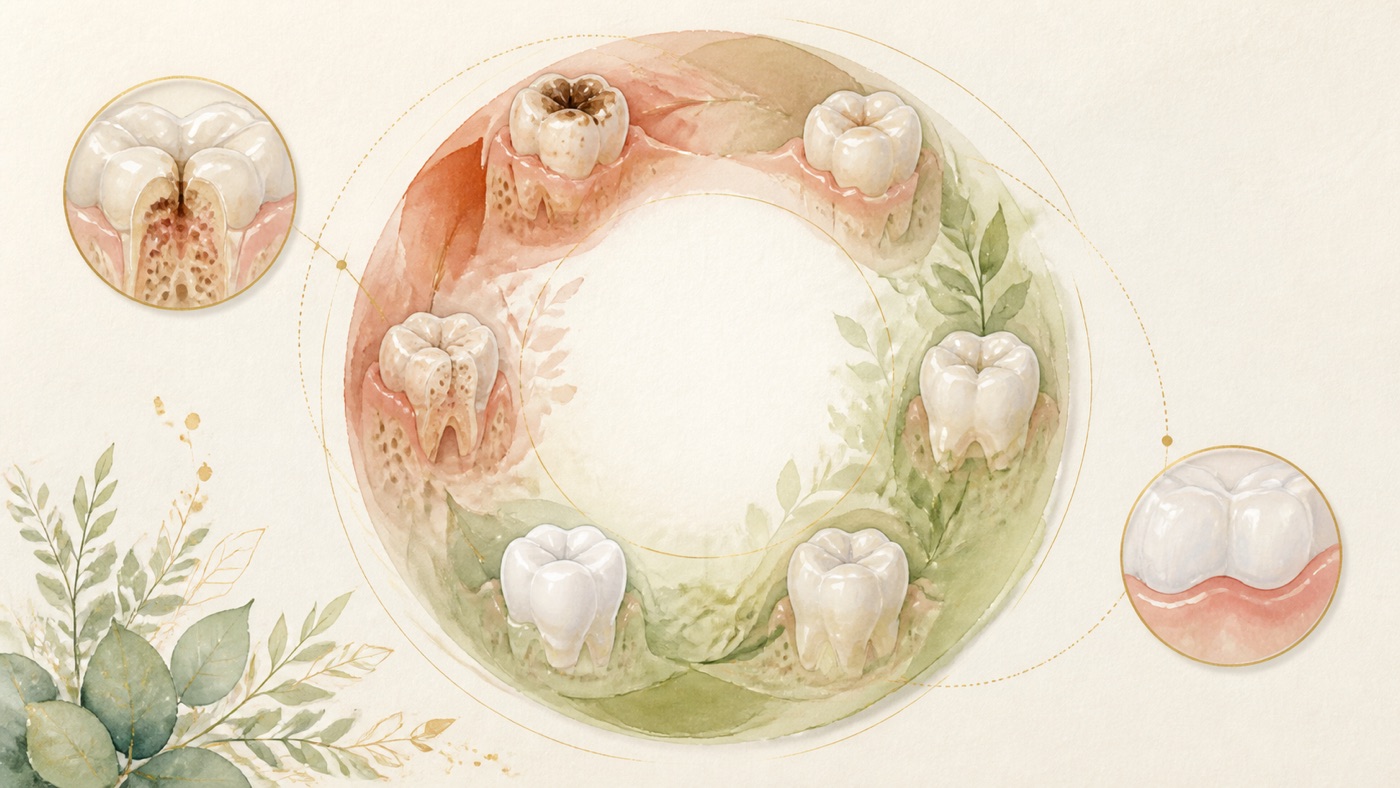
The Complete Guide to Tooth Decay and Fillings: a domain map from the line of reversibility to the restorative cycle|證據鏈
本頁是〈The Complete Guide to Tooth Decay and Fillings: a domain map from the line of reversibility to the restorative cycle〉的事實單元帳:每一條主張對應的來源、證據等級、地域與期間、原文引句與限制,逐條攤開。
The Complete Guide to Tooth Decay and Fillings: a domain map from the line of reversibility to the restorative cycle|證據鏈
F-Units (fact-unit ledger)
F1|A cavity is the result of a caries process that happens over time, and the content of that process is that the tooth sits all day between losing minerals and regaining them; saliva minerals and fluoride help enamel replace the minerals it has lost
- Source #: #07|confidence: high|basis: official_statement|geo: universal|period: Last Reviewed January 2025
- caveat: This is a mechanistic explanation at patient-education level, not quantified outcome data. The item carries three verbatim anchors ([FnAD] the process character, [FnAE] the daily budget, [Fn1] the role of saliva and fluoride); "not a one-off event" has to be hung on [FnAD] and must not be written as an unsourced common-sense sentence (correction item from round 3 of 2026-08-06).
F2|A white spot appearing where minerals have been lost is a sign of early caries, and at this stage the process can be stopped or reversed
- Source #: #07|confidence: high|basis: official_statement|geo: universal|period: Last Reviewed January 2025
- caveat: The official patient education gives no time window or success rate for reversal; no inference of the form "it is bound to reverse within such-and-such a time" may be drawn.
F3|Once a cavity has formed it is irreversible damage and has to be repaired by a dentist with a filling
- Source #: #07|confidence: high|basis: official_statement|geo: universal|period: Last Reviewed January 2025
- caveat: "Irreversible" means that tooth substance already lost does not grow back on its own; it does not mean that a filling is necessarily needed at that moment. For the indication threshold see F5.
F4|Fluoride toothpaste (1500 ppm), compared with non-fluoride toothpaste, reduces the caries increment in the primary teeth of young children
- Source #: #W6|confidence: moderate|basis: peer_reviewed (PMID 30829399)|geo: universal|period: the systematic review included 96 studies published between 1955 and 2014, 2019 update
- caveat: The outcome is caries increment (a reduction in new caries, that is, prevention), not the arrest or reversal of existing demineralised lesions; the two are not interchangeable, and this article therefore does not use this item as the basis for path A (monitoring and remineralisation). The effect size cited comes from a single study in a primary-teeth population (998 participants, moderate certainty) and is not a pooled estimate; the evidence grades of the comparisons between different concentrations vary, and it must not be generalised into "the same for every population and every concentration".
F4b|The International Caries Detection and Assessment System (ICDAS) is used for assessing coronal caries lesions; a systematic review including 54 studies meta-analysed its reproducibility and accuracy and concluded that its overall performance is good
- Source #: #W1|confidence: moderate|basis: peer_reviewed (PMID 29518788)|geo: universal|period: searches to 2016, Caries Res 2018
- caveat: This article states only that the system is "used for assessing coronal lesions" and its validity conclusion; it does not describe its coding rules or how many grades it has (that detail is not inside the retrievable abstract). The reproducibility of the associated system for activity assessment is only moderate.
F5|The ICCC identifies dental caries as the name of the disease that dentists should manage and stresses controlling the activity of existing cavitated lesions; the order of control is to use methods aimed at biofilm removal / control first; the indication threshold for restorative intervention is that the lesion is no longer cleansable or can no longer be sealed
- Source #: #W2|confidence: high|basis: clinical_guideline (ICCC consensus, PMID 28798430)|geo: universal
- period: consensus recommendations of 2017
- caveat: A consensus document sits at the level of expert recommendation; evidence appearing after 2017 is not included. Individual indications still require clinical diagnosis. Statements that must not be bolted on (blood evidence from round 3 of 2026-08-06): the word biofilm appears only 1 time in the whole abstract, in the sentence on order of management at [FnA], and it does not characterise caries as a "biofilm disease"; the previous version of the body text and of the metadata summary once wrote "caries is understood as a biofilm disease", a full-text-level / textbook-level bolt-on statement, which has been deleted and re-hung on [FnAF] (the name of the disease and the control of activity). Sentences of this "characterising the disease entity" kind are never to be written where there is no verbatim span.
F6|Caries-removal strategies take dentine hardness as their criterion and divide into selective, stepwise and non-selective removal; non-selective removal is no longer recommended as routine
- Source #: #W2|confidence: high|basis: clinical_guideline (PMID 28798430)|geo: universal|period: 2017
- caveat: "No longer recommended" is the wording of that consensus; it is not equivalent to the statutory rules of any country.
F7|In comparisons of caries-removal techniques in permanent teeth, no single technique is superior on all outcomes: SR is more favoured where the risk of pulp exposure is high, but on the outcome of restorative success NSR and SW may be superior to SR; post-operative pain is slightly lower with NSR than SW; overall certainty of evidence is low to very low
- Source #: #16|confidence: low|basis: peer_reviewed (PMID 42309376)|geo: universal|period: J Dent, 2026 (epub 2026-06-17)
- caveat: The umbrella review itself marks the methodological quality of most of its included reviews as very low; the conclusion of this item should be read as "insufficient evidence" rather than "no difference". Where the directions differ across outcomes, every one of them must be presented together; taking only the half in which SR was favoured amounts to selective reporting. Relation to the outcomes of #09 (correction from round 3 of 2026-08-06): the primary outcome of #09, failure, is a composite measure of pulp exposure, endodontic therapy, tooth extraction and restorative complications [FnQ], whereas this review lists pulp health, pulp exposure, post-operative pain and restorative success as separate independent outcomes [FnN]; their components overlap but they are cut up differently. The body text is therefore permitted to state this contrast as a fact and nothing more, and is forbidden to write a prohibition sentence stronger than the source, of the kind "the gap cannot be explained by 'they measure different things'" — the previous version was judged to have gone beyond its span for exactly that reason.
F8|In permanent teeth with deep lesions the odds of failure are higher for conventional restoration (CR) than for stepwise removal (OR 2.06, 95% CI 1.34 to 3.17); the odds of failure are also higher for stepwise removal than for selective removal (OR 2.25, 95% CI 1.33 to 3.82); a network meta-analysis shows the probability of failure to be higher for CR than for SE, SW and HT
- Source #: #09|confidence: moderate (first two items)|basis: peer_reviewed (PMID 34280957)|geo: universal|period: Cochrane, 2021
- caveat: The samples are only 3 studies / 398 teeth and 3 studies / 371 teeth respectively; most other comparisons in the same review are of very low certainty, and no overall generalisation may be made. The primary outcome of that review, failure, is a composite measure of pulp exposure, endodontic therapy, tooth extraction and restorative complications.
F9|38% silver diamine fluoride can arrest the progression of dentinal caries in primary teeth (children aged 12 years or under)
- Source #: #15|confidence: moderate|basis: peer_reviewed (PMID 41625031)|geo: universal|period: RCTs from 2015 to 2025 included, published 2026-01
- caveat: The population is restricted to primary teeth and to active dentinal lesions in children aged 12 years or under; it may not be extrapolated to adult permanent teeth. This article gives no medication or procedural instruction of any kind.
F9b|The data on non-restorative cavity control (NRCC) in the Cochrane comparison of interventions sit in cavitated, non-deep lesions in primary teeth, and its odds of failure are higher than those of the Hall Technique (OR 0.19, 95% CI 0.05 to 0.74)
- Source #: #09|confidence: low|basis: peer_reviewed (PMID 34280957)|geo: universal|period: Cochrane, 2021
- caveat: That comparison rests on only 1 study, 84 teeth, very low certainty; the function of this item is to narrow the availability claim for path B, and it must not be read in reverse as "NRCC does not work", nor extrapolated to adult permanent teeth. It has to be set alongside the other item from the same review (added in round 3 of 2026-08-06): there is insufficient evidence of a difference between CR and NRCC (OR 1.16, 95% CI 0.50 to 2.71; 1 study, 102 teeth, very low certainty) [FnAK]. Citing only the HT comparison and extrapolating it into "NRCC was not superior to the other interventions" would be selective reporting; the body text has been changed to "the evidence is too sparse to place it".
F10|As for differences in effect between direct restorative materials, the existing evidence is insufficient to support the existence of important differences
- Source #: #08|confidence: moderate|basis: clinical_guideline (ADA CSA systematic review, PMID 36610925)|geo: universal|period: JADA, 2023
- caveat: That review is limited to materials commercially available in the United States; the low rate of failure events in the included studies also limits the power to detect differences.
F11|The absolute risk difference in failure for amalgam versus resin-based composite is about 7 percentage points (RD 0.07; 2 studies, 3010 restorations); there may be little or no difference between RBC and GIC (1 study, 60 restorations); the failure risk of bulk-fill versus incremental layering is below 5% and no different between them
- Source #: #11|confidence: low (first two items) / moderate (bulk-fill item)|basis: peer_reviewed (Cochrane overview of systematic reviews, PMID 42444634)|geo: universal|period: searches to 2025-04, epub 2026-07-14
- caveat: (1) This source is an overview of reviews, not a meta-analysis; it must always be written as "overview of systematic reviews" and never as "pooled review / meta-analysis", so as not to raise expectations about the level of evidence. (2) RD 0.07 is an absolute risk difference, not a 7% relative risk reduction. (3) That 7% item and F12 are not two independent bodies of evidence: of the 14 included reviews only 1 is a Cochrane review, namely #10; 3010 = 1645 + 1365, the same body of primary data, so double counting is forbidden and describing them as "pointing in different directions" is forbidden. (4) The primary trials began recruitment in the late 1990s, and the source states of itself that this affects generalisability to contemporary practice, and in the same sentence goes on to give a quantified reason: the RBC failure rate in that batch of studies was almost 15%, higher than the approximately 5% for contemporary RBC recorded in other reviews [FnAH] — this half-sentence is the most direct piece of information weakening the "leans towards amalgam" reading, and carrying over only the period restriction while dropping it is forbidden (added in round 3 of 2026-08-06). (5) The RBC-versus-GIC item is small-sample, low-certainty evidence and should be read as "the evidence is insufficient to detect a difference" rather than "no difference"; it also points in the opposite direction to F14b (lower survival for GIC) and the two have to be set side by side. (6) Most of the included reviews carry a high risk of bias; only about 10% of the primary studies were conducted in general practice.
F11b|The two anchors on how things feel after treatment each belong to their own comparison: under the comparison of RBC against amalgam, only one review reported post-operative pain and discomfort (about 5% in both groups, very low certainty); under the comparison of bulk-fill against incrementally layered RBC, there was almost no post-operative sensitivity for either type (RD 0.00, 95% CI -0.01 to 0.02; 5 studies, 510 restorations, moderate certainty)
- Source #: #11|confidence: very low (first item) / moderate (second item)|basis: peer_reviewed (PMID 42444634)|geo: universal|period: searches to 2025-04
- caveat: The figure of about 5% is bound to the "RBC vs amalgam" comparison and to a single review, and must not be cited as a general incidence of post-operative pain; both the body text and the risk section have to state the comparison group. The certainty of the second item is higher than that of the incremental-layering sensitivity conclusion in F17, and the two have to be set side by side.
F12|Low-certainty evidence indicates that, in trials conducted in children, composite resin restorations carry almost double the risk of failure of amalgam (RR 1.89) and a higher risk of secondary caries (RR 2.14)
- Source #: #10|confidence: low|basis: peer_reviewed (Cochrane, PMID 34387873)|geo: universal|period: searches to 2021-02
- caveat: The main data come from two parallel-group trials in 921 children (1645 composite plus 1365 amalgam); recruitment was in an earlier period, which limits extrapolation to contemporary materials. This is the other expression (RR rather than RD) of the same body of data as the RD 0.07 item cited in F11, and the two must not be placed alongside one another as independent bodies of evidence corroborating each other. There is also a 2025 meta-analysis that found no significant difference (F13); that pair is the genuinely opposing juxtaposition.
F13|The 2025 meta-analysis found no statistically significant difference in failure risk between amalgam and composite resin (RR: 0.96, 95% CI 0.68-1.34)
- Source #: #W4|confidence: low|basis: peer_reviewed (PMID 40578032)|geo: universal|period: Int Dent J, 2025-08
- caveat: That review states of itself that the 13 studies it included defined "failure" inconsistently and did not adjust for important confounders.
F14|The scale and comparability of population-level survival data: one umbrella review included 16 systematic reviews and meta-analyses from 2012 to 2025, covering over 15,000 restorations with follow-up from 6 months to 120 months; another systematic review reports median survival exceeding 16 years for amalgam and 11 years for composite
- Source #: #12 (scale and follow-up span) / #13 (median survival)|confidence: moderate|basis: peer_reviewed (PMID 41159592 / 40873828)|geo: universal|period: 2012-2025 synthesis of reviews (#12) / studies from 2003 to 2023 (#13)
- caveat: The inclusion criteria and follow-up lengths of the two differ, so the figures cannot be compared directly against one another; both are population-level survival rates, not predictions for an individual tooth. The survival figures and annual failure rates for each material are the subject of canonical card KM-DENTAL-16 and are not expanded in this article — this article keeps only the methodological content of "how figures of this kind are read", and forbids stringing survival rates with different follow-up lengths into a single survival curve.
F14b|The survival performance of glass ionomer materials: the umbrella review records lower survival for GIC; an updated meta-analysis likewise records significantly shorter longevity for compomer and GIC
- Source #: #12 / #W3|confidence: moderate|basis: peer_reviewed (PMID 41159592 / 35221127)|geo: universal|period: 2012-2025 (#12) / clinical trials from 2000 to 2019 (#W3)
- caveat: This item points in the opposite direction to F11's "there may be little or no difference in failure risk between RBC and GIC" and the two must be set side by side; the latter rests on only 1 study and 60 restorations, which is insufficient evidence rather than a demonstrated absence of difference.
F15|The reasons for replacing resin composite restorations are mostly bulk fracture and wear (about 70%), with caries at the margins about 20%; for GIC the main reasons are loss of anatomical contour and of proximal contacts, and for compomer mainly fracture
- Source #: #W3|confidence: moderate|basis: peer_reviewed (PMID 35221127)|geo: universal|period: Dent Mater, 2022
- caveat: The subject of the 70% / 20% distribution is resin composite restorations, not all restorations, and the material restriction must not be dropped. Another systematic review (#13) gives a distribution pointing the other way (secondary caries the main reason for composite, fracture the main reason for amalgam); the inconsistency between them must be presented side by side, and taking one alone to derive a conclusion that "most re-treatment has nothing to do with decay" is not permitted. In that review 67.7% of the included studies were of unclear risk of bias and 30.6% of high risk of bias.
F16|For partly fractured composite resin restorations, repair compared with replacement gives better marginal adaptation (RR = 0.47; p < 0.05), with comparable longevity and more tooth structure conserved
- Source #: #14|confidence: moderate|basis: peer_reviewed (PMID 40831823)|geo: universal|period: 9 studies from 2006 to 2018 included, published 2025-07
- caveat: The secondary caries item did not reach statistical significance (RR = 0.72, p > 0.05); the inclusion criteria covered clinical and laboratory studies together, so this is evidence spanning levels; the original abstract reports only p values and no 95% confidence intervals, and this article reproduces that as it stands and marks the gap. Methodological quality is uneven. Whether an individual tooth can be repaired has to be judged by a dentist.
F17|Operative procedure affects the result: incremental layering is associated with lower post-operative sensitivity and better marginal adaptation; multi-step adhesive procedures correspond to higher five-year survival (up to 91%)
- Source #: #W5|confidence: low|basis: peer_reviewed (PMID 42035254)|geo: universal|period: Med Sci Monit, 2026-04
- caveat: The scope is confined to Class II resin-based composite restorations, and all three citations of it in the body text have to carry that restriction; generalising it to all restorations is forbidden. Of the 21 studies included, 10 were in vitro, and no meta-analysis was performed because of heterogeneity — this is extrapolation across levels (in vitro to clinical) and has to be made explicit. On the post-operative sensitivity item, the source of higher certainty (#11, moderate certainty) indicates almost no difference between bulk-fill and incremental layering, so this item must not be written on its own as an established fact and has to be set alongside it.
F18|Fillings and crowns do not last a lifetime and may need to be replaced later
- Source #: #06|confidence: high|basis: official_statement|geo: universal|period: Last Reviewed October 2024
- caveat: The official patient education gives no replacement interval; this article infers no individual timing.
F19|The use of dental amalgam in dentistry is subject to the phase-down recommended under the Minamata Convention on Mercury
- Source #: #11|confidence: high|basis: international-convention background quoted in a peer_reviewed source (PMID 42444634)|geo: universal|period: as stated in the 2026 review
- caveat: This is policy background at the level of material availability, not a judgement of efficacy; implementation differs from place to place and this article makes no country-specific statement.
Compliance note
- This article is a compilation of health education and of medical updates, is general oral-health information, does not solicit medical business, does not constitute medical advertising, and does not constitute diagnostic or treatment advice.
- This article provides no amount, charge or reimbursement information, recommends no medical institution, dentist, brand or product, contains no identifiable individual case, and carries no third-party subjective comment on a course of treatment.
- All figures in this article are research results at population level; actual treatment and its results vary from person to person and must be assessed by a dentist before anything is decided.
Source list
Date of retrieval / measurement: 2026-08-06 (all sources measured the same day with curl / PubMed E-utilities, HTTP 200, verbatim span comparison passed programmatically)
Sources already verified in the anchor file
| # | basis | Title | Publication | URL / PMID |
|---|---|---|---|---|
| #06 | official_statement | Dental Fillings | NIDCR (US NIH), Last Reviewed October 2024 | https://www.nidcr.nih.gov/health-info/dental-fillings |
| #07 | official_statement | The Tooth Decay Process: How to Reverse It and Avoid a Cavity | NIDCR (US NIH), Last Reviewed January 2025 | https://www.nidcr.nih.gov/health-info/tooth-decay/more-info/tooth-decay-process |
| #08 | clinical_guideline | Direct materials for restoring caries lesions: Systematic review and meta-analysis—a report of the American Dental Association Council on Scientific Affairs | J Am Dent Assoc, 2023 | PMID 36610925|https://pubmed.ncbi.nlm.nih.gov/36610925/ |
| #09 | peer_reviewed | Interventions for treating cavitated or dentine carious lesions | Cochrane Database Syst Rev, 2021 | PMID 34280957|https://pubmed.ncbi.nlm.nih.gov/34280957/ |
| #10 | peer_reviewed | Direct composite resin fillings versus amalgam fillings for permanent posterior teeth | Cochrane Database Syst Rev, 2021 | PMID 34387873|https://pubmed.ncbi.nlm.nih.gov/34387873/ |
| #11 | peer_reviewed | Restorative materials for direct coronal restoration of permanent posterior teeth: an overview of systematic reviews | Cochrane Database Syst Rev, 2026 (epub 2026-07-14) | PMID 42444634|https://pubmed.ncbi.nlm.nih.gov/42444634/ |
| #12 | peer_reviewed | Clinical Longevity of Direct Dental Restorations: An Umbrella Review of Systematic Reviews | J Esthet Restor Dent, 2026 Feb (epub 2025-10-29) | PMID 41159592|https://pubmed.ncbi.nlm.nih.gov/41159592/ |
| #13 | peer_reviewed | Longevity of Amalgam Versus Composite Resin Restorations in Permanent Posterior Teeth: A Systematic Review | Cureus, 2025 Jul | PMID 40873828|https://pubmed.ncbi.nlm.nih.gov/40873828/ |
| #14 | peer_reviewed | Longevity of Repair Versus Replacement of Partially Fractured Direct Composite Restorations in Permanent Teeth: A Systematic Review and Meta-Analysis | Cureus, 2025 Jul | PMID 40831823|https://pubmed.ncbi.nlm.nih.gov/40831823/ |
| #15 | peer_reviewed | Effectiveness of the Non-restorative Cavity Control (NRCC) Approach in Managing Dentinal Caries in Primary Teeth: A Systematic Review | Cureus, 2026 Jan (epub 2026-01-28) | PMID 41625031|https://pubmed.ncbi.nlm.nih.gov/41625031/ |
| #16 | peer_reviewed | Effectiveness of selective, non-selective, and stepwise caries removal techniques in permanent teeth: An umbrella review of systematic reviews and meta-analyses | J Dent, 2026 Oct (epub 2026-06-17) | PMID 42309376|https://pubmed.ncbi.nlm.nih.gov/42309376/ |
Sources #01-#05 in the anchor file are of the local-regulation and local-insurance-system kind; under the owner's decision of 2026-08-06 that the whole line is global, they are not used as the basis of any medical or system claim in this article, and are therefore not listed in its source list; local-system content is linked downwards to the corresponding local canonical cards throughout.
WRITER-ADDED SOURCES (added in the writing of this article, with measured evidence)
Reason for adding: the anchor file lacks ① evidence on the validity of the lesion grading system itself, ② the original wording of the international consensus on "the indication threshold and the terminology", ③ evidence specific to glass ionomer materials and to operative variables, ④ a recent meta-analysis whose conclusion runs contrary to #10 (needed for the adversarial pairing), ⑤ randomised-controlled-trial-level support for the reversible stage. All 6 items below were measured locally with curl and passed a programmatic verbatim comparison; the anchor file was not modified.
| # | basis | Title | Publication | PMID / URL |
|---|---|---|---|---|
| #W1 | peer_reviewed | The International Caries Detection and Assessment System - ICDAS: A Systematic Review | Caries Res, 2018 | PMID 29518788|https://pubmed.ncbi.nlm.nih.gov/29518788/ |
| #W2 | clinical_guideline | Contemporary operative caries management: consensus recommendations on minimally invasive caries removal (International Caries Consensus Collaboration) | Br Dent J, 2017 Aug 11 | PMID 28798430|https://pubmed.ncbi.nlm.nih.gov/28798430/ |
| #W3 | peer_reviewed | Clinical efficacy of resin-based direct posterior restorations and glass-ionomer restorations - An updated meta-analysis of clinical outcome parameters | Dent Mater, 2022 May | PMID 35221127|https://pubmed.ncbi.nlm.nih.gov/35221127/ |
| #W4 | peer_reviewed | Failure Risk of Composite Resin and Amalgam Restorations: A Systematic Review and Meta-Analysis | Int Dent J, 2025 Aug | PMID 40578032|https://pubmed.ncbi.nlm.nih.gov/40578032/ |
| #W5 | peer_reviewed | Influence of Operative Techniques on Clinical and Laboratory Outcomes in Class II Resin-Based Composite Restorations: A Systematic Review | Med Sci Monit, 2026 Apr 26 | PMID 42035254|https://pubmed.ncbi.nlm.nih.gov/42035254/ |
| #W6 | peer_reviewed | Fluoride toothpastes of different concentrations for preventing dental caries | Cochrane Database Syst Rev, 2019 Mar 04 | PMID 30829399|https://pubmed.ncbi.nlm.nih.gov/30829399/ |
FAQ
- Q1. Does decay always have to be filled?
- **Not every lesion starts with a filling: the threshold for restorative intervention is that the lesion is no longer cleansable or can no longer be sealed [Fn7]; before that point, disease activity is managed by methods aimed at biofilm control [FnA].** For the individual judgement see canonical card KM-DENTAL-12 (in production).
- Q1. むし歯は必ず詰めなければなりませんか? — **すべての病変が充填から始まるわけではありません:修復的介入の閾値は、病変がすでに清掃できない、あるいはもはや封鎖できないことであり [Fn7]、それ以前はまずバイオフィルムのコントロールを目的として疾患の活動性に対処します [FnA]。** 個々の判断については正典カード KM-DENTAL-12(作成中)を参照してください。
- Q1. Does decay always have to be filled? — **Not every lesion starts with a filling: the threshold for restorative intervention is that the lesion is no longer cleansable or can no longer be sealed [Fn7]; before that point, disease activity is managed by methods aimed at biofilm control [FnA].** For the individual judgement see canonical card KM-DENTAL-12 (in production).
- Q2. Can early decay really get better on its own?
- **A white spot formed where minerals have been lost is an early sign, and at this stage the process can be stopped or even reversed [Fn2]; but once a cavity has formed, the defect is irreversible and needs to be repaired by a dentist [Fn3].** For the boundary signals behind "how long can it be left" see canonical card KM-DENTAL-15 (in production).
- Q2. 初期のむし歯は本当に自然に治りますか? — **ミネラルが失われてできる白斑は早期の徴候であり、この段階では進行を止めること、さらには逆転させることも可能です [Fn2];しかしいったん窩洞が形成されると、その欠損は不可逆であり、歯科医師による修復が必要です [Fn3]。** 「どれくらい先延ばしにできるか」の分かれ目のシグナルについては正典カード KM-DENTAL-15(作成中)を参照してください。
- Q2. Can early decay really get better on its own? — **A white spot formed where minerals have been lost is an early sign, and at this stage the process can be stopped or even reversed [Fn2]; but once a cavity has formed, the defect is irreversible and needs to be repaired by a dentist [Fn3].** For the boundary signals behind "how long can it be left" see canonical card KM-DENTAL-15 (in production).
- Q3. Which is more durable, composite or amalgam?
- **The conclusions in the literature do not agree: one systematic review reports median survival times exceeding 16 years for dental amalgam, compared to 11 years for composite restorations [Fn30], but the meta-analysis from 2025 did not find any statistically significant difference in failure risk between the two (RR: 0.96, 95% confidence intervals: 0.68-1.34) [Fn26], and the review by the American Dental Association likewise holds that the evidence is insufficient to support important differences between materials [Fn22].** For the full comparison behind the choice of material see canonical card KM-DENTAL-16 (in production).
- Q3. レジンと銀色の詰め物は、どちらが長もちしますか? — **文献の結論は一致していません:あるシステマティックレビューは歯科用アマルガムの生存期間の中央値が 16 年を超え、コンポジットレジンは 11 年であると報告していますが [Fn30]、2025 年のメタアナリシスは両者の失敗リスクに統計学的に有意な差を見いだしておらず(RR: 0.96, 95% confidence intervals: 0.68-1.34)[Fn26]、米国歯科医師会のレビューも、材料間に重要な差があることを支持するにはエビデンスが不十分だとしています [Fn22]。** 材料選択の完全な比較については正典カード KM-DENTAL-16(作成中)を参照してください。
- Q3. Which is more durable, composite or amalgam? — **The conclusions in the literature do not agree: one systematic review reports median survival times exceeding 16 years for dental amalgam, compared to 11 years for composite restorations [Fn30], but the meta-analysis from 2025 did not find any statistically significant difference in failure risk between the two (RR: 0.96, 95% confidence intervals: 0.68-1.34) [Fn26], and the review by the American Dental Association likewise holds that the evidence is insufficient to support important differences between materials [Fn22].** For the full comparison behind the choice of material see canonical card KM-DENTAL-16 (in production).
Source anchors
- #06 | official_statement | Dental Fillings | NIDCR(US NIH),Last Reviewed October 2024 · https://www.nidcr.nih.gov/health-info/dental-fillings · 在 IDAEO 的其他引用
- #07 | official_statement | The Tooth Decay Process: How to Reverse It and Avoid a Cavity | NIDCR(US NIH),Last Reviewed January 2025 · https://www.nidcr.nih.gov/health-info/tooth-decay/more-info/tooth-decay-process · 在 IDAEO 的其他引用
- #08 | clinical_guideline | Direct materials for restoring caries lesions: Systematic review and meta-analysis—a report of the American Dental Association… · https://pubmed.ncbi.nlm.nih.gov/36610925/ · 在 IDAEO 的其他引用
- #09 | peer_reviewed | Interventions for treating cavitated or dentine carious lesions | Cochrane Database Syst Rev, 2021 | PMID 34280957 · · https://pubmed.ncbi.nlm.nih.gov/34280957/ · 在 IDAEO 的其他引用
- #10 | peer_reviewed | Direct composite resin fillings versus amalgam fillings for permanent posterior teeth | Cochrane Database Syst Rev, 2021 | PMID… · https://pubmed.ncbi.nlm.nih.gov/34387873/ · 在 IDAEO 的其他引用
- #11 | peer_reviewed | Restorative materials for direct coronal restoration of permanent posterior teeth: an overview of systematic reviews | Cochrane… · https://pubmed.ncbi.nlm.nih.gov/42444634/ · 在 IDAEO 的其他引用
- #12 | peer_reviewed | Clinical Longevity of Direct Dental Restorations: An Umbrella Review of Systematic Reviews | J Esthet Restor Dent, 2026 Feb(epub… · https://pubmed.ncbi.nlm.nih.gov/41159592/ · 在 IDAEO 的其他引用
- #13 | peer_reviewed | Longevity of Amalgam Versus Composite Resin Restorations in Permanent Posterior Teeth: A Systematic Review | Cureus, 2025 Jul | PMID… · https://pubmed.ncbi.nlm.nih.gov/40873828/ · 在 IDAEO 的其他引用
- #14 | peer_reviewed | Longevity of Repair Versus Replacement of Partially Fractured Direct Composite Restorations in Permanent Teeth: A Systematic Review and… · https://pubmed.ncbi.nlm.nih.gov/40831823/ · 在 IDAEO 的其他引用
- #15 | peer_reviewed | Effectiveness of the Non-restorative Cavity Control (NRCC) Approach in Managing Dentinal Caries in Primary Teeth: A Systematic Review |… · https://pubmed.ncbi.nlm.nih.gov/41625031/ · 在 IDAEO 的其他引用
- #16 | peer_reviewed | Effectiveness of selective, non-selective, and stepwise caries removal techniques in permanent teeth: An umbrella review of systematic… · https://pubmed.ncbi.nlm.nih.gov/42309376/ · 在 IDAEO 的其他引用
- #W1 | peer_reviewed | The International Caries Detection and Assessment System - ICDAS: A Systematic Review | Caries Res, 2018 | PMID 29518788 · · https://pubmed.ncbi.nlm.nih.gov/29518788/ · 在 IDAEO 的其他引用
- #W2 | clinical_guideline | Contemporary operative caries management: consensus recommendations on minimally invasive caries removal(International Caries… · https://pubmed.ncbi.nlm.nih.gov/28798430/ · 在 IDAEO 的其他引用
- #W3 | peer_reviewed | Clinical efficacy of resin-based direct posterior restorations and glass-ionomer restorations - An updated meta-analysis of clinical… · https://pubmed.ncbi.nlm.nih.gov/35221127/ · 在 IDAEO 的其他引用
- #W4 | peer_reviewed | Failure Risk of Composite Resin and Amalgam Restorations: A Systematic Review and Meta-Analysis | Int Dent J, 2025 Aug | PMID 40578032 · · https://pubmed.ncbi.nlm.nih.gov/40578032/ · 在 IDAEO 的其他引用
- #W5 | peer_reviewed | Influence of Operative Techniques on Clinical and Laboratory Outcomes in Class II Resin-Based Composite Restorations: A Systematic… · https://pubmed.ncbi.nlm.nih.gov/42035254/ · 在 IDAEO 的其他引用
- #W6 | peer_reviewed | Fluoride toothpastes of different concentrations for preventing dental caries | Cochrane Database Syst Rev, 2019 Mar 04 | PMID 30829399… · https://pubmed.ncbi.nlm.nih.gov/30829399/ · 在 IDAEO 的其他引用
Cite this article
Lucy・《The Complete Guide to Tooth Decay and Fillings: a domain map from the line of reversibility to the restorative cycle|證據鏈》・IDAEO 知識庫・2026-08-13・https://km.idaeo.ai/post/reports/dental-pillar-caries-restorative-evidenceUpdated 2026-08-27