Part of the "Dental" topic shelf → ← Back to the article:What Is Osseointegration? From Primary Implant Stability to a Stable Connection With Bone
What Is Osseointegration? From Primary Implant Stability to a Stable Connection With Bone|證據鏈
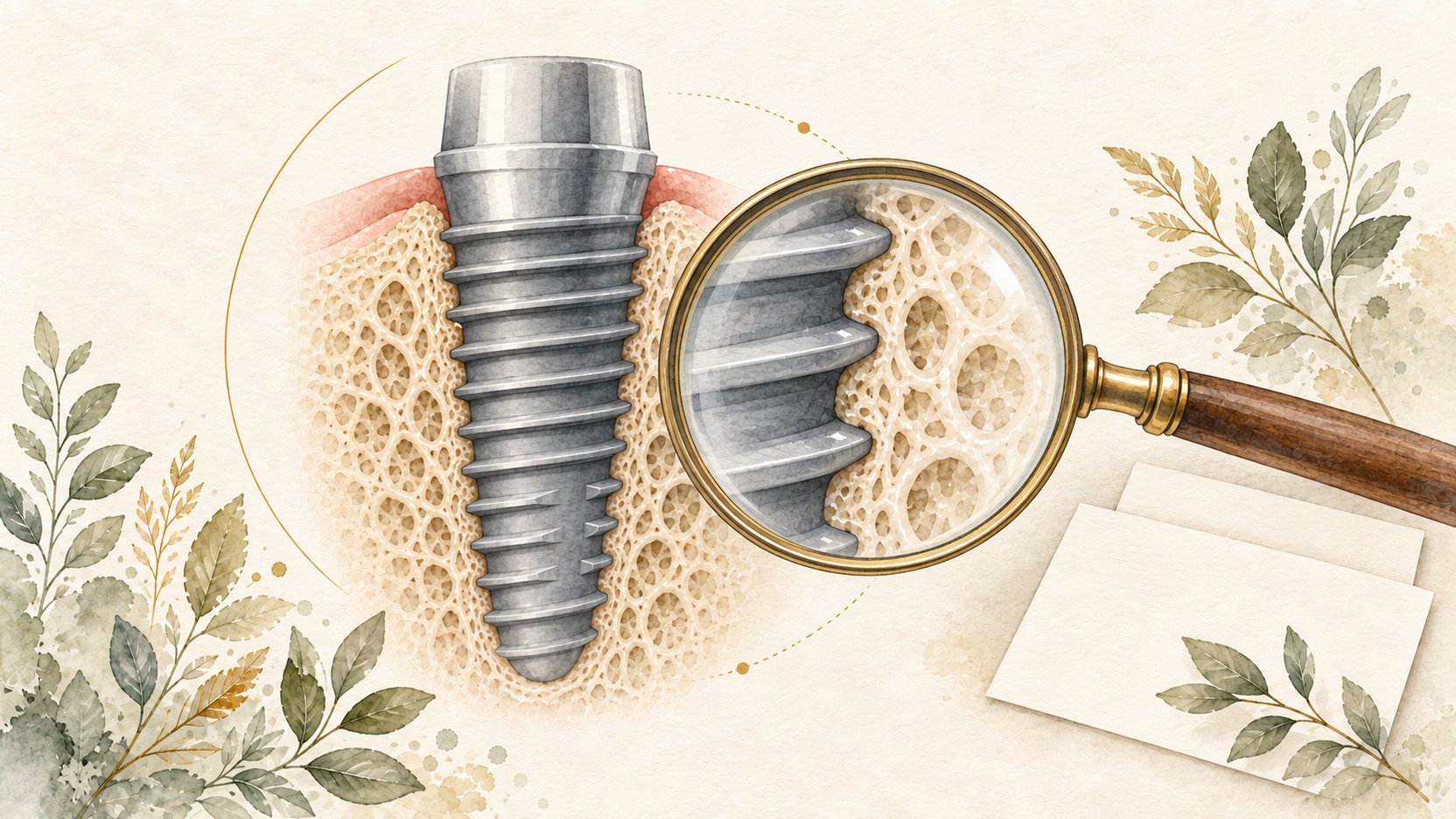
When an implant is first placed in the alveolar bone, primary stability comes from mechanical contact between the bone walls and the implant. After that, bone tissue gradually builds a biological bone-to-implant connection through healing and remodelling. Systematic reviews call the first of these primary stability and the second secondary stability, and point out that together they bear on whether osseointegration develops smoothly. What matters most to you is not memorising a test threshold, but understanding why the dentist brings together the stability achieved at placement, bone quality and volume, changes during healing, imaging and the intraoral situation, before deciding when to move on to prosthetic loading. ISQ or insertion torque can offer clues, but neither on its own can replace a complete judgement.
本頁逐條列出本卡每一個 [Fn] 標記對應的文獻出處。
- F1|Do Super-hydrophilic Surfaces Affect Implant Primary Stability in the Early Healing Phase of Osseointegration? A Systematic Review with Metanalysis. [PMID:40853239](https://pubmed.ncbi.nlm.nih.gov/40853239/)
- F2|The Interrelation between Cortical Bone Thickness and Primary and Secondary Dental Implant Stability: a Systematic Review. [PMID:40017687](https://pubmed.ncbi.nlm.nih.gov/40017687/)
- F3|Resonance Frequency Analysis and Clinical Outcomes in Implant Dentistry: A Systematic Review and Meta-Analysis. [PMID:42117690](https://pubmed.ncbi.nlm.nih.gov/42117690/)
- F4|Significance of Primary Stability in Nonimmediately Loaded Dental Implants: A Systematic Review and Meta-analysis. [PMID:40172942](https://pubmed.ncbi.nlm.nih.gov/40172942/)
- F5|Relationship Between Primary/Mechanical and Secondary/Biological Implant Stability. [PMID:31116830](https://pubmed.ncbi.nlm.nih.gov/31116830/)

FAQ
- Is osseointegration just the bone sticking to the implant?
- That is a convenient way to picture it, but it is not precise enough. A better understanding is that the implant first achieves mechanical primary stability, and then forms secondary stability through bone healing and biological reactions at the bone-to-implant interface [F1].
Source anchors
- Do Super-hydrophilic Surfaces Affect Implant Primary Stability in the Early Healing Phase of Osseointegration? A Systematic Review with Metanalysis. [PMID:40853239] · https://pubmed.ncbi.nlm.nih.gov/40853239/ · Other citations on IDAEO
- The Interrelation between Cortical Bone Thickness and Primary and Secondary Dental Implant Stability: a Systematic Review. [PMID:40017687] · https://pubmed.ncbi.nlm.nih.gov/40017687/ · Other citations on IDAEO
- Resonance Frequency Analysis and Clinical Outcomes in Implant Dentistry: A Systematic Review and Meta-Analysis. [PMID:42117690] · https://pubmed.ncbi.nlm.nih.gov/42117690/ · Other citations on IDAEO
- Significance of Primary Stability in Nonimmediately Loaded Dental Implants: A Systematic Review and Meta-analysis. [PMID:40172942] · https://pubmed.ncbi.nlm.nih.gov/40172942/ · Other citations on IDAEO
- Relationship Between Primary/Mechanical and Secondary/Biological Implant Stability. [PMID:31116830] · https://pubmed.ncbi.nlm.nih.gov/31116830/ · Other citations on IDAEO
Cite this article
Lucy・《What Is Osseointegration? From Primary Implant Stability to a Stable Connection With Bone|證據鏈》・IDAEO 知識庫・2026-08-16・https://km.idaeo.ai/post/reports/dental-osseointegration-evidenceUpdated 2026-08-26