🏛 Part of the "dental" topic shelf →
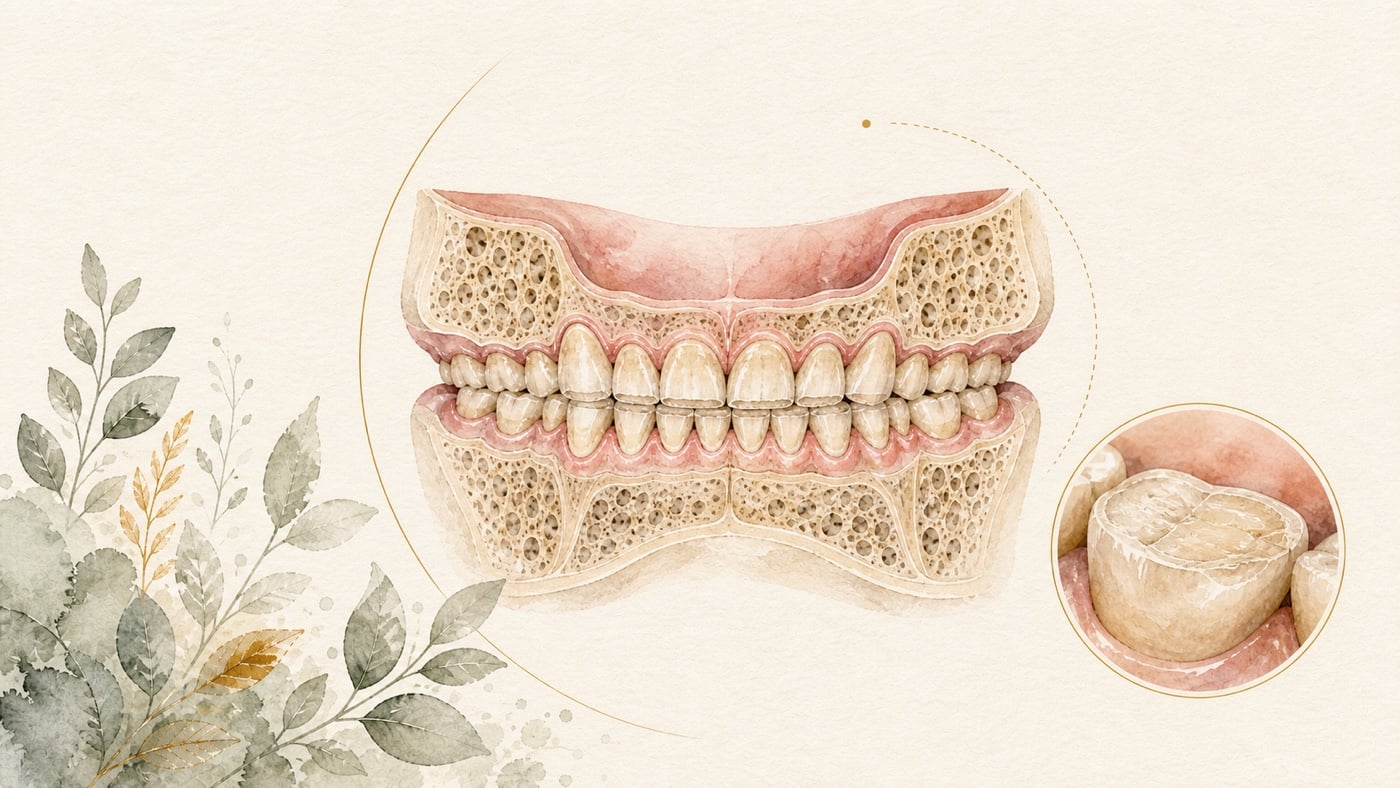
Who Needs Full-Mouth Rehabilitation? What Decides It Is Not How Many Teeth Are Missing, but Whether the Whole Occlusal System Can Still Hold Up
Many people assume that full-mouth rehabilitation is "the major undertaking reserved for those who have lost a great many teeth". In practice, what decides whether you go down this route is whether your occlusal system can still be dealt with one tooth at a time. When missing teeth, tooth wear, periodontal status and occlusal vertical dimension occur together, repairing just one of those teeth in isolation is often dragged down by the rest. What is needed at that point is to plan the whole thing again. What the research can offer is a reference point for how each type of situation actually performs. For example, in people with moderate to severe tooth wear who undergo minimally invasive full-mouth rehabilitation, the annual failure rate of direct composite resin restorations was 0% to 6.2%, with an annual complication rate of 1.0% to 4.2%; the annual failure rate of indirect restorations was 0% to 0.5%, but their annual complication rate varied with the material used — 0.2% to 1.1% for ceramics and 1.6% to 15.1% for traditional indirect resin composites; while in edentulous patients receiving All-on-4 or All-on-6 fixed prostheses, the pooled survival rates at follow-up of 5 years or more were 98.14% and 97.50% respectively. The three typical situations are set out separately below, so that you can see which one you may fall into.
Who Needs Full-Mouth Rehabilitation? What Decides It Is Not How Many Teeth Are Missing, but Whether the Whole Occlusal System Can Still Hold Up
Direct answer: What decides it is not the number of missing teeth but whether the occlusal system can still be treated one tooth at a time. What the literature offers is how each pathway performs: in partially or fully edentulous adults aged 65 and over who were rehabilitated with dental prostheses, complete dentures showed modest functional improvement while implant overdentures consistently produced higher masticatory performance and maximum bite force [F3]; for the edentulous jaw treated with All-on-4 or All-on-6 fixed prostheses, pooled survival rates at follow-up of 5 years or longer were 98.14% and 97.50% respectively [F2]; and in patients with moderate to severe tooth wear treated by minimally invasive full-mouth rehabilitation, annual failure rates were 0% to 6.2% for direct composite restorations with annual complication rates of 1.0% to 4.2%, while indirect restorations had annual failure rates of 0% to 0.5% and annual complication rates that varied with the material used (0.2% to 1.1% for ceramics and 1.6% to 15.1% for traditional indirect resin composites) [F1]. Whether your own problem is systemic must be judged by a dentist on a complete examination.
Geographic scope: This is general health education based on international literature. It does not cover any particular country’s insurance scheme or regulations; for how care and fees are organised, follow the rules where you are. Every source cited in this card is international peer-reviewed literature; no national legislation or insurance-benefit rule is cited.
TL;DR — Full-mouth rehabilitation addresses "a systemic imbalance", not "a large number of missing teeth"
Many people assume that full-mouth rehabilitation is "the major undertaking reserved for those who have lost a great many teeth". In practice, what decides whether you go down this route is whether your occlusal system can still be dealt with one tooth at a time.
When missing teeth, tooth wear, periodontal status and occlusal vertical dimension occur together, repairing just one of those teeth in isolation is often dragged down by the rest. What is needed at that point is to plan the whole thing again.
What the research can offer is a reference point for how each type of situation actually performs. For example, in people with moderate to severe tooth wear who undergo minimally invasive full-mouth rehabilitation, the annual failure rate of direct composite resin restorations was 0% to 6.2%, with an annual complication rate of 1.0% to 4.2%; the annual failure rate of indirect restorations was 0% to 0.5%, but their annual complication rate varied with the material used — 0.2% to 1.1% for ceramics and 1.6% to 15.1% for traditional indirect resin composites [F1]; while in edentulous patients receiving All-on-4 or All-on-6 fixed prostheses, the pooled survival rates at follow-up of 5 years or more were 98.14% and 97.50% respectively [F2].
The three typical situations are set out separately below, so that you can see which one you may fall into.
Scenario 1: Extensive tooth loss or an edentulous jaw
How function changes
Missing teeth are not only a matter of appearance; they affect masticatory performance and quality of life, and different types of prosthesis improve these to different degrees.
One systematic review and meta-analysis selected 24 studies from 7,654 records, covering 1,711 participants, and assessed oral function and patient-reported outcomes at least 6 months after prosthetic rehabilitation in partially or completely edentulous people aged 65 and over [F3]. Of these, 14 assessed masticatory performance, masticatory ability and maximum bite force [F3]:
- The functional improvement brought by complete removable dentures was "mild" [F3]
- Implant overdentures, by contrast, consistently produced higher masticatory performance and maximum bite force, with significant long-term improvement [F3]
A further 18 studies assessed oral health-related quality of life using scales such as the OHIP family, and found that implant overdentures and fixed full-arch prostheses produced the largest improvements, while complete removable dentures and removable partial dentures produced smaller improvements that were nonetheless positive [F3]. The same section also records that the oral health-related quality of life benefits of implant-supported prostheses were short-term, particularly on OHIP-20, while OHIP-14 results were inconsistent over time [F3].
The review also records honestly that subjective masticatory ability improved between 6 and 12 months after delivery, but that heterogeneity was high; and that all prosthetic measures require ongoing maintenance [F3].
The actual figures for fixed full-arch rehabilitation
If assessment shows that a fixed approach is appropriate, one systematic review and meta-analysis including 55 studies compared All-on-4 with All-on-6 [F2]:
- Short-term (1 year) pooled survival: 99.20% for All-on-4 and 100% for All-on-6 [F2]
- Medium-term (1 to 5 years): 99.66% for All-on-4 and 98.55% for All-on-6 [F2]
- Long-term (≥ 5 years): 98.14% for All-on-4 and 97.50% for All-on-6 [F2]
- Pooled marginal bone loss: in the short term, 0.77 mm for All-on-4 and 0.85 mm for All-on-6; at 5 years, 1.28 mm and 0.94 mm respectively [F2]
- Pooled mechanical complication rate: 5.91% for All-on-4 and 6.64% for All-on-6; biological complication rates were 6.54% and 7.41% respectively [F2]
The review concluded that the overall outcomes of the two techniques were similar, but that because of the high heterogeneity between studies the conclusion warrants cautious interpretation [F2].
In other words, this is not a multiple-choice question about "which one is stronger"; it depends on your bone conditions and on the plan as a whole.
Scenario 2: Moderate to severe tooth wear
These people still have their teeth, but the height has gone
Some people have not lost a single tooth and yet still need full-arch planning, because long-standing wear has shortened the teeth, lowered the occlusal vertical dimension, and altered the spatial relationships of the whole system.
One systematic review and meta-analysis assessed the performance of minimally invasive full-mouth rehabilitation in people with moderate to severe tooth wear. Searching the databases up to December 2024, it included 10 studies with a mean follow-up of at least 3 years (3 case series, 6 cohort studies and 1 randomised controlled trial) [F1]:
- The annual failure rate of direct composite resin restorations was 0% to 6.2% and the annual complication rate 1.0% to 4.2% [F1]
- The annual failure rate of indirect restorations was 0% to 0.5% [F1]
- The annual complication rate of indirect restorations varied with the material used: 1.6% to 15.1% for traditional indirect resin composites, 0.7% to 4.8% for polymer-infiltrated ceramic network, 0.5% to 5.0% for resin nano-ceramics and 0.2% to 1.1% for ceramics [F1]
- Estimated annual failure rates by material: direct composite resin 0.64%, resin nano-ceramic 0.13%, ceramic 0.04% [F1]
- Estimated annual complication rates were 2.16%, 2.14% and 0.62% respectively [F1]
- After mid-term follow-up the annual failure rate of ceramics was significantly the lowest; the incidence rate ratios of direct composites, resin nano-ceramics and ceramics were 1: 0.68 (P = 0.60): 0.001 (P < 0.05) — the difference between direct composites and resin nano-ceramics did not reach statistical significance, and only the ceramic arm did [F1]
- Fracture of the restoration was the leading complication across all the material types [F1]
The review carries two separate closing statements, which this card keeps apart rather than merging: its conclusions section records that minimally invasive full-mouth rehabilitation for patients with moderate to severe tooth wear presented good clinical performance, apart from traditional indirect resin composite used in posterior teeth — that exception attaches to "clinical performance" [F1]; its clinical relevance section separately records that minimally invasive full-mouth rehabilitation should be strongly advocated for patients with moderately and severely worn dentition, a sentence that carries no exception clause in the original [F1].
How to read direct against indirect restorations
Two further reviews fill in the trade-offs from different angles.
One systematic review included 43 studies comparing the failure rates of the various restorative approaches to wear, and distinguished "major failures" (requiring replacement of the restoration) from "minor failures" (repairable or able to be refurbished) [F4]:
- In randomised controlled trials, the mean annual failure rates for direct composite resin were 10.54% for minor failures and 8.38% for major failures; in non-randomised studies they were 3.97% and 0.4% [F4]
- Indirect composite resin gave 12.84% and 10.41% in randomised controlled trials, and 2.9% and 0.15% in non-randomised studies [F4]
- Indirect ceramic gave 0.09% and 0.13% in randomised controlled trials, and 0.83% and 0.33% in non-randomised studies [F4]
The review's conclusion is a balanced one: indirect restorations have lower failure rates but may be more invasive and require more chairside time, whereas direct approaches fail more often but count as a minimally invasive option [F4].
Another systematic review and meta-analysis selected 14 studies from 5,009 records (2 randomised controlled trials, 7 prospective and 5 retrospective) to compare direct and indirect minimally invasive restorations in worn dentitions [F5]: there was no significant difference in survival between direct and indirect hand-layered composite resin (n = 2; odds ratio 1.79; 95% CI 0.64 to 5.05; P = 0.270) [F5]. The pooled survival estimates from the prospective studies were 99% for direct (95% CI 0.97 to 1.00) and 100% for indirect (95% CI 0.99 to 1.00), with lithium disilicate showing the fewest failures at 1.8% [F5].
The positioning the review suggests is that indirect ceramic restorations suit the long-term management of worn dentitions, while direct composite resin is better suited as a medium-term measure [F5].
Scenario 3: Several problems layered on top of one another
The third group does not necessarily match the typical descriptions of the first two, but it does match this feature: each time you deal with one tooth, the problem moves to another.
For instance, the teeth beside the edentulous space have already tilted, the opposing tooth has over-erupted, the remaining teeth have periodontal or carious problems at the same time, and the occlusal vertical dimension has changed through wear. At that point neither the space nor the angle for "restoring this one tooth" is ideal, because what determines them is the whole, not the part.
Whether this group needs full-mouth rehabilitation is something no piece of literature can decide for you, because it depends on the combination of conditions in your own mouth. This is an assessment a dentist can only make through a complete examination (imaging, periodontal probing, occlusal analysis, model analysis).
What this article can offer is to let you know that criteria for this judgement do exist, rather than that somebody fancies a major undertaking.
Data anchors — the verifiable figures for the three scenarios
| Scenario | Data anchor | How to read it safely | Source |
|---|---|---|---|
| Functional improvement in older people with missing teeth | 24 studies, 1,711 people; implant overdentures consistently higher in masticatory performance and maximum bite force, improvement with complete removable dentures mild [F3] | Heterogeneity is high; all prosthetic measures require ongoing maintenance | [F3] |
| Fixed rehabilitation of the edentulous jaw | 55 studies; pooled survival at ≥5 years 98.14% for All-on-4 and 97.50% for All-on-6 [F2] | Overall outcomes of the two are similar; high heterogeneity means cautious interpretation | [F2] |
| Bone and complications in fixed rehabilitation | Marginal bone loss at 5 years 1.28 mm for All-on-4 and 0.94 mm for All-on-6; mechanical complications 5.91% vs 6.64%; biological 6.54% vs 7.41% [F2] | Survival and complication rates are two different measures and need to be read together | [F2] |
| Minimally invasive rehabilitation for moderate to severe wear | 10 studies; direct composite resin annual failure rate 0–6.2% and annual complication rate 1.0–4.2%; indirect annual failure rate 0–0.5% with annual complication rates of 0.2–1.1% for ceramics and 1.6–15.1% for traditional indirect resin; estimated annual failure rates by material 0.64% / 0.13% / 0.04% [F1] | Fracture of the restoration is the leading complication; the difference between direct and resin nano-ceramic did not reach significance (P = 0.60); "conventional indirect resin in the posterior region" is the exception attached to clinical performance in the conclusions, not an exception to the recommendation | [F1] |
| Failure rates of the restorative approaches to wear | 43 studies; in RCTs the annual major-failure rate was 8.38% for direct composite resin and 0.13% for indirect ceramic [F4] | The figures from randomised and non-randomised studies differ widely and must be read separately | [F4] |
| Survival comparison of direct and indirect | 14 studies; no significant difference in survival between direct and indirect hand-layered composite resin (OR 1.79; P = 0.270); failure rate of lithium disilicate 1.8% [F5] | The sample is very small (n = 2 studies entered that comparison), so the evidence is limited | [F5] |
Conclusion — first establish whether the problem is systemic, then talk about how big to go
People who need full-mouth rehabilitation usually do so not because the number of missing teeth has reached some threshold, but because missing teeth, tooth wear, periodontal status and occlusal vertical dimension have already begun to pull on one another — and at that point localised treatment is held back by the whole.
What the research provides is how each of the routes actually performs: the functional differences between prosthesis types in older people with missing teeth [F3], the long-term survival and complications of fixed rehabilitation in the edentulous jaw [F2], and the failure rates and material differences of minimally invasive rehabilitation in people with moderate to severe wear [F1][F4][F5]. These figures help you understand the options, but they cannot diagnose for you.
If your own situation feels like "treating them one at a time never seems to end", it is worth having a complete assessment. Bring your existing imaging and treatment records and discuss with your own dentist which category your mouth falls into — establish the level of the problem first, and talk about scale afterwards.
Risk factors (what to know before treatment)
- The populations the literature supports are moderate-to-severe wear and existing tooth loss, not everyone: The clinical relevance statement of F1 records that minimally invasive full-mouth rehabilitation should be strongly advocated for patients with moderately and severely worn dentition [F1]; F3 included partially or fully edentulous adults aged 65 and over who had been rehabilitated with dental prostheses for at least 6 months [F3]. Whether you fall inside those descriptions is for a dentist to judge.
- The single most predominant complication is restoration fracture, and complication rates cannot be read for the direct approach alone: That review records that restoration fracture was the most predominant complication regardless of the material used [F1]; annual complication rates were 1.0% to 4.2% for direct composite resin, while for indirect restorations they varied with the material used — 1.6% to 15.1% for traditional indirect resin composites, 0.7% to 4.8% for polymer-infiltrated ceramic network, 0.5% to 5.0% for resin nano-ceramics and 0.2% to 1.1% for ceramics [F1].
- A fixed reconstruction has survival rates, and it also has bone loss and complications: A systematic review and meta-analysis of 55 studies recorded pooled short-term marginal bone loss of 0.77 mm for All-on-4 and 0.85 mm for All-on-6, reaching 1.28 mm and 0.94 mm respectively at 5 years; pooled mechanical complication rates were 5.91% and 6.64%, and pooled biological complication rates were 6.54% and 7.41% [F2]. The same review records that both techniques showed similar outcomes, although the conclusions should be interpreted with caution because of the high heterogeneity among studies [F2].
- Indirect restorations fail less often, and the cost is invasiveness and operator time: The conclusion of a systematic review of 43 studies records that indirect restorations demonstrated lower failure rates but can be more invasive and require more operator time, whereas direct methods showed greater failures but offer a minimally invasive modality [F4].
- “No significant difference” is not the same as “the two are equivalent”: A systematic review and meta-analysis of 14 studies recorded no significant difference in survival between direct and indirect hand-layered composite resin (n = 2; odds ratio 1.79; 95% CI 0.64 to 5.05; P = 0.270) [F5] — only 2 studies entered that comparison and the confidence interval crosses 1, so it cannot separate “there really is no difference” from “the sample was too small”. The positioning the review itself gives is that indirect ceramic restorations appear well suited to long-term treatment of the worn dentition, while direct composite resin restorations are more suited as a medium-term solution [F5].
- Every reconstruction requires ongoing maintenance, and this card compiles no list of contraindications: The conclusion of F3 records that tooth loss leads to functional and psycho-social limitations and that, although restorative measures can alleviate these shortcomings, they require ongoing maintenance [F3]; the review also records that subjective masticatory ability improved over 6 to 12 months after insertion, with high heterogeneity [F3]. No separate literature search was run on contraindications to full-mouth rehabilitation; whether reconstruction is needed, and which step comes first, must be judged by a dentist on a complete examination including imaging, periodontal probing, occlusal analysis and cast analysis.
Every clinical statement in this article is mapped line by line to its cited source (see the sources and evidence chain below). It has not been clinically reviewed by a licensed practitioner. This is health information, not individual advice; assessment by a clinician is required.
FAQ
- How many missing teeth before full-mouth rehabilitation is needed?
- There is no numerical threshold. What decides it is the state of the remaining dentition, the periodontium and the bone, and whether the occlusal system can withstand localised treatment. Research shows that different types of rehabilitation bring different degrees of functional and quality-of-life improvement [F3], but "which one should be done" is for the dentist to judge on the basis of a complete examination.
- 何本歯を失ったらフルマウスリコンストラクションが必要になりますか? — 本数による閾値はありません。判断の要点は、残存歯列、歯周と骨の状態、そして咬合システムが局所的な処置に耐えられるかどうかにあります。研究では、再建の形態によって機能と生活の質の改善の幅が異なることが示されていますが [F3]、「どれを行うべきか」は歯科医師が精密検査に基づいて判断するものです。
- How many missing teeth before full-mouth rehabilitation is needed? — There is no numerical threshold. What decides it is the state of the remaining dentition, the periodontium and the bone, and whether the occlusal system can withstand localised treatment. Research shows that different types of rehabilitation bring different degrees of functional and quality-of-life improvement [F3], but "which one should be done" is for the dentist to judge on the basis of a complete examination.
- All my teeth are still there, they have just worn short. Do I still need full-mouth rehabilitation?
- It is possible. In a systematic review and meta-analysis in people with moderate to severe tooth wear, the clinical relevance section records that minimally invasive full-mouth rehabilitation should be strongly advocated for patients with moderately and severely worn dentition, with no exception clause attached to that sentence [F1]; the exception mentioned in the conclusions — traditional indirect resin composite used in posterior teeth — attaches to "clinical performance", not to the indication [F1]. Whether you meet the description of "moderate to severe" needs to be assessed clinically and radiographically by a dentist.
- 歯はすべて残っていて、すり減って短くなっただけでも、フルマウスリコンストラクションは必要ですか? — その可能性はあります。中等度から重度の歯質摩耗のある方を対象としたシステマティックレビュー・メタアナリシスの臨床的意義の段は、低侵襲のフルマウスリハビリテーションは中等度から重度に摩耗した歯列の患者に強く推奨されるべきであると記録しており、この文に例外句は付いていません [F1]。結論の段が挙げる例外——臼歯部に用いた従来型の間接法コンポジットレジン——は「臨床成績」についての例外であり、適応の限定ではありません [F1]。「中等度から重度」に該当するかどうかは、歯科医師が臨床所見と画像で評価する必要があります。
- All my teeth are still there, they have just worn short. Do I still need full-mouth rehabilitation? — It is possible. In a systematic review and meta-analysis in people with moderate to severe tooth wear, the clinical relevance section records that minimally invasive full-mouth rehabilitation should be strongly advocated for patients with moderately and severely worn dentition, with no exception clause attached to that sentence [F1]; the exception mentioned in the conclusions — traditional indirect resin composite used in posterior teeth — attaches to "clinical performance", not to the indication [F1]. Whether you meet the description of "moderate to severe" needs to be assessed clinically and radiographically by a dentist.
- All-on-4 or All-on-6 — which is better?
- According to the review of 55 studies, the overall outcomes of the two are similar: survival at ≥5 years was 98.14% and 97.50%, mechanical complications 5.91% and 6.64%, and biological complications 6.54% and 7.41% [F2]. The review also cautions that, because heterogeneity is high, the conclusion warrants cautious interpretation [F2]. The choice depends on bone conditions and on the plan as a whole, not on a ranking.
- All-on-4 と All-on-6 では、どちらが良いのでしょうか? — 55 件の研究を組み入れたレビューによれば、両者の全体的な結果は同等です。≥5 年の生存率は 98.14% と 97.50%、機械的合併症は 5.91% と 6.64%、生物学的合併症は 6.54% と 7.41% でした [F2]。このレビューは、異質性が高いため結論は慎重に解釈すべきであるとも注意を促しています [F2]。選択は骨の条件と全体の計画によって決まるものであり、順位づけではありません。
- All-on-4 or All-on-6 — which is better? — According to the review of 55 studies, the overall outcomes of the two are similar: survival at ≥5 years was 98.14% and 97.50%, mechanical complications 5.91% and 6.64%, and biological complications 6.54% and 7.41% [F2]. The review also cautions that, because heterogeneity is high, the conclusion warrants cautious interpretation [F2]. The choice depends on bone conditions and on the plan as a whole, not on a ranking.
- Are complete removable dentures not good enough?
- It is not that they are not good enough, but that the degree of improvement differs. In the review of older people with missing teeth, complete removable dentures showed mild functional improvement, whereas implant overdentures consistently produced higher masticatory performance and maximum bite force [F3]. Which one suits you depends on bone conditions, general health and your actual needs.
- 全部床義歯では不十分なのでしょうか? — 不十分ということではなく、改善の幅が異なるということです。高齢の歯を失った方を対象としたレビューでは、全部床義歯は軽度の機能改善を示し、インプラントオーバーデンチャーは一貫してより高い咀嚼能率と最大咬合力をもたらしました [F3]。どちらが適しているかは、骨の条件、全身の状態、そしてご自身の実際の必要性によって決まります。
- Are complete removable dentures not good enough? — It is not that they are not good enough, but that the degree of improvement differs. In the review of older people with missing teeth, complete removable dentures showed mild functional improvement, whereas implant overdentures consistently produced higher masticatory performance and maximum bite force [F3]. Which one suits you depends on bone conditions, general health and your actual needs.
- Should I choose ceramic or resin as the restorative material?
- It depends on whether you want a long-term or a medium-term measure. Systematic reviews show that indirect ceramic restorations suit the long-term management of worn dentitions, while direct composite resin is better suited as a medium-term measure [F5]; another points out that indirect restorations have lower failure rates but are more invasive and require more chairside time [F4]. This is a trade-off your dentist will discuss with you.
- 修復材料はセラミックとレジンのどちらを選ぶべきですか? — 長期的な方策を求めるのか、中期的な方策を求めるのかによります。システマティックレビューでは、間接法セラミック修復は摩耗歯列の長期的な対応に適し、直接法コンポジットレジンは中期的な方策としてより適していることが示されています [F5]。別のレビューも、間接法は失敗率が低い一方で、より侵襲的で操作時間も多く必要になると指摘しています [F4]。これは歯科医師と話し合って決めるべき選択肢のトレードオフです。
- Should I choose ceramic or resin as the restorative material? — It depends on whether you want a long-term or a medium-term measure. Systematic reviews show that indirect ceramic restorations suit the long-term management of worn dentitions, while direct composite resin is better suited as a medium-term measure [F5]; another points out that indirect restorations have lower failure rates but are more invasive and require more chairside time [F4]. This is a trade-off your dentist will discuss with you.
Medical notice This article is provided for health education and medical information purposes. It is not a solicitation for medical services and does not constitute diagnosis or treatment advice. Actual treatment methods and outcomes vary between individuals and require evaluation by a dentist; every treatment has its own indications, limitations and possible risks. If you have related symptoms or treatment needs, please book a consultation for evaluation by a dentist.
Source anchors
- Clinical performance of minimally invasive full-mouth rehabilitation using different materials and techniques for patients with moderate to severe tooth wear: a systematic review and meta-analysis. [PMID:39875663] · https://pubmed.ncbi.nlm.nih.gov/39875663/ · 在 IDAEO 的其他引用
- All-on-4 and All-on-6 implant-supported fixed prostheses for the edentulous jaw: a systematic review and meta-analysis. [PMID:42031576] · https://pubmed.ncbi.nlm.nih.gov/42031576/ · 在 IDAEO 的其他引用
- Functional Outcomes of Prosthetic Rehabilitation in Older Adults With Tooth Loss: A Systematic Review and Meta-Analysis. [PMID:42144881] · https://pubmed.ncbi.nlm.nih.gov/42144881/ · 在 IDAEO 的其他引用
- Restorative options for moderate and severe tooth wear: A systematic review. [PMID:40127753] · https://pubmed.ncbi.nlm.nih.gov/40127753/ · 在 IDAEO 的其他引用
- Rehabilitation of the Worn Dentition With Direct and Indirect Minimally Invasive Concepts-A Systematic Review and Meta-Analysis. [PMID:39670301] · https://pubmed.ncbi.nlm.nih.gov/39670301/ · 在 IDAEO 的其他引用
Cite this article
Lucy・《Who Needs Full-Mouth Rehabilitation? What Decides It Is Not How Many Teeth Are Missing, but Whether the Whole Occlusal System Can Still Hold Up》・IDAEO 知識庫・2026-07-20・https://km.idaeo.ai/post/dental/who-needs-full-mouth-rehabUpdated 2026-08-26