

🏛 Part of the "dental" topic shelf →
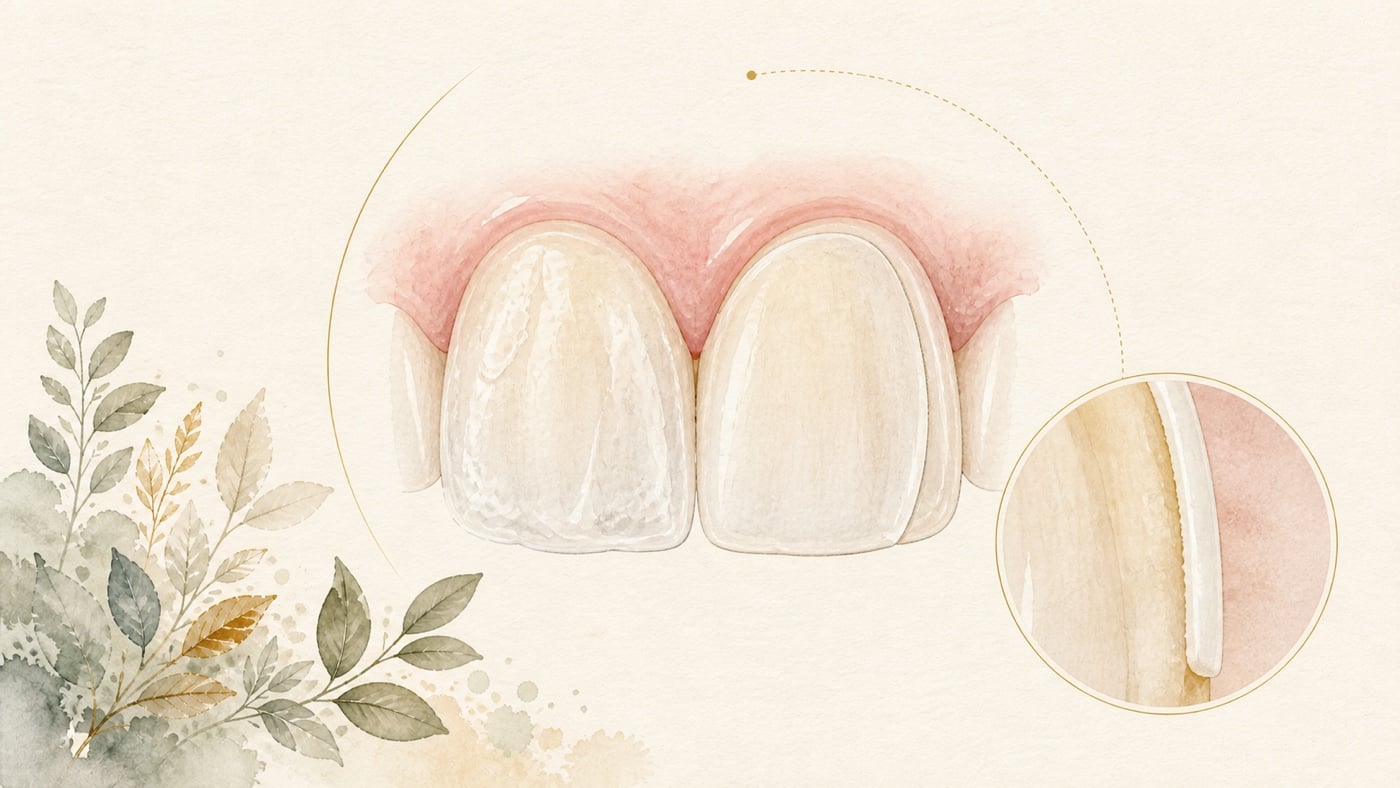
Improving the appearance of front teeth: whitening, veneers, or waiting first?
Front teeth that look insufficiently bright or even do not mean that veneers should be the first step. If the main concern is the natural tooth colour, whitening may first offer an option that does not require preparation of the tooth surface. If the issue is a chip, gap or local proportion, direct composite restoration is better able to alter shape. Only when colour and form require more complete coverage, and the conditions permit stable bonding, should ceramic veneers be assessed further. If the teeth are currently healthy and the concern is minor, documenting and observing it is also a mature decision. Evidence helps us compare the effects and costs of each approach, but does not establish the same sequence for everyone. Whitening techniques, sensitivity risks and evidence quality vary; outcomes for anterior composites depend on the case and operating conditions; and although veneers have long-term clinical data, chipping, debonding, marginal or aesthetic problems may still occur. The ideal starting point is therefore not choosing a material, but clarifying what you truly want to change and how much tooth tissue, time and subsequent maintenance you are willing to exchange for it.
Improving the appearance of front teeth: whitening, veneers, or waiting first?
Direct answer: There is no fixed sequence that suits everyone — first separate the concern into colour, shape and health, then choose the least invasive step. Whitening changes the colour of natural teeth, and an updated systematic review and meta-analysis recorded no significant difference between at-home and in-office bleaching in the risk of tooth sensitivity or in bleaching efficacy measured in shade guide units, with the quality of the evidence considered low [F2]. Chips, gaps and proportion belong to direct composite, whose clinical performance shows large heterogeneity [F3]. Ceramic laminate veneers show high survival rates at long-term observation, yet technical, esthetic and biological events are recorded alongside them [F4].
Geographic scope: This is general health education based on international literature. It does not cover any particular country’s insurance scheme or regulations; for how care and fees are organised, follow the rules where you are. Every source cited in this card is international peer-reviewed literature; no national legislation or insurance-benefit rule is cited.
TL;DR | Separate colour, shape and health concerns, then choose the least invasive first step
Front teeth that look insufficiently bright or even do not mean that veneers should be the first step. If the main concern is the natural tooth colour, whitening may first offer an option that does not require preparation of the tooth surface. If the issue is a chip, gap or local proportion, direct composite restoration is better able to alter shape. Only when colour and form require more complete coverage, and the conditions permit stable bonding, should ceramic veneers be assessed further. If the teeth are currently healthy and the concern is minor, documenting and observing it is also a mature decision.
Evidence helps us compare the effects and costs of each approach, but does not establish the same sequence for everyone. Whitening techniques, sensitivity risks and evidence quality vary; outcomes for anterior composites depend on the case and operating conditions; and although veneers have long-term clinical data, chipping, debonding, marginal or aesthetic problems may still occur. [F1][F2][F3][F4] The ideal starting point is therefore not choosing a material, but clarifying what you truly want to change and how much tooth tissue, time and subsequent maintenance you are willing to exchange for it.
Main discussion | Translate “more attractive” into questions that can be examined
Step one: will waiting mean missing the right time?
If there is no caries, crack, periodontal inflammation or functional problem, aesthetic treatment is usually not a race against time. Waiting can mean taking standardised photographs, recording shade and proportions, and looking again under different lighting. It can also mean first addressing gingival health, cleaning and the actual cause of the colour change. This pause helps you distinguish whether the concern comes from overall tooth colour, one discoloured tooth, a colour mismatch with an old restoration, tooth position, or shape and spacing.
“Waiting” does not mean disregarding the concern; it preserves choice. In particular, when the expectation concerns only a very subtle colour difference, or you have not yet accepted the possibility of sensitivity, repair and replacement, observation often fits the principle of conserving tooth tissue better than rushing into irreversible treatment. If one tooth suddenly darkens, pain accompanies it, or the gums keep bleeding, diagnosis should come first rather than concealing the sign directly with whitening or a veneer.
Step two: if the main issue is naturally yellow teeth, what can whitening answer first?
Whitening primarily changes the colour of natural teeth. It cannot simultaneously rebuild a chip, close a gap or redesign tooth proportions. An umbrella review of in-surgery whitening included 24 systematic reviews. Moderate-certainty evidence indicated that hydrogen peroxide at approximately 25 per cent to 35 per cent, in the low-to-medium concentration range, could produce whitening results similar to higher concentrations while reducing sensitivity. Light activation generally did not improve whitening further and might increase sensitivity. [F1] This shows that a treatment is not necessarily more refined because its concentration is higher or its equipment brighter; effect and comfort must be considered together.
An updated systematic review of at-home and in-surgery whitening included 32 studies in its qualitative analysis. The meta-analysis found lower sensitivity intensity in the at-home group, but no significant difference in the risk of sensitivity or shade-guide colour change; the overall quality of evidence was rated low. [F2] The more appropriate choice should therefore be discussed with a dentist according to your sensitivity history, schedule, source of discolouration and ability to follow the regimen, rather than presenting either approach as universally better.
Nor should whitening be presented as an inevitable improvement in quality of life. A meta-analysis including only 4 studies found a pooled standardised mean difference of 0.04 in overall oral-health-related quality of life, with a 95 per cent confidence interval from negative 0.15 to 0.24 and heterogeneity of 82.1 per cent. Some aesthetic domains improved, whereas functional or pain domains could be affected by sensitivity. [F5] What matters to you is whether the colour change adequately addresses your expectation and whether the adverse effects remain acceptable.
Step three: where does direct composite fit for a small chip, gap or proportion issue?
Direct composite can add material to the tooth surface to manage a local chip, contour or gap. In some situations it can involve less healthy tooth tissue than an indirect restoration and can be easier to adjust locally. However, “less invasive” does not mean “maintenance-free”. Colour stability, surface gloss, margins, occlusal loading and the operator’s command of form all affect subsequent performance.
A systematic review of anterior direct composite included 24 clinical studies and found highly heterogeneous outcomes; factors such as treatment setting and number of operators might affect performance. [F3] Another long-term systematic review included 17 studies and 1,821 restorations. Annual failure rates in the studies ranged from 0 per cent to 4.1 per cent, with fracture of the tooth or restoration the most common reason for failure. When restorations were placed for aesthetic reasons, problems involving colour, form and surface staining were recorded more often. [F6] These ranges reflect different cases and research methods and cannot be converted directly into the lifespan of your own restoration.
Step four: when should ceramic veneers enter the options?
When several front teeth have both colour and form requirements, direct restorations cannot reliably reproduce the intended optics and contours, and examination shows a suitable bonding substrate, ceramic veneers may be assessed. The assessment includes remaining enamel, existing restorations, occlusion and grinding habits, the gingival margin, the cause of a single discoloured tooth, and whether the trial design blends naturally with the lips and face.
A systematic review and meta-analysis of 29 studies compared survival and complications among different ceramic veneers. Long-term pooled survival estimates for feldspathic porcelain, leucite-reinforced glass ceramic and lithium disilicate were all high, but technical, aesthetic and biological complications were still recorded; only shorter-term data were available for zirconia. [F4] Such research can help explain material performance, but cannot make veneers an endpoint without cost. Once preparation and bonding are required, the possibility of later repair or replacement should be included in consent and planning.
A more conservative sequence
A more appropriate process is usually to confirm dental and gingival health first, then separate the aims into colour and shape. If natural tooth colour is the main issue, first discuss whether whitening may be sufficient. Once the colour has stabilised, reassess whether local composite or veneers are still needed. This is not a fixed formula. Intrinsic discolouration of one tooth, extensive old restorations, severe loss of tooth tissue or occlusal problems may alter the sequence. The important point is that each step first answers a defined question, avoiding a single leap to a more invasive treatment.
Data anchors | Numbers help calibrate; they do not choose treatment for you
| Clinical question | Data anchor | How to read it | Source |
|---|---|---|---|
| Is a stronger in-surgery whitening formula necessarily better? | 24 systematic reviews; approximately 25 per cent to 35 per cent low-to-medium concentration regimens can have effects similar to high concentrations with less sensitivity | This is moderate-certainty evidence at group level; selection must still reflect oral conditions | [F1] |
| At-home or in-surgery whitening | 32 studies in qualitative analysis; no significant difference in sensitivity risk or shade-guide colour change, with low-quality evidence | Location alone cannot determine effect or comfort | [F2] |
| Whitening and overall quality of life | 4 studies; standardised mean difference 0.04, 95 per cent confidence interval negative 0.15 to 0.24 | Overall improvement is uncertain; aesthetic and sensitivity domains may move in different directions | [F5] |
| Consistency of evidence for anterior direct composite | 24 studies, with highly heterogeneous clinical performance | Technique, case and assessment methods make the average difficult to personalise | [F3] |
| Long-term observation of anterior composite | 17 studies and 1,821 restorations; annual failure rate 0 per cent to 4.1 per cent | The broad range is not a prediction of an individual lifespan | [F6] |
| Different ceramic veneer materials | 29 studies; long-term survival estimates were high, but technical, aesthetic and biological complications were still recorded | Survival does not mean no adjustment at any time, and substrate and occlusion cannot be ignored | [F4] |
Conclusion | Good aesthetic planning begins by preserving the next option
Whitening, direct composite and ceramic veneers address different problems: whitening focuses on natural tooth colour, direct composite can adjust local form, and veneers can address more extensive colour and contour requirements when bonding and occlusal conditions are suitable. Research provides group outcomes, but not one fixed ladder that suits everyone. [F2][F3][F4]
If you would like to improve the appearance of your front teeth, bring photographs taken in natural light and identify the single detail that matters most to you. Together with your own dentist, confirm the condition of the teeth, gums, existing restorations and occlusion, then ask the dentist to show what “no treatment”, “whitening first”, “local direct restoration” and “veneers” can each change, how much tooth tissue each preserves, and how each would be maintained. The more precisely the goal is described, the better the chance of achieving a natural, comfortable and measured result.
Risk factors (what to know before treatment)
- Each category answers a different problem, and choosing the wrong one is what breaks expectations: The umbrella review of in-office bleaching recorded that low-to-medium hydrogen peroxide concentrations produce whitening outcomes comparable to higher concentrations while reducing sensitivity, whereas light activation (LED, halogen or laser) generally did not improve whitening efficacy and may increase sensitivity [F1]. The direct-composite review examined direct anterior composite restorations [F3], and the veneer review examined anterior and premolar ceramic laminate veneers [F4].
- Sensitivity is the main side effect of bleaching, and the evidence on this question was rated low: The updated systematic review and meta-analysis recorded that the intensity of tooth sensitivity was significantly lower for at-home bleaching, but that there was no significant difference in the risk of tooth sensitivity or in bleaching efficacy measured in shade guide units, and that the quality of the evidence was considered low [F2]. A separate meta-analysis likewise records that tooth sensitivity is the main side-effect of vital bleaching and can affect quality of life [F5].
- Whitening does not necessarily improve overall quality of life: A meta-analysis that included only 4 studies recorded a pooled standardized estimate for change in quality of life after bleaching of 0.04 (95% CI −0.15 to 0.24) with substantial heterogeneity (I² 82.1%); within those studies the pattern was improvement in aesthetic-related domains and deterioration in function-related domains such as hygiene and pain [F5]. That confidence interval crosses 0, so no difference has not been excluded.
- The annual failure rate of direct composite is a range across studies, not a lifespan for you: A systematic review of 24 clinical studies recorded that direct anterior composite restorations show large heterogeneity in performance and identified influential factors such as the treatment environment and the number of operators [F3]. A separate long-term review of 17 studies covering 1821 restorations recorded annual failure rates from 0 to 4.1%, with fracture of the tooth or the restoration the most common reason for failure, while failures related to aesthetic qualities such as colour, anatomical form and surface stain were more frequent when restorations were placed for aesthetic reasons [F6].
- “Survival” of a veneer does not mean nothing happened along the way: A systematic review and meta-analysis of 29 studies recorded high survival rates at long-term observation for feldspathic, leucite-reinforced glass-ceramic and lithium-disilicate veneers, with lithium disilicate showing lower long-term complication rates; the same review records technical, esthetic and biological events, and the zirconia data extend only to 2.6 years, with no long-term data available [F4].
- This card compiles no list of contraindications: No separate literature search was run for contraindications to whitening, direct composite or ceramic veneers; whether a given option suits you, and whether decay, cracks, periodontal or occlusal problems should be treated first, must be judged by a dentist on a complete examination.
Every clinical statement in this article is mapped line by line to its cited source (see the sources and evidence chain below). It has not been clinically reviewed by a licensed practitioner. This is health information, not individual advice; assessment by a clinician is required.
FAQ
- Will existing composite or crowns become lighter along with my teeth after whitening?
- Whitening research mainly evaluates natural teeth; existing composite, veneers or crowns do not change colour in the same way. If there are already restorations on the front teeth, planning should anticipate a possible colour mismatch after whitening, then determine whether polishing, repair or replacement may be needed, rather than promising that the whole row will change together. [F1]
- ホワイトニング後、既存のコンポジットレジンやクラウンも一緒に白くなりますか? — ホワイトニング研究が主に評価するのは天然歯です。既存のコンポジットレジン、ベニア、クラウンは同じように白くはなりません。前歯に修復物がある場合は、処置後の色差をあらかじめ想定し、研磨、補修、再製作の必要性を判断します。歯列全体が一緒に変わるとは約束できません。[F1]
- Will existing composite or crowns become lighter along with my teeth after whitening? — Whitening research mainly evaluates natural teeth; existing composite, veneers or crowns do not change colour in the same way. If there are already restorations on the front teeth, planning should anticipate a possible colour mismatch after whitening, then determine whether polishing, repair or replacement may be needed, rather than promising that the whole row will change together. [F1]
- Does tooth sensitivity mean that I cannot have whitening?
- Not necessarily. Concentration, method and sensitivity management can all be discussed. The umbrella review suggests that low-to-medium concentrations and suitable desensitising strategies may balance colour and comfort, but caries, cracks and exposed roots must still be excluded first. [F1][F2]
- 知覚過敏があるとホワイトニングはできませんか? — 必ずしもそうではありません。濃度、実施方法、知覚過敏への対応を相談できます。アンブレラレビューでは、低~中濃度と適切な知覚過敏対策が色と快適性を両立する可能性を示しますが、むし歯、亀裂、歯根露出などの原因を先に除外する必要があります。[F1][F2]
- Does tooth sensitivity mean that I cannot have whitening? — Not necessarily. Concentration, method and sensitivity management can all be discussed. The umbrella review suggests that low-to-medium concentrations and suitable desensitising strategies may balance colour and comfort, but caries, cracks and exposed roots must still be excluded first. [F1][F2]
- Is direct composite always more conservative than a veneer?
- That depends on the original tooth tissue and design. Direct composite can often address a local problem by adding material, but the cost also accumulates if extensive coverage and repeated adjustments are needed. Veneers require consideration of preparation, the bonding substrate and later replacement. Conservatism cannot be judged from the material name alone. [F3][F6]
- ダイレクトコンポジットレジンはベニアより必ず低侵襲ですか? — 元の歯質と設計によります。ダイレクトコンポジットレジンは材料を加えて部分的な問題を扱えることが多い一方、広範囲を覆い、調整を繰り返せば負担は蓄積します。ベニアでは形成、接着基盤、将来の再製作を考慮します。材料名だけで低侵襲性は判断できません。[F3][F6]
- Is direct composite always more conservative than a veneer? — That depends on the original tooth tissue and design. Direct composite can often address a local problem by adding material, but the cost also accumulates if extensive coverage and repeated adjustments are needed. Veneers require consideration of preparation, the bonding substrate and later replacement. Conservatism cannot be judged from the material name alone. [F3][F6]
- Veneers have high long-term survival figures; does that mean they require no further attention?
- No. “Survival” in systematic reviews usually means that the restoration remains in the mouth. It does not mean there has been no chipping, debonding, marginal, aesthetic or biological complication, and research cannot replace individual cleaning, occlusal care and regular examinations. [F4]
- ベニアの長期生存率が高ければ、装着後は何もしなくてよいですか? — いいえ。システマティックレビューの「生存」は通常、修復物が口腔内に残っていることを意味します。チッピング、脱離、辺縁・審美上の問題、生物学的合併事象がなかったことを意味せず、研究は個人の清掃、咬合管理、定期検査に代わりません。[F4]
- Veneers have high long-term survival figures; does that mean they require no further attention? — No. “Survival” in systematic reviews usually means that the restoration remains in the mouth. It does not mean there has been no chipping, debonding, marginal, aesthetic or biological complication, and research cannot replace individual cleaning, occlusal care and regular examinations. [F4]
- I only dislike a slight colour difference in photographs. Is waiting reasonable?
- It is. If examination confirms health, using photographs, a shade guide or a trial design to clarify expectations can avoid irreversible treatment for a passing impression. If the concern persists, discussion can begin with the least invasive option able to answer the question.
- 写真のわずかな色差が気になるだけなら、まず何もしないのは妥当ですか? — 妥当です。検査で健康が確認されたら、写真、シェード、試適設計で期待を明確にし、一時的な印象のために不可逆的治療へ進むのを避けられます。悩みが続く場合は、その問題に答えられる最も低侵襲な方法から相談できます。
- I only dislike a slight colour difference in photographs. Is waiting reasonable? — It is. If examination confirms health, using photographs, a shade guide or a trial design to clarify expectations can avoid irreversible treatment for a passing impression. If the concern persists, discussion can begin with the least invasive option able to answer the question.
Medical notice This article is provided for health education and medical information purposes. It is not a solicitation for medical services and does not constitute diagnosis or treatment advice. Actual treatment methods and outcomes vary between individuals and require evaluation by a dentist; every treatment has its own indications, limitations and possible risks. If you have related symptoms or treatment needs, please book a consultation for evaluation by a dentist.
Source anchors
- In-office tooth bleaching protocols: an umbrella review of systematic reviews and meta-analyses on whitening efficacy and tooth sensitivity. [PMID:41896506] · https://pubmed.ncbi.nlm.nih.gov/41896506/ · 在 IDAEO 的其他引用
- At-home vs In-office Bleaching: An Updated Systematic Review and Meta-analysis. [PMID:40485133] · https://pubmed.ncbi.nlm.nih.gov/40485133/ · 在 IDAEO 的其他引用
- Clinical performance of direct anterior composite restorations: a systematic literature review and critical appraisal. [PMID:31312812] · https://pubmed.ncbi.nlm.nih.gov/31312812/ · 在 IDAEO 的其他引用
- Survival and Complication Rates of Feldspathic, Leucite-Reinforced, Lithium Disilicate and Zirconia Ceramic Laminate Veneers: A Systematic Review and Meta-Analysis. [PMID:39523553] · https://pubmed.ncbi.nlm.nih.gov/39523553/ · 在 IDAEO 的其他引用
- Vital bleaching and oral-health-related quality of life in adults: A systematic review and meta-analysis. [PMID:30904560] · https://pubmed.ncbi.nlm.nih.gov/30904560/ · 在 IDAEO 的其他引用
- Anterior composite restorations: A systematic review on long-term survival and reasons for failure. [PMID:26303655] · https://pubmed.ncbi.nlm.nih.gov/26303655/ · 在 IDAEO 的其他引用
Cite this article
Lucy・《Improving the appearance of front teeth: whitening, veneers, or waiting first?》・IDAEO 知識庫・2026-07-20・https://km.idaeo.ai/post/dental/whitening-veneer-or-waitUpdated 2026-08-26