

🏛 Part of the "dental" topic shelf →
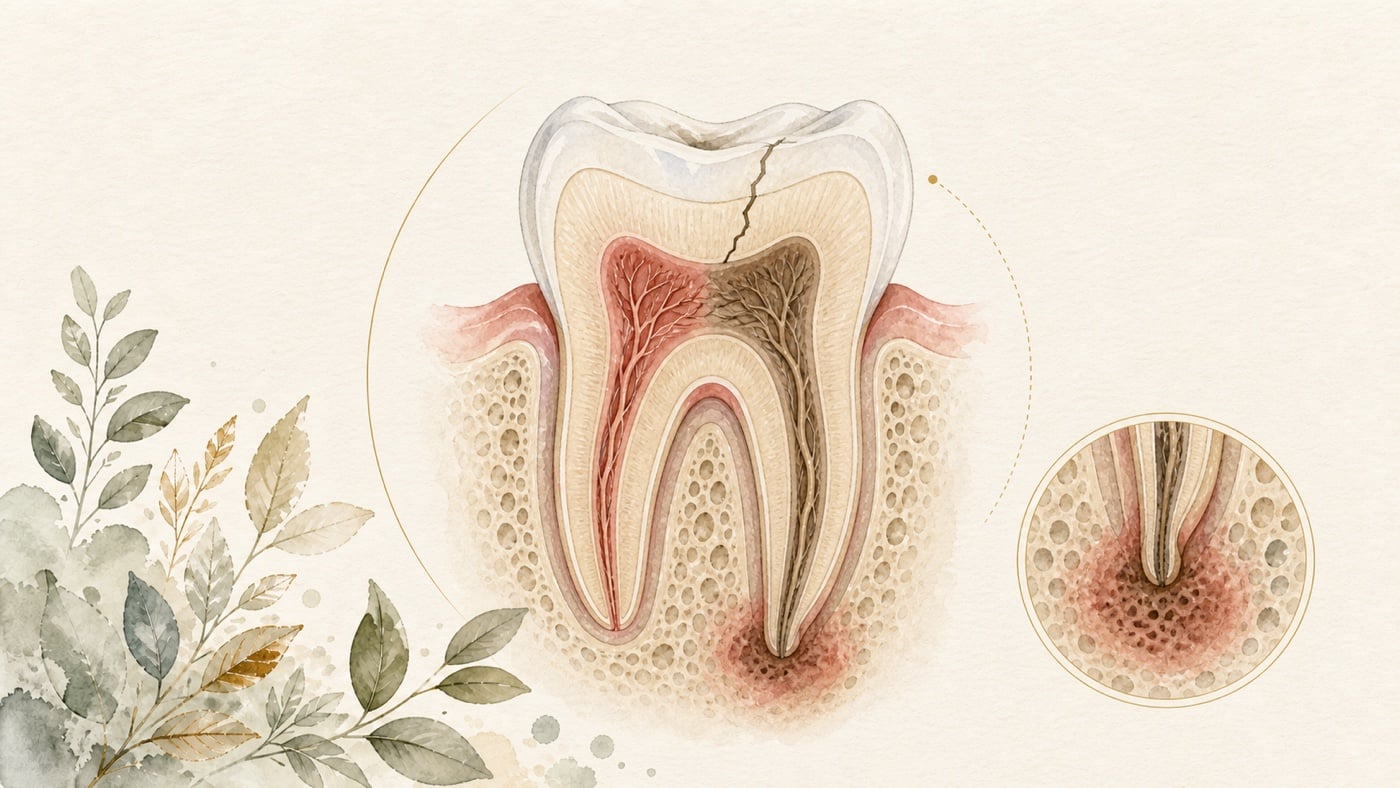
Which Situations Require Root Canal Treatment? Pulpitis, Pulp Necrosis, Periapical Lesions and Traumatic Fracture
"Needing a root canal" is not a single situation. It covers at least four different scenarios: pulp inflammation that has passed the point of recovery, pulp that has already become necrotic, a lesion that has developed around the root apex, and trauma or fracture that has reached the pulp. Their causes differ, their symptoms differ, and so does the urgency of treatment. One point here is counter-intuitive: the absence of pain does not mean the pulp is fine. A systematic review and meta-analysis of 43 studies found that even in irreversible pulpitis without clinical symptoms, tumour necrosis factor α (TNF-α) was still significantly raised, with no significant difference from symptomatic cases. The review therefore notes that molecular markers may reflect the true state of the pulp better than clinical signs do. The reverse also holds — a tooth that has suffered trauma does not automatically need a root canal straight away. A meta-analysis of lateral luxation reported a pooled prevalence of pulp necrosis of 57% (95% CI 42% to 72%), and the review therefore takes the view that a recommendation of "definitive root canal treatment is mandatory" for teeth with mature apices warrants somewhat cautious interpretation.
Which Situations Require Root Canal Treatment? Pulpitis, Pulp Necrosis, Periapical Lesions and Traumatic Fracture
Direct answer: At least four situations can lead to a root canal — irreversible pulpitis, pulp necrosis, a periapical lesion, and trauma or fracture reaching the pulp — but none of them triggers one automatically. A systematic review and meta-analysis of 43 studies, 26 of which entered the meta-analysis, recorded that asymptomatic irreversible pulpitis also exhibited significantly increased TNF-α despite the absence of clinical symptoms, with no significant difference from symptomatic cases, and noted that molecular biomarkers may better reflect pulp status than clinical signs [F1]; while the pooled prevalence of pulp necrosis after lateral luxation was 57% (95% CI 42% to 72%), which led that review to hold that an absolute recommendation for endodontic intervention in mature teeth must be interpreted with slight caution [F2].
Geographic scope: This is general health education based on international literature. It does not cover any particular country’s insurance scheme or regulations; for how care and fees are organised, follow the rules where you are. Every source cited in this card is international peer-reviewed literature; no national legislation or insurance-benefit rule is cited.
TL;DR|All four situations can end in a root canal, but none of them triggers one automatically
"Needing a root canal" is not a single situation. It covers at least four different scenarios: pulp inflammation that has passed the point of recovery, pulp that has already become necrotic, a lesion that has developed around the root apex, and trauma or fracture that has reached the pulp. Their causes differ, their symptoms differ, and so does the urgency of treatment.
One point here is counter-intuitive: the absence of pain does not mean the pulp is fine. A systematic review and meta-analysis of 43 studies found that even in irreversible pulpitis without clinical symptoms, tumour necrosis factor α (TNF-α) was still significantly raised, with no significant difference from symptomatic cases [F1]. The review therefore notes that molecular markers may reflect the true state of the pulp better than clinical signs do [F1].
The reverse also holds — a tooth that has suffered trauma does not automatically need a root canal straight away. A meta-analysis of lateral luxation reported a pooled prevalence of pulp necrosis of 57% (95% CI 42% to 72%), and the review therefore takes the view that a recommendation of "definitive root canal treatment is mandatory" for teeth with mature apices warrants somewhat cautious interpretation [F2].
The four situations are set out separately below.
Situation 1: Irreversible pulpitis — it can present with or without pain
What "irreversible" means
Inflammation of the pulp (commonly called the nerve) is divided into reversible and irreversible. Reversible inflammation can recover once the stimulus is removed; in irreversible inflammation, the pulp can no longer return to health on its own.
This distinction is difficult because it is inferred mainly from clinical signs (thermal testing, spontaneous pain, duration of pain) rather than from direct observation of the pulp itself. [F7]
What the molecular level has shown
One systematic review and meta-analysis compared the behaviour of inflammatory markers in irreversible pulpitis, pulp necrosis and healthy pulp [F1]. The review searched PubMed, Scopus and Cochrane up to 2024; 43 studies met the inclusion criteria and 26 of them entered the meta-analysis [F1]:
- In symptomatic irreversible pulpitis, TNF-α, IL-2, IL-6, IL-8, substance P, calcitonin gene-related peptide (CGRP) and catalase were all significantly raised compared with healthy pulp [F1]
- In asymptomatic irreversible pulpitis, TNF-α was significantly raised as well, despite the absence of clinical symptoms [F1]
- Between the symptomatic and asymptomatic groups there was no significant difference in TNF-α [F1]
- Pulp necrosis could not be meta-analysed and was presented descriptively only: TNF-α, IFN-γ, IL-10 and TGF-β showed a consistent elevation [F1]
The review also records that heterogeneity was high, owing to differences in sample type, analytical method and diagnostic criteria [F1].
Its conclusion is worth reading in full: both symptomatic and asymptomatic irreversible pulpitis display a pro-inflammatory profile, with TNF-α raised regardless of symptoms; molecular markers may reflect the state of the pulp better than clinical signs do; and the inflammatory activity that persists in the absence of clinical symptoms highlights its potential value in judging the appropriate timing of vital pulp therapy [F1].
What this means for you
Two practical conclusions:
- "No pain" cannot be taken as evidence of "no problem" — this is why a dentist may still advise treatment when the radiograph has changed, even at a time when nothing hurts
- Pulpitis does not necessarily mean "taking the whole nerve out" — which leads to the next question
Does irreversible pulpitis always require a complete root canal?
There is an intermediate option called pulpotomy: only the inflamed coronal pulp is removed and the vital radicular pulp is preserved.
An overview of systematic reviews examined the evidence for this approach in irreversible pulpitis of mature permanent teeth [F3]. The overview searched up to March 2024 and, out of 52 articles, only 1 systematic review met the inclusion criteria [F3]:
- That systematic review included 4 randomised controlled trials covering 874 patients [F3]
- Clinical success rates ranged from 81.2% to 98.19% [F3]
- Radiographic success rates ranged from 38.4% to 95% [F3]
- The best performers were calcium-enriched mixture and mineral trioxide aggregate (MTA) [F3]
- However, assessed with the AMSTAR 2 tool, the quality of that systematic review was rated critically low [F3]
The overview's conclusion is candid: the current evidence from systematic reviews is insufficient to clearly recommend pulpotomy for irreversible pulpitis in mature permanent teeth; nevertheless, the good clinical outcomes together with its minimally invasive and cost-effective character suggest it may be a practical alternative to root canal treatment in selected cases; high-quality randomised controlled trials and systematic reviews are urgently needed in this field [F3].
Note the gap between clinical and radiographic success rates (81.2%–98.19% vs 38.4%–95%) [F3] — these are two different measures, and the first cannot be read on its own.
Situation 2: Pulp necrosis — the pulp has lost its vitality
When pulp inflammation is left untreated, or the blood supply is cut off, the pulp gradually becomes necrotic. Necrotic pulp tissue becomes a reservoir for bacteria, and infection spreads towards the apex.
This stage is often painless, because the nerve has already lost its function. That is also why it is easily missed.
At the molecular level, the profile of pulp necrosis is not the same as that of irreversible pulpitis: necrotic pulp shows a consistent elevation of TNF-α, IFN-γ, IL-10 and TGF-β [F1]. The review does explain, however, that the data on pulp necrosis could not be meta-analysed and could only be presented descriptively [F1].
Situation 3: Periapical lesions — that dark shadow on the radiograph
Asymptomatic periapical lesions also fall within the scope of treatment
When infection spreads from the root canal system to the tissues around the apex, a radiolucent area forms on the radiograph. This is apical periodontitis. It may be accompanied by pain and swelling, or it may produce no symptoms at all.
One systematic review assessed the effect of root canal irrigants and intracanal medicaments in the management of asymptomatic apical periodontitis [F4]. The review searched up to May 2024; 4 studies met the inclusion criteria, providing data on 212 teeth for irrigation and 108 teeth for medicaments [F4]:
- For pain reduction within 7 days and for radiographic reduction in the size of the periapical lesion, there was no significant difference between 2% chlorhexidine, 5.25% sodium hypochlorite, EDTA and the various concentrations of sodium hypochlorite [F4]
- Single-visit and multiple-visit protocols likewise showed no significant difference in post-operative pain [F4]
- Of the 4 studies, 2 were at low risk of bias and 2 raised some concerns [F4]
- The evidence indicates that calcium hydroxide as an intracanal medicament may not provide any additional benefit [F4]
How to read this result
The significance of this review is that no difference was detected in the comparisons it actually made: between the different irrigants, and between single-visit and multiple-visit protocols, there were no significant differences in pain reduction within 7 days or in radiographic reduction of the apical lesion [F4]. Two things must be kept apart here: 'no difference was detected' is not 'the two were shown to be the same'. The review included only 4 studies, and it did not compare mechanical debridement or any other element of the procedure, so it cannot be used to conclude which part of the treatment the outcome mainly comes from [F4]. So if you hear that different clinics use different irrigating solutions, the current evidence is that no difference was detected in the comparisons above — not that one of them is necessarily better.
Situation 4: Trauma and fracture — deal with the acute injury first, then decide about the pulp
Read this first: right after an injury the question is not 'do I need a root canal'
This subsection is an editorial safety note from this card. It is not a research finding from the sources listed above, so no source marker is attached.
Acute dental trauma is time-sensitive. The order of care is for a dentist to assess the injury and stabilise the tooth first; what to do about the pulp is decided afterwards. In the situations below, contact a dental clinic or go to the emergency department immediately rather than waiting and watching at home:
- A tooth has come out completely (avulsion) — seek care immediately and bring the tooth with you; do not scrub or scrape the root surface, and do not let it dry out. Ask dental or emergency staff by telephone how to store it on the way.
- A tooth has been knocked out of position, has moved, or is clearly loose (luxation) — a dentist needs to reposition it and, where indicated, secure it with a splint. Seek care immediately; do not push it back yourself.
- A tooth is fractured with the pulp exposed at the fracture surface (a red spot or bleeding in the centre), or the pain after the fracture is severe — seek care immediately and bring any fragment you can find.
- After the impact there is altered consciousness, vomiting, severe headache, a bite that no longer meets, restricted mouth opening, bleeding that will not stop, or a suspected jaw fracture — go to the emergency department.
This card deliberately does not give a 'how long you can watch and wait' time limit: the timing of treatment has to be judged by a dentist from the actual injury, and setting your own waiting period can delay care.
Lateral luxation: a high probability of necrosis, but short of "inevitable"
When a tooth is displaced by an impact (lateral luxation), the vessels supplying the pulp may be damaged.
A systematic review and meta-analysis assessed pulp necrosis and related complications after lateral luxation of permanent anterior teeth, with the explicit aim of addressing the grey area of "whether pulp extirpation should be recommended for teeth with mature apices" [F2]. The review searched up to 10 July 2023 and finally carried out a qualitative synthesis of 13 studies conducted in hospital settings between 1985 and 2020 [F2]:
- The overall pooled prevalence of pulp necrosis was 57% (95% CI 42% to 72%) [F2]
- For immature teeth it was 12% (95% CI 8% to 18%, I² = 0%) [F2]
- For mature teeth it was 58% (95% CI 42% to 73%, I² = 86%) [F2]
- The pooled prevalence of external inflammatory root resorption (EIRR) was 11% (95% CI 4% to 27%, I² = 95%), with a higher risk in teeth with mature apices (RR 1.26, 95% CI 1.12 to 1.42, I² = 0%) [F2]
The quality of the evidence has to be read alongside these figures: 9 of the 13 studies were at moderate or high risk of bias, and on GRADE assessment 14 of the 15 outcomes were of very low quality of evidence [F2].
The review's conclusion is that laterally luxated teeth do carry a higher probability of pulp necrosis, particularly those with mature apices; yet in most circumstances this proportion can still be below 60%, with an EIRR prevalence below 20%; therefore a recommendation that "definitive root canal treatment is mandatory" after lateral luxation of mature teeth warrants somewhat cautious interpretation [F2].
Fractures with pulp exposure: vital pulp therapy is an option that has been studied
A crown fracture involving the pulp (complicated crown fracture) has traditionally been regarded as requiring a root canal. But there is evidence for vital pulp therapy in this category too.
A systematic review and meta-analysis assessed the factors associated with pulp survival after vital pulp therapy for complicated crown fracture — the inclusion criteria were teeth with vital pulp (mature or immature); every comparison the abstract reports is between different vital pulp therapies, with no comparison against root canal treatment [F5]. The review searched 8 published and unpublished literature sources up to 18 August 2021, included 24 of 506 initial articles in the qualitative synthesis, and 7 ultimately contributed to the meta-analysis [F5]:
- Among teeth treated by pulpotomy, there was no difference between bioceramic materials and calcium hydroxide in the clinical/radiographic success outcomes representing pulp survival (2 studies; RR 1.07, 95% CI 0.99 to 1.16; P = .09; I² = 0.0%) [F5]
- There was likewise no difference between MTA and calcium hydroxide (2 studies; RR 0.94, 95% CI 0.76 to 1.16; P = .56; I² = 0.0%) [F5]
- In samples combining immature and mature teeth, there was no evidence that pulpotomy performed better than pulp capping with calcium hydroxide or MTA (5 studies / 6 comparisons; RR 1.06, 95% CI 0.71 to 1.58; P = .77; I² = 74.8%) [F5]
As for risk of bias: the randomised controlled trials ranged from "some concerns" to "low", while the non-randomised studies were recorded as "serious" to "critical"; the quality of evidence was very low to moderate [F5]. The review states explicitly that more carefully designed clinical trials are badly needed in this field [F5].
Imaging changes the judgement — and not necessarily in the direction you would expect
Across all four situations above, the diagnostic tool influences the final decision.
One systematic review assessed the effect of cone-beam computed tomography (CBCT), compared with intraoral radiographs, on endodontic diagnosis, treatment planning and clinical confidence [F6]. The review included 26 studies, 10 of which were classified as at low risk of bias [F6]:
- Most studies focused on changes in treatment planning (n = 10) or on diagnosis for primary treatment (n = 7) [F6]
- Studies assessing dental trauma showed the most marked improvement [F6]
- CBCT influenced treatment planning and, in complex cases (external root resorption, complex canal morphology), increased the difficulty of selecting a treatment modality, often leading to more invasive treatment (extraction, for example) [F6]
The review concludes that CBCT influences diagnosis, treatment planning and confidence in complex endodontic cases, and often leads to more invasive treatment [F6].
This is an honest finding that is rarely mentioned: finer imaging does not necessarily lead to "more conservative" treatment.
Data anchors|The verifiable figures for the four situations
| Situation | Data anchor | How to read it safely | Source |
|---|---|---|---|
| Irreversible pulpitis: symptoms are unreliable | 43 studies, 26 entering the meta-analysis; TNF-α significantly raised in asymptomatic cases too, with no significant difference from symptomatic cases [F1] | The review notes that molecular markers may reflect the state of the pulp better than clinical signs do; heterogeneity was high | [F1] |
| Pulp necrosis: molecular profile | Descriptive analysis shows a consistent elevation of TNF-α, IFN-γ, IL-10 and TGF-β [F1] | Pulp necrosis could not be meta-analysed and was presented descriptively only | [F1] |
| An alternative approach to pulpitis | Only 1 systematic review out of 52 articles was eligible; it included 4 RCTs and 874 patients; clinical success 81.2%–98.19%, radiographic success 38.4%–95% [F3] | Rated critically low on AMSTAR 2; the evidence is insufficient for a clear recommendation, and it is an alternative only in selected cases | [F3] |
| Periapical lesions: irrigants and medicaments | 4 studies, 212 teeth for irrigation / 108 for medicaments; no significant difference between irrigants in 7-day pain or lesion reduction [F4] | Single-visit and multiple-visit protocols also showed no significant difference in post-operative pain; calcium hydroxide medicament may give no additional benefit | [F4] |
| Trauma: lateral luxation | 13 studies; pooled prevalence of pulp necrosis 57% (95% CI 42%–72%); immature teeth 12%, mature teeth 58% [F2] | 9 studies at moderate/high risk of bias, 14 of 15 outcomes GRADE very low; an absolute treatment recommendation is not appropriate | [F2] |
| Trauma: external inflammatory root resorption | Pooled prevalence 11% (95% CI 4%–27%); mature apices RR 1.26 (95% CI 1.12–1.42) [F2] | I² as high as 95%, so heterogeneity is very large | [F2] |
| Fractures with pulp exposure | 24 of 506 articles included, 7 in the meta-analysis; pulpotomy vs pulp capping RR 1.06 (95% CI 0.71–1.58; P = .77) [F5] | No evidence that pulpotomy is superior to pulp capping; quality of evidence very low to moderate | [F5] |
| The effect of imaging on decisions | 26 studies, 10 at low risk of bias; trauma studies improved most markedly; CBCT often leads to more invasive treatment [F6] | Finer imaging does not necessarily lead to more conservative management | [F6] |
Conclusion|Establish which category it is first, then discuss whether to treat
Back to the original question: which situations require root canal treatment?
- Irreversible pulpitis — but "no pain" does not rule it out, because inflammatory markers are raised in asymptomatic cases as well [F1]; and in some cases there may be an alternative that preserves pulp vitality, on evidence that remains limited [F3]
- Pulp necrosis — its molecular profile differs from that of pulpitis [F1], and it is often painless, which is why it is easily missed
- Periapical lesions — these fall within the scope of treatment even when asymptomatic, and the outcome comes mainly from the procedure itself rather than from a particular irrigant [F4]
- Trauma and fracture — acute injuries need care first: avulsion, luxation and fractures with pulp exposure are all time-sensitive events, so seek care immediately (this is an editorial safety note from this card, not from the sources listed above). What is then done about the pulp depends on which injury it is: after lateral luxation the probability of necrosis is indeed higher (58% for mature teeth), but short of "inevitable", and the review states plainly that absolute recommendations warrant cautious interpretation [F2]; where a complicated crown fracture leaves the pulp vital, vital pulp therapy is a studied option [F5]
The sentence that runs through all four categories is this: the decision about root canal treatment has never been "treat if there are symptoms, leave it if there are none"; it means looking at symptoms, testing, imaging and the long-term plan for the tooth together. And finer imaging does not necessarily bring a more conservative conclusion [F6].
If you have a tooth that has taken an impact, changed colour, or been flagged as abnormal on imaging, bring your existing radiographs and treatment records and discuss it with your own dentist — establish which category it falls into first, then discuss how and when to treat it. If the injury has only just happened, do not wait for an appointment: seek care first and sort out the category afterwards.
Risk factors (what to know before treatment)
- Symptoms cannot be the sole criterion: both symptomatic and asymptomatic irreversible pulpitis exhibit pro-inflammatory profiles, with TNF-α elevated regardless of symptoms and no significant difference between the two; the review also records that high heterogeneity was observed owing to variation in sample types, analytical methods and diagnostic criteria [F1].
- The vitality-preserving alternative is not yet supported well enough to be recommended definitively: of 52 articles retrieved, only 1 systematic review met the inclusion criteria; that review included 4 randomised controlled trials involving 874 patients, with clinical success rates ranging from 81.2% to 98.19% and radiographic success from 38.4% to 95%; the AMSTAR 2 assessment rated it as critically low quality, and its conclusion is that current evidence is insufficient to definitively recommend pulpotomy for irreversible pulpitis in mature permanent teeth, and that it may serve as a practical alternative only in select cases [F3].
- Asymptomatic apical periodontitis: several comparisons detected no difference: 4 studies provided data from 212 teeth for irrigation and 108 for dressings; no significant differences in pain reduction within 7 days or in radiographic reduction of apical lesion size were found between 2% chlorhexidine, 5.25% sodium hypochlorite, EDTA and various sodium hypochlorite concentrations, and single and multiple visit protocols also showed no significant differences in postoperative pain; of the 4 studies, 2 had a low risk of bias and 2 raised some concerns [F4].
- The probability of necrosis after trauma is high, but the quality of evidence is very low: the pooled prevalence of pulp necrosis after lateral luxation was 57% (95% CI 42% to 72%), 12% in immature teeth and 58% in mature teeth; the pooled prevalence of external inflammatory root resorption was 11% (95% CI 4% to 27%, I² = 95%), with greater risk in teeth with a mature root apex (RR 1.26, 95% CI 1.12 to 1.42, I² = 0%). The risk of bias was moderate or high in 9 of the 13 studies, and the GRADE of evidence was very low in 14 of 15 outcomes [F2].
- Vital pulp therapy after fracture with pulp exposure: no difference detected is not proof of equivalence: in pooled immature and mature tooth samples there was no evidence that pulpotomy performed better than pulp capping with either calcium hydroxide or MTA (5 studies/6 comparisons; RR 1.06, 95% CI 0.71 to 1.58; P = .77; I² = 74.8%); risk of bias for the randomised controlled trials ranged from raising some concerns to low, while non-randomised studies were recorded as serious to critical, and the overall quality of the evidence was very low to moderate [F5].
- Acute dental trauma is time-sensitive (editorial safety note from this card, not from the sources listed above): if a tooth has come out completely, has been knocked out of position or is clearly loose, or is fractured with the pulp exposed, seek care immediately or go to the emergency department rather than watching and waiting at home; this card deliberately does not give a "how long you can watch" time limit, and the timing of treatment has to be judged by a dentist from the actual injury.
- This card does not compile a list of contraindications: no separate literature search on contraindications was run for this card; whether root canal treatment is needed, whether pulp vitality can be preserved, and when to treat, has to be judged by a dentist from your symptoms, pulp vitality testing and imaging.
Every clinical statement in this article is mapped line by line to its cited source (see the sources and evidence chain below). It has not been clinically reviewed by a licensed practitioner. This is health information, not individual advice; assessment by a clinician is required.
FAQ
- My tooth does not hurt, so why does the dentist say I need a root canal?
- Because symptoms and the state of the pulp do not correspond exactly. A systematic review and meta-analysis showed that **in asymptomatic irreversible pulpitis TNF-α is significantly raised as well, with no significant difference from symptomatic cases** [F1]. The review therefore notes that molecular markers may reflect the state of the pulp better than clinical signs do [F1]. A dentist's judgement combines symptoms, testing and imaging, rather than resting on whether it hurts.
- 歯が痛くないのに、なぜ歯科医師は根管治療が必要だと言うのですか? — 症状と歯髄の状態が完全に対応しているわけではないからです。システマティックレビュー・メタアナリシスでは、**症状のない不可逆性歯髄炎でも TNF-α は同じく有意に上昇しており、症状のある場合とのあいだに有意差はありませんでした** [F1]。このレビューはそこから、分子マーカーが臨床徴候より歯髄の状態をよく反映しうると指摘しています [F1]。歯科医師の判断は症状、各種検査、画像を組み合わせたものであり、痛みの有無だけを見ているわけではありません。
- My tooth does not hurt, so why does the dentist say I need a root canal? — Because symptoms and the state of the pulp do not correspond exactly. A systematic review and meta-analysis showed that **in asymptomatic irreversible pulpitis TNF-α is significantly raised as well, with no significant difference from symptomatic cases** [F1]. The review therefore notes that molecular markers may reflect the state of the pulp better than clinical signs do [F1]. A dentist's judgement combines symptoms, testing and imaging, rather than resting on whether it hurts.
- If the pulp is inflamed, can only part of it be treated so that the rest stays vital?
- That is called pulpotomy, and it is indeed a line of research. An overview of systematic reviews showed clinical success rates in the relevant studies ranging from 81.2% to 98.19% and radiographic success rates from 38.4% to 95%, with MTA and calcium-enriched mixture performing best [F3]. But the overview's conclusion is that **the current evidence is insufficient to clearly recommend this approach for irreversible pulpitis in mature permanent teeth**; it is a practical alternative only in selected cases, and the systematic review it drew on was rated critically low in quality [F3]. Whether it suits you is for a dentist to judge.
- 歯髄が炎症を起こした場合、一部だけ処置して残りの生活歯髄を保存することはできますか? — これを歯髄切断法といい、確かに研究されている方向です。オーバービューによれば、関連する研究の臨床的成功率は 81.2% から 98.19%、エックス線学的成功率は 38.4% から 95% で、MTA とカルシウム強化混合物が最も良好でした [F3]。ただしこのレビューの結論は、**現時点のエビデンスは根完成永久歯の不可逆性歯髄炎に対してこの方法を明確に推奨するには不十分である**というものであり、選択された一部の症例でのみ実務的な代替となりうること、また組み入れられたシステマティックレビューの質はきわめて低いと評価されたことも示されています [F3]。あなたに適しているかどうかは、歯科医師の判断によります。
- If the pulp is inflamed, can only part of it be treated so that the rest stays vital? — That is called pulpotomy, and it is indeed a line of research. An overview of systematic reviews showed clinical success rates in the relevant studies ranging from 81.2% to 98.19% and radiographic success rates from 38.4% to 95%, with MTA and calcium-enriched mixture performing best [F3]. But the overview's conclusion is that **the current evidence is insufficient to clearly recommend this approach for irreversible pulpitis in mature permanent teeth**; it is a practical alternative only in selected cases, and the systematic review it drew on was rated critically low in quality [F3]. Whether it suits you is for a dentist to judge.
- There is a dark shadow on my radiograph but nothing hurts at all — does it need treating?
- Asymptomatic apical periodontitis still falls within the scope of treatment. A systematic review assessed the effect of irrigants and intracanal medicaments on asymptomatic apical periodontitis, covering irrigation data on 212 teeth and medicament data on 108 [F4]. The results showed no significant difference between the various irrigants, or between single-visit and multiple-visit protocols [F4]. Whether and how it should be treated still requires a dentist's judgement based on your imaging and clinical picture.
- エックス線写真に黒い影がありますが、まったく痛くありません。対応は必要ですか? — 症状のない根尖性歯周炎も治療の対象に入ります。システマティックレビューは、洗浄と根管貼薬が症状のない根尖性歯周炎に及ぼす効果を評価しており、洗浄について 212 歯、貼薬について 108 歯のデータを扱っています [F4]。その結果、異なる洗浄液のあいだにも、単回来院と複数回来院のあいだにも有意差はありませんでした [F4]。対応が必要かどうか、どのように対応するかは、やはり歯科医師があなたの画像と臨床状況に応じて判断します。
- There is a dark shadow on my radiograph but nothing hurts at all — does it need treating? — Asymptomatic apical periodontitis still falls within the scope of treatment. A systematic review assessed the effect of irrigants and intracanal medicaments on asymptomatic apical periodontitis, covering irrigation data on 212 teeth and medicament data on 108 [F4]. The results showed no significant difference between the various irrigants, or between single-visit and multiple-visit protocols [F4]. Whether and how it should be treated still requires a dentist's judgement based on your imaging and clinical picture.
- My tooth was knocked out of position once — will it need a root canal sooner or later?
- Not necessarily. A meta-analysis of lateral luxation of permanent anterior teeth showed an overall pooled prevalence of pulp necrosis of 57% (95% CI 42% to 72%); only 12% for immature teeth and 58% for mature teeth [F2]. The review's conclusion states explicitly that in most circumstances this proportion can still be below 60%, and that a recommendation of "definitive root canal treatment is mandatory" for mature teeth therefore **warrants somewhat cautious interpretation** [F2]. Regular follow-up and observation are an important part of this.
- 歯をぶつけて位置がずれたことがある場合、いずれ必ず根管治療になるのですか? — そうとは限りません。永久前歯の側方性脱臼を対象としたメタアナリシスによれば、歯髄壊死の全体の統合有病率は 57%(95% CI 42% から 72%)で、根未完成歯ではわずか 12%、根完成歯では 58% でした [F2]。このレビューの結論は、多くの場合この割合はなお 60% を下回るため、根完成歯に対して「必ず根管処置を行うべきである」とする推奨は**やや慎重に解釈する必要がある**と明確に述べています [F2]。定期的な経過観察が重要な要素になります。
- My tooth was knocked out of position once — will it need a root canal sooner or later? — Not necessarily. A meta-analysis of lateral luxation of permanent anterior teeth showed an overall pooled prevalence of pulp necrosis of 57% (95% CI 42% to 72%); only 12% for immature teeth and 58% for mature teeth [F2]. The review's conclusion states explicitly that in most circumstances this proportion can still be below 60%, and that a recommendation of "definitive root canal treatment is mandatory" for mature teeth therefore **warrants somewhat cautious interpretation** [F2]. Regular follow-up and observation are an important part of this.
- My tooth broke and the nerve is exposed — must the nerve be taken out?
- **Deal with the acute injury first: if the pulp is exposed at the fracture, seek care immediately rather than watching and waiting at home** (that sentence is an editorial safety note from this card, not a finding from the sources listed above). What is then done about the pulp has to be judged by a dentist from pulp vitality, the level of the fracture and how soon you are seen. The literature background that can be offered is this: a meta-analysis of teeth **with vital pulp** after complicated crown fracture compared several vital pulp therapies with each other and showed that, between pulpotomy and pulp capping, **there is no evidence that the former is superior** in the clinical/radiographic success outcomes for pulp survival (RR 1.06, 95% CI 0.71 to 1.58; P = .77) [F5]; nor was there any difference between the various materials (bioceramics, MTA, calcium hydroxide) [F5]. **Note that this review compared different vital pulp therapies with one another; it did not compare vital pulp therapy against root canal treatment, so it cannot answer "must I have a root canal". What it can show is that, where the pulp is still vital, preserving it is a studied option.** The review also notes that the quality of evidence was very low to moderate and that better clinical trials are badly needed in this field [F5].
- 歯が折れて神経が露出しました。必ず神経を取らなければいけませんか? — **まず急性の損傷への対応が先です。破折面から歯髄が露出している場合は、自宅で様子を見ずにただちに受診してください**(この一文は本カードの編集上の安全に関する注意であり、上記の文献に基づくものではありません)。歯髄をどう処置するかは、歯髄の生活性、破折の位置、受診までの時間に応じて歯科医師が判断します。文献上の背景としてお伝えできるのは次のとおりです。複雑性歯冠破折後で**歯髄が生活している**歯を対象としたメタアナリシスは、いくつかの生活歯髄療法どうしを比較し、歯髄切断法と覆髄法のあいだで、歯髄の生存を表す臨床的/エックス線学的な成功の結果について**前者が優れているというエビデンスはありませんでした**(RR 1.06、95% CI 0.71 から 1.58;P = .77)[F5]。異なる材料(バイオセラミック、MTA、水酸化カルシウム)のあいだにも差はありませんでした [F5]。**このレビューが比較したのは生活歯髄療法どうしであり、生活歯髄療法と根管治療を比較したものではないため、「根管治療が必要かどうか」には答えられません。示せるのは、歯髄が生活している場合には歯髄の保存が研究されている選択肢だということです。** このレビューは同時に、エビデンスの質がきわめて低いものから中等度までであり、この領域にはより良い臨床試験がぜひとも必要であると指摘しています [F5]。
- My tooth broke and the nerve is exposed — must the nerve be taken out? — **Deal with the acute injury first: if the pulp is exposed at the fracture, seek care immediately rather than watching and waiting at home** (that sentence is an editorial safety note from this card, not a finding from the sources listed above). What is then done about the pulp has to be judged by a dentist from pulp vitality, the level of the fracture and how soon you are seen. The literature background that can be offered is this: a meta-analysis of teeth **with vital pulp** after complicated crown fracture compared several vital pulp therapies with each other and showed that, between pulpotomy and pulp capping, **there is no evidence that the former is superior** in the clinical/radiographic success outcomes for pulp survival (RR 1.06, 95% CI 0.71 to 1.58; P = .77) [F5]; nor was there any difference between the various materials (bioceramics, MTA, calcium hydroxide) [F5]. **Note that this review compared different vital pulp therapies with one another; it did not compare vital pulp therapy against root canal treatment, so it cannot answer "must I have a root canal". What it can show is that, where the pulp is still vital, preserving it is a studied option.** The review also notes that the quality of evidence was very low to moderate and that better clinical trials are badly needed in this field [F5].
- Will taking a CBCT scan help me avoid an unnecessary root canal?
- Not necessarily, and the effect may run the other way. A systematic review showed that CBCT influences diagnosis, treatment planning and clinical confidence, with the most marked improvement in trauma cases; but in complex cases (external root resorption, complex canal morphology) CBCT **increased the difficulty of selecting a treatment modality and often led to more invasive treatment (extraction, for example)** [F6]. Imaging supports a judgement; it does not replace one.
- CBCT を撮れば、不要な根管治療を避けられるのでしょうか? — そうとは限らず、方向はむしろ逆かもしれません。システマティックレビューによれば、CBCT は診断、治療計画、臨床上の確信に影響し、外傷の症例で改善が最も顕著でした。しかし複雑な症例(外部歯根吸収、複雑な根管形態)では、CBCT は**治療方法を選ぶ難しさを増し、しばしばより侵襲的な治療(たとえば抜歯)につながりました** [F6]。画像は判断を助けるものであり、判断に取って代わる道具ではありません。
- Will taking a CBCT scan help me avoid an unnecessary root canal? — Not necessarily, and the effect may run the other way. A systematic review showed that CBCT influences diagnosis, treatment planning and clinical confidence, with the most marked improvement in trauma cases; but in complex cases (external root resorption, complex canal morphology) CBCT **increased the difficulty of selecting a treatment modality and often led to more invasive treatment (extraction, for example)** [F6]. Imaging supports a judgement; it does not replace one.
Medical notice This article is provided for health education and medical information purposes. It is not a solicitation for medical services and does not constitute diagnosis or treatment advice. Actual treatment methods and outcomes vary between individuals and require evaluation by a dentist; every treatment has its own indications, limitations and possible risks. If you have related symptoms or treatment needs, please book a consultation for evaluation by a dentist.
Source anchors
- Inflammatory Biomarkers in Irreversible Pulpitis and Pulp Necrosis: A Systematic Review and Meta-Analysis. [PMID:41747365] · https://pubmed.ncbi.nlm.nih.gov/41747365/ · 在 IDAEO 的其他引用
- Risk of pulp necrosis and related complications in the permanent anterior teeth with lateral luxation: A systematic review and meta-analysis. [PMID:38576393] · https://pubmed.ncbi.nlm.nih.gov/38576393/ · 在 IDAEO 的其他引用
- Pulpotomy for irreversible pulpitis in mature permanent teeth: An overview of systematic reviews of randomized controlled trials. [PMID:40420633] · https://pubmed.ncbi.nlm.nih.gov/40420633/ · 在 IDAEO 的其他引用
- Effectiveness of Root Canal Irrigation and Dressing for the Treatment of Asymptomatic Apical Periodontitis: A Systematic Review Assessing Complementary Timeframes. [PMID:39868615] · https://pubmed.ncbi.nlm.nih.gov/39868615/ · 在 IDAEO 的其他引用
- Factors Related to Pulp Survival After Complicated Crown Fracture Following Vital Pulp Therapy: A Systematic Review and Meta-analysis. [PMID:35090933] · https://pubmed.ncbi.nlm.nih.gov/35090933/ · 在 IDAEO 的其他引用
- Cone Beam Computed Tomography Impact on Diagnosis, Treatment Planning and Confidence in Endodontic Decision-Making: A Systematic Review. [PMID:40539414] · https://pubmed.ncbi.nlm.nih.gov/40539414/ · 在 IDAEO 的其他引用
- Effectiveness of diagnosing pulpitis: A systematic review. [PMID:35536159] · https://pubmed.ncbi.nlm.nih.gov/35536159/ · 在 IDAEO 的其他引用
Cite this article
Lucy・《Which Situations Require Root Canal Treatment? Pulpitis, Pulp Necrosis, Periapical Lesions and Traumatic Fracture》・IDAEO 知識庫・2026-07-20・https://km.idaeo.ai/post/dental/when-root-canal-is-neededUpdated 2026-08-26