

🏛 Part of the "dental" topic shelf →
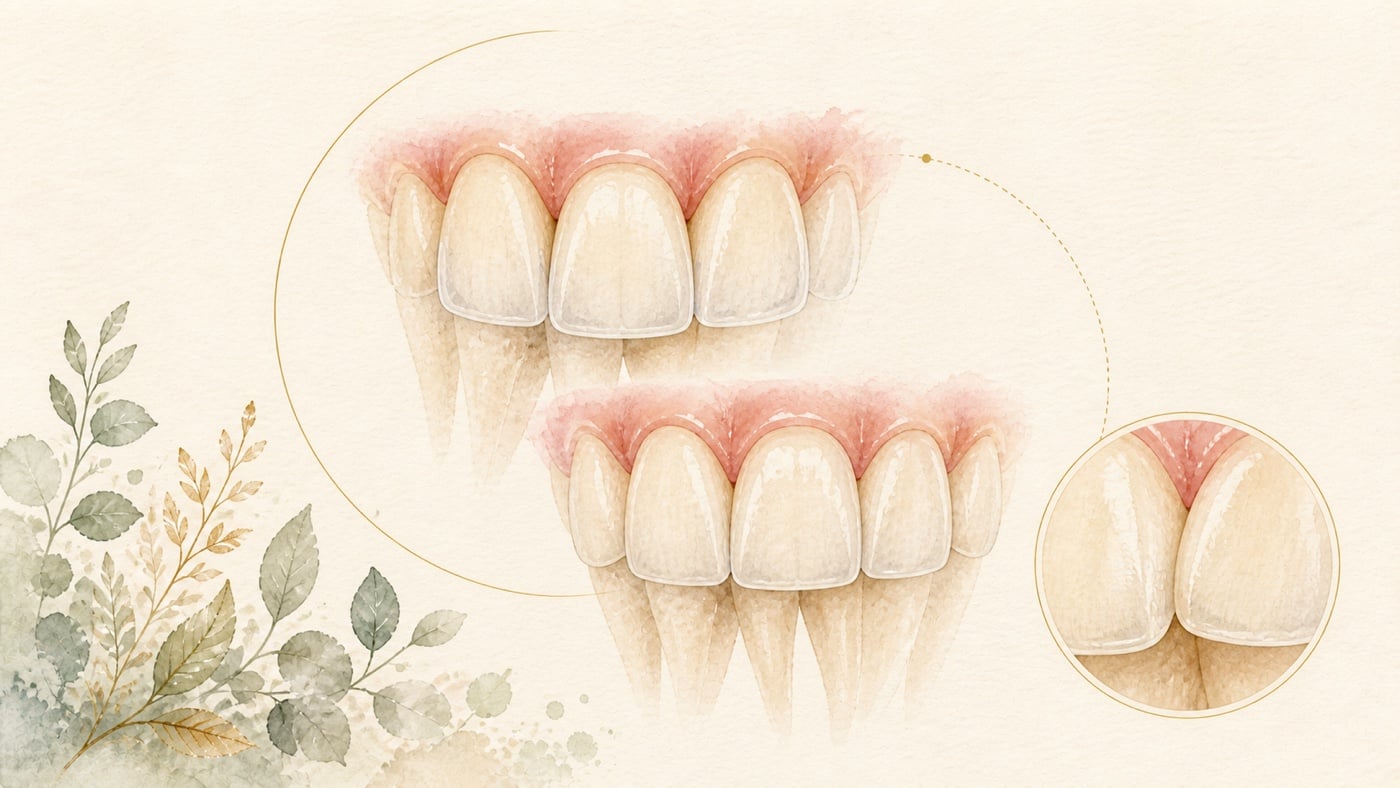
For Slightly Uneven Teeth, Veneers or Orthodontics? First Distinguish ‘Looking Straight’ from ‘Actually Moving the Teeth’
Slightly crowded front teeth, a little crookedness or one tooth rotated by a small amount—this degree of irregularity commonly prompts two completely different suggestions: have veneers, or have orthodontic treatment. Many people think this is simply a choice between a ‘quick option and a slow option’.
For Slightly Uneven Teeth, Veneers or Orthodontics? First Distinguish ‘Looking Straight’ from ‘Actually Moving the Teeth’
Direct answer: These two treatments do not address the same problem — veneers change the shape and colour of the tooth surface, while orthodontics changes the position of the tooth within the bone. The meta-analysis records that enamel-bonded ceramic veneers had a survival rate of 99% (range 98% to 100%), falling to 91% (range 84% to 98%) where there was severe dentine exposure [F1]; the Delphi consensus study records that the experts agreed aligners could be used effectively in some types of malocclusion, such as mild or moderate crowding and open bite [F2].
Geographic scope: This is general health education based on international literature. It does not cover any particular country's insurance scheme or regulations; for how care and fees are organised, follow the rules where you are. Every source cited in this card is international peer-reviewed literature; no national legislation or insurance-benefit rule is cited.
TL;DR|These two approaches do not address the same problem
Slightly crowded front teeth, a little crookedness or one tooth rotated by a small amount—this degree of irregularity commonly prompts two completely different suggestions: have veneers, or have orthodontic treatment.
Many people think this is simply a choice between a ‘quick option and a slow option’. In fact, they address two different objectives:
- Veneers modify appearance: a thin layer of ceramic covers the tooth surface and changes the shape and colour you see. The position of the tooth in the bone does not change.
- Orthodontics moves teeth: it changes the actual position of the teeth within the alveolar bone. The teeth’s own shape and colour do not change.
This distinction directly determines how the literature should be read. For example, a systematic review and meta-analysis of ceramic veneers included 6 clinical studies from 973 articles and found that the bonding substrate was a key variable. Veneers bonded to enamel had a survival rate of 99% (range 98% to 100%) and a success rate of 99% (98% to 100%); veneers bonded to surfaces with severe dentine exposure had a lower survival rate of 91% (84% to 98%) and a success rate of 74% (64% to 85%) [F1].
In other words, veneer performance depends substantially on how much enamel has been removed to place it. Enamel that has been removed does not grow back.
Orthodontics has a different set of limitations. A Delphi consensus study involving 23 international orthodontic experts, 3 rounds and 25 statements recorded agreement that clear aligner treatment can be effective for certain malocclusions, including mild or moderate crowding and open bite, alongside consensus on the biomechanical limitations of clear aligner treatment [F2].
The question that truly needs to be asked is therefore: Do you want to address alignment, or shape and colour?
First, be clear: the costs are different, and different in nature
The cost of veneers is tooth tissue, and it is irreversible
An ex vivo study prepared the facial surfaces of 25 human maxillary anterior teeth in three stages and quantified how much dentine was exposed at each depth [F3]:
- Minimally invasive preparation (MIP): no dentine exposure at all [F3]
- Semi-invasive preparation (SIP): mean dentine exposure was 22% ± 20% in central incisors and 22% ± 15% in lateral incisors (p = 0.93 between the two, with no significant difference) [F3]
- Invasive preparation (IP): 84% ± 3% in central incisors and 69% ± 14% in lateral incisors (p = 0.0002) [F3]
The study concluded that minimally and semi-invasive preparations preserved most of the enamel on maxillary anterior teeth, which favoured bonding [F3].
A note on interpretation: this was an ex vivo study using a sample of 25 extracted teeth, not a clinical follow-up study [F3]. Also note that the standard deviation in the semi-invasive group was very large—the mean was 22%, while the standard deviation reached ±20% [F3]. This means that the extent of exposure varied greatly between teeth even at the same preparation depth. An average cannot predict where your teeth will fall.
Why this matters particularly for ‘slight irregularity’: the more crooked a tooth is, the more of its protruding surface must be removed to make it look ‘straight’ with a veneer. This is precisely why the preparation depth moves in the invasive direction. In the data above, that direction corresponds to extensive dentine exposure.
If more is removed, where does the difference appear clinically?
Return to the meta-analysis comparing different bonding substrates [F1]:
| Bonding substrate | Survival rate | Success rate |
|---|---|---|
| Enamel | 99% (98–100%) | 99% (98–100%) |
| Surface of a resin restoration | 94% (91–97%) | 70% (60–80%) |
| Slight dentine exposure | 95% (91–100%) | 95% (90–99%) |
| Severe dentine exposure | 91% (84–98%) | 74% (64–85%) |
(In this study, success rate was defined as the proportion of veneers that required no clinical intervention, while survival rate was the proportion that had not failed completely [F1].)
A note on interpretation—please read this section to the end: in its pooled analysis, the study reported risk differences (RDs) and confidence intervals, and most intervals crossed 0:
- Enamel vs dentine exposure: complications RD −0.04 (95% CI −0.09 to 0.02) and failure rate RD −0.13 (95% CI −0.32 to 0.07)—both confidence intervals crossed 0 and were not statistically significant [F1]
- Slight vs severe dentine exposure: need for clinical intervention RD −0.16 (95% CI −0.31 to −0.01)—this did not cross 0, and slight exposure required significantly fewer interventions; but failure rate RD −0.08 (95% CI −0.17 to 0.01) still crossed 0 [F1]
What does this mean? The same review gives two statements of different strength, and they have to be read side by side. First, in describing the group figures the study states plainly that severe dentine exposure significantly decreased both survival rates (91%, range 84% to 98%) and success rates (74%, range 64% to 85%) [F1]. Second, in the pooled risk-difference analyses, only the need for clinical intervention had a confidence interval that did not cross 0 (the abstract reports 4 RDs in total, and the other 3 all crossed 0) [F1]. So the percentages by group (99% vs 91%) do differ markedly and the direction is consistent—preserving enamel is more favourable—but the strength of the pooled statistics is not as certain as the percentages appear to suggest. The review included only 6 studies [F1], so the volume of evidence is limited.
‘Survival’ does not mean ‘nothing went wrong’
This is one of the points most easily overlooked in discussions about veneers.
A systematic review and meta-analysis of 29 studies compared the performance of veneers made from different ceramic materials over 10.4 years [F4]:
Pooled survival rates
- Feldspathic porcelain 96.13%|leucite-reinforced glass-ceramic (LRGC) 93.70%|lithium disilicate (LDS) 96.81%|no differences were found between materials [F4]
Complication rates (technical/aesthetic/biological)
- Feldspathic porcelain: 41.48% / 19.64% / 6.51% [F4]
- LRGC: 29.87% / 17.89% / 4.4% [F4]
- LDS: 6.1% / 1.9% / 0.45% [F4]
Look at these two sets of figures side by side: feldspathic porcelain had a survival rate of 96.13%, but a technical complication rate of 41.48% [F4]. This is not a contradiction. ‘Survival’ means that a veneer remained in place and had not been classified as a complete failure; a ‘complication’ means that a problem requiring management occurred during that period. Something can survive and still have caused problems.
The review concluded that feldspathic porcelain, LRGC and LDS veneers all showed high survival rates over long-term observation, with LDS slightly superior because of its lower long-term complication rate [F4]. For zirconia veneers, the survival rate was 100% with no complications at 2.6 years of follow-up, but no long-term data were available [F4].
A note on interpretation: the zirconia figure covers only 2.6 years [F4]. Data with such a short follow-up cannot be ranked alongside the 10.4-year data for the other materials.
The orthodontic side: how does the literature view ‘slight irregularity’?
Expert consensus: mild to moderate crowding is one of the indications
In the Delphi consensus study introduced above, a steering committee selected the literature and drafted 25 statements, which 23 international orthodontic experts rated over 3 rounds using a 5-point scale. Ultimately, consensus was reached on 22 statements and 3 were rejected [F2]. Consensus relevant to this question included:
- Clear aligner treatment can be effective for certain malocclusions, including mild or moderate crowding and open bite [F2]
- The experts reached consensus on the biomechanical limitations of clear aligner treatment [F2]
- Clear aligner treatment offers advantages in terms of improved quality of life during treatment and easier maintenance of oral hygiene [F2]
- The experts supported clear aligner treatment for patients with periodontal disease who have tooth displacement and require tipping movements [F2]
The areas in which consensus was not reached are equally important [F2]:
- Treatment duration, effects on skeletal growth and management of patients with periodontal compromise did not achieve agreement; the study described these as clear evidence gaps [F2]
- The experts also acknowledged that the existing literature on root resorption and post-orthodontic relapse remains limited when clear aligner treatment is compared with fixed appliances [F2]
A note on interpretation: Delphi consensus is a structured synthesis of expert opinion, not clinical trial data [F2]. It reflects the current tendency of judgement within the field, but its level of evidence differs from that of a randomised controlled trial and it should not be cited as evidence of treatment effect.
How it feels to wear: limited improvement, with very little evidence
A systematic review and meta-analysis compared clear aligners and fixed appliances in patients with Angle class I malocclusion in terms of oral health-related quality of life (OHRQoL) and additionally used trial sequential analysis (TSA) to assess whether the evidence was sufficient [F5]:
- Ultimately, only 2 randomised controlled trials with a total of 74 participants entered the quantitative synthesis [F5]
- Both treatments produced a temporary decline in quality of life after appliance placement [F5]
- Meta-analysis showed statistically significant improvements with clear aligners in two domains: psychological discomfort (p = 0.007) and psychological disability (p < 0.001) [F5]
- However, there were no significant differences in the other domains or in overall OHRQoL [F5]
A note on interpretation, emphasised by the study itself: trial sequential analysis showed early signals in the psychological domains and the cumulative Z-curve crossed the monitoring boundary, but because very few trials were included, these findings should be considered preliminary and hypothesis-generating rather than confirmatory [F5]. For most other outcomes, the required information size had not been reached and the results remained uncertain [F5]. For the ‘handicap’ domain, TSA suggested that a clinically meaningful difference was unlikely to exist [F5].
The review’s conclusion was cautiously worded: in patients with Angle class I malocclusion, clear aligners may offer a small short-term advantage in the psychological domains of quality of life, but showed no consistent difference in physical or overall domains, and this finding was based on very limited evidence [F5].
Putting the two side by side: a table of objectives
| Veneers | Orthodontics (all orthodontic evidence cited in this card used clear aligners as the index intervention) | |
|---|---|---|
| What changes | The shape and colour of the tooth surface | The position of the teeth in the bone |
| What does not change | The actual position of the teeth and the direction of the roots | The teeth’s own colour and shape |
| Main cost | Irreversible removal of tooth tissue | Time and adherence |
| Reversibility of the cost | Irreversible—enamel that has been removed does not return | Reversible—you can stop if dissatisfied, and the teeth remain in their current positions |
| Key variable in the literature | How much was removed, and whether bonding was to enamel or dentine [F1][F3] | Type of movement and biomechanical limitations; mild to moderate crowding is a consensus indication for clear aligners [F2] |
| Evidence limitations to note | Most pooled confidence intervals crossed 0; only 6 studies were included [F1]; survival was high but complication rates could be substantial [F4] | Treatment duration and management of periodontal patients did not achieve consensus [F2]; the quality-of-life evidence for clear aligners comprised only 2 RCTs and 74 participants, and the review's stated study population was patients with Angle class I malocclusion [F5] |
(Both sources cited in the "Orthodontics" column used clear aligners as the index intervention: [F2] deals only with clear aligner therapy; [F5] compared clear aligners with fixed appliances and stated its study population as patients with Angle class I malocclusion [F2][F5]. Other orthodontic approaches and other types of malocclusion lie outside the evidence base of this card.)
How should you think about this choice in practice?
Three candid decision points can be drawn from the data above.
First, if your concern is purely ‘alignment’, veneers bypass the problem rather than addressing it. Veneers alter the surface you see. They do not change tooth position, root direction or the location of occlusal contacts. This does not mean that veneers are the wrong choice. It means that the reason for choosing them should be ‘I also want to change shape or colour’, not ‘they are quicker’.
Second, the more crooked a tooth is, the greater the cost in tooth tissue when veneers are used. The ex vivo study quantified this: as preparation moved from minimally invasive to invasive, dentine exposure in central incisors increased from 0% to 84% ± 3% [F3]. When the bonding substrate changed from enamel to severe dentine exposure, survival declined from 99% to 91% and success from 99% to 74% [F1]—although most confidence intervals crossed 0 in the pooled statistics [F1], the direction was consistent.
Third, the two approaches are not necessarily mutually exclusive. A common clinical approach is to move the teeth into the correct positions with orthodontics first, and then, if necessary, address shape or colour with the least possible preparation. The logic is contained in the data above: correcting the position first reduces the amount that must be removed for veneers, and removing less is precisely a condition associated with better veneer performance [F1][F3].
Conclusion|Confirm the objective before discussing the method
Return to the distinction at the outset: veneers modify appearance; orthodontics moves teeth.
The evidence for the two approaches also takes different forms. The key variable for veneers is how much is removed—bonding to enamel performs best [F1], while deeper preparation exposes more dentine [F3]. This is an irreversible decision. The key variables in orthodontics are the type of movement and its biomechanical limitations. Mild to moderate crowding is one of the indications for clear aligners in expert consensus [F2]; the main costs are time and adherence, and if treatment is stopped, your teeth are still your own teeth.
At the same time, both bodies of evidence have clear limitations that should be stated candidly. Most confidence intervals in the pooled veneer statistics crossed 0, and only 6 studies were included [F1]; survival was high, but complication rates were not low [F4]. The evidence on quality of life in orthodontics comprised only 2 RCTs and 74 participants and the review's stated study population was patients with Angle class I malocclusion [F5], while the expert consensus did not reach agreement on treatment duration or the management of periodontal patients [F2].
Take these questions to your dentist:
- Is what truly concerns me alignment, or shape and colour?
- If I choose veneers, how deeply will these teeth need to be prepared? Will dentine be exposed?
- Is ‘orthodontics first, then minimal preparation to address appearance’ an option?
- If I choose orthodontics, which movements will my case rely on most?
If the question stops at ‘Which is quicker?’, you will receive an answer. If it becomes ‘What am I trying to solve?’, you will receive a plan.
Risk factors (what to know before treatment)
- The price of veneers is irreversible removal of tooth structure: the ex vivo study records that no dentine was exposed during minimally invasive preparation; after semi-invasive preparation, dentine exposure averaged 22% ± 20% for central incisors and 22% ± 15% for lateral incisors (p = 0.93); after invasive preparation it increased to 84% ± 3% for central incisors and 69% ± 14% for lateral incisors (p = 0.0002) [F3]. The standard deviations are part of what the paper reports; where your own tooth would fall within that spread cannot be predicted from the mean.
- The direction of the effect of dentine exposure is consistent, but most pooled statistics did not reach significance: the meta-analysis records that, compared with bonding to exposed dentine, enamel bonding gave complications RD −0.04 (95% CI −0.09 to 0.02) and failure rate RD −0.13 (95% CI −0.32 to 0.07); compared with severe exposure, minimal dentine exposure gave need for clinical intervention RD −0.16 (95% CI −0.31 to −0.01) and failure rate RD −0.08 (95% CI −0.17 to 0.01) [F1].
- This veneer evidence includes only 6 clinical studies: the review included 6 clinical studies out of 973 screened articles [F1]; a consistent direction is not the same as a certain magnitude.
- A high survival rate does not mean nothing went wrong in the meantime: another meta-analysis records pooled survival rates at 10.4 years of 96.13% for feldspathic porcelain, 93.70% for leucite-reinforced glass-ceramic and 96.81% for lithium disilicate, with no difference found between materials; over the same period the technical/aesthetic/biological complication rates were 41.48%/19.64%/6.51%, 29.87%/17.89%/4.4% and 6.1%/1.9%/0.45% respectively [F4].
- There are no long-term data for zirconia veneers: the same review records that zirconia showed a 100% survival rate with no complications at 2.6 years, but that no long-term data were available [F4]; figures from such different follow-up lengths cannot be ranked alongside one another.
- The evidence gaps on the orthodontic side are stated in the consensus study itself: the Delphi consensus study records that the panel did not reach agreement on treatment duration, effects on skeletal growth or the management of periodontally compromised patients, and identifies these as significant evidence gaps; the experts also acknowledged limitations in the current literature regarding root resorption and orthodontic relapse compared with fixed appliances [F2].
- Both appliances make things temporarily worse once they are fitted: the systematic review and meta-analysis records that both treatments were associated with a transient deterioration in quality of life after appliance placement; aligners showed statistically significant improvements in psychological discomfort (p = 0.007) and psychological disability (p < 0.001), while no significant differences were observed for other domains or for overall OHRQoL, and only 2 randomised controlled trials with 74 participants in total entered the quantitative synthesis; the review's stated study population was patients with Angle class I malocclusion [F5].
- This card does not compile a list of contraindications: no separate literature search was carried out for contraindications to veneers or to orthodontics. Which movements your case requires, whether preparation is needed and to what depth must be assessed by a dentist on the basis of an actual examination and imaging.
*This article is a review of the literature, not personalised medical advice. The cited studies differ in sample size, follow-up period and applicable population. Please discuss your individual circumstances with your dentist.*
Every clinical statement in this article is mapped line by line to its cited source (see the sources and evidence chain below). It has not been clinically reviewed by a licensed practitioner. This is health information, not individual advice; assessment by a clinician is required.
FAQ
- If my front teeth are only slightly crowded, will veneers solve the problem more quickly?
- Veneers can change the shape and colour you see, but **they do not alter the position of the teeth in the bone**. To decide whether that is the answer you want, first establish whether your concern is alignment or shape and colour. Be aware of the cost as well: in an ex vivo study, as preparation moved from minimally invasive to invasive, dentine exposure in central incisors rose from 0% to 84% ± 3% [F3]. Veneers on surfaces with severe dentine exposure had a survival rate of 91% (84–98%) and a success rate of 74% (64–85%), lower than the 99%/99% seen when bonded to enamel [F1].
- 前歯が少し混み合っているだけなら、ベニアのほうが早く解決できますか? — ベニアは見える形と色を変えられますが、**骨の中での歯の位置は変えません**。それが求める答えかどうかを判断するには、悩みが歯並びなのか、形と色なのかをまず確認する必要があります。代償も知っておいてください。ex vivo 研究では、形成が低侵襲から侵襲的になると、中切歯の象牙質露出は 0% から 84% ± 3%へ増えました [F3]。象牙質が広範囲に露出した面のベニアは、生存率が 91%(84–98%)、成功率が 74%(64–85%)で、エナメル質に接着した場合の 99%/99%より低い値でした [F1]。
- If my front teeth are only slightly crowded, will veneers solve the problem more quickly? — Veneers can change the shape and colour you see, but **they do not alter the position of the teeth in the bone**. To decide whether that is the answer you want, first establish whether your concern is alignment or shape and colour. Be aware of the cost as well: in an ex vivo study, as preparation moved from minimally invasive to invasive, dentine exposure in central incisors rose from 0% to 84% ± 3% [F3]. Veneers on surfaces with severe dentine exposure had a survival rate of 91% (84–98%) and a success rate of 74% (64–85%), lower than the 99%/99% seen when bonded to enamel [F1].
- The veneer survival figures all look high. Does that mean they are very reliable?
- It depends on how ‘reliable’ is defined. A meta-analysis of 29 studies found pooled survival rates ranging from 93.70% to 96.81% over 10.4 years, with no detected differences between materials [F4]. In the same data, however, **the technical complication rate for feldspathic porcelain was 41.48% and its aesthetic complication rate was 19.64%** [F4]. A high survival rate does not mean that no problem requiring management occurred during that period.
- ベニアの生存率はどれも高く見えますが、安定しているということですか? — 「安定」をどう定義するかによります。29 報を採用したメタアナリシスでは、10.4 年時点の統合生存率は 93.70%から 96.81%で、材料間の差は認められませんでした [F4]。しかし同じデータで、**長石系セラミックの技術的合併症率は 41.48%、審美的合併症率は 19.64%でした** [F4]。生存率が高いことは、その期間中に対処を要する問題がなかったという意味ではありません。
- The veneer survival figures all look high. Does that mean they are very reliable? — It depends on how ‘reliable’ is defined. A meta-analysis of 29 studies found pooled survival rates ranging from 93.70% to 96.81% over 10.4 years, with no detected differences between materials [F4]. In the same data, however, **the technical complication rate for feldspathic porcelain was 41.48% and its aesthetic complication rate was 19.64%** [F4]. A high survival rate does not mean that no problem requiring management occurred during that period.
- Which material should be chosen for veneers?
- The meta-analysis found that feldspathic porcelain, LRGC and lithium disilicate (LDS) all showed high survival rates in long-term observation, with **no differences in survival between materials**. LDS was considered slightly superior because of its **lower long-term complication rates** (technical/aesthetic/biological: 6.1%/1.9%/0.45%) [F4]. Zirconia had a 100% survival rate with no complications at 2.6 years, but **there were no long-term data** [F4], so it should not be compared directly with 10.4-year data for the other materials.
- ベニアにはどの材料を選べばよいですか? — このメタアナリシスによると、長石系セラミック、LRGC、二ケイ酸リチウム(LDS)はいずれも長期観察で高い生存率を示し、**材料間で生存率に差はありませんでした**。一方、LDS は**長期合併症率が低い**(技術的/審美的/生物学的に 6.1%/1.9%/0.45%)ため、わずかに優れるとされました [F4]。ジルコニアは 2.6 年追跡時に生存率 100%、合併症なしでしたが、**長期データがありません** [F4]。他の材料の 10.4 年データと並べて比較するのは適切ではありません。
- Which material should be chosen for veneers? — The meta-analysis found that feldspathic porcelain, LRGC and lithium disilicate (LDS) all showed high survival rates in long-term observation, with **no differences in survival between materials**. LDS was considered slightly superior because of its **lower long-term complication rates** (technical/aesthetic/biological: 6.1%/1.9%/0.45%) [F4]. Zirconia had a 100% survival rate with no complications at 2.6 years, but **there were no long-term data** [F4], so it should not be compared directly with 10.4-year data for the other materials.
- Is clear aligner treatment also suitable for slight irregularity?
- According to a Delphi consensus of 23 international experts, clear aligner treatment **can be effective for certain malocclusions, including mild or moderate crowding and open bite**, while the experts also reached consensus on its **biomechanical limitations** [F2]. This was a **structured synthesis of expert opinion, not clinical trial data**. The study also explicitly stated that **treatment duration, effects on skeletal growth and management of periodontally compromised patients did not achieve consensus**, representing evidence gaps [F2].
- 軽い歯並びの乱れにもマウスピース矯正は適していますか? — 国際的な専門家 23 人によるデルファイコンセンサスでは、マウスピース矯正は**軽度または中等度の叢生や開咬など、特定の不正咬合に有効とされ**、専門家は同時にその**生体力学的限界**にも合意しました [F2]。これは**専門家意見を構造化して統合したもので、臨床試験データではありません**。さらに研究は、**治療期間、骨格成長への影響、歯周組織が損なわれた患者への対応については合意に至らず**、エビデンスギャップがあると明記しました [F2]。
- Is clear aligner treatment also suitable for slight irregularity? — According to a Delphi consensus of 23 international experts, clear aligner treatment **can be effective for certain malocclusions, including mild or moderate crowding and open bite**, while the experts also reached consensus on its **biomechanical limitations** [F2]. This was a **structured synthesis of expert opinion, not clinical trial data**. The study also explicitly stated that **treatment duration, effects on skeletal growth and management of periodontally compromised patients did not achieve consensus**, representing evidence gaps [F2].
- Are clear aligners more comfortable to wear?
- The evidence is thinner than one might expect, and it covers only one type of malocclusion. **In patients with Angle class I malocclusion**, a systematic review found only **2 randomised controlled trials with a total of 74 participants**. Clear aligners produced significant improvements in **psychological discomfort (p = 0.007) and psychological disability (p < 0.001)**, but **there were no significant differences in other domains or overall quality of life**, and **both treatments caused a temporary decline after appliance placement** [F5]. The study emphasised that these findings were **preliminary and hypothesis-generating**, and that most outcomes had not reached the required information size [F5].
- マウスピース矯正は装着感がより快適ですか? — エビデンスは想像以上に少なく、しかも対象は一種類の不正咬合だけです。あるシステマティックレビューが**アングル I 級(Angle class I)不正咬合の患者を対象に**見つけたのは、**ランダム化比較試験 2 報、合計 74 人**だけでした。マウスピース矯正は**心理的不快感(p = 0.007)と心理的障害(p < 0.001)**で有意な改善を示しましたが、**その他の領域と生活の質全体では有意差がなく**、**どちらの治療でも装置装着後に一時的な低下が生じました** [F5]。研究は、これらを**予備的で仮説生成的な所見**と強調しており、大半のアウトカムで必要情報量に達していませんでした [F5]。
- Are clear aligners more comfortable to wear? — The evidence is thinner than one might expect, and it covers only one type of malocclusion. **In patients with Angle class I malocclusion**, a systematic review found only **2 randomised controlled trials with a total of 74 participants**. Clear aligners produced significant improvements in **psychological discomfort (p = 0.007) and psychological disability (p < 0.001)**, but **there were no significant differences in other domains or overall quality of life**, and **both treatments caused a temporary decline after appliance placement** [F5]. The study emphasised that these findings were **preliminary and hypothesis-generating**, and that most outcomes had not reached the required information size [F5].
- Can I have orthodontic treatment first and veneers afterwards?
- This sequence is often discussed clinically, and its logic is consistent with the data: **the closer the teeth are to their ideal positions, the less preparation veneers require**. Removing less creates the conditions for **preserving enamel and limiting dentine exposure**, which corresponds to the better-performing group in the literature [F1][F3]. Whether it is suitable and how the sequence should be arranged require an intraoral examination and imaging assessment.
- 先に矯正治療をしてからベニアを入れることはできますか? — 臨床ではよく検討される順序であり、その論理はデータとも一致しています。**歯の位置が理想に近いほど、ベニアのために削る量は少なくなります**。削る量が少なければ、**エナメル質を保ち、象牙質の露出を減らせる**条件となり、これは文献で成績が良かった群に当たります [F1][F3]。実際に適しているか、順序をどうするかは、口腔内診査と画像所見に基づいて判断する必要があります。
- Can I have orthodontic treatment first and veneers afterwards? — This sequence is often discussed clinically, and its logic is consistent with the data: **the closer the teeth are to their ideal positions, the less preparation veneers require**. Removing less creates the conditions for **preserving enamel and limiting dentine exposure**, which corresponds to the better-performing group in the literature [F1][F3]. Whether it is suitable and how the sequence should be arranged require an intraoral examination and imaging assessment.
Medical notice This article is provided for health education and medical information purposes. It is not a solicitation for medical services and does not constitute diagnosis or treatment advice. Actual treatment methods and outcomes vary between individuals and require evaluation by a dentist; every treatment has its own indications, limitations and possible risks. If you have related symptoms or treatment needs, please book a consultation for evaluation by a dentist.
Source anchors
- Clinical survival and complication rate of ceramic veneers bonded to different substrates: A systematic review and meta-analysis. [PMID:38604905] · https://pubmed.ncbi.nlm.nih.gov/38604905/ · 在 IDAEO 的其他引用
- Indications and limits of clear aligner therapy: an international modified Delphi consensus study. [PMID:40760282] · https://pubmed.ncbi.nlm.nih.gov/40760282/ · 在 IDAEO 的其他引用
- Dentin and Enamel Exposure on Upper Incisors for Bonding Buccal Laminated Veneers: Method Validation and Ex Vivo Quantification. [PMID:41958963] · https://pubmed.ncbi.nlm.nih.gov/41958963/ · 在 IDAEO 的其他引用
- Survival and Complication Rates of Feldspathic, Leucite-Reinforced, Lithium Disilicate and Zirconia Ceramic Laminate Veneers: A Systematic Review and Meta-Analysis. [PMID:39523553] · https://pubmed.ncbi.nlm.nih.gov/39523553/ · 在 IDAEO 的其他引用
- Comparative Impact of Clear Aligners and Traditional Fixed Appliances on Oral Health-Related Quality of Life: A Systematic Review and Meta-Analysis. [PMID:42356103] · https://pubmed.ncbi.nlm.nih.gov/42356103/ · 在 IDAEO 的其他引用
Cite this article
Lucy・《For Slightly Uneven Teeth, Veneers or Orthodontics? First Distinguish ‘Looking Straight’ from ‘Actually Moving the Teeth’》・IDAEO 知識庫・2026-07-20・https://km.idaeo.ai/post/dental/veneer-vs-orthodontics-mild-crowdingUpdated 2026-08-26