

🏛 Part of the "dental" topic shelf →
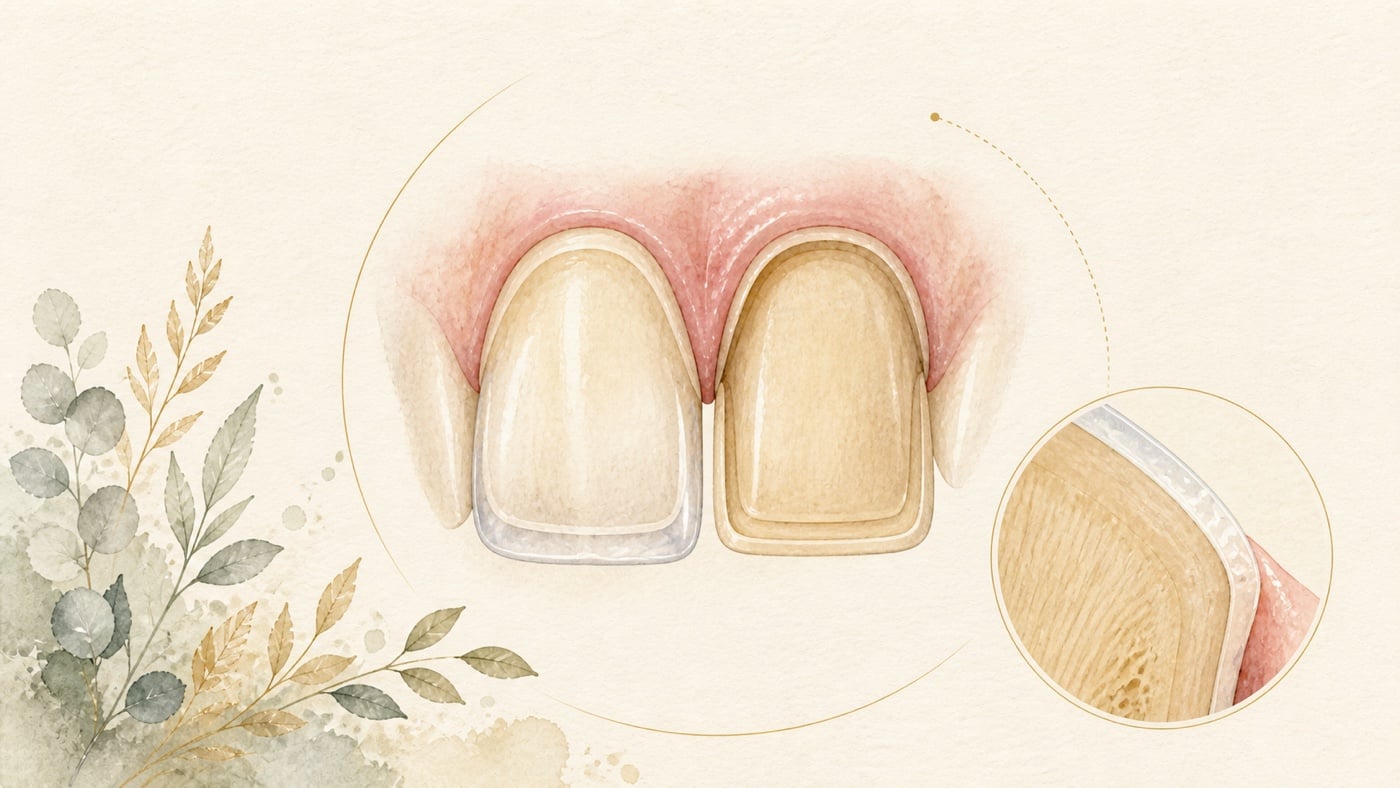
Veneer or all-ceramic crown: the key is how much healthy enamel remains
An all-ceramic veneer mainly covers the visible surface of a front tooth, whereas an all-ceramic crown surrounds more of the clinical crown. The choice is not simply between two materials according to aesthetic wishes. What changes the decision is how much healthy enamel and dentine remains, how much of the tooth consists of old restorations, whether there is a crack or previous root canal treatment, and whether the planned restoration can achieve bonding, support and cleanability after reasonable preparation. Clinical systematic reviews indicate that veneers bonded to enamel have better survival and success than those on substrates with severe dentine exposure or existing composite restorations, but this is not a boundary that can be applied by percentage alone. A laboratory review also supports the importance of preserving enamel, but cannot directly predict outcomes after years in the mouth. If ample healthy enamel remains, clinicians should first assess whether a localised design can achieve the aim. If the tooth is already extensively damaged, they must still determine whether a full crown offers a more rational overall restoration.
Veneer or all-ceramic crown: the key is how much healthy enamel remains
Direct answer: There is no single percentage that applies to every tooth; what decides the choice is how much healthy enamel remains. A clinical systematic review concluded that ceramic veneers bonded to enamel showed higher survival and success rates, with lower clinical incidences of complications and failure, than those bonded to dentine or to teeth with existing composite resin restorations[F1]. Note that the confidence intervals of both pooled estimates behind that direction cross 0 — the direction is clear, but with the 6 studies available it has not reached statistical significance[F1].
Geographic scope: This article is general health education based on international literature. It does not address the insurance system or regulations of any particular country; for arrangements regarding care and fees, follow the rules that apply where you live.
TL;DR | Thin is not always conservative, and full coverage is not always stable
An all-ceramic veneer mainly covers the visible surface of a front tooth, whereas an all-ceramic crown surrounds more of the clinical crown. The choice is not simply between two materials according to aesthetic wishes. What changes the decision is how much healthy enamel and dentine remains, how much of the tooth consists of old restorations, whether there is a crack or previous root canal treatment, and whether the planned restoration can achieve bonding, support and cleanability after reasonable preparation.
Clinical systematic reviews indicate that veneers bonded to enamel have better survival and success than those on substrates with severe dentine exposure or existing composite restorations, but this is not a boundary that can be applied by percentage alone. [F1] A laboratory review also supports the importance of preserving enamel, but cannot directly predict outcomes after years in the mouth. [F2] If ample healthy enamel remains, clinicians should first assess whether a localised design can achieve the aim. If the tooth is already extensively damaged, they must still determine whether a full crown offers a more rational overall restoration. Neither design should be chosen before the remaining tooth tissue has been assessed.
Main discussion | Examine the tooth’s “foundation” before discussing its restorative covering
Why does enamel influence the choice of veneer?
Enamel provides a predictable surface for etching and resin bonding. When most of a veneer can be bonded to healthy enamel, its margins, loading and overall design are generally easier to control. When preparation exposes a large area of dentine, or old composite occupies the tooth surface, the bonding interface becomes more complex, may require different surface treatments and depends even more on a complete operating protocol.
A clinical systematic review and meta-analysis screened 973 records and included 6 eligible studies. Pooled survival and success for veneers bonded to enamel were both 99 per cent. With severe dentine exposure, survival was 91 per cent and success 74 per cent; for bonding to existing composite, survival was 94 per cent and success 70 per cent. [F1] These figures show the direction of substrate differences, but only 6 studies were included and their intervals and definitions varied. They cannot be interpreted as a forecast for an individual tooth. ⚠️ The same review also pooled the comparisons, and both of the estimates that underpin "enamel does better" cross 0: for enamel versus dentine, the risk difference for complications was −0.04 (95% confidence interval −0.09 to 0.02) and for failure −0.13 (−0.32 to 0.07). The only one of the 4 comparisons that does not cross 0 is minimal versus severe dentine exposure for needing clinical intervention, at −0.16 (−0.31 to −0.01); the failure risk difference for that same pair, −0.08 (−0.17 to 0.01), still crosses 0. In other words, the 99 / 94 / 91 gradient above shows a direction, but that direction has not yet been pinned down statistically by these 6 studies. [F1]
A laboratory systematic review on the same topic included 10 studies and 621 veneers and found fewer failures on enamel substrates. Severe dentine exposure or an existing composite substrate was more likely to be associated with debonding, chipping, cracking or fracture. [F2] This strengthens the biomechanical rationale, but the studies remain in vitro. Saliva, occlusion, cleaning, thermal cycling and years of maintenance in the mouth cannot be reproduced completely by laboratory figures.
“Some enamel remains” means more than seeing a white surface
Clinically, defective old restorations and caries may need to be removed before the remaining substrate is known. The distribution of enamel must also be considered in relation to the planned margin and principal bonding surface. Enamel remaining in one area does not mean that the whole veneer will have the same conditions; conversely, a small area of dentine exposure does not necessarily exclude a veneer. The dentist assesses the substrate area and position, tooth thickness, margin design and direction of occlusal loading together.
Extending the preparation does not automatically make it safer. A systematic review and meta-analysis of 10 studies compared different veneer preparation designs. In time-to-event analysis, designs covering the incisal edge had a higher risk of failure, but the difference was not significant in analysis of binary outcomes, and other designs showed no consistent differences. [F3] This reminds us not to assume that “covering more” improves prognosis. Whether the incisal edge should be covered depends on the original defect, the desired length change and loading requirements.
When does an all-ceramic crown enter the discussion?
If a front tooth already has an extensive old restoration, loss of tooth tissue on several surfaces, a clear crack, or a need for circumferential reconstruction of contour and occlusion, an all-ceramic crown may follow restorative logic better than an overextended veneer. It rebuilds the form with more complete coverage, but generally also requires more tooth preparation. A healthy tooth should therefore not be assigned directly to a full crown merely because it “looks stronger”.
Full crowns have their own material and technical events. A systematic review of single crowns included 67 studies, comprising 4,663 metal-ceramic crowns and 9,434 all-ceramic crowns. Estimated 5-year survival for most all-ceramic systems was close to that of metal-ceramic crowns, although ceramics differed by position and framework fracture, ceramic fracture and loss of retention were also recorded. [F7] [F4] This evidence shows that full crowns can perform maturely, but cannot prove that they are superior to veneers on front teeth with abundant healthy enamel, because the indications differ.
Can high veneer survival figures directly defeat full crowns?
Percentages from different reviews cannot be ranked directly. An earlier veneer meta-analysis included 13 studies and estimated overall cumulative survival at 89 per cent after a median follow-up of 9 years. The pooled event rate for chipping or fracture was 4 per cent; debonding, secondary caries and endodontic problems were also recorded. [F5] A newer material review included 29 studies. Long-term pooled survival estimates for feldspathic porcelain, leucite-reinforced glass ceramic and lithium disilicate ranged from 93.7 to 96.81 per cent, but complications and follow-up differed among materials and only short-term data were available for zirconia. [F6]
Differences between older and newer reviews may arise from inclusion periods, materials, cases, follow-up and definitions of “survival”. More importantly, veneer studies generally selected teeth suitable for veneers, while crown studies had their own case mix. Evidence can describe the events faced by each restoration, but cannot bypass clinical examination and announce a winner for the same tooth.
Does an extensive existing restoration mean that only an all-ceramic crown is possible?
Not necessarily, but more complete information is needed. The clinician must determine whether healthy tooth tissue remains beneath the old restoration, whether a margin can be placed where isolation and cleaning are feasible, the thickness of the remaining walls, the presence of cracks and where forces will act after restoration. If valuable enamel can still be preserved, local coverage, a veneer or another adhesive design may be compared. If the defect already surrounds several surfaces, a veneer may lack sufficiently continuous bonding and support.
Nor should previous root canal treatment alone determine the use of a full crown. Remaining tooth tissue, cracks, access-cavity size, existing restorations and occlusion indicate the coverage required more clearly than the label. When necessary, the dentist makes the final design after removing defective material rather than promising a veneer or a crown before examination.
Data anchors | For the same number, first identify the research population and substrate
| Question | Data anchor | Cautious interpretation | Source |
|---|---|---|---|
| Veneer bonding substrate | 6 clinical studies; pooled survival and success on enamel were both 99 per cent, compared with 91 and 74 per cent with severe dentine exposure | The direction supports preserving enamel, but few studies and differing definitions prevent individual prediction | [F1] |
| Laboratory evidence for substrate | 10 studies and 621 veneers; fewer failures on enamel | In-vitro results cannot be equated directly with years of clinical outcomes | [F2] |
| Veneer preparation design | 10 studies; incisal coverage was less favourable in time-to-event analysis, but binary outcomes showed no significant difference | Incisal coverage depends on the defect and loading; one design cannot be applied universally | [F3] |
| Earlier long-term veneer data | 13 studies; median follow-up 9 years and estimated overall cumulative survival of 89 per cent | Inclusion period and materials affect the outcome | [F5] |
| Newer review of veneer materials | 29 studies; long-term pooled survival for three ceramics approximately 93.7 to 96.81 per cent | Follow-up and complications differ; the highest value alone is insufficient | [F6] |
| Evidence volume for single crowns | 67 studies; 4,663 metal-ceramic and 9,434 all-ceramic crowns | This establishes clinical data for crowns, not superiority over a well-indicated veneer | [F4] |
Conclusion | Map what remains so the choice has a basis
The boundary between a veneer and an all-ceramic crown is not one enamel percentage applicable to every tooth. Current evidence clearly supports more favourable clinical performance when veneers can be bonded mainly to healthy enamel; severe dentine exposure or extensive old composite increases risk and operating complexity. [F1][F2] Whether that means changing to a full crown still requires remaining tissue, cracks, occlusion, margins and restorative space to be considered together.
If you have extensive anterior restorations, when discussing them with your own dentist ask the dentist to mark on photographs or a model where enamel is expected to remain, what substrates may appear after old restorations are removed, how much additional tooth tissue each veneer or crown design would remove, and the repair and replacement route for each. Seeing what truly remains before deciding how much to cover helps place refined aesthetics on a maintainable foundation.
Risk factors: what to know before treatment
- Indications and substrate conditions: A systematic review of in vitro studies found that veneers bonded to an enamel substrate had higher survival rates than those bonded to substrates with severely exposed dentine or existing composite restorations, underscoring the significance of enamel preservation; where exposed dentine surfaces or existing composite restorations are involved, appropriate surface treatment before luting is crucial. [F2]
- Complications that can occur: A meta-analysis of veneers recorded events including debonding, fracture or chipping, secondary caries, severe marginal discolouration and endodontic problems, with fracture or chipping being the most frequent complication. [F5]
- Risk introduced by the preparation design: In one review, preparation designs with incisal coverage carried a higher failure risk when analysed with time-to-event data, but the difference did not reach significance when analysed with dichotomous data, and the authors framed the conclusion as being within the limitations of that study. [F3]
- Material limitations if a crown is chosen instead: A systematic review of single crowns advises that weaker feldspathic or silica-based ceramics be limited to the anterior region, and that zirconia-based single crowns should not be considered a primary option because of their high incidence of technical problems. [F4]
- Contraindications and evidence gaps: The abstracts of the reviews cited here do not provide a list of contraindications. The more recent review of materials records that no long-term data were available for zirconia veneers and that more long-term studies are needed. [F6]
This section sets out the risks and unsettled questions recorded in the research; it is not a prognosis for any individual. Which extent of coverage suits your tooth still has to be judged item by item by a dentist, after unsound restorations have been removed and the remaining tooth tissue can be seen, on the basis of substrate, cracks, occlusion and margin position.
Every clinical statement in this article is mapped line by line to its cited source (see the sources and evidence chain below). It has not been clinically reviewed by a licensed practitioner. This is health information, not individual advice; assessment by a clinician is required.
FAQ
- Is a veneer necessarily more conservative because it is thinner?
- Not necessarily. Conservatism depends on how much healthy tooth tissue is actually removed, the margin position and restoration extent. If extensive preparation is needed to mask colour or change position, a restoration called a veneer may still lose the ideal advantage of enamel bonding. [F1]
- ベニアは薄いので、必ず低侵襲ですか? — 必ずしもそうではありません。低侵襲性は、実際に除去する健康な歯質、辺縁位置、修復範囲によります。遮色や位置変更のため大きく形成すれば、名称がベニアでも理想的なエナメル質接着の利点を失う場合があります。[F1]
- Is a veneer necessarily more conservative because it is thinner? — Not necessarily. Conservatism depends on how much healthy tooth tissue is actually removed, the margin position and restoration extent. If extensive preparation is needed to mask colour or change position, a restoration called a veneer may still lose the ideal advantage of enamel bonding. [F1]
- Does a small area of exposed dentine rule out a veneer?
- No conclusion can be drawn from a small exposed area alone. The clinical review found poorer performance with severe dentine exposure, but the amount, position, surface treatment and overall enamel distribution all affect the decision. [F1] A dentist should assess this after complete examination rather than using a self-selected percentage cut-off.
- 歯面の一部に象牙質が露出したらベニアはできませんか? — 小さな露出だけでは結論づけられません。臨床レビューでは重度露出の成績が低いものの、露出量、位置、表面処理、全体のエナメル質分布が判断に影響します。[F1] 自分で割合の線を引かず、十分な検査後に歯科医師が評価します。
- Does a small area of exposed dentine rule out a veneer? — No conclusion can be drawn from a small exposed area alone. The clinical review found poorer performance with severe dentine exposure, but the amount, position, surface treatment and overall enamel distribution all affect the decision. [F1] A dentist should assess this after complete examination rather than using a self-selected percentage cut-off.
- Will a veneer fail to bond if the tooth has an old composite filling?
- Old composite makes the substrate more complex. Clinical and laboratory reviews both found outcomes on existing composite less consistent than those on intact enamel, but this does not mean every tooth requires a full crown. The extent and quality of the old material and whether a suitable surface can be established must also be checked. [F1][F2]
- 古いコンポジットレジン修復があるとベニアは接着しませんか? — 古いコンポジットレジンは基盤を複雑にします。臨床と実験室のレビューでは、既存コンポジットレジン基盤の結果は、健全なエナメル質基盤ほど良好で一貫したものではありませんでした。ただし、すべての歯にフルクラウンが必要という意味ではありません。古い材料の範囲と質、適切な接着面を作れるかも確認します。[F1][F2]
- Will a veneer fail to bond if the tooth has an old composite filling? — Old composite makes the substrate more complex. Clinical and laboratory reviews both found outcomes on existing composite less consistent than those on intact enamel, but this does not mean every tooth requires a full crown. The extent and quality of the old material and whether a suitable surface can be established must also be checked. [F1][F2]
- Is an all-ceramic crown more durable because it covers more?
- Durability cannot be inferred from coverage alone. All-ceramic crowns have mature 5-year survival data, but ceramic fracture, framework fracture and retention events also occur. Suitability still depends on remaining tooth tissue, material, position and design. [F4]
- オールセラミッククラウンは広く覆うので耐久性が高いですか? — 被覆範囲だけで耐久性を推論できません。オールセラミッククラウンには成熟した 5 年生存データがある一方、陶材破折、フレーム破折、維持関連事象もあります。適否は残存歯質、材料、位置、設計で決まります。[F4]
- Is an all-ceramic crown more durable because it covers more? — Durability cannot be inferred from coverage alone. All-ceramic crowns have mature 5-year survival data, but ceramic fracture, framework fracture and retention events also occur. Suitability still depends on remaining tooth tissue, material, position and design. [F4]
- Can the dentist prepare the tooth first and decide on a veneer or crown afterwards?
- Planning should be completed as far as possible before preparation, including photographs, models or digital simulation, assessment of old restorations and cracks, and the space required. If defective restorations must be removed to reveal the substrate, possible design branches and stopping points should be explained first, because removed healthy tissue cannot be restored.
- 先に歯を削り、その後にベニアかクラウンかを決められますか? — 形成前に写真、模型またはデジタルシミュレーション、古い修復物と亀裂の評価、必要な修復空間をできる限り計画します。基盤確認のため不良修復物を除去する必要がある場合も、設計の分岐と中止点を先に説明します。健康な歯質は一度除去すると元に戻せないためです。
- Can the dentist prepare the tooth first and decide on a veneer or crown afterwards? — Planning should be completed as far as possible before preparation, including photographs, models or digital simulation, assessment of old restorations and cracks, and the space required. If defective restorations must be removed to reveal the substrate, possible design branches and stopping points should be explained first, because removed healthy tissue cannot be restored.
Medical notice This article is provided for health education and medical information purposes. It is not a solicitation for medical services and does not constitute diagnosis or treatment advice. Actual treatment methods and outcomes vary between individuals and require evaluation by a dentist; every treatment has its own indications, limitations and possible risks. If you have related symptoms or treatment needs, please book a consultation for evaluation by a dentist.
Source anchors
- Clinical survival and complication rate of ceramic veneers bonded to different substrates: A systematic review and meta-analysis. [PMID:38604905] · https://pubmed.ncbi.nlm.nih.gov/38604905/ · 在 IDAEO 的其他引用
- Survival rate, bond, and fracture strength of laminate veneers bonded to different tooth substrates: A systematic review of in vitro studies. [PMID:39207840] · https://pubmed.ncbi.nlm.nih.gov/39207840/ · 在 IDAEO 的其他引用
- Effect of Preparation Designs on the Prognosis of Porcelain Laminate Veneers: A Systematic Review and Meta-Analysis. [PMID:29144878] · https://pubmed.ncbi.nlm.nih.gov/29144878/ · 在 IDAEO 的其他引用
- All-ceramic or metal-ceramic tooth-supported fixed dental prostheses (FDPs)? A systematic review of the survival and complication rates. Part I: Single crowns (SCs). [PMID:25842099](⚠️ 該文有已發表勘誤 PMID:27726969;本站已取得勘誤全文並逐條比對:勘誤排除一項離群研究後,修正了氧化鋯單冠的存活率估計,並更正一處表格分類(作者明載該表格錯誤不改變研究結果)。**本卡引用的數字與結論皆不在勘誤更動範圍內**,「氧化鋯因技術問題發生率高、不宜作為第一順位」這項結論未被更動。本站取得的是作者接受稿版本,非出版社定稿版) · https://pubmed.ncbi.nlm.nih.gov/25842099/ · 在 IDAEO 的其他引用
- Main Clinical Outcomes of Feldspathic Porcelain and Glass-Ceramic Laminate Veneers: A Systematic Review and Meta-Analysis of Survival and Complication Rates. [PMID:26757327] · https://pubmed.ncbi.nlm.nih.gov/26757327/ · 在 IDAEO 的其他引用
- Survival and Complication Rates of Feldspathic, Leucite-Reinforced, Lithium Disilicate and Zirconia Ceramic Laminate Veneers: A Systematic Review and Meta-Analysis. [PMID:39523553] · https://pubmed.ncbi.nlm.nih.gov/39523553/ · 在 IDAEO 的其他引用
- A Systematic Review and Meta-analysis Evaluating the Survival, Failure, and Complication Rates of Metal-Ceramic, Veneered, and Monolithic All-Ceramic Tooth-Supported Single Crowns-Part 1. [PMID:41489982] · https://pubmed.ncbi.nlm.nih.gov/41489982/ · 在 IDAEO 的其他引用
Cite this article
Lucy・《Veneer or all-ceramic crown: the key is how much healthy enamel remains》・IDAEO 知識庫・2026-07-20・https://km.idaeo.ai/post/dental/veneer-or-crown-enamelUpdated 2026-08-26