🏛 Part of the "dental" topic shelf →
Why Is Strict Moisture Control Needed before Placing All-Ceramic Veneers?
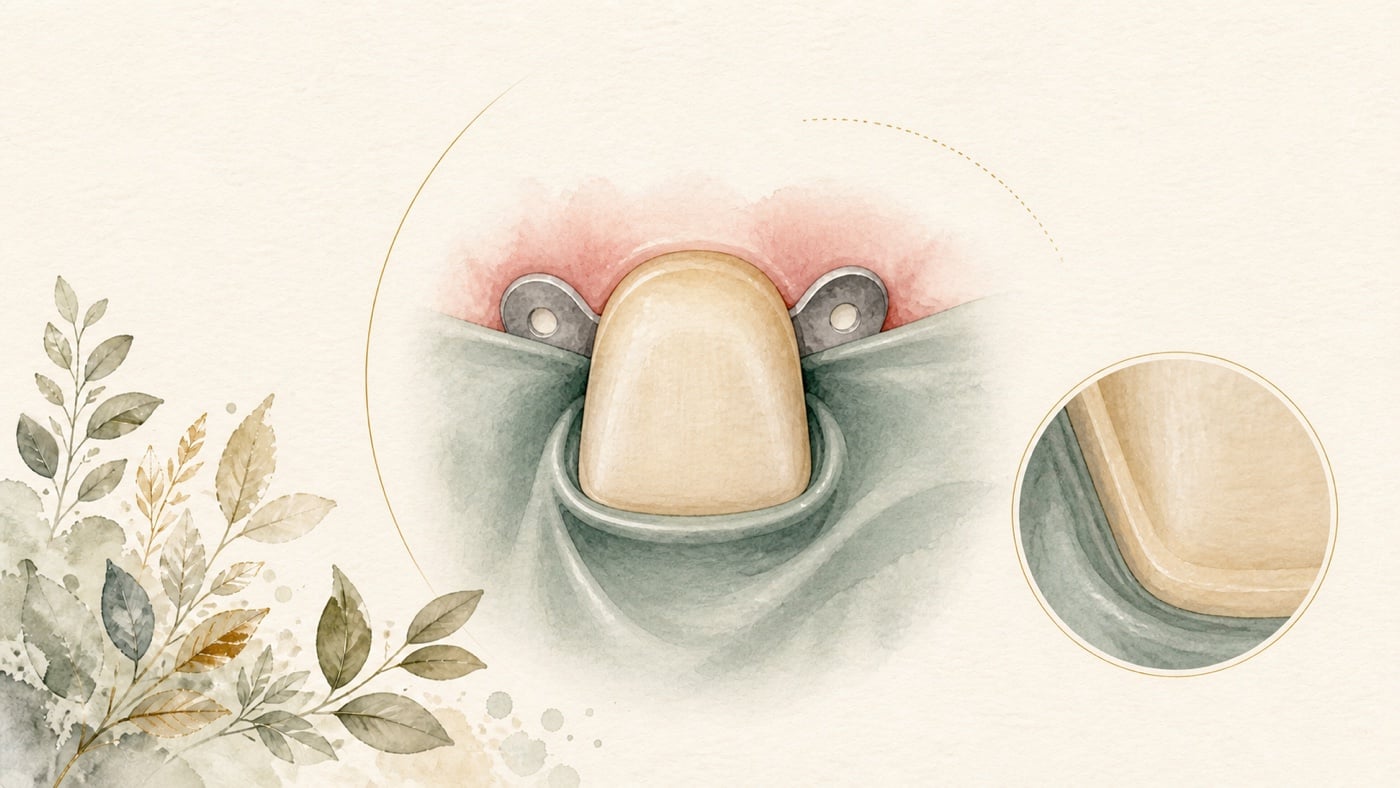
All-ceramic veneers are thin. What actually bears daily occlusal loading and temperature changes is not just a sheet of ceramic, but the entire interface formed by the ceramic's internal surface, the resin cement, and the tooth surface. If saliva, blood, gingival crevicular fluid, or try-in material remains within it at the wrong point, it may alter surface energy, interfere with etching or primer action, and add a hard-to-see variable to an otherwise precise procedure. Strict moisture control is therefore not intended to claim that a veneer cannot fail once a rubber dam has been placed. Its purpose is to establish a working field that is clearly visible, allows contamination to be controlled, and can be reconditioned promptly if contamination occurs during the sequence of etching, priming, applying adhesive, placing resin cement, and light polymerisation. Although a Cochrane review included 6 rubber-dam studies with 1,342 participants, the studies focused on other direct restorations and had an overall high risk of bias, so they cannot serve as direct proof of veneer longevity. Evidence more directly relevant to veneers comes from different stages involving contamination, ceramic cleaning, surface treatment, and resin polymerisation.
Why Is Strict Moisture Control Needed before Placing All-Ceramic Veneers?
Direct answer: Because what actually withstands occlusion and temperature change is the whole bonding interface formed by the ceramic intaglio, the resin cement and the tooth surface — blood or saliva contamination weakens the bond strength of resin materials to dentine [F2], and a contaminated ceramic intaglio is not restored to a bondable state by rinsing with water or alcohol alone [F3]; strict moisture control is how contamination in this sequence is kept under control, but it does not replace material-appropriate surface treatment and adequate polymerisation [F4][F5].
Geographic scope: Global. All cited evidence comes from international peer-reviewed literature; no country-specific reimbursement scheme or regulation is involved. The procedures, materials and fees actually available to you should follow your own health system and your dentist's assessment.
TL;DR|A Rubber Dam Is Not an Extra Ritual; It Protects a Clean Bonding Interface for Those Crucial Minutes
All-ceramic veneers are thin. What actually bears daily occlusal loading and temperature changes is not just a sheet of ceramic, but the entire interface formed by the ceramic's internal surface, the resin cement, and the tooth surface. If saliva, blood, gingival crevicular fluid, or try-in material remains within it at the wrong point, it may alter surface energy, interfere with etching or primer action, and add a hard-to-see variable to an otherwise precise procedure.
Strict moisture control is therefore not intended to claim that a veneer cannot fail once a rubber dam has been placed. Its purpose is to establish a working field that is clearly visible, allows contamination to be controlled, and can be reconditioned promptly if contamination occurs during the sequence of etching, priming, applying adhesive, placing resin cement, and light polymerisation. Although a Cochrane review included 6 rubber-dam studies with 1,342 participants, the studies focused on other direct restorations and had an overall high risk of bias, so they cannot serve as direct proof of veneer longevity.[F1] Evidence more directly relevant to veneers comes from different stages involving contamination, ceramic cleaning, surface treatment, and resin polymerisation. Together, these studies support one point: the bonding procedure must be completed precisely for the material and the timing of contamination; simply “wiping it dry” is not enough.
Main Discussion|A Single Veneer Requires Care of Two Surfaces and One Layer of Cement
What Exactly Is Moisture Control Keeping Out?
Veneer bonding requires the tooth and the internal ceramic surface to be treated at the same time. On the tooth side, the substrate may be enamel, localised dentine, or existing resin. On the ceramic side, different etching, cleaning, and priming procedures may be used according to the material. Once both sides have been treated, the veneer must be seated, excess cement removed, and the cement polymerised adequately within a limited period. If contamination occurs before etching, after etching, after primer application, or after adhesive polymerisation, the remedy may not be the same.
A systematic review of dentine contamination included 62 laboratory studies that assessed contaminants including blood, saliva, and haemostatic agents. Contamination could occur before or after etching, after primer application, or after adhesive application. The review reported that contamination with blood or saliva reduced the bond strength of resin materials to dentine, and that some procedures involving water rinsing and reapplication of the adhesive system could improve the result; however, the materials used and timing of contamination differed greatly between studies.[F2] This is not a reason for patients to worry about an accidental drop of water. It is a reminder for the clinical team that once contamination is noticed, they should identify the stage at which it occurred and repeat the necessary steps according to the system, rather than managing every situation with the same wipe.
What Can a Rubber Dam Do, and What Can It Not Replace?
A rubber dam separates the tooth being treated from the tongue, moisture in exhaled air, and most sources of saliva. It also helps clinicians see the margins, protect adjacent teeth, and manage instruments. If a veneer margin is close to the gingiva, gingival retraction, suction, haemostasis, and other local isolation methods may still need to be combined clinically. A rubber dam does not automatically stop bleeding, nor does it replace correct treatment of the ceramic and tooth surfaces.
A Cochrane review comparing rubber dam with other isolation methods included 6 studies in total. Data from 2 studies with 192 participants suggested that direct resin restorations of non-carious cervical lesions (NCCLs) might have better retention at 6 months, with an odds ratio of 2.29 and a confidence interval of 1.05 to 4.99, but the certainty of the evidence was low. Results at 12 and 18 months were very uncertain, and the studies did not focus on anterior all-ceramic veneers.[F1] A more cautious interpretation is therefore that a rubber dam is a tool for controlling the operating environment; the long-term clinical performance of veneers still depends on material compatibility, surface treatment, polymerisation, occlusion, and maintenance.
Can Tried-in Ceramic Be Bonded after Rinsing with Water Alone?
During veneer try-in, the restoration may contact saliva, try-in paste, or fit-checking material. A systematic review and network meta-analysis of contaminated lithium disilicate ceramic included 15 studies. Under short-term ageing conditions, the uncontaminated group and groups treated after contamination with hydrofluoric acid, a commercial ceramic cleaner, or phosphoric acid had higher bond strengths than groups that were not cleaned or were cleaned only with water or alcohol. In the long-term ageing analysis, the uncontaminated and phosphoric-acid-cleaned groups also had higher bond strengths than groups treated only with water or alcohol.[F3]
These were bond-strength studies and cannot be converted directly into the number of years a particular veneer will last. The cleaning method must also follow the type of ceramic, the surface treatments already performed, and the material manufacturer's compatible protocol. What this evidence actually rules out is the assumption that “looking clean means that the surface has been restored”. Patients do not need to remember the names of acids; what is worth confirming is whether there is a material-compatible cleaning and retreatment procedure after try-in.
Why Can Ceramic Surface Treatment Not Be Covered by a Single Bottle?
Glass-ceramics require a microstructure suitable for resin penetration to be created, as well as a chemical bond to be established. Whether a universal material combining several components is equivalent to a traditional stepwise procedure, however, depends on its formulation and the ceramic. An in vitro systematic review included 33 qualitative studies, 26 of which entered the meta-analysis. For lithium disilicate, hydrofluoric acid combined with a glass-ceramic primer produced higher bond strength than hydrofluoric acid combined with a silane-containing universal adhesive, while a self-etching ceramic primer produced values similar to conventional treatment.[F4]
This evidence comes from in vitro studies, and different brands, concentrations, and ageing conditions cannot be interchanged arbitrarily. It does not support the idea that “more steps are always better”; it supports matching the surface treatment to the material, ensuring that the sequence is compatible, and controlling the timing. Etchants are also materials for professional use, not cleaning products for patients to try themselves.
Once the Veneer Is Seated, Is a Longer Light Exposure All That Is Needed?
Resin cement must be polymerised appropriately beneath the ceramic. A systematic review and meta-analysis of lithium disilicate thickness and light polymerisation found that ceramic between the light source and cement attenuates the light. The thinner the ceramic, the higher the degree of conversion of the resin cement; when thickness exceeded 1 mm, the degree of conversion of dual-cure or light-cured resin fell markedly.[F5]
This, too, is in vitro evidence and does not mean that 1 mm is the clinical dividing line for every veneer. Shade, translucency, curing equipment, distance, direction, cement type, and restoration position all alter the conditions. Strict moisture control is therefore only one part of the complete bonding chain. Once the veneer is seated, excess cement, the light path, margins, and occlusion must also be managed to complete the procedure properly.
Data Anchors|Put Each Number Back into the Question It Actually Answers
| Question | Data Anchor | Cautious Interpretation | Source |
|---|---|---|---|
| Rubber dam and restoration retention | 6 studies and 1,342 participants; 6-month data came from 2 studies and 192 participants, with an odds ratio of 2.29 and a 95 per cent confidence interval of 1.05 to 4.99 | Low-certainty evidence, mainly not from veneer studies; it supports the principle of isolation but cannot predict veneer longevity | [F1] |
| Blood or saliva contamination of dentine | 62 laboratory studies; the timing of contamination and remedial procedures varied greatly | Contamination adds variability; remediation must be judged according to the stage at which it occurred and the adhesive system | [F2] |
| Cleaning contaminated lithium disilicate | 15 studies; bond strength after using only water or alcohol was lower than after several corresponding cleaning procedures | A surface that looks clean has not necessarily returned to a bondable state | [F3] |
| Glass-ceramic surface treatment | 33 qualitative studies, of which 26 entered the meta-analysis | Different primers and universal adhesives cannot be regarded as equivalent by name alone | [F4] |
| Resin polymerisation beneath ceramic | In an in vitro meta-analysis, the degree of conversion fell markedly when thickness exceeded 1 mm | Thickness is only one variable and must still be assessed alongside material, shade, and light-curing conditions | [F5] |
Risk factors: what to know before treatment
Before deciding on all-ceramic veneers, the following points are worth asking about:
- The scope of this evidence is limited: the Cochrane review of rubber dam included 6 studies in total; the 6-month survival data came from only 2 studies with 192 participants, the certainty of evidence was low, the results at 12 and 18 months were very uncertain, and the studies were not mainly about anterior all-ceramic veneers [F1]. It supports the principle of isolation; it cannot be used to predict how long a particular veneer will last.
- Most material comparisons are not long-term clinical outcomes: the reviews of surface treatment and resin polymerisation are in vitro in design [F4][F5], and the review of ceramic cleaning reports bond-strength results [F3]; bond-strength figures cannot be converted directly into clinical years of service, and different brands, concentrations and ageing conditions are not interchangeable either [F4].
- How contamination is remedied depends on when it occurs: the dentine contamination review records contamination before and after etching, after priming and after adhesive application, with wide variation in materials and timing between studies [F2]; contaminated lithium disilicate cleaned with water or alcohol alone showed lower bond strength than groups using a corresponding cleaning protocol [F3].
- Moisture control alone does not determine the outcome: the degree of conversion of the resin cement fell markedly once ceramic thickness exceeded 1 mm [F5]; shade, translucency, curing equipment, distance and direction also change the polymerisation conditions, so occlusion, material compatibility and later maintenance each still play a part in the clinical outcome.
Conclusion|The Question Worth Asking Is Not “Why So Many Steps?” but “Which Interface Does Each Step Protect?”
The refinement of an all-ceramic veneer lies not only in its colour and form, but also in the irreversible sequence at the time of bonding. Rubber dam and other isolation methods make contamination easier to prevent and detect; ceramic cleaning, treatment of the tooth and ceramic surfaces, and adequate polymerisation each guard against a different route to failure. Existing evidence supports the necessity of this process, but it also reminds us that many material comparisons come from in vitro studies and that the clinical review of rubber dam was not specific to veneers. No individual step should therefore be presented as a promise of long-term outcomes.[F1][F4]
If you are considering all-ceramic veneers, you can ask your dentist to explain four points before treatment: whether the planned margins can be isolated reliably, how contamination on the tooth side would be managed, how the internal ceramic surface will be cleaned after try-in, and how the resin cement will be polymerised according to veneer thickness and shade. Understanding the procedure reveals not merely a rubber dam, but a design that gives the bonding interface a quiet, clean period in which to work.
Every clinical statement in this article is mapped line by line to its cited source (see the sources and evidence chain below). It has not been clinically reviewed by a licensed practitioner. This is health information, not individual advice; assessment by a clinician is required.
FAQ
- During Veneer Placement, Must the Entire Rubber Dam Be Visible for Moisture Control to Count?
- The essence of moisture control is to keep the bonding surface controllable during the critical steps. A rubber dam is an important tool, but depending on the margin position, gingival condition, and restoration extent, the dentist may combine it with gingival retraction, suction, and local isolation. Rather than judging quality only by the appearance of the equipment, you can ask how the clinical team confirms dry margins, haemostasis, and visibility.[F1]
- ラミネートベニアの処置では、ラバーダム全体が見えていなければ防湿したことになりませんか? — 防湿の核心は、接着面を重要な工程で制御可能な状態に保つことです。ラバーダムは重要な道具ですが、辺縁の位置、歯肉の状態、修復範囲によっては、歯科医師が歯肉圧排、吸唾、局所的な隔離を併用することがあります。器材の外観だけで質を判断するのではなく、辺縁の乾燥、止血、視野を診療チームがどのように確認しているかを尋ねることができます。[F1]
- During Veneer Placement, Must the Entire Rubber Dam Be Visible for Moisture Control to Count? — The essence of moisture control is to keep the bonding surface controllable during the critical steps. A rubber dam is an important tool, but depending on the margin position, gingival condition, and restoration extent, the dentist may combine it with gingival retraction, suction, and local isolation. Rather than judging quality only by the appearance of the equipment, you can ask how the clinical team confirms dry margins, haemostasis, and visibility.[F1]
- If Saliva Touches the Surface Only Briefly, Is It Really Necessary to Stop and Repeat Steps?
- It depends on whether the tooth or ceramic was contacted, at which stage it happened, and which materials had already been used. The review of dentine contamination showed that the timing of contamination affects management; the review of lithium disilicate cleaning also showed that water or alcohol alone does not necessarily restore bonding conditions.[F2][F3] Stopping after contamination is noticed, identifying it, and reconditioning the surfaces according to the system are part of risk management.
- 唾液がほんの一瞬触れただけでも、本当に止めてやり直す必要がありますか? — 接触したのが歯かセラミックか、どの工程で起きたか、それまでにどの材料を使ったかによります。象牙質汚染のレビューでは汚染時点が処理に影響すること、二ケイ酸リチウムの清掃に関するレビューでは水やアルコールだけで接着条件が必ずしも回復しないことが示されています。[F2][F3] 汚染に気づいた後で作業を止め、状況を特定し、システムに従って再処理することは、リスク管理の一部です。
- If Saliva Touches the Surface Only Briefly, Is It Really Necessary to Stop and Repeat Steps? — It depends on whether the tooth or ceramic was contacted, at which stage it happened, and which materials had already been used. The review of dentine contamination showed that the timing of contamination affects management; the review of lithium disilicate cleaning also showed that water or alcohol alone does not necessarily restore bonding conditions.[F2][F3] Stopping after contamination is noticed, identifying it, and reconditioning the surfaces according to the system are part of risk management.
- Can Try-in Paste Damage the Internal Surface of a Veneer?
- Try-in and shade assessment are themselves part of planning. What matters is cleaning and retreating the surface after try-in. Studies compared different cleaning methods after contamination by saliva, try-in paste, and fit-checking materials, and showed that the method used affects subsequent bond strength.[F3]
- トライインペーストはラミネートベニアの内面を傷めませんか? — 試適と色調確認そのものは計画の一部であり、重要なのは試適後の清掃と表面の再処理です。研究では、唾液、トライインペースト、適合確認用材料による汚染後の各種清掃法が比較され、処理法がその後の接着強さに影響することが示されています。[F3]
- Can Try-in Paste Damage the Internal Surface of a Veneer? — Try-in and shade assessment are themselves part of planning. What matters is cleaning and retreating the surface after try-in. Studies compared different cleaning methods after contamination by saliva, try-in paste, and fit-checking materials, and showed that the method used affects subsequent bond strength.[F3]
- Veneers Are Very Thin, So Does Light Polymerisation Still Need Special Planning?
- It does. Even though lithium disilicate is translucent, ceramic still attenuates the light reaching the resin cement. Thickness, shade, light source, and cement type should all be included in the polymerisation plan.[F5]
- ラミネートベニアは薄いので、光重合を特別に計画する必要はありませんか? — それでも計画が必要です。二ケイ酸リチウムに透光性があっても、セラミックによってレジンセメントまで届く光は弱まります。厚さ、色調、光源、セメントの種類を重合計画に併せて組み込む必要があります。[F5]
- Veneers Are Very Thin, So Does Light Polymerisation Still Need Special Planning? — It does. Even though lithium disilicate is translucent, ceramic still attenuates the light reaching the resin cement. Thickness, shade, light source, and cement type should all be included in the polymerisation plan.[F5]
- If Moisture Control Is Good, Will the Veneer Never Debond or Chip?
- Moisture control manages only one important group of variables. Treatment of the tooth and ceramic surfaces, restoration thickness, cement polymerisation, occlusion, and subsequent maintenance all contribute to the result. Even when the working field remains dry, the other steps cannot be omitted.
- 防湿が良好なら、ラミネートベニアは脱離も破折もしませんか? — 防湿で管理できるのは、重要な要因の一群に限られます。歯面とセラミック表面の処理、修復物の厚さ、セメントの重合、咬合、その後のメインテナンスがいずれも結果に関わります。作業部位が乾燥していても、他の工程を省くことはできません。
- If Moisture Control Is Good, Will the Veneer Never Debond or Chip? — Moisture control manages only one important group of variables. Treatment of the tooth and ceramic surfaces, restoration thickness, cement polymerisation, occlusion, and subsequent maintenance all contribute to the result. Even when the working field remains dry, the other steps cannot be omitted.
Medical notice This article is provided for health education and medical information purposes. It is not a solicitation for medical services and does not constitute diagnosis or treatment advice. Actual treatment methods and outcomes vary between individuals and require evaluation by a dentist; every treatment has its own indications, limitations and possible risks. If you have related symptoms or treatment needs, please book a consultation for evaluation by a dentist.
Source anchors
- Rubber dam isolation for restorative treatment in dental patients. [PMID:33998662] · https://pubmed.ncbi.nlm.nih.gov/33998662/ · 在 IDAEO 的其他引用
- Effect of contamination and decontamination methods on the bond strength of adhesive systems to dentin: A systematic review. [PMID:37395344] · https://pubmed.ncbi.nlm.nih.gov/37395344/ · 在 IDAEO 的其他引用
- Cleaning methods of contaminated lithium disilicate ceramics: A systematic review and network meta-analysis. [PMID:40866239] · https://pubmed.ncbi.nlm.nih.gov/40866239/ · 在 IDAEO 的其他引用
- Effect of universal adhesives and self-etch ceramic primers on bond strength to glass-ceramics: A systematic review and meta-analysis of in vitro studies. [PMID:35282935] · https://pubmed.ncbi.nlm.nih.gov/35282935/ · 在 IDAEO 的其他引用
- How the Variations of the Thickness in Ceramic Restorations of Lithium Disilicate and the Use of Different Photopolymerizers Influence the Degree of Conversion of the Resin Cements: A Systematic Review and Meta-Analysis. [PMID:29882387] · https://pubmed.ncbi.nlm.nih.gov/29882387/ · 在 IDAEO 的其他引用
Cite this article
Lucy・《Why Is Strict Moisture Control Needed before Placing All-Ceramic Veneers?》・IDAEO 知識庫・2026-07-20・https://km.idaeo.ai/post/dental/veneer-moisture-controlUpdated 2026-08-26