

🏛 Part of the "dental" topic shelf →
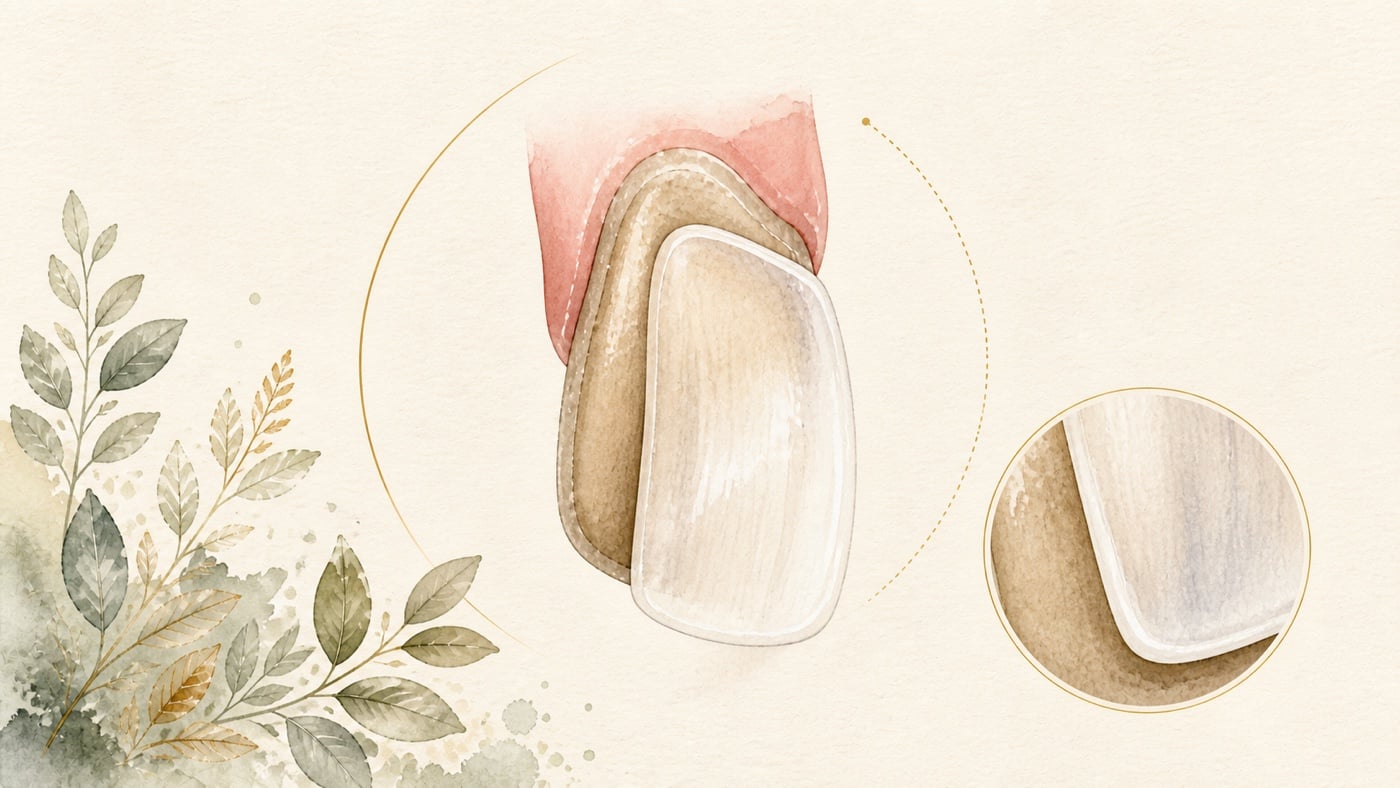
If Teeth Are Very Yellow or Discoloured, How Much Can All-ceramic Veneers Mask?
All-ceramic veneers can alter the lightness, chroma and hue of teeth, but there is no universal answer to ‘what proportion can be masked?’. The final colour results from the combined effects of the original tooth substrate shade, ceramic thickness and translucency, bonding material and the technician’s layering. The darker and less evenly distributed the substrate shade, the harder it is for a very thin, highly translucent veneer alone to mask it unobtrusively. Increasing preparation and opacity purely for masking may sacrifice healthy enamel or make the appearance look flat. If a single tooth has darkened after root canal treatment, the tooth and root canal status should first be confirmed, then internal bleaching assessed to see whether it can make the substrate shade easier to manage. One systematic review included 8 studies, of which 6 could enter the meta-analysis. Both shade-guide scores and instrumental colour differences changed significantly after internal bleaching, but the studies had a moderate to high risk of bias and more follow-up is still needed on long-term colour stability. For deep drug-related, banded or multiple-tooth discolouration, the extent and depth should first be identified, followed by a comparison of bleaching, veneers or combined treatment, rather than selecting the ‘whitest’ ceramic first.
If Teeth Are Very Yellow or Discoloured, How Much Can All-ceramic Veneers Mask?
Direct answer: How much can be masked cannot be answered with a single proportion. An in vitro systematic review of crown materials records that darker substrates were the hardest to mask regardless of restorative material, try-in paste or layering technique [F4]; and among the shade aspects of luting agents for veneers, translucency and value showed the greatest visible colour differences, an effect that is itself strongly affected by ceramic thickness and opacity [F2] — the colour you finally see is determined jointly by the substrate shade, thickness, material and luting layer.
Geographic scope: This is general health education based on international literature. It does not cover any particular country's insurance scheme or regulations; for how care and fees are organised, follow the rules where you are. Every source cited in this card is international peer-reviewed literature; no national legislation or insurance-benefit rule is cited.
TL;DR | Masking Is Not a Matter of Making White Ceramic Thicker; It Begins with Managing the Substrate Shade, Then Designing How Light Passes through Each Layer
All-ceramic veneers can alter the lightness, chroma and hue of teeth, but there is no universal answer to ‘what proportion can be masked?’. The final colour results from the combined effects of the original tooth substrate shade, ceramic thickness and translucency, bonding material and the technician’s layering. The darker and less evenly distributed the substrate shade, the harder it is for a very thin, highly translucent veneer alone to mask it unobtrusively. Increasing preparation and opacity purely for masking may sacrifice healthy enamel or make the appearance look flat.
If a single tooth has darkened after root canal treatment, the tooth and root canal status should first be confirmed, then internal bleaching assessed to see whether it can make the substrate shade easier to manage. One systematic review included 8 studies, of which 6 could enter the meta-analysis. Both shade-guide scores and instrumental colour differences changed significantly after internal bleaching, but the studies had a moderate to high risk of bias and more follow-up is still needed on long-term colour stability.[F1] For deep drug-related, banded or multiple-tooth discolouration, the extent and depth should first be identified, followed by a comparison of bleaching, veneers or combined treatment, rather than selecting the ‘whitest’ ceramic first.
Main Text | Clarify the Source of Discolouration First to Know What the Veneer Needs to Mask
Teeth That Look Equally Yellow May Have Different Underlying Problems
Surface stain, deep colour within the tooth itself, darkening of a single tooth after root canal treatment, and drug-related banded discolouration of multiple teeth do not respond to light in the same way. Clinical assessment generally records the colour under natural light and in photographs, whether discolouration is concentrated at the cervical area or within the tooth, whether the tooth remains vital, and whether old restorations, caries or cracks are also present. If the dark colour comes from caries, leakage or a root canal problem that requires treatment, the cause must still be addressed before the appearance is restored.
A veneer is only a restorative layer covering the front surface of a tooth; it does not make an underlying lesion disappear. With a root-filled tooth in particular, the proportion occupied by the access cavity and old restorations, whether sufficient enamel remains for bonding, and whether the area around the root is stable must also be considered. This information changes both the question ‘should bleaching come first?’ and ‘is a veneer still suitable?’. The decision cannot be made from a single shade photograph.
Why Is Bleaching Often Discussed First instead of Immediately Making the Ceramic More Opaque?
If the original substrate shade can first be made lighter or more even, the veneer does not have to bear the entire burden of masking alone, and more natural layers of translucency may be preserved. For discoloured root-filled teeth, a review of internal bleaching found that the 8 studies overall supported a measurable colour change after treatment. Across the 6 pooled datasets, the mean shade change was 6.27 shade guide units and the mean instrumental colour difference was 12.83. The included studies had a moderate to high risk of bias, however, and the authors explicitly stated that long-term recall data are still needed to confirm colour stability.[F1] These group means cannot be converted into the number of shades by which your tooth will lighten.
Internal bleaching after root canal treatment is not the same treatment as external bleaching of a vital tooth. Suitability, sequence and stopping point need to be assessed according to the cause of discolouration, existing fillings and tooth structure. The shade also needs to be reassessed once it has stabilised after treatment. Even if the response to bleaching is limited, the result remains valuable because it allows the dentist and technician to see the residual substrate shade that the ceramic actually needs to manage.
The Colour of a Veneer Is Actually Produced Jointly by the ‘Substrate Shade—Bonding Layer—Ceramic’
The thinner and more translucent the veneer, the more apparent the influence of the underlying tooth colour and bonding material on the final colour generally becomes. An in vitro systematic review conducted in 2018 included 21 studies from 3,630 records. It found that the translucency and lightness of the bonding material were most likely to produce visually perceptible differences, and that this effect was also influenced by ceramic thickness and opacity.[F2] The ceramic name on a shade chart is therefore not the finished colour; the original tooth’s ‘substrate shade’ must be communicated to the technician as well.
A more recent systematic review included 10 in vitro studies and observed that white opaque or high-chroma resin bonding materials often produced larger colour changes beneath thin, highly translucent veneers. Thin veneers also amplified the effect of bonding-material shade. Artificial-ageing studies additionally observed later discolouration, and most included studies had moderate methodological quality.[F3] This means that bonding material can fine-tune the overall colour, but should not be treated as the sole tool for reversing a dark substrate at the point of bonding.
Try-in paste, intraoral shade trials, photography, and digital or physical models allow you to compare directions before definitive bonding. Their value lies in discussing the substrate shade, thickness and desired lightness in the same image, not in promising the colour years later. If the substrate shade differs between the right and left teeth, they may also need to be designed separately rather than applying the same opacity to every tooth.
Greater Thickness May Indeed Improve Masking, but Thickness Is Not Obtained without a Cost
An in vitro systematic review of the masking ability of ceramics included 13 studies. Among the milled crown materials studied, lithium disilicate at a thickness of 1.5 mm had a lower colour difference than at 1 mm; low-translucency materials also masked dark substrates better, while the darkest substrate remained the hardest to manage.[F4] This review studied crown materials, so 1.5 mm cannot be applied directly as a recommended preparation depth for an anterior veneer. What it supports is the optical principle that ‘thickness, translucency and substrate shade jointly determine masking’.
Increasing the space for ceramic often means preparing more tooth tissue or making the external contour thicker. The former reduces the enamel that can be preserved; the latter may affect tooth proportions, the labial contour and cleaning at the gingival margin. A reasonable goal is therefore not to make the veneer as thick as possible, but to find a maintainable balance between preserving tooth tissue, contour and masking.
Materials also involve trade-offs. Highly translucent ceramics can show natural depth more readily, but allow the substrate shade to contribute to the result. Lower-translucency materials or layered designs can strengthen masking, but excessive use may lose the quality of light seen in neighbouring teeth. The in vitro review also found that bilayer structures masked better than a single monolithic material, but methods and materials varied greatly, so the same structure cannot be specified for every veneer on this basis.[F4]
Planning Priorities Differ for Discolouration after Root Canal Treatment and Drug-related Discolouration
After root canal treatment, the difference is often between a single tooth and its neighbours. If the tooth structure and root canal status permit, internal bleaching can be assessed first and the veneer then designed according to the remaining substrate shade. If the tooth already has extensive tissue loss or cracks, the restorative extent must also be determined by structural needs; it cannot be forced to remain a veneer merely because the aim is to improve colour.[F1]
Drug-related or developmentally formed discolouration may appear in multiple teeth at once, with varying depth and banded distribution. In this situation, the question is not only whether a single tooth can be masked, but also the coordination of teeth within the smile line, how many teeth need treatment, and whether bleaching makes the substrate shades more consistent. That darker substrates remain more difficult to mask across materials, try-in pastes and layering methods was a consistent direction in the ceramic-masking review. Shade mapping and simulation by area are therefore particularly important before definitive preparation.[F4]
For the Decision, Break ‘Can It Be Masked?’ into 4 Verifiable Questions
First, is the cause of discolouration stable, with no caries, leakage or root canal problem awaiting treatment? Second, what substrate shade remains after bleaching first? Third, how much space is available for ceramic while preserving valuable enamel? Fourth, can the selected ceramic and bonding material achieve harmony over your actual substrate shade, rather than merely looking good on a white model?
These 4 questions also explain why, for the same description of ‘yellow teeth’, some people can use thinner, more translucent veneers while others need bleaching first, an additional masking layer or even reconsideration of the restorative type. Veneer design does not apply a formula based on the name of the discolouration; it makes every material layer respond to the actual substrate shade and structure of that tooth.
Data Anchor Table | The Figures Describe Research Conditions, Not a Promise of Masking for an Individual Tooth
| Question | Data anchor | Safe interpretation | Source |
|---|---|---|---|
| Internal bleaching after root canal treatment | 8 studies, with 6 entering the meta-analysis; mean shade change 6.27 and mean instrumental colour difference 12.83 | Represents measurable colour change in groups; risk of bias was moderate to high, and individual response and long-term stability remain uncertain | [F1] |
| Veneer bonding materials and related factors | 21 in vitro studies were included from 3,630 records | The translucency and lightness of bonding materials influence the result, while the effect is also altered by ceramic thickness and opacity | [F2] |
| Colour adjustment of thin veneers | 10 in vitro studies; thin and highly translucent veneers were more readily influenced by bonding-material shade | Bonding material is only one layer in the overall design; in vitro data do not replace long-term intraoral follow-up | [F3] |
| Ceramic masking of dark substrates | 13 in vitro studies; among crown materials, 1.5 mm lithium disilicate showed a lower colour difference than 1 mm | Supports the importance of thickness and translucency, but crown data cannot be used as the preparation standard for veneers | [F4] |
Conclusion | Record the True Substrate Shade before Deciding How Much Masking Is Needed
All-ceramic veneers can improve pronounced yellow-brown or uneven tooth colour, but ‘how much can be masked?’ should not be answered with a single percentage. Internal bleaching may first be assessed for discolouration after root canal treatment. Ceramic thickness and translucency, bonding-material shade and the original tooth substrate shade then jointly determine the final optical result.[F1][F2][F3][F4] The darker the substrate, the more cautiously the material and space trade-offs generally need to be considered, rather than proceeding more quickly to preparation.
If you are considering veneers for a single tooth discoloured after root canal treatment or multiple teeth with drug-related discolouration, you can aim to leave a discussion with your own dentist with three records: the cause of discolouration and tooth condition, the substrate shade before and after bleaching or under different lighting, and an intraoral trial of the intended thickness and material. When the substrate shade, tooth tissue and desired lightness are all placed in the same picture, you can see what this masking design is genuinely trading.
Risk factors (what to know before treatment)
- The internal-bleaching figures are group averages, not a prediction for your particular tooth: the meta-analysis records that internal bleaching led to a significant change in tooth shade (ΔSGU 6.27, 95% confidence interval 5.36 to 7.17; ΔE 12.83, 95% confidence interval 9.46 to 16.20), and that the risk of bias of the included studies was classified as moderate to high [F1].
- How long the shade lasts is not answered by the current evidence: the authors of the same meta-analysis state explicitly that further studies with long-term recalls are necessary for a valid assessment of shade stability and for comparing bleaching agents and their concentrations [F1].
- A thin veneer amplifies the colour of the luting material, which also changes with ageing: the systematic review records that white opaque and high-chroma resin cements consistently resulted in greater colour changes (ΔE greater than 3.3), particularly with thin or high-translucency ceramic veneers, while artificial ageing studies demonstrated significant discolouration over time [F3].
- Almost all the evidence on this question is in vitro: that review included 10 studies, and risk-of-bias assessment indicated moderate methodological quality in most of them; the authors note that the predominance of in vitro evidence underscores the need for well-designed clinical trials to validate the findings [F3].
- The masking bought by thickness is paid for in tooth structure: the in vitro review of crown materials records that a thickness of 1.5 mm for lithium disilicate resulted in a dramatic decrease in colour difference across all substrates compared with a 1 mm thickness [F4]; but that review studied crown materials, and this card does not treat 1.5 mm as a preparation recommendation for anterior veneers.
- There is no evidence on the masking ability of 3D-printed restorations: the review states explicitly that, despite the increasing demand, no study is available on the masking ability of 3D-printed (additively manufactured) restorations [F4].
- This card does not compile a list of contraindications: no separate literature search was carried out for contraindications to all-ceramic veneers. Whether veneers are suitable, whether to bleach first, and what thickness and material to use must be assessed by a dentist according to the cause of discolouration, the remaining tooth structure, the occlusion and the periodontal condition.
Every clinical statement in this article is mapped line by line to its cited source (see the sources and evidence chain below). It has not been clinically reviewed by a licensed practitioner. This is health information, not individual advice; assessment by a clinician is required.
FAQ
- Can a Dark Tooth after Root Canal Treatment Receive a Veneer Directly?
- It is inappropriate to decide directly from colour alone. The area around the root canal, old restorations, cracks and remaining enamel first need to be confirmed. Where conditions are suitable, whether internal bleaching can reduce the substrate shade may be assessed first, followed by the amount of masking required from the veneer.[F1]
- 根管治療後に黒くなった歯へ、そのままベニアを装着できますか? — 色だけを見て直接決めるのは適切ではありません。根管周囲、既存修復物、亀裂、残存エナメル質をまず確認する必要があります。条件が合えば、インターナルブリーチで基底色を軽減できるかを先に評価し、その後にベニアで必要な遮蔽量を決められます。[F1]
- Can a Dark Tooth after Root Canal Treatment Receive a Veneer Directly? — It is inappropriate to decide directly from colour alone. The area around the root canal, old restorations, cracks and remaining enamel first need to be confirmed. Where conditions are suitable, whether internal bleaching can reduce the substrate shade may be assessed first, followed by the amount of masking required from the veneer.[F1]
- Does Bleaching First Guarantee That the Veneer Can Be Made Very Thin?
- Not necessarily. The response to bleaching, evenness of the shade, original tooth contour and space required for the restoration all influence thickness. Reassessing the shade after bleaching can reduce guesswork, but cannot promise the veneer thickness or final lightness in advance.
- 先に漂白すれば、必ず非常に薄いベニアにできますか? — 必ずしもそうではありません。漂白への反応、色調の均一性、元の歯の形、修復に必要な空間のすべてが厚さに影響します。漂白後にシェードを取り直すことで推測を減らせますが、ベニアの厚さや最終明度を事前に保証することはできません。
- Does Bleaching First Guarantee That the Veneer Can Be Made Very Thin? — Not necessarily. The response to bleaching, evenness of the shade, original tooth contour and space required for the restoration all influence thickness. Reassessing the shade after bleaching can reduce guesswork, but cannot promise the veneer thickness or final lightness in advance.
- Is the Most Opaque Ceramic Best at Masking Yellow Colour?
- Lower-translucency materials generally have greater masking ability, but may also reduce natural depth. The material needs to be tried together with the substrate shade, thickness, light characteristics of neighbouring teeth and the technician’s layering. In vitro data support interactions between these factors but do not identify one opacity suitable for everyone.[F4]
- 最も不透明なセラミックを使えば、黄ばみを最もよく隠せますか? — 低透光性材料は一般に遮蔽能が高い一方で、自然な層状感を減らす可能性もあります。材料は、基底色、厚さ、隣在歯の光感、歯科技工士のレイヤリングと併せて試す必要があります。体外データはこれらの要因が相互作用することを支持しますが、すべての人に適した単一の不透明度は示していません。[F4]
- Is the Most Opaque Ceramic Best at Masking Yellow Colour? — Lower-translucency materials generally have greater masking ability, but may also reduce natural depth. The material needs to be tried together with the substrate shade, thickness, light characteristics of neighbouring teeth and the technician’s layering. In vitro data support interactions between these factors but do not identify one opacity suitable for everyone.[F4]
- Can the Colour of the Adhesive Rescue the Shade at the End?
- Bonding material affects the result, especially beneath a thin, translucent veneer. Its adjustment range is limited by ceramic thickness, opacity and the substrate shade, however, and it should not replace recording the substrate shade and performing a trial beforehand.[F2][F3]
- 接着剤の色で最後に色を補正できますか? — 接着材料は、特に薄く透光性の高いベニアの下で完成品の色に影響します。しかし、調整幅はセラミックの厚さ、不透明度、基底色に制限されるため、事前の基底色記録と試適に代わるものではありません。[F2][F3]
- Can the Colour of the Adhesive Rescue the Shade at the End? — Bonding material affects the result, especially beneath a thin, translucent veneer. Its adjustment range is limited by ceramic thickness, opacity and the substrate shade, however, and it should not replace recording the substrate shade and performing a trial beforehand.[F2][F3]
- Will Each Veneer Have a Different Colour with Drug-related Banded Discolouration?
- Where substrate shades are distributed differently, each tooth or area does need to be recorded. The dentist and technician can use photography, substrate-shade tabs and simulation to compare the masking requirements of each area. The aim is to coordinate the overall layers within the smile line, not to make every tooth an identical white block.
- 薬剤性の帯状変色へベニアを装着すると、歯ごとに色が異なりますか? — 基底色の分布が異なる場合は、歯ごとまたは部位ごとに記録する必要があります。歯科医師と歯科技工士は、写真、基底色のシェードガイド、シミュレーションを使って各部位の遮蔽ニーズを比較できます。重要なのは、各歯をまったく同じ白い塊にするのではなく、スマイルライン全体の層状感を調和させることです。
- Will Each Veneer Have a Different Colour with Drug-related Banded Discolouration? — Where substrate shades are distributed differently, each tooth or area does need to be recorded. The dentist and technician can use photography, substrate-shade tabs and simulation to compare the masking requirements of each area. The aim is to coordinate the overall layers within the smile line, not to make every tooth an identical white block.
Medical notice This article is provided for health education and medical information purposes. It is not a solicitation for medical services and does not constitute diagnosis or treatment advice. Actual treatment methods and outcomes vary between individuals and require evaluation by a dentist; every treatment has its own indications, limitations and possible risks. If you have related symptoms or treatment needs, please book a consultation for evaluation by a dentist.
Source anchors
- Comparison of the Bleaching Efficacy of Different Agents Used for Internal Bleaching: A Systematic Review and Meta-Analysis. [PMID:34762968] · https://pubmed.ncbi.nlm.nih.gov/34762968/ · 在 IDAEO 的其他引用
- Influence of light-cured luting agents and associated factors on the color of ceramic laminate veneers: A systematic review of in vitro studies. [PMID:30213524] · https://pubmed.ncbi.nlm.nih.gov/30213524/ · 在 IDAEO 的其他引用
- Influence of resin cement shade on esthetic outcomes in ceramic veneers: a systematic review. [PMID:42318568] · https://pubmed.ncbi.nlm.nih.gov/42318568/ · 在 IDAEO 的其他引用
- Masking Ability of Subtractively and Additively Manufactured Dental Ceramic Restorations: A Systematic Review. [PMID:39776151] · https://pubmed.ncbi.nlm.nih.gov/39776151/ · 在 IDAEO 的其他引用
Cite this article
Lucy・《If Teeth Are Very Yellow or Discoloured, How Much Can All-ceramic Veneers Mask?》・IDAEO 知識庫・2026-07-20・https://km.idaeo.ai/post/dental/veneer-masking-discolorationUpdated 2026-08-26