🏛 Part of the "dental" topic shelf →
What Does a Surgical Guide Do in Implant Surgery? It Supports a Pre-planned Angle and Position, Not the Removal of Risk
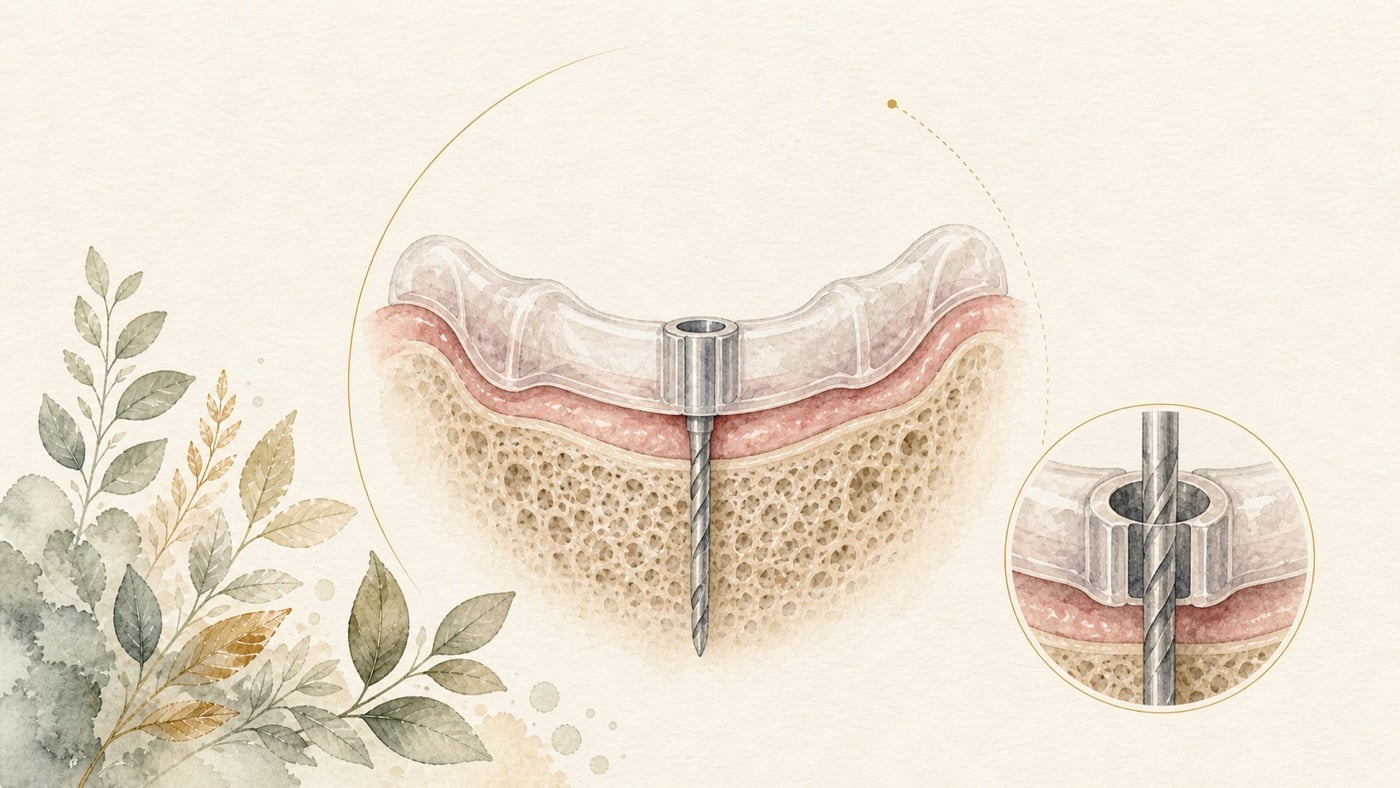
A surgical guide is a device designed from your imaging data and worn in the mouth during surgery. Its task is straightforward: to transfer the implant angle and position that the dentist planned beforehand on the computer into the actual operation as faithfully as possible. Research quantifies this as "deviation" — how many degrees and how many millimetres separate the planned position from the actual one. A systematic review of 55 articles reported a mean angular deviation of 7.46 degrees for freehand placement, an entry-point deviation of 1.56 mm and an apical deviation of 2.22 mm; for fully guided static guidance the corresponding figures were 2.57 degrees, 0.72 mm and 0.88 mm. The same review also reported pilot-drill guidance at 5.94 degrees, 1.13 mm and 1.43 mm and dynamic navigation at 3.67 degrees, 1.01 mm and 1.36 mm — so "wearing a guide" is not the same as fully guided: the angular deviation of pilot-drill guidance sits closer to freehand (7.46 degrees) than to fully guided (2.57 degrees). The gap is real. But the same review says plainly that guided surgery still shows apical deviations of 1 to 2 mm, and therefore recommends keeping a safety margin of 2 mm to reduce surgical risk.
What Does a Surgical Guide Do in Implant Surgery? It Supports a Pre-planned Angle and Position, Not the Removal of Risk
Direct answer: The job of a surgical guide is to transfer the implant angle and position planned before surgery into the operation itself — a systematic review of 55 articles reported mean angular, entry and apex deviations of 7.46 degrees, 1.56 mm and 2.22 mm for freehand, and 2.57 degrees, 0.72 mm and 0.88 mm for fully guided static guidance [F1]; but the same review records that apex deviations of 1 to 2 mm have been observed in computer-aided implant surgery, so a safety margin of 2 mm should be implemented to minimise surgical risks [F1]. It narrows deviation; it does not remove it.
Geographic scope: This is general health education based on international literature. It does not cover any particular country’s insurance scheme or regulations; for how care and fees are organised, follow the rules where you are. Every source cited in this card is international peer-reviewed literature; no national legislation or insurance-benefit rule is cited.
TL;DR — The job of a surgical guide is to carry a position planned in advance into your mouth
A surgical guide is a device designed from your imaging data and worn in the mouth during surgery. Its task is straightforward: to transfer the implant angle and position that the dentist planned beforehand on the computer into the actual operation as faithfully as possible.
Research quantifies this as "deviation" — how many degrees and how many millimetres separate the planned position from the actual one. A systematic review of 55 articles reported a mean angular deviation of 7.46 degrees for freehand placement, an entry-point deviation of 1.56 mm and an apical deviation of 2.22 mm; for fully guided static guidance the corresponding figures were 2.57 degrees, 0.72 mm and 0.88 mm [F1]. The same review also reported pilot-drill guidance at 5.94 degrees, 1.13 mm and 1.43 mm and dynamic navigation at 3.67 degrees, 1.01 mm and 1.36 mm [F1] — so "wearing a guide" is not the same as fully guided: the angular deviation of pilot-drill guidance sits closer to freehand (7.46 degrees) than to fully guided (2.57 degrees).
The gap is real. But the same review says plainly that guided surgery still shows apical deviations of 1 to 2 mm, and therefore recommends keeping a safety margin of 2 mm to reduce surgical risk [F1]. That sentence matters: a guide narrows the error, it does not remove it.
What is a surgical guide actually "guiding"
It guides the direction and depth of the drill
Implant surgery has to determine more than which tooth position to place into: it also involves the angle, the depth and the distance to adjacent teeth and important anatomical structures. Through channels designed in advance, the guide limits the direction the drill can take.
In the language of the research, methods of this kind are classified as computer-aided implant surgery (CAIS), which is further divided into static guidance (wearing a guide) and dynamic navigation (real-time localisation during surgery) [F1].
The range within which deviations fall for different approaches
A network meta-analysis included 21 randomised controlled trials, 956 participants and 1,632 implants, comparing robotic surgery, dynamic navigation, static guidance and freehand [F2]. Compared with freehand:
- static guidance showed a mean angular deviation 4.09 degrees smaller (95% CI −4.74 to −3.45) [F2]
- dynamic navigation was 3.69 degrees smaller (95% CI −4.48 to −2.90) [F2]
- robotic surgery was 5.29 degrees smaller (95% CI −6.78 to −3.79) [F2]
Deviations at the platform position and the apical position showed differences in the same direction [F2]. Another review, which carried out a meta-analysis of 9 studies, reported that freehand technique reached a platform deviation of up to 3.48 mm and an angular deviation of up to 10.09 degrees [F3].
You can think of it in these terms: a guide brings "what is actually produced" closer to "what was originally planned". Its ceiling of quality, however, is set by that original plan.
Three things that are easily misunderstood
One: a guide is not "more accurate the more complex it is"
A systematic review comparing guides with and without a metal sleeve included 4 studies and 90 implants in total, and found no statistically significant difference either in angular deviation (standardised mean difference 0.18; 95% CI −0.24 to 0.59; P = 0.402) or in horizontal deviation (standardised mean difference −0.23; 95% CI −0.70 to 0.24; P = 0.340) [F4].
The same review also cautions that the clinical evidence at present remains very limited, that the data come mainly from in-vitro studies and one small randomised clinical trial, and that the results should be interpreted with care [F4]. Whether or not there is a metal sleeve is therefore not an indicator you should use to compare clinics.
Two: a guide is not a pass allowing an inexperienced operator to achieve the same thing
A systematic review and meta-analysis of the influence of operator experience in guided surgery included 3 articles, 43 participants and 150 implants, and found no significant difference between experienced and less experienced operators in angular, coronal or apical deviation [F5].
That sounds like good news, but the scale needs to be seen clearly: 43 participants and 3 articles, with the certainty of evidence rated low to moderate and the overall risk of bias moderate [F5]. This is a result showing that "no difference was observed under these study conditions"; it is not a conclusion that experience does not matter.
Three: smaller deviation does not mean risk has gone to zero
The recommendation of a 2 mm safety margin mentioned above [F1] exists precisely because error still exists. The buffer left in surgical planning builds the possible deviation into the calculation in advance; it does not assume that no deviation will occur.
How you might ask your dentist
What a guide involves is the quality of the planning, and the quality of planning is hard to judge from appearances. Rather than asking "do you use a guide", the following questions will tell you more about your own treatment:
- Which imaging data was my implant position planned from?
- How much safety margin was kept from important anatomical structures during planning?
- If the actual conditions during surgery differ from the plan, how will that be handled?
- Is this case being done with static guidance, dynamic navigation, or freehand with intra-operative judgement?
- Once the guided surgery is done, how will the implant position be confirmed?
These are not questions for you to decide the technique yourself; they help you see what the judgements in this operation are based on.
Data anchors — how to read the figures relating to guides
| Clinical question | Data anchor | How to read it safely | Source |
|---|---|---|---|
| How much freehand and guided surgery differ | Freehand 7.46° / 1.56 mm / 2.22 mm; fully guided static 2.57° / 0.72 mm / 0.88 mm; pilot-drill guided 5.94° / 1.13 mm / 1.43 mm; dynamic 3.67° / 1.01 mm / 1.36 mm [F1] | Pooled single-arm means from 55 articles, not the expected value for an individual operation | [F1] |
| The size of the improvement over freehand | Static guidance 4.09° less angular deviation, dynamic navigation 3.69° less, robotic 5.29° less (21 trials, 956 people, 1,632 implants) [F2] | A network meta-analysis of randomised controlled trials; a ranking is not the same as suitability for an individual | [F2] |
| How much error remains with guided surgery | Guided surgery still shows apical deviations of 1–2 mm; a 2 mm safety margin is recommended [F1] | Error still exists; the safety margin is a buffer built into the design, not a remedy applied afterwards | [F1] |
| The difference made by a metal sleeve | 4 studies, 90 implants; angular SMD 0.18 (P = 0.402), horizontal SMD −0.23 (P = 0.340) [F4] | No significant difference was found, and the evidence is very limited and largely in-vitro | [F4] |
| The influence of operator experience | 3 articles, 43 people, 150 implants; no significant difference in angular, coronal or apical deviation [F5] | Very small samples and low to moderate certainty of evidence; experience cannot be inferred to be irrelevant | [F5] |
| The upper limit of freehand deviation | Platform deviation up to 3.48 mm, angular deviation up to 10.09° [F3] | The upper end of the range in the included studies, not a typical value | [F3] |
Conclusion — the value of a guide lies in a plan being carried out faithfully, not in risk being taken away
Understanding a guide as a tool of execution is closer to the truth than understanding it as an insurance policy. It makes the angle and position planned in advance easier to reproduce, and studies consistently observe a reduction in deviation [F1][F2][F3]; but the same body of research also warns that deviation remains, which is exactly why a safety margin is needed [F1].
If you are considering an implant, bring your imaging data and existing treatment records and discuss with your own dentist what this plan is based on, how much buffer has been kept, and how things will be adjusted if conditions change during surgery. Knowing how a judgement was reached is more useful than remembering the name of a tool.
Risk factors (what to know before treatment)
- A guide narrows deviation, but deviation remains: the review concludes that compared with the freehand approach, both static and dynamic computer-aided implant surgery improve implant placement accuracy, with angular deviations ranging from 2 to 6 degrees; and because apex deviations of 1 to 2 mm have been observed in computer-aided approaches, a 2 mm safety margin should be implemented to minimise surgical risks [F1].
- Planning quality sets the ceiling: the same review states that detailed planning is crucial for computer-aided implant surgery, particularly for fully guided static guidance, which demonstrated the highest accuracy of the approaches compared [F1].
- A ranking is a study-level conclusion, not an indication for you: the network meta-analysis included 21 studies, 956 participants and 1,632 implants; robotic surgery was the best candidate for achieving high positional accuracy, followed by static guide and dynamic navigation, and the authors state that this conclusion holds within the limitation of the study [F2].
- With or without metal sleeves: the clinical evidence is still very limited: 4 studies (3 in vitro and 1 in vivo randomised clinical trial) totalling 90 implants showed no statistically significant differences in angular deviation (standardised mean difference 0.18; 95% CI −0.24 to 0.59; P = 0.402) or horizontal deviation (standardised mean difference −0.23; 95% CI −0.70 to 0.24; P = 0.340); the review states that current data derive mainly from in vitro studies and one small randomised clinical trial, and that these findings should be interpreted with caution [F4].
- The study base on operator experience is very small: 3 articles, 43 participants and 150 implants; no significant difference was found between experienced and inexperienced surgeons in angular, cervical or apical deviations, and the difference between surgeons in positioning accuracy was less than 0.01 degrees for angular deviation, 0.35 mm for apical deviation and 0.16 mm for cervical deviation; the overall bias risk was moderate and the certainty of evidence ranged from low to moderate [F5].
- This card does not compile a list of contraindications: no separate literature search on contraindications was run for this card; whether a guide is used, whether static guidance or dynamic navigation is chosen, and how much safety margin to keep, has to be assessed by a dentist from your imaging, bone conditions and overall treatment plan.
Every clinical statement in this article is mapped line by line to its cited source (see the sources and evidence chain below). It has not been clinically reviewed by a licensed practitioner. This is health information, not individual advice; assessment by a clinician is required.
FAQ
- With a guide, will the surgery not deviate at all?
- No. The systematic review states explicitly that guided surgery still shows apical deviations of 1 to 2 mm, and therefore recommends keeping a safety margin of 2 mm [F1]. A guide is a tool for narrowing deviation, not a device that reduces it to zero.
- サージカルガイドを使えば、手術でずれることはないのですか — いいえ。システマティックレビューは、ガイドを用いた手術でも 1 から 2 mm の根尖部の偏差が観察されており、そのため 2 mm の安全域を確保することを推奨する、と明確に述べています [F1]。サージカルガイドは偏差を小さくする道具であって、偏差をゼロにする装置ではありません。
- With a guide, will the surgery not deviate at all? — No. The systematic review states explicitly that guided surgery still shows apical deviations of 1 to 2 mm, and therefore recommends keeping a safety margin of 2 mm [F1]. A guide is a tool for narrowing deviation, not a device that reduces it to zero.
- Which is better, a surgical guide or robotic surgery?
- In the ranking within that network meta-analysis, robotic surgery performed best for positional accuracy, followed by static guidance and dynamic navigation [F2]. A ranking, however, is the result of a study-level comparison; whether it suits you depends on the edentulous site, the bone conditions and the overall treatment plan, as assessed by your dentist.
- サージカルガイドとロボット手術では、どちらがよいのですか — ネットワークメタアナリシスのその研究における順位では、ロボット手術の位置的な正確さが最も良好で、次いで静的ガイド、動的ナビゲーションでした [F2]。ただし順位は研究レベルの比較の結果です。あなたに適しているかどうかは、欠損部位、骨の条件、治療計画全体を歯科医師が評価して判断します。
- Which is better, a surgical guide or robotic surgery? — In the ranking within that network meta-analysis, robotic surgery performed best for positional accuracy, followed by static guidance and dynamic navigation [F2]. A ranking, however, is the result of a study-level comparison; whether it suits you depends on the edentulous site, the bone conditions and the overall treatment plan, as assessed by your dentist.
- Without a guide, is the surgery less safe?
- That inference cannot be drawn. What the research compares is the indicator of positional deviation, and a larger deviation is not the same as the outcome of an individual operation. Angular deviation with freehand reached up to 10.09 degrees in the included studies [F3], but your individual situation has to be judged by your dentist on the basis of an actual examination.
- サージカルガイドを使わないと、安全性が低いということですか — そのように推論することはできません。研究が比較しているのは位置の偏差という指標であり、偏差が大きいことが個々の手術の結果と同じ意味になるわけではありません。フリーハンドの角度偏差は、組み入れ研究のなかで最大 10.09 度に達しています [F3]。しかし、あなた個別の状況は、歯科医師が実際の診査にもとづいて判断する必要があります。
- Without a guide, is the surgery less safe? — That inference cannot be drawn. What the research compares is the indicator of positional deviation, and a larger deviation is not the same as the outcome of an individual operation. Angular deviation with freehand reached up to 10.09 degrees in the included studies [F3], but your individual situation has to be judged by your dentist on the basis of an actual examination.
- Is a guide with a metal sleeve more accurate?
- The current systematic review found no significant difference (angular P = 0.402, horizontal P = 0.340), and it included only 4 studies and 90 implants, so the evidence is very limited [F4]. This is not a suitable indicator for choosing a clinic.
- メタルスリーブのあるガイドのほうが精密なのですか — 現時点のシステマティックレビューでは有意差は認められておらず(角度 P=0.402、水平 P=0.340)、組み入れられたのは 4 件の研究、90 本のインプラント体のみで、エビデンスは非常に限られています [F4]。これは歯科医院を選ぶための適切な指標ではありません。
- Is a guide with a metal sleeve more accurate? — The current systematic review found no significant difference (angular P = 0.402, horizontal P = 0.340), and it included only 4 studies and 90 implants, so the evidence is very limited [F4]. This is not a suitable indicator for choosing a clinic.
- Can a guide replace a detailed pre-operative examination?
- It cannot. What a guide transfers is the outcome of the planning; the planning itself still requires imaging and clinical assessment. The review also emphasises that detailed planning is crucial in computer-aided implant surgery, particularly with fully guided static guidance [F1].
- サージカルガイドがあれば、術前の詳しい検査は省けますか — いいえ。サージカルガイドが移すのは計画の結果であり、計画そのものにはなお画像と臨床的な評価が必要です。レビューも、コンピュータ支援インプラント手術、とりわけフルガイドの静的ガイドにおいて、詳細な計画がきわめて重要であることを強調しています [F1]。
- Can a guide replace a detailed pre-operative examination? — It cannot. What a guide transfers is the outcome of the planning; the planning itself still requires imaging and clinical assessment. The review also emphasises that detailed planning is crucial in computer-aided implant surgery, particularly with fully guided static guidance [F1].
Medical notice This article is provided for health education and medical information purposes. It is not a solicitation for medical services and does not constitute diagnosis or treatment advice. Actual treatment methods and outcomes vary between individuals and require evaluation by a dentist; every treatment has its own indications, limitations and possible risks. If you have related symptoms or treatment needs, please book a consultation for evaluation by a dentist.
Source anchors
- Freehand vs. computer-aided implant surgery: a systematic review and meta-analysis-part 1: accuracy of planned and placed implant position. [PMID:40314873] · https://pubmed.ncbi.nlm.nih.gov/40314873/ · 在 IDAEO 的其他引用
- Accuracy of Implant Placement with Robotic Surgery, Dynamic Navigation, Fully Static Guide, and Freehand Surgery: A Systematic Review and Network Meta-analysis. [PMID:40810997] · https://pubmed.ncbi.nlm.nih.gov/40810997/ · 在 IDAEO 的其他引用
- Comparison of accuracy in freehand versus computer-assisted (dynamic and static) dental implant placement: A systematic review and meta-analysis. [PMID:40654119] · https://pubmed.ncbi.nlm.nih.gov/40654119/ · 在 IDAEO 的其他引用
- Accuracy of guided implant placement using surgical guides with or without metal sleeves: Systematic review and meta-analysis. [PMID:41342574] · https://pubmed.ncbi.nlm.nih.gov/41342574/ · 在 IDAEO 的其他引用
- Influence of surgeon experience on implant placement in guided surgeries: A systematic review and meta-analysis of randomized clinical trials. [PMID:38336565] · https://pubmed.ncbi.nlm.nih.gov/38336565/ · 在 IDAEO 的其他引用
Cite this article
Lucy・《What Does a Surgical Guide Do in Implant Surgery? It Supports a Pre-planned Angle and Position, Not the Removal of Risk》・IDAEO 知識庫・2026-07-20・https://km.idaeo.ai/post/dental/surgical-guideUpdated 2026-08-26