

🏛 Part of the "dental" topic shelf →
Why Are Regular Appointments Still Needed after Periodontal Treatment Is Complete?
The absence of pain and swelling after periodontal treatment is reassuring progress. Long-term management of periodontitis, however, also requires checking whether inflammation remains controlled, whether deep pockets have begun bleeding again, and whether home cleaning genuinely reaches high-risk sites. This is the role of supportive periodontal care: each appointment uses probing, bleeding, plaque, dental, and systemic risks to schedule professional cleaning and the next follow-up. “Regular appointments” means returning continuously and according to a plan; it does not mean that everyone must attend every 3 months. A systematic review of recall intervals found only 8 cohort studies and no randomised controlled trials. The authors considered the evidence for requiring the same specific interval for every patient to be weak, and called for further research into risk-based recall. The important point, therefore, is not to memorise a number of months, but to produce comparable periodontal records at every appointment and adjust the next stop according to the findings.
Why Are Regular Appointments Still Needed after Periodontal Treatment Is Complete?
Direct answer: Because very few people have met the endpoints for periodontal stability by the time active treatment ends, and not meeting them is statistically associated with subsequent tooth loss — a systematic review with meta-analyses of 15 studies, 12,884 patients and 323,111 teeth recorded that at the start of supportive periodontal care 1.35%, 11.00% and 34.62% respectively had achieved “stable periodontitis”, the “endpoints of therapy” and “controlled periodontitis”, and that the relative risk of tooth loss for not achieving “controlled periodontitis” was 2.57 [F2]; the pooled odds ratio for tooth loss in non-compliers versus compliers was 1.26 (95% CI 1.06 to 1.51, I² = 0%, p = 0.008) [F3]. As for the interval itself, only 8 cohort studies and no randomised controlled trials were found on this question, and the authors considered the evidence for requiring the same specific interval of every patient to be weak [F1].
Geographic scope: This is general health education based on international literature. It does not cover any particular country’s insurance scheme or regulations; for how care and fees are organised, follow the rules where you are. Every source cited in this card is international peer-reviewed literature; no national legislation or insurance-benefit rule is cited.
TL;DR|Reaching the End of Treatment Does Not Mean Risk Has Fallen to Zero
The absence of pain and swelling after periodontal treatment is reassuring progress. Long-term management of periodontitis, however, also requires checking whether inflammation remains controlled, whether deep pockets have begun bleeding again, and whether home cleaning genuinely reaches high-risk sites. This is the role of supportive periodontal care: each appointment uses probing, bleeding, plaque, dental, and systemic risks to schedule professional cleaning and the next follow-up.
“Regular appointments” means returning continuously and according to a plan; it does not mean that everyone must attend every 3 months. A systematic review of recall intervals found only 8 cohort studies and no randomised controlled trials. The authors considered the evidence for requiring the same specific interval for every patient to be weak, and called for further research into risk-based recall.[F1] The important point, therefore, is not to memorise a number of months, but to produce comparable periodontal records at every appointment and adjust the next stop according to the findings.
Main Discussion|Supportive Periodontal Care Carries Treatment Gains into Daily Life
Why Not Simply Wait for Symptoms to Return after Treatment Is Complete?
Periodontitis can still involve local bleeding, pockets, or attachment problems with little pain. Subgingival debridement or surgery addresses the inflammation and difficult-to-clean areas that can be identified at that time. The biofilm that accumulates each day afterwards, inaccessible cleaning areas, smoking status, glycaemic management, and tooth-specific furcations or deep pockets may all alter long-term stability.
A systematic review and meta-analysis of supportive periodontal care included 15 studies, 12,884 patients, and 323,111 teeth. On entry to the maintenance phase, only 1.35% met the study-defined endpoint for “stable periodontitis”, 11.00% reached the “treatment endpoint”, and 34.62% reached “controlled periodontitis”. Among the 1,190 participants with 5 years of maintenance data, fewer than one-third had lost a tooth, and the teeth lost accounted for 3.14% of all teeth.[F2]
These data convey two points at once: not reaching a stringent endpoint after treatment is not uncommon; and under long-term supportive care, most patients still retain most of their teeth. They do not prove that attendance itself is the sole cause, nor can they predict how many teeth you will lose. The included studies had different designs and maintenance conditions. A more useful clinical interpretation is to treat post-treatment status as the starting point for follow-up, not as a graduation certificate.
What Exactly Is the Dentist Looking at during Each Maintenance Appointment?
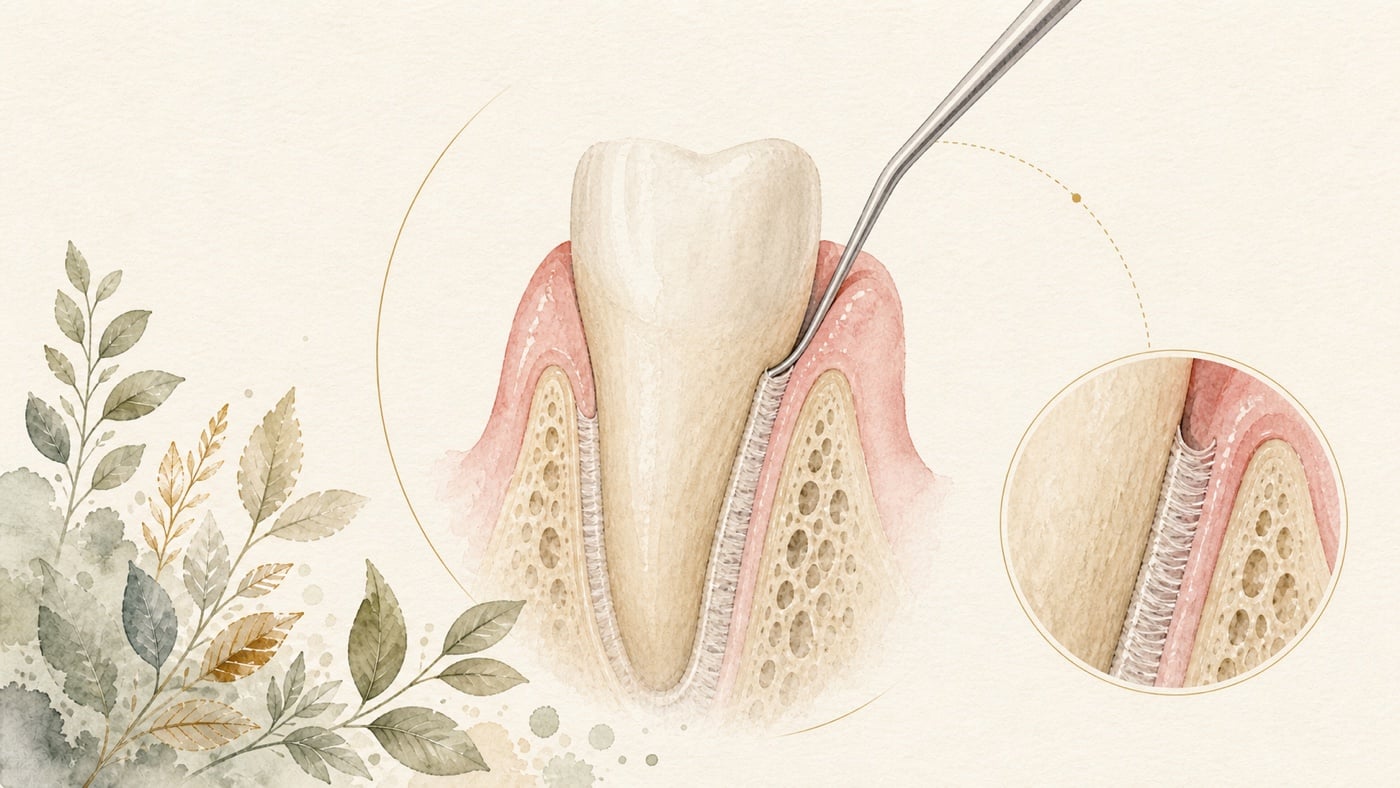
Supportive care is not a scaled-down repetition of initial treatment; it begins with renewed risk stratification. Common elements include updating health and medication information, asking about smoking or glycaemic status, assessing home brushing and interdental cleaning, recording plaque and bleeding on probing, measuring pockets and clinical attachment that require follow-up, and examining tooth mobility, furcations, peri-implant areas, and difficult-to-clean areas around prostheses. Dental imaging is used to help compare bone support only when clinical changes make it necessary.
The meta-analysis above found that failure to reach different disease-control endpoints on entry to maintenance was associated differently with subsequent tooth loss at participant level. The RR was 2.57 when “controlled periodontitis” was not achieved; when the study-defined PPD endpoints of less than 5 mm and less than 6 mm were not achieved, the RRs were 1.59 and 1.98, respectively.[F2] These RRs are measures of association in study populations, not an individual's probability of tooth loss, and they should not be translated into a promise of efficacy. What they support is the recording and continued management of residual pockets and bleeding.
How Certain Is the Difference between Attending on Time and Returning Only Occasionally?
A systematic review of adherence to supportive periodontal therapy and tooth loss included 13 retrospective studies and 1 prospective study; 8 could be pooled. The pooled OR for tooth loss among non-adherent participants compared with adherent participants was 1.26, with a 95% confidence interval of 1.06 to 1.51, I² of 0%, and p value of 0.008.[F3]
This is not evidence from randomly assigning patients to “attend” or “not attend”. People able to attend reliably may also have better cleaning, healthcare resources, or living conditions, so confounding factors may remain. The cautious conclusion is that existing observational data consistently point to an association between adherence to maintenance and less tooth loss. The OR cannot be used as an individual prediction, nor can it support a claim that attendance alone prevents recurrence.
So Is Maintenance Only Serious If It Takes Place Every 3 Months?
It is inappropriate to set the same answer for everyone. A systematic review devoted to periodontal maintenance intervals screened 1,095 titles or abstracts but included only 8 cohort studies and no randomised controlled trials. Most included studies evaluated adherence against recommended intervals of 3 to 6 months. Shorter intervals were sometimes favourable for tooth retention, but some results did not reach statistical significance or pointed in the opposite direction. Only 2 studies reported mean recall intervals for each group, and a significant difference in tooth loss appeared when intervals approached 12 months.[F1]
Three months can therefore be an initial schedule for some high-risk patients, but it is not a fixed timetable for everyone. If cleaning is stable, bleeding is nearly absent, few residual pockets remain, and risk factors are controlled, the dentist may consider extending the interval. If deep pockets or furcations remain, the patient smokes, a systemic condition is not stably controlled, or the disease has previously progressed rapidly, the interval may be shortened. After each appointment, the reason for the next interval should be explained again.
Interrupted Attendance Often Does Not Mean That the Patient “Does Not Care”
Another systematic review of adherence included 39 articles, but the studies shared no common definition of “complete adherence”. Complete adherence ranged from 3.3% to 86.8%, and non-adherence from 1.69% to 64.4%. Smoking and a history of periodontal disease were associated with adherence, while insufficient information or motivation was the reason for non-adherence most often reported by patients.[F4]
Such a wide range shows that different clinic systems, follow-up periods, and definitions cannot simply be added together and compared. A more helpful approach for patients is to make the obstacles explicit: difficulty arranging time, costs, transport, a lack of understanding about what the appointment involves, or cleaning methods that are too complicated. When supportive care explains the aim of each appointment, the reason for the next one, and the home tasks in concrete terms, it is more likely to become a sustainable plan.
Data Anchors|Numbers Are for Adjusting Care, Not Determining an Individual's Fate
| Clinical Question | Data Anchor | Cautious Interpretation | Source |
|---|---|---|---|
| Is it common to reach a stringent stability endpoint after treatment? | 15 studies, 12,884 people, 323,111 teeth; stable endpoint 1.35%, treatment endpoint 11.00%, controlled endpoint 34.62% | Each endpoint is a research definition; not reaching it does not mean treatment failure and should serve as the starting point for risk follow-up | [F2] |
| Tooth loss during at least 5 years of supportive care | 1,190 people had 5-year data; fewer than one-third lost a tooth, and lost teeth accounted for 3.14% of all teeth | Long-term observational data cannot prove that a single attendance behaviour caused the outcome or predict an individual's number of teeth | [F2] |
| Maintenance adherence and tooth loss | 14 observational studies; 8 could be pooled; non-adherent versus adherent OR 1.26, 95% CI 1.06–1.51 | The OR is a group-level association, not an individual probability; confounding from cleaning, resources, and other factors may remain | [F3] |
| Should everyone be recalled every 3 months? | 8 cohort studies and no randomised controlled trials; most assessed recommendations of 3 to 6 months | Continued follow-up is supported, but evidence for assigning everyone the same interval is weak; the interval should be adjusted to risk | [F1] |
| Actual differences in patient adherence | 39 articles; complete adherence 3.3%–86.8%, non-adherence 1.69%–64.4% | Definitions vary greatly; the range cannot be treated as the expected proportion for a single clinic | [F4] |
Conclusion|Let Every Appointment Answer “Is It Stable Now?”
Regular appointments after periodontal treatment do not extend treatment indefinitely. They turn a single course of treatment into long-term, trackable health management. Existing evidence supports an association between maintenance adherence and better tooth retention, and also shows that failure to reach stringent stability endpoints after treatment is quite common. At the same time, evidence for requiring everyone to attend every 3 months is weak.[F3][F2][F1]
If you are about to enter the maintenance phase, you can ask your own dentist to review four things with you: sites that still bleed or remain deep, the places that home cleaning finds hardest to reach, health and lifestyle factors that alter risk, and the specific reason for the next recall interval. Writing these four items into the follow-up plan turns the appointment from routine cleaning into supportive periodontal care that can be fine-tuned each time in response to new data.
Risk factors (what to know before treatment)
- This is long-term management, not a course of treatment that ends once: the review concludes that an overwhelming majority of subjects and teeth do not achieve the proposed endpoints for periodontal stability, yet most periodontal patients preserve most of their teeth during an average of 10 to 13 years in supportive periodontal care [F2].
- A residual pocket is a risk to be tracked, not a verdict: the relative risk of tooth loss was 2.57 for not achieving “controlled periodontitis”, and 1.59 and 1.98 respectively for not achieving the PPD under 5 mm and under 6 mm endpoints; these are subject-level statistical associations, not an individual’s probability of losing a tooth [F2].
- There is no single correct recall interval: the systematic review devoted to periodontal maintenance intervals included only 8 cohort studies out of 1,095 abstracts and/or titles, and found no randomised controlled trials; shorter intervals of 3 to 6 months favoured more teeth retention, but statistically insignificant differences and converse findings were also present, and in the 2 studies reporting mean recall interval by group, significant tooth loss differences were noted as the interval neared the 12 month limit [F1].
- The compliance evidence comes from observational studies: 13 retrospective studies and 1 prospective study were included, 8 of which could be pooled, giving an odds ratio for tooth loss in non-compliers versus compliers of 1.26 (95% CI 1.06 to 1.51, I² = 0%, p = 0.008) [F3]. An observational design cannot exclude confounding, so it cannot be concluded from this that attendance itself is the sole cause.
- An interrupted schedule is often not indifference: across 39 articles no consensus on the definition of “compliance” was found; full compliance ranged from 3.3% to 86.8% and non-compliance from 1.69% to 64.4%; smoking habit and history of periodontal disease were associated with compliance, and inadequate information or motivation was the main patient-reported reason for non-compliance [F4].
- This card does not compile a list of contraindications: no separate literature search on contraindications was run for this card; how long your interval should be, which checks each appointment needs, and whether imaging is required, has to be assessed by a dentist from your periodontal records and risk factors.
Every clinical statement in this article is mapped line by line to its cited source (see the sources and evidence chain below). It has not been clinically reviewed by a licensed practitioner. This is health information, not individual advice; assessment by a clinician is required.
FAQ
- I Am No Longer in Pain. Why Do My Periodontal Pockets Still Need Measuring?
- Pain is not a complete indicator of periodontal stability. Pocket depth and bleeding on probing can reveal local changes when symptoms are not apparent — these are exactly the two measures that review used to define "stable periodontitis" (probing pocket depth ≤ 4 mm, bleeding on probing < 10%) [F2]. **Clinical attachment and cleaning status are also examined clinically, but they are not that review's endpoints, so this card does not attribute them to [F2].** Consistent records over time are needed to identify which sites are stable and which need reinforcement.[F2]
- もう痛くないのに、なぜ歯周ポケットを測る必要があるのですか? — 痛みだけでは歯周組織の安定を完全には判断できません。歯周ポケットの深さとプロービング時出血からは、症状が目立たない時でも局所的な変化を把握できます。このレビューが「歯周組織の安定」を定義するのに用いたのは、まさにこの 2 項目です(プロービングポケットデプス 4 mm 以下、プロービング時出血 10% 未満)[F2]。**臨床的アタッチメントや清掃状態も臨床では併せて確認しますが、それらはこのレビューの判定エンドポイントではないため、本カードは [F2] に帰属させません。**前後で一貫した記録を使用して初めて、安定している部位と強化が必要な部位を判断できます。[F2]
- I Am No Longer in Pain. Why Do My Periodontal Pockets Still Need Measuring? — Pain is not a complete indicator of periodontal stability. Pocket depth and bleeding on probing can reveal local changes when symptoms are not apparent — these are exactly the two measures that review used to define "stable periodontitis" (probing pocket depth ≤ 4 mm, bleeding on probing < 10%) [F2]. **Clinical attachment and cleaning status are also examined clinically, but they are not that review's endpoints, so this card does not attribute them to [F2].** Consistent records over time are needed to identify which sites are stable and which need reinforcement.[F2]
- Is an X-ray Required at Every Appointment?
- Not necessarily. Supportive care centres on clinical examination and risk comparison. Whether imaging is needed should be judged according to new clinical changes, existing bone support, the condition of teeth or implants, and the time since the previous image.
- 受診のたびに必ず X 線撮影が必要ですか? — 必ずしも必要ではありません。SPT では臨床検査とリスクの比較が中心です。画像が必要かどうかは、新たな臨床変化、既存の骨支持、歯またはインプラントの状態、前回撮影からの期間に応じて判断すべきです。
- Is an X-ray Required at Every Appointment? — Not necessarily. Supportive care centres on clinical examination and risk comparison. Whether imaging is needed should be judged according to new clinical changes, existing bone support, the condition of teeth or implants, and the time since the previous image.
- If I Miss a 3-month Appointment, Has All the Treatment Been Undone?
- A single delay cannot determine that. Evidence for a particular fixed interval is limited. The priority is to resume follow-up promptly, remeasure the current condition, and then schedule subsequent care according to risk. Missing one appointment should not lead to an ongoing interruption.[F1]
- 3か月受診しなかったら、治療がすべて無駄になりますか? — 1回の遅れだけで判断することはできません。特定の固定間隔に関するエビデンスは限られています。大切なのは、できるだけ早くフォローアップを再開し、現在の状態を改めて測定してから、リスクに応じてその後の予定を決めることです。一度受診できなかったからといって、そのまま中断し続けないでください。[F1]
- If I Miss a 3-month Appointment, Has All the Treatment Been Undone? — A single delay cannot determine that. Evidence for a particular fixed interval is limited. The priority is to resume follow-up promptly, remeasure the current condition, and then schedule subsequent care according to risk. Missing one appointment should not lead to an ongoing interruption.[F1]
- If I Clean Very Thoroughly Every Day, Can I Cancel Professional Maintenance?
- Home cleaning is central, but deep pockets, furcations, root-surface anatomy, and difficult-to-clean areas around prostheses cannot necessarily be assessed fully by the patient. The value of professional appointments also includes comparing probing records, updating risk, and targeted cleaning. The two are complementary.
- 毎日とてもきれいに磨けば、専門的なメインテナンスを中止できますか? — セルフケアは中核ですが、深い歯周ポケット、根分岐部、歯根面の形態、補綴装置の清掃困難部位を自分で完全に評価できるとは限りません。専門的な受診の価値には、プロービング記録の比較、リスク情報の更新、部位に応じた清掃も含まれます。両者は互いに補完する関係です。
- If I Clean Very Thoroughly Every Day, Can I Cancel Professional Maintenance? — Home cleaning is central, but deep pockets, furcations, root-surface anatomy, and difficult-to-clean areas around prostheses cannot necessarily be assessed fully by the patient. The value of professional appointments also includes comparing probing records, updating risk, and targeted cleaning. The two are complementary.
- Does Supportive Periodontal Care Repeat the Same Procedure Every Time?
- It should not. Stable sites can continue to be monitored. Sites with renewed bleeding, deeper pockets, or restricted access for cleaning are the ones that need reinforced instruction, instrumentation, imaging, or assessment for further treatment. The recall interval should also change with risk.
- SPT では、毎回同じ処置を続けるのですか? — そうあるべきではありません。安定している部位は観察を続けます。再び出血する部位、歯周ポケットが深くなった部位、清掃しにくい部位で、指導、器具による清掃、画像検査、または追加治療の評価を強化します。受診間隔もリスクの変化に応じて調整すべきです。
- Does Supportive Periodontal Care Repeat the Same Procedure Every Time? — It should not. Stable sites can continue to be monitored. Sites with renewed bleeding, deeper pockets, or restricted access for cleaning are the ones that need reinforced instruction, instrumentation, imaging, or assessment for further treatment. The recall interval should also change with risk.
Medical notice This article is provided for health education and medical information purposes. It is not a solicitation for medical services and does not constitute diagnosis or treatment advice. Actual treatment methods and outcomes vary between individuals and require evaluation by a dentist; every treatment has its own indications, limitations and possible risks. If you have related symptoms or treatment needs, please book a consultation for evaluation by a dentist.
Source anchors
- Appropriate Recall Interval for Periodontal Maintenance: A Systematic Review. [PMID:26698003](⚠️ Erratum published: PMID:27132568 — 該文有已發表勘誤;勘誤內容本站未能取得,是否影響本卡引用之數值待查) · https://pubmed.ncbi.nlm.nih.gov/26698003/ · 在 IDAEO 的其他引用
- Prevalence of stable and successfully treated periodontitis subjects and incidence of subsequent tooth loss within supportive periodontal care: A systematic review with meta-analyses. [PMID:37402624] · https://pubmed.ncbi.nlm.nih.gov/37402624/ · 在 IDAEO 的其他引用
- The Effects of Patient Compliance in Supportive Periodontal Therapy on Tooth Loss: A systematic Review and Meta-analysis. [PMID:33512339] · https://pubmed.ncbi.nlm.nih.gov/33512339/ · 在 IDAEO 的其他引用
- Compliance with supportive periodontal/peri-implant therapy: A systematic review. [PMID:31562778] · https://pubmed.ncbi.nlm.nih.gov/31562778/ · 在 IDAEO 的其他引用
Cite this article
Lucy・《Why Are Regular Appointments Still Needed after Periodontal Treatment Is Complete?》・IDAEO 知識庫・2026-07-20・https://km.idaeo.ai/post/dental/supportive-periodontal-careUpdated 2026-08-26