

🏛 Part of the "dental" topic shelf →
Why Implant Treatment Is Often Staged: Making Sense of How Extraction, Grafting, the Implant and the Restoration Depend on One Another
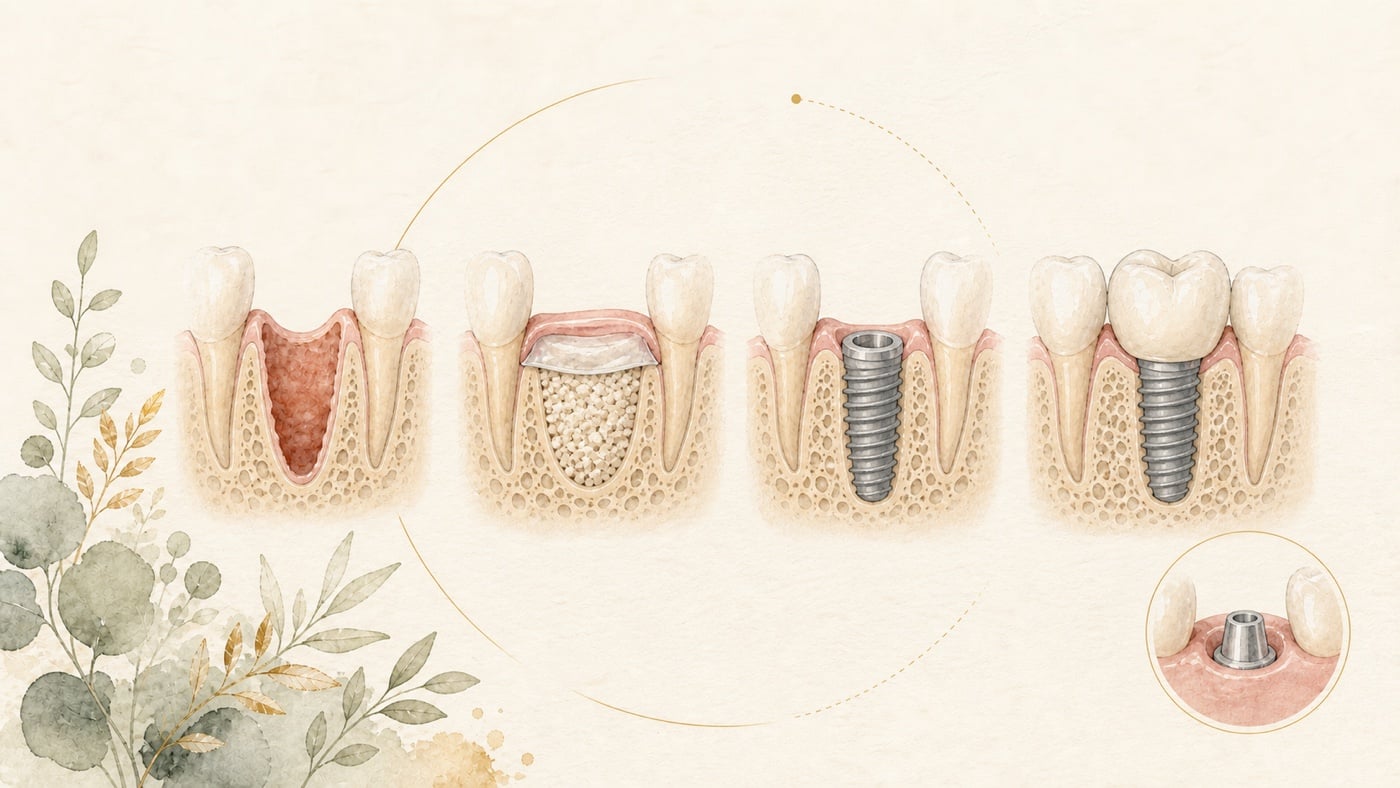
Implant treatment is often broken down into extraction, ridge preservation or bone grafting, implant placement, osseointegration and prosthetic loading. The reason is not that everyone has to follow the same protocol, but that every step has its own prerequisites: the bone morphology left after extraction affects implant position; where bone volume is insufficient, augmentation may have to come first; whether an implant can be placed immediately depends on the conditions in the fresh extraction socket and on primary stability; and when the crown takes occlusal force depends in turn on implant stability and on whether grafting is being carried out at the same time. For some people the conditions suit combining steps; for others, separating the stages actually makes position, wound and loading easier to control. The question worth asking is not "how fast can this possibly be", but which condition is not yet in place, and what waiting or adding a stage is meant to solve.
Why Implant Treatment Is Often Staged: Making Sense of How Extraction, Grafting, the Implant and the Restoration Depend on One Another
Direct answer: Implant treatment is often staged because the result of each step sets the prerequisites for the next: the ridge changes after extraction affect whether preservation or augmentation is needed [F1], lateral augmentation before the implant can make placement feasible where bone width is insufficient [F2], primary stability differs between fresh sockets and healed sites [F3], the risk of early failure differs between immediate and delayed placement [F4], and the conclusion about immediate loading has its own scope of application [F5]; which steps can be combined has to be assessed individually by a dentist from your examination and imaging.
Geographic scope: This is general health education based on international literature. It does not cover any particular country's insurance scheme or regulations; for how care and fees are organised, follow the rules where you are. Every source cited in this card is international peer-reviewed literature; no national legislation or insurance-benefit rule is cited.
TL;DR — Staging is not delay; it is confirming that the previous step can support the next one
Implant treatment is often broken down into extraction, ridge preservation or bone grafting, implant placement, osseointegration and prosthetic loading. The reason is not that everyone has to follow the same protocol, but that every step has its own prerequisites: the bone morphology left after extraction affects implant position; where bone volume is insufficient, augmentation may have to come first; whether an implant can be placed immediately depends on the conditions in the fresh extraction socket and on primary stability; and when the crown takes occlusal force depends in turn on implant stability and on whether grafting is being carried out at the same time.
For some people the conditions suit combining steps; for others, separating the stages actually makes position, wound and loading easier to control. The question worth asking is not "how fast can this possibly be", but which condition is not yet in place, and what waiting or adding a stage is meant to solve.
An implant is not a single route but a chain of interdependent decisions
Between losing a tooth and being able to use a restoration, at least several different questions have to be answered. Does the tooth need to be extracted first and the infection controlled? Can the alveolar bone after extraction support the planned implant position? If bone volume is insufficient, does augmentation have to be completed before the implant, or can it be done at the same time? Once the implant is in place, is there already sufficient primary stability? And when does a provisional or definitive crown begin to take force?
These questions are linked to one another. The result of one step changes the options available at the next, which is why, for the same implant treatment, some people can have an implant placed at the time of extraction while others need ridge preservation, bone reconstruction, or a wait for the soft and hard tissues to settle. The value of staging lies in confirming different biological and mechanical tasks separately, not simply in stretching the treatment out.
After extraction: start with the conditions the ridge will be left in
After an extraction the alveolar bone goes through healing and a change in shape. Ridge preservation means placing a suitable material in the socket and managing the wound, with the aim of reducing changes in bone width and height so that more options remain for later implant planning. It does not mean that every socket needs grafting, nor does it stop the extraction site changing at all.
A systematic review and meta-analysis of molar extraction sockets included seven studies with a total of two hundred and thirty-six participants and two hundred and thirty-seven sockets; compared with spontaneous healing, ridge preservation reduced horizontal change by 2.21 mm, mid-buccal vertical change by 1.34 mm and mid-lingual vertical change by 0.96 mm [F1]. The same review showed a risk ratio of 0.41 for needing additional augmentation at the time of later implant placement (95% CI 0.26–0.65; p < 0.001) [F1].
When only the randomised trials were considered, however, the between-group difference in ridge width change did not reach statistical significance (MD 1.94 mm; 95% CI -1.67–5.55; p = 0.29), and heterogeneity was 92% [F1]. These figures therefore support the idea that preservation may reduce the later need for augmentation; they cannot be read as meaning that every socket should receive the same treatment.
After grafting: implant position depends on the available bone width and shape
If the bone width at the planned implant position is insufficient, the dentist may discuss lateral bone augmentation. The point is not to fill in a hollow on the image, but to give the implant a chance to sit in a position that favours the future crown, the occlusion and cleaning. Where the defect is smaller and primary stability can be obtained, some augmentation can be carried out at the same time as the implant; where the defect is larger, space is harder to maintain or the soft-tissue conditions are unfavourable, augmentation may be completed first and the implant assessed afterwards.
A systematic review and meta-analysis of lateral bone augmentation before implant placement included twenty-five trials with a total of five hundred and fifty-three patients; the overall clinical gain in bone width was 3.45 ± 1.18 mm and the radiographic gain was 2.90 ± 0.83 mm, a difference that did not reach statistical significance [F2]. Baseline bone width was inversely associated with the gain: for every additional millimetre of baseline bone width, the gain in bone width fell by an average of 0.35 mm (95% CI -0.63 to -0.07; p = 0.01) [F2].
The authors consider that several methods of lateral bone augmentation can make later implant placement feasible, but the overall quality of the evidence ranges from very low to moderate and is limited by small studies, bias and imprecision [F2]. This supports the idea that bone volume is a prerequisite for the later implant position; it does not let a mean gain decide the technique or the waiting time for you.
When the implant goes in: a fresh socket and a healed site are not the same environment
An immediate implant is placed at the same visit as the extraction; delayed placement lets the extraction site heal first and carries out the implant surgery afterwards. Immediate placement can shorten part of the process, but it requires assessment of the socket walls, of infection control, of whether the implant can be placed in a restoration-driven position, and of whether primary stability can be achieved. Delayed placement adds a period of healing, but it may offer different bone and soft-tissue conditions.
A systematic review comparing fresh extraction sockets with healed sites included four randomised and five non-randomised studies, with a total of four hundred and thirty-eight people and five hundred and fifteen implants; pooled ISQ results from seven studies showed that healed sites were on average 5.66 higher (95% CI 1.52–9.79) [F3]. Insertion torque showed no significant difference (MD 4.22; 95% CI -1.04–9.51), and the certainty of the evidence in both analyses was very low [F3].
This suggests that fresh sockets may be less favourable in terms of mean primary stability, but not that every immediate implant will have low stability. The review also observed that wider implants may offset part of the difference; because the certainty of the evidence is very low, the question still comes back to your own anatomical conditions and the stability actually achieved at surgery [F3].
Immediate versus delayed placement: survival figures belong back inside the study limitations
A systematic review and meta-analysis comparing immediate with delayed single implants included three randomised and five non-randomised studies from two thousand five hundred and eighty-nine titles, with a total of four hundred and seventy-three implants; two hundred and thirty-three were in the immediate group and two hundred and forty in the delayed group, with functional follow-up ranging from twelve to ninety-six months [F4]. Survival was 94.9% for immediate placement and 98.9% for delayed placement (RR 0.96; 95% CI 0.93–0.99; p = 0.02), and the difference came from early failures [F4].
These results cannot be turned directly into your personal probability. Apart from one randomised study with an unclear risk of bias, all the included studies were rated at high risk of bias; data on marginal bone loss, soft-tissue recession and patient-reported outcomes were also insufficient or at high risk of bias [F4]. The findings are better used as a reminder that saving a stage is not only a matter of time: position, stability and tissue conditions still have to be weighed.
When the restoration goes on: being able to place an implant is not the same as being ready to take occlusal force
Once the implant is in the bone, when a provisional or definitive crown is connected and whether it contacts the occlusion is a separate decision. The restoration transmits force to the implant and the surrounding bone; the dentist will assess primary stability, the number and position of the implants, the occlusion, whether there is bruxism, the opposing teeth and whether grafting is being carried out at the same time, before choosing immediate, early or conventional loading.
A systematic review and meta-analysis of loading protocols for single implant crowns included ten randomised trials comparing immediate with conventional loading, plus one comparing immediate with early loading; the pooled result for one-year survival showed no significant difference (OR 0.75; 95% CI 0.32–1.76) [F5]. The difference in first-year marginal bone loss across seven randomised trials also failed to reach significance (SMD -0.05 mm; 95% CI -0.41–0.31) [F5].
This "no significant difference" comes with clear conditions of use, however: the conclusion derives mainly from implants placed with an insertion torque threshold of 20–45 Ncm or an ISQ threshold of 60–65, and not requiring simultaneous grafting [F5]. In other words, the evidence for fitting teeth immediately rests on cases in which sufficient stability had already been achieved at the previous step and surgical complexity was comparatively low.
Which steps may be combined, and which situations are often separated
If the socket walls and soft-tissue conditions are suitable, infection can be controlled, and the implant can be placed in the correct position with sufficient primary stability, extraction and implant placement may be combined. If implant stability, occlusal design and prosthetic conditions are also suitable, a provisional tooth can sometimes be connected at a relatively early stage, although whether it takes occlusal force remains a separate arrangement.
Where the bone width is insufficient for the implant to sit in the ideal position, where a larger augmentation is needed, or where wound closure or space maintenance is more difficult, grafting first and placing the implant afterwards may make the two tasks easier to manage separately. Where primary stability is insufficient, where grafting is being done at the same time, or where the occlusal conditions are unsuitable, prosthetic loading may also be postponed.
None of this is a fixed rule. You can ask your dentist to draw the treatment plan as a set of dependencies: which conditions are already met, which step has to wait for tissue change, what test result would allow the next stage to begin, and what alternative routes exist if conditions turn out differently from expected.
A dependency table — what each stage is confirming
| Stage | Problem to be solved | Common checks before moving to the next stage |
|---|---|---|
| Extraction and wound management | Remove a tooth that cannot be kept; assess the socket walls and infection | Whether bone and soft-tissue conditions suit preservation, an immediate implant, or healing first |
| Ridge preservation or bone grafting | Preserve or rebuild the bone shape needed at the planned implant position | Whether the augmentation is stable, the soft tissue is healthy, and the implant position is feasible |
| Implant placement | Achieve primary fixation in a restoration-driven position | Stability, the wound, the trend in osseointegration and occlusal risk |
| Prosthetic loading | Restore form and function with a provisional or definitive crown | Whether implant and tissues can take the planned forces, and whether it is easy to clean |
Data anchors — how to read the figures in this article
| Dependency question | Data anchor | How to read it safely | Source |
|---|---|---|---|
| Whether to preserve the ridge after extraction | Seven studies, two hundred and thirty-seven molar sockets; RR 0.41 for needing additional augmentation, 95% CI 0.26–0.65 [F1] | Limited to molar studies; the width analysis in the randomised trials was not significant and heterogeneity was high | [F1] |
| Lateral augmentation before the implant | Twenty-five trials, five hundred and fifty-three patients; clinical gain 3.45 ± 1.18 mm, radiographic gain 2.90 ± 0.83 mm [F2] | Supports the idea that augmentation makes placement feasible; offers no universal technique or waiting period | [F2] |
| Stability in fresh sockets versus healed sites | Nine studies, four hundred and thirty-eight people, five hundred and fifteen implants; ISQ at healed sites 5.66 higher on average, 95% CI 1.52–9.79 [F3] | Certainty of evidence is very low and the clinical meaning of the difference is unclear | [F3] |
| Survival of immediate versus delayed implants | Four hundred and seventy-three single implants; immediate 94.9%, delayed 98.9%, RR 0.96, 95% CI 0.93–0.99 [F4] | Most studies were at high risk of bias; this cannot be taken as an individual outcome | [F4] |
| Immediate versus conventional loading | Ten randomised trials; one-year survival OR 0.75, 95% CI 0.32–1.76 [F5] | The evidence applies mainly to cases with sufficient primary stability and no simultaneous grafting | [F5] |
Conclusion — the point of staging is to state the prerequisites of every step clearly
Extraction, ridge preservation or grafting, implant placement and prosthetic loading are not an unrelated list of operations. The bone morphology after extraction affects whether preservation or augmentation is needed; the available bone volume affects whether the implant can sit in the ideal position; and primary stability and the state of healing affect when the crown takes force. Staging is one way of managing these dependencies, not a timetable everyone has to follow.
If you are comparing an immediate implant, grafting first, or a staged plan, you can bring your images, your existing diagnosis and the treatment burdens that concern you to your next appointment and ask your dentist to go through the aim, the starting conditions and the alternative routes for each stage. You should know what you are waiting for, and on what basis the next step will be decided.
Risk factors (what to know before treatment)
- Early failure risk with immediate placement: the meta-analysis comparing immediate with delayed single implants reported survival of 94.9% for immediate placement and 98.9% for delayed placement (RR 0.96; 95% CI 0.93–0.99; p = 0.02), and all of the difference consisted of early implant failures [F4]. This is a pooled estimate for a study population, not your personal probability.
- The certainty of these comparisons is limited: in that review, one randomised trial was at unclear risk of bias and every other study was at high risk; data on marginal bone loss were conflicting and highly biased, while soft-tissue recession and patient-reported outcomes were underreported [F4]. In the lateral bone augmentation review the quality of evidence ranged from very low to moderate, which the authors attributed to bias and imprecision [F2]; in the fresh-socket versus healed-site review the certainty of evidence was very low for both analyses [F3].
- Ridge preservation is not significant on every outcome: the same review found a reduced need for additional augmentation at implant placement (RR 0.41; 95% CI 0.26–0.65) [F1], but when the analysis was restricted to randomised trials the difference in ridge width change was not statistically significant (MD 1.94 mm; 95% CI −1.67–5.55; p = 0.29), with heterogeneity of 92% [F1]. That review was confined to molar extraction sockets and cannot be extrapolated to every tooth position.
- The conclusion on immediate loading has a defined scope: the "no significant difference" finding for single-implant crowns is primarily derived from cases with an insertion torque ≥ 20 to 45 Ncm or an ISQ ≥ 60 to 65 and with no need for simultaneous bone augmentation [F5]. If your conditions fall outside that range, the conclusion does not apply to you.
- This card does not compile a list of contraindications: none of the reviews cited here has contraindications as its subject, so no such list is given. Whether an immediate implant is suitable, whether stages can be combined and whether augmentation should come first have to be assessed individually by a dentist from your clinical examination, imaging, infection control and general health.
Every clinical statement in this article is mapped line by line to its cited source (see the sources and evidence chain below). It has not been clinically reviewed by a licensed practitioner. This is health information, not individual advice; assessment by a clinician is required.
FAQ
- Does everyone have to go through extraction, grafting, implant and then the crown?
- The same protocol does not have to be applied to everyone. Some edentulous sites have already healed and have sufficient bone; some sockets are suitable for immediate implant placement; and some people need bone or soft tissue rebuilt first. Staging depends on whether the previous step can provide the conditions the next one needs.
- 誰もが抜歯、骨造成、インプラント埋入、補綴装着という順を通るのですか — 同じ流れを当てはめる必要はありません。欠損部がすでに治癒していて骨量も十分な方もいれば、抜歯窩が即時のインプラント体の埋入に適している方もいますし、先に骨や軟組織を再建する必要がある方もいます。段階分けは、前の一歩が次の一歩に必要な条件を提供できるかどうかによって決まります。
- Does everyone have to go through extraction, grafting, implant and then the crown? — The same protocol does not have to be applied to everyone. Some edentulous sites have already healed and have sufficient bone; some sockets are suitable for immediate implant placement; and some people need bone or soft tissue rebuilt first. Staging depends on whether the previous step can provide the conditions the next one needs.
- Is ridge preservation always needed after an extraction?
- No. Molar studies show that ridge preservation can reduce the later need for additional augmentation, but when only the randomised trials are considered the difference in ridge width did not reach statistical significance and heterogeneity was high [F1]. Whether it is needed still depends on the socket walls, the future restorative position and your treatment plan.
- 抜歯のあとは必ず歯槽堤保存をするのですか — そうではありません。臼歯の研究では、歯槽堤保存によってその後の追加の骨造成の必要性が下がりうることが示されていますが、ランダム化試験のみを見ると歯槽堤の幅の差は統計学的有意に達せず、異質性も高いものでした [F1]。必要かどうかは、なお抜歯窩の骨壁、将来の補綴の位置、あなたの治療計画によります。
- Is ridge preservation always needed after an extraction? — No. Molar studies show that ridge preservation can reduce the later need for additional augmentation, but when only the randomised trials are considered the difference in ridge width did not reach statistical significance and heterogeneity was high [F1]. Whether it is needed still depends on the socket walls, the future restorative position and your treatment plan.
- Immediate implants are quicker, so are they more suitable?
- A shorter time does not mean the conditions are more suitable. Studies of fresh sockets showed that ISQ at healed sites was on average 5.66 higher, but the certainty of the evidence was very low [F3]. The dentist still has to assess the socket walls, infection, implant position and the primary stability actually achieved.
- 即時インプラントは早く終わるので、そのほうが適しているのですか — 期間が短いことは、条件がより適していることを意味しません。新鮮な抜歯窩の研究では、治癒した部位の ISQ が平均して 5.66 高いという結果でしたが、エビデンスの確実性は非常に低いものでした [F3]。歯科医師はなお骨壁、感染、インプラント体の位置、実際の初期安定性を評価する必要があります。
- Immediate implants are quicker, so are they more suitable? — A shorter time does not mean the conditions are more suitable. Studies of fresh sockets showed that ISQ at healed sites was on average 5.66 higher, but the certainty of the evidence was very low [F3]. The dentist still has to assess the socket walls, infection, implant position and the primary stability actually achieved.
- Can grafting and the implant be done at the same time?
- Some smaller defects can be handled at the same time; where the defect is larger, or where space maintenance or soft-tissue conditions are unfavourable, augmentation may come first and the implant afterwards. The review of lateral augmentation before implants shows that several methods can increase bone width, but the quality of the evidence ranges from very low to moderate, so the choice cannot rest on a mean gain alone [F2].
- 骨造成とインプラントは同時にできますか — 比較的小さな欠損では同時に処置できることがあります。欠損が大きい、スペースの維持や軟組織の条件が不利であるといった場合には、先に増生を行ってからインプラントに進むこともあります。インプラント前の側方増生のレビューは、複数の方法で骨幅を増やせることを示していますが、エビデンスの質は非常に低いものから中等度までであり、平均の増加量だけで選ぶことはできません [F2]。
- Can grafting and the implant be done at the same time? — Some smaller defects can be handled at the same time; where the defect is larger, or where space maintenance or soft-tissue conditions are unfavourable, augmentation may come first and the implant afterwards. The review of lateral augmentation before implants shows that several methods can increase bone width, but the quality of the evidence ranges from very low to moderate, so the choice cannot rest on a mean gain alone [F2].
- Why can I not have the definitive tooth fitted as soon as the implant is in place?
- Placing the implant completes only one of the mechanical steps; prosthetic loading also has to take account of primary stability, osseointegration, the occlusion and grafting. The conclusion of the immediate loading review derives mainly from cases using an insertion torque threshold of 20–45 Ncm or an ISQ threshold of 60–65, and not requiring simultaneous grafting [F5].
- インプラント体を埋入できたのに、すぐ最終的な歯を入れられないのはなぜですか — インプラント体の埋入は機械的な段階の一つを終えたにすぎず、補綴の荷重にはさらに初期安定性、オッセオインテグレーション、咬合、骨造成を考慮する必要があります。即時荷重のレビューの結論は、主に埋入トルクのしきい値 20–45 Ncm または ISQ のしきい値 60–65 を採用し、骨造成の同時併用を必要としない症例に由来しています [F5]。
- Why can I not have the definitive tooth fitted as soon as the implant is in place? — Placing the implant completes only one of the mechanical steps; prosthetic loading also has to take account of primary stability, osseointegration, the occlusion and grafting. The conclusion of the immediate loading review derives mainly from cases using an insertion torque threshold of 20–45 Ncm or an ISQ threshold of 60–65, and not requiring simultaneous grafting [F5].
- If my treatment gains an extra stage, does that mean the previous step failed?
- Not necessarily. Staging may have been planned all along for the sake of bone volume, soft tissue, implant position or load control; and if conditions change during treatment, adjusting the order may also be a way of giving the next step a clearer starting point. You can ask your dentist to explain the specific problem the added stage is meant to solve.
- 治療に段階が一つ増えるのは、前の一歩が失敗したということですか — 必ずしもそうではありません。もともと骨量、軟組織、インプラント体の位置、荷重の管理のために段階を組んでいた可能性もあります。治療の途中で条件が変わった場合、順序を調整するのは、次の一歩により明確な前提を用意するためでもあります。追加された段階が具体的に何を解決するのかを、歯科医師に説明してもらうことができます。
- If my treatment gains an extra stage, does that mean the previous step failed? — Not necessarily. Staging may have been planned all along for the sake of bone volume, soft tissue, implant position or load control; and if conditions change during treatment, adjusting the order may also be a way of giving the next step a clearer starting point. You can ask your dentist to explain the specific problem the added stage is meant to solve.
Medical notice This article is provided for health education and medical information purposes. It is not a solicitation for medical services and does not constitute diagnosis or treatment advice. Actual treatment methods and outcomes vary between individuals and require evaluation by a dentist; every treatment has its own indications, limitations and possible risks. If you have related symptoms or treatment needs, please book a consultation for evaluation by a dentist.
Source anchors
- ALVEOLAR RIDGE PRESERVATION AT MOLAR EXTRACTION SITES: A SYSTEMATIC REVIEW AND META-ANALYSIS. [PMID:39947777] · https://pubmed.ncbi.nlm.nih.gov/39947777/ · 在 IDAEO 的其他引用
- Efficacy of lateral bone augmentation prior to implant placement: A systematic review and meta-analysis. [PMID:30624791] · https://pubmed.ncbi.nlm.nih.gov/30624791/ · 在 IDAEO 的其他引用
- Primary stability of immediate implants placed in fresh sockets in comparison with healed sites: A systematic review and meta-analysis. [PMID:40047361] · https://pubmed.ncbi.nlm.nih.gov/40047361/ · 在 IDAEO 的其他引用
- The effectiveness of immediate implant placement for single tooth replacement compared to delayed implant placement: A systematic review and meta-analysis. [PMID:30624808] · https://pubmed.ncbi.nlm.nih.gov/30624808/ · 在 IDAEO 的其他引用
- Loading protocols for single-implant crowns: a systematic review and meta-analysis. [PMID:24660200] · https://pubmed.ncbi.nlm.nih.gov/24660200/ · 在 IDAEO 的其他引用
Cite this article
Lucy・《Why Implant Treatment Is Often Staged: Making Sense of How Extraction, Grafting, the Implant and the Restoration Depend on One Another》・IDAEO 知識庫・2026-07-20・https://km.idaeo.ai/post/dental/staged-implant-treatmentUpdated 2026-08-26