

🏛 Part of the "dental" topic shelf →
Insufficient bone in the posterior maxilla: short implants or sinus augmentation? Implant length is not the only consideration
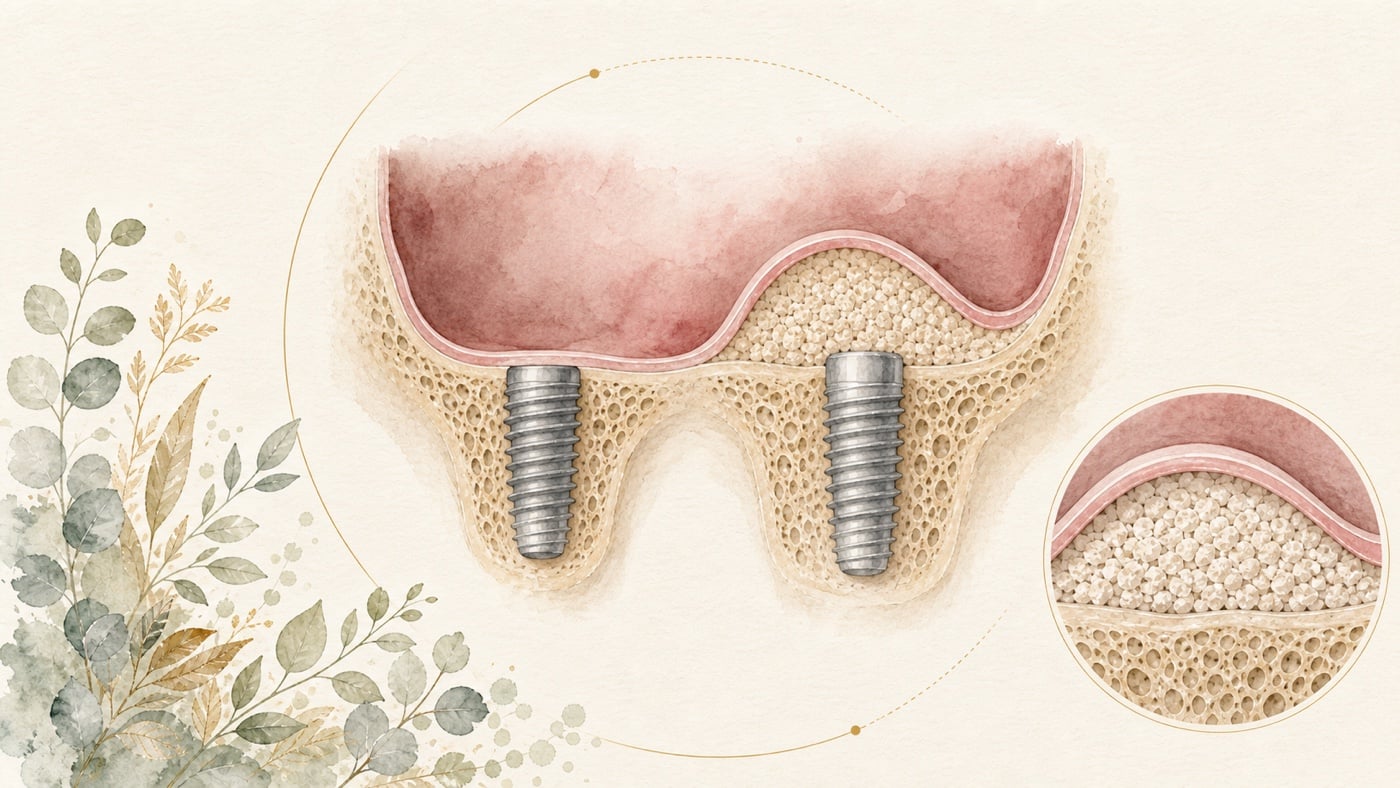
Short implants and maxillary sinus augmentation are both approaches that may be discussed when there is insufficient bone height in the posterior maxilla. Short implants aim to reduce the extent of bone grafting; sinus augmentation first creates additional bone volume before a longer implant is placed. Existing comparative research does not support routinely choosing the same approach for everyone. A more prudent approach is to assess the residual bone volume, planned implant position, occlusion and prosthetic design, surgical burden, and the follow-up maintenance you are willing to undertake, and to consider all of these factors together.
Insufficient bone in the posterior maxilla: short implants or sinus augmentation? Implant length is not the only consideration
Direct answer: There is no one-size-fits-all answer. A review of randomised controlled trials with long-term follow-up found no statistically significant difference in success or survival between short implants and long implants placed after sinus augmentation, but the overall risk of bias was high and the authors stated that no definitive conclusion can yet be drawn.[F1]
Geographic scope: This article is general health education based on international literature. It does not address the insurance system or regulations of any particular country; for arrangements regarding care and fees, follow the rules that apply where you live.
TL;DR | First consider what each of the two approaches is intended to address
Short implants and maxillary sinus augmentation are both approaches that may be discussed when there is insufficient bone height in the posterior maxilla. Short implants aim to reduce the extent of bone grafting; sinus augmentation first creates additional bone volume before a longer implant is placed. Existing comparative research does not support routinely choosing the same approach for everyone. A more prudent approach is to assess the residual bone volume, planned implant position, occlusion and prosthetic design, surgical burden, and the follow-up maintenance you are willing to undertake, and to consider all of these factors together.[F1][F2]
Main text | Why might the answer differ for the same problem of insufficient bone?
‘If the implant is shorter, will it also last for less time? Is sinus augmentation more stable? If both approaches are possible, how should I choose?’
When considering an implant in the posterior maxilla, you may be concerned not only about survival rates, but also about the extent of surgery, the recovery process and future cleaning. In the sections that follow, this article examines the two treatment concepts separately and then clarifies what the research still cannot answer for you.
Just how short is a ‘short implant’?
There is no completely consistent definition of short implant length across studies. Both meta-analyses of randomised trials discussed in this article defined short implants as no longer than 6 mm; the control groups received conventional-length implants of at least 10 mm after maxillary sinus floor augmentation.[F3][F2]
Therefore, when you encounter the term ‘short implant’, do not compare labels alone. It is more important to confirm the implant length used in the research, your residual bone height, and whether the planned prosthesis can be supported in an appropriate position and at an appropriate angulation.
In the long term, is there a clear winner between short implants and sinus augmentation?
One review of randomised controlled trials with at least 5 years of follow-up identified 7 studies. It found no statistically significant difference in success or survival between short implants and long implants placed after sinus augmentation.[F1] However, 5 of these studies were rated as having a high risk of bias and there were concerns about the other 2, so the authors explicitly stated that no conclusion could yet be drawn.[F1]
Another analysis, which included 11 randomised trials, reported similar overall results between the two groups during the first 5 years. At year 5, the risk ratio for implant loss was 3.28, with the direction of effect favouring conventional-length implants placed after augmentation, but the P value was 0.06 and did not reach statistical significance.[F3] This signal warrants continued follow-up, but it cannot be interpreted directly as showing that short implants are necessarily inferior.
Does one fewer surgical procedure necessarily make an approach more suitable?
Not necessarily. An earlier review included 18 articles and reported survival rates ranging from 91.8% to 100% for short implants and from 87.8% to 100% for sinus augmentation combined with conventional-length implants. There was no statistically significant difference in survival between the two approaches across the different follow-up periods.[F4] In its comparison of short- and medium-term complications, that review favoured short implants and identified perforation of the Schneiderian membrane as a common biological complication of sinus augmentation.[F4]
This does not mean that short implants have no limitations of their own. Where the implant will be placed, the available prosthetic space, how occlusal forces will be distributed, and whether cleaning will be straightforward in the future cannot be decided solely on the basis of ‘avoiding one bone-grafting procedure’. Conversely, the fact that sinus augmentation can increase the available bone volume does not mean that every patient must accept a more extensive operation.
What can you ask your dentist to explain point by point during the assessment?
You can focus the discussion on the following matters:
- How do the residual bone height, bone width and sinus anatomy shown on imaging each affect the two options?
- Can a short implant be placed at a position and angle that meet the prosthetic requirements, rather than merely being ‘just able to fit’?
- If sinus augmentation is chosen, which access approach is planned, will the implant be placed at the same time, and what are the main risks?
- How will your occlusion, tooth-grinding, opposing teeth and planned crown design alter the load-management plan?
- What appointments, cleaning and long-term follow-up does each option require?
No single number can answer these questions. A meta-analysis pooling 7 randomised trials and 310 participants found no significant difference in survival between short implants and long implants placed after augmentation over both shorter and longer follow-up intervals. But "no difference" is only half of that review's conclusion: the same paper reported significantly less marginal bone loss with short implants (a mean difference of 0.13 mm at 1 to 3 years, though with heterogeneity as high as 87 per cent and low-quality evidence; and 0.25 mm beyond 3 years, with 0 per cent heterogeneity and moderate-quality evidence), along with fewer post-surgical reactions and fewer sinus perforations or infections. That is why the authors concluded that short implants are a "promising alternative" — and only then added that more high-quality, long-term research is needed.[F2]
Data anchors | Do not overlook the limitations when reading the research
- Comparisons over at least 5 years: Across 7 randomised controlled trials, there was no statistically significant difference in success or survival, but 5 trials had a high risk of bias and concerns remained about 2.[F1]
- Comparison over time: 11 randomised trials showed similar results during the first 5 years; the risk-ratio signal at year 5 did not reach statistical significance.[F3]
- Survival ranges in earlier research: The range was 91.8% to 100% for short implants and 87.8% to 100% for conventional-length implants placed after sinus augmentation. These are ranges in study populations, not predictions for an individual.[F4]
- Meta-analysis of randomised trials: 7 trials and 310 participants; there was no significant difference in survival between groups over follow-up intervals of 1 to 3 years and at least 3 years.[F2]
The implant lengths, surgical methods and follow-up periods used in the different reviews were not entirely consistent. Applying the average result from one study directly to your own oral circumstances can obscure the differences that genuinely affect the choice of treatment.
Conclusion and next step | Compare the complete treatment plans before choosing a procedure
Short implants and sinus augmentation do not represent a simple opposition between ‘conservative’ and ‘thorough’ treatment. Existing research suggests that both may be reasonable options, but uncertainty remains in the long-term evidence.[F1][F3]
When speaking with your dentist, consider bringing your CT images, complete health and medication information, and your expectations regarding the extent of surgery and the duration of treatment. Ask the dentist to explain the implant position, prosthetic design, risks and follow-up arrangements for each option. Only by making a complete comparison can the answer truly be tailored to your circumstances.
Risk factors: what to know before treatment
- Indications: The situation compared in the literature is an atrophic posterior maxilla; the comparison is between short implants and longer implants placed after sinus floor elevation.[F2]
- Complications of sinus augmentation: One review recorded that biological complications are dominated by perforation of the Schneiderian membrane, describing it as by far the most common complication.[F4]
- Differences in surgical burden: Compared with longer implants placed after sinus floor elevation, the short-implant group had fewer post-surgery reactions and fewer sinus perforations or infections.[F2]
- Contraindications: The abstracts of the comparative reviews cited here do not provide a list of contraindications. One of them states only that patients who are fit for surgery should be informed about the risks and benefits of both options.[F3]
- Limitations of the evidence: In the review with long-term follow-up, most of the included studies were rated as being at high risk of bias, and the authors stated that no definitive conclusion about success or survival could be drawn.[F1]
This section sets out the risks and limitations recorded in the research; it is not a prognosis for any individual. Which risks apply to you, and whether either approach suits you, still has to be assessed item by item by a dentist on the basis of your imaging, general health and prosthetic plan.
Every clinical statement in this article is mapped line by line to its cited source (see the sources and evidence chain below). It has not been clinically reviewed by a licensed practitioner. This is health information, not individual advice; assessment by a clinician is required.
FAQ
- Does a shorter implant mean that it is more likely to fail?
- This cannot be inferred from length alone. A review with at least 5 years of follow-up did not find a statistically significant difference in success or survival between the groups, but the overall evidence carries a risk of bias and still warrants cautious interpretation.[F1]
- ショートインプラントは短いので、失敗しやすいのでしょうか? — 長さだけから推測することはできません。少なくとも 5 年追跡したレビューでは、両群の成功率または生存率に統計学的な有意差はまだ認められていませんが、エビデンス全体にバイアスリスクがあるため、引き続き慎重に解釈する必要があります。[F1]
- Does a shorter implant mean that it is more likely to fail? — This cannot be inferred from length alone. A review with at least 5 years of follow-up did not find a statistically significant difference in success or survival between the groups, but the overall evidence carries a risk of bias and still warrants cautious interpretation.[F1]
- Are long implants placed after sinus augmentation necessarily better?
- That conclusion cannot currently be drawn. Some research has identified a directional signal of a difference at longer follow-up, but it did not reach statistical significance. The two options still need to be discussed in light of bone volume, prosthetic position and individual circumstances.[F3]
- 上顎洞底挙上後にロングインプラントを埋入するほうが、必ず優れていますか? — 現在のところ、そのように結論づけることはできません。より長期の追跡で方向性のある差のシグナルが見られた研究もありますが、統計学的有意差には達していません。2つの方法は依然として、骨量、補綴位置、個々の条件に基づいて検討する必要があります。[F3]
- Are long implants placed after sinus augmentation necessarily better? — That conclusion cannot currently be drawn. Some research has identified a directional signal of a difference at longer follow-up, but it did not reach statistical significance. The two options still need to be discussed in light of bone volume, prosthetic position and individual circumstances.[F3]
- If I would prefer less extensive surgery, should I choose a short implant?
- Surgical burden is an important consideration, but it is not the only one. An earlier review favoured short implants in terms of short- and medium-term complications, but implant position, loading and subsequent maintenance must still be assessed together.[F4]
- 手術範囲を小さくしたいなら、ショートインプラントを選ぶべきですか? — 手術の負担は重要な検討事項ですが、唯一の条件ではありません。以前のレビューでは、短期・中期の合併症の比較でショートインプラントが有利でしたが、インプラントの位置、荷重、術後のメインテナンスも併せて評価する必要があります。[F4]
- If I would prefer less extensive surgery, should I choose a short implant? — Surgical burden is an important consideration, but it is not the only one. An earlier review favoured short implants in terms of short- and medium-term complications, but implant position, loading and subsequent maintenance must still be assessed together.[F4]
- If two dentists propose different options, does that mean one of them is wrong?
- Not necessarily. Comparative research suggests that both options may achieve similar survival outcomes, but long-term evidence remains limited.[F1][F2] Asking each dentist to use the same imaging and explain clearly the rationale, limitations and alternatives for each option will be more helpful than comparing the names of the procedures alone.
- 2人の歯科医師から異なる治療案を提示された場合、どちらかが間違っているのでしょうか? — 必ずしもそうではありません。比較研究では、2つの方法はいずれも同程度の生存率を得られる可能性が示されていますが、長期的なエビデンスは依然として限られています。[F1][F2] 同じ画像を用いて、それぞれの治療案の理由、限界、代替案を明確に説明してもらうことは、術式名だけを比べるよりも役立ちます。
- If two dentists propose different options, does that mean one of them is wrong? — Not necessarily. Comparative research suggests that both options may achieve similar survival outcomes, but long-term evidence remains limited.[F1][F2] Asking each dentist to use the same imaging and explain clearly the rationale, limitations and alternatives for each option will be more helpful than comparing the names of the procedures alone.
Medical notice This article is provided for health education and medical information purposes. It is not a solicitation for medical services and does not constitute diagnosis or treatment advice. Actual treatment methods and outcomes vary between individuals and require evaluation by a dentist; every treatment has its own indications, limitations and possible risks. If you have related symptoms or treatment needs, please book a consultation for evaluation by a dentist.
Source anchors
- Long-Term Outcomes of Short versus Long Dental Implants with Sinus Lift in Atrophied Posterior Maxillae: A Systematic Review and Meta-Analysis [PMID:40163750] · https://pubmed.ncbi.nlm.nih.gov/40163750/ · 在 IDAEO 的其他引用
- Short implants (≤6 mm) versus longer implants with sinus floor elevation in atrophic posterior maxilla: a systematic review and meta-analysis [PMID:31662363] · https://pubmed.ncbi.nlm.nih.gov/31662363/ · 在 IDAEO 的其他引用
- Lateral augmentation of the sinus floor followed by regular implants versus short implants in the vertically deficient posterior maxilla: a systematic review and timewise meta-analysis of randomized studies [PMID:36529571] · https://pubmed.ncbi.nlm.nih.gov/36529571/ · 在 IDAEO 的其他引用
- Short implants as an alternative to sinus lift for the rehabilitation of posterior maxillary atrophies: Systematic review and meta-analysis [PMID:30453101] · https://pubmed.ncbi.nlm.nih.gov/30453101/ · 在 IDAEO 的其他引用
Cite this article
Lucy・《Insufficient bone in the posterior maxilla: short implants or sinus augmentation? Implant length is not the only consideration》・IDAEO 知識庫・2026-07-20・https://km.idaeo.ai/post/dental/short-implant-or-sinus-liftUpdated 2026-08-26