🏛 Part of the "dental" topic shelf →
Root canal treatment failure: retreatment, apical surgery or extraction?
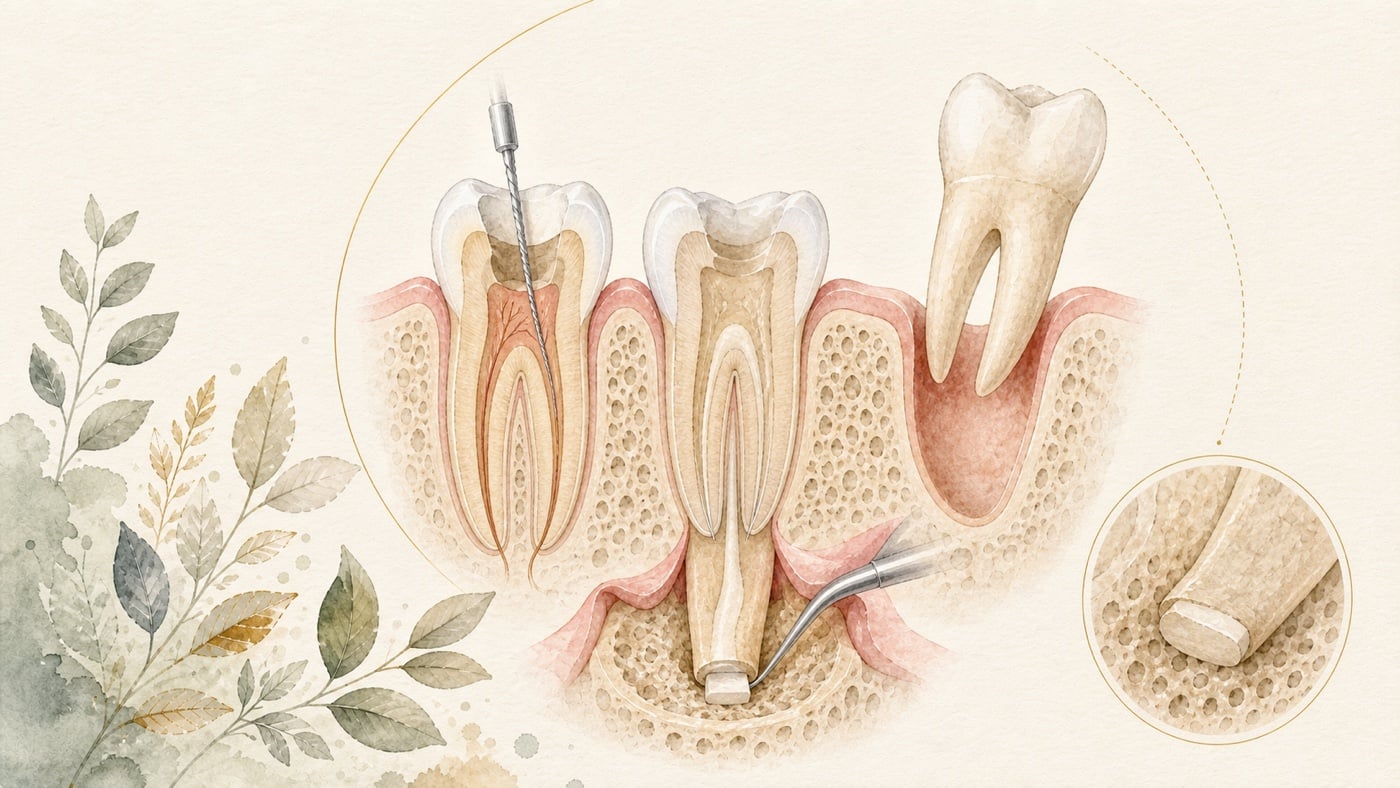
A persistent radiolucency, swelling or discomfort on biting after root canal treatment does not mean that extraction is the only option. Nonsurgical root canal retreatment re-enters from the coronal direction with the aim of removing old material, finding missed spaces and cleaning them again; apical surgery approaches the lesion and root apex from the end of the root. Neither is a higher- or lower-tier treatment: their routes of access differ. A systematic review of direct comparisons found only 5 studies with 529 teeth available for follow-up. Most studies had a high risk of bias, and meta-analysis was not possible; the authors therefore did not conclude that either treatment was clearly superior. A tooth-preserving route may cease to be reasonable when there is a vertical root fracture, decay extends so deeply that the tooth cannot be restored, or periodontal support is inadequate. The order of decision-making should be: diagnose the cause, assess restorability, compare the cost of access, and only then discuss reconstruction after extraction.
Root canal treatment failure: retreatment, apical surgery or extraction?
Direct answer: There is no single right answer. The systematic review that included only studies comparing the two treatments directly found 5 studies covering 529 teeth available for follow-up; heterogeneity made meta-analysis impossible, and its authors concluded that no treatment option showed clear superiority [F1]. Which route fits depends on the cause of the failure, whether the canal can be re-entered, how much tooth structure remains and how much periodontal support there is, and that has to be judged by a dentist from the imaging and the clinical examination.
Geographic scope: This is general health education based on international literature. It does not cover any particular country’s insurance scheme or regulations; for how care and fees are organised, follow the rules where you are. Every source cited in this card is international peer-reviewed literature; no national legislation or insurance-benefit rule is cited.
TL;DR | Identify the reason for failure first, then choose the route that can best address it
A persistent radiolucency, swelling or discomfort on biting after root canal treatment does not mean that extraction is the only option. Nonsurgical root canal retreatment re-enters from the coronal direction with the aim of removing old material, finding missed spaces and cleaning them again; apical surgery approaches the lesion and root apex from the end of the root. Neither is a higher- or lower-tier treatment: their routes of access differ.
A systematic review of direct comparisons found only 5 studies with 529 teeth available for follow-up. Most studies had a high risk of bias, and meta-analysis was not possible; the authors therefore did not conclude that either treatment was clearly superior.[F1] A tooth-preserving route may cease to be reasonable when there is a vertical root fracture, decay extends so deeply that the tooth cannot be restored, or periodontal support is inadequate. The order of decision-making should be: diagnose the cause, assess restorability, compare the cost of access, and only then discuss reconstruction after extraction.
Main text | Three routes answer three different clinical questions
Do not translate ‘the X-ray still shows a radiolucency’ directly into treatment failure
Radiographic healing takes time; two-dimensional X-rays, CBCT, symptoms and clinical examination may also provide different information. Reassessment will generally review the timeline of symptoms, percussion and palpation, periodontal probing, restoration margins, indications of a crack, and whether the lesion is shrinking or expanding. A single image is often insufficient to distinguish ongoing healing, persistent infection or non-odontogenic pain.
A 2024 review of contemporary nonsurgical retreatment included 29 studies. Using the strict criterion of ‘complete disappearance of the radiolucency’, the pooled rate of periapical healing was 78.8%; using the more lenient criterion of ‘reduction in the radiolucency’, it was 87.5%.[F2] The gap between these two figures is a reminder that results change with the definition, imaging method and length of follow-up. The higher figure alone cannot be selected and promised to an individual patient.
When should nonsurgical root canal retreatment be discussed first?
If the existing canals can be re-entered from the coronal direction without sacrificing excessive healthy tooth structure when the crown, post and core, or old material are removed, retreatment can directly address missed canals, inadequate filling length, coronal leakage or persistent intraradicular infection. The review's meta-regression identified four factors with a significant influence on outcomes (P < 0.05): periapical status, lesion size, apical root filling extent, and follow-up duration. The source states only that these four had a significant influence; it does not give a direction for each, and this card does not assign one either.[F2]
‘Can be re-entered’ does not refer only to whether an instrument can reach the canal. The clinician must also estimate the cost of removing the restoration, root curvature, the risk from a separated instrument or perforation, and whether a durable definitive restoration can be created afterwards. If the cost of access exceeds the infection control that can be achieved, retreatment may not be the most conservative option.
When can apical surgery address the problem more directly?
When the coronal restoration is sound and removal would be costly, there is an obstruction in the canal that is difficult to bypass, or the lesion is suspected to involve extraradicular factors, apical surgery can debride from the root end, resect the apex and place a root-end filling. In a long-term review, the pooled proportion of success was 91.3% in randomised trials (453 teeth) and 78.4% in prospective studies (839 teeth), with follow-up ranging from 2 to 13 years. The study designs, case selection and outcome criteria were not the same.[F3]
An earlier meta-analysis estimated overall pooled success proportions of 92% for endodontic microsurgery and 80% for nonsurgical retreatment. Short-term outcomes favoured surgery, while there was no significant difference at 4 years or more.[F4] This does not mean that ‘surgery is necessarily better’: the two groups are often not the same types of cases, and short-term healing and long-term tooth retention are not the same endpoint.
Why did direct comparative research not provide a single answer?
A 2022 meta-analysis reported risk ratios for failure with nonsurgical retreatment relative to surgery of 1.05 at 1 year (95% CI 0.74–1.47), 1.08 at 3 to 4 years (0.73–1.62), and 0.92 at 8 to 10 years (0.53–1.61). All three confidence intervals crossed 1, so they cannot be interpreted as showing a certain difference between the treatments. Only the risk ratio at 2 years, 2.22 (1.45–3.41), did not cross 1.[F5]
Another systematic review of the same question could not pool the 5 comparative studies because they were highly heterogeneous, and reported that 4 studies had a high risk of bias while there were concerns about 1. Overall, there was no clear winner.[F1] A safe interpretation acknowledges differences between time points and cases rather than isolating a figure from one year to create a ranking.
When does extraction become a main option?
Extraction may become the more reasonable route when a vertical root fracture is confirmed, loss of tooth structure makes it impossible to provide a seal and retention, periodontal bone support is extremely poor, or repeated treatment still cannot control the cause. Extraction is not the automatic next step after ‘root canal failure’. It also begins a new set of decisions about replacing the missing tooth, bone and soft-tissue conditions, the condition of adjacent teeth, and the ability to maintain the result.
A systematic review comparing tooth retention with implant placement after extraction included 60 studies. In the data with direct comparisons, no important difference was seen for at least 8 years, but the evidence came primarily from retrospective studies and lacked randomised comparisons.[F6] Implant treatment and tooth-preserving treatment are therefore both available tools; definitions of ‘survival’ and ‘success’ from different studies cannot be set against each other in a superficial contest.
Data anchors | Look at the denominator, time and definition first
| Evidence question | Data anchor | Safe interpretation | Source |
|---|---|---|---|
| Contemporary nonsurgical retreatment | 29 studies; strict healing 78.8% (95% CI 75.2–82.4), lenient healing 87.5% (83.8–91.2) | Different criteria change the proportion; this is not a prediction for an individual tooth | [F2] |
| Direct comparison of the two routes | 5 studies and 529 teeth; 4 studies had a high risk of bias | Heterogeneity made pooling impossible, and there was no clear winner | [F1] |
| Failure risk ratios at different follow-up times | 1.05 at 1 year, 1.08 at 3 to 4 years, and 0.92 at 8 to 10 years; all three 95% CIs crossed 1 | A confidence interval crossing 1 cannot be described as a certain difference | [F5] |
| Long-term outcomes of endodontic microsurgery | 453 teeth in randomised trials, pooled 91.3%; 839 teeth in prospective studies, pooled 78.4% | Study designs and cases differed, so they should not be combined directly into one promise | [F3] |
| Retreatment and microsurgery | Overall pooled proportions of 80% and 92%; no significant difference at 4 years or more | An advantage in short-term healing does not equal an advantage in long-term tooth retention | [F4] |
| Tooth retention and implant placement after extraction | 60 studies; direct comparative research found no important difference for at least 8 years | The evidence was mainly retrospective, and outcome definitions differed | [F6] |
Conclusion | Preservation is not obstinacy, and extraction is not a shortcut
A lesion after root canal treatment requires a fresh diagnosis. When a reasonable coronal approach is possible, nonsurgical retreatment can address intraradicular causes directly. When the cost of coronal access is high or the problem is concentrated at the apex, apical surgery may provide a more direct route to the lesion. Extraction should become a main option only when the root is fractured or the tooth structure cannot be restored. Existing comparative evidence is heterogeneous, and confidence intervals at several time points cross 1; it therefore does not support using a single percentage to make the decision for you.[F5][F1]
If you have X-rays from before and after treatment, or information about the crown, post or core, you can bring it to a review appointment and ask your own dentist to assess it. The assessment can review changes in the lesion, whether re-entry is possible, the remaining tooth structure, the surgical approach and the restorative plan point by point, then help you choose the route that best addresses the cause while preserving the most options for the future.
Risk factors (what to know before treatment)
- What shifts the outcome of non-surgical retreatment: the meta-regression in that review found significant influences on the outcome (P < 0.05) including periapical status, lesion size, the extent of the apical root filling and the duration of follow-up [F2]. These are population-level prognostic factors, not a guarantee for an individual tooth.
- The surgical route has prognostic factors of its own: the long-term review of endodontic microsurgery disclosed 5 prognostic factors with an influence on the outcome: smoking habits, tooth location and type, the absence or presence of dentinal defects, the interproximal bone level and the root-end filling material [F3]. When surgery is being considered, these conditions matter as much as how easy the access is.
- Healing, success and survival are three different endpoints: in the same review of contemporary non-surgical retreatment, pooled success rates were 78.0% (95% CI 74.9-81.2) under strict criteria and 86.4% (95% CI 82.6-90.1) under loose criteria, which is not the same thing as the healing rates quoted earlier [F2]; in the microsurgery review, survival rate outcomes varied from 79% to 100% over the same follow-up period [F3]. Before comparing figures, check which endpoint they refer to.
- A confidence interval crossing 1 means "no difference was detected", not "the two are proven equal": in the direct comparison meta-analysis the risk ratios for failure were 1.05 at one year, 1.08 at 3-4 years and 0.92 at 8-10 years, and all three confidence intervals crossed 1, so they cannot separate "genuinely no difference" from "not enough data"; only the two-year figure of 2.22 (1.45-3.41) did not cross 1 [F5]. The comparison with extraction followed by an implant likewise found no important differences until at least 8 years later, and that evidence comes mainly from retrospective studies, with randomised comparisons lacking [F6].
- Red flags: these do not wait for the next review appointment: if swelling keeps spreading, if there is fever or restricted mouth opening, or if swallowing or breathing is affected, contact a dentist immediately or seek emergency assessment. None of the six sources cited in this card is a study of emergency criteria; this paragraph is a general safety reminder about seeking care and does not come from the sources listed above.
- What this card did not do: it did not run a separate literature search on the indications and contraindications for retreatment, apical surgery, extraction or implant placement, and therefore does not compile a list of contraindications; which route suits you has to be assessed by a dentist from the imaging, the remaining tooth structure, the periodontal condition and your overall situation.
Every clinical statement in this article is mapped line by line to its cited source (see the sources and evidence chain below). It has not been clinically reviewed by a licensed practitioner. This is health information, not individual advice; assessment by a clinician is required.
FAQ
- If there is only a radiolucency and no pain, does the treatment need to be redone immediately?
- Not necessarily. Images from different times, the interval since treatment was completed, whether the lesion is shrinking, and whether there is clinical swelling, a sinus tract or functional discomfort need to be compared. A single image is insufficient to decide on immediate intervention.
- 透過像があるだけで痛みがなくても、直ちに再治療が必要ですか? — 必ずしもそうではありません。異なる時期の画像、治療完了からの期間、病変が縮小しているか、臨床的な腫れ、瘻孔、機能時の不快感があるかを比較する必要があります。単独の画像だけでは、直ちに介入するかを決められません。
- If there is only a radiolucency and no pain, does the treatment need to be redone immediately? — Not necessarily. Images from different times, the interval since treatment was completed, whether the lesion is shrinking, and whether there is clinical swelling, a sinus tract or functional discomfort need to be compared. A single image is insufficient to decide on immediate intervention.
- Will removing the crown for retreatment make the tooth more fragile?
- Removal itself may consume tooth structure and may reveal a crack or decay. If a coronal approach can effectively address the cause, however, retreatment may still be the more direct route. Before treatment, the clinician should explain the estimated extent of removal and the stopping point if safe access cannot be achieved.
- クラウンを外して再治療すると、歯が弱くなりますか? — 除去自体によって歯質が失われ、亀裂やう蝕が明らかになることもあります。しかし、歯冠側からのアクセスで原因に効果的に対処できる場合、再治療は依然としてより直接的な経路となり得ます。歯科医師は治療前に、予測される除去範囲と、安全にアクセスできない場合の中止点を説明する必要があります。
- Will removing the crown for retreatment make the tooth more fragile? — Removal itself may consume tooth structure and may reveal a crack or decay. If a coronal approach can effectively address the cause, however, retreatment may still be the more direct route. Before treatment, the clinician should explain the estimated extent of removal and the stopping point if safe access cannot be achieved.
- The proportion for apical surgery looks higher. Should I proceed directly to surgery?
- The two pooled proportions cannot be compared on their own. Case selection, follow-up time and success criteria differed, and the review of direct comparisons also found no clear winner.[F1] Whether access is feasible and how much tooth structure remains often change the individual decision more than average proportions do.
- 歯根端切除術の割合のほうが高く見えますが、直接手術を受けるべきですか? — 2つの統合割合だけを比較することはできません。症例選択、追跡期間、成功基準が異なり、直接比較したレビューでも明確な優位性を示す治療は見つかりませんでした。[F1] アクセスが可能か、残存歯質がどの程度かは、平均割合よりも個々の判断を左右することが少なくありません。
- The proportion for apical surgery looks higher. Should I proceed directly to surgery? — The two pooled proportions cannot be compared on their own. Case selection, follow-up time and success criteria differed, and the review of direct comparisons also found no clear winner.[F1] Whether access is feasible and how much tooth structure remains often change the individual decision more than average proportions do.
- If the tooth is eventually extracted, must it be replaced with an implant?
- No. A fixed bridge, removable appliance, deferred replacement or implant treatment each has different requirements. They should be discussed together with the site of the missing tooth, adjacent teeth, bone volume, cleaning ability and your needs in daily life.
- 最終的に抜歯する場合、必ずインプラント治療を受ける必要がありますか? — いいえ。固定性ブリッジ、可撤性義歯、再建の延期、インプラント治療には、それぞれ異なる条件があります。欠損部位、隣在歯、骨量、清掃能力、生活上のニーズと併せて検討する必要があります。
- If the tooth is eventually extracted, must it be replaced with an implant? — No. A fixed bridge, removable appliance, deferred replacement or implant treatment each has different requirements. They should be discussed together with the site of the missing tooth, adjacent teeth, bone volume, cleaning ability and your needs in daily life.
Medical notice This article is provided for health education and medical information purposes. It is not a solicitation for medical services and does not constitute diagnosis or treatment advice. Actual treatment methods and outcomes vary between individuals and require evaluation by a dentist; every treatment has its own indications, limitations and possible risks. If you have related symptoms or treatment needs, please book a consultation for evaluation by a dentist.
Source anchors
- Non-surgical root canal treatment and retreatment versus apical surgery in treating apical periodontitis: A systematic review. [PMID:35762859] · https://pubmed.ncbi.nlm.nih.gov/35762859/ · 在 IDAEO 的其他引用
- Outcome of Contemporary Nonsurgical Endodontic Retreatment: A Systematic Review of Randomized Controlled Trials and Cohort Studies. [PMID:38280514] · https://pubmed.ncbi.nlm.nih.gov/38280514/ · 在 IDAEO 的其他引用
- Long-Term Prognosis of Endodontic Microsurgery-A Systematic Review and Meta-Analysis. [PMID:32899437] · https://pubmed.ncbi.nlm.nih.gov/32899437/ · 在 IDAEO 的其他引用
- Outcome of nonsurgical retreatment and endodontic microsurgery: a meta-analysis. [PMID:25595864] · https://pubmed.ncbi.nlm.nih.gov/25595864/ · 在 IDAEO 的其他引用
- Comparison of Endodontic Failures between Nonsurgical Retreatment and Endodontic Surgery: Systematic Review and Meta-Analysis with Trial Sequential Analysis. [PMID:35888613] · https://pubmed.ncbi.nlm.nih.gov/35888613/ · 在 IDAEO 的其他引用
- Endodontics, Endodontic Retreatment, and Apical Surgery Versus Tooth Extraction and Implant Placement: A Systematic Review. [PMID:28343928] · https://pubmed.ncbi.nlm.nih.gov/28343928/ · 在 IDAEO 的其他引用
Cite this article
Lucy・《Root canal treatment failure: retreatment, apical surgery or extraction?》・IDAEO 知識庫・2026-07-20・https://km.idaeo.ai/post/dental/root-canal-retreatment-optionsUpdated 2026-08-26