

🏛 Part of the "dental" topic shelf →
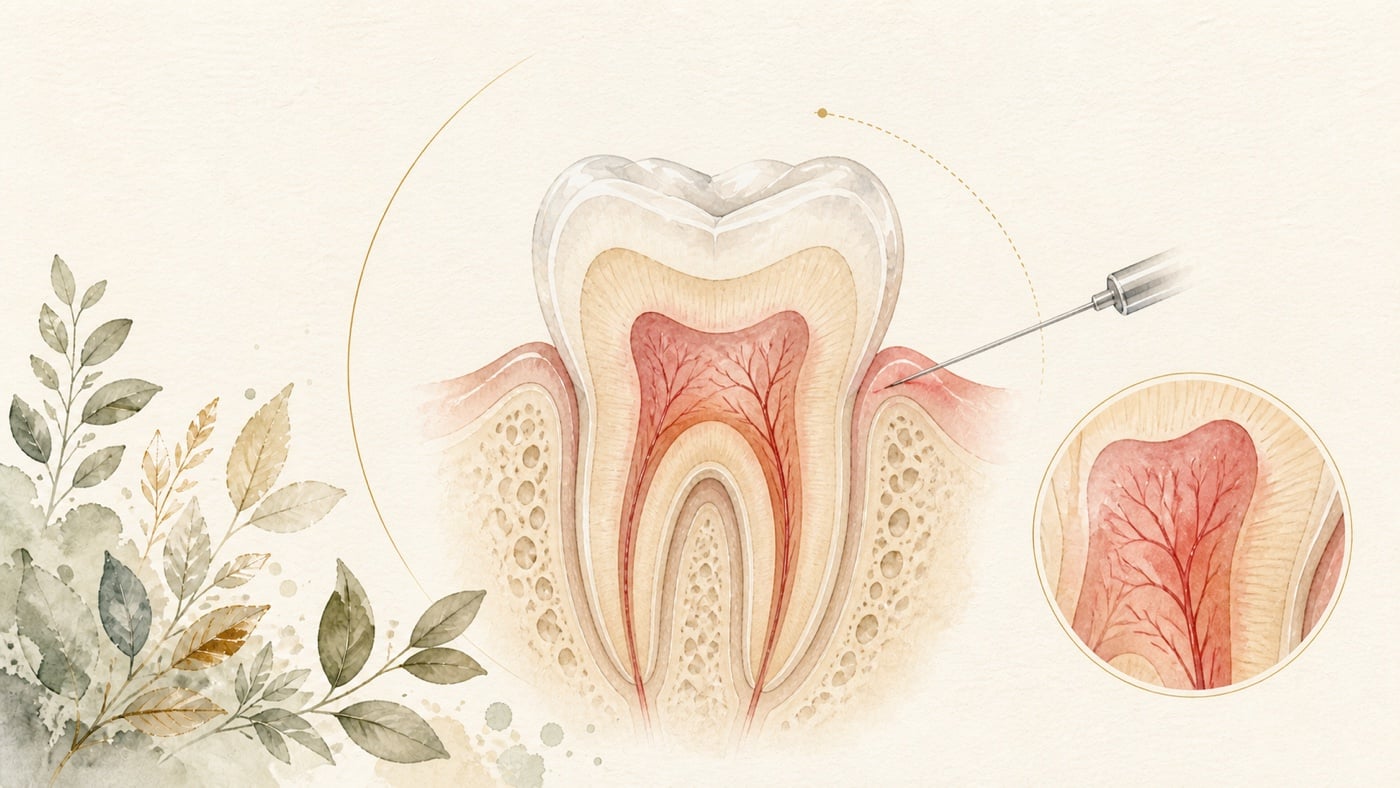
Is Root Canal Treatment Really That Painful? Pulp Status and Anaesthetic Success Rates Behind the Myth That "Taking the Nerve Out Always Hurts"
If you are afraid of root canal treatment, what you are afraid of is usually the same thing: lying back in the chair, the instruments going in, and the anaesthetic not seeming to cover everything. That fear is not unfounded, but its origin is often misunderstood. The problem repeatedly documented in the literature is that when the pulp is already inflamed, the success rate of the inferior alveolar nerve block (IANB) drops — several systematic reviews take precisely this as their starting point. In other words, the variable that governs pain is the current state of your pulp and the anaesthetic strategy chosen, not the step of "taking the nerve out" itself. The good news is that this has been studied thoroughly. Supplemental injections, changing technique, increasing the dose, premedication — each has been quantified in systematic reviews and meta-analyses. We shall look at them one at a time.
Is Root Canal Treatment Really That Painful? Pulp Status and Anaesthetic Success Rates Behind the Myth That "Taking the Nerve Out Always Hurts"
Direct answer: Whether it hurts depends mainly on the current state of your pulp and the anaesthetic strategy used, not on the act of "taking the nerve out" itself; an inflamed pulp really is harder to anaesthetise, but supplemental injection, alternative techniques, dose adjustment and premedication have all been quantified in systematic reviews and meta-analyses [F1][F2][F3][F4]. If facial or neck swelling is continuing to enlarge, or there is fever, or difficulty swallowing or breathing, this is no longer a question of how much it hurts — seek care immediately (see the next section).
Geographic scope: Global. All cited evidence comes from international peer-reviewed literature; no country-specific reimbursement scheme or regulation is involved. The procedures, materials and fees actually available to you should follow your own health system and your dentist's assessment.
Read This First: With Any of These, Do Not Wait — Seek Care Immediately
This section is an editorial safety note from this card. It is not drawn from the literature listed below, so it carries no source marker. Inflammation and infection of the pulp can spread into the surrounding tissues, so if any of the following applies, seek dental or emergency care immediately:
- Swelling of the cheek, below the eye, of the jaw or of the neck that is continuing to enlarge
- Inability to open the mouth, or pain on swallowing, or inability to swallow your own saliva
- Breathing becoming laboured, or a change in the sound of your voice
- Fever, chills, or feeling generally very unwell
- Swelling of the floor of the mouth or under the tongue, with the tongue being pushed upward
The criterion is whether it is continuing to enlarge, not how many days have passed; this card deliberately gives no observation interval and no "watch it for a few days" safe period. Actual management has to be assessed by a dentist or an emergency physician.
TL;DR — What decides whether it hurts is not the act of "taking the nerve out"
If you are afraid of root canal treatment, what you are afraid of is usually the same thing: lying back in the chair, the instruments going in, and the anaesthetic not seeming to cover everything.
That fear is not unfounded, but its origin is often misunderstood. The problem repeatedly documented in the literature is that when the pulp is already inflamed, the success rate of the inferior alveolar nerve block (IANB) drops — several systematic reviews take precisely this as their starting point [F1][F2].
In other words, the variable that governs pain is the current state of your pulp and the anaesthetic strategy chosen, not the step of "taking the nerve out" itself.
The good news is that this has been studied thoroughly. Supplemental injections, changing technique, increasing the dose, premedication — each has been quantified in systematic reviews and meta-analyses. We shall look at them one at a time.
Why a Tooth That Already Hurts Is Harder to Anaesthetise
This is not your imagination, and it is not a matter of the dentist's technique
A systematic review and meta-analysis of mandibular teeth states its premise at the outset: in patients with symptomatic irreversible pulpitis, the success rate of the inferior alveolar nerve block is lower, so supplemental techniques are needed to anaesthetise these patients effectively [F1].
Another meta-analysis, this one on premedication, opens with the same observation: IANB has a high failure rate in patients with symptomatic irreversible pulpitis, and it has been proposed that drugs with anti-inflammatory activity might improve anaesthetic outcomes [F2].
Two independent reviews treat the same phenomenon as a known clinical problem. That is the starting point for understanding all of this.
What this means for you
If you have previously had the experience of "the anaesthetic went in and it still ached", that does not mean your physiology is unusual or that you are difficult to treat. It is a documented phenomenon for which strategies already exist.
The point is that dentists know about it, and there are several researched ways of dealing with it.
Strategy One: Adding an Intraligamentary Injection
When the primary block is not enough, one approach is a supplemental injection into the periodontal ligament (intraligamentary injection, IL).
A systematic review and meta-analysis specifically assessed the success rate of an intraligamentary injection given after IANB in mandibular teeth with symptomatic irreversible pulpitis [F1]. The review was written in accordance with the PRISMA checklist, registered with PROSPERO, and the included studies were appraised with the Cochrane risk of bias tool [F1]:
- 4 studies were finally included [F1]
- The forest plot gave a risk ratio of RR 3.56 (95% CI 2.86 to 4.44), with the direction favouring a supplemental intraligamentary injection [F1]
- Statistical heterogeneity was I² = 0% [F1]
The review concluded that, taking the qualitative and quantitative analyses together, the supplemental intraligamentary injection improved anaesthetic efficacy [F1].
An I² = 0% means the results of these 4 studies are highly consistent, which is not common in the dental literature. Even so, with only 4 included studies, the volume of evidence remains limited.
Strategy Two: Change the Technique Rather Than Repeating the Same One
If one technique is not working well enough, repeating it is usually not the best answer — changing technique may be.
A systematic review and meta-analysis evaluated a range of anaesthetic techniques for mandibular posterior teeth with symptomatic irreversible pulpitis, all compared against IANB as the reference [F3]. The review searched six databases up to May 2021, included 22 studies covering 14 anaesthetic techniques, and appraised quality with Cochrane RoB 2.0 and certainty of evidence with GRADE [F3]:
- Risk of bias: 2 high, 5 unclear, 15 low [F3]
- Vazirani-Akinosi nerve block (VANB): RR = 1.27 (95% CI 1.07 to 1.52; p = 0.007; I² = 0%), certainty of evidence low [F3]
- Intraosseous injection (IOI): RR = 1.48 (95% CI 1.02 to 2.15; p = 0.04; I² = 46%), certainty of evidence low [F3]
- Buccal infiltration combined with IANB (BI + IANB): RR = 1.84 (95% CI 1.22 to 2.79; p = 0.004; I² = 52%), certainty of evidence very low [F3]
The review concluded that the evidence shows buccal infiltration with IANB, VANB and IOI to be more effective than IANB alone in anaesthetising mandibular posterior teeth with symptomatic irreversible pulpitis, and that alternative primary anaesthetic techniques may be indicated for such teeth [F3].
Two things are worth noting. The three techniques point in the same direction, but the certainty of evidence is only "low" and "very low" respectively; and the technique that looks most effective, BI + IANB, happens to be the one with the lowest certainty [F3]. Reading the data honestly means holding both parts together.
Strategy Three: The Volume of Anaesthetic
The dose itself has also been studied in its own right.
A systematic review and meta-analysis with trial sequential analysis compared the same anaesthetic solution at 1.8 mL and 3.6 mL for IANB in permanent mandibular teeth with irreversible pulpitis [F4]. The conclusion of that review states the finding for mandibular molars, and lists "other types of teeth" as still requiring high-quality trials [F4]. The review searched up to May 2020 and included 4 randomised clinical trials and 280 teeth, in patients aged 18 to 65 years [F4]:
- Risk of bias: 3 low and 1 with "some concerns" [F4]
- The primary meta-analysis showed a significantly higher success rate for 3.6 mL than for 1.8 mL: RR = 1.94 (95% CI 1.07 to 3.52; I² = 77%) [F4]
- A sensitivity analysis restricted to trials using the Heft-Parker visual analogue pain scale pointed in the same direction [F4]
- Trial sequential analysis confirmed the evidence for a beneficial effect of 3.6 mL as "conclusive" [F4]
- On GRADE assessment, the quality of evidence was "high" [F4]
Conclusions rated "high" quality on GRADE are not common in dental meta-analyses; this is one of them [F4]. The review nevertheless notes I² = 77% (heterogeneity on the high side) and recommends further high-quality trials on different anaesthetic solutions and other tooth positions [F4].
Strategy Four: Premedication — Reducing Inflammation Before the Anaesthetic
If the problem lies in inflammation, does dealing with the inflammation before the anaesthetic help?
A meta-analysis assessed the effect of dexamethasone on anaesthetic success in patients with symptomatic irreversible pulpitis [F2]. The included studies were appraised with the Cochrane risk of bias tool, and anaesthetic success, pain intensity (VAS) and adverse effects were extracted [F2]:
- Compared with placebo, dexamethasone increased anaesthetic success: n = 502; p < 0.001; OR = 2.59 (95% CI 1.46 to 4.59) [F2]
- Pain scores at 6 hours postoperatively were lower: n = 302; p < 0.001; MD = −1.43 (95% CI −2.28 to −0.58) [F2]
- At 12 hours: n = 302; p < 0.0001; MD = −1.65 (95% CI −2.39 to −0.92) [F2]
- At 24 hours: n = 302; p < 0.0008; MD = −1.27 (95% CI −2.01 to −0.53) [F2]
The meta-analysis concluded that systemic administration of dexamethasone can improve anaesthetic success in patients with symptomatic irreversible pulpitis and improve pain control [F2].
The OR = 2.59 here is an odds ratio, a measure of statistical association; it cannot be read directly as "2.59 units less pain". Whether medication is appropriate, or usable at all, falls within what your dentist judges from your health status and medication history.
And Afterwards? Two Points That Are Often Misunderstood
Misconception One: Splitting treatment over several visits hurts less (or finishing in one visit hurts less)
Many people ask whether they should come back several times and take it slowly, on the intuition that this is gentler.
An umbrella review specifically synthesised and critically appraised the evidence on postoperative pain in "single-visit versus multiple-visit root canal treatment" [F5]. The review searched the major bibliographic databases and grey literature up to December 2025, appraised methodological quality with AMSTAR 2 and risk of bias with ROBIS, and examined the overlap of primary studies between reviews [F5]:
- 12 systematic reviews met the inclusion criteria [F5]
- Postoperative pain was most often measured as pain intensity on visual analogue or numerical rating scales, with pain incidence measured less often [F5]
- The definition of flare-up was inconsistent between reviews, as was the way it was reported [F5]
- Overall, the higher-confidence reviews did not show a consistent or clinically important difference in postoperative pain between single and multiple visits [F5]
- Confidence in the evidence was limited by heterogeneity in outcome definitions, pain measurement and follow-up periods, and by the overlap of primary studies included across reviews [F5]
The clinical implication the review draws is clear: for adults requiring root canal treatment of permanent teeth, current evidence indicates broadly comparable postoperative pain outcomes for single and multiple visits, so the choice of the number of visits should be based on case complexity, infection control, patient preference and practical arrangements, rather than on an expectation of any noticeable difference in pain [F5].
Misconception Two: Keeping the pulp alive is bound to hurt less
In recent years, some situations can be managed with vital pulp therapy (retaining part of the pulp) instead of complete root canal treatment. Is the postoperative course then more comfortable?
A systematic review and meta-analysis compared postoperative pain after vital pulp therapy and root canal treatment [F6]. The review searched up to 30 June 2022 and included 57 studies in the qualitative synthesis and 3 in the meta-analysis [F6]:
- Full pulpotomy (PULP) produced more asymptomatic cases than single-visit root canal treatment: RR 1.06 (95% CI 1.01 to 1.11; P < .01; I² = 67%) [F6]
- Less mild postoperative pain: RR 0.89 (95% CI 0.79 to 0.99; P < .04; I² = 37%) [F6]
- Less moderate postoperative pain: RR 0.70 (95% CI 0.51 to 0.95; P < .02; I² = 57%) [F6]
- Severe pain occurred infrequently after both vital pulp therapy and root canal treatment [F6]
- Moderate to severe pain appeared more often at 48 to 72 hours after root canal treatment, and within 36 hours after pulpotomy [F6]
- When calcium-enriched material was used for pulpotomy, pain intensity at 12, 18 and 36 hours was higher than with mineral trioxide aggregate (MTA) (P < .001) [F6]
The review's conclusion deserves to be read in full: pulpotomy had a significantly higher rate of "no pain" and lower rates of mild to moderate pain; however, the clinical decision between root canal treatment and pulpotomy should not be based on differences in postoperative pain [F6].
Put another way: the difference is real, but it is not a reason for choosing a treatment.
Data Anchors — Checkable Numbers About Pain
| Question | Data anchor | How to read it | Source |
|---|---|---|---|
| An inflamed pulp is harder to anaesthetise | Two independent reviews both take "low IANB success / high failure in symptomatic irreversible pulpitis" as their premise [F1][F2] | This is a known clinical phenomenon, not an individual matter of technique | [F1][F2] |
| Supplemental intraligamentary injection | 4 studies; RR 3.56 (95% CI 2.86–4.44); I² = 0% [F1] | Consistency is high, but with only 4 studies included the volume of evidence is limited | [F1] |
| Changing technique: VANB | RR 1.27 (95% CI 1.07–1.52; p = 0.007; I² = 0%) [F3] | GRADE certainty of evidence "low" | [F3] |
| Changing technique: intraosseous injection | RR 1.48 (95% CI 1.02–2.15; p = 0.04; I² = 46%) [F3] | GRADE certainty of evidence "low" | [F3] |
| Changing technique: buccal infiltration + IANB | RR 1.84 (95% CI 1.22–2.79; p = 0.004; I² = 52%) [F3] | The largest effect figure, but GRADE certainty "very low" | [F3] |
| Anaesthetic volume 3.6 vs 1.8 mL | 4 trials, 280 teeth; RR 1.94 (95% CI 1.07–3.52; I² = 77%) [F4] | Trial sequential analysis "conclusive", GRADE "high"; but I² is on the high side | [F4] |
| Preoperative dexamethasone | n = 502; OR 2.59 (95% CI 1.46–4.59; p < 0.001) [F2] | OR is an odds ratio, not the size of pain reduction; medication must be assessed by a dentist | [F2] |
| Postoperative pain: 6 / 12 / 24 hours | MD −1.43 / −1.65 / −1.27 (n = 302 each) [F2] | These are mean differences on VAS; individual variation remains wide | [F2] |
| Single versus multiple visits | 12 systematic reviews; the higher-confidence ones showed no consistent or clinically important difference [F5] | The number of visits should follow the case and infection control, not an expectation about pain | [F5] |
| Vital pulp therapy versus root canal treatment | 57 studies qualitatively, 3 in meta-analysis; asymptomatic RR 1.06, mild RR 0.89, moderate RR 0.70 [F6] | Severe pain is rare with both; the review states explicitly that this should not drive the choice of procedure | [F6] |
| Timing of pain | Moderate to severe pain: 48–72 hours after root canal treatment; within 36 hours after pulpotomy [F6] | Pain has a time window; it does not mean pain that never settles | [F6] |
Risk factors: what to know before treatment
Before agreeing to any anaesthetic technique or procedure, these points are worth knowing:
- One injection may not be enough, and that is expected: two independent reviews both take as their premise that the inferior alveolar nerve block has a lower success rate and a higher failure rate in patients with symptomatic irreversible pulpitis [F1][F2], so needing a supplemental technique does not mean that something has gone wrong.
- The certainty of evidence for alternative techniques is not high: VANB, intraosseous injection and buccal infiltration with IANB all point in the same direction, but the same review records their GRADE certainty of evidence as low, low and very low respectively [F3]; of these, buccal infiltration with IANB has the larger effect estimate and its certainty of evidence is rated very low [F3].
- The dose study has clear boundaries: the meta-analysis showing a higher success rate for 3.6 mL than for 1.8 mL included only 4 randomised clinical trials and 280 teeth, in patients aged 18 to 65 years, with heterogeneity of I² = 77% [F4]; its conclusion is stated for mandibular molars, with other tooth types listed by the authors as an open question [F4]; the review itself also recommends further high-quality trials on different anaesthetic solutions and other tooth positions [F4].
- Premedication is a prescribing decision, not one you can make yourself: the dexamethasone meta-analysis extracted anaesthetic success, pain intensity (VAS) and adverse effects together [F2]; whether it is suitable for you, and whether it interacts with your existing medication, must be judged by your dentist or physician from your health status and medication history.
- Postoperative pain has a time window, but it is not the same for everyone: moderate to severe pain occurred more often 48 to 72 hours after root canal treatment, and more often within 36 hours after pulpotomy [F6]; this is a population-level distribution, not a prediction for you. Pain beyond what was expected, or pain that keeps worsening, is a signal to go back for assessment.
Conclusion — Change the Question from "Will It Hurt" to "What State Is My Pulp In"
Back to the original question: is root canal treatment really that painful?
The honest answer is this: the likelihood and degree of pain depend on the current state of your pulp and the anaesthetic strategy used, not on the act of "taking the nerve out" itself.
Three things the literature supports:
- An inflamed pulp really is harder to anaesthetise — this is the shared premise of two independent reviews [F1][F2]; it is not an individual impression, and you are not imagining it
- There is more than one strategy, and all have been quantified — supplemental injection [F1], alternative techniques [F3], adjusting the dose [F4] and premedication [F2] each have their figures, and each has its limitations in level of evidence
- Postoperative pain has a time window, and severe pain is uncommon — moderate to severe pain clusters at 48 to 72 hours after root canal treatment, and severe pain is infrequent after both root canal treatment and vital pulp therapy [F6]
For the same reason, two things should not form the basis of your decision: splitting treatment across visits will not make the postoperative course less painful [F5]; and the choice of procedure should not be based on differences in pain either [F6].
If fear of pain is making you put off a tooth that already hurts, that is in fact the least favourable option — because delay will not improve the state of the pulp.
Bring a description of your symptoms (when it hurts, how long it lasts, whether hot and cold differ) and your existing radiographs, and discuss them with your dentist. Say plainly that you are very afraid of pain. That is information which can be built into the anaesthetic plan, not something to feel awkward about.
Every clinical statement in this article is mapped line by line to its cited source (see the sources and evidence chain below). It has not been clinically reviewed by a licensed practitioner. This is health information, not individual advice; assessment by a clinician is required.
FAQ
- Why is this tooth so painful, and why does the anaesthetic seem particularly hard to get working?
- Because this is a documented phenomenon. A systematic review explicitly takes as its premise that **the inferior alveolar nerve block has a lower success rate in patients with symptomatic irreversible pulpitis** [F1], and another meta-analysis likewise notes the high IANB failure rate in these patients [F2]. This does not mean you are difficult to treat; it is a known situation for which several strategies have already been quantified.
- この歯はとても痛むのですが、なぜ麻酔が特に効きにくいのでしょうか — それが文献に記録されている現象だからです。システマティックレビューは、**下歯槽神経伝達麻酔は症候性不可逆性歯髄炎の患者において成功率が低い**ことを研究の前提として明記しており [F1]、別のメタアナリシスも同様に、こうした患者では IANB の失敗率が高いと指摘しています [F2]。これはあなたが扱いにくいという意味ではなく、既知であり、かつ複数の対策がすでに定量的に研究されている状況だということです。
- Why is this tooth so painful, and why does the anaesthetic seem particularly hard to get working? — Because this is a documented phenomenon. A systematic review explicitly takes as its premise that **the inferior alveolar nerve block has a lower success rate in patients with symptomatic irreversible pulpitis** [F1], and another meta-analysis likewise notes the high IANB failure rate in these patients [F2]. This does not mean you are difficult to treat; it is a known situation for which several strategies have already been quantified.
- If the anaesthetic is not enough, what else can the dentist do?
- The literature describes several approaches evaluated in meta-analyses. The risk ratio for a supplemental intraligamentary injection is RR 3.56 (95% CI 2.86 to 4.44), with the direction favouring the supplemental injection [F1]; among alternative techniques (the population in that review was **mandibular posterior teeth with symptomatic irreversible pulpitis**), the Vazirani-Akinosi nerve block gave RR 1.27, intraosseous injection RR 1.48 and buccal infiltration with IANB RR 1.84, all more effective than IANB alone [F3]. The same review, however, records the GRADE certainty of evidence for these three as low, low and very low respectively [F3]. Which one is actually used is for your dentist to judge from the tooth involved and the situation on the day.
- 麻酔が足りないとき、歯科医師にはどのような手立てがあるのですか — 文献にはメタアナリシスで評価された方法がいくつかあります。歯根膜内注射の追加ではリスク比は RR 3.56(95% CI 2.86 〜 4.44)で、方向としては追加注射を支持しています [F1]。ほかの方法に変える場合(このレビューの対象は**有症状不可逆性歯髄炎のある下顎臼歯部の歯**です)、Vazirani-Akinosi 伝達麻酔が RR 1.27、骨内注射が RR 1.48、頬側浸潤麻酔と IANB の併用が RR 1.84 で、いずれも単独の IANB より優れていました [F3]。ただし同じレビューは、この三つの GRADE によるエビデンスの確実性がそれぞれ低、低、極めて低いことも記録しています [F3]。実際にどれを用いるかは、あなたの歯種とそのときの状況に応じて歯科医師が判断します。
- If the anaesthetic is not enough, what else can the dentist do? — The literature describes several approaches evaluated in meta-analyses. The risk ratio for a supplemental intraligamentary injection is RR 3.56 (95% CI 2.86 to 4.44), with the direction favouring the supplemental injection [F1]; among alternative techniques (the population in that review was **mandibular posterior teeth with symptomatic irreversible pulpitis**), the Vazirani-Akinosi nerve block gave RR 1.27, intraosseous injection RR 1.48 and buccal infiltration with IANB RR 1.84, all more effective than IANB alone [F3]. The same review, however, records the GRADE certainty of evidence for these three as low, low and very low respectively [F3]. Which one is actually used is for your dentist to judge from the tooth involved and the situation on the day.
- Does having more anaesthetic help?
- Under specific conditions this has been demonstrated. A systematic review and meta-analysis showed that, for IANB in mandibular teeth with irreversible pulpitis, increasing the anaesthetic solution from 1.8 mL to 3.6 mL improved the success rate, RR = 1.94 (95% CI 1.07 to 3.52) [F4]. **The conclusion of that review states this result for mandibular molars**, and lists other tooth types as still requiring high-quality trials [F4]. Trial sequential analysis judged the evidence for this benefit "conclusive", and GRADE quality was rated "high" [F4]. The review, however, included only 4 trials and 280 teeth, with heterogeneity of I² = 77%, and recommended further high-quality trials on different solutions and tooth positions [F4].
- 麻酔をもう少し多く打てば効くのでしょうか — 特定の条件下では、そのことが確認されています。システマティックレビューおよびメタアナリシスによれば、不可逆性歯髄炎のある下顎の歯に IANB を行う場合、麻酔薬液を 1.8 mL から 3.6 mL に増やすと成功率が高まり、RR = 1.94(95% CI 1.07 〜 3.52)でした [F4]。**このレビューの結論文はこの結果を下顎大臼歯について述べており**、ほかの歯種は今後の質の高い試験が必要な課題として挙げられています [F4]。試験逐次解析はこの有益性のエビデンスを「結論的」と判定し、GRADE の質は「高」と評価されています [F4]。ただしこのレビューが組み入れたのは 4 件の試験、280 歯にとどまり、異質性は I² = 77% で、今後は異なる薬液と歯種を対象とした質の高い試験が必要だと提言しています [F4]。
- Does having more anaesthetic help? — Under specific conditions this has been demonstrated. A systematic review and meta-analysis showed that, for IANB in mandibular teeth with irreversible pulpitis, increasing the anaesthetic solution from 1.8 mL to 3.6 mL improved the success rate, RR = 1.94 (95% CI 1.07 to 3.52) [F4]. **The conclusion of that review states this result for mandibular molars**, and lists other tooth types as still requiring high-quality trials [F4]. Trial sequential analysis judged the evidence for this benefit "conclusive", and GRADE quality was rated "high" [F4]. The review, however, included only 4 trials and 280 teeth, with heterogeneity of I² = 77%, and recommended further high-quality trials on different solutions and tooth positions [F4].
- Will splitting the treatment over several visits hurt less?
- On current evidence, there is unlikely to be a noticeable difference. An umbrella review searching up to December 2025 and including 12 systematic reviews states that **the higher-confidence reviews did not show a consistent or clinically important difference in postoperative pain between single and multiple visits** [F5]. The review therefore recommends deciding the number of visits on case complexity, infection control, your preference and practical arrangements [F5].
- 分けて行えば痛みは軽くなりますか — 現在のエビデンスでは、明らかな差は出にくいと考えられます。2025 年 12 月までを検索し、12 件のシステマティックレビューを組み入れたアンブレラレビューは、**より信頼性の高いレビューは、単回来院と複数回来院のあいだに術後疼痛の一貫した、あるいは臨床的に重要な差を示していない**と述べています [F5]。そのためこのレビューは、来院回数は症例の複雑さ、感染のコントロール、あなたの希望、実務上の都合によって決めるべきだと提言しています [F5]。
- Will splitting the treatment over several visits hurt less? — On current evidence, there is unlikely to be a noticeable difference. An umbrella review searching up to December 2025 and including 12 systematic reviews states that **the higher-confidence reviews did not show a consistent or clinically important difference in postoperative pain between single and multiple visits** [F5]. The review therefore recommends deciding the number of visits on case complexity, infection control, your preference and practical arrangements [F5].
- How long will it hurt after treatment?
- What the literature records is a time window, not continuous pain. A systematic review and meta-analysis showed that moderate to severe pain appeared more often at **48 to 72 hours** after root canal treatment, and within **36 hours** after pulpotomy [F6]. The same paper records that **severe pain occurred infrequently after both vital pulp therapy and root canal treatment** [F6]. If pain exceeds what you were told to expect, or does not settle, that is a signal to be reviewed, not something to be endured.
- 治療が終わったあと、痛みはどのくらい続きますか — 文献が記録しているのは時間の窓であり、痛みが続くという話ではありません。システマティックレビューおよびメタアナリシスによれば、中等度から重度の疼痛は根管治療後では **48 〜 72 時間**に多く、歯髄切断術後では **36 時間以内**に多く現れます [F6]。同じ論文は、**重度の疼痛が生じる頻度は生活歯髄療法と根管治療のいずれにおいても低い**ことも記録しています [F6]。痛みが想定を超える場合や引かない場合は、再診で評価すべきサインであって、「我慢すればよい」というものではありません。
- How long will it hurt after treatment? — What the literature records is a time window, not continuous pain. A systematic review and meta-analysis showed that moderate to severe pain appeared more often at **48 to 72 hours** after root canal treatment, and within **36 hours** after pulpotomy [F6]. The same paper records that **severe pain occurred infrequently after both vital pulp therapy and root canal treatment** [F6]. If pain exceeds what you were told to expect, or does not settle, that is a signal to be reviewed, not something to be endured.
- Can I ask for vital pulp therapy instead of having the nerve taken out, since I hear it hurts less?
- The difference in postoperative pain is real, but it should not be the reason for the choice. The meta-analysis showed that pulpotomy produced more asymptomatic cases than single-visit root canal treatment (RR 1.06) and less mild (RR 0.89) and moderate (RR 0.70) pain [F6]; the review's conclusion, however, states plainly that **the clinical decision between root canal treatment and pulpotomy should not be based on differences in postoperative pain** [F6]. Whether it is suitable depends on the state of your pulp and the long-term plan for the tooth.
- 痛くないと聞いたので、神経を抜かずに生活歯髄療法をお願いできますか — 術後疼痛の差はたしかに存在しますが、それは選択の理由にはなりません。メタアナリシスによれば、歯髄切断術は単回来院の根管治療より無症状の症例が多く(RR 1.06)、軽度(RR 0.89)と中等度(RR 0.70)の疼痛は少ないという結果でした [F6]。しかしこのレビューの結論には、**「根管治療を行うのか歯髄切断術を行うのか」という臨床上の決定は、術後疼痛の差に基づいて下すべきものではない**とはっきり書かれています [F6]。適応となるかどうかは、あなたの歯髄の状態と、その歯の長期的な計画によって決まります。
- Can I ask for vital pulp therapy instead of having the nerve taken out, since I hear it hurts less? — The difference in postoperative pain is real, but it should not be the reason for the choice. The meta-analysis showed that pulpotomy produced more asymptomatic cases than single-visit root canal treatment (RR 1.06) and less mild (RR 0.89) and moderate (RR 0.70) pain [F6]; the review's conclusion, however, states plainly that **the clinical decision between root canal treatment and pulpotomy should not be based on differences in postoperative pain** [F6]. Whether it is suitable depends on the state of your pulp and the long-term plan for the tooth.
- Does taking medication beforehand help?
- It has been studied. A meta-analysis showed that, compared with placebo, systemic dexamethasone improved anaesthetic success in patients with symptomatic irreversible pulpitis (n = 502; OR = 2.59; 95% CI 1.46 to 4.59; p < 0.001), with lower pain scores at 6, 12 and 24 hours postoperatively [F2]. This is a prescription medicine, however, and whether it suits you and whether it interacts with your current medication must be assessed by a dentist or doctor; it is not something to decide on your own.
- 術前に薬を飲むことは役に立ちますか — 研究されています。メタアナリシスによれば、プラセボと比較してデキサメタゾンの全身投与は症候性不可逆性歯髄炎の患者の麻酔成功率を高め(n = 502;OR = 2.59;95% CI 1.46 〜 4.59;p < 0.001)、術後 6、12、24 時間の疼痛スコアも低いものでした [F2]。ただしこれは処方薬であり、あなたに適しているか、いま服用している薬との相互作用がないかは歯科医師または医師の評価が必要で、ご自身で決められることではありません。
- Does taking medication beforehand help? — It has been studied. A meta-analysis showed that, compared with placebo, systemic dexamethasone improved anaesthetic success in patients with symptomatic irreversible pulpitis (n = 502; OR = 2.59; 95% CI 1.46 to 4.59; p < 0.001), with lower pain scores at 6, 12 and 24 hours postoperatively [F2]. This is a prescription medicine, however, and whether it suits you and whether it interacts with your current medication must be assessed by a dentist or doctor; it is not something to decide on your own.
Medical notice This article is provided for health education and medical information purposes. It is not a solicitation for medical services and does not constitute diagnosis or treatment advice. Actual treatment methods and outcomes vary between individuals and require evaluation by a dentist; every treatment has its own indications, limitations and possible risks. If you have related symptoms or treatment needs, please book a consultation for evaluation by a dentist.
Source anchors
- Anesthetic efficacy of supplemental intraligamentary injection in human mandibular teeth with irreversible pulpitis: a systematic review and meta-analysis. [PMID:35169615] · https://pubmed.ncbi.nlm.nih.gov/35169615/ · 在 IDAEO 的其他引用
- Dexamethasone Increases the Anesthetic Success in Patients with Symptomatic Irreversible Pulpitis: A Meta-Analysis. [PMID:35890176] · https://pubmed.ncbi.nlm.nih.gov/35890176/ · 在 IDAEO 的其他引用
- Effectiveness of different anesthetic methods for mandibular posterior teeth with symptomatic irreversible pulpitis: a systematic review and meta-analysis. [PMID:34453595] · https://pubmed.ncbi.nlm.nih.gov/34453595/ · 在 IDAEO 的其他引用
- Comparing the anaesthetic efficacy of 1.8 mL and 3.6 mL of anaesthetic solution for inferior alveolar nerve blocks for teeth with irreversible pulpitis: a systematic review and meta-analysis with trial sequential analysis. [PMID:33040335] · https://pubmed.ncbi.nlm.nih.gov/33040335/ · 在 IDAEO 的其他引用
- Single-visit versus multiple-visit root canal therapy: Post-endodontic pain outcomes from an umbrella review. [PMID:41856391] · https://pubmed.ncbi.nlm.nih.gov/41856391/ · 在 IDAEO 的其他引用
- Postoperative pain after single-visit root canal treatment or vital pulp therapy: A systematic review and meta-analysis. [PMID:38325970] · https://pubmed.ncbi.nlm.nih.gov/38325970/ · 在 IDAEO 的其他引用
Cite this article
Lucy・《Is Root Canal Treatment Really That Painful? Pulp Status and Anaesthetic Success Rates Behind the Myth That "Taking the Nerve Out Always Hurts"》・IDAEO 知識庫・2026-07-20・https://km.idaeo.ai/post/dental/root-canal-pain-mythUpdated 2026-08-26